Monday, December 29, 2025
Home Blog Page 317

Iranian translator, historian Bijan Ashtari dies at 64

According to Mohammad-Ali Jafariyeh, director of Sales Publishing, Ashtari had been battling cancer in recent years, but the cause of death was reported as cardiac arrest.

Ashtari was widely recognized for his extensive body of translations focused on contemporary history, politics, and totalitarian regimes.

He began his career in the early 1980s translating for arts and film magazines and later contributed as a film critic, notably for Donya-ye Tasvir.

Over four decades, Ashtari translated numerous influential works including The Young Stalin, Che Guevara: A Revolutionary Life, The Harem of Qaddafi, Mao, and Aquariums of Pyongyang.

His signature books became a staple for Persian-speaking readers seeking critical perspectives on history and authoritarianism.

His final published work, Silence as a Weapon, chronicled the life and death of Soviet writer Isaac Babel and was released in March 2025.

Ashtari is remembered as a pivotal figure in Iranian intellectual circles, credited with enriching public understanding of 20th-century political history.

Israeli soldiers seize Gaza aid boat

The British-flagged yacht Madleen, which is operated by the pro-Palestinian Freedom Flotilla Coalition (FFC), was aiming to deliver a symbolic amount of aid to Gaza later on Monday and raise international awareness of the humanitarian crisis there.

However, the boat was boarded during the night before it could reach shore, the FFC said on its Telegram account.

The Israeli Foreign Ministry later confirmed that it was under Israeli control.

Among the 12-strong crew are Swedish climate campaigner Thunberg and Rima Hassan, a French member of the European Parliament.

“The crew of the Freedom Flotilla was arrested by the Israeli army in international waters around 2 a.m.,” Hassan posted on X.

A photograph showed the crew seated on the boat, all wearing life jackets, with their hands in the air.

The yacht is carrying a small shipment of humanitarian aid, including rice and baby formula.

Israeli Defence Minister Israel Katz ordered the military on Sunday to prevent the Madleen from reaching Gaza, calling the mission a propaganda effort in support of Hamas.

Israel imposed a naval blockade on the coastal enclave after Hamas took control of Gaza in 2007.

The blockade has remained in place through multiple conflicts, including the current war, which began after a Hamas-led assault on southern Israel on October 7, 2023, that killed more than 1,200 people, according to an Israeli tally.

Gaza’s health ministry says over 54,000 Palestinians have been killed since the start of Israel’s military campaign. The United Nations has warned that most of Gaza’s more than 2 million residents are facing famine.

The United Nations’ special rapporteur on human rights in the Palestinian territories, Francesca Albanese, has supported the FFC operation and on Sunday, urged other boats to challenge the Gaza blockade.

“Madleen’s journey may have ended, but the mission isn’t over. Every Mediterranean port must send boats with aid & solidarity to Gaza,” she wrote on X.

Gaza aid sites branded ‘human slaughterhouses’ under deadly Israeli army fire

Gaza War

Sunday’s killings are the latest in a series of attacks on civilians seeking food at aid centres operated by the controversial Gaza Humanitarian Foundation (GHF), a US-led initiative backed by Israel in Israeli-controlled zones.

More than 130 people have now been killed and more than 700 wounded by Israeli troops while desperately trying to access meagre food parcels for their hungry families from the aid sites since the GHF programme began on May 27.

At least nine people are still missing.

In a statement, Gaza’s Government Media Office condemned the distribution sites as “human slaughterhouses”, accusing Israeli forces of luring desperate civilians to their deaths.

“These are war crimes and crimes against humanity,” the statement added, urging an independent international probe and an immediate suspension of GHF’s delivery model.

The drive backed by Israel and the United States has faced growing criticism from human rights organisations and the United Nations for violating basic humanitarian standards and bypassing organisations that have decades of experience distributing aid to the entire population of the besieged enclave.

The latest bloodshed reportedly began around 6am local time (03:00 GMT), as hundreds of Palestinians stalked by starvation gathered near the aid point in the al-Alam area of Rafah.

Witnesses said people had started forming queues as early as 4:30am, desperate to get food before the site became overwhelmed.

“After about an hour and a half, hundreds moved toward the site, and the army opened fire,” stated witness Abdallah Nour al-Din.

The Israeli military later announced its troops opened fire on individuals who “continued advancing in a way that endangered the soldiers”, and claimed the area had been designated an “active combat zone” at night. However, survivors insist the shooting took place after sunrise.

“This is a trap for us, not aid,” said Adham Dahman, speaking to the Associated Press from Nasser Hospital in southern Gaza with a bloodied bandage on his chin. He added a tank fired towards the crowd, and people were left scrambling for cover.

Doctors Without Borders (MSF) reported that 13 wounded individuals and one person who was dead on arrival came to its clinic in the al-Mawasi area of southern Khan Younis today.

MSF added the injured and dead were “carried in donkey carts, on bicycles, or on foot”.

The wounded were all men between the ages of 17 and 30. The victims said they were shot in the Shakoush area while travelling to a food distribution site in Saudi village.

Footage from outside the hospital showed mourning families weeping over blood-soaked shrouds, as emergency workers rushed to treat the wounded.

UN Special Rapporteur on the Occupied Palestinian Territories Francesca Albanese called the GHF operation “humanitarian camouflage” and “an essential tactic of this genocide”.

In a post on social media, Albanese blamed “the moral and political corruption of the world” for enabling the destruction of Gaza.

An unnamed GHF official claimed there has been no violence in or around its aid distribution sites, all three of which delivered food on Sunday, according to The Associated Press.

The violence comes as Gaza’s Health Ministry reports that the total death toll from Israel’s ongoing war has reached 54,880, with more than 126,000 injured since October 7, 2023. Since Israel ended a ceasefire on March 18, 4,603 Palestinians have been killed and more than 14,000 injured.

In just the last 24 hours, Israeli strikes have killed at least 108 people and wounded nearly 400 more across the besieged enclave, the ministry said.

Hospitals are overwhelmed and on the brink of collapse, the ministry said.

Rafah’s Red Cross Field Hospital has declared 12 mass casualty emergencies in just two weeks, with more than 900 wounded arriving during that period — 41 of them already dead. Most of those treated had been trying to reach food distribution sites when they were shot or injured.

A spokesman at Al-Aqsa Martyrs Hospital in Deir el-Balah warned that fuel supplies for Gaza’s health facilities may run out within 48 hours, leaving patients without care.

“The hospital’s artificial kidney department is out of service due to the occupation’s attacks,” he told Al Jazeera.

Meanwhile, the director of al-Shifa Hospital told Al Jazeera that the lives of 300 kidney failure patients hang in the balance.

“We are facing a real disaster in the hospital if electricity is not provided,” he warned.

US expects Russia’s retaliation for Ukraine’s “Spiderweb” military operation to resume soon: Reuters

Russia Ukraine War

One official told Reuters that, while the timing remains unclear, a retaliatory strike could be expected in the coming days and is likely to be “asymmetrical.”

Another U.S. source added Russia would likely employ missiles and drones to hit a combination of targets.

The U.S. assessment follows the June 1 attack by Ukraine’s Security Service (SBU) on four Russian air bases using drones launched from trucks concealed within Russian territory.

Kyiv’s operation reportedly damaged 41 aircraft, including Tu-95 and Tu-22M3 bombers — two of Russia’s primary platforms for missile attacks against Ukraine.

At least 21 planes were damaged or destroyed, according to open-source intelligence analysts.

A Western diplomatic source told the outlet that the Kremlin’s response could focus on high-value government sites, such as administrative buildings or intelligence facilities.

Michael Kofman, a military analyst with the Carnegie Endowment for International Peace, suggested Moscow may aim medium-range ballistic missiles at headquarters belonging to the SBU, which organized the operation.

On June 6, Russia launched one of its most intense aerial barrages of the full-scale war, firing 452 drones and 45 missiles at Ukrainian cities and infrastructure, according to the Air Force. The attack was likely part of Russia’s response to Operation Spiderweb.

At least four civilians were killed, including emergency service workers, and 80 others were injured in the overnight assault, President Volodymyr Zelensky reported.

The June 6 strikes followed a phone call between Russian President Vladimir Putin and U.S. President Donald Trump on June 4, during which Putin reportedly vowed to retaliate against the Ukrainian drone operation.

U.S. officials say Moscow’s June 6 barrage may not be the full extent of its response. Russia has carried out near-nightly air assaults in recent weeks, several of which predated Spiderweb, making it difficult to separate a targeted reprisal from Russia’s ongoing campaign of attrition.

Shortly after the June 6 Russian attack, Trump seemed to justify the aggression against Ukrainian cities that was launched in response to Ukraine’s Operation Spiderweb.

“They gave Putin a reason to go in and bomb the hell out of them last night,” Trump told reporters aboard Air Force One on June 6.

Iran’s Olfati wins historic gold at Asian Gymnastics Championships

This marks the first-ever gold medal for Iran in the history of the Asian Gymnastics Championships, signaling a major breakthrough for the country’s presence in the sport at the continental level.

Olfati, already known for his silver medal at the 2023 Asian Games in Hangzhou and for securing an Olympic berth through the qualification rounds, has now further cemented his status as one of Iran’s most decorated and groundbreaking athletes in gymnastics.

Afghanistan’s Kabul at risk of becoming first modern city to run out of water: Report

Water levels within Kabul’s aquifers have dropped by up to 30 metres over the past decade owing to rapid urbanisation and climate breakdown, according to a report by the NGO Mercy Corps.

Meanwhile, almost half of the city’s boreholes – the primary source of drinking water for Kabul residents – have dried out. Water extraction currently exceeds the natural recharge rate by 44m cubic metres each year.

If these trends continue, all of Kabul’s aquifers will run dry as early as 2030, posing an existential threat to the city’s seven million inhabitants.

“There should be a committed effort to document this better and to draw international attention to the need to address the crisis,” said Mercy Corps Afghanistan country director, Dayne Curry.

“No water means people leave their communities, so for the international community to not address the water needs of Afghanistan will only result in more migration and more hardship for the Afghan people.”

The report also highlights water contamination as another widespread challenge. Up to 80% of Kabul’s groundwater is deemed unsafe, with high levels of sewage, salinity and arsenic.

Water access has become a daily battle for people in Kabul. Some households spend up to 30% of their income on water, and more than two-thirds have incurred water-related debt.

“Afghanistan is facing a lot of problems, but this water scarcity is one of the hardest,” stated Nazifa, a teacher living in the Khair Khana neighbourhood of Kabul.

“Every household is facing difficulty, especially those with low income. Adequate, good quality well water just doesn’t exist.”

Some private companies are capitalising on the crisis by actively digging new wells and extracting large amounts of public groundwater, then selling it back to city’s residents at inflated prices.

“We used to pay 500 afghanis (£5.30) every 10 days to fill our cans from the water tankers. Now, that same amount of water costs us 1,000 afghanis,” Nazifa continued, adding, “The situation has been getting worse over the past two weeks. We are afraid it will get even more expensive.”

Kabul’s sevenfold growth from less than 1 million people in 2001 has drastically transformed water demands. A lack of centralised governance and regulation has also perpetuated the problem over the decades.

In early 2025, the UN’s office for the coordination of humanitarian affairs announced that its partners had received just $8.4m (£6.2m) of the $264m required to implement planned water and sanitation programming in Afghanistan. A further $3bn in international water and sanitation funding has been frozen since the Taliban’s return to power in August 2021. The US’s recent move to cut more than 80% of its USAID funding has compounded the crisis.

“Everything is so aid-dependent,” said Curry.

“We can throw millions of dollars at short-term water fixes and say we’ve addressed the need, but that need will continue until there’s better investment for longer-term solutions. And that’s where foreign governments are stopping short at this point due to political dynamics.”

Nazifa added: “Water is a human right and natural resource of Afghanistan. It is not a political issue. My heart bleeds when I look at the flowers and fruit trees in the garden, all drying up. But what can we do? We are currently living in a military state, so we can’t exactly go to the government to report the issue.”

The Panjshir River pipeline is one project which, if completed, could alleviate the city’s over-reliance on groundwater and supply 2 million residents with potable water. The design phases for this were completed in late 2024 and are awaiting budget approval, with the government seeking additional investors to supplement the $170m cost.

“We don’t have time to sit around waiting for budgets. We are caught in a storm from which there will be no return if we don’t act immediately,” stated Dr Najibullah Sadid, a senior researcher on water resource management and member of the Afghan Water and Environment Professionals Network.

“Those in Kabul are in a situation where they have to decide between food or water. And yet, the locals we’ve spoken to are still willing to invest what little they have towards a sustainable solution. Whichever project will bring the most immediate impact is the priority. We just need to start somewhere.”

Russia says actively assists in seeking solution for Iran, US

Kremlin

“We are keeping up our efforts aimed at assisting in the energetic search for the necessary negotiation solutions,” the senior diplomat noted.

“We think that they are quite possible with due reliance on international law, the principle of equitable and indivisible security, as well as with the carefully calibrated balance of interests and gradual progress which will allow to boost trust by observing the agreements achieved. We would like to believe that both the US and Iran fully realize this.”

The Kremlin announced on Thursday President Vladimir Putin told U.S. President Donald Trump that he was ready to use Moscow’s close partnership with Tehran to help with negotiations over Iran’s nuclear programme,

Trump said after a phone call with Putin on Wednesday that time was running out for Iran to make a decision on its nuclear programme and that he believed Putin agreed that the Islamic Republic should not have nuclear weapons.

Putin, according to Trump, suggested that he participate in the discussions with Iran and that “he could, perhaps, be helpful in getting this brought to a rapid conclusion”, though Iran was “slowwalking”.

“We have close partner relations with Tehran and, naturally, President Putin said that we are ready to use this level of partnership with Tehran in order to facilitate and contribute to the negotiations that are taking place to resolve the issue of the Iranian nuclear dossier,” Kremlin spokesman Dmitry Peskov told reporters on Thursday.

Asked when Putin could join the negotiations, Peskov said that dialogue with Tehran and Washington continued through various channels.

“The president will be able to get involved when necessary,” Peskov added.

Tehran supports lasting peace between Pakistan, India: Iran’s president

Pezeshkian Shehbaz Sharif

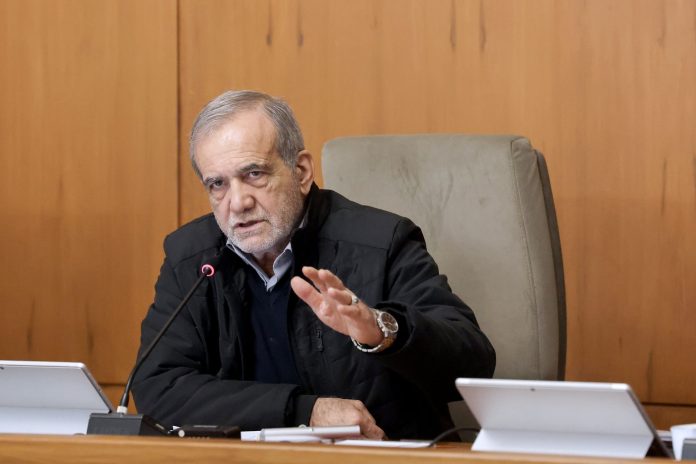
In a telephone conversation with Pakistan’s Prime Minister Shehbaz Sharif on Saturday, Pezeshkian expressed Iran’s support for any effort aimed at establishing sustainable peace between Pakistan and India, offering Tehran’s willingness to mediate in this process.

The president emphasized that Iran’s principled policy entails promoting deescalation and fostering peace globally, particularly within the Islamic world.

Pezeshkian also welcomed the Pakistani prime minister’s invitation to visit Islamabad, saying he would instruct his administration to explore avenues for enhancing cooperation.

For his part, Sharif expressed gratitude to Iran for its hospitality during his recent visit to Tehran, highlighting the productive discussions that took place on defense, security, and economic fields.

The prime minister proposed that an Iranian delegation should visit Pakistan to explore ways to strengthen bilateral ties before Pezeshkian’s future trip to the neighboring country.

He also hailed Iran’s position on the Pakistan-India tensions, reaffirming Islamabad’s commitment to dialogue with New Delhi to achieve peace. Sharif also welcomed Iran’s potential role as a mediator in this context.

Intelligence Minister: Documents on Israel nuclear facilities in Iran’s possession

Iran Minister of Intelligence Esmaeil Khatib

Seyed Esmaeil Khatib, Iran’s Intelligence Minister, stated in a televised interview regarding the details of the Islamic Republic’s intelligence strike against the Zionist regime that these documents pertain to information on the regime’s nuclear facilities and other strategic records.

According to Khatib, the possession of these strategic documents enhances Iran’s offensive strength.

Well-informed sources in the region revealed on Saturday that the Islamic Republic of Iran’s intelligence apparatus had delivered one of the most significant intelligence blows in history to the Zionist regime, adding that extensive data, including nuclear-related information, had been extracted from the occupied territories.

According to a Fars News Agency correspondent, the informed sources revealed that Iran’s intelligence apparatus had successfully extracted a vast trove of strategic and sensitive information, including nuclear blueprints and facility details, from the occupied territories.

It came as recently the Zionist regime’s internal security agency (Shin Bet) and Israeli police disclosed in a statement that they had arrested Roy Mizrahi and Almog Atias, both 24 years old and residents of Nesher in Northern Israel, on suspicion of security-related offenses linked to Iran.

US pushing to ensure ‘maximum impunity’ for Israel through attack on four ICC judges: Iran

ICC

Commenting on X, former Twitter, on Saturday, Iranian Foreign Ministry Spokesman Esmaeil Baghaei said the move marked a “new low,” even for a country such as the US, which was “badly” addicted to using sanctions and intimidation towards realizing its foreign policy goals.

The US, he said, has issued the coercive measures in line with its way of abusing its power and obstructing international justice.

The administration of President Donald Trump imposed the measures on Friday in response to the court’s serving Israeli Prime Minister Benjamin Netanyahu with the warrant last year, amid the regime’s genocidal war against the Gaza Strip that began in October 2023.

The war has so far claimed the lives of around 55,000 Palestinians, mostly women and children.

The American sanctions were also meant to punish the court’s judges for investigating the war crimes that had been committed by American troops in Afghanistan during the US’s invasion of the Asian country.

Washington dismissed the probes as “illegitimate and baseless.”

Baghaei, however, said the American bans were aimed at “ensuring maximum impunity for Israel’s atrocity crimes and ethnic cleansing in occupied Palestine.”

The spokesman cited an earlier case in point across the US’s policies as the American diplomatic representatives at the United Nations Security Council’s vetoing a draft resolution mandating “permanent” ceasefire in the Israeli war.

Such moves, the official regretted, had made the United States “the most enduring & persistent accomplice in Israeli regime’s horrifying crimes of genocide, war crimes, crimes against humanity, and aggression.”

Baghaei urged the international community to act in response to the deadly American-Israeli partnership, warning that the US’s actions were undermining international law and threatening the foundational principles of humanity.