Wednesday, December 31, 2025
Home Blog Page 3166

A Look at Iranian Newspaper Front Pages on July 25

A Look at Iranian Newspaper Front Pages on November 19

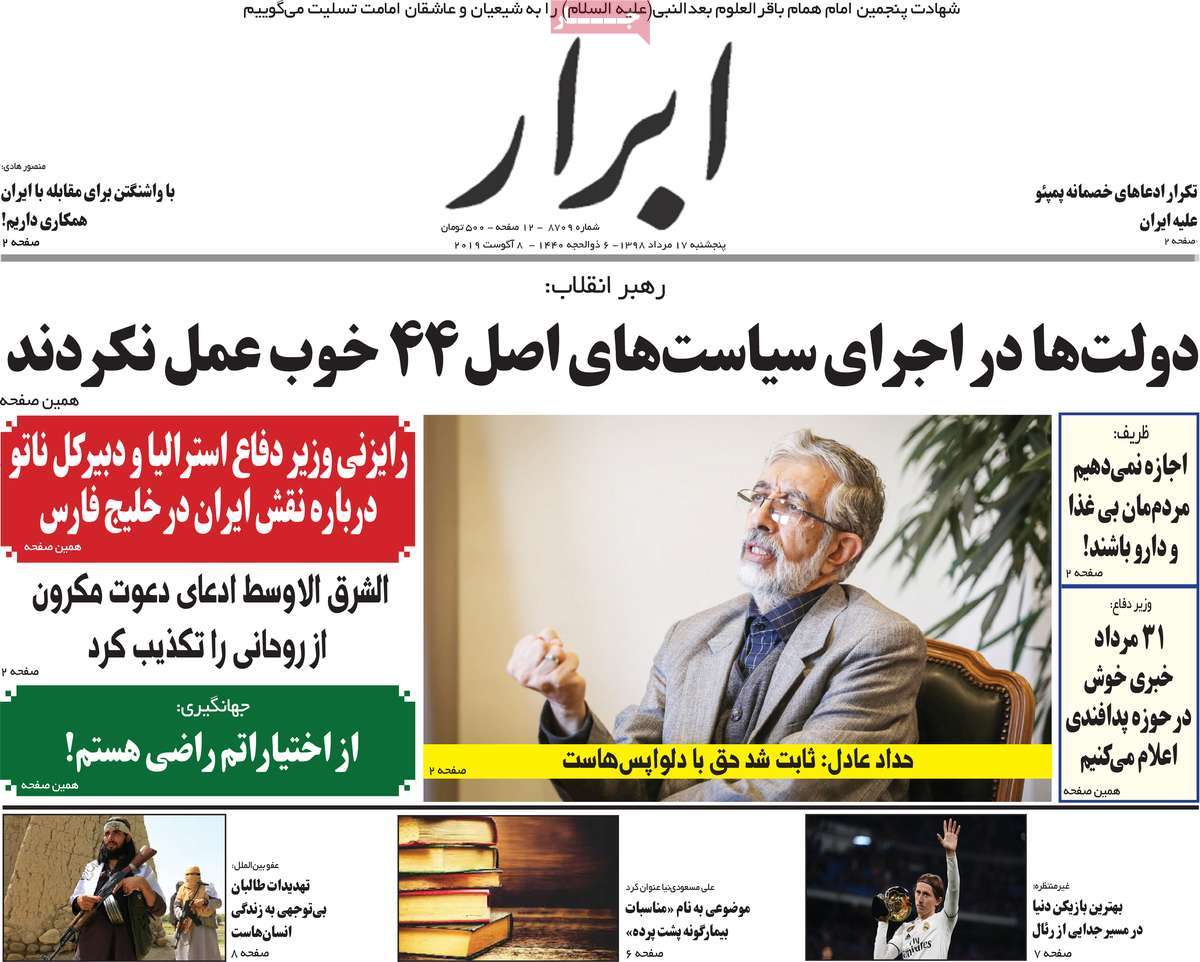
Abrar:

1- US Warns Companies Offering Services to Iranian Airlines

2- Rouhani: We Won’t Sit for Talks If It Means Surrender

3- Araqchi: We Won’t Allow Anyone to Disrupt Strait of Hormuz Security

4- Iraq: Iran Has Gave Assurance to Iraqi PM about Security of Oil Tankers in PG

5- ISIS Claims Responsibility for Damascus Blast

A Look at Iranian Newspaper Front Pages on July 25


Afkar:

1- Lavrov: Iran Must Be Part of Solution to Region’s Problem

2- Rouhani: Strait of Hormuz No Place for Playing with Int’l Rules

A Look at Iranian Newspaper Front Pages on July 25


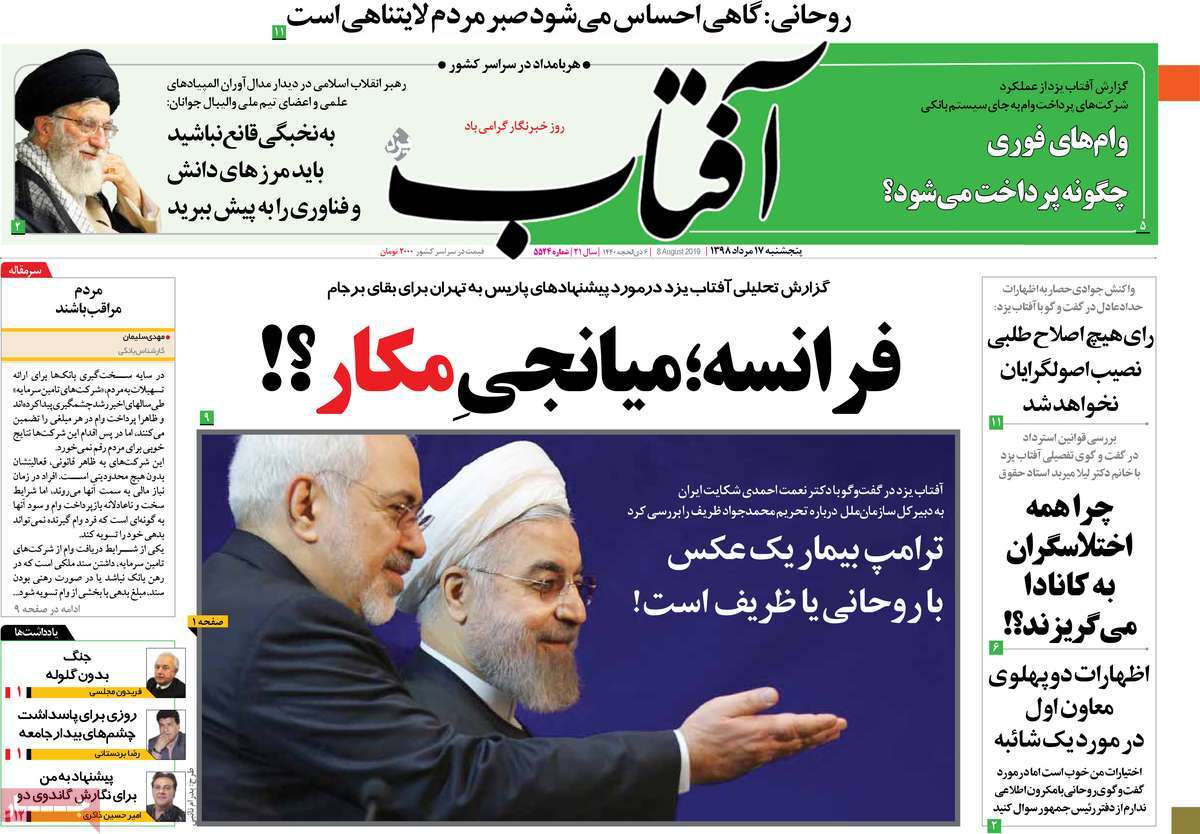
Aftab-e Yazd:

1- Rouhani: People Should Know We’re Not after War, but We Won’t Accept Bullying

2- Europe’s Indirect Pressure against Tehran? * Purposes behind Europe’s Bid to Form Naval Fleet to Secure Shipping in PG

3- Europe’s Move for Show [Editorial]

A Look at Iranian Newspaper Front Pages on July 25


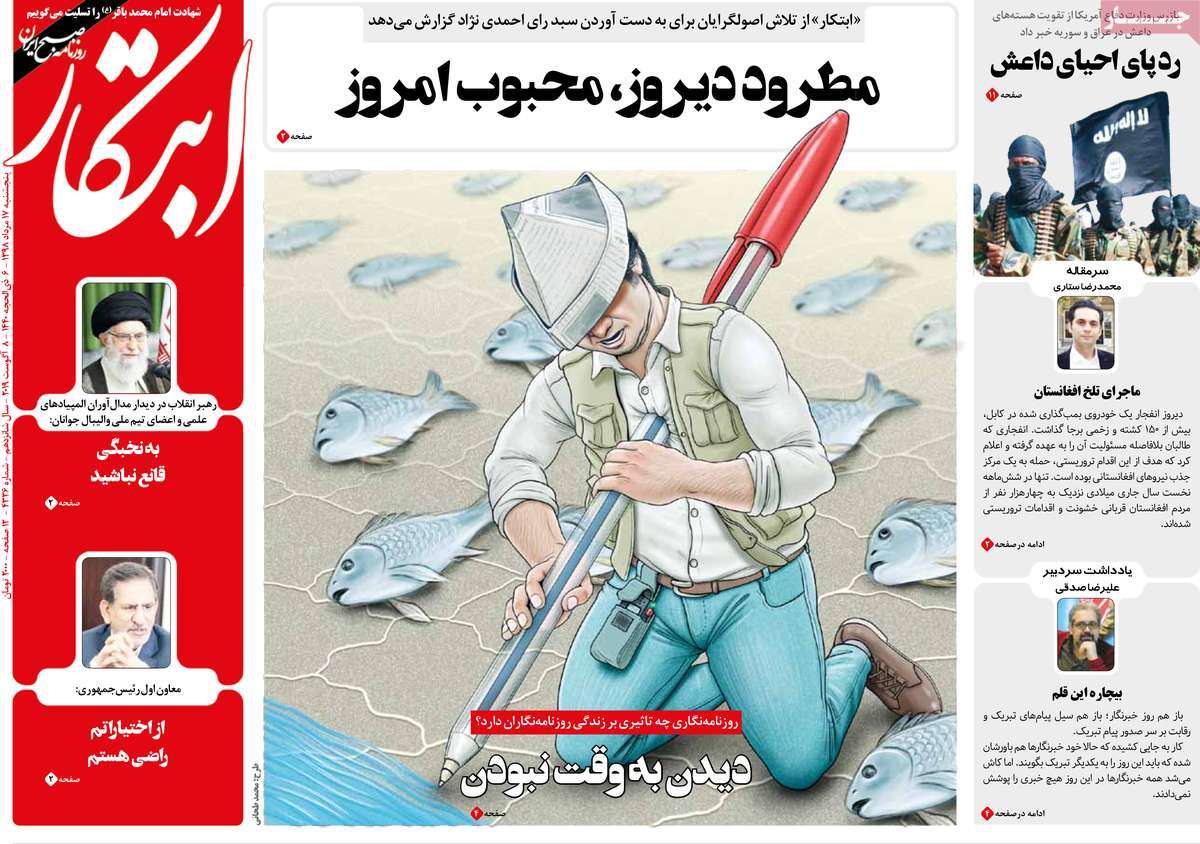
Ebtekar:

1- Araqchi in Paris: What’s France’s Response to Rouhani’s Message?

2- Baghdad’s Efforts to Ease Tension in Region

A Look at Iranian Newspaper Front Pages on July 25


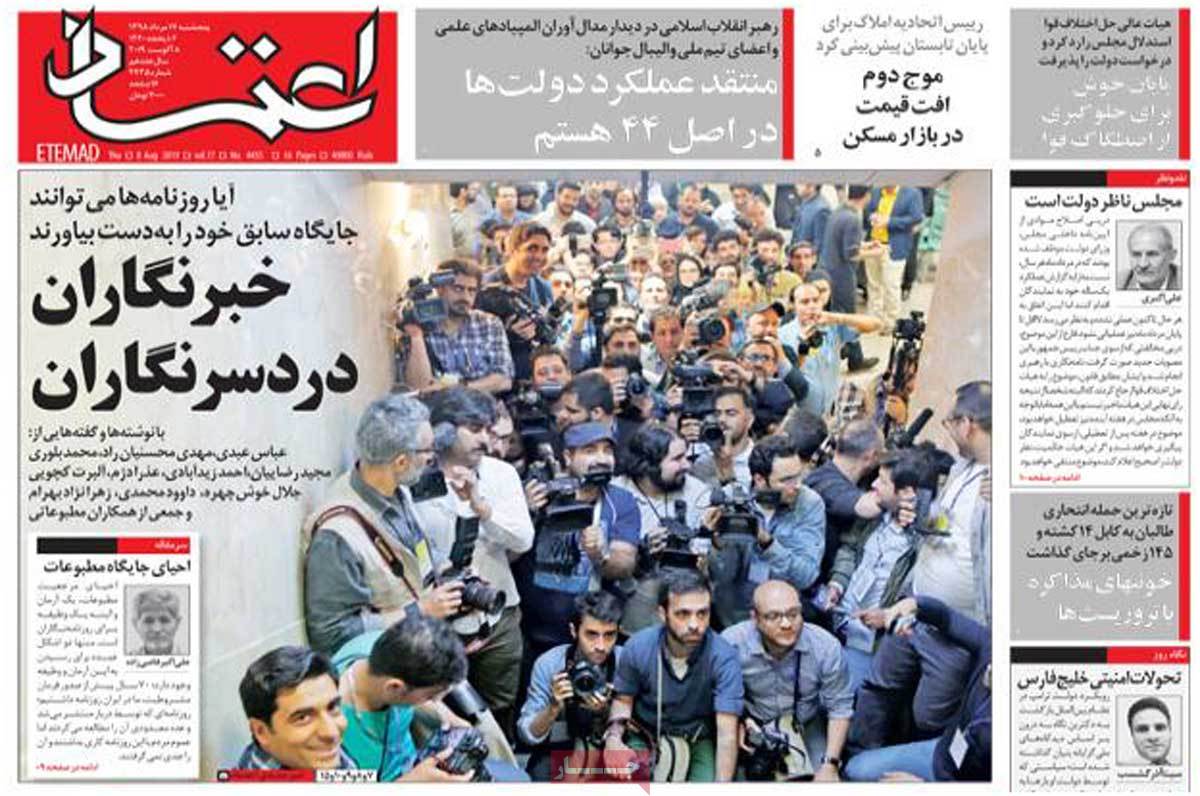
Etemad:

1- UK Envoy: We Won’t Join Any Anti-Iran Coalition

2- Drop in World’s Economic Growth Rate

A Look at Iranian Newspaper Front Pages on July 25


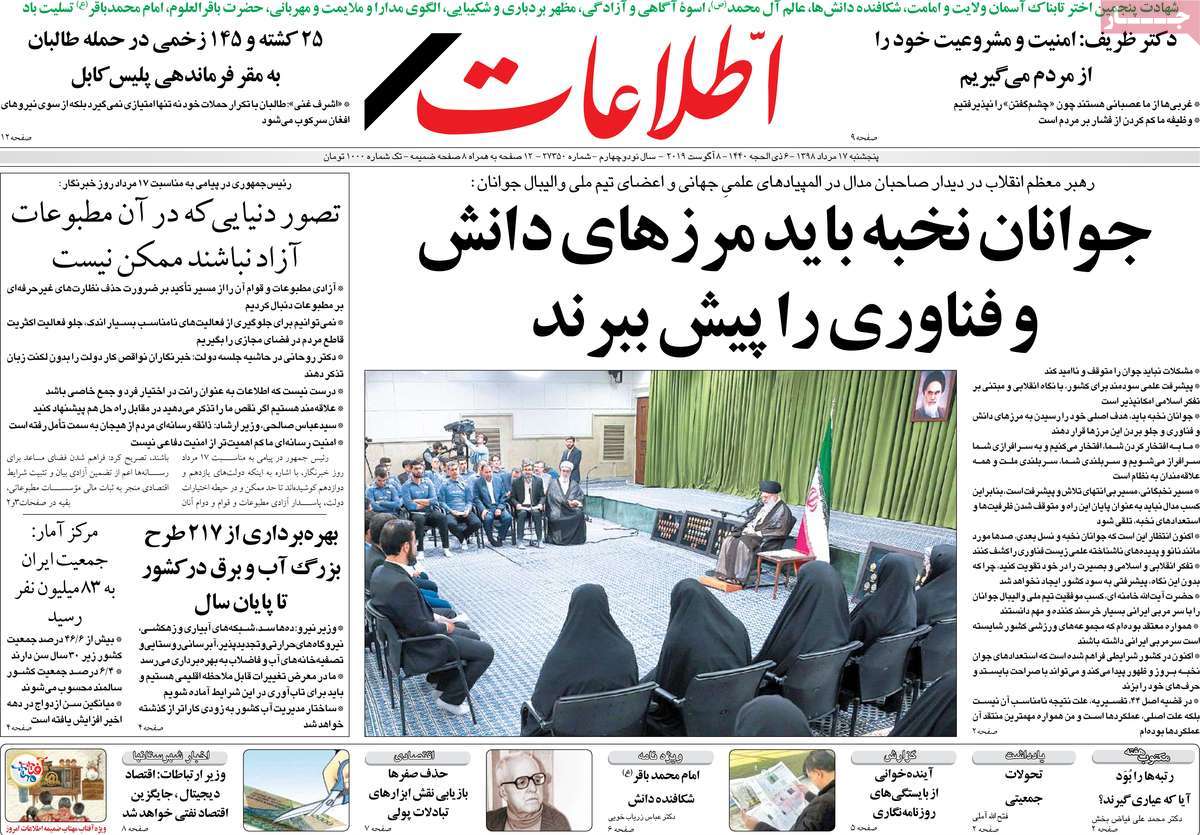
Ettela’at:

1- Trump: We Won’t Become Police of Hormuz Strait Serving Interests of China, Saudi, Japan

2- IRGC Chief: No Iranian Drone Downed

A Look at Iranian Newspaper Front Pages on July 25


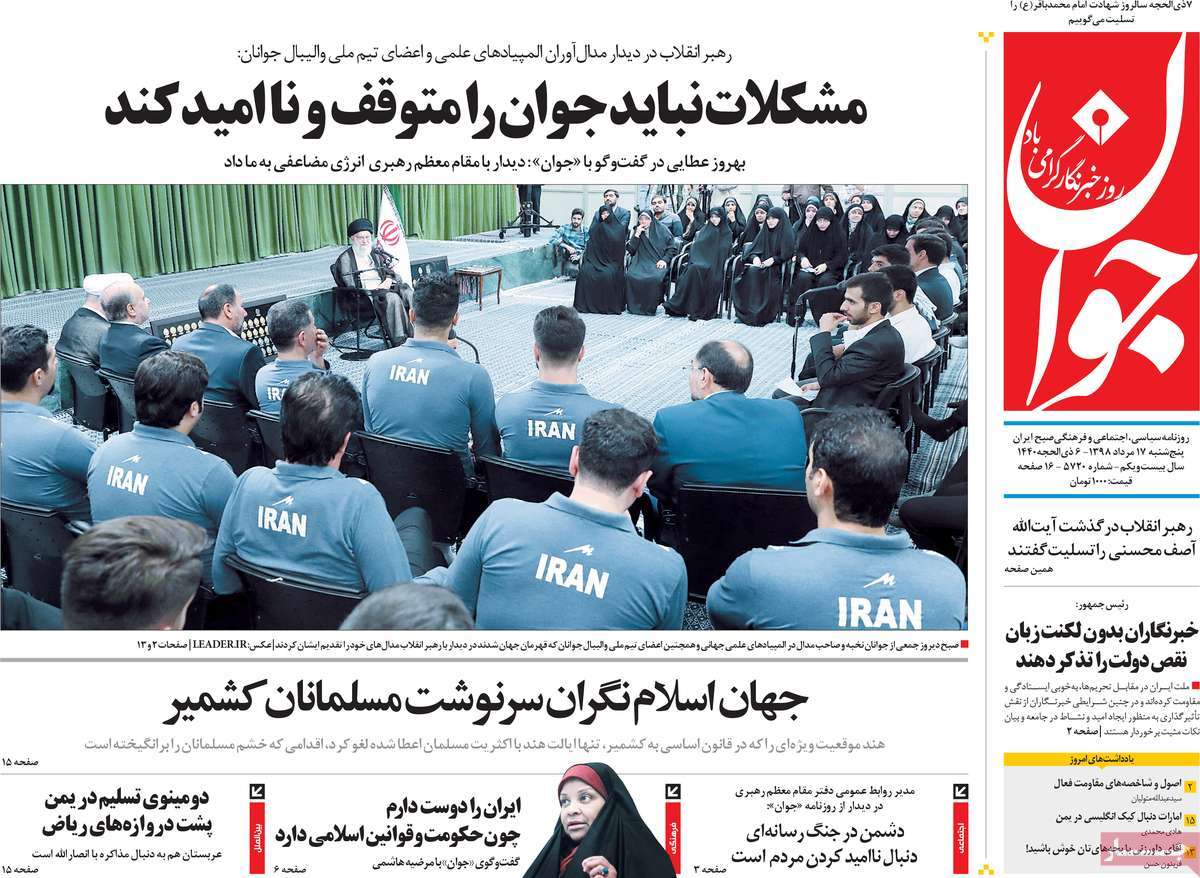
Javan:

1- IRGC Chief: We’ve Become Extremely Strong

2- Rouhani: World Must Be Grateful to IRGC for Security of PG

3- Leader’s Military Aide: European Coalition in Hormuz Strait to Have Unpredicted Consequences

4- Coalition on Water: Europe Escalating Tension with Tehran in Separate Path from US

A Look at Iranian Newspaper Front Pages on July 25


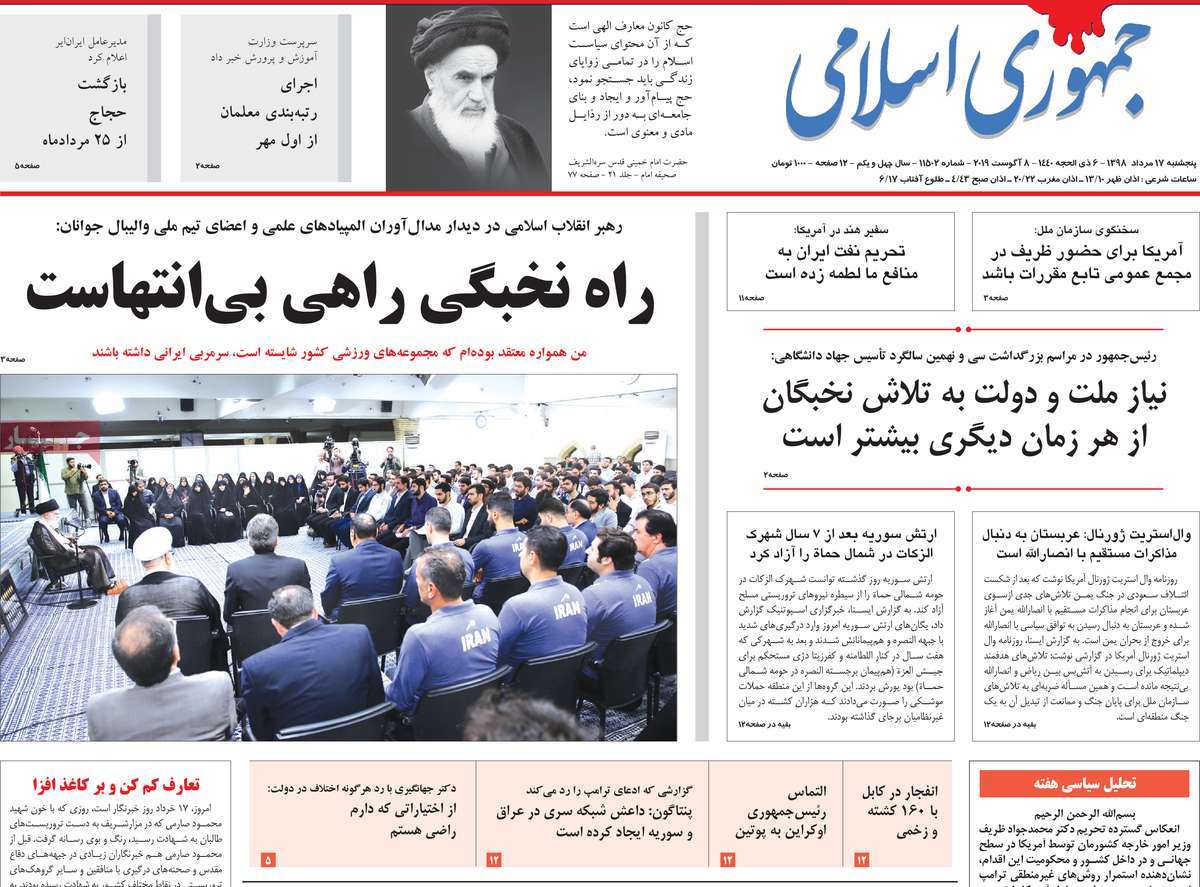
Jomhouri Eslami:

1- Foreign Policy: Trump Must Take Practical Steps for Talks with Iran

2- Rouhani: We Won’t Let Disorder in PG, Strait of Hormuz

A Look at Iranian Newspaper Front Pages on July 25


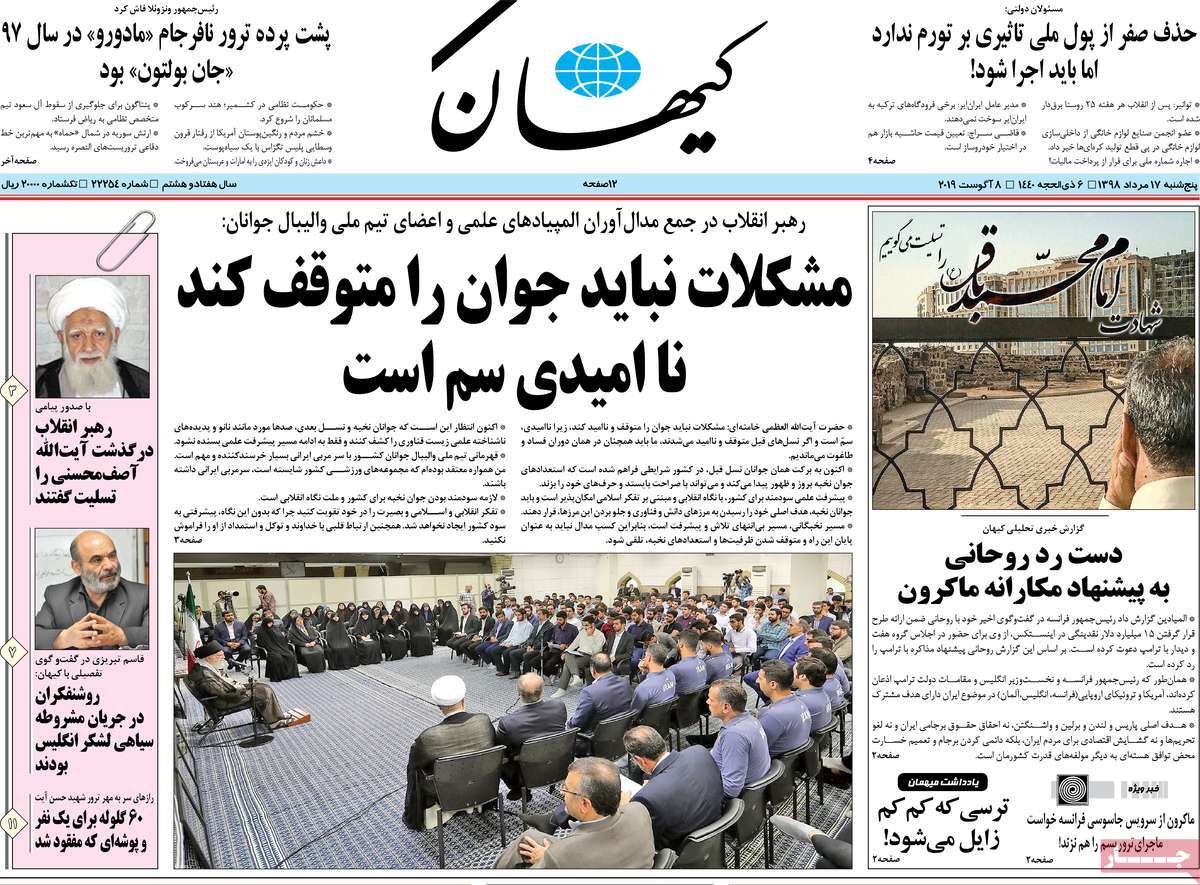
Kayhan:

1- Iran to Stop Its $2bn Imports from Brazil If Its Vessels Not Refuelled

2- 53 Global Figures Call for Release of Sheikh Zakzaky in Letter to UN Chief

3- CNN: Trump Breaks His Own Record by Telling 61 Lies in One Week!

4- Sunset of UK Queen’s Empire amid Crises

A Look at Iranian Newspaper Front Pages on July 25


Mardom Salari:

1- Iran’s Letter to UN Security Council on Seizure of UK Oil Tanker

2- Gov’t Will Never Miss Chance for Talks: Rouhani

3- Negotiation with Promise-Breakers ‘Stupidity’: Iran

A Look at Iranian Newspaper Front Pages on July 25


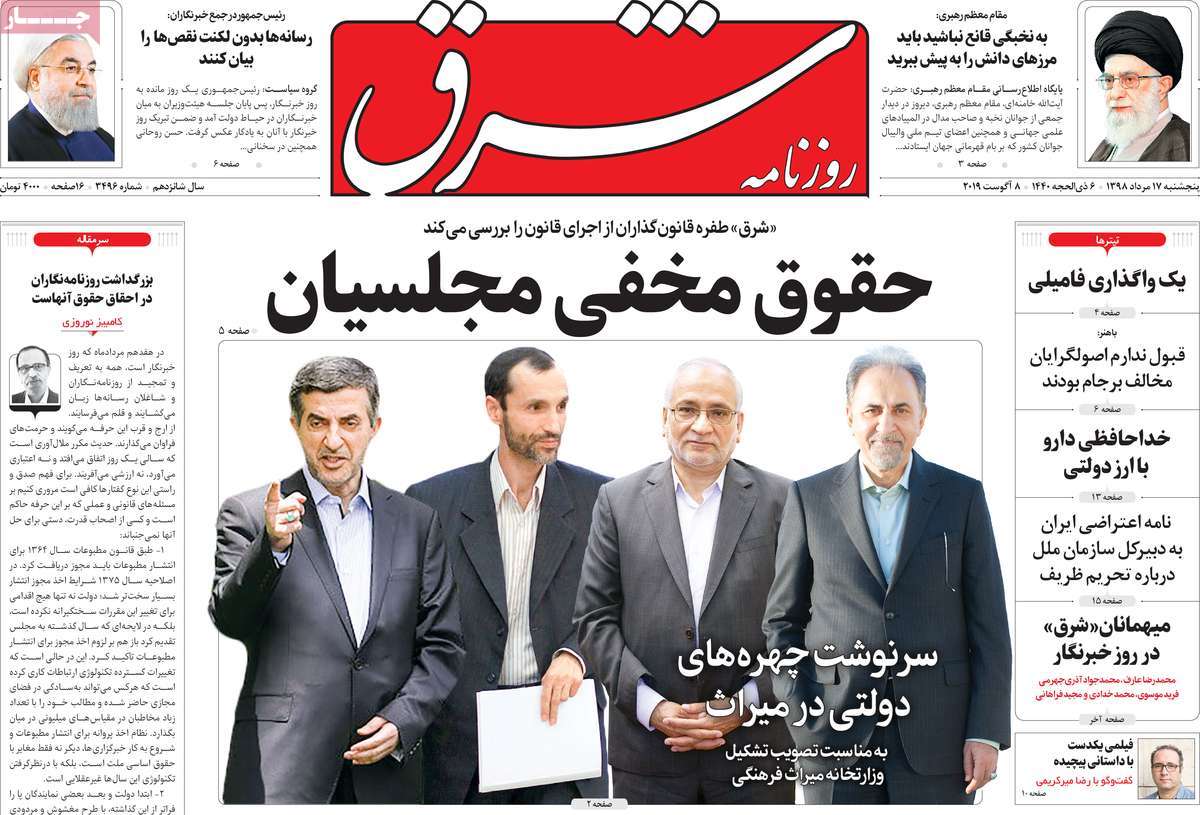
Shargh:

1- Iran’s Letter to UN Security Council

2- Rouhani: Strait of Hormuz No Place for Playing with Int’l Rules

A Look at Iranian Newspaper Front Pages on July 25

Iran, Senegal Discuss Economic Ties, Regional Issues

Iranian Foreign Minister Mohammad Javad Zarif arrived in Senegal’s capital Dakar on Thursday morning after a tour of Americas that took him to New York for a UN meeting and later to Venezuela, Nicaragua and Bolivia.

During the one-day stay in Dakar, Zarif held a meeting with his Senegalese counterpart Amadou Ba.

In the meeting, the ministers discussed the ways to enhance cooperation between the two countries in the trade fields, energy and power plant industry, automotive industry, and nanotechnology.

Zarif and Ba also stressed the need for holding a session of Iran-Senegal joint economic commission, for promoting cooperation in the international organizations, particularly in the United Nations and the Non-Aligned Movement, for Islamic world’s unity, supporting Palestine and restoration of the Palestinians’ rights, as well as the need for stability and security in the region and de-escalation of tensions.

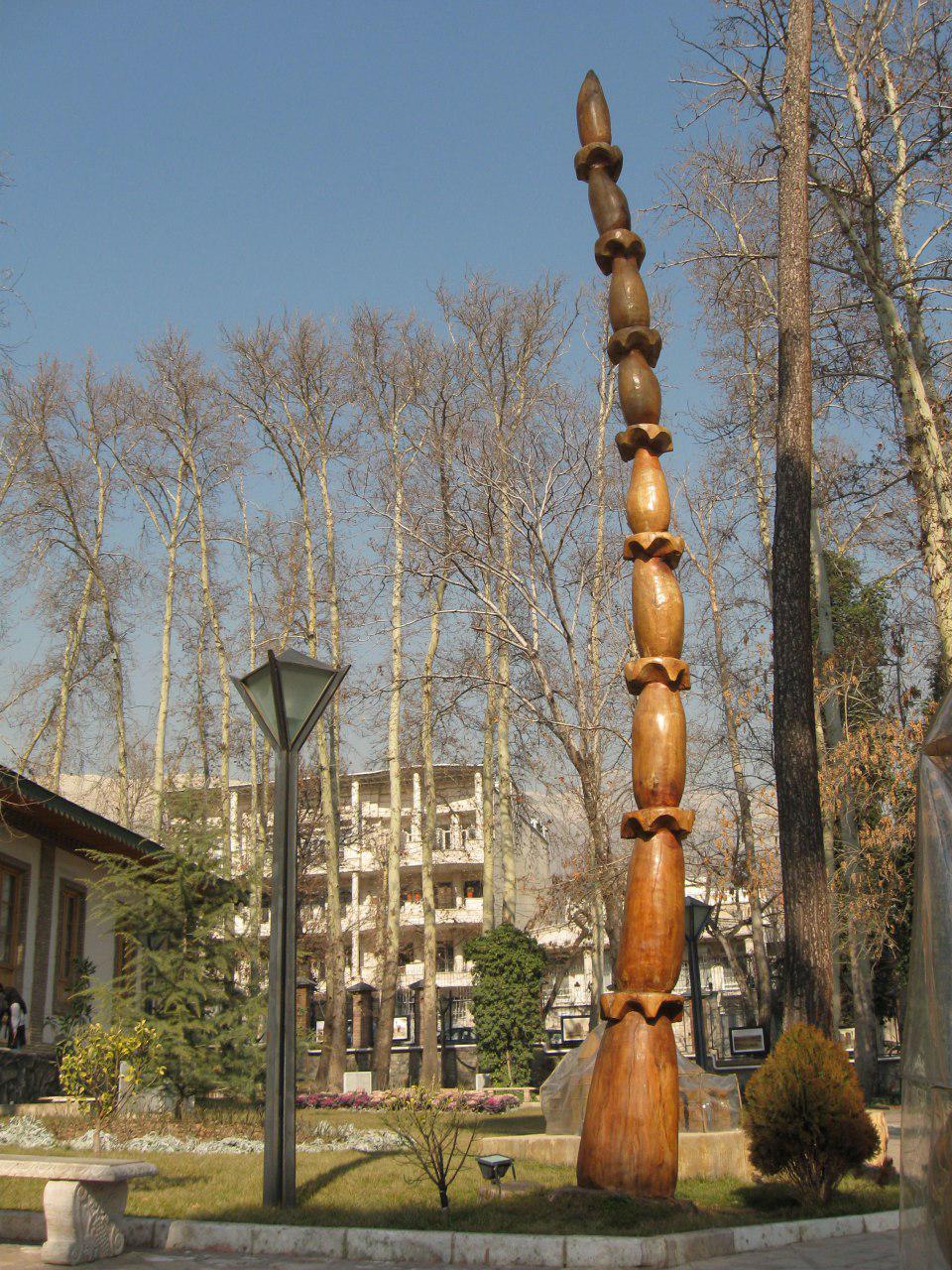
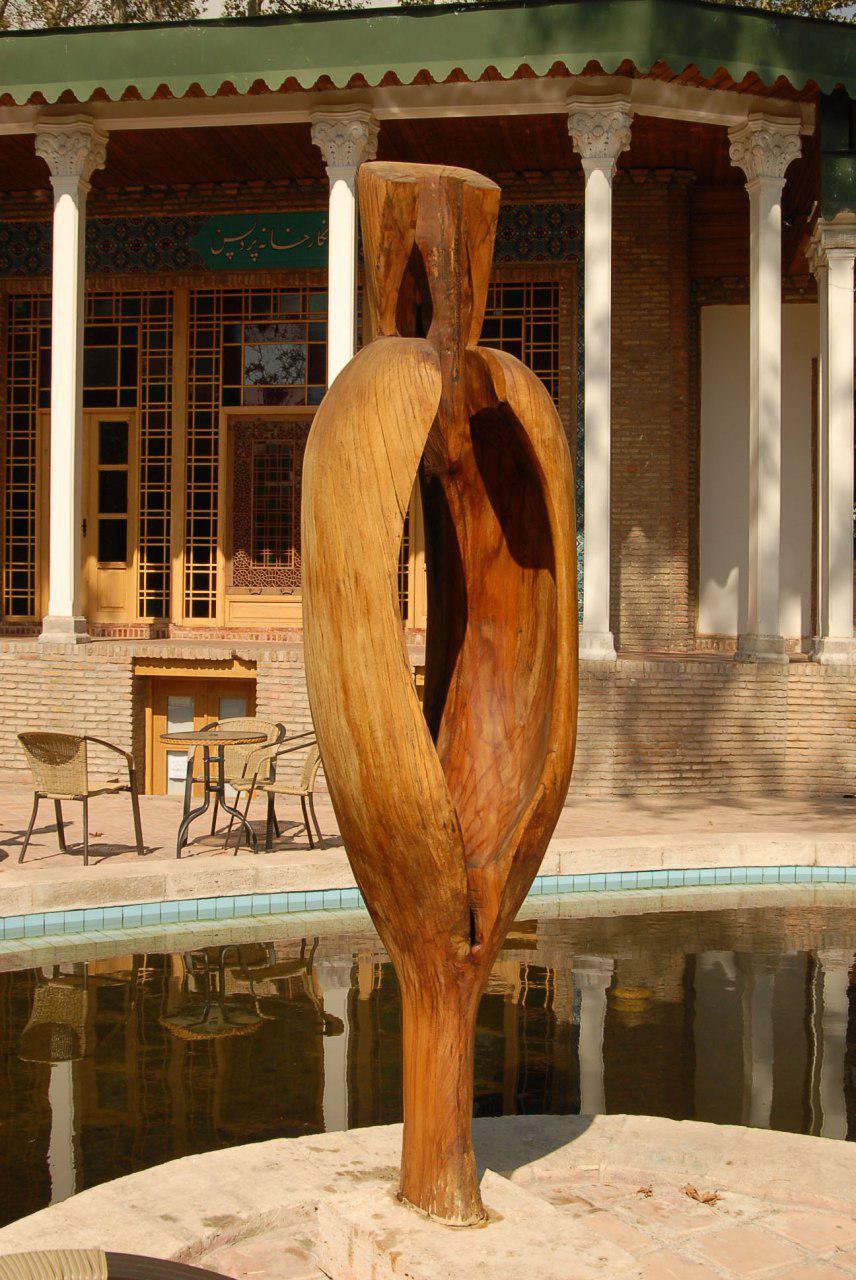
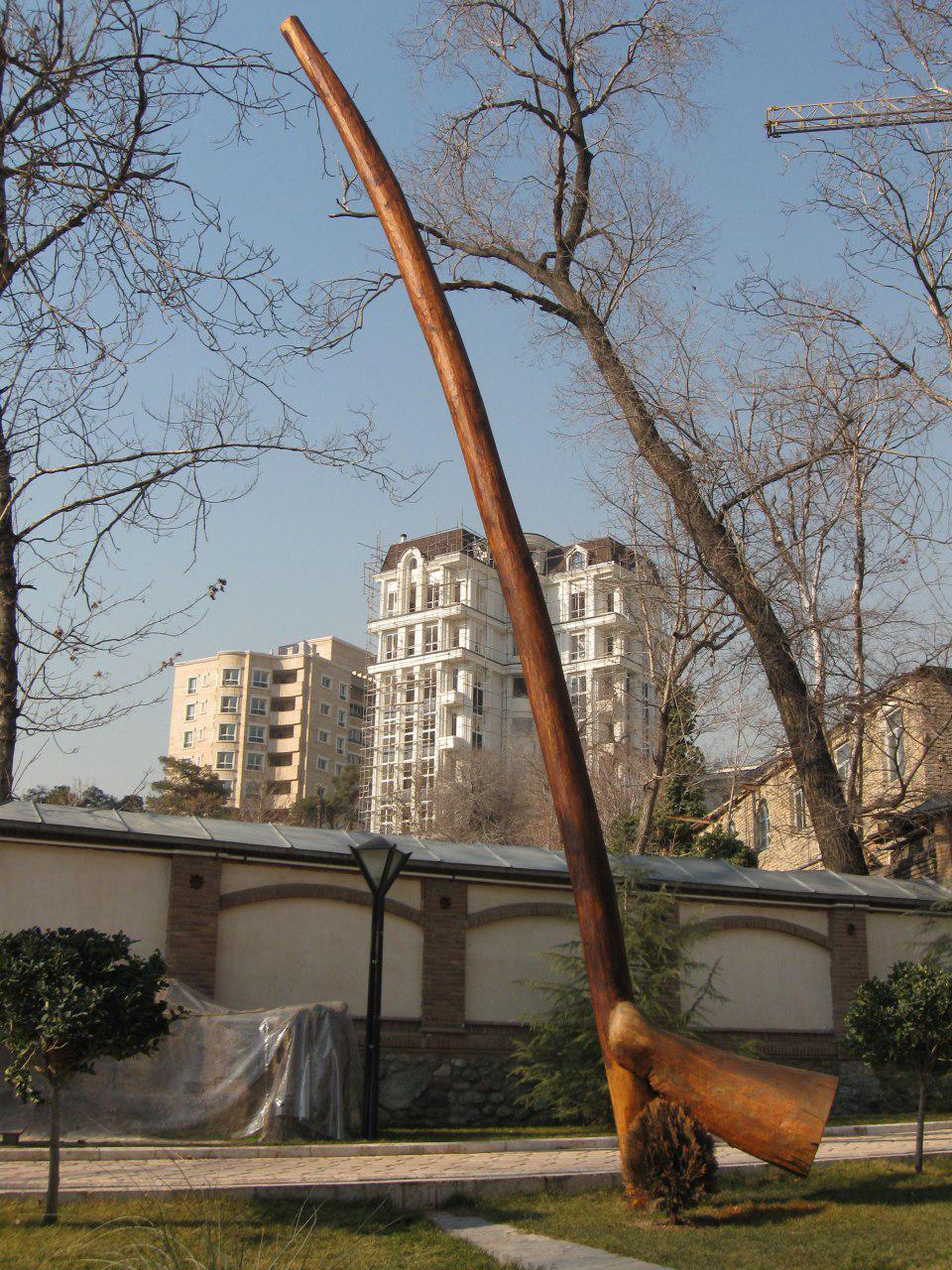
Tehran Hosting ‘Four Corners of Imagination’ Sculpture Exhibition

It is the largest and most inclusive exhibition of the Iranian Sculptor’s Association. The exhibition features 182 works by 160 artists.

As in previous years, the works selected by artists have been put on display at the exhibition and there is no jury.

Based on a call by the association, members were asked to display three of their most recent works.

The theme of the exhibition is free and the artist is able to display his own personal ideas. This will make a good and professional look at the sculpture industry in Iran.

What is remarkable in this edition is the social concerns expressed by the artists in their works.

The “Four Corners of Imagination” runs through August 26 in the gallery of Iranian Artists Forum.

What follows are Honar Online’s photos of the exhibition:

Iranian Farmers Start Growing Quinoa

Director of the Centre for Herbal Medicines at Golestan University of Medical Sciences said growing Quinoa has been fully mechanised in the province since March last year, and its harvest began recently using combine harvesters.

Mostafa Hamidi in an interview with ISNA said this year, two hectares of farms in Gorgan and Kordkuy cities are cultivating Quinoa.

Hamidi went on to say that Quinoa is an organic bioactive vegetable and is considered a kind of semi-grain. This plant is the main source of protein, iron and fibre and its protein is twice as rice.

The plant is native to Peru, Chile and Bolivia, he said, adding that Quinoa is used in South and North America as a major dish. The FAO has compared its nutritional value with powdered milk.

Stressing that Quinoa is known as the vegetarian caviar in the world, he maintained the plant is used to enrich flour, pasta and biscuits. “Quinoa can replace many foods because of its high nutritional value.”

“This plant tolerates high salinity and dryness.

Quinoa has the ability to be raised in arid lands and therefore can be grown in the northern lands of the province.”

“The amount of water needed for Quinoa cultivation is one-fourth in comparison with that of rice,” Hamidi said, saying that the plant needs little water.

“Patients with celiac disease who are suffering from gastrointestinal problems can replace wheat with Quinoa. Its cultivation in the country has started in recent years, and by informing people about the benefits of using this plant, its market can be boosted, and it will provide a good incentive to grow this plant, especially in salt lands, “ concluded Hamidi.

In addition to Golestan province, Iranian agriculture officials say the cultivation of Quinoa has been successful in the southern province of Kerman, despite the fact that it is an arid region.

Iranian Farmers Start Growing Quinoa
Quinoa cultivation in Iran’s Kerman province

In Photos: Iranian Market Run by Afghan Immigrants

The presence of these fellow Persian speakers has given a special atmosphere to the traditional market, as if you are walking in a market in Kabul, Afghanistan’s capital.

What follows are Mehr News agency’s photos of this beautiful bazaar, where products with Baluch embroidery are being sold alongside various colourful fabrics:

What’s Purpose of Iraqi PM’s Recent Short Visit to Iran?

The trip was more significant than a formal visit to Iran by the top official of a neighboring country, because it came at a time of specific regional and internal situation facing both Iraq and Iran.

The most likely reasons behind the visit could be discusses in several dimensions:

Internal Aspect: Growing Crises in Social Services

The political situation in recent months has not been suitable for Abdul-Mahdi. Although the Iraqi government has emerged quite successful with initiatives in the foreign policy arena, it faces many problems inside, as there is still no tangible change in the quality of social services nearly a year after formation of the cabinet and several months after its completion.

The circumstances are so unfavorable that a formal opposition has been shaped in Iraq, and people have poured into the streets several times in an act of protest. Even the religious authorities have warned against the continuation of such trend.

In a recent interview with AFP, former Iraqi prime minster Haider al-Abadi touched on the current circumstances in Iraq, voicing readiness to return to power by saying that he has good intentions to do so.

Bilateral Ties

Abdul-Mahdi was accompanied by the ministers of oil, finance, transportation, defense, and by the national security advisor in the visit to Iran.

The arrangement of his delegation reveals that the economic and security issues were high on the agenda in the trip, and the visit should be considered within that framework.

From the economic viewpoint, the anti-Iran sanctions have had considerable impacts on Iraq. The Iraqi officials have repeatedly voiced opposition to the US’ unilateral sanctions against Iran, arguing that there is no replacement for the import of energy from Iran, particularly in the hot season when Iraq’s demand for gas and power is much higher, in such a way that the supply of energy is directly related to Iraq’s national security.

There are popular protests against the blackouts and shortage of water in Iraq in the summertime every year. The city of Basra had tumultuous weeks last year.

The situation became so tough for Baghdad that Washington had to exempt Iraq from the sanctions for a period of time.

On the other hand, the oil exchanges between the two countries are of special significance even in the current situation. The two countries maintain relations in this area, and the ties are such close that have angered the US. The US secretary of treasury is said to have travelled to Iraq recently to warn the Iraqis about these ties. However, it is not clear how seriously Baghdad has taken the warning.

The two countries are also conducting banking and financial transactions. Maybe the Iraqi finance minister was in the delegation to facilitate this section.

Regional Aspect: A Bridge Between Iran, Arab World

A number of political experts believe that Abdul-Mahdi’s visit to Iran in the current circumstances was related to the regional developments, in which Saudi Arabia and the United Arab Emirates have each suffered losses from the foreign policies they have been adopting in recent years, and are rectifying them.

An example is the gradual withdrawal of Emirati forces from Yemen and a change in the blatant, hostile stances against the Islamic Republic of Iran, which was obvious in the attack on four oil tankers in the Port of Fujairah. The UAE did not name any specific country in its report to the United Nations Security Council, and preferred to remain silent on the subject.

In the meantime, Iraq, which is known as a bridge between Iran and the Arab world, can take a role and prepare the ground for a change in the region’s current situation.

Iraq has got such potential, and could convene meetings on the issue in Baghdad, which would be welcomed by Iran, according to the Supreme National Security Council.

International Aspect: JCPOA and Tanker War

As regards the international aspect, tensions have arisen in the region between Iran and two other countries, the US and the UK, over the JCPOA and the issue of oil tankers.

Trump, who created a new global crisis by withdrawing from the JCPOA, does not sill accept the fact that this issue would not be resolved with sanctions and pressures, and that he must return to the negotiation table by lifting the sanctions.

Moreover, the efforts in this regard made by some countries like Iraq, Japan, France and Oman have not yielded results so far.

But the conditions are somehow different in the standoff with the UK, since the tension with Britain could be settled rapidly and through diplomatic channels with the release of the Iranian oil tanker that has been seized in Gibraltar.

It appears that the UK authorities, who are also grappling with the internal crisis of Brexit, are willing to resolve the tension with Iran in an honorable manner.

The telephone conversations between Adil Abdul-Mahdi and the UK defense secretary just hours before visiting Iran could be described as part of the British willingness to address the issue, though no details of the telephone conversation has been made public.

Another notable subject in this regard will be Omani Foreign Minister Yusuf bin Alawi’s visit to Iran next week. He is trying to have the regional and international crises resolved diplomatically.

Speaking about his trip to Iran at a press conference last night, the Iraqi prime minister said he has discussed the subject of the captured oil tankers in the meeting with Hassan Rouhani and has emphasized the necessity to relieve the tensions.

He also noted that Iraq will have a significant role in de-escalation of tensions, and will be friends with everyone.

No matter which files Abdul-Mahdi had brought to Iran, one could say that he will receive a welcome from Tehran and face Iran’s help in addressing them.

Iran Reveals New Evidence against UK Oil Tanker in Letter to UNSC

Iran’s permanent mission to the United Nations has sent a letter to the Security Council, providing a description of the incident that resulted in the capture of Britain’s “Stena Impero” oil tanker.

According to the letter, the UK oil tanker has had a crash with an Iranian fishing vessel at the Strait of Hormuz on July 19 and caused damages to the Iranian boat in a way that a number of its crew and fishermen are in a critical condition in hospital.

The British oil tanker ignored warnings from Iran after the accident, switched off its navigation systems, made a dangerous maneuver, and began to sail into the wrong way to flee the area before it was captured by the Iranian naval forces, said the letter.

It said Iran has carried out a necessary operation to ensure maritime security and rule of law in the high-traffic strait in compliance with the international regulations, noting that the UK oil tanker has been transferred to the port city of Bandar Abbas under a warrant issued by the local judicial authorities.

The Iranian judicial officials have ordered an investigation into the British tanker’s violations, including the damages it has done to the environment and to the Iranian fishing vessel and its crew, the letter noted.

Iran’s UN mission has also made it clear that the Islamic Republic’s main purpose is to enforce the law and ensure maritime order, security and safety in the delicate Persian Gulf region and the Strait of Hormuz.

The letter has also cited Iran’s recent measure to capture ‘Riah’ oil tanker, saying it was smuggling fuel.

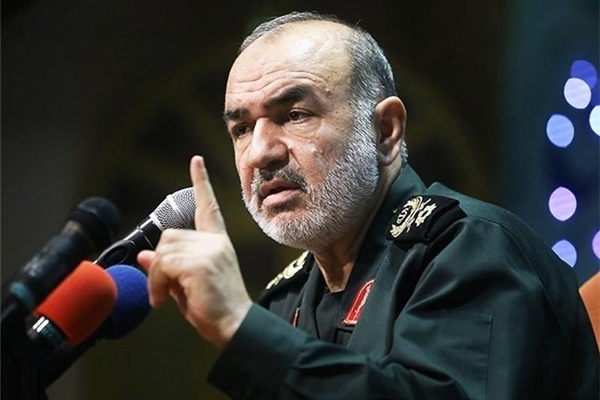
IRGC Chief Assures No Iranian Drone Downed by US

“I, hereby, announce officially that no drone belonging to the Islamic Republic of Iran has been shot down,” Major General Hossein Salami told reporters in the western Iranian city of Khorramabad on Wednesday afternoon.

He went on to say that an Iranian drone was on a reconnaissance mission in the skies over Persian Gulf waters for three hours and 40 minutes, underlining that the aircraft sent images and videos of regional and transregional vessels – some of which were broadcast to enlighten the Iranian and world public opinions.

Salami then challenged the US to offer convincing proof for its claim of shooting down the Iranian drown, saying, “Today, the world would not believe unsubstantiated remarks.”

“Enemies should present the Iranian-made parts of the drone and substantiate their claims. Otherwise, no one would believe their spurious allegations,” the top IRGC commander said.

“I state it unequivocally: This is a big lie and we have proved it false. Enemies should provide evidence for their claims, because we have validated what we have already done. They (enemies) should do the same,” he added.

The remarks came in reaction to remarks by a US general who claimed the US forces took action against a second Iranian drone in the Strait of Hormuz last week, but did not see the drone go into the water.

“We’re confident we brought down one drone; we may have brought down a second,” CENTCOM Commander Gen. Kenneth McKenzie said on Tuesday, while failing to procure any evidence for bringing down the first one despite claiming to be in possession of its footage.

Moving between the Persian Gulf and the Gulf of Oman, the USS Boxer is said to have used electronic measures to take down a drone, which Washington claims was being operated by Iran.

“We believe two drones were successfully engaged,” McKenzie claimed, speaking aboard the USS Boxer amphibious assault ship. “There may have been more that, you know, we’re not aware of. Those are the two that we engaged successfully.”

US President Donald Trump announced on July 18 that the USS Boxer downed an Iranian drone that came within 1,000 yards of the Navy ship and ignored “multiple calls to stand down.”

A few hours after Trump’s allegation, Iran moved to reject his claim with Iranian Deputy Foreign Minister Abbas Araqchi saying in a tweet that “We have not lost any drone in the Strait of Hormuz nor anywhere else.”

The IRGC has also released footage captured by an Iranian drone flying over the Strait of Hormuz and monitoring a US Navy vessel, belying the claim.

Iran defense minister rejects US claim of destroying Iranian drone

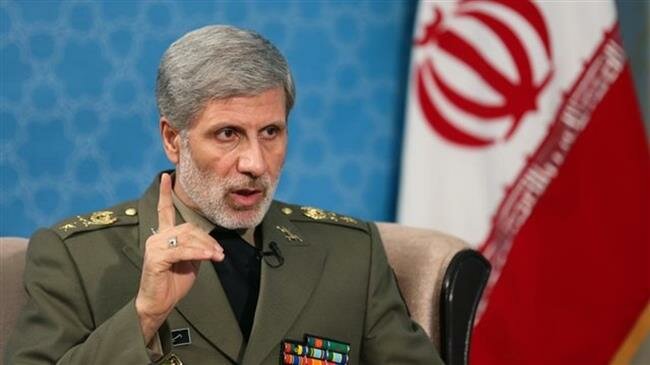
Meanwhile, Iran’s Defense Minister Brigadier General Amir Hatami said no Iranian drone has been brought down.

“None of our drones has been shot down, and they are carrying out their regular missions. We showed the body of the [US] drone that we brought down. If anyone claims to have brought down our drone, prove it. No drone from the Islamic Republic of Iran has been brought down,” Hatami said.

Tensions in the Persian Gulf region have intensified recently, where Washington has sent an aircraft carrier and B-52 long-range bombers in a show of force against Iran.

The US deployment came after a series of attacks since mid-May on tankers around the Strait of Hormuz, the world’s most important oil artery. Washington blames Tehran for the attacks. Iran roundly rejects the allegations, saying its has even come to the rescue of vessels requesting help in the Persian Gulf.

On June 20, the IRGC shot down the advanced US-made RQ-4 Global Hawk over Iran’s territorial waters off the coastal province of Hormozgan after the unmanned aircraft breached the country’s airspace on a spying mission.

In a statement, the IRGC said the US-made Global Hawk surveillance drone was brought down by its Air Force near the Kouh-e Mobarak region — which sits in the central district of Jask County — after the aircraft violated Iranian airspace.

Iran Jumps 4 Notches in GII 2019

Iranian Vice President for Science and Technology Sorena Sattari hailed the country’s rising performance in the Global Innovation Index (GII) 2019, saying Iran has jumped to the 61st place in the most recent report.

“Amid the anti-Iranian threats and sanctions imposed by the US and Europe that have caused a lot of limitations and challenges for our country, release of the latest Global Innovation Index report by an institution affiliated with the United Nations indicated Iran’s 4-step rise (in the ranking) compared to the previous year,” Sattari added.

The Global Innovation Index 2019 has provided detailed metrics about the innovation performance of 129 countries and economies around the world.
For a brief review of Iran’s achievements in various fields of science and technology, check the book “Science and Technology in Iran: A Brief Review – 2019

Its 80 indicators have explored a broad vision of innovation, including political environment, education, infrastructure and business sophistication.
The GII 2019 has analyzed the medical innovation landscape of the next decade, looking at how technological and non-technological medical innovation will transform the delivery of healthcare worldwide.

Switzerland is the world’s most innovative country followed by Sweden, the United States of America, the Netherlands and the United Kingdom, according to the GII 2019.

‘The Warden’ Screened for Visually Impaired in Iran

Habib Rezaei narrating the film "The Warden" for the visually impaired in a special screening on July 19, 2019, at Tehran's Charsou Cinematic Complex / Photo by Shahpar R.mat

The feature “The Warden” directed by Nima Javidi, was screened while more than 250 visually impaired people attended the event.

‘The Warden’ Screened for Visually Impaired in Iran
Soundtrack Album of ‘The Warden’ to Be Released Globally

The screening was attended by the founder of the Cinema of the Visually Impaired, Gelareh Abbasi.

Celebrities including Parinaz Izadyar, Habib Rezaei, Nima Javidi, Pouria Alami, Samira Hassanpour, Mahdi Rahmani and Farshad Azarnia were among the special guests.

Rezaei was the one who narrated the entire film for the audiences, making it possible for the visually impaired to feel the movie.

He later in a tweet described it as a fantastic experience. “The Warden was screened for the visually impaired and I explained all the scenes in which there was no dialogue.”

“The result was astonishing, and this experience cannot be described by words.”