Sunday, December 28, 2025
Home Blog Page 3135

Cryptocurrency: The New Oil and Spice in Middle East

bitcoin

Trade, and especially the understanding of trade in the Middle East have been the reasons why mineral wealth and spices have become such valuable commodities and perhaps next on the list could be cryptocurrencies.

Oil Controls the World

The prices of oil are monitored closely as are the exchange rates that buy and sell this precious liquid. Monitoring and controlling the price of oil is something that has had to be mastered and is fundamental to the survival of many Middle Eastern states. Oil priced in dollars relies on the strength or weakness of the dollar to maintain its price and be sold and purchased. The region dominates the oil market globally, even impacting the value of the dollars that buy it, but as cyber currency emerges as a tool of trade the Middle East could begin impacting the value of these currencies too.

Cryptocurrency Trading

There has been a rise in people all over the world now trading in, or at least dabbling in cryptocurrency. Growing numbers of people are looking to get in on the rewarding truth about cryptocurrency trading as stats from people searching for the best crypto bots on https://top10cryptobots.com/ will prove. This trend has made cryptocurrency become more prevalent as a strong trading currency that could outstrip the value and even dominance of the Green Back in time to come. Cryptocurrency trading on a grand scale could become big business for oil-producing states as purchases of the black gold begin to be made in currencies other than conventional foreign money.

The Value of Cryptocurrency

When things like Bitcoin first emerged, they were laughed at and many were skeptical. It is understandable because people and business around the world were and are so used to conventional Dollars, Pounds, Euros, and Yen. However, small cryptocurrencies soon disrupted the way the world started to see money, value, and worth. Yes, cryptocurrencies could take over the world if you believe what some experts are saying. With this in mind and with the dominance of the oil production industry in the Middle East trading in oil is cyber currencies could easily spark the beginning of cyber currency trading domination. The first-ever purchase with a cyber-currency was a pizza and this proved that the strings of ones and zeros had value in the real world. Because of this cryptocurrency can theoretically be used to purchase anything, including oil and spice. If these currencies became the preferred trade mechanism and with the global oil dominance the Middle East could soon find itself the dominant player in the cyber currency world. This could be a very real possibility.

5 Things You Must Check Before Starting a Tour

Check Passport

Most countries require that your passport be valid for six months from the date of your return. The Department of Foreign Affairs recommends that you renew your passport less than nine months before the expiry date because I will make easy your tour and there will be no problem for you. Now check your passport expiration date, and if you need to renew, make it renew and then start your tour after renew. And if your passport is up to date then you have no problem and you no need to renew it but you must make a copy of it for local issues and when it require originally by any official then show it, other wise use copy. You can check more secrets about tour just click on it www.touristsecrets.com.

Pack Properly

In addition to essential electronics, do not bring valuables with you. Expensive jewelry can attract thieves who specialize in targeting tourists. If you bring valuables, always carry them with you, and keep them locked in the hotel because on road or on public places there are many chances that the thieves attract to you which cause disturbance for you, and may be cause for loss. Before leaving, empty your wallet of unnecessary items, such as credit cards that you do not intend to use in your travels. If you have a bag with you that contain a costly thing, put the bag close your table when you stay at any palace for food or any purpose. Buy locks approved by the Transportation Security Administration, and keep your belongings locked at all times. Check to see if you can ship your locked bags on overseas flights. TSA locks may not be recognized. And can be cut to inspect your bag. Never store valuables in your checked luggage and check carefully after security arrangements to make sure all your valuables are still in your luggage.

Take exchanged currency

Every country has its own and unique currency, so it is not possible that your homeland currency work in local market. It is why, when you are ready to start your tour must conform that you have exchanged the currency to the related country you want to visit. There are two ways to exchange, one is that you can exchange it from your own country and second is you can exchange to toured country. But the essential thing is that you must exchange your money before start tour.

Check hotel detail to stay

When all things done about your tour, don’t miss to check the hotels at the place you have target to stay. As there are lots of hotels on every visiting places but they have different categories, so you should must select a hotel according to your requirements, because when you reach at the place the very first thing is that you will want to take some rest, so if it is possible to book in advance online you should book your room in advance.

 Target Visiting Place

All things are done and you are full ready to visit, you must select the places you will visit. As there are many purpose of tour, it may be about enjoy of places, may be for business purposes so you should make a sketch of your whole visit, also make a time sketch.

Iran, Sweden Discuss Persian Gulf Security

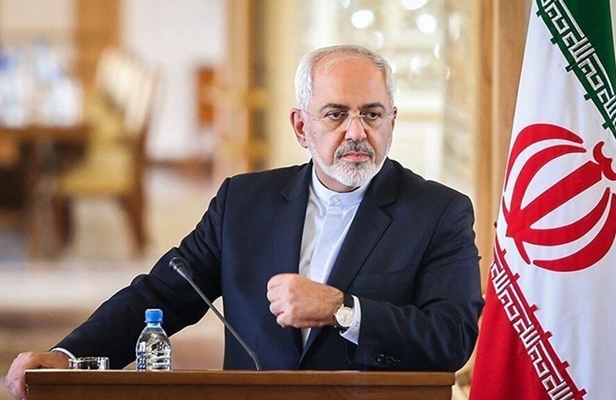
Iranian Foreign Minister Mohammad Javad Zarif on Tuesday held a meeting with his Swedish counterpart Margot Wallström in Stockholm, the second leg of his Scandinavian tour.

The two ministers discussed a broad range of subjects in the meeting, including the bilateral, regional and international issues.

They also exchanged views on the security of the Persian Gulf region, as well as the situation in Yemen and Afghanistan.

Moreover, Zarif and Wallström stressed the need to expedite the implementation of INSTEX (Instrument in Support of Trade Exchanges), a financial mechanism that the three European parties to the 2015 Iran nuclear deal have developed to maintain trade with Tehran.

The top Iranian diplomat further held a meeting with Sweden’s Minister for Foreign Trade Ann Linde, who is in charge of Iran-Sweden joint economic commission.

Iran, Sweden Discuss Persian Gulf SecurityZarif also had another meeting with former Swedish prime minister, Carl Bildt, known as an influential European figure.

The Iranian foreign minister arrived in Stockholm on Monday night in the second leg of a tour of Scandinavia that took him earlier to Finland. He is scheduled to visit Norway afterwards.

Iran, Sweden Discuss Persian Gulf Security

In Memory of Ali Golshan: An Iconic Iranian Photographer

• A photo of the main mansion of Shazdeh Mahan Garden taken by Ali Golshan in 1941 and a new photo of the building taken in 2019

Ali Golshan was born in the city of Kerman in south-central Iranian Kerman province in 1921.

He established the Golshan photography shop in 1937. The photos taken by him and left behind show he would use a certain method in preparing photography chemicals in order to get the best results. To develop better-quality pictures, Ali Golshan would always use the latest equipment such as the first chemical photocopier, the first printer, and the first automatic photo developing machine in the atelier of his photography shop. He also had many photography students.

He died of cancer in 1979 after years of offering services and taking memorable photos of people, urban locations and historical monuments of Kerman. Some of the photos he took during his lifetime are published below in remembrance of the late veteran photographer, also marking World Photography Day (August 19).

Many Iranian Students Studying Abroad Back Home: VP

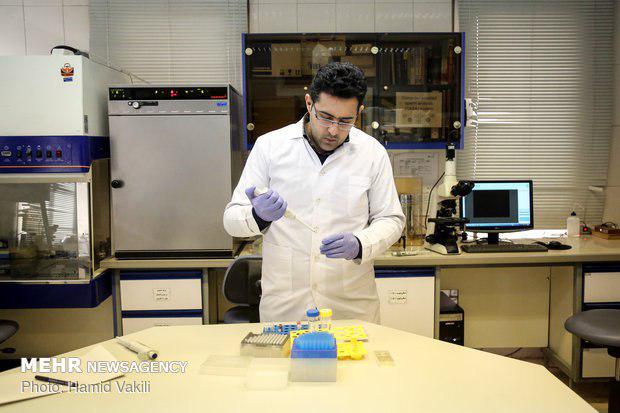
Over 5,300 Iranian Knowledge-Based Firms Opened in 6 Years: VP

Vice President for Science and Technology Sorena Sattari made the comment while criticizing some figures about the brain drain in Iran and the migration of the elite from the country.

“We are trying to base the country’s economy on manpower. Accordingly, [it is noteworthy that] more than 130 Iranian students studying at 100 top universities around the world returned home in the four months to August, 2019, and it is estimated that more than a thousand such individuals will return home by late March, 2020,” the vice president told ISNA.

He said the fact that some elite Iranian students are studying abroad should be regarded as “brain circulation,” not brain drain.

“Only 50,000 out of 4 million Iranian students are studying abroad,” he said, adding the figure amounts to 1.1 percent of the whole Iranian students while the global average for the percentage of students in other countries studying overseas is 3 percent.

“More than 30 percent of students of Arab countries in the region are studying abroad,” he added.

He further denied statistics allegedly published by the International Monetary Fund (IMF) which put Iran in the first rank in 2009 as far as brain drain is concerned.

“These statistics have been published while there is no such report at all,” he said.

Sattari then said around 12,000 Iranian students are currently studying in the United States.

“On websites, there are some statistics about the migration of elite individuals. I’m not a pessimistic person, but wrong figures are published in this regard with certain intentions,” he added.

The official also said 25 percent of the Iranian students who have returned from abroad have been employed at universities as faculty members or at other scientific circles.

“The remaining 75 percent either began to work at companies or started their own business by establishing start-ups or knowledge-based companies,” he said.

Iranian Judiciary Chief Urges Compensation for Supertanker’s Detention

US Protests to Engulf Entire America: Iran's Top Judge

In comments on Monday, Raeisi described the government of Gibraltar’s decision to release Iran’s supertanker Adrian Darya, formerly known as Grace-1, as a testimony to the defeat of Iran’s enemies.

“Such length of detention (of Iran’s tanker) would not be simply made up for with its release, rather, compensation must be received with legal proceedings, so that it would give a lesson to all those violating international regulations,” the top Iranian judge noted.
The Iranian supertanker has been released by the government of Gibraltar more than a month after it had been captured by the British Royal Navy on suspicion of attempting to breach global sanctions against Syria.

Gibraltar on Sunday rejected a US request to continue holding the Iranian supertanker. The ship, containing more than 2 million gallons of Iranian light crude oil, was seized on July 4 in a British Royal Navy operation off the coast of Gibraltar.

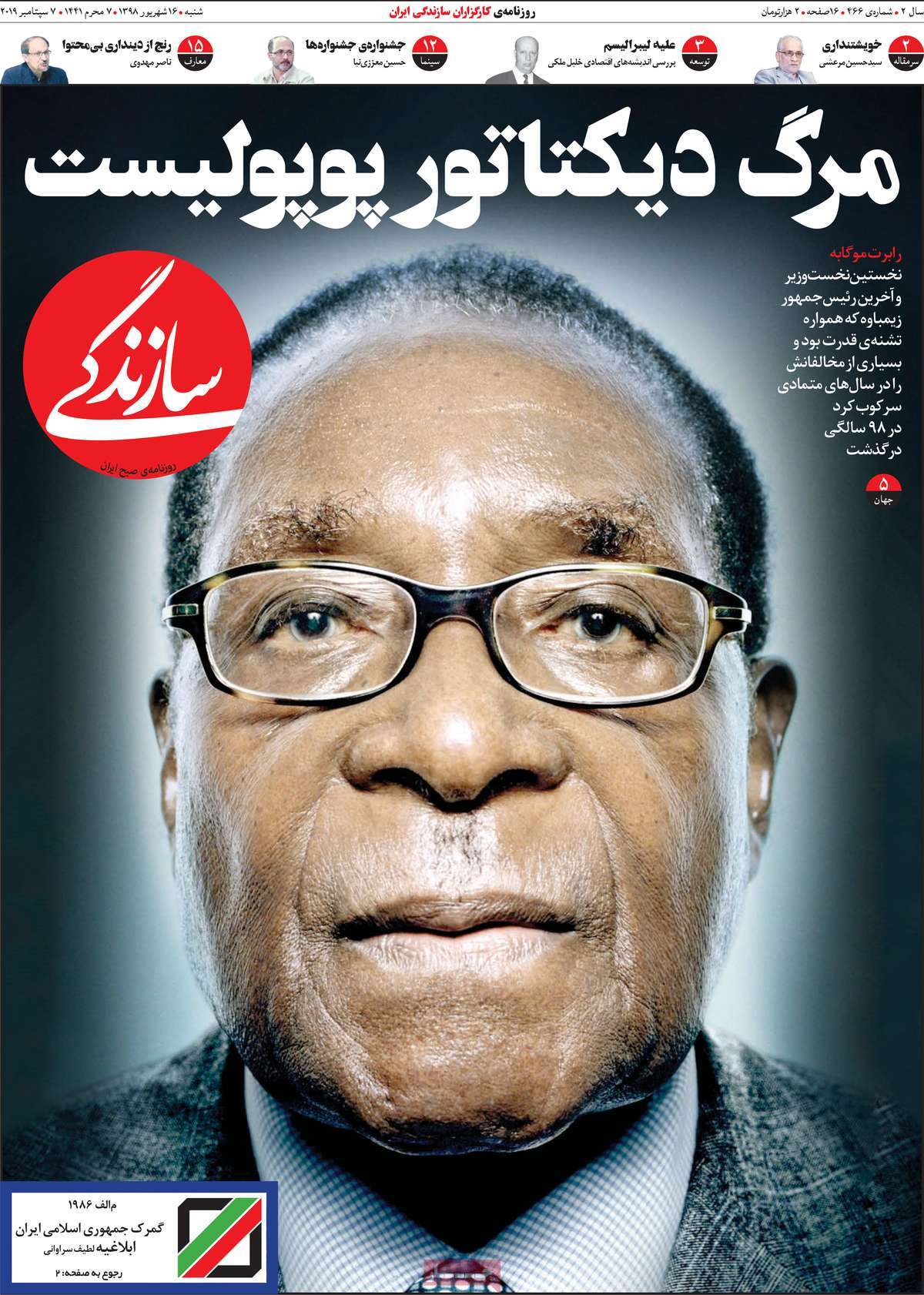
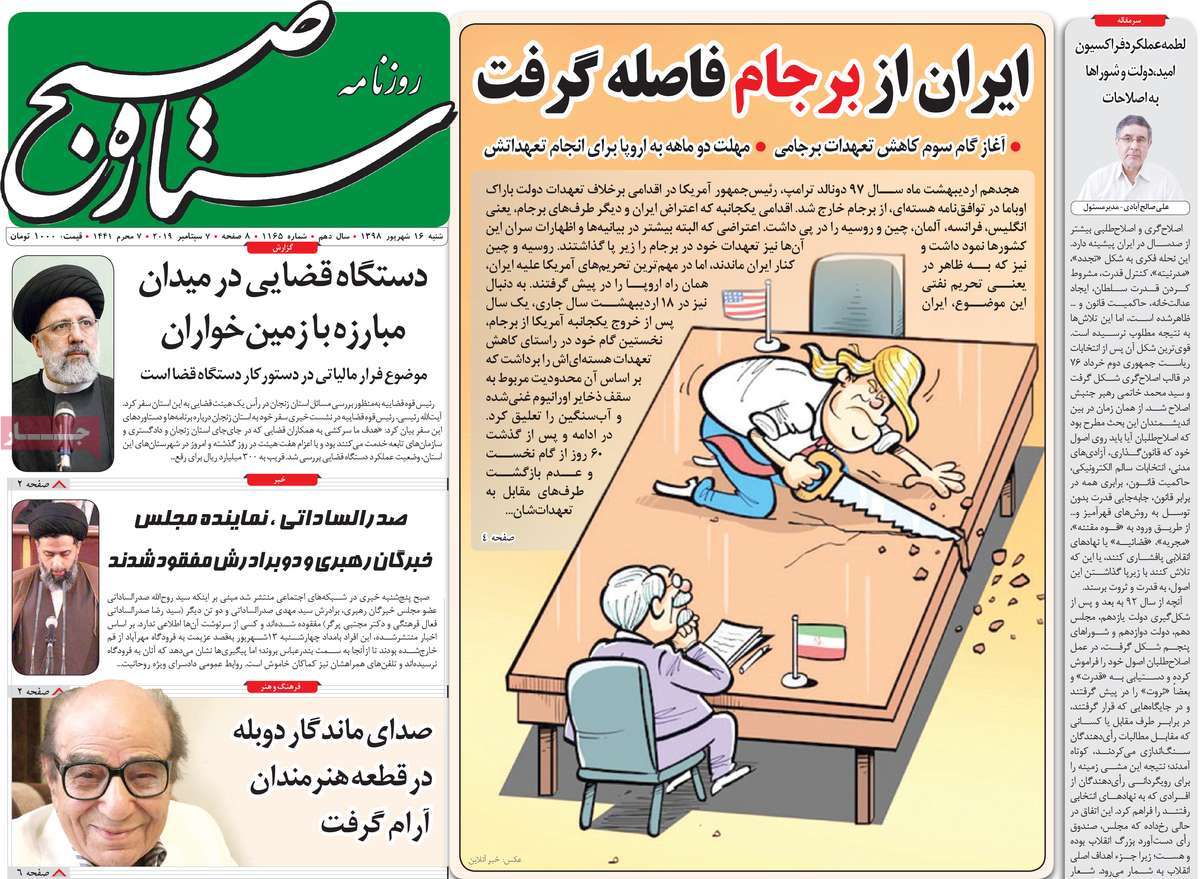
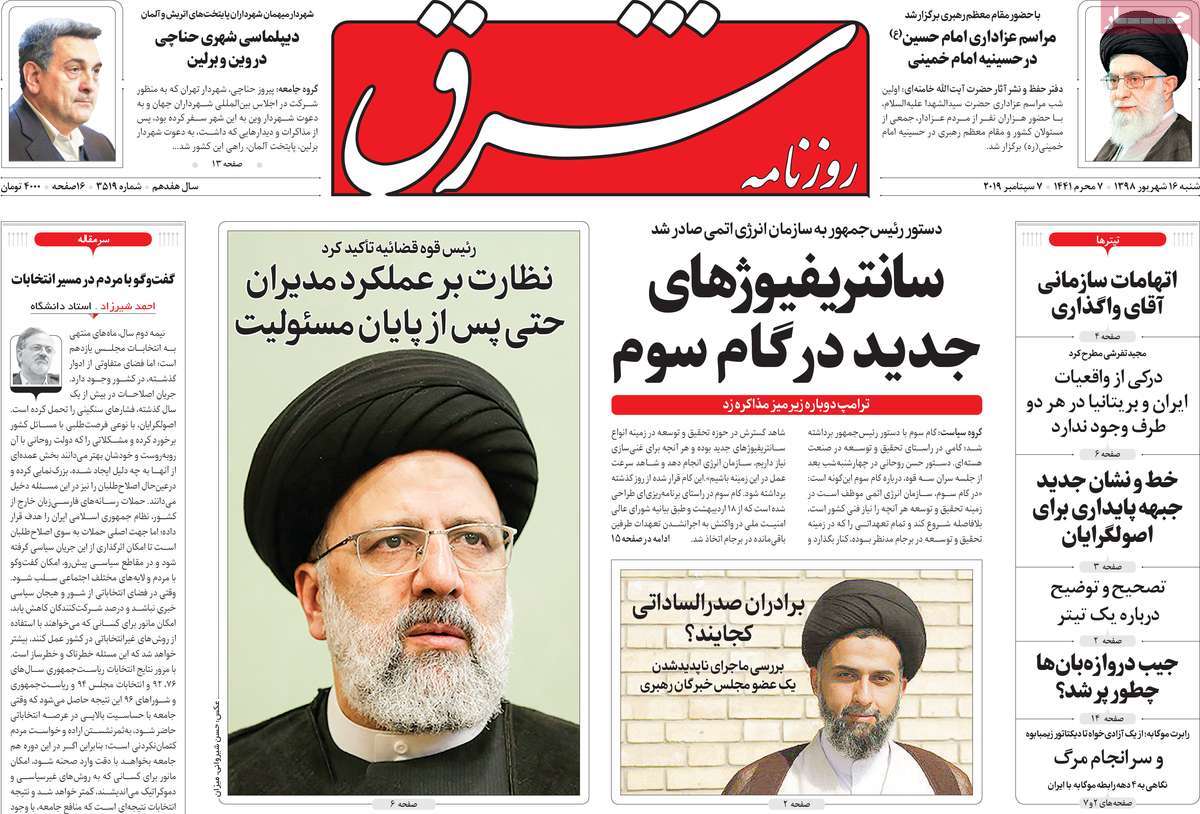
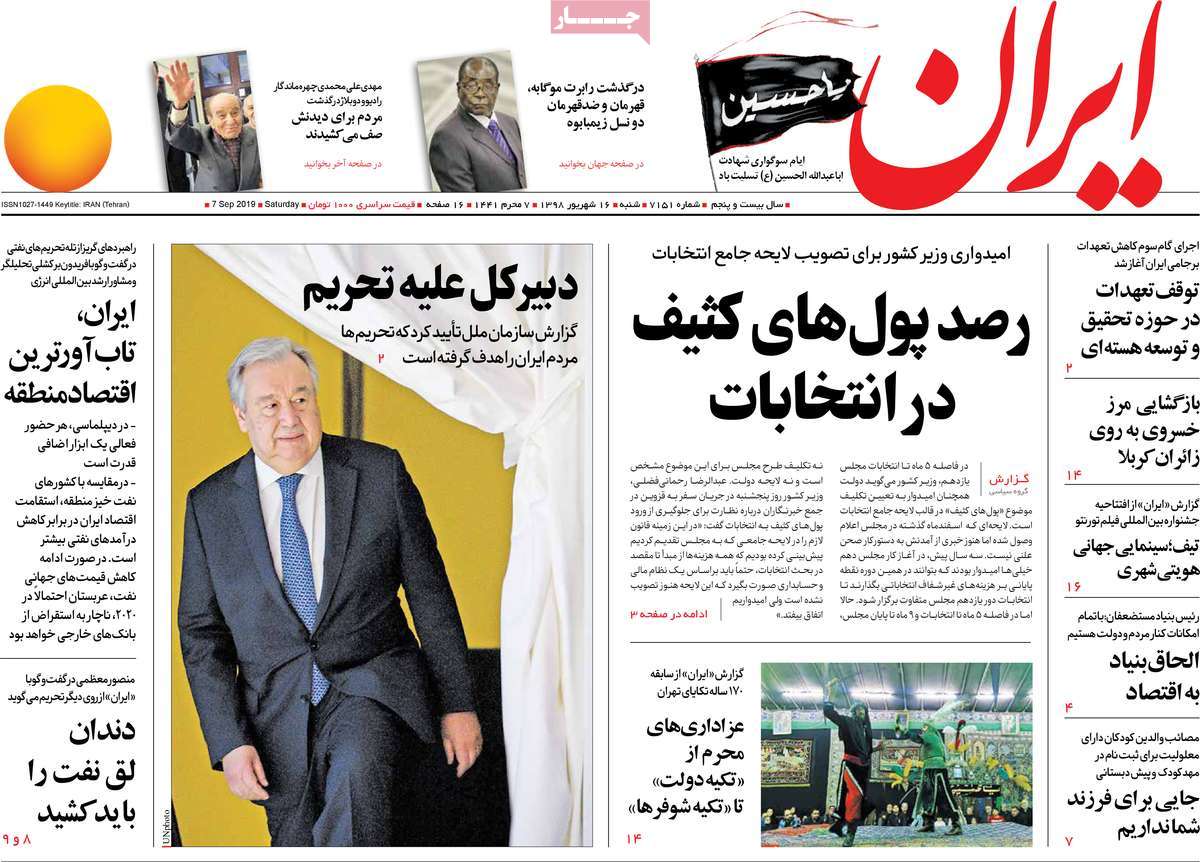
A Look at Iranian Newspaper Front Pages on August 19

A Look at Iranian Newspaper Front Pages on November 19

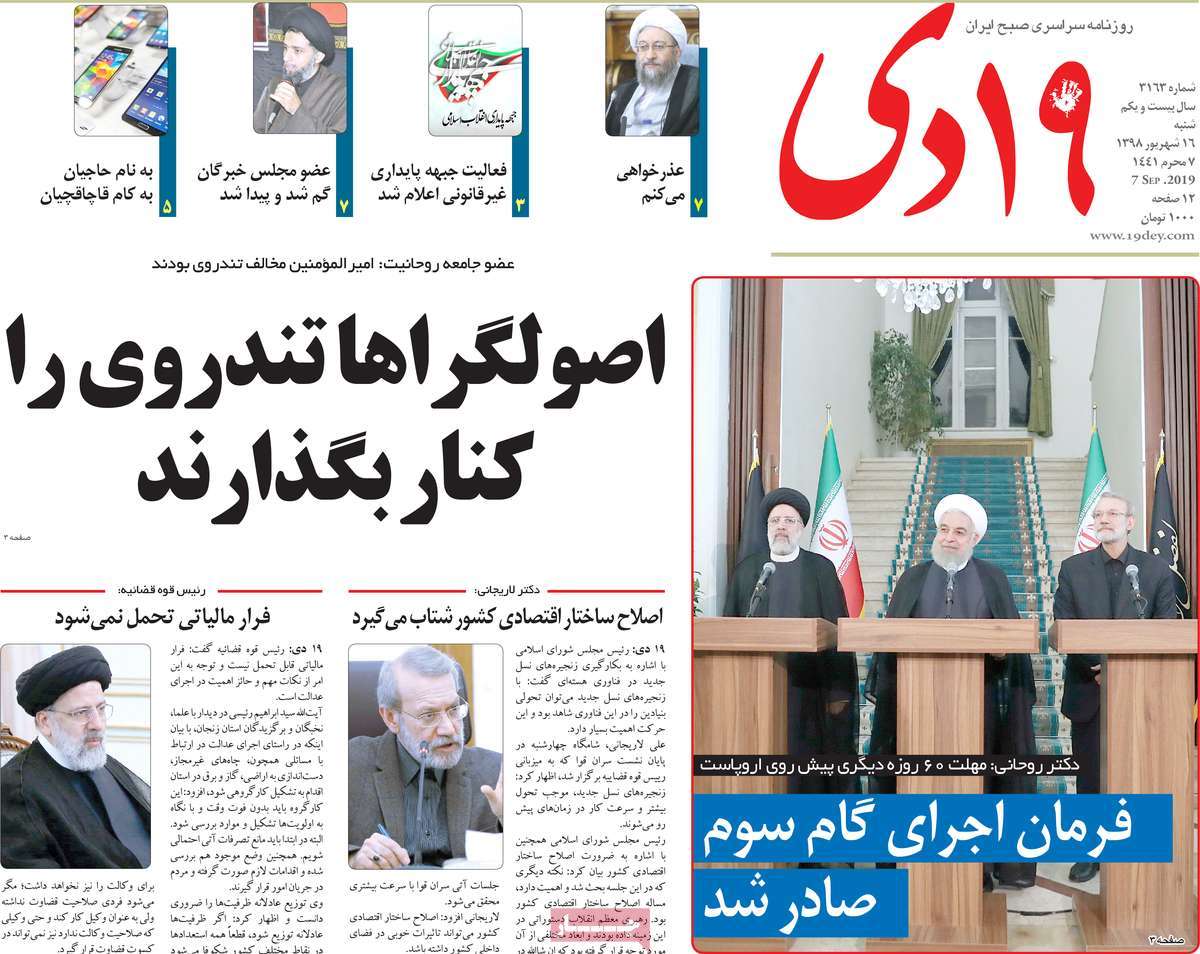
19 Dey:

1. “We’ll Remain and Outsiders Are Doomed to Leave”, Zarif Tells Senior Kuwaiti Officials
2. Rouhani: Iran Resolved to Strengthen Very Close and Cordial Ties with Italy
A Look at Iranian Newspaper Front Pages on August 19


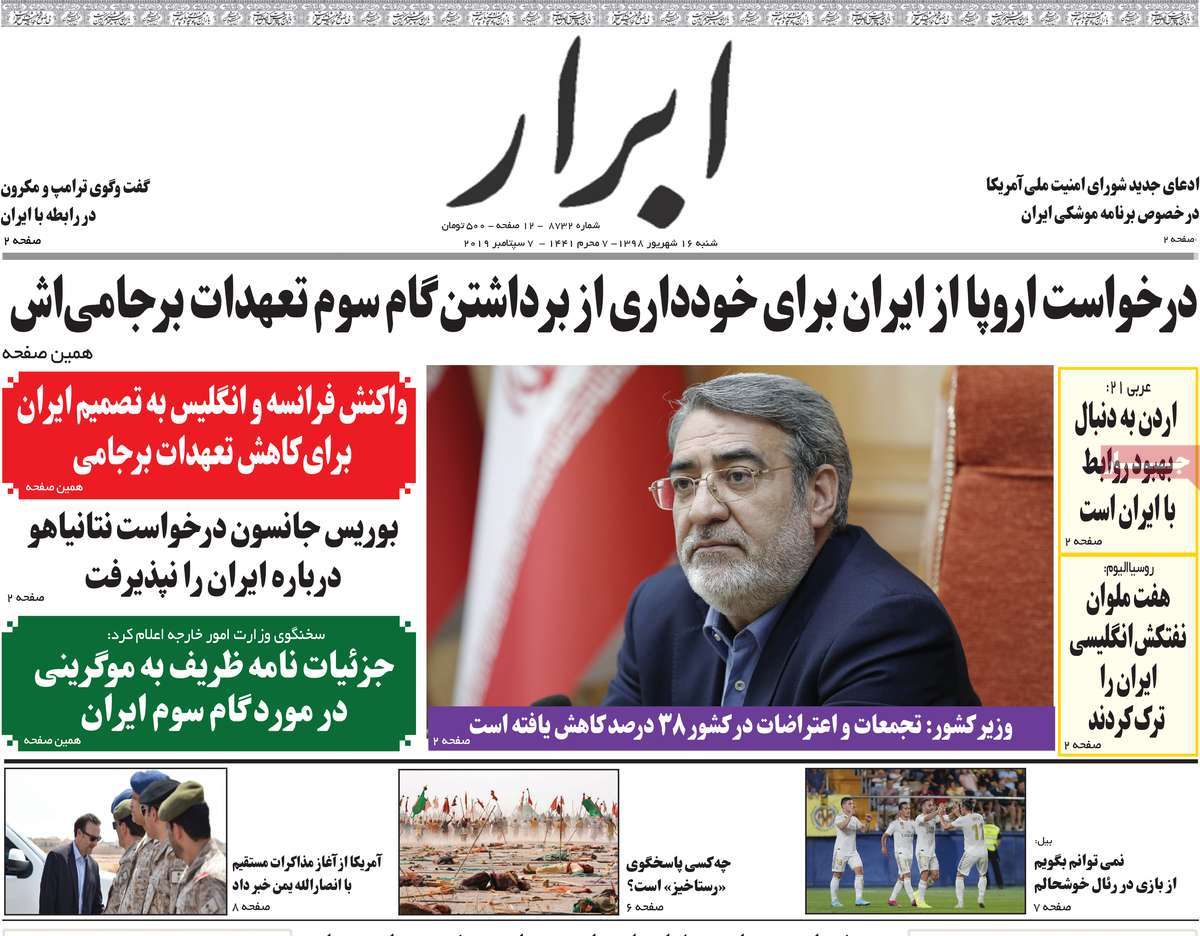
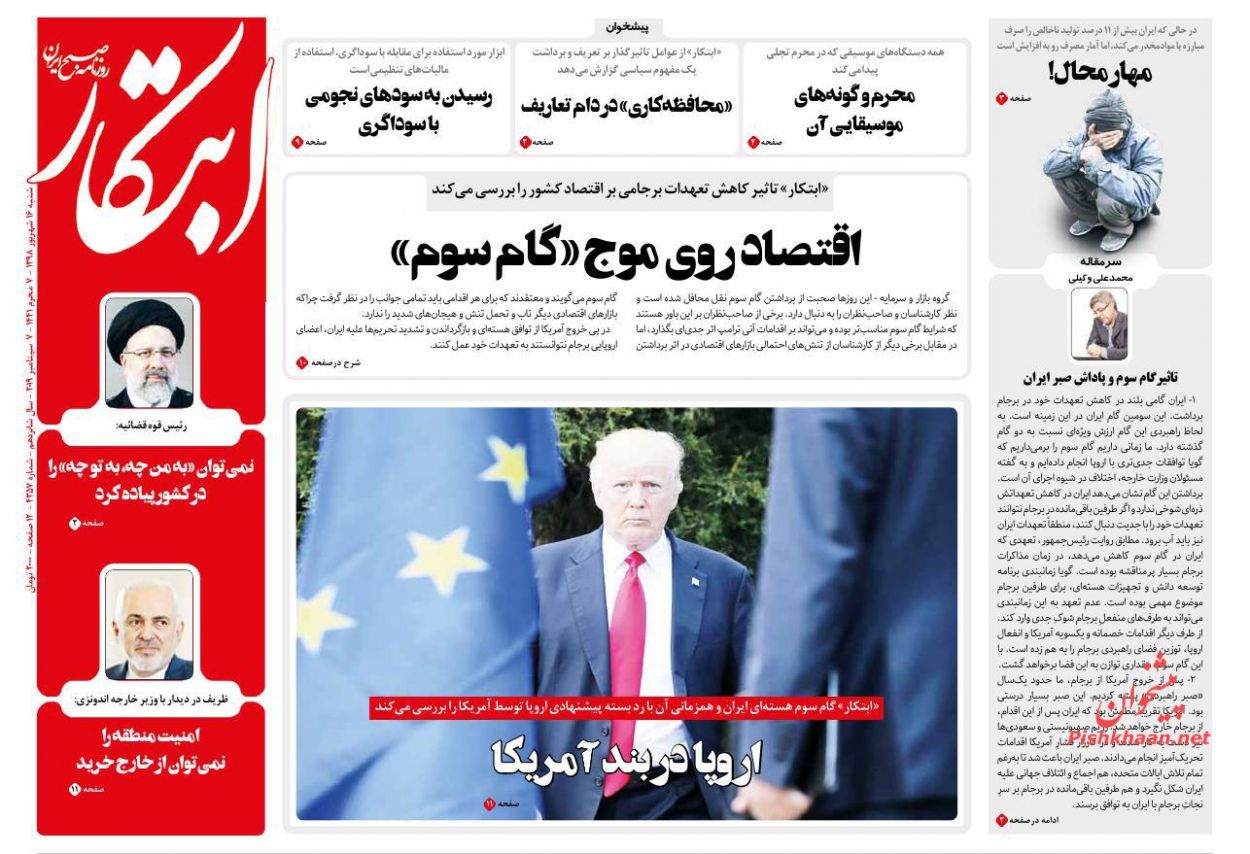
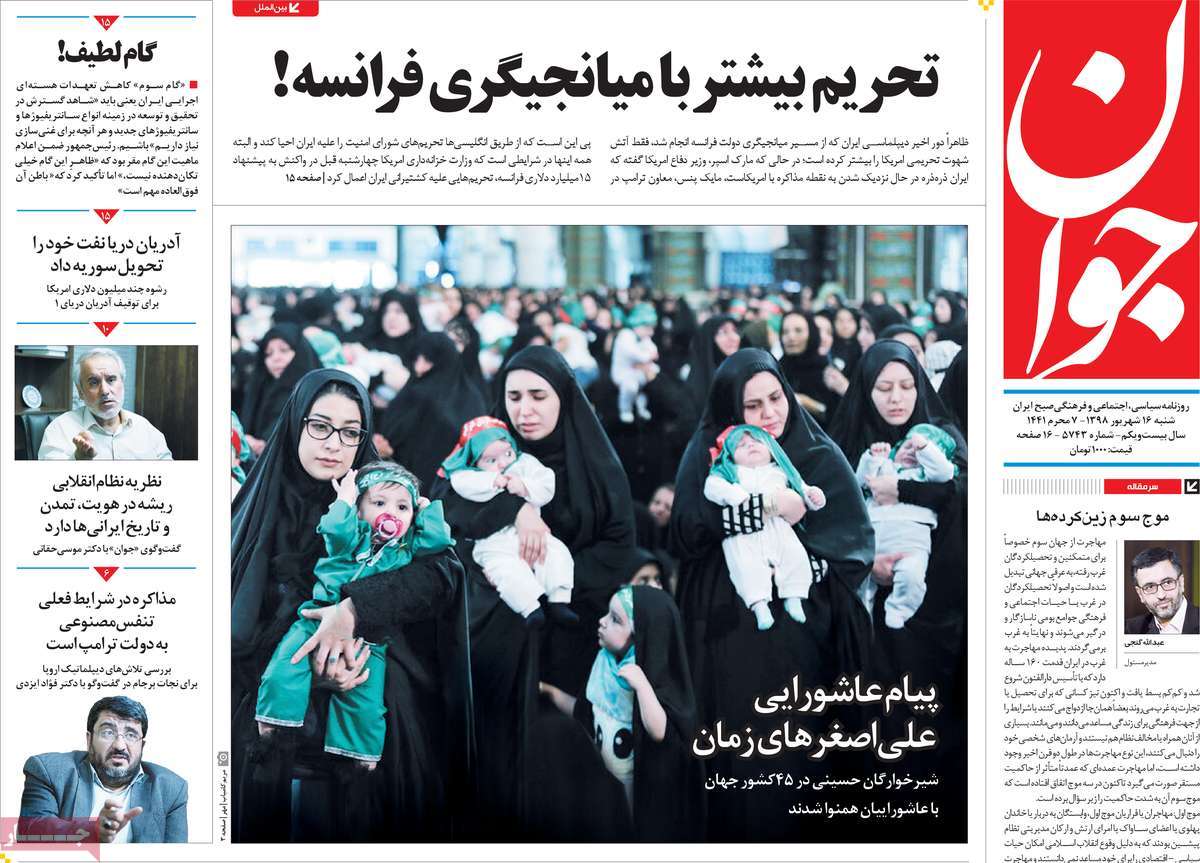
Abrar:

1. Johnson: UK Parliament Cannot Stop Brexit
2. IRGC Navy Commander: Iran Flag-Bearer of Security in Persian Gulf, Sea of Oman
3. President Rouhani Invited to Attend D-8 Summit
A Look at Iranian Newspaper Front Pages on August 19


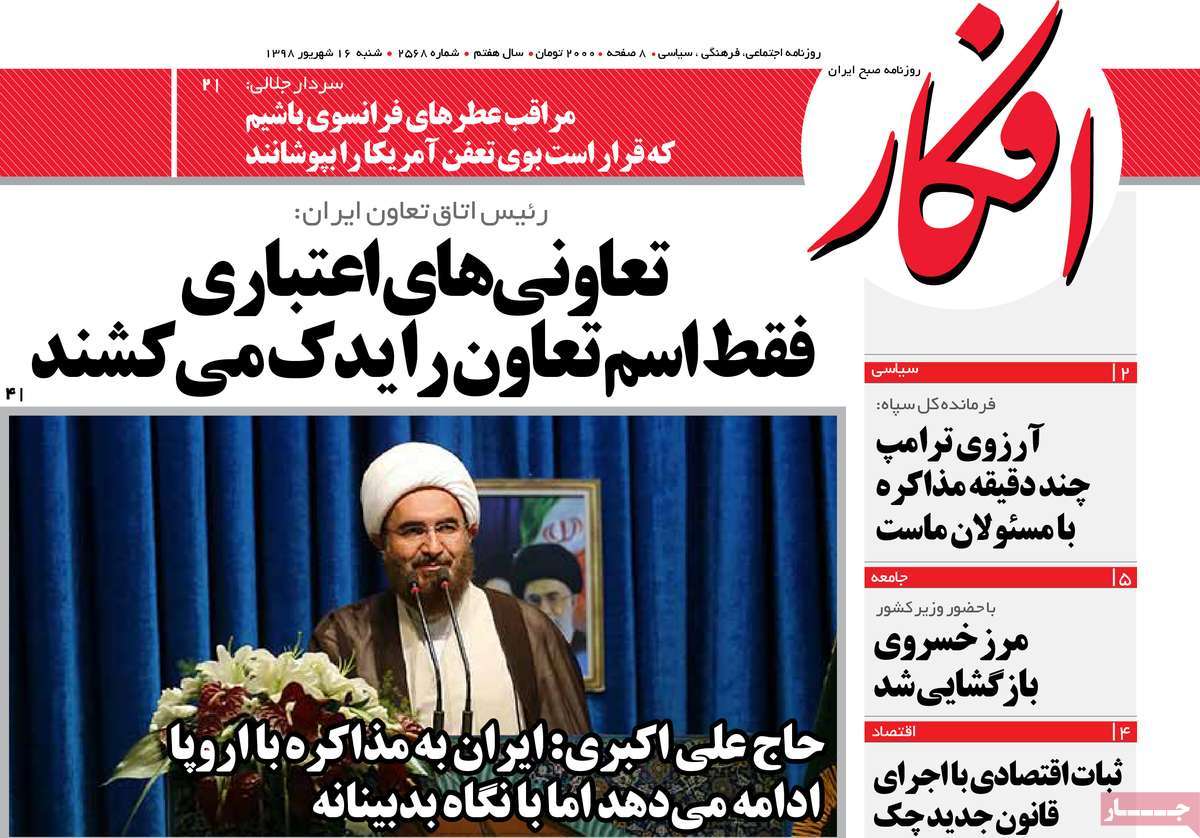
Afkar:

1. Iran Has Assembled Some Twenty IR-6 Centrifuges in New Factory, Salehi Says about the 3rd Step
A Look at Iranian Newspaper Front Pages on August 19


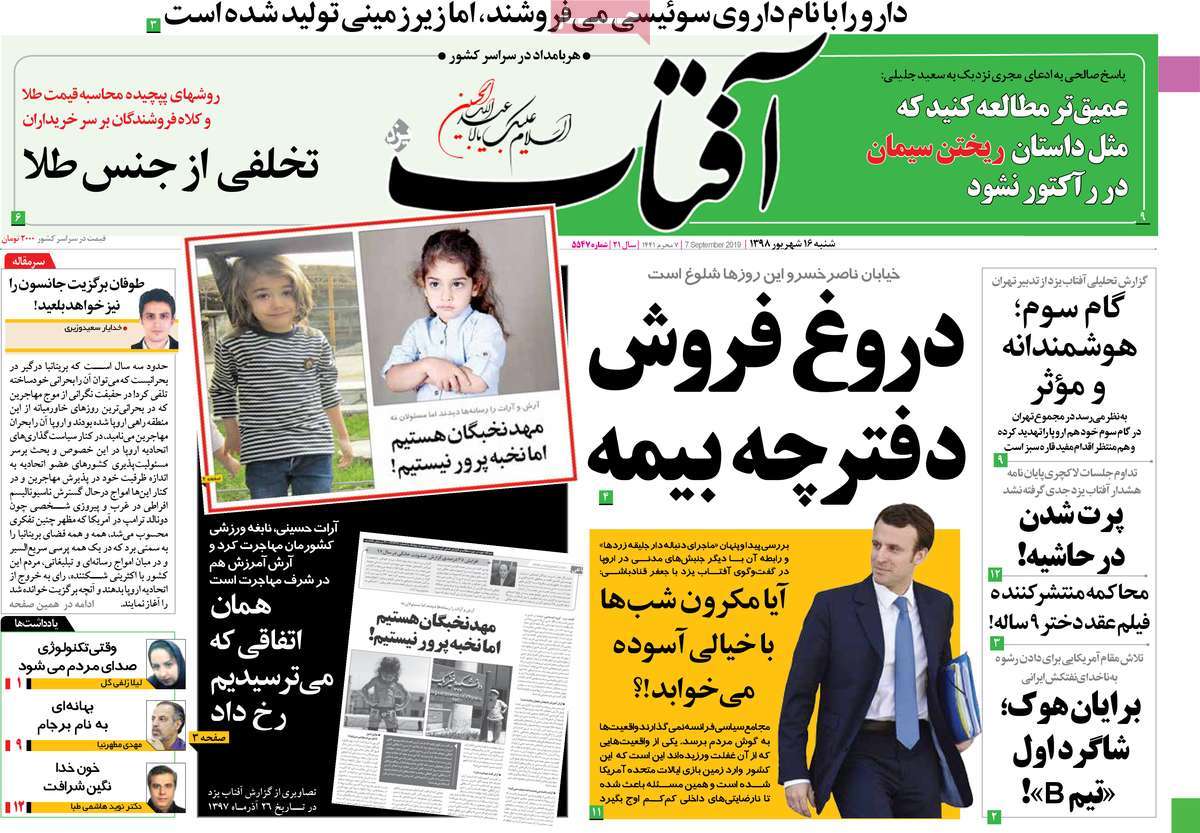
Aftab-e-Yazd:

1. “Iran Can Be the Most Influential Mediator in Kashmir Crisis,” Pir Mohammad Mulla Zehi Says in An Interview with Aftab in Response to the International Organizations’ Silence
A Look at Iranian Newspaper Front Pages on August 19


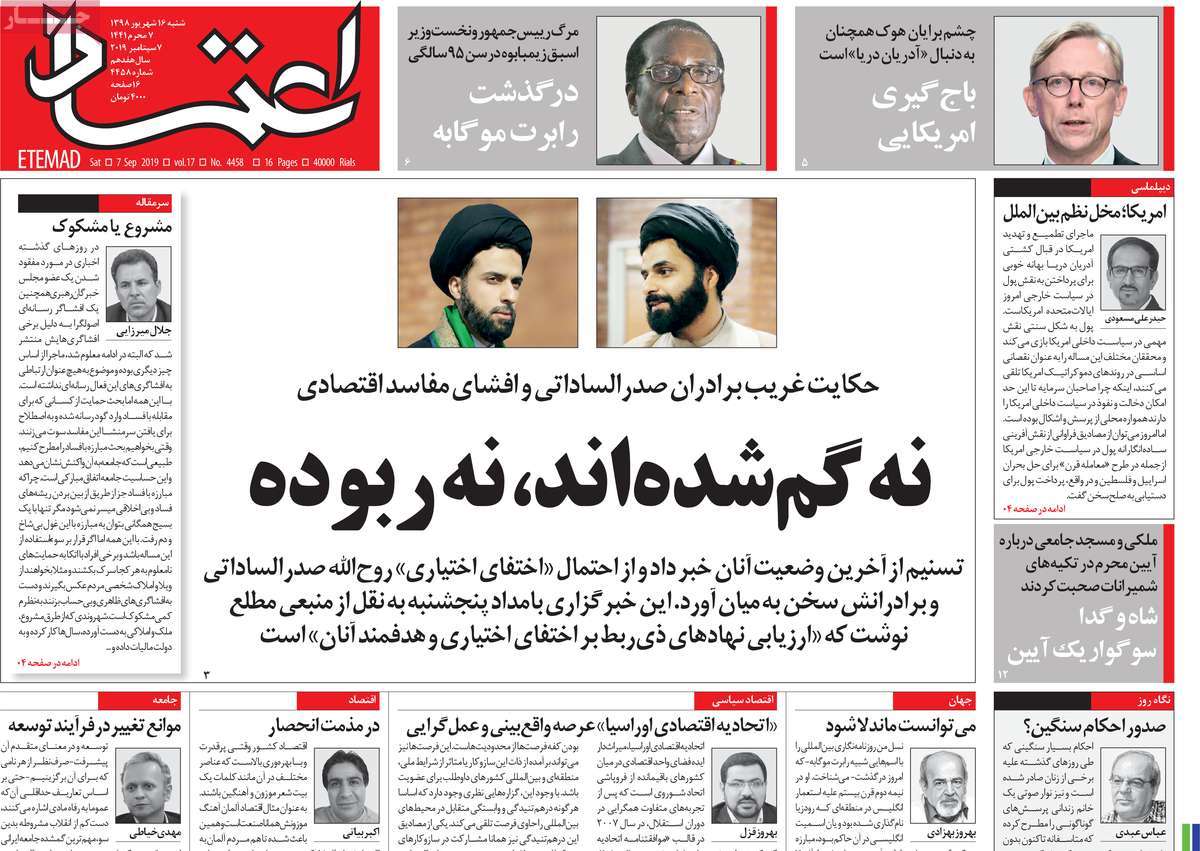
Etemad:

1. Iran’s Active Diplomacy, from Persian Gulf to Scandinavia
A Look at Iranian Newspaper Front Pages on August 19


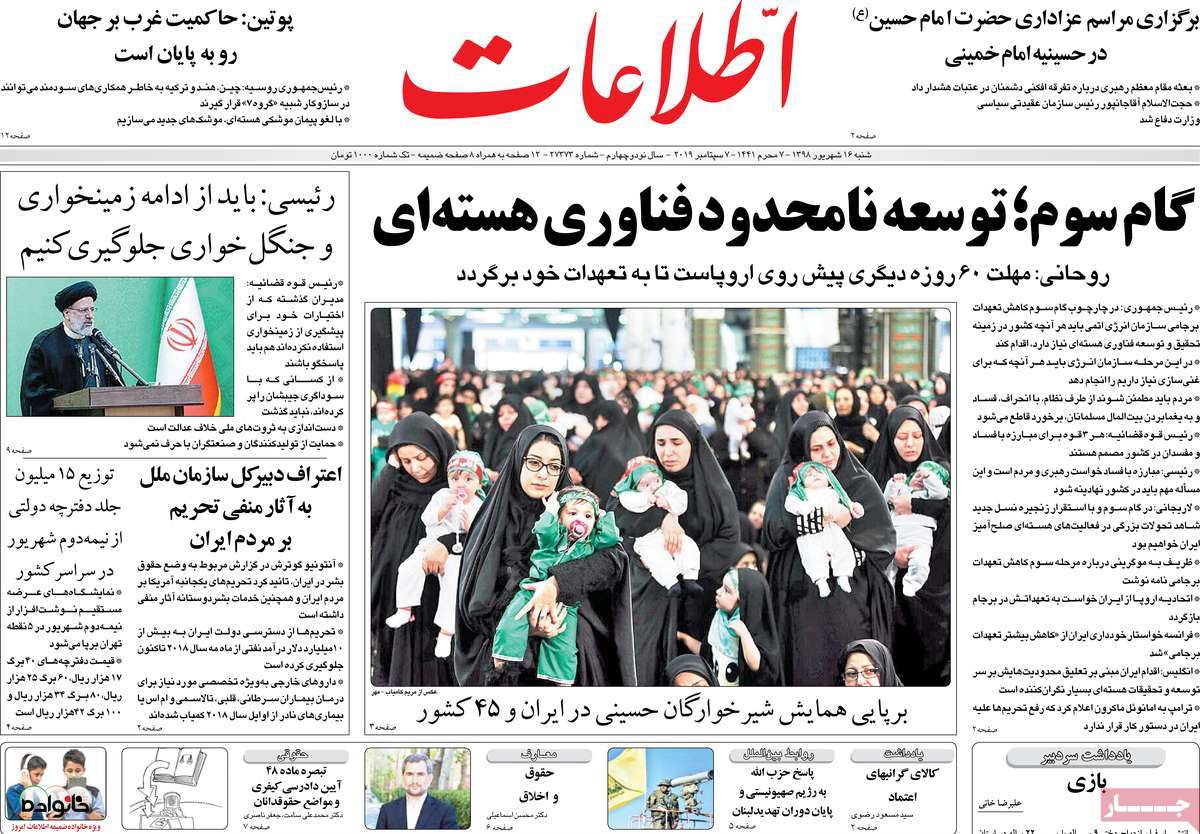
Ettela’at:
1. Rouhani: Presence of Foreign Forces in Regional Countries Trouble-Making
2. Iran’s Navy Chief: Interests of Foreign Enemies in Region Within Reach of Our Forces
3. Terrorist Attack on Wedding Kills 63, Wounds 182 in Kabul
A Look at Iranian Newspaper Front Pages on August 19


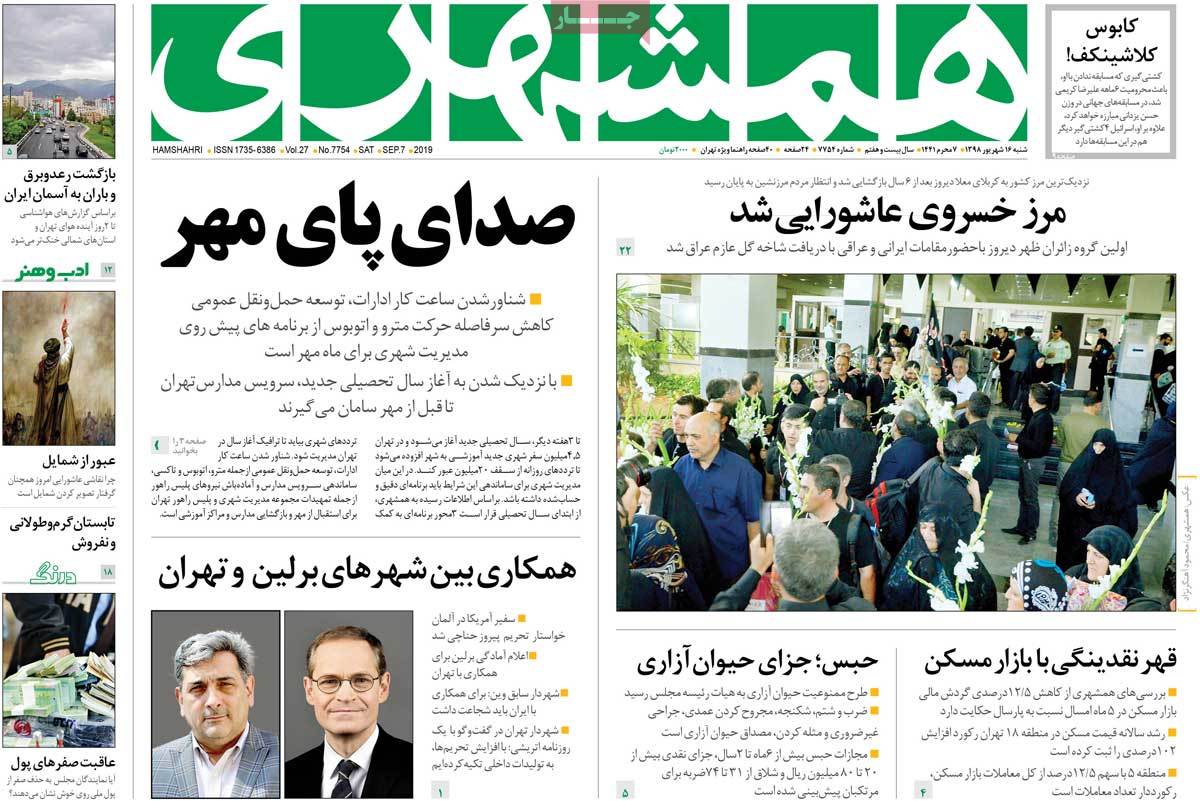
Hamshahri:

1. Tour of Defeat of Sanctions
* Despite US Sanctions, Iran’s Foreign Minister Receives Welcome in Capitals of Arab, European States.
* Zarif Goes to Kuwait after Qatar, Proposes Idea of Non-Aggression Pact.

2. Leader’s Gift for People of Tehran on Eid
* Pirooz Hanachi: Tehran’s Chaharbagh Is A Gift from the Leader for People, Whose Construction Has Begun on Eve of Eid al-Ghadir
A Look at Iranian Newspaper Front Pages on August 19


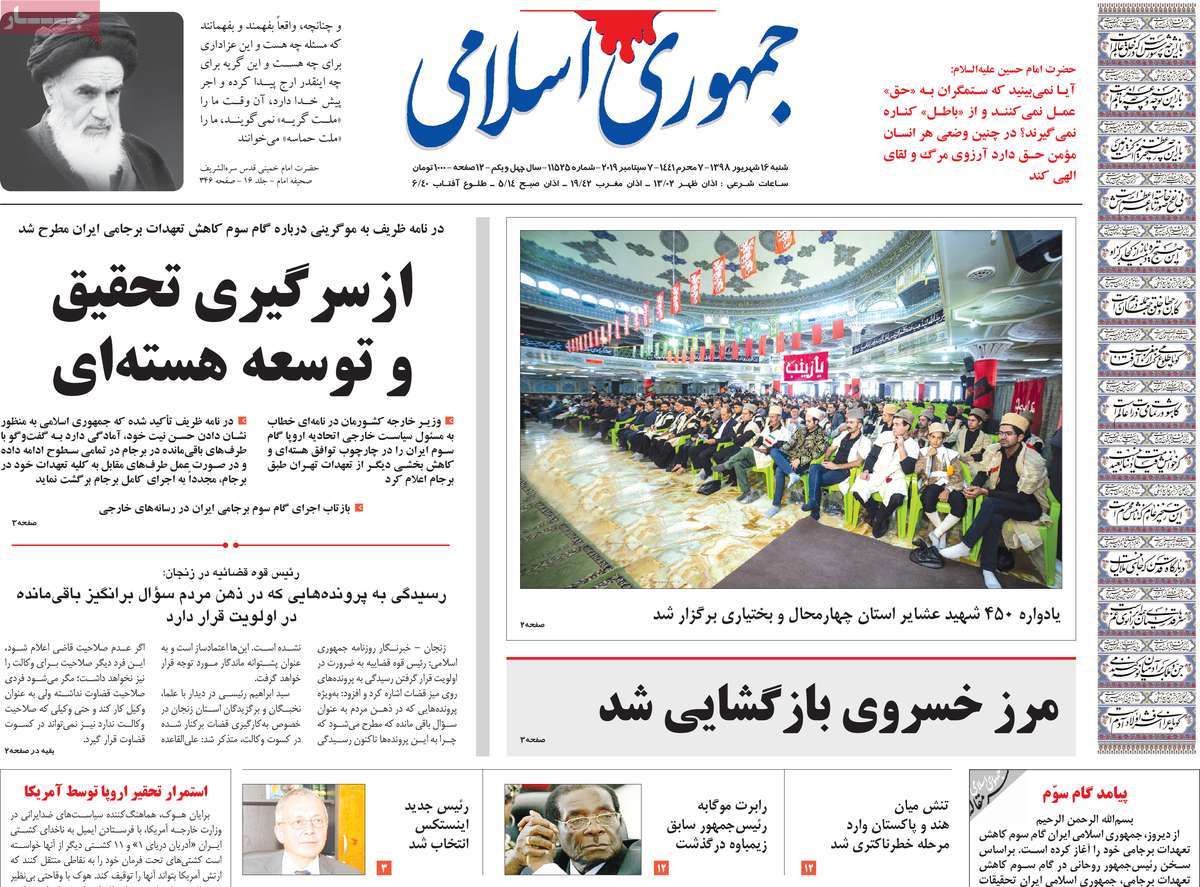
Jomhouri Eslami:
1. Head of Iran’s Atomic Energy Organization: Iran’s Enrichment Hits 370 kg
2. Trump’s Ex-Advisor: Trump to Walk Away from Election Race
A Look at Iranian Newspaper Front Pages on August 19


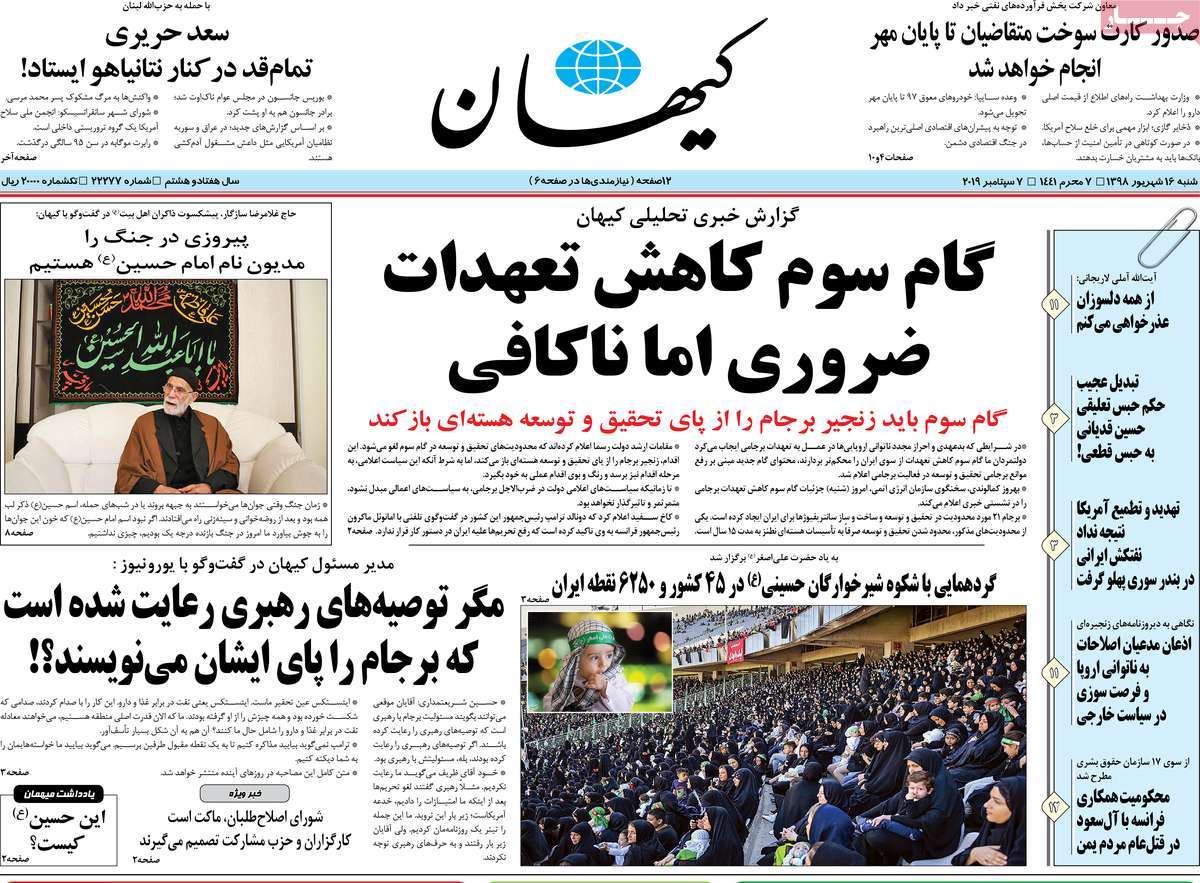
Kayhan:
1. The Entrepreneurs Who Defeated Sanctions / Existing Problems Have Local Solutions
2. First Residential Complex Project for Flood-Hit Residents of Simorgh Region Inaugurated with ICF Modern Technology
3. Road Minister: Repair Work on Ships Thrives Unprecedentedly with Local Potential
A Look at Iranian Newspaper Front Pages on August 19


Shahrvand:
1. Critics Comment on Selection of “Finding Farideh” as Iran’s Candidate in Oscars

A Look at Iranian Newspaper Front Pages on August 19


Sobh-e No:
1. The Plan that Ends Foreign Presence in Region
* Zarif Holds Talks with Kuwait on “Non-Aggression Pact”
A Look at Iranian Newspaper Front Pages on August 19

Finland Eyes Closer Trade Ties with Iran

In a Monday meeting with Iranian Foreign Minister Mohammad Javad Zarif in Helsinki, Finland’s Minister for Development Cooperation and Foreign Trade Ville Skinnari described his country’s rotating presidency of the European Union as an opportunity for the expansion of business and economic cooperation between Iran and Finland.

“Finland hopes that economic cooperation between the two countries would increase, and we deeply regret that the US has withdrawn from the JCPOA and that it has had consequences for the Iranian people’s lives, and are worried about the escalation of tensions; however, Finland’s role as the president of the European Union will be constructive in the reduction of tensions,” Skinnari added.

“There are opportunities and grounds for mutual cooperation between the two countries, as in the ICT sector and academic cooperation, and the prospect of growing bilateral ties through poly-technical cooperation between Iran and Finland is bright,” the Finnish minister noted.

For his part, Zarif said Finland’s rotating presidency of the EU could help implement the 2015 nuclear deal and normalize Iran’s foreign trade relations.

“Also within the framework of the JCPOA, the business people and economic activists have had higher expectations from Europe,” he added.

“The US’ unilateral measures will not be limited to Iran, and have also targeted the other European partners. In order to counter the unilateral measures and mitigate the effects of US economic war against Iran, which affect people directly, there are approaches such as boosting bilateral trade and exercising multilateral interaction in the form of initiatives like the INSTEX,” Zarif stated.
The top Iranian diplomat is in Finland for a tour of Scandinavia that will take him later to Norway and Sweden.
Zarif has already held separate meetings with Finland’s president and foreign minister.
Finland Says EU Defies US Sanctions on Iran through INSTEX

The remarks were made in a Monday meeting with Iranian Foreign Minister Mohammad Javad Zarif in Helsinki.

In the Monday meeting, the two sides conferred on bilateral relations between Iran and Finland as well as the latest regional and international developments.

Zarif and Haavisto particularly discussed the issue of Iranian oil tanker Adrian Darya 1 (formerly Grace 1) and the latest developments related to the Iran nuclear deal (JCPOA), particularly the necessity for the full operation of the Instrument in Support of Trade Exchanges (INSTEX).

They also discussed the security of the Persian Gulf region and Iran’s ideas and initiatives for regional dialogues.

Stressing the necessity for a cognitive transformation in the region, Zarif said Iran has the longest coastline of the Persian Gulf and is highly prepared and has a great capacity for ensuring the region’s security.

The Finnish foreign minister, in turn, said Helsinki and the European Union support the INSTEX financial mechanism despite the US pressures on European companies.

Iran Leader Pardons, Commutes Sentences of Over 1,000 Inmates

Iran Leader Grants Clemency to Large Group of Iranian Inmates

The pardon was granted on Monday upon the proposal of Judiciary Chief Ebrahim Raisi, on the occasion of two Muslim festivals, namely Eid al-Adha and Eid al-Ghadeer.

Eid al-Ghadeer, which will be celebrated in Iran on Tuesday, marks the appointment of the first Shiite Imam, Ali ibn Abi Talib (AS), by Prophet Muhammad (PBUH) as his successor.

Article 110 of the Constitution grants the Leader the right to pardon or reduce the sentences of convicts upon a recommendation from the head of the Judiciary.

The clemency, however, does not apply to several types of convicts, including those who have been sentenced for their role in armed struggle against the country, armed or organized drug trafficking, rape, armed robbery, arms smuggling, abduction, bribery, and embezzlement.