Tuesday, December 23, 2025
Home Blog Page 3074

Curfew in Baghdad Lifted as Life Returns to Normal after Unrest

Reuters reported on Saturday that traffic ran as usual in Baghdad, with streets and main squares being otherwise quite.

Iraqi Prime Minister Adil Abdul-Mahdi had announced the curfew on Thursday.

The country’s National Security Council had issued a statement on Thursday saying that the measure was required to “protect citizens and public and private properties”.

Affirming the demonstrators’ “right to protest”, the council condemned “acts of vandalism that accompanied the protests.”

The curfew came after several days of Iraqi protests against mismanagement and corruption, with certain elements turning to acts of violence.

A number of protesters and security personnel have been killed as a result of the provocations.

On Friday, Iraqi police said in a statement that “unidentified snipers” killed two security forces and two civilians across the capital Baghdad earlier in the day.

Washington’s plan

Arab media outlets and observes have published reports revealing that the US seeks to drive recent anti-corruption protests in Iraq into chaos in a bid to install a pro-US regime.

“Despite the legitimate demands of the Iraqi people in fighting corruption”, recent developments in Iraq have been a “manifestation of an American plot to abuse such grievances,” the Lebanese Arabic-language daily newspaper al-Akhbar reported.

The paper added that Iraqi security officials have uncovered a plan that seeks to provoke major clashes between Iraqi protesters and security forces.

The clashes, hyped with provocative media coverage, are meant to produce a major security vacuum that can set the stage for the emergence of a US-affiliated Iraqi military commander who can take on the leadership role of a “savior government”.

The plan will seek to ultimately strengthen US control over the country.

The report, however, added that the Iraqi government was well aware of the plan and had adopted several policies to counter it.

Security sources speaking to al-Akhbar earlier this year had said that 2019 would be a tense year for the “people of Iraq”.

Writing for the Arabic-language al-Ahd news website, Ali Matar, an analyst in Arab political affairs, said that Washington sought to create insecurity in the country so that Iraq would remain “hostage” to the US in a bit to exploit its resources.

Matar added that Washington sought to revive ISIS Takfiri terror cells and sabotage the protests.

The Arab analyst said that Washington had always sought to undermine Iraq when it was close to attaining certain points of political and economic breakthrough.

Matar highlighted that the tensions came shortly after the Abdul-Mahdi government reopened the country’s Al-Qa’im crossing with Syria and accused Israel of orchestrating a string of recent drone strikes on Iraqi popular mobilization forces.

Abdul-Mahdi had also entered talks with Beijing and Moscow in a bid to acquire air defenses against the attacks, he noted.

The US seeks to “get revenge” from Abdul-Mahdi’s government, he added.

Seyyed Reza Sadr-alhoseini, an Iranian Middle East analyst, also echoed Matar’s analysis.

“The American’s thought that Baghdad would be more cooperative with them. However, the policies of Abdul-Mahdi, the Iraqi parliament and its president did not allow Washington to achieve its goals,” he said.

Hossien Sheikholeslam, another political analyst, highlighted that Iraq’s current troubles are largely rooted in the “corrupt system set up by the Americans in the country following the overthrow of Saddam”.

Sheikholeslam added that current tensions in the country were a product of American plans seeking to weaken “the Resistance”, an alliance that has gradually formed in the region in a bid to counter foreign-backed intervention in the Middle East.

Nearly 19% of State Managerial Posts Run by Women: Iran VP

Massoumeh Ebtekar

Massoumeh Ebtekar said only 13.8 percent of managers at state institutions were women in 2017, but the figure rose to 18.8 percent this year, and will further increase.

“Forty-one percent of civil servants are also women at the moment,” said Ebtekar at a meeting with women managers and entrepreneurs as well as authorities at NGOs for women and family.

She also recalled an order by President Hassan Rouhani to allocate 30 percent of managerial position to women and youth, and said gender equality has always been a key issue in Iranian society.

“Equality has always been part of important issues in our society given our culture and religious beliefs as well as values and ideals set forth by the Islamic Revolution,” she added.

“In addition to economic, social and political dimensions, justice has also another important aspect which has come under the spotlight in religious, revolutionary and the late Imam Khomeini’s points of view, and that is gender equality,” she added.

Ebtekar said the indicators of “gender justice” have been drawn up by the Rouhani administration and announced to relevant institutions.

Here’s Why You Should Always Tell Your Employees They’re Being Monitored

But, employees usually aren’t very happy when it comes to gathering information about their work. In this article, we’ll talk about how to prepare employees for such a thing and how to gain their trust.

Benefits

What we need to discuss first are the benefits which employee monitoring software brings to the company.

The main advantage of such software is that you can monitor your employees and see whether they spend their working hours productively or not. Next, you can also see what kind of sites they visit and how much time they spend on each task. Furthermore, you can categorize sites as productive, unproductive or neutral.

The information you get from such platform is something you can’t gather in any other way. Computer spy monitoring software is really one of a kind and if you look at it the right way, it can become your best friend when it comes to employee evaluation.

Be Specific and Upfront

To avoid paranoia, be specific and clear in identifying what is monitored and why, as well as in explaining how the monitoring will work. Imagine the last time you’ve done something new to you. It wasn’t like standing on the solid ground right? But, when you got familiar with it, it became easier each time you’ve done it.

It’s the same with employee monitoring tools. If you’re transparent with your workers and you establish a clear policy about such tool, it will go a long way toward countering uncomfortable or negative situations.

It goes without saying that you should always have a proper reason for implementing a tracking tool into your business. If you don’t, your employees will ask questions you don’t have an answer to. Why should you even monitor them if they’re doing everything correctly?

Emphasize the benefits of best tracking software for PC and make sure they understand it’s there for their own good, as a tool to improve the way they work.

Working Environment

Since your employees are coming to work every single day, it’s something like their other home. You’re also talking to them on a daily basis and you’ve built a connection which is extremely important for further work.

This is why having a proper reason and telling your employees about employee monitoring builds trust and preserves the relationship you have with them.

Not only they’ll know you won’t do anything behind their backs, but they’ll also feel happy and respected if you advise them when it comes to important decisions like this one.

Leadership and Bigger Picture

Great business leaders know how important it really is to stay at par with the competition and always know their organizations will keep progressing. You need to transfer this mindset to your employees as well. They need to embrace the fact that upgrading the way you work is necessary for progress. And implementing the best PC monitoring software is no different.

You need to look at it as a pitstop for further goals of your business and realize that technology can only help you and make your company better.

Conclusion

Let’s face it, implementing computer monitoring software is a big deal. It’s not like buying a new piece of office furniture or a new printer. You need to be steady with it in order for the implementation to go right.

But, if you are straightforward with your employees about it and you follow some of the tips in this article, you won’t have any issue to use such a software to its full potential.

Iranian Official: Arbaeen Pilgrims Going to Iraq, Full Security Prevails 

In remarks on Saturday, Alireza Rashidian said the recent protests in Iraq have not hampered the dispatch of pilgrims visiting Iraq to pay tribute to Imam Hussein (PBUH).

The Iranian travelers are going to Iraq by plane or via three land border crossings –Shalamche, Chazzabe and Mehran—without any trouble, he added.

Rashidian noted that Iraq has fully ensured security of the pilgrims along the routes to Karbala, stressing that the situation is normal in spite of the wrong reports by the “hostile and Western” media about the recent unrest in Iraq.

He emphasized that the Western media campaign has not had any impact on the Iraqi people’s hospitality during the Arbaeen season.

According to the official, more than two million Iranians have applied to travel to Iraq for Arbaeen as of Saturday.

Last week, Iranian Interior Minister Abdolreza Rahmani Fazli said the number of Iranian pilgrims visiting Iraq for Arbaeen was expected to reach three million.

Arbaeen, one of the largest religious gatherings in the world, comes 40 days after Ashura, the martyrdom anniversary of the third Shiite Imam.

Every year, a huge crowd of Shiites flock to the Iraqi city of Karbala, where the holy shrine of Imam Hussein (PBUH) is located, to perform mourning rites.

Iran Vice President: Women’s Entry into Stadiums A Step Forward

In an interview with Iran daily, Masoumeh Ebtekar said the Iranian women have been finally allowed entry into football stadiums after two years of efforts to prepare the necessary infrastructures.

She said more than 4,000 tickets have been sold to women as of Saturday for Iran’s upcoming match against Cambodia in a home game of the FIFA 2022 qualifying competition, noting that although the number of the seats allocated to women is very low in comparison to the 100,000 seats available at Tehran’s Azadi Stadium, this is yet the result of “very positive steps” that have been taken in recent years.

Ebtekar said the administration has been struggling to fulfill the women’s demands in compliance with the law, religion, and regulations, citing a recently-approved law that allows children with an Iranian mother and a non-Iranian father to obtain the country’s citizenship.

She also called on the spectators and football fans to take the presence of women in the stadiums into consideration, stressing that the sports arenas must be among the healthiest parts of the society.

In September, president of football’s world governing body, FIFA, said his organization has been assured by Iran that women will be allowed to attend men’s football matches from the next international game.

Gianni Infantino said this important move has been long overdue. “We have been assured that as of the next international game of Iran, which is to be played on the 10th of October, women will be allowed to enter football stadiums. This is something very important.”

“Since 40 years this was not happening, with a couple of exceptions. But it is important to move to the next level and to the next stage with, of course, our thoughts to all the women of Iran, but also all the women around the world,” Infantino added.

A Look at Iranian Newspaper Front Pages on October 5

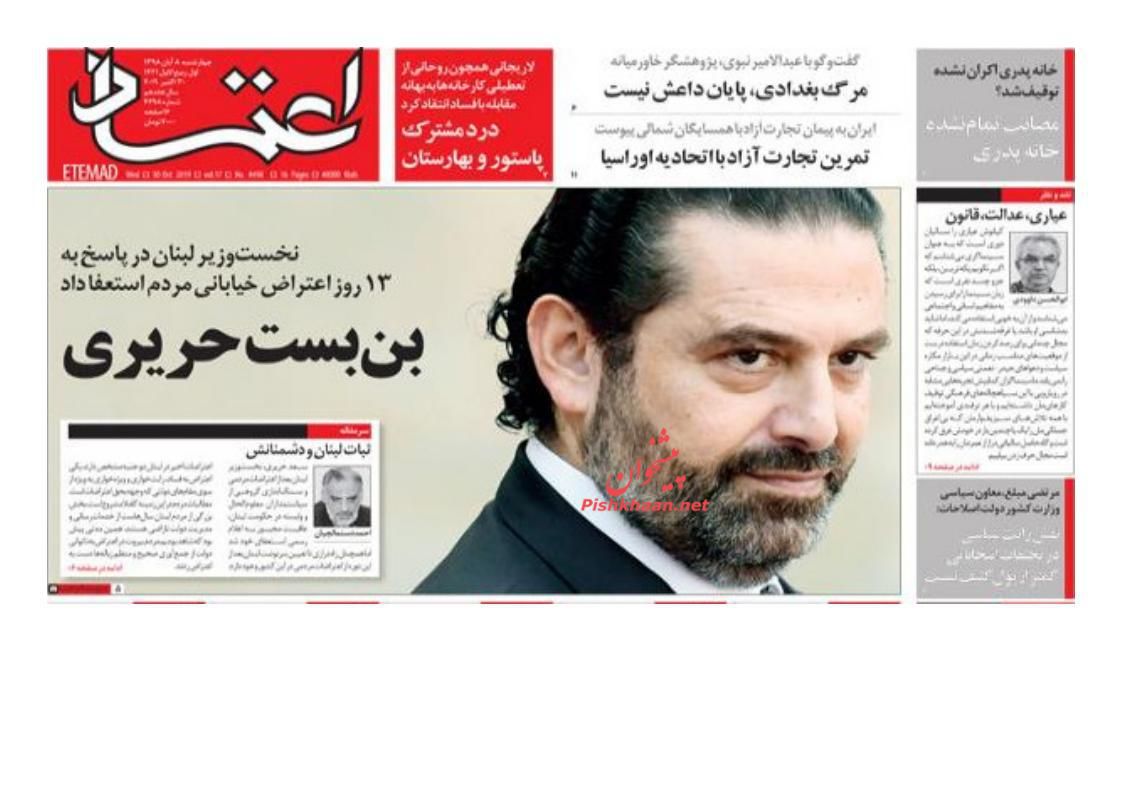
A Look at Iranian Newspaper Front Pages on November 18

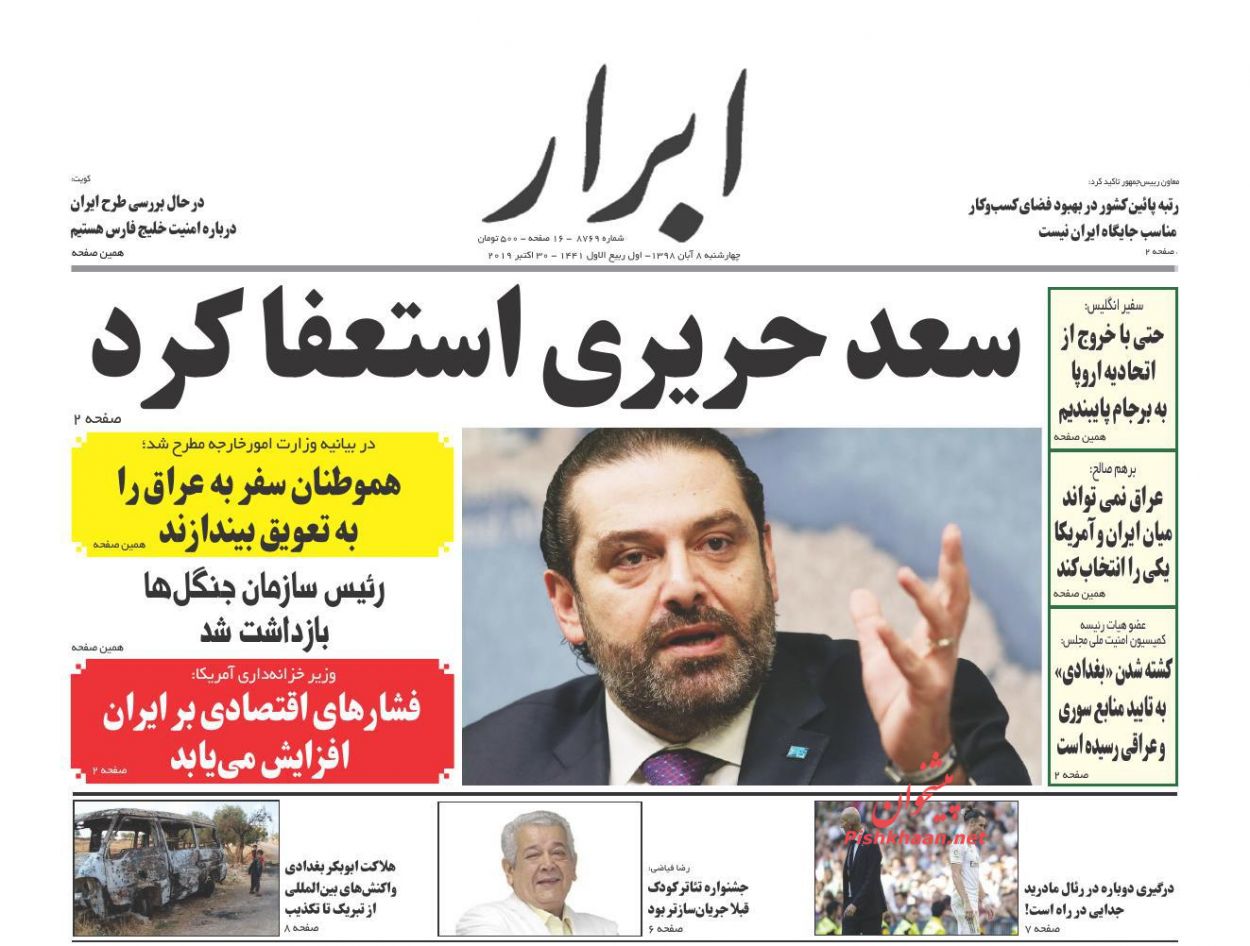
Abrar:

1- Iraq PM: We’ll Meet Legitimate Demands of Iraqi People

2- Putin: We Urge Saudi Arabia, Iran Not to Bring Their Confrontation to Syria

3- Postpone Your Arba’een Trip: Iran Foreign Ministry

A Look at Iranian Newspaper Front Pages on October 5


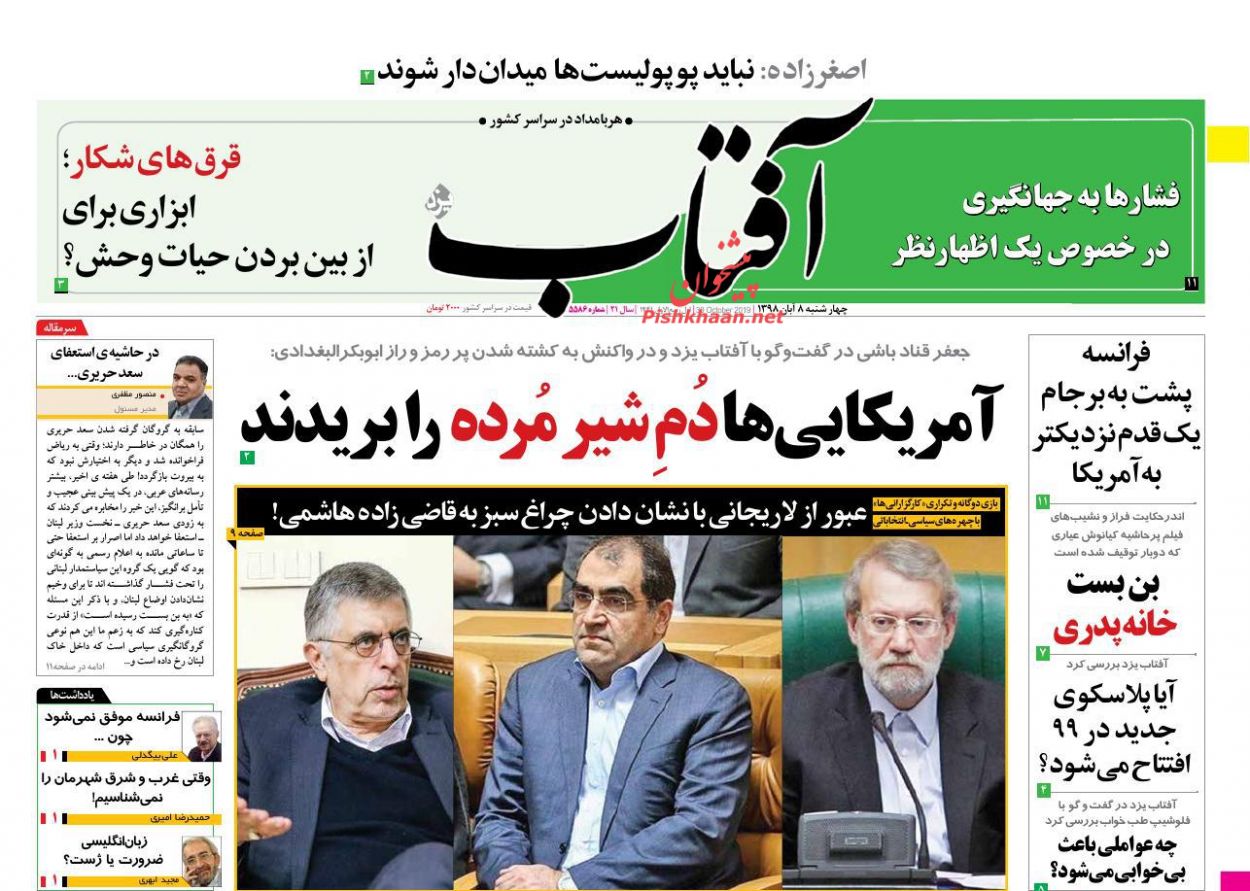
Aftab-e Yazd:

1- Gap of France

* Experts Review France’s One-Month Deadline for Iran-US Talks

2- Ambiguous Epidemic of HIV in Iranian Village

* 26 People Diagnosed with HIV So Far in Chenar-Mahmoudi Village

A Look at Iranian Newspaper Front Pages on October 5


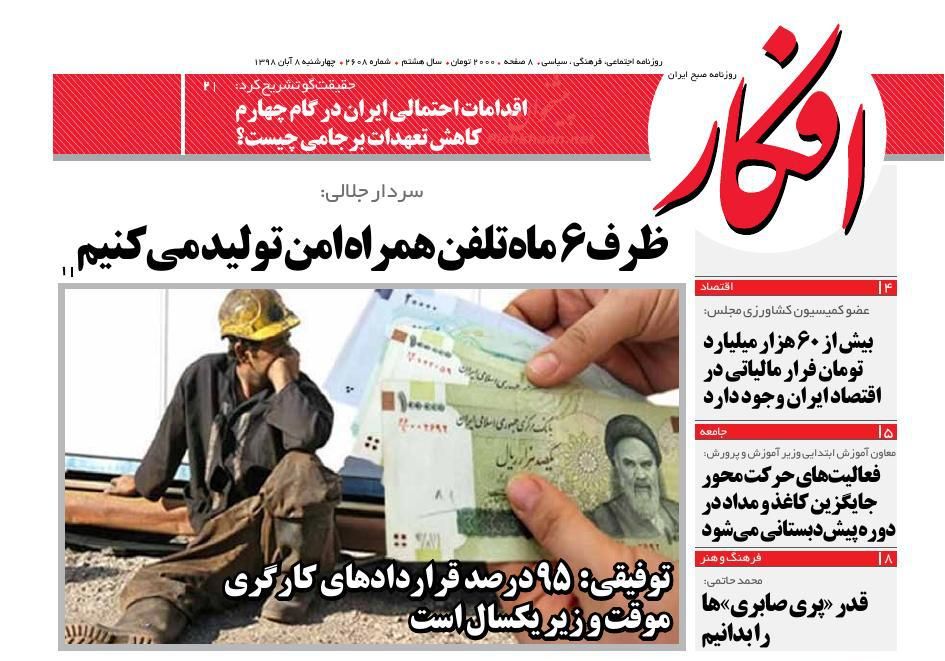
Ebtekar:

1- Iraqi Government’s Incompetent Heritage

2- A Brief Look at Iraq Developments [Editorial]

A Look at Iranian Newspaper Front Pages on October 5


Etemad:

1- Europe Gives in to US’ Unilateralism

2- Celebrating Purple Seats: Women Buy Tickets to Azadi Stadium

3- Realizing Women’s Presence [Editorial]

A Look at Iranian Newspaper Front Pages on October 5


Ettela’at:

1- Iran Leader: Realities of Sacred Defence Shouldn’t Be Forgotten or Denied

2- Arabic-Hebrew Plot to Assassinate General Soleimani Foiled

A Look at Iranian Newspaper Front Pages on October 5


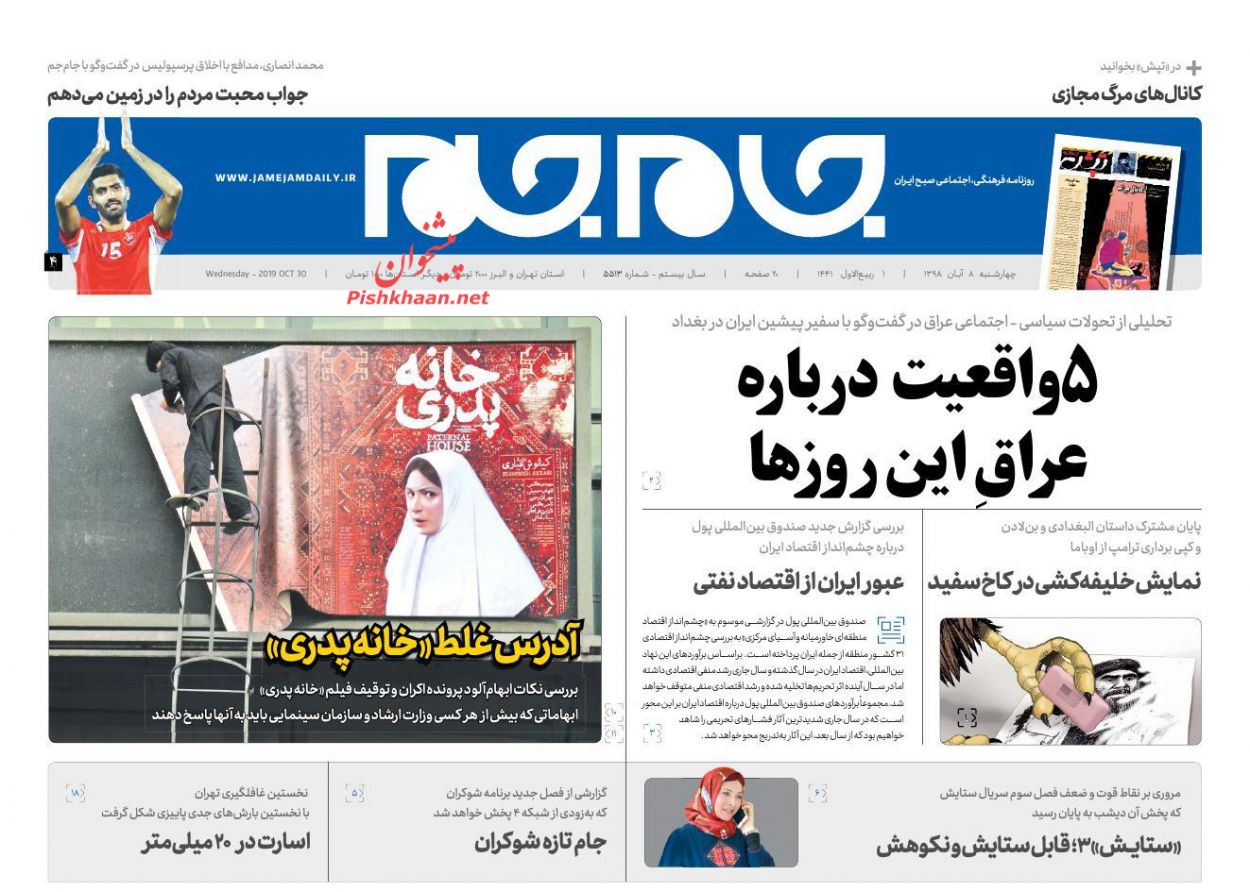
Jame Jam:

1- Saudi Sedition against Arba’een

* A Review of Recent Iraq Developments, Role of Certain Countries in Creating Sedition ahead of Arba’een

A Look at Iranian Newspaper Front Pages on October 5


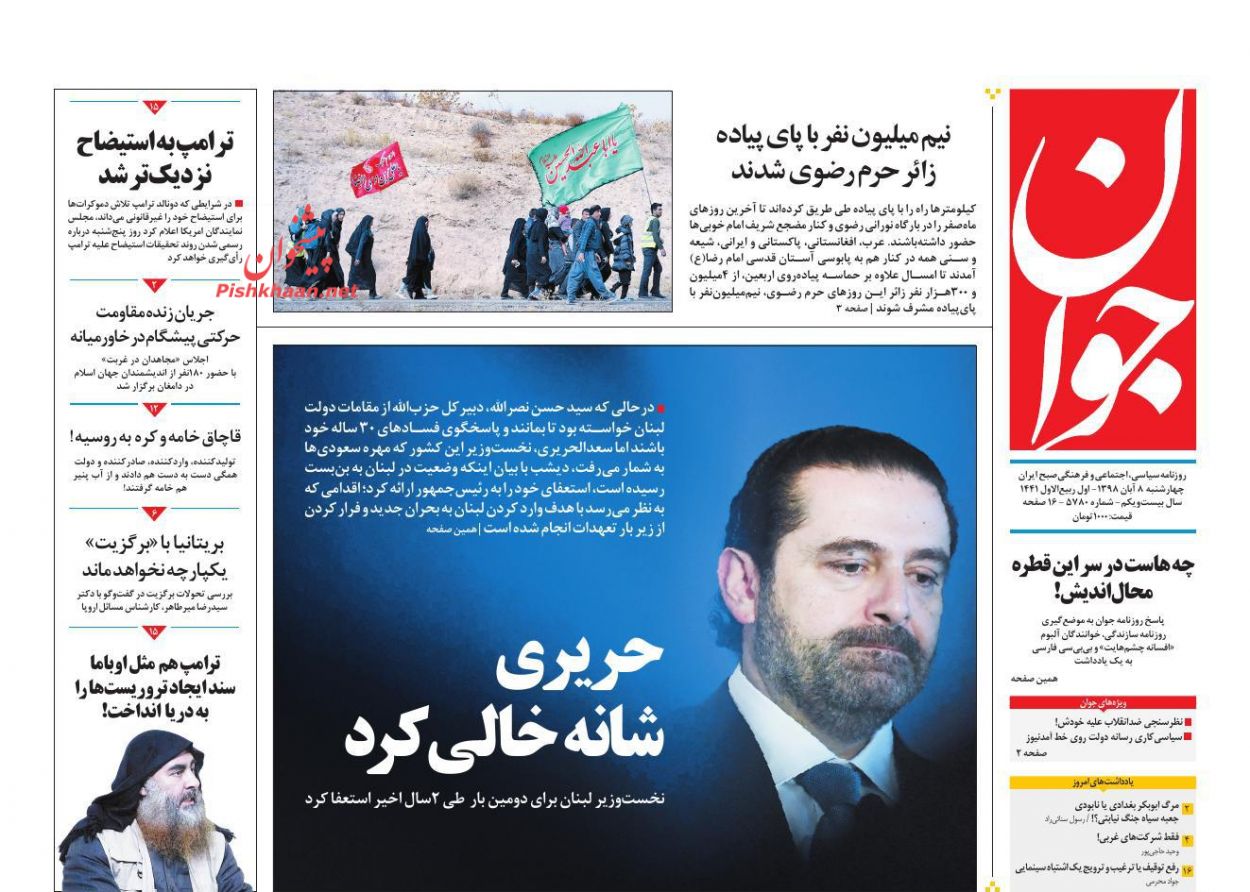
Javan:

1- CNN: US Easily Defeated in War with Iran

2- Over 2 Million People Register for Arba’een Pilgrimage

3- Saudis Taking Advantage of Iraqis’ Protests against Corruption

A Look at Iranian Newspaper Front Pages on October 5


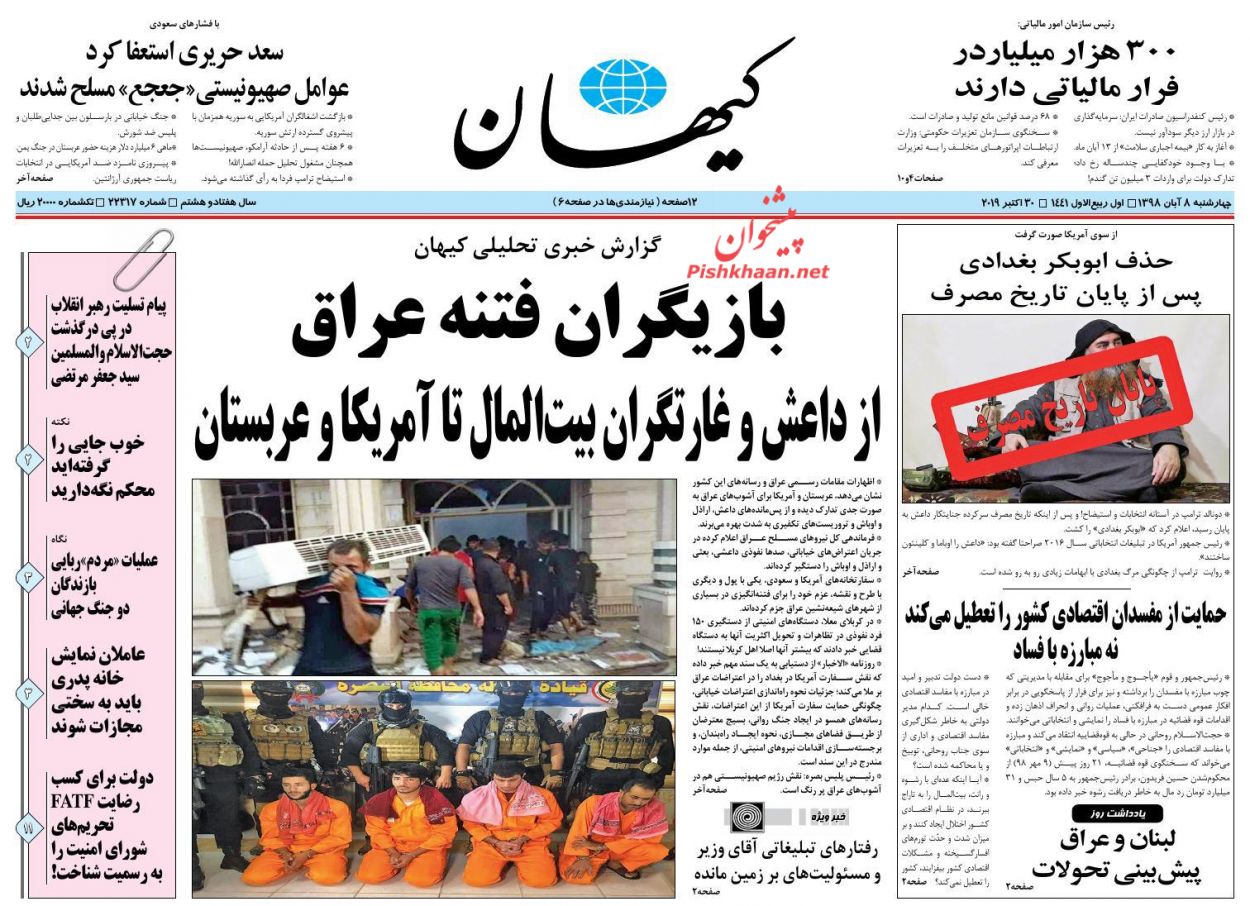
Kayhan:

1- Vigilant People of Iraq Will Foil Saudi-Zionist Sedition

2- Iran Rejects Unjustified Interference of France in Iranian National’s Case

3- Russian Female Journalist Detained in Iran on Espionage

A Look at Iranian Newspaper Front Pages on October 5


Sazandegi:

1- Plot to Assassinate General Soleimani Foiled

A Look at Iranian Newspaper Front Pages on October 5


Setareh Sobh:

1- Curfew Declared in Baghdad

* Ayatollah Sistani: Yes to Reforms, No to Violence

2- Qeshm Free Trade Zone Joins UNWTO

A Look at Iranian Newspaper Front Pages on October 5


Shargh:

1- Seniors of Al Saud against Bin Salman

2- Women Allowed into Stadium, This Time Not in Selective Mode

A Look at Iranian Newspaper Front Pages on October 5


Tejarat:

1- Region’s Problems Not to Be Resolved through Military Option: Larijani

2- Continued Protests in Iraq for Fourth Consecutive Day

A Look at Iranian Newspaper Front Pages on October 5

World’s Largest Pictorial Carpet Woven in Iran for China

This Persian rug has been woven with the consultation and in collaboration with a faculty member of the Kashan University’s Handmade Carpets Department.

The 2.5-metre rug was ordered by the Chinese government for the Silk Road Museum of Shanxi province.

The masterpiece was woven in nine months, in 168 colours and with 23 million knots, and is now placed at the museum.

The pictorial carpet is a great, unique, and valuable work of art which gives a picture of the great nations of the old times in trade with China.

The work gain much more value as all stages of the project have been carried out in modern and innovative ways to overcome the numerous constraints.

The combination of experience, art, knowledge and technology together is a valuable thing and can be a fresh hope for the future of the Iranian rug weaving.

Fat’h-Ali Qashqaifar, a professor at the University of Kashan and a member of the faculty of handmade carpets has been the artistic technical consultant of this global project. He constantly accompanied the team and came up with creative ideas and scientific solutions.

Professor Mohammed Seif has also given a hand in this project.

According to the ministry of science, 115 people were involved in weaving the rug, including 55 female artists.

The Persian carpet also known as Iranian carpet, is a heavy textile made for a wide variety of practical and symbolic purposes including home use, local sale, and export.

Carpet weaving is a vital part of Iranian culture and art. Within the group of oriental rugs, the Persian carpet stands out thanks to the variety and ornateness of its diverse designs.

Australia Releases Iranian Student after One Year in Jail

Reza Dehbashi who studied at the University of Queensland in Australia had been apprehended in September 2018 and remained in detention for 13 months on the baseless charge of sending American military equipment to Iran.

He was a student of the PhD program, and was finally released thanks to efforts by the Iranian diplomatic apparatus and Iran’s Embassy in Canberra.

After his detention, Iran’s then Foreign Ministry Spokesman Bahram Qassemi announced that the issue was being reviewed and that Iran’s embassy in Canberra and the Australian embassy in Tehran were following up the matter.

At that time, Australia’s ABC news channel reported that the United States had charged an Iranian student at the University of Queensland with sending military gear to Iran (purchasing and sending to Iran modern radar equipment used to spot missiles and stealth jet fighters) and demanded he be extradited to the US.

Last week, Negar Ghodskani, another Iranian citizen arrested in Australia and extradited to the US was also freed upon a court ruling and returned to Iran. She had been behind bars in Australia for almost three years on charges of circumventing US sanctions on Iran and had been recently extradited to the United States. She was released upon a US court verdict.

The developments come as Iran has released British-Australian woman Jolie King and her Australian boyfriend, Mark Firkin, after dropping all charges against them.

The Australian foreign affairs minister, Marise Payne, told reporters Thursday, “It is with some enormous relief that I announce that they have been released and returned.”

Payne said the Australian government held “very sensitive” negotiations with Iran over King and Firkin’s release and helped ensure they were treated appropriately while in detention.

Iran Ranks 2nd Worldwide in Terms of Growth in Tourism Sector

Figures by the United Nations World Tourism Organization (UNWTO) show the number of tourists visiting Iran in 2018 stood at 7,295,000 in 2018, registering a 49.9-percent rise year on year.

Only 4,867,000 visitors had visited Iran in 2017, the Iranian Cultural Heritage, Handicrafts and Tourism Organization quoted the WTO as saying.

The nearly 50-percent rise in the number of international visitors coming to Iran is registered as a negative growth of 1.5 percent had been reported in 2017 over the previous year.

The WTO has offered no figures on revenues generated by international tourism in Iran in 2018, but puts the figure at $4.402 billion for 2017.

Reports suggest Iran’s income in the tourism sector hovered around $2.438 billion in 2010.

Ecuador stood in the first place with a 51-percent growth. Located in Latin America, Ecuador managed to increase the number of tourists visiting the country from 1.6 million in 2017 to 2.6 million in 2018.

Iran, which ranks second, was followed by Egypt with a 36-percent growth, Uganda with 31.9 percent, Slovenia with 23 percent, Palestine with 20.5 percent, Vietnam with 19.9 percent, Georgia with 16.9 percent, South Korea with 15.1 percent and Qatar with 19.4 percent respectively in terms of the number of foreign tourists.

Iran Uses Nanotechnology to Develop Water-Repellent Construction Material

Nanotechnology can be used in a whole variety of sectors, including construction materials and the coating of structures. A knowledge-based company in Iran has, for the first time, produced a kind of nano-mortar which is completely water-repellent.

In the construction material sector, it has been quite some time that Iran has been importing materials that prevent the penetration of water, but they are not water-repellent. Scientifically, there is a huge difference between the two concepts.

The Research and Development Department of this company has, for the first time in Iran, produced a type of construction material with super hydrophobe (water-repellent) property. The material has numerous applications. For instance, it can be used to produce a type of artificial stone for facades in different colours and shapes. The material is water-repellent; so; it never gets dirty and does not need cleaning.

The material is used as coating, two to three millimeters thick, on different types of artificial stone, making them economical construction materials to be used for the façades of buildings.

The material comes in different colours and shapes. Similar materials which are imported and which are not water-repellent is sold at between $8-15 per kilo on the Iranian market. However, the Iranian-made material costs less than $5.1 for end users.

In fact, the constructions materials used as the façade of buildings are expensive and are not insulators, either. For example, they may cause the building to become too warm in summer. However, the artificial stone produced with the newly-developed nano-mortar almost never gets dirty, is much cheaper and functions as an insulator, too. Moreover, it is produced in hundreds of different beautiful designs.

The water-repellent mortar made with nano-particles is not only used to produce materials for facades; rather, it has other uses as well. As a case in point, some equipment and devices in hot and humid climates can be coated with it to make them rust-proof. For example, pylons of some huge industrial tankers can be coated with this nano-mortar, so that they will never rust as a result of natural causes such as humidity.

The product can make its present felt on the export market as it is of a very high quality and extremely cheaper than similar foreign-made products.