Sunday, December 21, 2025
Home Blog Page 27

Iranian lawmakers approve 14-coin cap for enforcing marriage portion, triggering strong reactions

Iranian Parliament

The amendment, adopted with 177 votes in favor, 43 against and 8 abstentions, forms part of a broader reform of laws governing the enforcement of financial convictions.

Under the new measure, if mahrieh is set at 14 gold coins or less, normal enforcement rules apply. For higher amounts, only the husband’s financial ability will determine payment, and imprisonment will be replaced with electronic monitoring, the spokesperson of the parliament’s president boarding Abbas Goudarzi explained.

The passage of the proposal prompted an unusual celebratory reaction from one lawmaker, who exclaimed, “Oh, great!” a moment that circulated widely on Iranian media and social networks.

Supporters argue the reform eases pressure on men imprisoned for unpaid mahrieh, with some MPs claiming the amendment was driven by mounting appeals from those facing incarceration.

Opponents, including women’s rights advocates and several female lawmakers, condemned the move as deepening gender inequality.

Critics such as Azar Mansouri, the head of the Reformists Party, said the measure fails to address “structural inequalities in family law” and instead further weakens women’s financial protections in marriage.

Parliament officials later clarified that the 14-coin limit applies only to enforcement mechanisms, not the mahrieh amount couples may agree upon.

The bill must be approved by the Guardian Council to become law. The Council determines whether the legislation complies with Islamic law and the Iranian Constitution.

US does not seek real talks: Iran Parliament speaker

Addressing a press conference in Tehran on Tuesday, Mohammad Bagher Qalibaf said the 12-day US-Israeli aggression proved that Iran “neither surrenders nor retreats under threat.”

He added that the US “bombed the negotiation table” just two days before a scheduled meeting, showing that “they are not looking for negotiations at all, and have practically chosen war.”

Speaking about Iran’s talks with the West after the 12-day war, Qalibaf said they demanded Iran reduce its missile range, but emphasized that defending the country is non-negotiable and such a demand is “absolutely impossible.”

“In the recent negotiations, they also showed themselves to be conspirators and liars; their behavior proved that their goal is not to solve the issue, but rather pressure, deception, and imposition,” he added.

Ghalibaf described the 12-day war as a sophisticated, heinous terrorist aggression planned by the criminal ruling body of the Zionist regime in collaboration with the US.

While admitting a brief delay in Iran’s initial response, he stressed the speed with which the country reacted.

“Within about five days, we achieved sufficient dominance over the Zionist enemy’s air and ground,” Ghalibaf stated, asserting that the enemy was desperate for a ceasefire by the sixth and seventh days.

He attributed this victory to the wisdom and courage of Leader of Iran’s Islamic Revolution Ayatollah Seyed Ali Khamenei, the sacrifice of the Iranian people, and the precise operations of the Armed Forces that “brought the enemy to its knees.”

“Today, we truly believe that our power is not only in our military and missile capabilities,” Ghalibaf emphasized.

“Our main power, after the grace of God, lies in the hearts of our people.”

The speaker highlighted lessons learned from True Promise 1, 2, and 3 operations, which provided immense tactical and technical experience.

“In a real battleground, despite the enemy’s multi-layered defense systems and air superiority, to fire more than 100 missiles in a limited timeframe and achieve over 70% accurate hits is a great military achievement.”

He warned that any future aggression from the US or the Zionist regime would be met with an exponentially stronger response.

“Today, Iran’s defensive and offensive capability, both quantitatively and qualitatively, is such that any aggression by the U.S. or the Zionist regime will be met with a much stronger, more precise, and more effective response.”


EU agrees to ban Russian gas imports by autumn 2027

Russia Gas

The accord marks a compromise between the member states and the European Parliament, which wanted the ban to come in sooner.

“Today, the Council presidency and the European Parliament’s representatives reached a provisional agreement on the regulation to phase out imports of Russian natural gas,” said a European Council statement.

The move aims “to end dependency on Russian energy following Russia’s weaponisation of gas supplies with significant effects on the European energy market”, it added.

The ban on long-term contracts will apply from November 1, 2027 at the latest for gas delivered by pipelines and from January 1, 2027 for liquified natural gas (LNG).

For short-term contracts, the ban will come in from April 25, 2026 for LNG and from June 17, 2026 for pipeline gas.

The timeline must get final approval from the European Parliament and member states.

Israel says agreement with Syria possible but demands buffer zone

Israeli Army

Netanyahu’s comments on Tuesday came a day after US President Donald Trump said he wanted both Syria and Israel to “have a long and prosperous relationship together”.

Talks have been ongoing over a security agreement between Israel and Syria for months, but appear to have made little progress in recent weeks.

Syria does not formally recognise Israel, which has expanded its illegal occupation of Syrian territory over the last year.

Israel captured the Golan Heights from Syria in the 1967 war and later illegally annexed the area, a move recognised by the United States but rejected by most of the international community.

Then, after the fall of former Syrian President Bashar al-Assad in December 2024, it reneged on a 1974 agreement and expanded further into Syrian territory, seizing areas including the whole of Jabal al-Sheikh, a mountain that commands views over northern Israel and southern Syria.

Israel has repeatedly attacked Syria in the last year, despite the new government in Damascus’s insistence that it is not looking for a fight. Most recently, an Israeli raid last Friday killed 13 people in the town of Beit Jinn, southwest of Damascus.

“What we expect Syria to do is, of course, to establish a demilitarised buffer zone from Damascus to the buffer area, including the approaches to Mount Hermon and the Hermon peak,” Netanyahu stated, using the Israeli name for Jabal al-Sheikh, during a visit to wounded soldiers in central Israel.

“We hold these areas in order to ensure the security of Israel’s citizens, and that is what obligates us.”

He added, “With goodwill and an understanding of these principles, it is possible to reach an agreement with the Syrians, but we will stand by our principles in any case.”

The Trump administration has been attempting to broker a non-aggression pact between the two sides, while the US president has expressed his support for Syria’s new leader, President Ahmed al-Sharaa.

Trump praised what he described as progress under al-Sharaa’s fledgling government, which has promised to unify Syria after years of civil war and sectarian fragmentation.

“The United States is very satisfied with the results displayed, through hard work and determination, in the Country of Syria,” the US president wrote.

“We are doing everything within our power to make sure the Government of Syria continues to do what was intended, which is substantial, in order to build a true and prosperous Country.”

“The new President of Syria, Ahmed al-Sharaa, is working diligently to make sure good things happen, and that both Syria and Israel will have a long and prosperous relationship together,” he added.

Shortly after Trump’s statement, Netanyahu’s office announced that the two leaders had spoken by phone.

US Special Envoy Tom Barrack was in Damascus on Tuesday, where he met Syrian Foreign Minister Assad al-Shaibani to discuss Syria-Israel relations. Barrack had met al-Sharaa on Monday.

Israel and Syria have been in talks for months over a settlement, but Israeli media have recently reported that talks between the two had reached a dead end, mainly as a result of Netanyahu’s unwillingness to compromise on Israel’s refusal to withdraw from the territory it has seized in the last year.

Israel has also reportedly demanded that it be allowed to maintain an aerial corridor to Iran via Syria, in case it needs to use it for future air strikes.


Iran health official warns of unprecedented decline in fertility, rapid shift toward aging society

Alireza Raeisi, Deputy for Public Health at the Ministry of Health, said demographic data show that while Iran followed trends similar to European countries in the 1980s and 1990s, it has since entered a phase of declining fertility “at a pace unmatched globally.”

Speaking at a national conference on population, family health, and schools, Raeisi said people aged 60 and above currently make up less than 12% of Iran’s population, but that proportion is expected to rise to 27-28% in the near future.

Despite their current share, older adults already account for roughly 40% of hospitalizations, he noted, underscoring the need for long-term planning in healthcare, urban design, and social support systems.

Raeisi stressed that demographic policies must be based on data rather than “emotional or slogan-driven approaches,” and called for revisions to parts of Iran’s population-growth legislation.

He warned that countries entering old age without sufficient economic development face far greater challenges, and urged Iranian policymakers to make better use of the country’s still-open demographic window.

Some US proposals unacceptable: Russian presidential aide

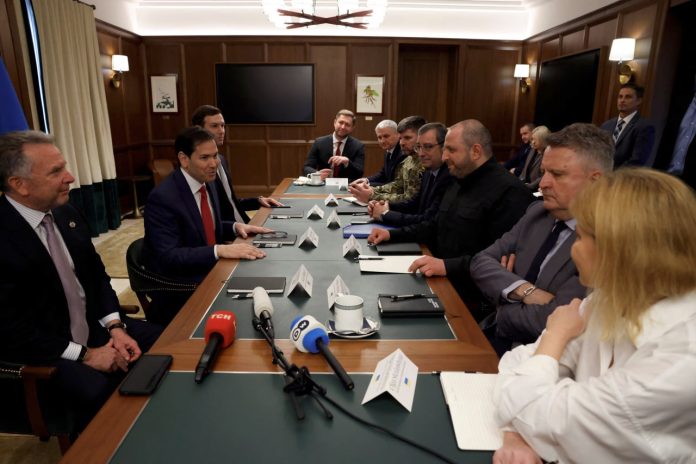
He made the comment after five hours of talks between the Russian president, his envoy Kirill Dmitriev, and US President Donald Trump’s special envoy Steve Wtikoff which fininshed after midnight local time.

”No compromises have been found as of yet,” Ushakov said after the meeting. A meeting between Putin and Trump is not currently planned, he added.

“We discussed the substance, not specific wording and solutions. The parties see enormous potential for cooperation,” Ushakov stated.

”Some American proposals are acceptable to Russia, while others are not,” the aide continued. He noted that the territorial issue was also discussed at the meeting.

Responding to the question of whether peace had become closer or further following these talks, Ushakov said, “Definitely not further.”

According to the aide, the US delegation presented the Russian counterparts with four more documents concerning a possible settlement to the Ukraine conflict.

Dmitriev tweeted that the session was “productive” while Witkoff went immediately to the US embassy compound.

Before departing for his meeting with Witkoff, Putin dismissed out of hand any contribution from Kiev’s European backers, citing their failure to recognize reality and accusing them of trying to disrupt the US-led process.

Putin also warned of blocking Ukraine’s maritime access should drone attacks on boats from third countries carrying Russian oil continue.


Iraqi president calls for strengthening ties with Iran

Rashid met and held talks with Al Sadegh in Baghdad, Iraq’s capital, on Tuesday.

During the meeting, the Iraqi president emphasized the importance of strengthening relations between Iraq and Iran, as well as the need for ongoing consultations and coordination on various issues of mutual concern.

For his part, Al Sadegh expressed his country’s desire to deepen bilateral relations and expand cooperation with Iraq across multiple fields, aiming to serve the best interests of both neighboring countries.


Putin slams EU ‘fantasy’ of Russian defeat

Putin was commenting on the increasingly belligerent rhetoric coming from some European nations, as well as the EU’s de-facto rejection of the US-drafted Ukraine peace plan.

Last month, German Defense Minister Boris Pistorius claimed that direct confrontation between Russia and NATO in Europe could be possible as early as 2028. Meanwhile, France has floated the idea of sending NATO troops to Ukraine.

Kiev’s Western backers also derided the peace proposal put forward by Washington in November as favoring Moscow and issued their own set of demands that Russia dismissed as “unconstructive.”

According to Putin, Western nations nourish a “fantasy about inflicting a strategic defeat on Russia and are still stuck in these illusions.” Such an outcome has been impossible from the start, but they cannot bring themselves to admit it, the president said.

They are trying to derail the US-backed peace process because they do not like its potential outcome, Putin stated.

The EU “does not have a peaceful agenda. They are on the side of war.”

Moscow has no plan to fight either the EU or NATO, he maintained. Yet if Western nations were to launch a war against Russia, “events could very quickly reach a point where there will simply… be no one left for us to negotiate with,” the Russian leader warned.

The EU has cited the alleged “Russian threat” to justify military spending hikes, such as Brussels’ €800 billion ($930 billion) ReArm Europe plan and NATO members’ pledge to raise defense spending to 5% of GDP.


Middle East needs ‘new attitudes’ to reject violence: Pope

He made the appeal on his third day in the country at the end of his first trip abroad as pontiff, after arriving on Sunday from Turkey.

Pope Leo said he wanted “to come as a pilgrim of hope to the Middle East, imploring God for the gift of peace for this beloved land, marked by instability, wars and suffering”.

“The Middle East needs new approaches in order to reject the mindset of revenge and violence, to overcome political, social and religious divisions, and to open new chapters in the name of reconciliation and peace,” he stated at the conclusion of a mass in Beirut attended by some 150,000 people.

“I especially pray for beloved Lebanon. I ask the international community once again to spare no effort in promoting processes of dialogue and reconciliation,” he added.

He also made “a heartfelt appeal to those who hold political and social authority here and in all countries marked by war and violence. Listen to the cry of your peoples who are calling for peace.”

“Let us all place ourselves at the service of life, the common good and the integral development of people,” he continued.

Despite a November 2024 ceasefire that sought to end more than a year of hostilities between Israel and armed group Hezbollah, Israel has kept up strikes in Lebanon and many fear a further escalation.

“Christians of the Levant, citizens of these lands in every respect, I repeat, have courage. The whole Church looks to you with affection and admiration,” he stressed.


Autumn colors draw visitors to Alishtar in Iran’s Lorestan

In the middle of this landscape, the town of Alishtar has become a popular destination for visitors.

Its wide plains, old orchards, gentle hills and seasonal rivers take on a striking appearance during the fall.

More in pictures: