Ukraine accuses Moscow of ‘provocation’ over Bakhmut buildings
A Ukrainian military spokesperson accused Moscow of “provocation” after Russian proxy forces said Ukrainian forces had blown up four buildings in Bakhmut, killing 20 civilians.
“This is another Russian information provocation with the goal of … distracting [attention] from the crimes of the Wagner terrorist organisation,” Serhiy Cherevatyi, a military spokesperson, told Reuters news agency.
“Ukrainian service members absolutely adhere to all rules and doctrines of war fighting [and] never violate either national nor international law, especially regarding civilians,” Cherevatyi added.
Russia’s TASS news agency quoted an unnamed source earlier on Wednesday who said Ukrainian forces had blown up the buildings as they pulled back from the city’s outskirts.
Putin says deliveries to annexed regions is ‘problematic’
Russian President Vladimir Putin stated that delivering goods to regions of Ukraine that Russia annexed last year was “problematic” and ordered the government to address the problem.
Putin visited Russian-controlled territory in Ukraine’s Luhansk and Kherson regions on Monday, according to the Kremlin.
US urges Turkey, Hungary to approve Sweden’s NATO bid
Lloyd Austin, the US defence chief, has urged Turkey and Hungary to quickly ratify Sweden’s NATO membership bid, which has been blocked due to a series of disputes.
“We look forward to soon welcoming Sweden as the 32nd [member of NATO]. And to be clear, we look forward to that happening before the [NATO] summit in July,” he said in Sweden.
All members must approve newcomers to the military alliance.
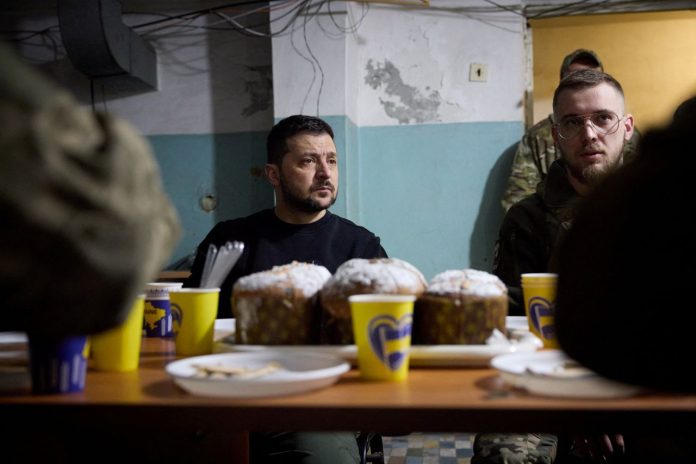
Zelensky travels to the Volyn region, thanks border guards
Ukrainian President Volodymyr Zelensky has inspected the border with Belarus and Poland.
“It is an honour for me to be here today to thank our border guards for protecting the state border,” Zelensky wrote in a Telegram post that included footage of him handing out awards.
He added that Ukraine must “be ready” at the border with Belarus even though Kyiv did not see “anything powerful” there apart from statements.
Ukraine receives first shipment of Patriots from US
Kyiv’s defence minister says Ukraine has received the first lot of Patriots, considered one of the most advanced US air defence systems.
Oleksiy Reznikov wrote on Twitter, “Today, our beautiful Ukrainian sky becomes more secure because Patriot air defence systems have arrived in Ukraine. Our air defenders have mastered them as fast as they could. And our partners have kept their word.
“This is the result of hard work led by our President Volodymyr Zelensky. Thank you to my colleagues German Defence Minister Boris Pistorius, and the American, German, Dutch people. We will win together,” he added.
Ukraine to ask West for anti-air missiles: Report
Ukraine will ask its Western backers to provide it with more surface-to-air missiles, the Financial Times reported on Wednesday, citing three people familiar with the matter. According to the outlet, it will happen during a meeting at Ramstein Air Base in Germany this week, as Kiev prepares an anticipated counteroffensive against Russian troops.
“Short-range air defense has been a topic that has been raised increasingly by the Ukrainians,” a European official was quoted as saying.
“If they use them all up, it opens the space up for air forces,” the official added.
According to FT, a Pentagon document from late February that was leaked online in the spring assessed that Kiev’s ability to protect its forces from aerial attacks would be “completely reduced” by May 23. The leaked files reportedly specified that Ukraine might run out of ammunition for “five critical air defense systems.”
NATO members have received intelligence that Russia is amassing warplanes and attack helicopters along the frontline with Ukraine, FT added.
German president slams Putin over invasion of Ukraine
German President Frank-Walter Steinmeier has condemned Russia’s Vladimir Putin for invading Ukraine during a commemoration marking the 80th anniversary of the Warsaw Ghetto Uprising in the Polish capital.
“With his illegal attack on a peaceful, democratic neighbouring country … the Russian president has broken international law …” he stated.
This war brings immeasurable suffering, violence, destruction and death to the people of Ukraine,” Steinmeier added.
No ‘magic wand’ for Ukraine: UK
The conflict between Russia and Ukraine will likely continue into next year, UK Defence Secretary Ben Wallace said.
“I’m optimistic that between this year and next year, I think Ukraine will continue to have the momentum with it and a position of strength,” Wallace told reporters during a trip to Washington, DC.
Wallace warned, however, that “there is not going to be a single magic-wand moment when Russia collapses.”
The UK has been one of Kiev’s main backers, supplying the country with heavy weapons, including Challenger 2 tanks. Britain has trained 10,000 Ukrainian soldiers, according to the Defence Ministry, and pledged to train 20,000 more this year.
For the past several months, Kiev has been outspoken about its planned counteroffensive, but has not publicly revealed the timetable. Ukrainian officials have stated, however, that the schedule and success of the endeavor will heavily depend on the supply of Western tanks and other equipment.
Moscow warns Seoul against sending arms to Kyiv
The deputy chairman of Russia’s Security Council, Dmitry Medvedev, has warned against South Korea’s plans to supply weapons to Ukraine.
Moscow could offer advanced weapons to North Korea if South Korea begins to supply military aid to Ukraine, the former Russian president has suggested.
On Telegram, Medvedev said: “Until recently, the South Koreans ardently assured that the possibility of supplying lethal weapons to Kyiv was completely ruled out.”
“I wonder what the inhabitants of this country will say when they see the latest designs. Russian weapons from their closest neighbours – our partners from the DPRK [North Korea],” he added.
South Korean President Yoon Suk-yeol indicated a possible policy shift regarding the Ukraine conflict in an interview with Reuters on Wednesday, ahead of a state visit to the US next week.
EU preparing 100 million-euro compensation for Ukrainian grain
A European Commission spokesperson said the European Union is preparing 100 million euros ($109.4m) of compensation for farmers in countries bordering Ukraine.
Pressure has been mounting on Brussels to work out an EU-wide solution after Poland and Hungary announced bans on Ukrainian grain imports.
The Commission, which oversees trade policy, will take what it described as “preventative measures” for specific grain and oil seeds categories.
European Trade Commissioner Valdis Dombrovskis is set to discuss the plans later on Wednesday with ministers from the affected countries, Bulgaria, Hungary, Poland, Romania and Slovakia, as well as with Ukrainian counterparts.
South Korea sending military aid would signify involvement: Kremlin
The Kremlin announced that if South Korea supplies military aid to Ukraine, it would mean Seoul would become involved in the conflict to a certain extent.
“Seoul has taken a rather unfriendly position towards the Russian Federation; the possibility of sending military assistance is a continuation of this line,” Kremlin spokesman Dmitry Peskov stated.
South Korean President Yoon Suk-yeol said in a Reuters interview that Seoul might extend its support for Ukraine beyond humanitarian and economic aid if there were a large-scale attack on civilians.
Russia lauches drone attack on Odesa
Local authorities stated that Russia launched a drone attack on Odesa, hitting civilian infrastructure.
“At night, the enemy carried out an attack by UAVs of the Shahed-136 type on the Odesa region,” Yuriy Kruk, head of the Odesa district military administration, said on Telegram.
“According to preliminary information, there were no casualties. Measures are being taken to contain the fire, units of the State Emergency Service and other structures are working on the spot.”
General Mykola Oleshchuk, commander of the Ukrainian Air Force, added that air defences had destroyed 10 of 12 “kamikaze” drones.
Brazil condemns Russia’s invasion, calls for mediation
Brazilian President Luiz Inacio Lula da Silva condemned Russia’s violation of Ukraine’s territorial integrity and called for mediation to end the war.
Speaking with Romanian President Klaus Iohannis, Lula said a group of neutral nations must come together to help broker peace between Russia and Ukraine.
His comments came after he stated that Western nations were prolonging the war by sending weapons to Ukraine.
A White House spokesperson accused Lula of “parroting Russian and Chinese propaganda without looking at the facts”.
The White House added that Lula’s “tone was not one of neutrality”.
Russia’s DM inspects new missile systems
According to state-owned news agency TASS, Russian Defence Minister Sergei Shoigu has inspected newly installed silo-based “Yars” strategic missile systems in the Kaluga region south of Moscow.
The Defence Ministry announced earlier on Wednesday that eight Russian long-range bombers had flown over neutral waters in the Sea of Okhotsk and the Sea of Japan as Russia’s navy stages exercises in the Pacific.
Moldova declares Russian embassy staff member persona non grata
Moldova has summoned the Russian ambassador to declare a member of the Russian embassy staff persona non grata, a government spokesperson in Chisinau says.
Government press secretary Daniel Vode told reporters that the decision was connected to a staff member’s actions towards Moldovan border guards who had denied entry to a regional Russian politician at Chisinau airport this week.
The embassy staffer was not named.
Russian FM praises framework proposed by China and Brazil to end conflict in Ukraine
Russian Foreign Minister Sergey Lavrov praised a framework introduced by China and Brazil, which proposed an end to the conflict in Ukraine.
“We applaud the position from China, and we have also held talks with Brazil on this, and these are very useful proposals because they can help to share ideas and help resolve problems,” Lavrov said Tuesday during a news conference in Caracas, Venezuela.
“All this, however, is not part of the West’s rules,” he added.
Lavrov explained the West would not accept the so-called “peace proposal” that would see the Crimean Peninsula fully integrated into the Russian Federation.
Meanwhile, Ukraine has repeatedly said peace in the conflict will only be achieved if Russia restores the country’s borders and Kyiv takes back Crimea.
“We hope the regime in Kyiv respects the rights of Crimea, we already know the West, it’s demanding that Crimea is returned,” Lavrov continued.
Since taking office this year, Brazilian President Luiz Inácio Lula da Silva has suggested his country could help broker a negotiation in the Russian invasion of Ukraine, arguing Kyiv should relinquish sovereignty claims over Crimea in exchange for the end of the conflict.
Last week, Lula traveled to China and both countries reiterated calls for a peaceful solution to the conflict.
Lula has largely adopted a policy of non-intervention over the war in Ukraine, following in the same footsteps of many leaders in middle-income and developing countries.
On Saturday, Lula said the US and the EU need to start talking about peace between Ukraine and Russia.
“The United States needs to stop encouraging war and start talking about peace; the European Union needs to start talking about peace so that we can convince Putin and Zelensky that peace is in the interest of everyone and that war is only interesting, for now, to the two of them,” Lula told reporters in Beijing on Saturday.
The US and EU have been major suppliers of arms and aid to Ukraine amid Russia’s invasion.
Lavrov is in Caracas as part of a five-day trip to Latin America, visiting Brazil, Venezuela, Cuba and Nicaragua.
On Tuesday, Lavrov criticized US sanctions on Venezuela and stated that Russia intends to strengthen diplomatic and commercial relationships with the Andean country
No evidence so far China is providing lethal military aid to Russia: NATO chief
NATO Secretary General Jens Stoltenberg said on Tuesday that so far there is no evidence China is providing lethal military aid to Russia.
“We are watching very closely and so far we haven’t seen any evidence that China is providing lethal military aid to Russia,” he told CNN’s Christiane Amanpour.
“Our message is very clear: It would be a big mistake to support President [Vladimir] Putin’s illegal war,” he added.
China has claimed neutrality over the war in Ukraine and called for peace in the conflict. But it has also refused to condemn Russia’s invasion or make any public call for Russia to withdraw its troops. The leaders of both countries met in March.
Earlier on Tuesday, the head of US forces in the Indo-Pacific warned of the partnership between Russia and China, telling lawmakers it is “pretty concerning.”
“They have no friends,” Adm. John Aquilino, commander of US Indo-Pacific Command, told the House Armed Services Committee.
“They have identified that it is better if they’re together in order to achieve their strategic objectives. That’s a concerning world,” he continued.
Aquilino added that the relationship ties “directly” the question of misinformation and disinformation
Gazprom says it will be difficult for Europe to refill gas storage
Russian natural gas giant Gazprom said it would be very difficult for Europe to refill its gas storage to last year’s levels.
In a message on Telegram social media, Gazprom said Europe had been helped by relatively mild weather, which may not be the case next year.
Repeating storage filling could become “a non-trivial task” for European companies, Gazprom announced.
“This will be very difficult to do, given the politically motivated decisions aimed at refusing to import Russian pipeline gas. The volume of gas available on the European market will be greatly affected by competition for LNG,” Gazprom added.
Egypt agreed to supply arms to Ukraine after US talks: Report
Egypt was planning to manufacture rockets for Russia but then suspended that effort and decided to supply ammunition to Ukraine after talks with US officials, the Washington Post has reported.
The Post had reported earlier that Egypt secretly planned to produce 40,000 rockets for Russia, but in a new report – based on leaked Pentagon files – the newspaper said Cairo suspended that push in March.
The Post said Egypt also approved the sale of artillery ammunition to the US “for transfer to Ukraine”, calling the shift an “apparent diplomatic win” for Biden.
Egypt previously denied plans to produce rockets for Russian forces, stressing that it is pursuing a policy of “noninvolvement” in the Ukraine war.
NATO chief calls for allies to “do even more” when its comes to weapons and supplies for Ukraine
NATO allies need to give more weapons and supplies to Ukraine, Secretary General Jens Stoltenberg said on Tuesday.
Referring to the information contained in leaked United States documents that suggests Ukraine may soon run out of air defense ammunition, Stoltenberg stated military aid is going to be critical in helping Ukrainians take back positions.
“We recognize the enormous amount of weapons, ammunitions, supplies that have already been provided to Ukraine, but we need to do even more,” Stoltenberg continued.
“Because we need to ensure that Ukrainians are in a position where they can punch through the Russian lines and also across minefields and be in a position where they can liberate, take back territory,” he added
Russian FM will visit US next week and discuss Black Sea grain deal with UN chief
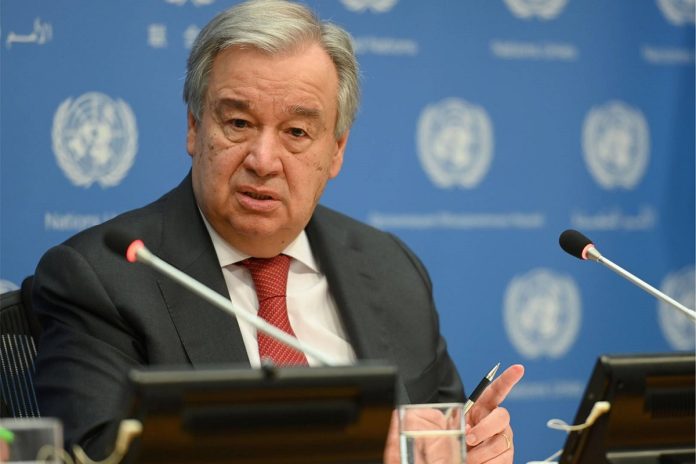
Russian Foreign Minister Sergey Lavrov is set to discuss the Black Sea grain deal with United Nations Secretary General António Guterres when he visits New York next week, Russian state news agency TASS reported on Tuesday citing Vasily Nebenzya, Russia’s Permanent Representative to the UN.
On Monday, Ukraine accused Moscow of threatening the UN-brokered grain deal — which aims to ease a global food crisis sparked by the war — and said that the inspections of ships in Turkish territorial waters were blocked for the second time.
Russian state news agency RIA reported inspections under the grain deal had resumed on Tuesday, citing Pyotr Ilyichev, director of the department for international organizations at the Russian Ministry of Foreign Affairs.
Lavrov’s trip to New York was made possible after Russian Ambassador to US, Anatoly Antonov, urged Washington last week to issue a permit for the foreign minister’s special aircraft and visas for the Russian delegation to chair the UN Security Council meeting in New York.
In response, a State Department spokesperson said last week that as a host country of the UN, the United States takes its obligations under the UN Headquarters Agreement seriously, “including with respect to visa issuance.”
The agreement states, “the federal, state or local authorities of the United States shall not impose any impediments to transit to or from the headquarters district of: (1) representatives of Members or officials of the United Nations, or of specialized agencies as defined in Article 57, paragraph 2, of the Charter, or the families of such representatives or officials.
Russia is “going backwards” in equipment and deploying post WWII-era tanks: Western officials
Russia is “going backwards” with the equipment it is using in Ukraine, Western officials said, explaining they’ve seen Moscow deploy tanks originally built after World War II while it struggles to replenish stocks of lost armored vehicles.
Officials said during a briefing on Tuesday they hadn’t seen “a large uptick in increasing equipment.”
“If anything, the equipment they [the Russians] are using is older generation,” they continued, adding Moscow had been increasingly relying on older models of tanks in the war.
“They started with the T-80 and T-90 [tanks], went down to T-72, and indeed, we saw the first T-55s rolled out of the refurbishment to be put into battle and the same picture across artillery pieces as well,” the officials said.
The T-90 was first introduced in 1992, the T-80 in 1976, while the T-72 came into service in 1972 and the T-55 after World War II in 1948.
“They’re going backwards in terms of equipment,” they added.
The officials also stated that Russia was still struggling with manpower, explaining that despite being able to muster large numbers of personnel, Moscow was still not providing them with adequate training.
“We’ve seen two quite relatively small training cycles go through Belarus, but out of a force of 150,000 which they claimed were mobilized, we’ve probably seen maybe 15,000 which have gone for any kind of company level training,” the officials said, adding, “That’s where we see the Russian force at the moment; it’s been degraded from the force that originally went into Ukraine
US leaks have had no impact on Ukraine battlefield: Western officials
The US intelligence documents leaked over the past few weeks have had no visible impact on the battlefield in Ukraine, Western officials say.
“We haven’t seen any change in the battlefield,” the officials told CNN during a briefing on Tuesday.
The officials declined to comment on the content of the leaked documents.
Several of the documents, which US officials say are authentic, disclose the extent of US eavesdropping on Ukraine among other key allies. Others divulge significant weaknesses in Ukrainian weaponry, air defense, and battalion sizes and readiness at a critical point in the war, as Ukrainian forces prepare to launch a counteroffensive against the Russian. Ukraine has already altered some of its military plans because of the leak, a source close to Ukrainian President Volodymyr Zelensky told CNN.