Number of injured in Dnipro attack rises to 30 people
The number of people injured in Friday’s attack on the city of Dnipro has risen to 30 people, including two children, according to the head of the Dnipropetrovsk region military administration.
The search for three people who could have been at the facility at the time of the attack is still ongoing, regional military administration head Serhii Lysak said in a Telegram post on Friday.
Earlier on Friday, the Dnipropetrovsk regional military administration confirmed that two people died in the rocket strike.
Meanwhile, Dnipro Mayor Boris Filatov told journalists that a change of shifts for doctors was ongoing when the attack occurred at the Dnipropetrovsk City Hospital No. 14 — meaning fewer people were working at the facility at the time.
“Hopefully, there will be no more victims,” Filatov told journalists at the hospital site, adding, “It is a miracle that the rocket struck at the very moment of the doctors’ change of shifts.”
Kremlin demands unfreezing Russian foreign assets “without any conditions”
The Kremlin demanded that the United Kingdom and other countries unfreeze Russian foreign assets without any conditions, as Western allies of Ukraine load economic pressure onto Moscow over the conflict.
“Britain and other countries that encroached on Russian assets are obliged to unfreeze them immediately without any conditions,” Moscow spokesperson Dmitry Peskov told reporters on Friday.
“Otherwise, they violate all the norms and rules of both their domestic legislation and international law,” he added.
The United States and its allies have blocked or seized $58 billion worth of assets owned or controlled by sanctioned Russians in the past year, in an effort to crunch Russia’s economy amid the war.
The Russian Elites, Proxies and Oligarchs (REPO) Task Force said in March that they will “redouble” their efforts to punish Russian President Vladimir Putin and his associates.
REPO is a joint effort between the US, Australia, Canada, Germany, Italy, France, Japan, the UK and the European Commission. It was established last year in order to monitor sanctions evasion.
2 killed and 23 injured in Dnipro attack on medical facility
At least two people have died and 23 people left injured following an attack on a medical facility in the central Ukrainian city of Dnipro on Friday.
A 69-year-old man “was just passing by when the rocket struck the city” and the body of another man “was pulled out of the rubble,” said Serhii Lysak, head of the regional military administration.
He stated that 23 people were wounded in the bombardment, with 21 of them hospitalized and three in a critical condition.
At least four people are missing following the attack in Dnipro, according to the Ukrainian Prosecutor General’s Office.
The fire covered 1,000 square meters of the medical facility, where a three-story building was partially destroyed, Lysak continued.
He added that rescue workers are searching for people under the rubble.
Russian Foreign Ministry summons US diplomats over Sullivan’s comments on Crimea strikes
The Russian Foreign Ministry called on senior US diplomats on Friday to express “strong protest” over US National Security Adviser Jake Sullivan’s remarks about Ukrainian strikes on Crimea, after he said the US has not placed limitations on Kyiv to hit its territory.
The ministry called Sullivan’s remarks in an interview with CNN on Sunday “unacceptable.”
Sullivan also said that Washington will not enable Ukraine with Western systems to attack Russian territory, which includes Crimea.
A statement by the ministry said: “It was emphasized that the assurances of American officials that the United States does not encourage such attacks on Russia are hypocritical and false, given the direct material evidence of the use of weapons and equipment supplied for the needs of the AFU [Armed Forces of Ukraine] by the Pentagon to prepare and carry out terrorist acts by Ukrainian militants.”
“The hostile actions of the United States, which has long been a party to the conflict, plunged Russian-American relations into a deep and dangerous crisis, fraught with unpredictable consequences,” the ministry added.
“It is time for Washington to learn that any form of aggression against Russia will continue to meet the strongest resistance,” it noted.
Diplomatic relations between Western allies of Kyiv and the Kremlin further deteriorated after Moscow launched its full-scale invasion of Ukraine in February 2022
2 attack drones hit buildings in Krasnodar: Russian governor
Two unmanned aerial vehicles (UAVs) damaged buildings in Krasnodar on Friday, after local media reported that an explosion was heard in the southern Russian city.
The governor of Krasnodar Veniamin Kondratiev said no major infrastructure was impacted, and said there were no casualties following the incident.
State news agency TASS reported that the city’s emergency call center was alerted to an explosion on Morskaya Street early Friday.
“Emergency services were sent to the scene. No casualties have been reported. There was damage to the building’s roof and windows, but no fire,” according to TASS.
China hopes Black Sea grain export deal can be implemented in balanced manner
China hopes the Black Sea grain export deal can be implemented in a balanced and comprehensive manner, foreign ministry spokesperson Mao Ning says.
On Thursday, Russia hinted that if its ability to export grain and fertilizer has not improved, it will not extend the agreement beyond July 17. The deal allows Ukraine to export its agricultural goods from its Black Sea ports.
China’s Ukraine envoy is expected to meet Russian Foreign Minister Sergey Lavrov on Friday in Moscow.
At least one person killed in Dnipro missile strike: Zelensky
At least one person has been killed and 15 wounded in a Russian missile strike on a medical clinic in the city of Dnipro, Ukrainian President Volodymyr Zelensky says.
“Russian terrorists once again confirm their status of fighters against everything humane and honest,” he wrote on the Telegram messaging app.
“A rocket attack on a clinic in the city of Dnipro. As of now, one person was killed and 15 were wounded. The shelling aftermath is being eliminated, and the victims are being rescued,” he added.
Earlier in the day, Ukrainian officials said air defence systems had shot down 10 missiles and more than 20 drones in overnight attacks on the capital, Kyiv, as well as Dnipro and eastern regions.
Russia says West is underestimating risk of nuclear war
A former Russian president and prime minister warns that the West is underestimating the risk of nuclear war and says peace negotiations are “impossible” as long as President Volodymyr Zelensky remains in power.
“There are irreversible laws of war. If it comes to nuclear weapons, there will have to be a pre-emptive strike,” Dmitry Medvedev, who is now the deputy chairman of Russia’s Security Council, was quoted as saying by Russian news agencies.
“The Anglo-Saxons do not fully realize this and believe that it will not come to this,” the senior ally of President Vladimir Putin stated, adding, “It will under certain conditions.”
Medvedev also said it is “inevitable” that the war will end due to negotiations but “as long as these people are in power, the situation for Russia will not change”, referring to the Zelenskyy administration.
Ukraine says it shoots down 10 missiles and more than 20 drones overnight
Ukraine says it has shot down 10 missiles and more than 20 drones in an overnight attack on Kyiv, the city of Dnipro and eastern regions.
Volodymyr Zelensky’s office said in a statement that a fire broke out on the outskirts of Kharkiv after an oil depot was hit twice.
The Ukrainian air force said the missiles it shot down were fired from the Caspian Sea.
It said 17 missiles and 31 drones had been launched during the attacks, which started about 10pm (19:00 GMT) on Thursday and continued until 5am (02:00 GMT) on Friday.
This month, Russia has intensified its missile and drone attacks on Ukraine, mainly targeting logistics and infrastructure facilities.
Russia will not achieve military victory in Ukraine: Top US commander
Russia will not achieve a military victory in Ukraine, Chairman of the Joint Chiefs of Staff Mark Milley stated while also cautioning that Kyiv is unlikely to force out all of Moscow’s troops anytime soon.
“This war, militarily, is not going to be won by Russia. It’s just not,” Milley told journalists at the Pentagon.
US does not support attacks on Russian soil and has “made it very clear” to Ukraine: White House official
US President Joe Biden’s administration has reiterated in conversations with Ukraine that it does not support attacks on Russian soil, White House National Security Council spokesperson John Kirby told CNN Thursday.
“We have again made it very clear to the Ukrainians what our expectations are about attacking Russia — we don’t want to encourage or enable that, we certainly don’t want any US-made equipment used to attack Russian soil,” Kirby told CNN’s Wolf Blitzer.
“And we have gotten assurances from the Ukrainians that they will respect those wishes … we have been very clear that we want Ukraine to be able to defend its own soil, its own territory. They have been attacked. They have been invaded. They have a right to defend themselves,” he continued.
“But, we’ve also been clear, well, that we don’t want to see this war escalate beyond this, the devastation and the violence that is already visited on the Ukrainian people,” he added.
The conversations with Ukraine didn’t involve “outlining consequences” but were “simply a reaffirmation,” Kirby told CNN. He stated that these discussions have happened “as recently as over just the last day or so.”
Kirby’s comments come on the heels of a CNN report that anti-Putin Russian fighters, fighting alongside Ukrainian armed forces, conducted a raid inside Russian territory.
In an interview with CNN’s Sam Kiley, one of the Russian nationals stated the raid was conducted using American-manufactured equipment purchased on the open market. Kirby added Thursday that he could not confirm that.
He instead said the US is providing equipment “to be used to defend Ukrainian soil.”
Security assistance for Ukraine has evolved: US officials
“As Russia’s invasion has evolved, so has our security assistance,” US Defence Secretary Lloyd Austin tells reporters during a press conference in Washington, DC, in response to questions about providing Ukraine with F-16 fighter planes.
President Joe Biden has long been reluctant to supply the warplanes to Kyiv, but at the weekend, he agreed to allow other countries to send the US-made aircraft to Ukraine
“It’s not a question of will we agree later or agree now or under pressure; that’s not at all what is going on here,” Chairman of the Joint Chiefs of Staff Mark Milley said.
“This is hardcore military analysis that looks at cost, benefit and risk and what is the need on the battlefield now and in the near future,” he added.
The US has long asked Ukraine not to use US-provided military equipment to carry out attacks inside Russian territory, the top US general stated following accusations that pro-Ukrainian militia used US armoured vehicles in a cross-border attack this week.
Milley stressed his office was looking into imagery showing the vehicles allegedly used in an attack on the Russian border region of Belgorod. But he noted Kyiv was clear about the US position that such US equipment should not be used inside Russia.
Kremlin responds to Ukrainian threat to kill Putin
Ukraine’s leadership has again demonstrated its “terrorist” nature by threatening to assassinate President Vladimir Putin, Kremlin Press Secretary Dmitry Peskov has said, while giving assurances that the Russian leader is well protected.
“A terrorist regime talks about its terrorist aspirations,” Peskov told the Rossiya 24 broadcaster on Thursday.
The spokesman was commenting on an acknowledgement by Vadim Skibitsky, deputy head of Ukraine’s Main Directorate of Intelligence (GUR), who told the German outlet Die Welt on Wednesday that Putin was on his agency’s kill list.
Peskov stated such statements show that the military operation, launched by Russia in Ukraine in February 2022, was “more than justified, more than necessary and that it must be completed.”
When asked if the Russian president’s security detail had been boosted after the threat from Kiev, Peskov replied: “Trust me, our security services know their job and know what they’re doing.”
In his interview, Skibitsky claimed that Putin “notices that we’re getting ever closer to him,” suggesting that Ukrainian operatives have so far been unable to get to him because the Russian leader “stays holed up.” The intelligence official also said the GUR was “trying to kill” the head of the Wagner private military company, Evgeny Prighozhin, Russian Defense Minister Sergey Shoigu, and Chief of the General Staff Valery Gerasimov.
In early May, two small drones were disabled by air defenses, while trying to strike Putin’s Kremlin residence in Moscow. The Russian leader was not there at the time of the failed attack, and no one was hurt.
Despite the Ukrainian authorities denying any involvement, Moscow called the incident a “a pre-planned terrorist act” and an attempt on Putin’s life perpetrated by Kiev.
The Kremlin vowed that Russia would retaliate to the raid “anywhere and anytime it deems necessary,” while senior lawmaker Vyacheslav Volodin called for the use of “weapons capable of stopping and destroying the Kiev terrorist regime.”
Russia has accused Ukrainian President Volodymyr Zelensky’s government of engaging in “terrorist tactics” since last fall, when it said Ukraine was targeting Russian infrastructure, including nuclear facilities and the strategic Crimean Bridge. The accusations were followed by the launch of a large-scale missile campaign across Ukraine, which delivered serious damage to the country’s energy system and depleted the capabilities of Ukrainian air defenses.
US imposes sanctions on head of Wagner Group in Mali
The United States has imposed sanctions on the head of the Wagner Group in Mali, accusing the Russian private army of trying to obscure its efforts to acquire military equipment for use in Ukraine, and of working through Mali and other countries.
The US Department of the Treasury in a statement also accused Ivan Aleksandrovich Maslov, who it described as the head of Wagner paramilitary units and its principal administrator based in Mali, of working in close coordination with Malian government officials to execute the group’s deployment in Mali.
“Treasury’s sanctions against the most senior Wagner Group representative in Mali identify and disrupt a key operative supporting the group’s global activities,” the Treasury’s Under Secretary for Terrorism and Financial Intelligence, Brian Nelson, said in a statement.
The move comes after Department of State spokesperson Matthew Miller on Monday said that there were indications that Wagner has been attempting to buy military systems from foreign suppliers and route those weapons through Mali.
Pentagon reveals value of military aid pumped into Ukraine
The so-called Ukraine Defense Contact Group has committed almost $65 billion in military aid to prop up Kiev in the ongoing conflict with Moscow, US Defense Secretary Lloyd Austin has revealed.
The Pentagon boss made the estimate during the 12th meeting of the group, which brings together all 31 NATO nations, as well as a handful of ‘non-aligned’ countries. Washington is “committed to standing with Ukraine for the long haul,” Austin announced.
“In total, the Contact Group has committed nearly $65 billion in security assistance,” he said, claiming that Ukraine’s backers remain “as united as ever.”
“And, last week, President Biden announced that the United States will support a joint effort with our allies and partners to train Ukrainian pilots on fourth-generation aircraft, including F-16s. We hope this training will begin in the coming weeks,” Austin declared.
Apart from supplying modern combat aircraft to Kiev, the US is now focusing on providing Ukraine with “additional air-defense systems and munitions,” he said. The air defenses are “crucial” for “protecting Ukraine’s skies and civilian infrastructure from Russia’s assault,” he added.
Moscow has consistently said it has been exclusively targeting military or dual-purpose targets in the country. It has also accused Kiev of subjecting the country’s cities near the frontlines to indiscriminate artillery and rocket attacks, which have resulted in multiple civilian casualties over the course of the ongoing conflict.
Russia has repeatedly warned Ukraine’s Western backers against pouring assorted weaponry into the country, as doing so would only prolong the conflict and inflict more suffering on Ukrainian civilians.
Over 2,500 foreign mercenaries fighting for Ukraine: Russian DM
Western countries are forcing Kiev to present tactical successes on the battlefield regardless of the cost to human lives and “pumping” the country full of weapons and fighters, Russian Defense Minister Sergey Shoigu has claimed.
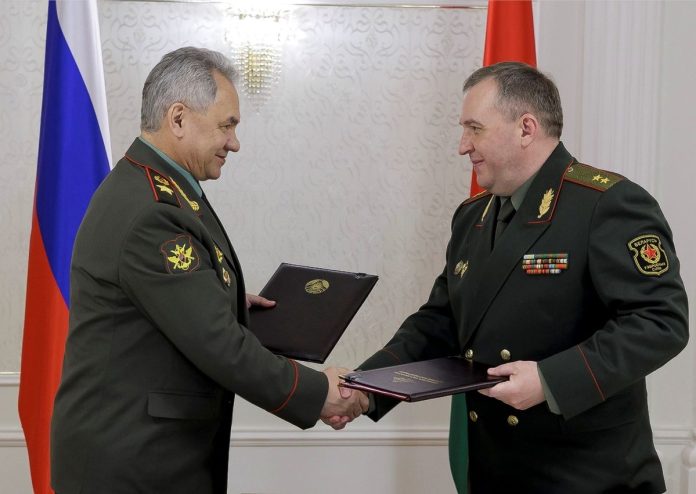
Speaking at a meeting of the council of defense ministers of the Collective Security Treaty Organization (CSTO) in Minsk on Thursday, the Russian minister said the value of the West’s military-technical assistance to Kiev has already exceeded $65 billion and that more than 2,500 foreign mercenaries are currently taking part in military operations in the country.
He also claimed that Kiev’s tactics have evolved to include terrorist methods of confrontation, including sabotage and high-profile killings.
“The most tense situation today has developed in the Eastern European region. The West is forcing the Kiev regime, regardless of losses, to show tactical successes and willingness to fight ‘to the last Ukrainian’ and pumping it with weapons,” Shoigu added.
He claimed that this would only lead to further escalation and prolong the conflict. Shoigu suggested that this was being done intentionally and that NATO had been using the Ukraine crisis as an excuse to build up its military capabilities and modernize its infrastructure in Central and Eastern Europe.
Shoigu claimed the US and its allies are intentionally creating hotbeds of tension and provoking crises near the borders of CSTO members, leading to an “extremely unstable” military-political situation in these areas. The minister accused the West of providing support for terrorist and extremist structures, and also using sanctions, threats and blackmail to achieve their goals of destabilizing the region.
US has been preparing Ukrainian counteroffensive ‘for months’: Top diplomat
The US Under Secretary of State for Political Affairs Victoria Nuland told an audience in Kiev on Thursday that Washington has been helping plan the Ukrainian ‘counteroffensive’ against Russia for almost half a year.
“Even as you plan for the counteroffensive, which we have been working on with you for some 4-5 months, we are already beginning our discussions with [the] Ukrainian government and with friends in Kiev – both on the civilian side and on the military side – about Ukraine’s long-term future,” Nuland told the Kiev Security Forum via video-link from the State Department.
She added that the attack will be “likely starting and moving concurrently” with events such as the NATO summit in Lithuania, scheduled for July 11.
According to Nuland, the US is also planning for Ukraine’s future military to deter Russia, so “wherever and however this ends – one year, six years, 16 years – we are not doing this again.”
She also painted a rosy picture of a future in which Ukraine would be the “engine of Europe’s revitalization” and “setting the democratic example… for the whole world.”
Russian reconnaissance ship seemingly hit by unmanned surface vessel
The Russian reconnaissance ship Ivan Khurs was seemingly hit by an unmanned surface vessel in the Black Sea, new video shows, disputing a claim by Moscow, which said on Wednesday it had been able to thwart a Ukrainian attack on the craft.
Footage shared by the Ukrainian Ministry of Defense on social media Thursday appeared to show the moments just before the impact.
The video is filmed from a camera placed on the surface vessel. It shows the vessel as it approaches a larger ship at high speed.
CNN analysis determined the ship is likely to be the Ivan Khurs. It also shows the tip of the unmanned surface vessel, similar to the unmanned surface vessels seen in video posted by the Russian Ministry of Defense on Thursday.
The feed cuts as the vessel comes within a few yards of the ship.
“When the Russian reconnaissance ship ‘Ivan Khurs’ met a Ukrainian drone,” the Ukrainian Ministry of Defense said in a tweet, adding, “Indeed, a perfect match!”
On Wednesday, the Russian defense ministry acknowledged the attack on the Ivan Khurs but said all the surface vessels had failed to hit the ship.
“Today at 5:30 a.m., the armed forces of Ukraine made an unsuccessful attempt to attack the Ivan Khurs ship of the Black Sea Fleet with three unmanned speedboats,” said the spokesperson for the Russian Ministry of Defense, Maj. Gen. Igor Konashenkov.
“All enemy boats were destroyed by fire from the standard armament of a Russian ship 140 kilometers northeast of the Bosphorus,” he added.
The Russian Ministry of Defense also shared footage that appears to show one of the surface vessels exploding as it is hit by gunfire.
“The ship ‘Ivan Khurs’ of the Black Sea Fleet continues to fulfill its tasks,” Konashenkov added.
It is unclear what happened after the surface vessel seemingly hit the Ivan Khurs and how damaged the reconnaissance ship may have been during the attack.
Ukraine government must cease to exist: ex-Russian president
There is no doubt that Ukraine has no future in its current form, former Russian president Dmitry Medvedev said on Thursday, outlining three possible scenarios for the collapse of its statehood and assessing the risks of renewed conflict in Europe and a global war.
“This conflict will last for long. For decades, probably. This is a new reality,” the former Russian leader, now the vice-chair of the national security council, told journalists upon wrapping his visit to Vietnam earlier this week.
“It is necessary to destroy the very nature of the Nazi government in Kiev,” Medvedev added, claiming that otherwise the conflict could drag on perpetually, with “three years of truce, two years of conflict, rinse and repeat.”
In a Telegram post on Thursday evening, Medvedev elaborated that the collapse of Ukraine’s statehood is inevitable, and could either happen quickly, or through a “relatively slow erosion, with the gradual loss of remaining elements of sovereignty.” He went even further to outline exactly how he believes the “Kiev regime” would cease to exist.
In the first scenario, parts of Western Ukraine will come under control and eventually be annexed by the neighboring European Union states, Medvedev claimed. The remaining “no man’s land” wedged between Russia and the EU protectorate will become the “new Ukraine,” still striving to join NATO and posing a threat to Russia. In that case, he believes, the armed conflict will shortly reignite, likely becoming permanent with a risk of quickly escalating into a full-blown world war.
In the second scenario, Ukraine would get a government-in-exile but de-facto cease to exist, with control over its entire territory split between the EU and Russia. In that case, according to Medvedev, the risk of world war is “moderate,” but the “terrorist activity by Ukrainian neo-Nazis” on the territories annexed by the EU neighbors would drag on.
Medvedev stated he would prefer the third scenario, in which Ukraine’s Western territories voluntarily join their EU neighbors, while the Eastern and some central regions exercise their “right for self-determination sealed in Article 1 of the UN Charter.”
Villages at risk of flooding after Russia destroys dam in eastern Ukraine: Regional leader
An official in Ukraine’s eastern Donetsk region has accused Russian forces of destroying a dam and endangering nearby residents.
The attacks on the Karlivka Reservoir’s dam put the nearby villages of Halytsynivka, Zhelanne-1 and Zhelanne-2 at risk of flooding, said Pavlo Kyrylenko, the Donetsk regional military administration leader.
“Since the beginning of the large-scale invasion, the Russian occupation army has been constantly shelling Karlivka, targeting the dam, ignoring the fact that civilians would suffer from these actions,” Kyrylenko wrote on Telegram Thursday.
Ukraine’s emergency services believe the dam could break and have already started responding to the situation, the regional leader said.
“Communities in the area of possible flooding have been warned. If necessary, the evacuation of civilians will begin,” he added.
Moscow says Ukraine carried out missile strike in Russian-occupied Berdiansk
Russian officials in occupied Berdiansk said Ukrainian forces have struck the city with a missile.
Ukraine’s military “launched a massive strike” on the city, Vladimir Rogov, a member of Russia’s local administration in Zaporizhzhia, posted on Telegram on Thursday.
Rogov said he still did not have information on casualties, adding that response teams were on site.
“It’s not yet known whether British Storm Shadow missiles or something else was used,” Rogov added.
If Ukraine was behind the alleged strike, the use of Storm Shadow missiles are a likely option, given Berdiansk is deep in Russian-controlled territory, around 100 kilometers (about 62 miles) from the front line.
The Storm Shadow is a long-range cruise missile with stealth capabilities, jointly developed by the UK and France, which is typically launched from the air. With a firing range in excess of 250 kilometers, or 155 miles, it is just short of the 185-mile range capability of the US-made surface-to-surface Army Tactical Missile Systems, or ATACMS, that Ukraine has long asked for. The United Kingdom said it delivered multiple of the Storm Shadow missiles to Ukraine earlier in May.
Ukraine’s clashes with Wagner in Bakhmut are decreasing while it still remains in the southwest
Ukraine’s number of clashes with Wagner fighters in and around Bakhmut has been decreasing over the past few days, according to the spokesperson for the eastern grouping of the Ukrainian Armed Forces.
“What we can state today is that over the past three days, the number of engagements primarily with Wagner’s units in the Bakhmut direction has decreased,” Serhii Cherevatyi told CNN on Thursday.
“We explain this by the significant exhaustion of Wagner’s units over the previous months of fighting and the fact that they need to regroup and recover,” he added.
Wagner leader Yevgeny Prigozhin had announced his fighters would begin withdrawing from the city on Thursday and would be replaced by Russian soldiers. Cherevatyi said the switchover had been slowly taking place for the past few weeks, attributing the change to “huge losses.”
Cherevatyi acknowledged Wagner fighters conducted more offensives and were more difficult to face than regular Russian soldiers because of the brutality of the organization.
While Wagner controls the majority of the town, Cherevatyi stated Ukraine controlled a part of the southwestern district of the city.
“Our units are located there and are engaged in defense,” he added.
Cherevatyi concluded by saying that the ultimate outcome of the battle for Bakhmut would be the complete destruction of the Wagner paramilitary company.
“The more the enemy is bloodied and knocked out, the easier it will be for our soldiers to liberate Ukrainian land with fewer losses,” he concluded.
EU extends suspension of tariffs and quotas on Ukrainian imports for another year
European trade ministers agreed to extend the temporary measures that suspend customs duties and quotas on Ukrainian imports to the European Union for another year, until June 2024.
The temporary easing of trade regulations between Ukraine and the EU went into force in June 2022.
“By renewing these measures the EU is continuing to demonstrate its unwavering political and economic support for Ukraine,” the European Council, which met in Brussels Thursday, said in a press release.
The European Commission, which proposed the extension in February, said the continued lifting of restrictions will help “alleviate the difficult situation faced by Ukrainian producers and exporters” amid Russia’s invasion.