US announces new sanctions on Russia
The US announced new Russian penalties, adding to the most severe sanction efforts ever implemented.
Washington targeted Russia’s sanctions evasion, future energy revenues and military-industrial supply chains in Friday’s action.
“Today’s actions will further tighten the vise on (Russian President Vladimir) Putin’s ability to wage his barbaric invasion and will advance our global efforts to cut off Russian attempts to evade sanctions,” US Treasury Department Secretary Janet Yellen said in a statement.
In the statement, the Treasury added it imposed sanctions on 22 people and 104 entities with touchpoints in over 20 countries in jurisdictions, while the State Department targeted almost 200 people, entities, vessels and aircraft.
Earlier on Friday, Britain also announced further penalties on Russian companies that circumvent Western sanctions.
Source: Biden tells G7 allies US will support F-16 training effort for Ukrainians
President Joe Biden on Friday told G7 leaders the United States will support an effort to train Ukrainian pilots on advanced aircraft, including F-16s, a senior administration official tells CNN.
The joint training effort is not expected to happen in the US, the official said, and will likely happen entirely in Europe. But US personnel will participate in the training alongside allies and partners, the official said. It is expected to take several months to complete.
“As the training takes place over the coming months, our coalition of countries participating in this effort will decide when to actually provide jets, how many we will provide, and who will provide them,” the official said.
The official repeated a US refrain on the subject of military assistance for Ukraine, saying it has been primarily focused thus far on preparing Kyiv with weapons, equipment and training it needs immediately to fight its anticipated counteroffensive.
“Discussions about improving the Ukrainian Air Force reflect our long-term commitment to Ukraine’s self-defense,” the official added.
The push for fighter jets: Top Ukrainian officials have escalated their public lobbying campaign for US-made F-16s in recent months, arguing they need them urgently to defend against Russian missile and drone attacks.
The Biden administration has signaled to European allies in recent weeks that the US would allow them to export F-16 fighter jets to Ukraine, sources familiar with the discussions told CNN, though the US remains reluctant to send any of its own F-16s to Kyiv.
In March, the US hosted two Ukrainian pilots at a military base in Tucson, Arizona, to evaluate their skills using flight simulators and to assess how much time they would need to learn to fly various US military aircraft, including F-16s. Congress set aside money in the 2023 budget for such training.
A spokesperson for United Kingdom Prime Minister Rishi Sunak said earlier this week that the UK and the Netherlands were looking to form an “international coalition” not only to procure the jets for Ukraine but also to train Ukrainian pilots on the fourth generation fighters, which are more advanced than the Ukrainian fleet.
US adds 71 companies to trade blacklist as G7 widens Russia sanctions
The Joe Biden administration has added 71 companies to a trade blacklist for supporting Russia.
The US Department of Commerce’s action targets support for Russia’s military and expands the scope of export controls on Russia and Belarus. The blacklist includes 69 Russian entities, one from Armenia and one from Kyrgyzstan.
The new export controls target oil and gas projects in Russia and Belarus, Commerce added. Other companies include aircraft repair and parts production plants, gunpowder, tractor and car factories, shipyards and engineering centres in Russia.
Russia has shifted the focus of it missile attacks: Ukraine
Russia has shifted the focus of its missile attacks to try to disrupt preparations for a Ukrainian counterattack, a senior Ukrainian military intelligence official said.
“Previously, they failed to knock out our energy system, and now they have completely different priorities – to disrupt our plans and preparations for active [military] action during the spring-summer campaign,” Vadym Skibitskyi, deputy head of the defence ministry’s Main Intelligence Directorate told the RBK-Ukraine news portal.
He stated the Russians were attacking decision-making centres, supply routes and places where large quantities of ammunition, equipment, fuel or troops are.
“The enemy began to pay special attention to the areas where our air defence equipment is located,” Skibitskyi added.
US says Wagner Group is trying to use third-party countries to obscure weapons shipments to Ukraine
The Russian mercenary organization Wagner Group has been working to obscure its efforts to acquire military equipment for use in Ukraine, including by trying to source the materials from Mali, where the group has a strong foothold, a US official told CNN.
The official, citing US intelligence declassified within the last week, said the Joe Biden administration has been informed that Wagner has been trying to ship equipment for Ukraine through Mali and falsifying paperwork for the transactions.
There are no signs yet that Wagner has successfully procured the equipment, but the group has continued working to procure mines, drones, radar and counter-battery systems from contacts in Mali for use in Ukraine, the official said. “We are monitoring this closely,” the official added.
Wagner has sought to expand its foothold in Africa in recent years and has been operating alongside Mali’s armed forces for more than a year, fighting against a jihadist insurgency.
Russian Foreign Minister Sergey Lavrov said in September 2021 that the Malian government would be hiring private Russian mercenaries for help with security.
Mali is not the only country Wagner has turned to for help in Ukraine, officials believe, as the mercenary group faces severe shortages of weapons and ammunition amid fierce fighting in the eastern Ukrainian city of Bakhmut.
A US intelligence document contained in a trove of classified information leaked online in recent months and obtained by CNN says that Wagner Group personnel met with “Turkish contacts” in early February with the intent “to purchase weapons and equipment from Turkey” that could then be used in Ukraine. That document also said that Wagner was likely trying to use weapons procured from Turkey for use in its operations in Mali.
The White House has also previously accused North Korea of supplying Russia’s Wagner Group with missiles and rockets for use in Ukraine.
“Wagner is directly supporting Russia’s war against Ukraine, and we oppose efforts by any other country to assist Russia through Vagner,” the US official stated, adding, “The United States has sanctioned numerous entities and individuals, across multiple continents, that support Vagner’s military operations. We will continue to identify, expose, and counter these efforts by Vagner to procure military equipment for use in Ukraine.”
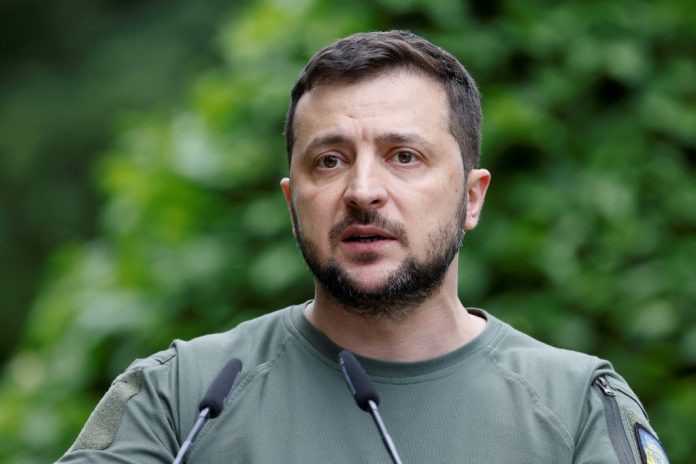
Zelensky: Some countries took a ‘blind eye’ to Ukraine
During Volodymyr Zelensky’s Arab League speech, he said some countries preferred to “turn a blind eye” to Russia’s illegal annexation of Ukrainian land.
“Unfortunately, there are some in the world and here, among you, who turn a blind eye to those cages and illegal annexations,” he stated, urging leaders “take an honest look” at the war.
“Ukrainians has never chosen the war. Our troops didn’t go to other lands. We do not engage in annexation and plunder of other nation’s resources. But we will never submit to any foreigners or colonisers. That’s why we fight,” the president continued.
Zelensky also highlighted how the war in Ukraine had affected Muslims in Crimea.
“Crimea was the first to suffer under the Russian occupation and until now most of those who are subjected to repression in occupied Crimea are Muslims,” he said.
Zelensky’s attendance at G7 summit is “extremely important”: Top Ukraine security official
Ukrainian President Volodymyr Zelensky’s attendance in person at the G7 summit in Hiroshima, Japan, is “extremely important,” a senior Ukrainian security official said Friday.
Zelensky’s expected visit to Japan comes as Kyiv continues to look to its Western partners for military backing ahead of a highly anticipated counteroffensive.
“Very important things will be decided there,” Oleksii Danilov, Secretary of the National Security and Defense Council of Ukraine, said on Ukrainian television.
“Therefore the physical presence of our president is absolutely important — to defend our interests, to explain, to provide clear proposals and clear arguments on the events that are taking place in our country,” he added.
Danilov also stressed the importance of face-to-face meetings.
“Because when a person is far away, across the ocean or somewhere else, they do not always feel and understand what is happening here in our country,” hecontinued, noting, “It is the physical presence of our president that is extremely, extremely important at such events.”
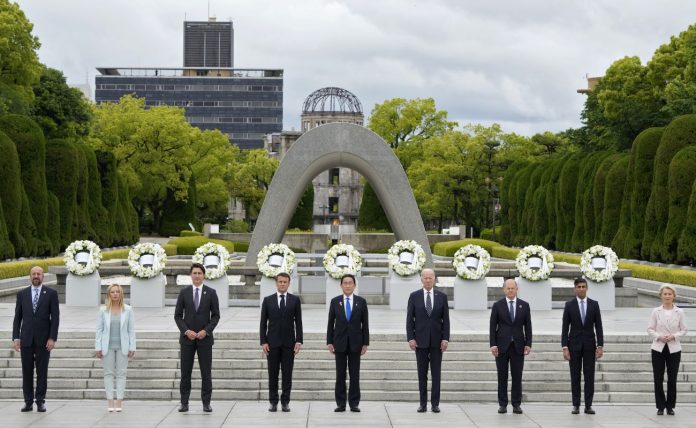
G7 member countries — Canada, France, Germany, Italy, Japan, the United Kingdom and the United States — include Ukraine’s largest backers.
G7 leaders agree to impose further sanctions on Russia
Leaders of the Group of Seven (G7) countries have agreed to impose further sanctions on Russia and have “reaffirmed” their commitment to stand against Moscow’s “illegal, unjustifiable, and unprovoked” war in Ukraine.
The further sanctions and measures are intended “to increase the costs to Russia and those who are supporting its war effort,” and build on efforts to “ensure that Russia is no longer able to weaponize the availability of energy,” the G7 leaders said in a statement issued from the G7 summit in Hiroshima.
“We will broaden our actions to ensure that exports of all items critical to Russia’s aggression including those used by Russia on the battlefield are restricted across all our jurisdictions,” the statement said.
This will include “exports of industrial machinery, tools, and other technology that Russia uses to rebuild its war machine,” the statement continued. Key sectors that will be targeted include manufacturing, construction, and transportation as well as business services.
Leaders said they “remain committed” to upholding the price caps on Russian oil and petroleum products and will enhance efforts “to counter evasion of these caps while avoiding spillover effects and maintaining global energy supply.”
G7 leaders also renewed their commitment to provide “the financial, humanitarian, military and diplomatic support Ukraine requires for as long as it takes,” echoing previous vows of support for Kyiv.
“Our support for Ukraine will not waver. We will not tire in our commitment to mitigate the impact of Russia’s illegal actions on the rest of the world,” the statement added.
Furthermore, leaders underlined that peace “cannot be realized without the complete and unconditional withdrawal of Russian troops and military equipment,” and reiterated that threats by Russia of nuclear weapon use are “inadmissible.”
Australia imposes new sanctions on Russia
Australia announced new financial sanctions and an export ban on Russia, according to a joint media release from Prime Minister Anthony Albanese and Foreign Minister Penny Wong on Friday.
The sanctions will target 21 entities including subsidiaries of state-owned energy company Rosatom and Russia’s largest petroleum and gold companies.
Defense entities supporting Russia’s war in Ukraine and five Russian banks, as well as three individuals have also been targeted, according to the release.
Meanwhile, Australia will also ban the export of all machinery and related parts to Russia and areas temporarily under Russian control.
Foreign Minister Penny Wong said the sanctions targeted sectors of economic and strategic importance to Russia.
It comes as Albanese arrived in Japan on Friday to attend the G7 Summit in Hiroshima.
“We will continue to work with the G7 and international partners to address the global impacts of Russia’s invasion,” Albanese said in the release, adding, “This includes food and energy insecurity, which is a significant concern for our own region.”
Earlier, the United Kingdom and European Union also announced new sanctions on Russia.
EU calls on China to “press Russia to stop its military aggression”
The European Union has called on China to “press Russia to stop its military aggression,” the president of the EU Council said Friday.
Speaking before the G7 summit in Hiroshima, Japan, Charles Michel also stressed the importance of strengthening the bloc’s relations with Beijing, saying that a “stable and constructive relation with China is in our mutual interest.”
However, Michel added the EU will remain “firm” on its values and will promote its interests.
Michel stressed the “need to engage together with China on global challenges: climate change, conservation of natural resources; biodiversity; debt sustainability,” given its role in the international community and its expansive economy.
“China has a special responsibility in the world. It has to play by international rules. And we call on China to press Russia to stop its military aggression,” Michel stated.
“We will keep voicing our concerns on human rights whether it is in Hong Kong, in Xinjiang or in Tibet. We will not tolerate interferences in our countries that would undermine our democratic societies,” he continued.
Michel added that the EU will work to “reduce our over dependencies” on China and “create a true level playing field for our companies and for our workers.”
He also restated the bloc’s commitment to its “One China policy” on Taiwan, adding that there was “no unilateral change of the status quo” on the EU side.
Russia’s prime minister is due to visit China next week for trade talks, Moscow said on Friday.
G7 leaders renew commitment to Ukraine
Group of Seven (G7) leaders say they have ensured that Ukraine has the budget support it needs for this year and early 2024, renewing its commitment to support Kyiv in its fight against Russia.
“Today we are taking new steps to ensure that Russia’s illegal aggression against the sovereign state of Ukraine fails and to support the Ukrainian people in their quest for a just peace rooted in respect for international law,” they announced in a statement at the G7 summit, which began in the Japanese city of Hiroshima.
Russia is trying to recapture land around Bakhmut: Ukraine
Russian forces are trying to recapture land they have lost around Bakhmut, but Kyiv’s forces are repelling the attacks, Deputy Ukrainian Defence Minister Hanna Maliar stated on Friday.
Moscow has gained some ground inside the city, but they do not control it and fighting rages on, Maliar said in televised comments.
Wagner founder Yevgeny Prigozhin has also stated that Bakhmut was unlikely to fall in the next two days as Ukrainian forces have fortified their positions in the south of the city.
“Bakhmut has still not been taken,” Prigozhin said in a voice message posted on Telegram.
“Bakhmut is unlikely to be taken either tomorrow or the day after tomorrow,” he added.
“There is a quarter known as the ‘Airplane’ – it is like an impregnable fortress from a bed of multi-storey buildings in the southwest of Bakhmut, where incredibly heavy battles are going on,” he continued.
Russia has been trying to capture Bakhmut since last summer in what has been the longest and bloodiest battle in the war.
Russian air strikes hit several buildings in Zelensky’s hometown
Russian air strikes hit several buildings in President Volodymyr Zelensky’s hometown and seriously wounded a 64-year-old woman.
“Several explosions occurred in (the central Ukrainian city of) Kryvyi Rih. The enemy hit a private industrial enterprise. Several buildings caught fire at once,” the president’s office said in a statement.
“A 64-year-old woman was injured. She was hospitalised in a serious condition,” the president’s office added.
“The enemy attack caused a fire in the administrative building. It has already been extinguished,” it noted.
The Ukrainian military announced it had shot down three of six cruise missiles and 16 of 22 attack drones that were fired.
Russian forces enhancing positions in Zaporizhzhia: Report
Russian military forces have been enhancing defensive positions in and around the Zaporizhzhia nuclear power plant in recent weeks, four witnesses told the Reuters news agency.
New trenches have been dug around the city, and more mines have been laid.
The measures described by two Ukrainians who work at the power plant and two other residents in the city of Enerhodar underline the risks the war poses to the facility’s security.
The sources spoke on condition of anonymity because of fears for their safety.
The four sources said they heard occasional blasts, which they assumed were from stray animals stepping on mines.
One of the workers also saw tracer bullets fired across from the roof of one of the plant’s buildings, most likely at a drone.
Zelensky asks G7 for peace summit without Russia: Report
President Volodymyr Zelensky has asked the G7 to consider holding a summit on the peaceful settlement of the conflict in Ukraine without the participation of Russia, an EU official has told the Financial Times on Friday.
The leaders of Canada, France, Germany, Italy, Japan, the UK, the US and the EU will discuss the possibility of staging such an event this summer during a three-day Group of Seven meeting, which kicks off in Hiroshima on Friday, the outlet reported.
According to the official, the discussions at the high-profile meeting in Japan will focus on the ten-point peace plan that Zelensky has been promoting in recent months. Among other things, this proposal calls for Russia to withdraw its forces from all territories within Ukraine’s 1991 borders, to pay reparations, and to submit to war-crime tribunals.
Moscow has rejected the plan as “unacceptable,” pointing out that it ignores the reality on the ground and is actually a sign of Kiev’s unwillingness to resolve the crisis through talks.
Zelensky’s spokesperson has confirmed to the FT that Kiev asked the G7 to consider the ten-point plan as Kiev is trying to get as many nations as possible to support the proposal.
The Ukrainian leader himself is expected to address the summit in Hiroshima via video link.
Ukraine is also interested in “China being involved in the implementation of the Ukrainian peace formula,” said Andrey Yermak, Zelensky’s chief of staff, as quoted by the newspaper.
On Thursday, Zelensky and other Ukrainian officials, including Yermak, held a meeting in Kiev with China’s newly appointed special envoy for Eurasian affairs, Li Hui.
According to the Chinese Foreign Ministry, Li told the Ukrainians that Beijing is eager to serve as a peace broker to help reach a political resolution between Kiev and Moscow, based on the principles outlined in a 12-point roadmap published by China in late February.
Beijing’s plan, which calls for early talks between Russia and Ukraine without preconditions, got a positive reception in Moscow, which said it’s ready to discuss it further. However, the West reacted negatively, with NATO Secretary General Jens Stoltenberg claiming that Beijing lacked “credibility” as a mediator, having refused to condemn Moscow’s military operation. EU foreign policy chief Josep Borrell described the Chinese roadmap as merely “a set of wishful considerations.”
On Wednesday, Russian Foreign Minister Sergey Lavrov said Moscow remains prepared to listen to peace proposals “based on a genuine wish to contribute to the stabilization of the world order,” including those recently made by Brazil and the African nations.
UK imposes new sanctions on Russia, targeting theft of Ukrainian grain
The United Kingdom on Friday announced new sanctions against Russia, targeting companies connected to the theft of Ukrainian grain and those involved in the shipment of Russian energy.
“The 86 designations target individuals and organisations connected to Russia’s energy, metals, defence, transport, and financial sectors – ramping up pressure on Putin’s remaining revenue and attempts to use these sectors to support the military machine,” the UK Foreign Office said in a statement.
Russian forces have been accused of stealing farm equipment and thousands of tons of grain from Ukrainian farmers in areas they have occupied, as well as targeting food storage sites with artillery.
The announcement comes as British Prime Minister Rishi Sunak meets with G7 leaders in Hiroshima on Friday.
In an earlier statement Friday, the prime minister’s office said the UK will ban the import of Russian diamonds, Russian-origin copper, aluminum and nickel under legislation to be introduced later this year.
Britain has sanctioned more than 1,500 individuals and entities since Russia’s invasion of Ukraine began, freezing more than £18 billion ($22.3 billion) of assets in the UK, according to Downing Street.
Zelensky to attend Arab League summit in Saudi Arabia
Ukrainian President Volodymyr Zelensky will attend the Arab League summit in Saudi Arabia on Friday, two Arab diplomats confirmed to CNN.
The Ukrainian leader is en route to Japan to attend the Group of Seven (G7) summit, according to an official familiar with the planning.
Officials have declined to say exactly when Zelensky would arrive in Hiroshima or detail his travel arrangements. He has been traveling outside his country more as the war grinds onward, including a tour of Europe last week.
ICRC, Japanese Red Cross urge G7 members to sign Treaty on the Prohibition of Nuclear Weapons
The International Committee of the Red Cross (ICRC) and Japanese Red Cross are urging the members of the G7 to sign the Treaty on the Prohibition of Nuclear Weapons.
On Friday morning, G7 leaders paid their respects at the memorial to those killed as a result of the bombing of Hiroshima.
Medical and humanitarian workers from the ICRC and Japanese Red Cross were among those who tried to help the dying and injured after the bomb was dropped in 1945, in what the organisation described as “near impossible” conditions.
“For the sake of the survival of humanity, we must free the world of weapons that threaten catastrophic humanitarian consequences and irreversible harm,” the two organisations said in a joint statement.
“We cannot allow a repetition of this dark part of our past; we owe it to the survivors – the Hibakusha – to ensure that the horrors they suffered are never repeated,” they added.
Around the world some 68 states have ratified the treaty, and 27 more have signed it. No G7 members have done so.
Zelensky to attend G7 in person: Source
Ukrainian President Volodymyr Zelensky will travel in person to Japan for the Group of Seven (G7) summit, according to an official familiar with the planning.
The war in Ukraine is at the top of agenda for the three-day summit, where leaders are expected to make a strong statement of unity in support of Ukraine and unveil new measures to choke off Russia’s ability to fund and supply its war.
Zelensky’s expected visit would be his first to Asia since Moscow launched its full-scale assault on Ukraine last February, and comes as Kyiv continues to look to its Western partners for military backing ahead of a highly anticipated counteroffensive.
G7 member countries — Canada, France, Germany, Italy, Japan, the United Kingdom and the United States — include Ukraine’s largest backers.
Zelensky’s expected travel to Asia follows a four-country European tour, where he welcomed additional pledges of military support for Kyiv’s defense.
Japan’s Ministry of Foreign Affairs on Thursday had stated Zelensky would participate virtually in a Sunday session of the G7, after being invited by Japanese Prime Minister Fumio Kishida earlier this year.
US plans 300 new sanctions as G7 moves to tighten screws on Russia
A key topic on the G7 agenda is how to put more pressure on Russia to end its war in Ukraine.
Western countries – and some other democracies including South Korea and Japan – have already imposed some of the toughest sanctions ever devised, but leaders in Hiroshima are expected to tighten the screws still further.
According to Rachel Lukasz, a member of the International Working Group on Russian Sanctions at Stanford University, there is “definitely plenty of space” for further action.
A senior official with the administration of US President Joe Biden has told reporters that Washington plans 300 new sanctions targeting 70 Russian entities and place more countries on a US blacklist.
As well as the diamond ban, British Prime Minsiter Rishi Sunak says the UK will also ban imports of Russian copper, aluminium and nickel, and impose sanctions on 86 people and companies linked to Russian President Vladimir Putin.
EU says ‘stable and constructive’ cooperation with China important
China is a big issue as the G7 leaders meet in Japan, with some calling for a tougher line.
But European Council President Charles Michel has stressed it is in the European Union’s interest to maintain “stable and constructive” cooperation with China.
Michel was speaking on the sidelines of the Hiroshima summit.
He added the EU will urge China to step up pressure on Russia to stop its military aggression in Ukraine.
Zelensky to join G7 virtually on Sunday
Ukrainian President Volodymyr Zelensky will participate in the G7 summit virtually on Sunday, Japan’s Ministry of Foreign Affairs announced Thursday.
Zelensky will join a session held Sunday morning on Ukraine, the ministry said.
Earlier this year, Zelensky had accepted an invite from Japanese Prime Minister Fumio Kishida to participate in the summit, which kicks off Friday in Hiroshima, but it was unknown whether he would attend in person or virtually.
US signals to allies that it won’t block them from exporting F-16 jets to Ukraine
The Joe Biden administration has signaled to European allies in recent weeks that the US would allow them to export F-16 fighter jets to Ukraine, sources familiar with the discussions stated.
It comes as the White House has been facing increasing pressure from members of Congress and allies to help Ukraine procure the planes amid intensifying Russian aerial attacks.
Administration officials are not aware, however, of any formal requests by any allies to export F-16s, and State Department officials who would normally be tasked with the paperwork to approve such third-party transfers have not been told to get to work, officials said.
A handful of European countries have a supply of the US-made jets, including the Netherlands, which has signaled a willingness to export some of them to Ukraine. But the United States would have to approve that third-party transfer because of the jets’ sensitive US technology.
While the US remains reluctant to send any of its own F-16s to Kyiv, US officials told CNN that the administration is prepared to approve the export of the jets to Ukraine if that is what allies decide to do with their supply.
Top Ukrainian officials have escalated their public lobbying campaign for US-made F-16s in recent months, arguing they need them urgently to defend against Russian missile and drone attacks.
The issue is expected to be a subject of debate at the next NATO summit in Vilnius, Lithuania, in July, officials added.
Another open question is where Ukrainian pilots would train on these F-16s. A spokesperson for UK Prime Minister Rishi Sunak said earlier this week that the UK and the Netherlands were looking to form an “international coalition” not only to procure the jets for Ukraine but also to train Ukrainian pilots.
In March, the US hosted two Ukrainian pilots at a military base in Tucson, Arizona, to evaluate their skills using flight simulators and to assess how much time they would need to learn to fly various US military aircraft, including F-16s. But the US has no plans as of now to expand that training, a defense official told CNN, despite Congress setting aside money in the 2023 budget.
Russia remains reliable global food supplier despite sanctions: Putin
Russia’s exports of agricultural produce increased last year despite Western trade barriers, President Vladimir Putin announced on Thursday.
During a meeting with the country’s agriculture minister, Putin stated that Russia had enjoyed its largest-ever grain harvest in the previous crop year, of almost 158 million tons.
In the current agricultural year, which ends on June 30, the country is expecting to export up to 60 million tons of grain, the president added.
According to estimates by the Agriculture Ministry, Russia had already exported 40 million tons of grain as of March. In the last farming year, overall grain exports stood at just over 38 million tons.
“As before, our country is one of the key suppliers of agricultural products in the world, and we have established ourselves as a reliable, predictable partner,” Putin noted.
The country has also become self-sufficient in terms of farming and has a surplus of fish, meat, vegetable oils, grains, and sugar that can be exported, according to the Russian president.
“Despite the barriers to foreign trade, Russia managed to increase the exports of farming produce to $41.6 billion last year,” Putin added.
In 2021, Russia supplied $37.1 billion worth of farm produce to overseas customers, data from the Agriculture Ministry showed. Since 2010, the country’s overall agricultural exports have increased fivefold.
Moscow has been targeted by several rounds of Western economic sanctions since last year that curtailed its ability to settle foreign trade deals.
However, Russia has forged new economic partnerships and has found alternative ways of carrying out foreign trade, including using national currencies instead of the US dollar and the euro.
Zelensky says offensive brigades are preparing, but offers no details
Ukrainian President Volodymyr Zelensky held a meeting with senior commanders Thursday, hinting afterward that his military’s offensive brigades are gearing up for a fight but offering no concrete information.
“The offensive brigades are doing well, we are preparing, but no details,” Zelensky said.
Ukraine has made significant gains along the conflict’s front lines in recent days, raising speculation that its highly anticipated counteroffensive may already be underway.
A senior US official told CNN “shaping operations” began last week, but Ukraine has yet to state outright that its counterattack has formally begun.
After several days of heavy Russian missile attacks on Kyiv and other parts of Ukraine, Zelensky stated that his military will prioritize bolstering its air defense systems and missile stocks, training troops and acquiring more long-range weapons.
Ukraine has successfully used UK-provided Storm Shadow missiles: British official
Ukraine has used the Storm Shadow missiles provided by the United Kingdom against Russian forces, a British defense official said Thursday.
“All I can confirm is it has been used successfully, that is the information I received from the Ukrainians, and I’m pleased it is helping them to defend their country,” British Defense Secretary Ben Wallace told CNN’s Jim Sciutto in an exclusive interview on “News Central.”
The Storm Shadow missiles, the longest-range weapon in Ukraine’s arsenal, were just recently given to Kyiv ahead of an anticipated counteroffensive against the Russian military. The long-range cruise missile has stealth capabilities and a firing range of more than 250km, or 155 miles.
Asked about a potential counteroffensive and Ukrainian attempt to retake Crimea from Russia, Wallace said that under international law, Ukraine has “every right to do that in accordance of self-defense.”
“It’s their sovereign soil,” he continued, adding, “It’s a bit like you asking me if the US were choosing to take back parts of Texas from an enemy that had invaded it. You wouldn’t take anyone else from abroad telling you what you can and can’t take back, it is Ukrainian soil, it is their sovereign territory, it has been invaded, they’ve lost thousands of lives as a result of that invasion, and I think ultimately it will be Ukraine’s decision.”
“Britain isn’t going to stand in the way of that,” he added.
In the last several days, Russia has continued pounding Ukraine with missiles, killing one civilian and injuring two others in Odesa overnight. Ukraine, however, has maintained that it has been able to knock down many of Russia’s missiles before impact, particularly in the capital of Kyiv.
On Tuesday morning, Russia launched what Ukraine described as an “exceptional” assault on Kyiv that was largely intercepted by air defenses.
While the battle rages, there has been confusion on whether Ukraine’s counteroffensive has started yet — though that may be the point. US and NATO-supplied equipment has continued pouring into the country, and Wallace said Thursday that the international community’s support of Ukraine is only growing stronger.
Patriot missile battery damaged in Ukraine is now repaired: Pentagon
A Patriot missile battery damaged by a Russian missile barrage against Kyiv has been fixed, the Pentagon announced Thursday.
“One Patriot system was damaged, but it has now been fixed and is fully back and operational,” said Pentagon deputy press secretary Sabrina Singh.
Storm Shadow missiles have been used in Ukraine: UK DM
United Kingdom Defense Minister Ben Wallace said long-range Storm Shadow missiles, which were provided to Ukraine by Britain, have been used since the deployment was announced.
Speaking at a news conference in London alongside his Norwegian counterpart Bjørn Arild Gram on Thursday, Wallace said he would not give more operational details.
“All I can say is it is my understanding that it has been used since we announced its deployment to Ukraine, but I’m not going to go into further details,” he said.
The Storm Shadow is a long-range cruise missile with stealth capabilities, jointly developed by the UK and France, which is typically launched from the air. With a firing range in excess of 250 kilometers, or 155 miles, it is just short of the 185-mile range capability of the US-made surface-to-surface Army Tactical Missile Systems, or ATACMS, that Ukraine has long asked for.
The missiles have the range to strike deep into Russian-held territory in eastern Ukraine. A Western official told CNN that the UK has received assurances from the Ukrainian government that these missiles will be used only within Ukrainian sovereign territory and not inside Russia.
Last week, Wallace called the donation Ukraine’s “best chance to defend themselves against Russia’s continued brutality.”
Global wheat prices fall as Black Sea grain deal gets 2-month extension
Global wheat prices fell Thursday after Ukraine and Russia agreed to extend a deal allowing grain to be exported from Ukrainian ports in the Black Sea.
Wheat futures on the Chicago Board of Trade dropped 2% to $6.12 a bushel. Prices have fallen 23% since the start of the year and 57% since hitting an all-time high of $14.30 a bushel in March last year.
“These agreements matter for global food security,” António Guterres, secretary general of the United Nations, told journalists Wednesday. “Ukrainian and Russian products feed the world.”
The grain deal, first signed in July 2022, was due to expire on Thursday, but Turkish, Russian and Ukrainian officials said on Wednesday that it would be extended for another two months.
Russia had previously threatened to pull out of the deal, complaining about a related agreement with the UN to facilitate shipments of Russian grain and fertilizers.
Ukraine and Russia together account for nearly a third of global wheat exports, according to Gro Intelligence, an agricultural data firm. They are also among the top three global exporters of barley, maize, rapeseed oil and sunflower oil.
Following its full-scale invasion of Ukraine in February last year, Moscow blockaded crucial grain shipments from the country’s Black Sea ports. That meant that millions of tons of the region’s grain went undelivered to the many countries that rely on it.
In the days after the invasion, global wheat prices skyrocketed, with the UN’s Food and Agriculture Organization warning that as many as 47 million people could be pushed into “acute food insecurity” because of the war.
But the July grain deal and its renewals have helped “stabilize markets and reduce volatility,” the United Nations Conference on Trade and Development, an intergovernmental body, said in a press release on Wednesday, noting that global food prices had fallen 20% since hitting all-time highs in March 2022.
Ukrainian brigade claims breakthrough on western outskirts of Bakhmut
As intense combat continues in and around the eastern Ukrainian city of Bakhmut, one Ukrainian unit says it has made more progress on the western outskirts of the city.
The Third Separate Assault Brigade said its recent “offensive actions” have helped it stake out a strong position ahead of Ukraine’s anticipated counteroffensive. Brigade leaders said the breakthrough came in an area about 2000 meters (about 1.25 miles) wide and 700 meters (a little less than half-a-mile) deep.
The Ukrainian fighters claim they’ve killed at least 50 Russian troops and wounded as many as 100 more, taking an additional four Russians prisoner. This has significantly cut into the enemy’s reserves in the area, the brigade said.
Other recent developments in Bakhmut: Ukrainian forces have claimed advancements in several areas surrounding the embattled eastern city in recent days, despite coming under heavy fire from Russian troops.
Ukrainian fighters from another unit, the 46th Separate Air Assault Brigade, said on Telegram that they’re focused on a promising territory in a rural area south of the city, as well as villages close to the main highway that runs northwest from Bakhmut toward Sloviansk.
The head of the Wagner mercenary group, Yevgeny Prigozhin, claimed Thursday that Russian army units pulled back in an area north of Bakhmut, leaving his own fighters exposed.
However, Prigozhin said his fighters in the city itself continue to take streets and buildings along the western edge of Bakhmut.
US wants to ‘freeze’ Ukraine conflict: Report
The administration of US President Joe Biden is reportedly considering ‘freezing’ the conflict in Ukraine for the foreseeable future, instead of pushing for the country’s victory, according to sources cited by Politico on Thursday.
Three serving and one former US official told the outlet that a long-term low-intensity stand-off was currently being discussed in the White House.
The former official compared the possible scenario to how the Korean War of the early 1950s ended in an armistice. There was no formal peace agreement, with both Pyongyang and Seoul claim sovereignty over the entire Korean Peninsula and a demilitarized zone separating the two parts.
“A Korea-style stoppage is certainly something that’s been discussed by experts and analysts in and out of government,” the source said, adding, “It’s plausible, because neither side would need to recognize any new borders and the only thing that would have to be agreed is to stop shooting along a set line.”
The benefits for the US would be that a frozen conflict would be less costly for Western nations and draw less public attention, and consequently less pressure to assist Kiev, the outlet explained.
Ukraine would still be allied with Washington and continue switching its military to NATO standards, as it seeks to join the bloc someday.
The ‘Korean scenario’ for Ukraine drew media attention in January, after Aleksey Danilov, the secretary of the country’s national security council, claimed in an interview that Moscow had sent a top official to European capitals to promote it.
The Kremlin denied the reports and claimed Danilov may have mistaken a Ukrainian politician surnamed Kazak for his namesake in the Russian government, whom he identified as the messenger.
Dmitry Medvedev, the deputy chair of the Russian Security Council, argued that Danilov’s words were meant for “domestic consumption,” so that the Ukrainian government could measure the public reaction to it. The Russian official mused that “being split is the best-case scenario,” for Kiev, under the circumstances.
Moscow called NATO’s expansion in Europe and its creeping takeover of Ukraine without its formal accession as one of the key reasons for sending troops against its neighbor. The conflict, Russia has maintained, is part of a US proxy war against it, in which Ukrainians serve as cannon fodder.
Ukraine has ‘five months left’ to impress US: Report
Ukraine has five months to demonstrate some “advances” to the US and other Western backers, to convince them of its plans for the conflict with Russia, the Financial Times reported on Thursday, citing several European and American officials.
Washington is entering an election cycle and has to show that the massive military support the US and its allies have been providing to Ukraine has not been in vain, the paper also said.
“It is important for America to sell this war as a successful one, as well as for domestic purposes to prove that all of those aid packages have been successful in terms of Ukrainian advances,” a European official told the daily.
The polls show that public support for Ukraine is waning in the US, and President Biden’s administration has to show that the tens of billions of dollars it spent on assistance for Kiev made a major difference on the frontlines, the media outlet added.
According to FT sources, Washington believes the next five months are critical to the outcome of the conflict. “If we get to September and Ukraine has not made significant gains, then the international pressure on [the West] to bring them to negotiations will be enormous,” another source told the FT, on condition of anonymity.
September will see the UN General Assembly and G20 leaders’ summit take place one after another. Both events could be used to make the warring parties sit down at a negotiating table, FT reported.
The Western military support for Kiev is also about to reach its limits, the sources warned.
“The message [to Kiev] is basically that this is the best you’re going to get,” a European official told the paper, adding, “There’s no more flexibility in the US budget to keep writing checks, and European arms factories are running at full capacity.”
The US continues to be Ukraine’s biggest backer when it comes to arms supplies. Washington’s allies are concerned about its capacity to maintain that support and expect it to decrease in 2024 amid a US presidential election.
“We can’t keep the same level of assistance forever,” a European official said, adding that the current level of support might be sustained for a year or two but no longer.