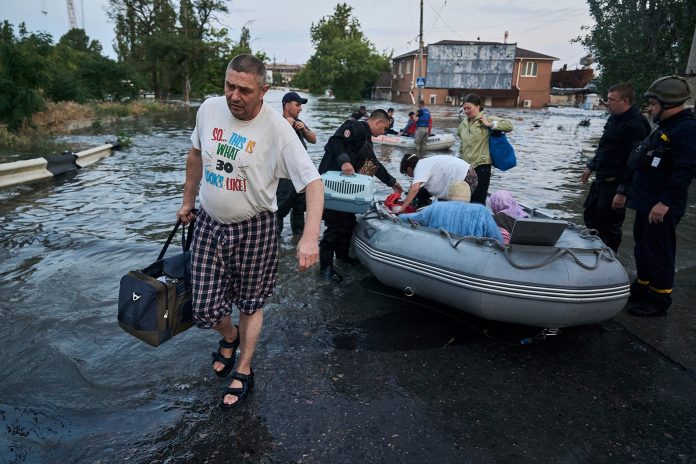
Dam collapse evacuations ‘completely failed by occupiers’: Zelensky
President Volodymyr Zelensky says evacuation efforts in Russia-occupied areas near the Nova Kakhovka dam are faltering, as he calls for urgent humanitarian aid.
On Telegram, Zelensky said the Nova Kakhovka dam was the main topic of a government conference call in the morning.
“Evacuation on the left bank has been completely failed by the occupiers. We will appeal to international organisations,” he continued, adding, “Minister Ihor Klymenko, the newly appointed head of the emergency response headquarters, delivered a report. He is already on the ground.”
The priorities are the “evacuation of people”, he said, as well as urgent provision of drinking water and long-term solutions for settlements that were dependent on the reservoir.
Zelensky added Klymenko is also assessing environmental damage.
Russia’s DM orders military contractor to speed up deliveries
Russian defence minister Sergei Shoigu has ordered military contractor Almaz-Antey to speed up new production facilities to manufacture air defence systems.
“The products manufactured by Almaz-Antey Corporation are in demand and show high efficiency in the special military operation area,” Shoigu said on a visit to one of the company’s plants.
The statement quoted a top official at Almaz-Antey as saying the corporation was delivering its products ahead of schedule.
Almaz-Antey makes air defence missile systems like the S-300 and S-400, which are used to shoot down aircraft and ballistic and cruise missiles.
Ukrainian troops advance 1,100 meters in Bakhmut: Minister
Ukrainian Deputy Defence Minister Hanna Maliar says troops have advanced from 200 to 1,100 metres on parts of the front around the Bakhmut in the last 24 hours.
On Telegram, Maliar said, “In the direction of Bakhmut, our troops switched from defence to offensive. Over the past day, we have advanced from 200 to 1,100 meters in various sections of the Bakhmut direction.”
“The enemy in this direction went on the defensive, trying to hold the occupied positions. At present, the enemy is withdrawing its reserves in this direction from the depth for protection,” she continued.
The minister added that Wagner forces still remain in some place in the rear, and the Russian army is “conducting hostilities”.
“It is possible to hold the defence of the Bakhmut direction for so long and now to advance on it thanks to the fortifications prepared in advance,” she added.
Ukraine evacuates more than 1,500 people from flooded Kherson areas
Some 1,548 people had been evacuated from Ukrainian controlled flooded areas of the Kherson region by 11:30 a.m. local time, the State Emergency Services and National Police of Ukraine confirmed Wednesday.
Thousands have been evacuated and there are fears of an ecological catastrophe after the Nova Kakhovka dam and hydroelectric power plant collapsed on Tuesday.
Authorities added in a post on Telegram that “20 settlements on the west bank of the Dnipro River and more than 1,900 houses were flooded in Kherson region.”
The operation to save people has involved 1,700 workers, 300 pieces of equipment and 33 water vessels.
One of the pieces of equipment used in the rescue was the “Bohun” all terrain vehicle that can move freely through water and mud.
Kyiv and Moscow have traded accusations over the dam’s destruction, without providing concrete proof that the other is culpable. It is not yet clear whether the dam was deliberately attacked or whether the breach was the result of structural failure.
Ukrainian President Volodymyr Zelensky, however, said Russia bears “criminal liability” and Ukrainian prosecutors are investigating the dam incident as a case of “ecocide.”
Concerns are now turning to the dangers to wildlife, farmlands, settlements and water supplies from the floodwaters and possible contamination from industrial chemicals and oil leaked from the hydropower plant into the Dnipro River.
Russia’s Belgorod region heavily shelled from Ukraine overnight: Regional governor
Ukrainian forces carried out heavy shelling of Russia’s Belgorod region overnight, Gov. Vyacheslav Gladkov said on Telegram Wednesday.
According to Gladkov, the shelling targeted several areas in the border region of Belgorod, including Shebekino.
“460 units of various ammunition were fired in the Shebekino urban district, 26 drops of explosive devices from UAVs (unmanned aerial vehicles) were recorded,” Gladkov wrote, adding that in the town of Shebekino strikes were carried out mainly on residential areas.
Galdkov added that the villages of Zhuravlyovka, Tsapovka, Stary, and Kozinka also came under fire, with no reported injuries.
Russia has seen the effects of its war on Ukraine increasingly reverberate back onto its own territory in recent months.
Belgorod has seen a series of drone attacks. Last week, a “massive” shelling attack injured four people in the region. Eight apartment buildings, four homes, a school and two administrative buildings were damaged during the shelling in Shebekino, a village in the border region of Belgorod.
A drone attack was also launched on Russia’s Bryansk region last Wednesday, state news agency RIA Novosti reported. About 10 drones tried to attack the Klimovsky district and were shot down or intercepted, RIA reported citing emergency services.
At least 500,000 hectares of land could become ‘deserts’: Ukraine
Ukraine’s agriculture ministry says the Kakhovka dam flooding will affect tens of thousands of hectares of land in southern Ukraine and could leave at least 500,000 hectares into “deserts”.
“The destruction of the Kakhovka hydroelectric power station will lead to the fact that fields in the south of Ukraine may turn into deserts next year,” the agriculture ministry said.
The disaster would cut off the water supply to 31 irrigation systems in the Ukrainian regions of Dnipro, Kherson and Zaporizhzhia, the statement added.
Kyiv has estimated that about 42,000 people are at risk from flooding, which it expects to peak on Wednesday.
President Volodymyr Zelenskyy said the dam’s collapse had left hundreds of thousands of people without normal access to drinking water.
Russia’s Medvedev says Moscow should launch its own offensive
Dmitry Medvedev, Russia’s former president, has said it seems that Ukraine has already launched its long-awaited counteroffensive and that Moscow should respond with its own offensive once it had repelled Kyiv’s forces.
“The enemy has long promised a great counteroffensive. And it seems to have already started something,” Medvedev, who now serves as the deputy chairman of Russia’s Security Council, said in a statement on the Telegram messaging app.
“We have to stop the enemy and then launch an offensive,” he added.
Hundreds of thousands with no drinking water after dam collapse: Zelensky
President Volodymyr Zelenskyy stated that the destruction of the Nova Kakhovka dam in southern Ukraine had left hundreds of thousands of people without normal access to drinking water.
“The destruction of one of the largest water reservoirs in Ukraine is absolutely deliberate … Hundreds of thousands of people have been left without normal access to drinking water,” the Ukrainian president said on social media.
Zelensky has called the collapse of the Kakhovka dam an act of “mass environmental destruction” and said the attack on such critical infrastructure would not alter Ukraine’s plans to retake territory from occupying Russian forces.
Describing the explosion that destroyed the dam as a deliberate and chaotic act by Russia, Zelensky stated that the dam was blown up in a bid to “use the flood as a weapon” to hamper Ukrainian forces.
The Kremlin blamed Ukraine for the dam’s collapse, saying Kyiv had destroyed the site to distract from the faltering launch of its counteroffensive that Moscow had already blunted.
At least 7 missing after dam collapse
At least seven people are missing following the collapse of the Nova Kakhovka dam on Tuesday, the occupied town’s Moscow-appointed mayor told Russian state-run news agency RIA Novosti.
“We are clarifying the information on the missing people now,” Vladimir Leontiev said Wednesday, according to RIA.
“We know about seven people for sure,” he added.
Earlier on Wednesday, Leontiev said 900 people had been evacuated so far and the water levels in Nova Kakhovka were decreasing after the dam’s collapse caused extensive flooding.
A Ukrainian military official said that more than 1,400 people have been evacuated in the Kherson region as of early Wednesday following the collapse of the Nova Kakhovka dam.
In a statement on Telegram, Oleksandr Prokudin, head of the Kherson regional military administration, stated that over 1,800 houses on the west bank of the Dnipro River have flooded.
Ukraine awaits final agreements with allies on delivery of F-16 jets: Zelensky
Ukraine is waiting for final agreements with its allies on the delivery of F-16 jets, President Volodymyr Zelensky told journalists on Tuesday.
“Our partners know how many aircraft we need. I have already received an understanding of the number from some of our European partners, and it is powerful. I am very happy with the information I received from some countries … It was a serious, powerful offer,” Zelensky said.
A news release on the Ukrainian presidency’s website about the conversation said Zelensky had met the leaders of countries ready to provide Ukraine with F-16s on a recent trip to Moldova.
“Now we [Ukraine] still need a joint agreement with the United States,” the release said.
The Joe Biden administration gave its backing for Kyiv’s pilots to be trained on US-made F-16s at the G7 summit in Japan on May 19 and has signaled to allies — some of whom have a supply of the jets — it won’t block their export to Ukraine.
Training on the F-16s has started in several EU countries, the bloc’s High Representative, Josep Borrell, told reporters last month.
Dam collapse possibly the most significant damage to civilian infrastructure since start of war: UN
The collapse of the Nova Kakhovka dam is possibly the “most significant incident of damage to civilian infrastructure” since the start of Russia’s invasion of Ukraine, according to Martin Griffiths, UN Under-Secretary-General for Humanitarian Affairs and Emergency Relief Coordinator.
The dam is a lifeline in the region as a critical water source for millions of people in Kherson as well as Dnipro and Zaporizhzhia oblasts, he said, and a key source of agricultural irrigation in southern Kherson and the Crimean peninsula – impacting farming and food production.
Griffiths added that a severe impact is expected in Russian-occupied areas where humanitarian agencies are still struggling to gain access.
The UN aid chief, speaking to the Security Council on Tuesday, also highlighted the danger fast-moving water poses to the risks of mine and explosive ordinance contamination, displacing the projectiles to areas previously assessed as safe.
Griffiths pointed out the impact the dam’s collapse will have on electricity generation and the safety of the Zaporizhzhia nuclear power plant.
“The damage caused by the dam’s destruction means that life will become intolerably harder for those already suffering from the conflict,” Griffiths said, “The consequences of not being able to deliver assistance to the millions of people affected by the flooding in these areas are potentially catastrophic.”
US and Western officials see signs that Ukraine’s counteroffensive is beginning: Senior NATO official
US and western officials see signs that Ukraine’s long-awaited counteroffensive against Russia is beginning and have noted a “substantial increase in fighting” in the east of the country over the last 48 hours as Ukrainian troops probe for weaknesses in Russian defensive lines, a senior NATO official said on Tuesday.
While preliminary attacks, also known as “shaping” operations, have been underway for at least two weeks, Ukrainian forces have in the last several days begun testing Russian positions with artillery strikes and ground attacks to find vulnerable areas they can break through, the NATO official and a senior European military intelligence official told CNN.
The collapse of a sprawling dam in Ukraine’s Russian-occupied Kherson region, which triggered a wave of evacuations on Tuesday as floods of water spilled from the Nova Kakhovka hydro-electric plant, could complicate some of Ukraine’s plans, officials told CNN.
The dam’s breach could now make it more difficult for Ukrainian troops to cross the Dnipro River and attack Russian positions there, said two western officials. And the dam’s collapse has already created a significant humanitarian challenge into which the Ukrainian government will need to address and funnel resources.
“Anything that may have been planned downstream from the dam probably has to be replanned,” a European ambassador in Washington said, adding, “Ultimately, the water levels will recede, but most likely, the catastrophic flooding has impacted the bridges and roads in the area, so they may not be usable in the way as planned before.”
The US and the Western intelligence community are still examining who is responsible for the dam’s destruction, but officials are leaning toward Russia as the culprit, the official said.
Over the last several days, analysts have seen some notable Ukrainian operations and probes in the southeastern region of Zaporizhzhia, between the southern city of Kherson and the Zaporizhzhia nuclear power plant, the NATO official said. Ukrainian forces are also conducting operations south of Donetsk city in eastern Ukraine, which appears to be a new effort, the western official said.
The counteroffensive is expected to be carried out on multiple fronts, a senior US military official said. The official added that “there are many moving parts to synchronize” before a major ground operation can be launched. The weather has also played a role and delayed Ukraine’s initial attacks on Russian defensive lines.
Intel shows Ukraine’s military was planning attack on Nord Stream pipelines: US officials
The US received intelligence from a European ally last year that the Ukrainian military was planning an attack on the Nord Stream natural gas pipelines three months before they were hit, three US officials told CNN.
The attack on the pipelines last September has been condemned by US officials and Western allies alike as a sabotage on critical infrastructure. It is currently being investigated by other European nations.
The intelligence assessment was first disclosed by The Washington Post, which obtained the document from a trove of classified documents allegedly leaked on the social media platform Discord by Air National Guardsman Jack Teixeira.
CNN has not seen the document, but the three officials confirmed the US was told about the Ukrainian plans.
According to the Post, the intelligence cited a source in Ukraine, which said Western allies “had a basis to suspect Kyiv in the sabotage” for almost a year. The intelligence said that those who may have been responsible were reporting directly to Ukraine’s commander in chief, Valerii Zaluzhnyi, “who was put in charge so that Ukraine’s president, Volodymyr Zelensky, wouldn’t know about the operation,” the Post reported.
But, the intelligence also said that Ukraine’s military operation was “put on hold.”
White House National Security Council coordinator for strategic communications John Kirby declined to address the reporting directly on Tuesday.
“I think you know there are three countries conducting an investigation of the Nord Stream sabotage — and we called it sabotage at the moment — Germany, Sweden, and Denmark. Those investigations are ongoing and again the last thing that we’re going to want to do from this podium is get ahead of those investigations,” Kirby stated.
The news comes less than a year after leaks caused by underwater explosions were discovered in the Nord Stream 1 and 2 pipelines, which funnel gas from Russia into the European Union and run under the Baltic Sea. The pipelines were controversial before the war in Ukraine began, stoking concerns about European dependence on Russian gas.
Kyiv and Moscow point fingers at each other for collapse of critical dam
Both Ukraine and Russia are blaming each other for the collapse of the Nova Kakhovka dam Tuesday as residents in the area rush to evacuate.
Ukrainian President Volodymyr Zelensky has described the collapse as “an environmental bomb of mass destruction” while the Russian Foreign Ministry claimed it was caused by an “act of sabotage” by Ukraine.
“For the sake of their own security, the world should now show that Russia will not get away with such terror,” Zelensky said in his nightly address to the nation Tuesday.
He called on the Office of the Prosecutor of the International Criminal Court to “involve international justice” and investigate what caused the collapse.
Only the “complete liberation of Ukrainian land from Russian occupiers… will guarantee that such acts of terrorism will not happen again,” he added.
It is not clear whether the dam was deliberately attacked or whether the breach was the result of structural failure.
“This act of sabotage by the Kiev regime has caused devastating damage to the farmland in the region and the ecosystem at the mouth of the Dnieper river. The inevitable drop in the water level of the Kakhovka reservoir will affect Crimea’s water supply and will hinder the improvement of agricultural land in the Kherson region,” the Russian Foreign Ministry announced in a statement.
More than 1,000 people have been evacuated from the southern Ukrainian city of Kherson and other Ukrainian-held parts of the wider region following the collapse of the Nova Kakhovka dam, a local official stated Tuesday on the Telegram messaging app.