Wheat prices rise after strikes on Ukrainian river port
Wheat prices rose sharply on international markets following the strike by a Russian drone against a Ukrainian port on the Danube River.
One grain silo at the port of Reni was hit and substantially damaged, according to geolocated images and video.
Markets are concerned about a tightening supply situation following the collapse of the Black Sea grain initiative last week and a sequence of Russian drone attacks against Ukrainian port infrastructure.
China sending gear to equip Russian army: Report
An investigation by Politico has revealed that China has been sending military gear to equip Russia’s army.
Chinese companies like Shanghai H Win has been supplying hundreds of thousands of bulletproof vests and helmet.
Leaders in the West have repeatedly warned China not to militarily aid Russia’s war in Ukraine.
Beijing has not condemned Moscow’s actions in Ukraine so far, but has proposed a 12-point peace plan to end the war.
Russian attacks aim to fully block Ukrainian grain exports: Odesa governor
The governor of Ukraine’s Odesa region says Russia is trying to completely block exports of Ukrainian grain to global markets after the latest in a series of Russian air attacks struck grain infrastructure on the Danube River.
“Russia is trying to fully block the export of our grain and make the world starve,” Oleh Kiper told Ukrainian television.
Earlier, Ukraine’s Foreign Minister Dmytro Kuleba also called on nations to address “food terrorism” amid Russia’s repeated strikes on Ukrainian grain storage.
Kremlin says it will press on with ‘special operation’ in Ukraine
The Kremlin says it will press on with what it calls its “special military operation” in Ukraine and achieve all of its aims despite Ukrainian drone attacks on Russia.
Kremlin spokesman Dmitry Peskov made the comment when asked how Russia would respond to a drone attack on the Russian capital in the early hours of Monday which it blamed on Ukraine.
The Kremlin also denied that Russian forces had struck a cathedral in the Ukrainian city of Odesa and accused Ukraine of hitting it.
On Sunday, Ukrainian President Volodymr Zelenskyy stated a Russian missile had slammed into Odesa’s Transfiguration Cathedral.
Russia says ‘reserves the right to take tough retaliatory measures’ after drone attacks
The Russian ministry of defence has announced in a statement that the country “reserves the right to take tough retaliatory measures”, after drone attacks on Moscow.
Russia claims that Ukraine launched drones which hit Moscow and Crimea.
“We regard what happened as another use of terrorist methods by the military-political leadership of Ukraine,” the ministry said in a statement on the Telegram messaging app and highlighted that “these attacks had no military meaning”.
“We strongly condemn this yet another crime of the Kyiv regime. We call on international organisations to give it a proper assessment,” ministry added.
The ministry also stressed that Ukraine’s actions were a result of “the West’s focus on further aggravating the situation” and added that the Investigative Committee of Russia has opened criminal cases on the drone attacks.
Russia now producing more munitions per month than last year: Minister
Russia’s Industry Minister Denis Manturov has said that the defence industry was now producing more ammunitions per month, according to a report by Russia’s state news agency RIA Novosti.
Manturov added that the amount was more than 2022.
Russian foreign ministry condemns Ukraine drone strikes and vows retaliation
The Russian foreign ministry has issued a statement calling on international organizations to condemn the recent Ukrainian drone attacks on Moscow and Crimea.
“We regard what happened as another use of terrorist methods by the military-political leadership of Ukraine, intimidation of the civilian population. These attacks had no military meaning,” the foreign ministry said in an official statement published Monday.
“We strongly condemn this yet another crime of the Kyiv regime. We call on international organizations to give it a proper assessment,” it added.
The ministry blamed the West for exacerbating the situation, stating that the actions of Kyiv were influenced by the West’s focus on further escalating tensions.
“The Russian side reserves the right to take tough retaliatory measures,” the ministry said, adding that the Investigative Committee of Russia has opened criminal cases in response to these incidents, assuring that all those responsible will be identified and brought to justice.
The reported attacks come after Russian missiles badly damaged a historic Orthodox cathedral in the southern Ukrainian port city of Odesa, sparking outrage and prompting Ukrainian President Volodymyr Zelensky to vow retaliation.
The Odesa strikes killed at least one person and injured several others, Ukrainian officials said, the latest in a wave of attacks on the port city. The attacks also destroyed other historic buildings, Ukraine’s culture ministry said.
Ukrainian minister claims responsibility for strikes in Moscow and Crimean peninsula
A Ukrainian security official has claimed Kyiv’s responsibility for the drone strikes that hit the Russian capital of Moscow and Crimea overnight.
“Drones attacked the orc capital and Crimea last night. Electronic warfare and air defense are becoming less and less capable of protecting the occupiers’ skies,” said Mykhailo Fedorov, the Ukrainian minister of digital transformation, in a Telegram post on Monday.
“Whatever happens, there will be more of it,” he added.
Fedorov’s ministry is in charge of the Ukrainian “Army of Drones” initiative, the government’s drone procurement plan.
Ukraine almost never publicly claims responsibility for attacks that have taken place on Russian soil or in Russian-occupied territories during the course of the war, but has recently admitted its role in the huge explosion of the Crimean bridge in October.
The Russian Ministry of Defense says Ukraine launched 17 drones toward Crimea overnight through Monday, referring to strikes on the peninsula, which was illegally annexed by Russian forces in 2014, as a “terrorist attack.”
A Russian ammunition depot was hit by the Ukrainian drone attack in Crimea.
Meanwhile in Russia, Ukrainian drones struck two non-residential buildings in Moscow in the early hours of Monday morning and were “suppressed” by defenses there, Russian authorities said, describing the incident a “thwarted” attack.
Ukraine calls for a global response to address ‘food terrorism’
Ukraine’s Foreign Minister Dmytro Kuleba calls on nations to address “food terrorism” amid Russia’s repeated strikes on Ukrainian grain storage.
“Russia hit another Ukrainian grain storage overnight. It tries to extract concessions by holding 400 million people hostage,” he said in a tweet.
“I urge all nations, particularly those in Africa and Asia who are most affected by rising food prices, to mount a united global response to food terrorism,” he added.
Drones brought down near Russian Ministry of Defense complex in Moscow
One of the drones spotted in Moscow on Monday was brought down near a Russian Ministry of Defense complex. Social media footage of the aftermath showed damage to one of its buildings.
One of the buildings seen damaged in footage houses the Russian Ministry of Defense military orchestra. It was not immediately clear if the damage had been caused by the drones.
The area also houses the Russian Foreign Military Intelligence, known as GRU, 26165 unit, which carries out cyber activities, according to multiple Western sources. It’s also in the vicinity of the Russian Ministry of Defense’s National Defense Management Center.
Drones struck two non-residential buildings in Moscow in the early hours of Monday morning and were “suppressed” by defenses there, Russian authorities said, describing the incident a “thwarted” attack.
Russia’s FSB says traces of explosives found on foreign grain ship
Russia’s Federal Security Service (FSB) says it has found traces of explosives on a ship travelling from Turkey to the port of Rostov-on-Don in Russia to pick up grain.
The FSB announced the ship had been docked in the Ukrainian port of Kiliia in May and that it may have been used to deliver explosives to Ukraine.
It added the ship had changed its name while in the Turkish port of Tuzla earlier this month and replaced its crew, which comprised 12 Ukrainian nationals.
The Kremlin has announced that “increased vigilance” was needed after the FSB alleged it had found traces of explosives on a ship travelling to Russia to pick up grain.
Moscow should broaden its strike targets in Ukraine: Medvedev
Russia’s former President Dimitry Medvedev says Moscow needs to broaden the range of targets it strikes in Ukraine.
“We need to choose unconventional targets for our strikes. Not just storage facilities, energy hubs and oil bases,” Medvedev, who is deputy chairman of Russia’s Security Council, said on the Telegram messaging app.
Ukrainian drones hit central Moscow in ‘terrorist’ attack: Russia
Ukrainian drones hit two buildings in Moscow, Russian officials have claimed, both of which were downed.
One of the drones crashed close to the defence ministry in the centre of the Russian capital, while the other hit an office building in southern Moscow. No casualties were reported.
“A Kyiv regime attempt to carry out a terrorist act using two drones on objects on the territory of the city of Moscow was stopped,” Russia’s defence ministry stressed.
Ukraine fired 17 drones at Crimean Peninsula: Russia
The Russian defence ministry says Ukraine tried to attack Crimea overnight using 17 drones.
It added 11 of the drones crashed into the Black Sea after being repressed by anti-drone equipment, three fell on Crimean territory and three were destroyed by air defences.
Ukraine forces retook occupied areas from Russia in east, south last week
Ukraine has claimed its forces over the past week had recaptured more than 16 sq kilometres (6.2 sq miles) from Russian forces in the south and east of the country.
“During the week… the liberated area (in the south) increased by 12.6 sq kilometres (4.86 sq miles),” Deputy Defence Minister Ganna Malyar said in televised remarks, adding that Kyiv’s forces had wrested another four kilometres squared in the east.
Russian ammunition depot hit by Ukrainian drone attack in Crimea
An ammunition depot and a house were destroyed in strikes hitting Crimea overnight into Monday, according to the Russian-appointed head of the annexed region.
Sergey Aksyonov, the official installed by Russia to Crimea, said in a statement that “eleven enemy UAVs were shot down by air defense forces and suppressed by electronic warfare equipment in the skies over Crimea.”
This comes after Ukrainian forces hit an ammunition dump in Crimea on Saturday, forcing an evacuation of the area and canceling train services, Russian-backed authorities in the region say.
Russian drones strike Ukraine port infrastructure destroying grain hangar
Russian drones have attacked Ukraine’s port infrastructure on the Danube river overnight, targeting Ukrainian grain stocks, the Ukrainian Army said in separate statements.
The attack was carried out by attack drones and lasted for 4 hours, Ukraine’s Southern Operational Command posted on Facebook.
There are three main Danube ports in Ukraine — Izmail, Reni and Ust-Dunaiskyi but the post did not specify which were hit.
The statement added that three drones were destroyed by Ukrainian air defense forces, although “some got through,” according to a separate statement by Serhiy Bratchuk, a spokesperson for the Odesa regional military administration.
Six people have been injured in the attack, Oleh Kiper, the head of Odesa’s regional military administration said on Telegram. He added three of those injured were hospitalized with light shrapnel wounds and bruises.
The Ukrainian Army announced a hangar with grain was destroyed while storage tanks for other types of cargo also were damaged in the attack. The army said a fire broke out in one of the production facilities but was quickly extinguished.
Putin claims vital Black Sea grain deal became “meaningless” as Russia continues attacks on key Ukrainian port city
Russian President Vladimir Putin said Moscow withdrew from a vital Black Sea grain deal intended to stabilize global food prices and bring relief to developing countries because it “failed” to ensure the delivery of grain.
The deal struck a year ago allowed Ukraine to export grain by sea, with ships bypassing a Russian blockade of the country’s Black Sea ports and navigating safe passage through the waterway to Turkey’s Bosphorus Strait in order to reach global markets.
Vessels were inspected before they arrived in Ukraine by Russian, Ukrainian and Turkish officials, to ensure weapons were not being smuggled into Ukraine.
The impact of the war on global food markets was immediate and extremely painful, especially because Ukraine is a major supplier of grain to the World Food Programme (WFP).
Since quitting the deal, Russia has continually attacked the southern city of Odesa, a key Ukrainian food-exporting port.
In a self-penned article published Monday on the Kremlin’s website ahead of a Russia-Africa summit scheduled to take place in St. Petersburg later this week, Putin claimed Moscow could make up the shortfall in Ukrainian grain.
“I want to give assurances that our country is capable of replacing the Ukrainian grain both on a commercial and free-of-charge basis, especially as we expect another record harvest this year,” Putin wrote.
“Notwithstanding the sanctions, Russia will continue its energetic efforts to provide supplies of grain, food products, fertilizers and other goods to Africa,” he added.
Putin claimed the grain deal had been used for the “enrichment of large US and European businesses” and that “barriers have been mounted” to Russia’s own attempts to supply mineral fertilizers to countries in need — an effort that, in his opinion, “should be exempt from any sanctions.”
“Considering all these facts, there is no longer any use in continuing the “grain deal” as it has failed to serve its original humanitarian purpose,” Putin concluded.
Last week, Ukrainian President Volodymyr Zelensky spoke with UN Secretary-General Antonio Guterres after Russia pulled out of the grain deal.
“This is another attempt by Russia to weaponize hunger and destabilize the global food market,” Zelensky said in a post on his Telegram page last Monday.
According to the European Commission, Ukraine accounts for 10% of the world wheat market, 15% of the corn market, and 13% of the barley market. It is also a key global player in the market of sunflower oil.
Prior to Russia’s withdrawal, the deal had allowed for the export of almost 33 million metric tons of food through Ukrainian ports, according to data from the United Nations.
Russia claims drone strikes hit two non-residential buildings in Moscow
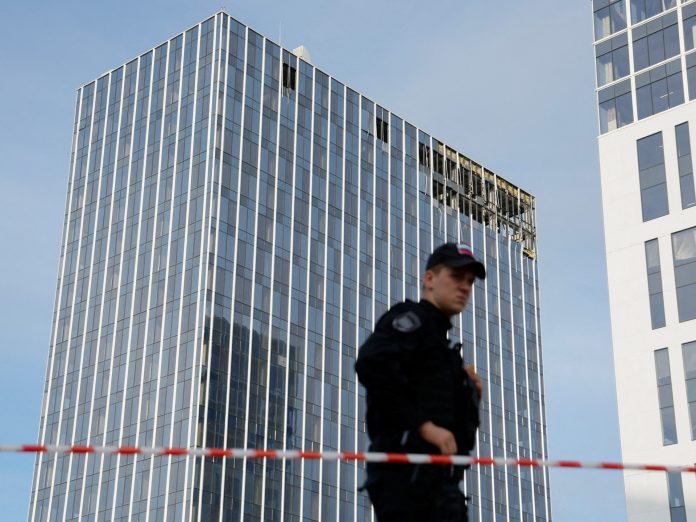
Drones struck two non-residential buildings in Moscow in the early hours of Monday morning and were “suppressed” by defenses there, Russian authorities said, describing the incident a “thwarted” attack.
The strikes caused no serious damage or casualties, Moscow Mayor Sergei Sobyanin said on Telegram Monday.
Russia’s Ministry of Defense blamed Ukraine, describing the strike as a “terrorist attack of the Kiev regime” and that the two drones were “suppressed” and crashed in Moscow.
According to Russian state media outlet, TASS, a drone hit a high-rise business center on Likhacheva Avenue in Moscow.
TASS reported drone debris was found on Komsomolsky Avenue in Moscow on Monday morning.
Traffic on Komsomolsky Avenue from the center of Moscow towards the region has been blocked off, TASS reported citing the Department of Transportation and Road Infrastructure Development of Moscow.
Ukraine almost never publicly claims responsibility for attacks which have taken place on Russian soil during the course of the war which Moscow began when it invaded in February last year.
The reported attack comes after Russian missiles badly damaged a historic Orthodox cathedral in the southern Ukrainian port city of Odesa, sparking outrage and prompting Ukrainian President Volodymyr Zelensky to vow retaliation.
The Odesa strikes killed at least one person and injured several others, Ukrainian officials said, the latest in a wave of attacks on the port city. The attacks also destroyed other historic buildings, Ukraine’s culture ministry confirmed.
Those include a drone attack on Moscow in May, which damaged two buildings and and injured two people for which Ukraine denied direct involvement.
Earlier this month, Russia announced it “destroyed or neutralized” five Ukrainian drones in what it described as a “terrorist” attack.
Ukrainian migrants: 33,000 more arrive in Poland, bringing total to 13.8 million since war began
Some 33,700 more Ukrainians have crossed into Poland in the past 24 hours, bringing the total number of people fleeing war in their country to over 13 million, Polish authorities have said.
More than 13.8 million people have crossed into Poland from Ukraine since February 24, 2022, when Russia launched its war against Ukraine, according to Polish Border Guard figures.
Approximately four million non-European Union Ukrainians currently have temporary protection status in EU countries, according to data.
Blinken says he believes Ukraine will get US-made F-16 fighter jets
When asked if Ukraine will get United States-made F-16 fighter jets, US Secretary of State Antony Blinken has said he believed it would.
“And the important focus is on making sure that when they do, they’re properly trained, they’re able to maintain the planes, and use them in a smart way,” Blinken stated.
A coalition of 11 nations will start training Ukrainian pilots to fly the F-16 fighter jets in August in Denmark, and a training centre will be set up in Romania.
Ukraine has long appealed for the Lockheed Martin-made F-16s, but US National Security adviser Jake Sullivan said last month that there was no final decision on Washington sending the aircraft. US officials have estimated it would take at least 18 months for training and delivery of the planes.
US says Ukraine has taken back 50 percent of territory that Russia seized
US Secretary of State Antony Blinken says Ukraine has taken back about 50 percent of the territory that Russia seized, although Kyiv’s counteroffensive will extend several months.
“It’s already taken back about 50 percent of what was initially seized,” Blinken said in an interview with CNN.
“These are still relatively early days of the counteroffensive. It is tough,” he continued, adding: “It will not play out over the next week or two. We’re still looking I think at several months.”
Kyiv, Warsaw ‘will always stand united’: Ukraine’s FM
Ukraine’s Foreign Minister Dmytro Kuleba has stated that Kyiv and Warsaw would “always stand united” after Russia’s President Vladimir Putin and Belarus’s President Alexander Lukashenko accused Poland of having territorial ambitions.
“The attempts by Putin to create a gap between Kyiv and Warsaw are as futile as his failed invasion of Ukraine,” said Kuleba, after Putin and Lukashenko suggested Poland had ambitions to capture parts of western Ukraine for itself.