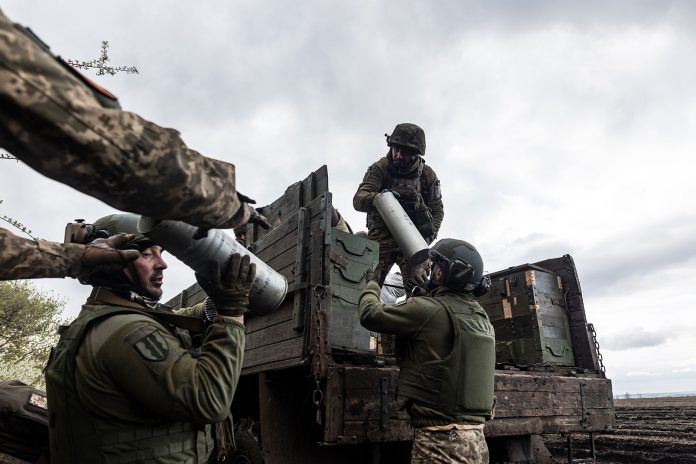
Zelensky expresses belief in soldiers amid offensive push
Ukrainian President Volodymyr Zelensky has expressed belief in his soldiers amid reported Ukrainian pushes in the south and eastern frontline.
“We believe in our guys. We continue to work,” he posted on Telegram after being updated by the Commander-in-Chief of the Ukrainian Armed Forces, General Valerii Zaluzhnyi.
His remarks come amid a reported large Ukrainian offensive along the southern front and renewed pushes around Bakhmut, specifically in the south of the beleaguered city, where Kyiv’s forces are closing in on the settlements of Andriivka and Klishchiivka.
Zelensky went on to say he had received updates on the supply of weapons and ammunition.
“There is a reinforcement for our air defense system,” he stated, adding, “It will be sent to where it is needed most.”
EU agrees to impose ‘restrictive measures’ against Belarus
The EU has agreed to adopt “restrictive measures” against Belarus over its involvement in Russia’s conflict with Ukraine, the Spanish presidency of the bloc says.
“Today, EU ambassadors agreed on adopting restrictive measures in view of the situation in Belarus and the involvement of Belarus in the Russian agression [sic] against Ukraine. The measures include listings of individuals and entities,” it said in a post on Twitter.
“West’s attempts to cause discord in our relations have failed”: Russia
The West’s attempts to “cause discord in our relations have failed,” Russia’s Foreign Ministry Spokesperson Maria Zakharova has said, ahead of the second Russia-Africa summit.
The summit, taking place in St Petersburg on Thursday and Friday, “will be dedicated to the development of the entire range of relations with the African continent,” Zakharova said in comments shared online Wednesday by the ministry.
“The spirit of mutual understanding and trust formed over the years of Soviet-African cooperation still serves as a good basis for maintaining Russia’s high reputation in Africa,” she added.
Russia’s President Vladimir Putin is set to hold bilateral meetings with all heads of African states taking part in the summit, the Kremlin said Tuesday.
The assistant for foreign affairs to Putin, Yuri Ushakov, told the official TASS news agency that the “summit is expected to be attended by 17 heads of African states.”
The Kremlin announced that 49 African countries will be represented.
It noted Putin and the leaders of a number of African states will also continue to discuss “possible ways of settling the situation around Ukraine within the African Peace Initiative, which they launched in St Petersburg in June.”
Putin will describe to the summit’s plenary session “the state of and prospects for developing the full range of ties between Russia and African nations in the political, economic and humanitarian areas,” the Kremlin added.
“The President of Russia will take part in the plenary session of the Economic and Humanitarian Forum, to be held as part of the summit. Russian and African officials, businesspeople and public figures have been invited to attend the session. The Russian President has plans to meet with the heads of African regional organisations,” the Kremlin also noted.
The Kremlin said “dozens” of agreements in trade, economic, investment, scientific, technical, cultural and humanitarian areas are expected to be signed.
African leaders are beginning to arrive in St Petersburg, with some events taking place ahead of the main summit. Egyptian president Abdel Fattah El-Sisi will meet Putin on Wednesday, Ushakov added.
The summit comes as the British government is heavily criticized for underplaying and underestimating the activities of Russia’s Wagner private military company (PMC) for nearly a decade, including its significant expansion in Africa, in a report by the UK Parliament’s Foreign Affairs Committee published Wednesday.
The report outlines the Wagner Network’s increased activity in Africa and lists the countries in which Wagner military operations have been identified, including the Central African Republic (CAR), Sudan, Libya, Mozambique and Mali.
In a voice note to Afrique Media earlier this week, Wagner chief Yevgeny Prigozhin is reported to say: “As for our work in Africa… of course we will continue to work in all the countries where we have started or where we are working currently.”
Questions have recently been asked about what Wagner’s continued role on the continent following its failed mutiny in Russia last month.
“The only condition by the way that we fulfil is that we must not contravene the interests of the Russian federation. For the rest, we are open to dialogue. Consequently, there has not been and will not be a reduction of our programme in Africa,” Afrique Media’s French translation of Prigozhin’s voice note, originally in Russian, said.
UK: Russia ‘preparing to blockade Ukraine’
Russia could be preparing to “enforce a blockade” on Ukraine using its Black Sea Fleet, according to the UK Ministry of Defence (MoD).
In an intelligence update, it wrote on Twitter: “The modern corvette Sergey Kotov, has deployed to the southern Black Sea, patrolling the shipping lane between Bospohorus and Odesa.”
“There is a realistic possibility that it will form part of a task group to intercept commercial vessels Russia believes are heading to Ukraine,” it noted.
“There is now the potential for the intensity and scope of violence in the area to increase,” the ministry added.
US State Department announces new $400 million tranche of security assistance for Ukraine
US Secretary of State Antony Blinken on Tuesday announced a new $400 million tranche of security assistance for Ukraine, which includes air defense munitions and armored vehicles.
The assistance includes “air defense munitions, artillery rounds, armored vehicles, and anti-armor capabilities, as well as other equipment essential to strengthening Ukraine’s brave forces on the battlefield, helping them retake Ukraine’s sovereign territory, and defend their fellow citizens,” according to a statement announcing the latest drawdown – the 43rd to date.
Blinken also slammed Russia’s withdrawal from the Black Sea Grain Initiative, noting that Moscow “continues to attack Ukrainian ports and grain infrastructure,” including in the southern port city of Odesa.
The strikes – the latest in a wave of attacks on Odesa – killed at least one person and injured several others, Ukrainian officials said. At least 25 architectural monuments were destroyed and a historic Orthodox cathedral was badly damaged, a regional military official said.
“Russia could end this war at any time by withdrawing its forces from Ukraine and stopping its brutal attacks against Ukraine’s cities and people,” Blinken continued, adding, “Until it does, the United States and our allies and partners will stand united with Ukraine, for as long as it takes.”
According to a State Department spokesperson, some of the specific capabilities in this package are:
- Additional munitions for Patriot air defense systems and National Advanced Surface-to-Air Missile Systems (NASAMS)
- Stinger anti-aircraft systems
- Additional ammunition for High Mobility Artillery Rocket Systems (HIMARS)
- 155mm and 105mm artillery rounds
- Javelin and other anti-armor systems and rockets
- Hornet unmanned aerial systems
- Demolitions munitions for obstacle clearing
- Over 28 million rounds of small arms ammunition and grenades
- Night vision devices and thermal imagery systems
5 countries bordering Ukraine ask EU to extend temporary ban on importing Ukrainian grain products
Five European Union member states bordering Ukraine are requesting that an existing ban on imports of four types of Ukrainian grain be extended beyond the scheduled expiry date of September 15, the EU Council said on Tuesday.
Poland, Hungary, Bulgaria, Slovakia and Romania would like to see a temporary EU import ban of Ukrainian wheat, maize, rapeseed and sunflower oil be extended to the end of the year, Spain’s Minister for Agriculture Luis Planas Puchades said at a news conference in Brussels. He was speaking in his capacity as president of the EU Agriculture and Fisheries Council.
The EU adopted the measures in May to ease logistical bottlenecks and protect local farmers from being undercut in price by cheaper grain produced in Ukraine.
Speaking at the same event, the EU’s Commissioner for Agriculture Janusz Wojciechowski stated the bloc will need to consider “new circumstances” while considering the extension given Russia’s withdrawal from the Black Sea grain deal.
Zelensky rebukes Ukrainian lawmakers and public officials who vacation during war
Ukrainian President Volodymyr Zelensky is sternly rebuking lawmakers and public officials who are going on vacation during the war.
“Millions of Ukrainians are focused on one thing day after day. Not on themselves, not on their own desires, but on defending the state and their lives,” he said, according to an official English transcript of his nightly address on Tuesday.
“But unfortunately, some people think that the war is somewhere far away from them,” he added.
He spoke directly to members of parliament, officials and others in public office, asking them to work “in Ukraine and for the sake of the Ukrainian people.”
“When every day you search for weapons for the state, when all the attention is on providing artillery, missiles, drones, when you constantly see and feel the moral strength gained for Ukraine by our warriors, our people, who are doing everything possible and impossible for the victory and preservation of freedom, any internal betrayal, any ‘beach’ or any personal enrichment instead of Ukraine’s interests triggers fury at the very least,” Zelensky stated.
His remarks come amid a slew of corruption scandals being reported in Ukrainian media involving public officials.
Ukraine claims it has advanced in area close to embattled eastern city of Bakhmut
Russian forces south of the embattled eastern city of Bakhmut have taken heavy losses and appear to have fallen back amid intense artillery fire from the Ukrainian side, according to official and unofficial Ukrainian accounts, as well as reports from Russian military bloggers.
Ukraine has been trying to break Russian resistance here for several weeks. Ukrainian advances near Andriivka are part of a plan to encircle Bakhmut and drive out Russian forces, the spokesperson for the eastern grouping of the Ukrainian Armed Forces, Serhii Cherevatyi, said on Tuesday.
At stake are a string of villages that are important in safeguarding Russian resupply routes into the ruined city of Bakhmut, which fell to the Russians in the spring. Control of this area would also enable Ukrainian forces to hit Russian targets in and around the city from higher ground.
Both Russian and Ukrainian sources have reported heavy fighting around the village of Klishchiivka, with the Russian Defense Ministry claiming on Monday that Ukrainian attacks near the village had been repelled. However, Ukrainian progress towards the nearby village of Andriivka makes Russian positions in Klishchiivka more vulnerable.
In the Bakhmut sector, Russian losses have outnumbered those of Ukraine by a ratio of eight or nine to one, Ukraine’s Deputy Defense Minister Hanna Maliar claimed Tuesday.
“And the question should be asked not about the number of kilometers passed, but about the fact whether we are moving forward or not,” she added.
UK believes Russia could target civilian ships in Black Sea: Foreign secretary
The UK believes that Russia could target civilian ships in the Black Sea, following the Kremlin’s decision to leave the Black Sea Grain Initiative, British Foreign Secretary James Cleverly said on Tuesday.
“The UK believes that Russia may escalate its campaign to destroy Ukraine’s food exports by targeting civilian ships in the Black Sea. We will highlight this unconscionable behaviour at the UNSC. Russia should stop holding global food supplies hostage and return to the deal,” he said in a tweet.
Russia could target civilian ships in the Black Sea and blame Ukraine, a spokesperson for the US National Security Council said last week.
Russia has also laid additional sea mines in the approach to Ukrainian ports, NSC spokesperson Adam Hodge said in a statement Wednesday. Earlier that day, Russia’s defense ministry said any ship sailing toward a Ukrainian port would be considered a potential carrier of military cargo.
Repeating the warning from the NSC, the director of the CIA said on Thursday that Russia could be preparing a false-flag operation attacking a ship in the Black Sea.
Russia’s Ambassador to the US Anatoly Antonov said on Thursday that attempts to attribute to Russia the preparation of attacks on civilian vessels are “pure fabrication” and “completely contradicts our approaches.”
British Prime Minister Rishi Sunak said any Russian attempt to stop grain exports from leaving Ukraine would be completely “unacceptable.”
Sunak said in a tweet that he spoke with Ukrainian President Volodymyr Zelensky earlier on Tuesday “and made it clear that any Russian attempt to stop grain leaving Ukraine is completely unacceptable. We must continue to stand with Ukraine.”
United Nations denies Russian account of attack that killed 50 Ukraine prisoners of war last year
Russian accounts of a rocket attack on a camp holding Ukrainian prisoners of war in July 2022 are not supported by evidence, according to the United Nations.
The findings by the UN Human Rights Commissioner (UN OHCHR) support the conclusions of an extensive CNN investigation published in August last year, which demonstrated that the Russian narrative that the camp had been hit by a Ukrainian HIMARS rocket did not stand up to scrutiny.
More than 50 Ukrainian prisoners of war were killed in the strike at the detention center in the town of Olenivka.
Russian and local officials from the self-declared Donetsk People’s Republic said the attack was carried out by the Ukrainian side, using one of the HIMARS rockets that had been recently supplied by the United States.
But the CNN investigation, based on analysis of video and photographs from the scene, satellite imagery from before and after the attack and the work of forensic and weapons experts, concluded that “the Russian version of events is very likely a fabrication. There is almost no chance that a HIMARS rocket caused the damage to the warehouse where the prisoners were being held.”
A UN statement issued Tuesday concurred that “the information available and our analysis enable the Office to conclude that [the strike] was not caused by a HIMARS rocket.”
“The Russian Federation provided neither satisfactory assurances about secure access for the United Nations to visit the particular site, nor granted general requests by the UN Human Rights Office to access areas of Ukraine under the temporary military control of the Russian Federation,” the statement read.
The UN OHCHR said that it had been able to “conduct extensive interviews with survivors of the incident at Olenivka and undertaken detailed analysis of available additional information… While the precise circumstances of the incident on the night of 28-29 July 2022 remain unclear, the information available and our analysis enable the Office to conclude that it was not caused by a HIMARS rocket.”
Russia’s lower parliament approves bill expanding military draft age to include citizens from 18 to 30 years
The Russian state Duma has passed an amendment extending the military call up age to include citizens from 18 to 30 years.
“Starting January 1, 2024, citizens aged 18 to 30 will be called up for military service. The bill has been adopted today in the third reading,” an official statement on the State Duma on Telegram reads.
Previously, military service was compulsory for Russian citizens aged 18 to 27 years.
The new bill will now be forwarded to the Federation Council for further consideration before the law can be signed by President Vladimir Putin.
The senators of the Federation Council will support the law, said Valentina Matvienko, the speaker of the upper house, adding that there is “no reason for excessive resonance” regarding these changes, according to state news RIA Novosti.