Senior Ukrainian official defends speed of counteroffensive progress
Mykhailo Podolyak, adviser to the head of the Office of the President of Ukraine, defended progress made by Ukraine in its counteroffensive.
He argued that before Russia’s full-scale invasion of Ukraine, the Russian army was “hysterically feared and not even imagined to be effectively fought against.”
“In order to finally debunk another myth that yesterday people were afraid to even think about, everyone needs to be patient and closely monitor the high-quality work of the Armed Forces of Ukraine. They will in any case achieve a mandatory and fair conclusion. Russia will cease to exist as a military threat after the war in Ukraine. At least for Ukraine and Europe. Meanwhile… offensive operations continue,” he tweeted.
In a video released on Tuesday, Ukrainian President Volodymyr Zelensky said that the counteroffensive hasn’t been easy and is “happening probably slower” than some had hoped.
Ukraine deny accusation of Zaporizhzhia plant attack
A senior adviser to Zelenskyy denied a Russian allegation that Kyiv tried to attack the Zaporizhzhia Nuclear Power Plant (ZNPP) with a drone.
“Undoubtedly, Ukraine did not carry out any kind of drone attack on the ZNPP, was not planning and will not even in theory do so,” Mykhailo Podolyak told the Reuters news agency in a statement.
Russia opens investigation into explosion at Moscow region plant that left dozens injured
At least 56 people were injured in an explosion at a mechanical plant Wednesday in the city of Sergiev Posad, located northeast of Moscow, the governor of Moscow region, Andrei Vorobyov, said in an update.
Russia’s Investigative Committee said it has opened a criminal investigation into the incident.
“In total, 56 people asked for medical help. 30 are now in the hospital, six of them are in intensive care,” the governor said in a Telegram post.
“Another 26 people went to the emergency room – they did not need hospitalization, after the examination, the doctors let them go home,” he added.
Rescue teams continue to working at the site of the explosion as more people could remain under the rubble.
“Rescuers will need about 12 hours to clear the rubble. There may still be people left, three have already been removed – doctors assess their condition as serious,” the official continued.
Russian state media reported earlier Wednesday, citing local authorities, that the source of detonation was a pyrotechnics warehouse rented by a third company on the site of the Zagorsk Optical and Mechanical Plant, which makes optical systems for the Russian military. The cause of the explosion is a violation of technological processes, they added.
A representative from Russia’s Investigative Committee told TASS news agency that suggestions of an unmanned aerial vehicle (UAV) attack on the plant have not been confirmed. The official cause of an explosion is being determined by authorities, they said.
“As for the explosion, it was very powerful. And now the operational services are engaged, investigating. I cannot comment on what it was, because journalists traditionally ask the question: was it a blow from above or an explosion inside — this is done by specialists,” the governor of the Moscow region told RIA Novosti in an interview.
“One thing is clear, that the explosion was powerful, and it was in the pyrotechnics workshop,” he added.
The explosion was captured on security cameras and car dashcams in the small city. Video shared on social media shows a huge mushroom-shaped plume of smoke rising over the plant.
An eyewitness named Nikolai said in an interview with MASH, an independent Russian media blog present at the scene, that there used to be a munition factory at the site before “it was sold and turned into pyrotechnics factory.”
“The company went bankrupt; it is not clear who worked there and what they did there. What caused the explosion is also unclear,” Nikolai stated.
The eyewitness added “the bang was very strong and immediate color of the explosion was orange before it turned into grey smoke. Usually, when pyrotechnics explode you can smell sulfur — but there was absolutely no smell of sulfur. There were no detonations — only a big bang.”
China to continue in talks to find an end to war
China will continue in talks promoting a political settlement in Ukraine, the Russian state-owned TASS news agency reported.
The Chinese Ministry of Foreign Affairs commented on Beijing’s further participation in international discussions on ways to resolve the conflict, to TASS in a statement.
The statement said, “China will continue to strengthen dialogue and exchanges with all parties to promote a political solution to the crisis in Ukraine.”
Russia accuses Ukraine of attacking nuclear facility
Russian security forces say Ukraine attempted to attack a spent nuclear fuel storage facility at the Zaporizhzhia Nuclear Power Plant with a drone, the state news agency RIA reported.
Without citing a named source or official, Russian security forces reached their conclusion by analysing the flight path of the drone, which they downed, RIA said.
Zelensky holds meeting with top military commanders
Ukraine’s President Volodymyr Zelensky said on Wednesday he held a meeting with top military commanders on the counteroffensive.
“Today’s Staff [meeting of the Staff of the Supreme Commander-in-Chief] was in a special format. The narrowest circle of people and maximum attention to a single topic – our offensive,” Zelensky posted on Telegram.
“In-depth analysis of the current situation, planning of future steps, providing troops with everything they need, and analysis of the enemy’s actions,” he added.
Earlier this week Zelensky conceded that the counteroffensive has been “difficult,” he said in a video released by his office on Tuesday.
This prompted US officials to acknowledge that Ukraine’s recent progress had been slowed.
“Even the Ukrainians…including President (Volodymyr) Zelensky, have said that they’re not going as far or as fast as he would like,” White House National Security Council Coordinator for Strategic Communications John Kirby told CNN on Tuesday
The primary challenge for Ukrainian forces is the continued difficulty of breaking through Russia’s multi-layered defensive lines in the eastern and southern parts of the country, which are marked by tens of thousands of mines and vast networks of trenches.
Ukrainian forces have incurred staggering losses there, leading Ukrainian commanders to hold back some units to regroup and reduce casualties.
Kyiv opens border crossing with Russia
Kyiv has reopened a border crossing with Russia so Ukrainian refugees can return home, the German news agency, dpa, reported.
Ukrainian Deputy Prime Minister Iryna Vereshchuk said, “It is possible and necessary to leave via the Kolotilovka-Pokrovka humanitarian corridor!”
The humanitarian corridor is the crossing point between the Ukrainian Sumy region and the Russian Belgorod region.
To return to Ukrainian-controlled regions from Russia, Ukrainian refugees have to take detours via European Union states or Georgia.
Kyiv has repeatedly called on Ukrainians living in Russian-occupied areas of the country to flee into Ukrainian territory.
Russia plans to build up its forces on western borders
Russian Defense Minister Sergei Shoigu has discussed plans for Moscow to bolster the country’s forces on its western borders, as the war in Ukraine has ramped up tensions between countries in the region.
“Today, at the meeting of the Board, we will consider issues related to the creation of the Leningrad and Moscow military districts with the simultaneous strengthening of groupings of troops of the Armed Forces of the Russian Federation on our western borders,” Shoigu said, according to a readout from a board meeting published by the Defense Ministry on Wednesday.
Shoigu cited Poland’s increased militarization as among the reasons for the expansion, saying the move threatens the “occupation” of Russian territory.
“There are plans to create on a regular basis the so-called Polish-Ukrainian connection supposedly to ensure the security of Western Ukraine, but in fact — for the subsequent occupation of this territory,” territory,” he stated at a meeting of the board of the military department.
Earlier this month, Poland said it would deploy more troops at its border with Belarus, a Kremlin ally, amid an escalation in military tensions between both countries.
Thousands of fighters from the Russian mercenary group Wagner were sent to Belarus after a failed mutiny against Moscow in June. They have since been moving towards a key corridor in the region, a thin strip of land between Poland and Lithuania called the Suwalki gap, in an apparent attempt to put pressure on NATO and EU members.
The war in Ukraine prompted leaders in Europe to rethink their national security strategy in the face of Russian President Vladimir Putin, who has long sought to undermine NATO expansion in the region.und: Earlier this month, Poland said it will deploy more troops at the border with Belarus, a Kremlin ally, amid an escalation in military tensions between both countries.
Thousands of fighters from the Russian mercenary group Wagner were sent to Belarus after a failed mutiny against Moscow in June. They have since been moving towards a key corridor in the region, the Suwalki gap, in an apparent attempt to put pressure on NATO and EU members.
The war in Ukraine prompted leaders in Europe to rethink their national security strategy in the face of Russian President Vladimir Putin, who has long sought to undermine NATO expansion in the region.
Germany’s Rheinmetall to deliver at least 30 tanks to Ukraine
Germany’s defence giant Rheinmetall will deliver about 30 more tanks to Ukraine.
German public broadcaster ARD reported that Rheinmetall acquired dozens of decommissioned Leopard-1 tanks from Belgium and will modernise them for the Ukrainian military.
According to the report, the defence company will be able to ship some of the repaired tanks to Ukraine within the next six months.
Germany has significantly increased its military support to Ukraine following pressure from the US and other allies, and has become the second largest supplier of weapons to the country.
Ukraine says it hit a Russian command post in city of Nova Kakhovka
Kyiv claimed on Wednesday that it struck a Russian command post in the city of Nova Kakhovka, as the Ukrainian military ramps up activity in the southern Kherson region amid a sweeping counteroffensive.
Nova Kakhovka is located on the occupied east bank of the Dnipro River, where Ukrainian forces reportedly carried out a raid on Tuesday. Kyiv refused to confirm reports of the operation.
“At about 10:00 a.m. (local time), the Armed Forces of Ukraine hit a command post of the Russian army in the temporarily occupied Nova Kakhovka,” the Strategic Communications Department of the Armed Forces of Ukraine said on Telegram.
Ukraine claims “partial success” on southern front as Russia move east
Ukrainian forces have achieved “partial success” on the southern front, Ukrainian officials have said.
“The Ukrainian Defense Forces continue to conduct offensive operation in the Melitopol and Berdiansk directions. Our defenders had partial success in the areas of Urozhaine, Pryiutne and Verbove. Now they are consolidating the achieved positions,” Ukraine’s Deputy Defense Minister Hanna Maliar said in a Telegram post Wednesday.
Ukrainian forces are also continuing “to conduct offensive actions on the southern flank around the town of Bakhmut, consolidating the achieved positions,” Maliar added.
In the east: Russian forces are focusing their attention on the area around the city of Kupyansk in Kharkiv region, Maliar stated.
Ukraine liberated the city from Russian forces last autumn and it has recently come under increased shelling.
“As of now, Kupyansk direction remains the main direction of the enemy’s offensive. Here, the enemy has formed an offensive grouping and is trying to move forward, but without success,” she said, adding that the operational situation is “difficult but under control.”
“The enemy’s goal in the Kupyansk direction is to break through the defense of our troops and advance directly to Kupyansk. The intensity of the fighting and enemy shelling is high. There can be sometimes several changes of situation at some positions per day,” she continued.
President Volodymyr Zelensky said in a video released by his office on Tuesday the Ukrainian counteroffensive has been “difficult” and is “happening probably slower” than some had hoped.
Western officials have also spoken of increasingly “sobering” assessments about Kyiv’s ability to retake significant territory, senior US officials told CNN. US National Security Council spokesperson John Kirby said the offensive is “not without its difficulties, but they keep trying.”
Ukrainian forces conducted raid across Dnipro River
Ukrainian forces conducted a raid across the Dnipro River in the Kherson region on Tuesday, attempting to land near the Russian-occupied village of Kozachi Laheri, state media and military bloggers said.
One Russian military blogger claimed “a total of 25 soldiers [were either] killed or captured including three officers,” before adding that the group was “ambushed and the survivors are now prisoners.”
He went on to say that Ukrainian forces do not control the village but they are “definitely present on our bank” — referring to the occupied east-bank of the Dnipro river.
Pro-Russian media also claimed the raid took place, posting a video of their correspondent claiming Ukrainian forces tried to land near the village of Kazachi Lagerya but that “their actions did not bring results.”
Ukrainian forces first established a bridgehead on the Russian-controlled east bank of the Dnipro River near the Antonivsky Bridge in June.
On July 1, the Russian-appointed governor of occupied Kherson, Vladimir Saldo, said it had been eliminated following almost a week of heavy fighting in the area.
The Institute for the Study of War (ISW) said in its latest update that Ukrainian forces are present on the east bank, although it remains unclear whether Ukrainian troops have established an enduring presence.
Natalia Humeniuk, head of the United Coordinating Press Center of Security and Defense Forces of South of Ukraine, dismissed the claims.
“The enemy is trying to create artificial hype and panic, drawing attention to the directions where they want to focus the efforts of the Defense Forces,” Humeniuk told CNN.
Bohdan Senyk, head of the Public Relations Department of the Armed Forces of Ukraine, told CNN: “We don’t have any official information yet.”
Western countries’ statements about providing security guarantees to Ukraine are empty, groundless excuses, Russian Foreign Ministry Spokeswoman Maria Zakharova said.
“Security guarantees presuppose the words ‘guarantees’ and ‘security’ and, overall, a range of certain characteristics as well, but these are missing here. No one here can even say anything about it, so these are empty, absolutely groundless excuses that are becoming more and more numerous,” the diplomat told Sputnik Radio.
Zakharova also highlighted Tuesday’s statement by EU foreign policy spokesman Peter Stano that the EU cannot provide security guarantees to Ukraine because it is not a military organization.
According to the diplomat, the EU is currently unable to guarantee anything, even directly within the bloc itself, due to a “political and ideological deadlock.”
“They cannot guarantee themselves anything; they cannot guarantee a stable supply of energy resources, which they need like an organism needs blood. They can’t guarantee themselves even that. They can’t even afford an investigation to determine who undermined their energy security. They themselves have become vassals of a single colonial power,” Zakharova pointed out.
2 drones shot down in Moscow suburbs: Mayor
Two drones were shot down in the Moscow suburbs, according to Mayor Sergei Sobyanin.
“There was an attempted flight over the city by two ‘combat drones.’ Both were shot down by our air defense,” he said in a message posted to Telegram.
“One of the drones was shot down near Domodedovo, while the other was shot down near the Minsk highway,” Sobyanin said.
There is an international airport in Domodedovo.
There is no information on casualties, he added, and a response team was working on the scene.
Russia’s free grain offer to African nations ‘laughable’: US
US Secretary of State Antony Blinken has crticised Moscow for its offer to supply six African nations with free grain, saying the proposal is “laughable”.
“What Russia was proposing was to get grain to a half dozen countries, about 50,000 tonnes,” Blinken said in an interview with British broadcaster BBC.
“The Black Sea Grain Initiative (BSGI) delivered 20 million tonnes to lower- and middle-income countries. In other words, what the Russians were proposing in compensation for getting out of the agreement is a drop in the bucket of what countries were getting and what they need,” he added.
Zelensky says Ukraine will fight back in Black Sea
In a video, President Volodymyr Zelensky said Ukraine would fight back against Russia in the Black Sea to ensure its waters were not blockaded and it could import and export grain and other goods.
The comments come days after Ukraine targeted a Russian warship near a major Russian port and struck a tanker.
“If Russia continues to dominate the Black Sea, outside its territory, blockading or firing at us again, launching missiles at our ports, Ukraine will do the same. This is a just defence of our opportunities, of any corridor,” Zelensky stressed.
“We don’t have that many ships. But they should clearly understand that by the end of the war, they will have zero ships, zero,” he added.
He also called on Russia to stop firing at Ukrainian ports and to allow trade to take place in comments made at a briefing with reporters from Latin American countries.
Ukraine’s counteroffensive is “not without its difficulties”: White House
The US is aware the Ukrainian counteroffensive against Russia isn’t progressing as quickly as was expected, White House National Security Council Coordinator for Strategic Communications John Kirby said Tuesday.
“Even the Ukrainians…including President (Volodymyr) Zelensky, have said that they’re not going as far or as fast as he would like,” Kirby told CNN’s Wolf Blitzer on Tuesday.
“While they are making progress — and they are — it’s incremental and it’s slow and it’s not without its difficulties, but they keep trying. They’re still at it,” Kirby continued.
“There is active fighting along that front, they are definitely trying to push forward. How far they’ll get, where that will be, what kind of breakthrough they might be able to achieve? I don’t think anybody can say right now,” he added.
In a video released by his office Tuesday, Zelensky acknowledged that the counteroffensive hasn’t been easy and is “happening probably slower” than some had hoped.”
“It is very difficult to be fighting for such a long time—which is obvious. All this is very difficult when you lack this or that equipment,” the Ukrainian leader said in remarks from a meeting Sunday with Latin American media outlets.
“I know it is difficult for us but I definitely know it is more difficult for the Russians,” he stated.
In terms of military aid to Ukraine, Kirby said the US will continue to provide military resources to Kyiv, including mine-clearing equipment, artillery ammunition and High Mobility Artillery Rocket Systems.
Ukraine accuses Russia of attempt to hack armed forces systems
Ukrainian special services say they have foiled an attempt by Russian hackers to penetrate the Armed Forces of Ukraine’s combat information system.
“As a result of complex measures, SBU exposed and blocked the illegal actions of Russian hackers who tried to penetrate Ukrainian military networks and organise intelligence gathering,” the SBU security service said on Telegram.
The service announced hackers tried to gain access to “sensitive information on the actions of the Ukrainian Armed Forces, the location and movement of the Defence Forces, their technical support”.
SBU added a sophisticated Russian hacking team, known as Sandworm, was responsible for the attack.
Cyber-specialists also found that hackers planned to use military tablets to spread viruses in the battle system.
Ukraine has reported an increase in Russian attempts to hack into government computer systems, armed forces and the energy sector since the start of the invasion.
But Russia has repeatedly denied such accusations.
9 people were killed and dozens injured in Russian attack on Pokrovsk: Zelensky
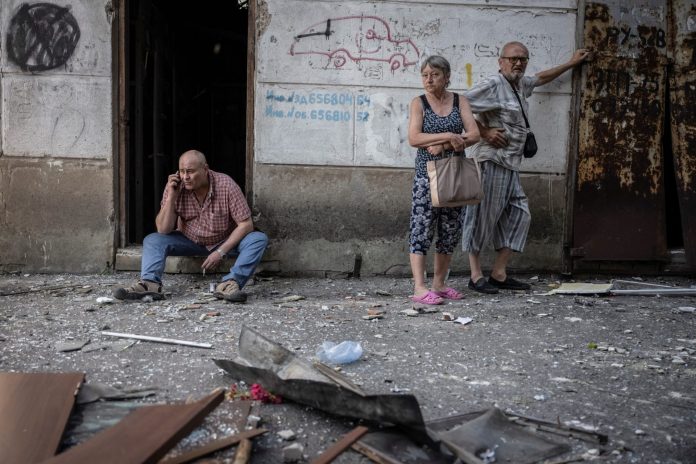
Nine people were killed and 82 were injured after Russian missiles on Monday struck residential areas in the eastern city of Pokrovsk, according to Ukrainian President Volodymyr Zelensky.
“Rescue operations in Pokrovsk in Donetsk region were completed today in the afternoon after yesterday’s rocket attack by Russian terrorists,” Zelensky said, adding, “Nine people died. My condolences to their family and friends. 82 people were injured.”
Zelensky also said there were two children among the injured. One of them, an 11-year-old, is in serious condition, he added.
The Ukrainian president reiterated that the fact that the second strike occurred when the rescue operation was underway indicated it was “a conscious decision of terrorists to cause the most pain and the most damage.”
Zelensky acknowledges that Ukraine’s counteroffensive is “happening probably slower” than some had hoped
The Ukrainian counteroffensive hasn’t been easy and is “happening probably slower” than some had hoped, President Volodymyr Zelensky said in a video released by his office on Tuesday.
His remarks from a meeting Sunday with Latin American media outlets come amid CNN reporting that Western officials describe increasingly “sobering” assessments about Ukrainian forces’ ability to retake significant territory.
“But all of this is secondary. In some places, there are mines, in some places there are technical difficulties, in some places we have been waiting for long. Or there are other complications. We can be discussing it for a long time,” Zelensky stated, adding, “The direction of the counteroffensive, what’s wrong with it, what we have enough of, what we lack.”
“The counteroffensive is when the army is attacking and not when it is retreating. And this is an important and positive moment. And it is Ukraine that has the initiative. It is very difficult to be fighting for such a long time—which is obvious. All this is very difficult when you lack this or that equipment. I know it is difficult for us but I definitely know it is more difficult for the Russians,” Zelensky added.
While there is fatigue in the eyes of Ukrainians, there is fear in Russians’ eyes, the president said.
The primary challenge for Ukrainian forces is the continued difficulty of breaking through Russia’s multi-layered defensive lines in the eastern and southern parts of the country, which are marked by tens of thousands of mines and vast networks of trenches. Ukrainian forces have incurred staggering losses there, leading Ukrainian commanders to hold back some units to regroup and reduce casualties.
“Russians have a number of defensive lines and they [Ukrainian forces] haven’t really gone through the first line,” a senior Western diplomat told CNN.
“Even if they would keep on fighting for the next several weeks, if they haven’t been able to make more breakthroughs throughout these last seven, eight weeks, what is the likelihood that they will suddenly, with more depleted forces, make them? Because the conditions are so hard,” the top diplomat added.
A senior US official said the US recognizes the difficulties Ukrainian forces are facing, though retains hope for renewed progress.
Ukraine claims some advances in southern Zaporizhzhia region despite movement being slowed down by mines
Efforts to “eliminate” Russian forces around the southern Ukrainian village of Robotyne in the Zaporizhzhia region are continuing with offensive action from Kyiv’s forces, according to Serhii Kuzmin, deputy commander of the Tavria Operational and Strategic Grouping for Strategic Communications.
“There are also some advances of hundreds of meters in this direction. Offensive actions also continue in the Berdiansk sector. There are also advances there, our defense forces are moving forward. We are destroying the enemy,” he told Ukrainian national TV Tuesday.
Berdiansk is very densely mined, he explained.
“There are a lot of occupiers in this area — probably their number per square meter is the same as the number of mines,” the official said.
“We have already reached the first line of defense of the occupiers. The first line is very difficult, but our military are pushing through it and moving forward. This movement is slowed down by minefields and our lack of aviation,” he continued.
Nearly 80 rescuers killed in Ukraine while responding to missile strikes since war began: Officials
At least 78 rescuers have been killed and 280 wounded in Ukraine since the start of Russia’s full-scale invasion while responding to missile strikes, according to Col. Oleksandr Khorunzhyi, spokesperson for the State Emergency Service of Ukraine.
Khorunzhyi spoke Tuesday at a briefing at the Military Media Center following a deadly double missile strike in Pokrovsk, where emergency service workers were injured after rushing to the scene of the first strike. The deputy head of the State Emergency Service of Ukraine in Donetsk region, Andrii Omelchenko, was killed, Ukraine’s National Police said.
“Russians fire at rescuers, ignoring international conventions,” the center wrote on Telegram.
“It is worth noting that rescuers are protected by international conventions, as they do not engage in hostilities, but go to rescue people and provide assistance,” the center added.
Russian budget deficit widens to 2.82 trillion roubles
Russia’s budget deficit for January-July widened to 2.82 trillion roubles ($29.3bn), or 1.8 percent of gross domestic product (GDP), the finance ministry reported.
Despite posting a surplus of 557 billion roubles ($5.7bn) in the first seven months of last year, significant outlays to support its war in Ukraine and Western sanctions on its oil and gas exports have affected state finances.
Russia has doubled its 2023 defence spending target to more than $100bn, a third of all public expenditure, a government document reviewed by the Reuters news agency showed.