Zelensky vows victory for Ukraine, says counteroffensive slowly continuing
Ukrainian President Volodymyr Zelensky has promised that Ukraine will do everything to win its war with Russia, adding that the counteroffensive slowly progressing.
“There is fatigue but we will do everything to win against our enemy, and our counter-offensive goes ahead, even if slowly we do everything to repel the enemy,” he told Italian broadcaster SkyTg24 speaking through a translator into Italian.
He said Ukraine felt support from the United States in “these very difficult times” and was convinced this would be the case in the future despite the delay in the approval of US financial aid due to the political bickering in Washington, DC.
UK urges more support for Ukraine
British Prime Minister Rishi Sunak has delivered a speech before his fellow Conservative Party members, as he tries to rally support ahead of the general elections due some time in 2024.
Most of Sunak’s speech was focused on domestic policies, but he also talked about the need to support Ukraine in its war with Russia.
“I say this to our allies: If we give President [Volodymyr] Zelenskyy the tools, the Ukrainians will finish the job,” Sunak told the Tory party conference in Manchester.
Hungary proposing to split EU aid for Ukraine: Report
Amid efforts by European Union nations to unite behind Ukraine in its conflict with Russia, EU member Hungary has reportedly proposed splitting an estimated $52.4bn aid package for Ukraine.
According to a Bloomberg News report, Hungary reportedly told EU members last week that an estimated $26.2bn would be sufficient for Ukraine at this time.
Furthermore, Hungary proposed that the EU evaluate its contribution halfway through the 2024-2027 disbursement period before the second half of the funding would be released.
The proposal threatens to derail the EU’s effort to back Ukraine’s military campaign against Russia.
A unanimous vote by all EU states is required for the funding to be approved. Hungary is seen as being more sympathetic to Russia despite its EU membership.
Ukraine grain exports down almost a quarter so far in 2023/24
Following a de facto blockade by Russia on Ukrainian grain shipments in the Black Sea, the country’s grain exports fell by almost a quarter from 8.99 million tonnes in the same period last year to 6.82 million metric tonnes so far in the 2023/24 season.
The agriculture ministry was also quoted by Reuters that 153,000 tonnes of grain were exported in the first three days of October 2023, compared with 297,000 tonnes a year ago.
In July, Russia ended a deal negotiated by the UN and Turkey that allowed the continuous flow of grain exports from the Black Sea, through Istanbul, Turkey’s Bosphorus Strait and to the Mediterranean.
Despite the drastic drop in grain exports, the country’s central bank still predicts a better than expected performance of the overall Ukrainian economy this year, compared with last year.
Ukraine’s central bank: Inflation slowing, GDP performing better than expected
Ukraine’s inflation is slowing and its economy is performing better than expected.
That’s what the Ukraine central bank deputy governor, Sergiy Nikolaychuk, stated in an interview with Forbes Ukraine edition, adding that the exact figures would be announced on October 26 at the country’s next monetary board meeting.
“The economy continues to demonstrate high resilience in wartime,” he was quoted as saying.
Twelve more vessels to enter Black Sea corridor towards Ukrainian ports: Kyiv
Ukraine’s navy has announced that 12 more vessels were ready to enter a Black Sea shipping corridor on their way towards Ukrainian ports, and that 10 other vessels were ready to depart from the country’s ports.
Navy spokesperson Dmytro Pletenchuk made the announcement in defiance of a de facto Russian blockade on Ukrainian exports via the Black Sea, after Moscow pulled out of a deal in July that had allowed Kyiv to safely export grain.
Since the end of the deal, Russia has also targeted several grain storage facilities in Ukraine, including one in the port of Odesa in late September.
Ukrainian official criticizes “Western conservative elites” for reluctance to confront Russia
A senior Ukrainian official has criticized “Western conservative elites” for suggesting that military aid to Ukraine should be suspended.
Mykhailo Podolyak, an adviser to the head of the Ukrainian president’s office, wrote in a social media post on Wednesday, “When any of the representatives of Western conservative elites talk about the need to suspend military aid to #Ukraine, I have a direct question: what are your motives?”
“Why are you so insistently against… destroying the Russian army, which has been terrifying democracies for decades, and why are you against drastically reducing #Russia’s ability to conduct ‘special destructive operations’ in different countries and on different continents?” Podolyak added.
He did not specifically reference the blockade of US aid to Ukraine in the temporary spending measure approved by Congress over the weekend, nor the ousting of US House Speaker Kevin McCarthy.
Meanwhile, Ukraine’s ambassador in Washington said on Wednesday that the embassy has a good dialog with the “vast majority” of likely candidates to replace the ousted House speaker.
“We at the Embassy of Ukraine in the USA continue our active work with caucuses, committees, individual congressmen, and of course the Senate to discuss our needs and possible solutions for the next package of assistance to Ukraine,” Ambassador Oksana Markarova said on Facebook.
She added it was too early to discuss specific candidates, adding, “I can only say that we have built a good constructive dialog with the vast majority of the names that are being mentioned and their teams.”
Japan will continue to exert sanctions pressure on Russia and to actively support Ukraine, the country’s Chief Cabinet Secretary Hirokazu Matsuno told reporters on Wedneday.
“For all this time, Japan has been actively promoting the policy of anti-Russian sanctions and support for Ukraine. We will keep doing this in the future, in close cooperation with the international community,” he said.
Commenting on the recent phone conversation that involved US President Joe Biden, Japanese Prime Minister Fumio Kishida and other leaders, Matsuno stated the sides had reaffirmed their commitment to continue their support for Ukraine.
Russia downs dozens of Ukrainian drones over border regions: Defense ministry
Russian air defenses destroyed 31 Ukrainian drones over the border regions of Belgorod, Bryansk and Kursk overnight, Russia’s Defense Ministry said on Wednesday.
In a Telegram post, the ministry said it had “foiled” attempted Ukrainian “terrorist attacks” on Russian territory.
The ministry also claimed that a Russian Air Force aircraft prevented a Ukrainian attempt to “infiltrate” Crimea in “a fast military boat and three jet skis,” which were heading toward Cape Tarkhankut, the occupied peninsula’s westernmost point.
Ukraine has ramped up strikes on Crimea in recent weeks. On Tuesday, Russia’s Defense Ministry said its air defenses destroyed a Ukrainian Neptune anti-ship missile near the peninsula.
Italy is all tapped out where Ukraine is concerned, as the population is becoming increasingly critical of such assistance, according to the newspaper La Repubblica.
According to the daily, the new eighth military aid package, which should be ready by Christmas, is stalled.
Italian Deputy Prime Minister and Foreign Minister Antonio Tajani reported the package’s preparation in Kiev the previous day. The newspaper said that the defense ministry could not confirm this. Later, Tajani clarified that the new package may not include weapons, but rather uniforms and various non-lethal materials, such as night vision helmets.
“Our line has not changed: no weapons received from Italy can be used to hit Russian territory. We are not at war with Russia,” the newspaper quotes his explanation.
As the daily points out, the previous seven packages considerably drained Italy’s arsenals. Only one of them came under the current government. Meanwhile, funds for purchasing new weapons are scarce as the country needs to cut spending on health care and other social programs when drawing up the new budget, which is already causing protests from both the population and the opposition. Keeping voters happy at a time when they are increasingly less supportive of the continuation of the conflict is a hot topic. According to some opinion polls, up to 70% of Italians do not support sending arms. A number of protests and strikes have already been announced. It is important to note that the League party, which is part of the ruling coalition, has long been quite skeptical of the new shipments. Its leader, Deputy Prime Minister of Italy and Minister of Infrastructure and Transport Matteo Salvini, has to find the funds to build an expensive bridge across the Strait of Messina, which will connect Sicily with the Italian mainland.
According to the paper, Rome will try to keep the issue of arms supplies particularly low-profile and transfer aid to Ukraine to help rebuild the country, its infrastructure and cultural heritage.
Majority of US lawmakers want a vote on Ukraine funding beyond 2024 polls: Report
The weekly British publication, The Economist, is reporting that pro-Ukraine members of the US House and Senate are eyeing a vote that would guarantee funding for Kyiv beyond the US presidential election in 2024.
With the removal of the Republican speaker of the House by his own party members, however, The Economist reported that passing such legislation “could be even trickier than avoiding a shutdown”.
The Republicans only hold a slim majority in the US House of Representatives. It would only take a few votes from hardliners, who oppose more Ukraine funding, to possibly prevent aid legislation from even getting to the House floor for a vote.
US wants to avoid direct war with Russia: Blinken
Speaking at a conference at Rice University’s Baker Institute for Public Policy, US Secretary of State Antony Blinken has said that Washington has been trying to avoid a direct conflict with Moscow since the start of the war in Ukraine.
“From day one, President [Joe] Biden had two ‘North Stars’ in mind. One was to make sure that we are doing everything we possibly can to support Ukraine and to bring other countries along to the same thing,” Blinken stated.
“But the other is also to avoid being in direct conflict with Russia, because the potential where that conflict could go is not a place that anyone wants to be and not a place that’s good for the security of the American people,” he added.
The US has repeatedly called countries around the world to stand with Ukraine against Russia’s invasion – take a look below at Biden’s speech at the United Nations General Assembly late last month.
Russia says its air defenses shot down Ukrainian Neptune missile near Crimea
Russian air defenses detected and destroyed a Ukrainian Neptune anti-ship missile near Crimea, the Russian Defense Ministry has announced.
“On October 3, at about 8:30 pm Moscow time, an attempt by the Kyiv regime to carry out a terrorist attack using the Neptune anti-ship missile against objects on the territory of the Russian Federation was stopped,” the ministry said in a post on social media.
“Air defense systems detected and destroyed a Ukrainian missile over the northwestern part of the Black Sea off the coast of the Crimean peninsula,” the ministry added.
The ministry didn’t include additional details about the alleged incident.
Pentagon warns of depleting funds for Ukraine support and urges Congress to act
The Pentagon cautioned on Tuesday that while there are enough funds for the time being to continue supporting Ukraine, funding could run out without action from Congress.
“We have enough funding authorities to meet Ukraine’s battlefield needs for just a little bit longer, but we need Congress to act to ensure there is no disruption in our support, especially as the department seeks to replenish our stocks,” deputy Pentagon press secretary Sabrina Singh said.
“As (Defense Secretary Lloyd) Austin said on Saturday, we urge Congress to live up to America’s commitment to provide urgently needed assistance to the people of Ukraine as they fight to defend their own country against forces of tyranny,” she continued.
Singh added that it was unclear how long the $1.6 billion left from previously allocated funds for Ukraine would last, saying that it depends “how that funding is used to replenish our stocks.”
“It really depends on what Ukraine requests,” she stated.
“And again, we know that their priorities are air defense and artillery and also mine-clearing equipment. So that’s what our focus is on to that, of course, is what we’re inevitably going to be refilling as well.”
White House says aid for Ukraine to last only couple of months
US aid for Ukraine’s fight against Russia will run out in “a couple of months” if Republican hardliners fail to pass new funds for Kyiv, the White House announced.
“You’re talking perhaps a couple of months or so, roughly,” National Security Council spokesman John Kirby told a briefing.
“Time is not our friend,” Kirby said at a briefing, adding, “We have enough funding authorities to meet Ukraine’s battlefield needs for a bit longer, but we need Congress to act.”
Earlier, President Joe Biden called Western allies to reassure them US aid for Ukraine will continue.
“The bottom of the barrel”: Officials warn western militaries running out of ammunition to give to Ukraine
Western militaries are running out of ammunition to give to Ukraine — and therefore, production needs to increase, NATO and United Kingdom officials have warned.
“The bottom of the barrel is now visible,” Adm. Rob Bauer, the chair of the NATO Military Committee and NATO’s most senior military official, said Tuesday during a discussion at the Warsaw Security Forum.
“We need the industry to ramp up production in a much higher tempo,” he stated.
Allies had increased budgets before the start of the war, but production capacity didn’t increase, and that in turn led to higher prices even before the war began, he added.
“That was exacerbated by the fact that we give away weapons systems to Ukraine, which is great, and ammunition, but not from full warehouses. We started to give away from half-full or lower warehouses in Europe, and therefore the bottom of the barrel is now visible.”
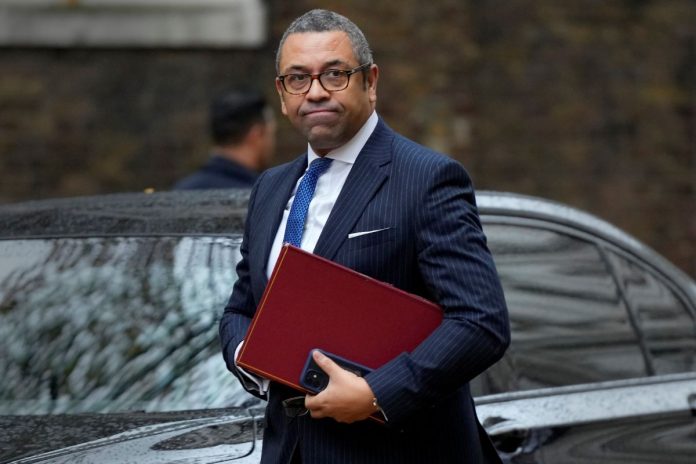
UK Minister of State for the Armed Forces James Heappey, speaking at the same panel alongside Bauer, said the “just-in-time” model “definitely does not work when you need to be ready for the fight tomorrow,” and that aid for Ukraine should continue.
“We can’t stop just because our stockpiles are looking a bit thin,” Heappey stated, noting, “We have to keep Ukraine in the fight tonight and tomorrow and the day after and the day after. And if we stop, that doesn’t mean that (Russian President Vladimir) Putin automatically stops.”
That means “continuing to give, day in day out, and rebuilding our own stockpiles,” he added.
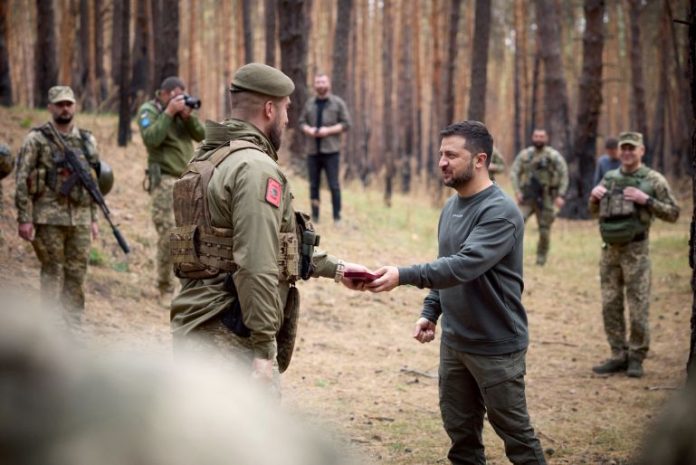
Zelensky visits troops in the northeast, holds security meetings
President Volodymyr Zelensky discusses the battlefield situation with commanders in Ukraine’s northeast, where he visited troops on one of the hottest fronts of the war with Russia.
In his nightly video address, Zelensky says he had been near Kharkiv, Ukraine’s second-largest city, and heard from the commander of Ukraine’s ground forces, Oleksandr Syrskyi, on defence in the area and on offensive actions further south, near Bakhmut.
“It is extremely important that Kharkiv, despite everything, not only holds on, but helps to keep our entire east strong,” Zelensky added.
In a post on X, formerly known as Twitter, the president also stated he met brigades fighting near the northeastern towns of Kupiansk and Lyman, recaptured by Ukrainian forces late last year.
Biden speaks with top US allies on Ukraine support
President Joe Biden spoke by phone with a group of top United States allies Tuesday morning as the future of US funding for Ukraine remains uncertain.
“President Biden convened a call this morning with allies and partners to coordinate our ongoing support for Ukraine,” the White House said in a statement.
The call came days after Congress passed a temporary government spending bill that notably did not include aid for Ukraine, which remains a thorny issue with hardline conservatives.
Participants, the White House said, included:
- Canadian Prime Minister Justin Trudeau
- European Commission President Ursula von der Leyen
- European Council President Charles Michel
- German Chancellor Olaf Scholz
- Italian Prime Minister Giorgia Meloni
- Japanese Prime Minister Fumio Kishida
- NATO Secretary General Jens Stoltenberg
- Polish President Andrzej Duda
- Romanian President Klaus Iohannis
- United Kingdom Prime Minister Rishi Sunak
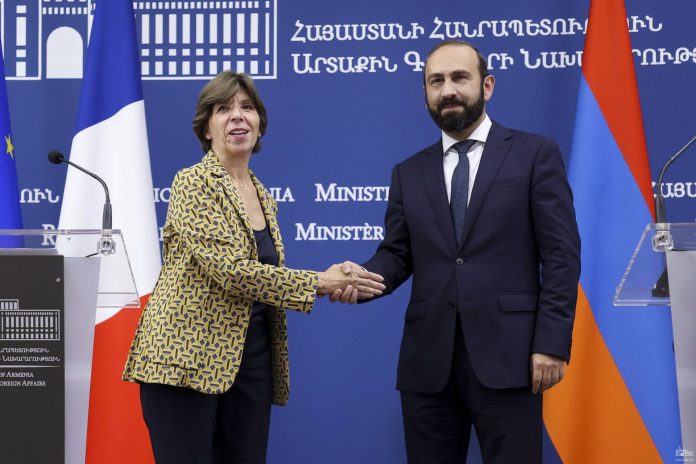
- French Foreign Minister Catherine Colonna
- Following the call, EU leaders reiterated their support for Ukraine.
“We stand united and ready to provide additional military equipment, financial and political support for Ukraine,” Michel said.
“Peace and security in Ukraine equals peace and security in Europe.”
Von der Leyen said Europe’s support for Ukraine “is unwavering” through a proposed new 50 billion euros (about $52 billion) on macro-financial assistance, one million rounds of ammunition delivered by March 2024, as well as “EU action to ensure full accountability for Russian crimes against Ukrainians.”
“Good call with NATO leaders hosted by the President of the United States. As Russia continues its brutal war, we are all committed to supporting Ukraine for as long as it takes,” stated Stoltenberg.
British Prime Minister Rishi Sunak echoed that sentiment, according to a readout from his country, reiterating the UK’s “ongoing military, humanitarian and economic assistance” to Kyiv.
The Italian readout of the call also said Biden was “keen to reassure” Kyiv’s allies about the continuing American support for Ukraine.
European Parliament adopts multi-year support for Ukraine worth $52 billion
European Union lawmakers have approved a four year budget that would provide up to $52.3 billion (50 billion euros) for Ukraine in order to tackle the crisis caused by Russia’s war, the European Parliament said in a statement on Tuesday.
The budget revision was introduced to adapt to the ongoing “war against Ukraine and growing migration issues,” the statement added.
The facility for Ukraine will provide up to $52 billion in direct budgetary support for Ukraine over the period 2024 to 2027, to support reforms, create a favorable investment climate and conditions for attracting private investors to Ukraine’s recovery.
The funding would be separate to financing for military assistance.
MEP Jan Olbrycht said of the revised budget: “Our goal was an ambitious but realistic proposal…and we have managed to keep it targeted but comprehensive. We aim to stabilise Ukraine’s situation with a new €50 billion facility while bolstering the EU’s economy.”
At the same time, Ukraine is working towards satisfying the European Union’s demands for reform as part of a path towards membership of the EU, though analysts expect this will take at least several years.
According to Ukraine’s Prime Minister Denys Shmyhal Ukraine will work on a single document – a “roadmap for reforms plan until 2027.”
Much of Ukraine’s annual budget is financed by credits from external sources while its spending is focused on financing the war against Russia.
Shmyhal stated the plan would have a number of documents with reform proposals from partners including the seven conditions that the EU has laid out for Ukraine’s membership to move forward. Most significantly, these include action on corruption and money laundering, as well as guarantees for media freedom and the protection of ethnic minorities.
The International Monetary Fund is also reviewing financial support for Ukraine, following the agreement of a $15.6 billion package of aid in March designed to help Ukraine’s economic recovery from the devastating effects of Russia’s invasion This week an IMF team has started technical discussions in Kyiv “with the aim of discussing fiscal, budgetary, financial, and structural measures .”
The arrangement is part of a US$115 billion total IMF support package for Ukraine.
The European Union is also planning to step up the pipeline of credits to finance military aid to Ukraine, principally munitions and weapons systems.
On Monday, EU foreign policy chief Josep Borrell proposed an annual $5 billion “peace facility” for Ukraine, an EU fund that reimburses states that supply arms to Ukraine.
Ruble exchange rate to dollar doesn’t matter: Kremlin
The Russian currency’s continued backslide against the US dollar is not a reason for concern, Kremlin spokesperson Dmitry Peskov stated on Tuesday, calling such worries a “remnant of the past.”
The comment follows the ruble’s depreciation past the symbolic threshold of 100 rubles to one dollar on Tuesday for the first time since mid-August. The currency recovered slightly through the morning to trade just above 99 to the dollar.
“Excessive attention to the ruble-dollar exchange rate is possible from an emotional point of view, but rather is a remnant of the past after all,” Peskov told a press briefing.
“We have to get used to living in the ruble zone and not feel dependent on the dollar,” he said, adding that the central bank and the government are fully ensuring macroeconomic stability.
The ruble’s weakness has been attributed to soaring demand for, and insufficient supply of, foreign currency in the country (including demand from importers) and changes in the country’s trade balance. Experts forecast that the currency could stabilize to 95-96 against the dollar within a month and, by the end of autumn, strengthen to 90.
President Vladimir Putin stated recently that the ruble’s slide was no cause for concern as the central bank has all the necessary instruments to support the national currency.