Thursday, January 15, 2026
Home Blog Page 1151

Iran says Israel’s treatment of Palestinian captives reminder of Daesh

Hossein Amirabdollahian

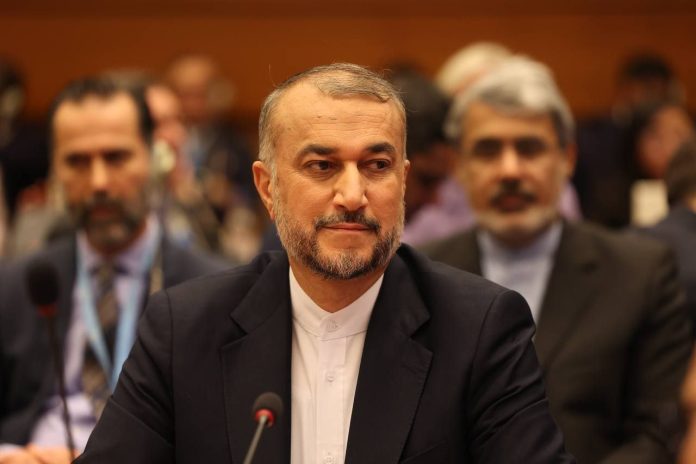
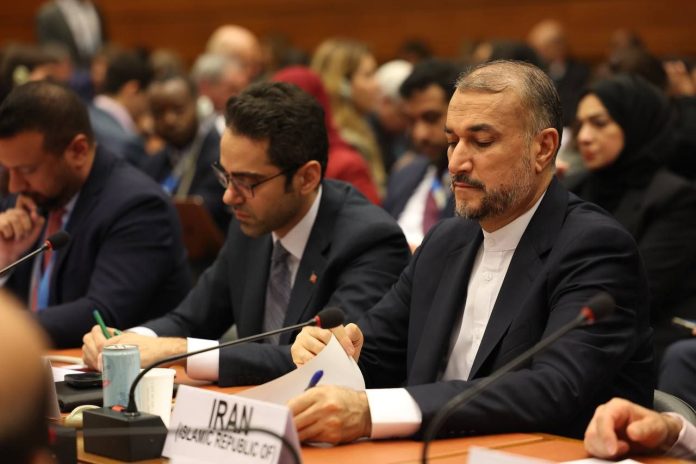
“The inhumane conduct of the Zionist regime vis-à-vis Palestinian citizens held captive in the Gaza Strip is an example of the Daseh-like nature of this regime,” said Amirabdollahian during a high-profile United Nations meeting in Geneva, Switzerland, on Tuesday.

The comments come days after videos released on the internet showed dozens of Palestinians being stripped and abused by Israeli soldiers in a camp in northern Gaza.

The detained Palestinians, among them journalists, were forced to kneel on the ground while being searched and questioned by the Israeli guards.

Israeli regime authorities first denied the authenticity of the video but later admitted they had wrongly arrested many of those people on suspicion of being members of the Palestinian resistance group Hamas.

Amirabdollahian stated during the UN meeting in Geneva, which was attended by top diplomats from the West Asia region, that there was no doubt that the Israeli actions in Gaza in the past two months were blatant examples of war crimes and genocide.

He warned that the conflict would spread to other parts of the region if there is no immediate action to halt “the savage attacks by the apartheid regime of Israel” towards the people in Gaza.

Nearly 18,500 people have been killed in Gaza as a result of the Israeli attacks that started on October 7, the day on which Hamas launched a major operation into the occupied territories near Gaza, killing some 1,200 Israeli settlers and military forces.

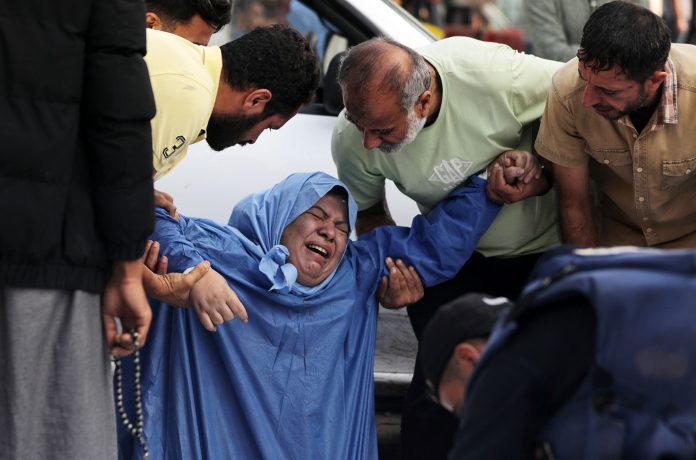
Palestinian health ministry and WHO say diseases including chicken pox, meningitis and other infections spread in Gaza

Gaza War

Roughly 160,000 to 165,000 cases of diarrhea have been recorded amongst children under the age of five, a top World Health Organization (WHO) official told a briefing Tuesday, describing the figure as “much more” than normal.

Cases of impetigo, meningitis, and jaundice have also been recorded in the enclave, according to Richard Peeperkorn, WHO representative in the occupied Palestinian territories. WHO is trying to set up mobile labs in Gaza to analyze samples for jaundice, Peeperkorn added.

He warned that cramped living conditions are contributing to disease spread.

About 80% of the population has been displaced as the Israeli military instructs hundreds of thousands of people to move into ever smaller areas of Gaza amid the Israel Defense Forces ground offensive against Hamas. Medicines and other vital medical supplies have been choked off by the closure of Gaza’s border to all but a trickle of aid.

More than 130,000 cases of respiratory tract infections and 35,000 cases of skin rashes have been recorded, the Hamas-controlled Palestinian Ministry of Health in Gaza said in a report published Monday.

At least 4,395 cases of chickenpox, 17,511 cases of lice and 19,325 cases of scabies have been recorded, according to the report.

The spread of diseases has created additional pressures for the health system in Gaza which WHO’s Peeperkorn described as being “on its knees”.

Only 11 out of the enclave’s 36 hospitals are even partially functional, Peeperkorn said in the briefing, emphasizing the challenges posed by short staffing and surging patient numbers.

“The doctors are really forced to prioritize who receives care and who doesn’t. And they are treating many of the serious cases actually straight away in the corridors or on the floor or even in the chapel,” he added.

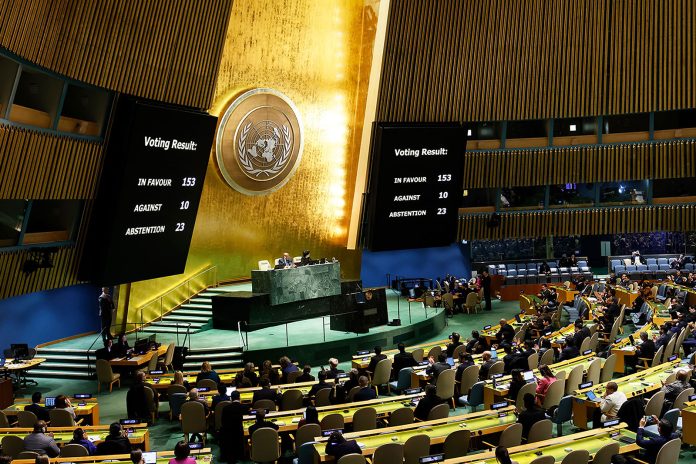
UN General Assembly passes resolution for ceasefire in Gaza

United Nations General Assembly

Tuesday’s resolution passed with 153 countries voting in favour, 23 abstaining and 10 countries voting against, including Israel and the United States. While the resolution is non-binding, it serves as an indicator of global opinion.

The vote comes as international pressure builds on Israel to end its months-long assault on Gaza, where more than 18,000 Palestinians have been killed, the majority of them women and children. More than 80 percent of Gaza’s 2.3 million residents have also been displaced.

Relentless air strikes and an Israeli siege have created humanitarian conditions in the Palestinian territory that UN officials have called “hell on earth”. The Israeli military offensive has severely restricted access to food, fuel, water and electricity to the Gaza Strip.

Tuesday’s vote comes on the heels of a failed resolution in the UN Security Council (UNSC) on Friday, which likewise called for a humanitarian ceasefire.

The US vetoed the proposal, casting the sole dissenting vote and thereby dooming its passage. The United Kingdom, meanwhile, abstained. Unlike UNGA votes, UNSC resolutions have the power to be binding.

After Friday’s scuttled UNSC resolution, UN Secretary-General Antonio Guterres took the extraordinary step of invoking Article 99 of the UN Charter, which allows him to issue warnings about serious threats to international peace. The last time it was used was in 1971.

But the passage of the non-binding UNGA resolution on Tuesday likewise faced US opposition.

Both the US and Austria introduced amendments to the resolution to condemn the deadly Hamas attack on October 7, which marked the start of the current conflict.

Israel’s envoy Gilad Erdan railed against calls for a ceasefire, calling the UN a “moral stain” on humanity.

“Why don’t you hold the rapists and child murderers accountable?” he asked in a speech before the vote.

“The time has come to put the blame where it belongs: on the shoulders of the Hamas monsters.”

The administration of US President Joe Biden has firmly supported Israel’s military campaign, arguing that it must be allowed to dismantle Hamas.

But as Israeli soldiers level entire neighbourhoods, including schools and hospitals, the US has found itself increasingly at odds with international opinion.

In remarks on Tuesday, however, Biden sharpened his criticism of the US ally, saying that Israel was losing international support due to “indiscriminate bombing” in Gaza.

The US, which has strongly criticised Russia for similar actions in Ukraine, has been accused of employing a double standard on human rights.

Iran blames US for supporting Israeli genocide in Gaza

Hossein Amirabdollahian

The Iranian foreign minister made the comments during a speech at a high-level meeting called “The Situation of Human Rights in Occupied Palestinian Territories, the Universal Declaration of Human Rights and International Humanitarian Rights” in Geneva, Switzerland. 

The full text of the speech by Amirabdollahian is as follows:

In the Name of God, the Compassionate, the Merciful 

Your Excellencies, Ministers and Honorable Guests,

I am pleased to be attending this significant meeting. 

We are sharing our viewpoints in Geneva today at a time when the Israeli regime’s military strikes and genocide in Gaza continue through the killing of women, children and ordinary people. 

Please pay attention to figures and statistics carefully. Around 18,000 civilians, more than 12,000 of whom women and children, have been killed. 

A humanitarian ceasefire was violated by the Israeli regime. The exchange of the Israeli regime’s captives with over 9,000 Palestinian prisoners ground to a halt. 

The United States blatantly vetoed a resolution proposed by the United Arab Emirates (UAE) that highlighted an end to the war, the establishment of a ceasefire, the reopening of the Rafah and Abusalem border crossings, the dispatch of humanitarian aid including medicines, food and fuel, and the prevention of the forced displacement of residents of Gaza. 

Today, the United States openly supports the killing of women and children by the Israeli regime. 

The Israeli regime has spoken of using an atomic bomb against residents of Gaza. They are capturing and killing Palestinian men using the same style and method as the ISIS. Look at the images posted online in the virtual space. The Israeli regime’s behavior is the same as the ISIS’, and the United States keeps fully supporting the war against civilians. 

Dear guests,

We believe that the Israeli regime is merely an occupying and apartheid regime. Hamas is a Palestinian freedom movement against the occupation force.

Currently, we are witnessing war spreading day by day in West Asia and the region, a war that could turn into an uncontrollable explosion any moment. We believe war is not the solution.

Indubitably, the United States and the Israeli regime will never be able to destroy Hamas as Hamas has its roots in Palestinian people. The Israeli regime cannot secure the freedom of its captives by means of war. The solution would be a political one, only. 

All should respect the United Nations holding a real referendum among all original residents of Palestine.

The apartheid regime’s war and genocide should stop immediately. All governments should be actively involved in sending humanitarian aid to Palestine. We sternly warn that the consequences of this genocide threaten international peace and security. If genocide and war crimes in Gaza and the West Bank continue, the United States will have to incur further repercussions as a result of its ongoing support for the Israeli regime. 

One should bear in mind that complicity in genocide will have dire consequences. 

Thank you for your attention

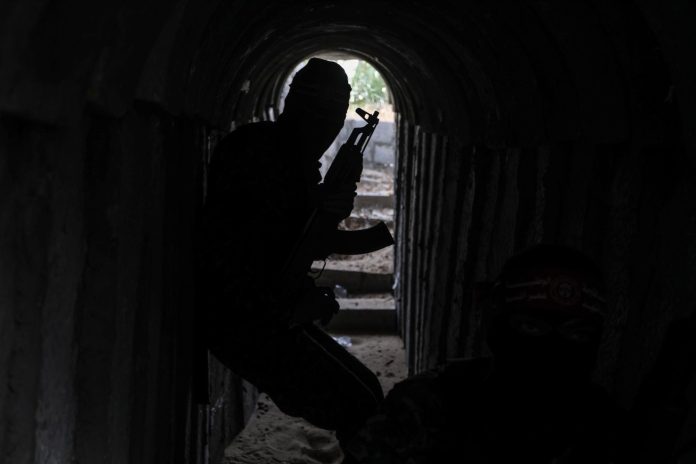
Israel begins flooding Gaza tunnels with seawater “on a limited basis”: US

Hamas

The Israelis are still unsure of whether it will work, the official said, but they assured the US that they are being careful to only test it in tunnels where they do not believe hostages are being held.

The Israeli Prime Minister’s office announced it believes 135 hostages are still being held by Hamas, some of whom are believed to be US citizens.

The Israeli military noted earlier this month that it destroyed at least 500 tunnel shafts in Gaza and located more than 800 around the Palestinian enclave. The IDF said last week that many of the tunnel shafts “were located in civilian areas” and inside civilian structures.

In 2021, Hamas claimed to have built 500 kilometers (311 miles) worth of tunnels under Gaza, though it is unclear if that figure was accurate or posturing.

Also on Tuesday, Israel’s Defense Minister Yoav Gallant stated that troops inside Gaza are operating deep underground.

“They are locating Hamas infrastructure and destroying it,” he added.

He went on to say that Hamas’ infrastructure in Gaza City and the northern area of the Gaza Strip was on the verge of collapsing. IDF operations were being conducted above and below ground.

“Our troops also descend deep underground to locate [Hamas] bunkers, command centers, communication rooms and weapon storages,” Gallant continued.

Senior Hamas spokesman Osama Hamdan said during an address that Israel has so far failed to take back its captives held in Gaza by armed Palestinian groups, indicating that Israel has failed in one of its major goals of its assault.

Hamdan added that Israel’s military campaign is not only failing to secure the captives but endangering their lives altogether.

“Do not try as you will not succeed in freeing the captives alive,” Hamdan continued, stating, “All you do is endanger their lives.”

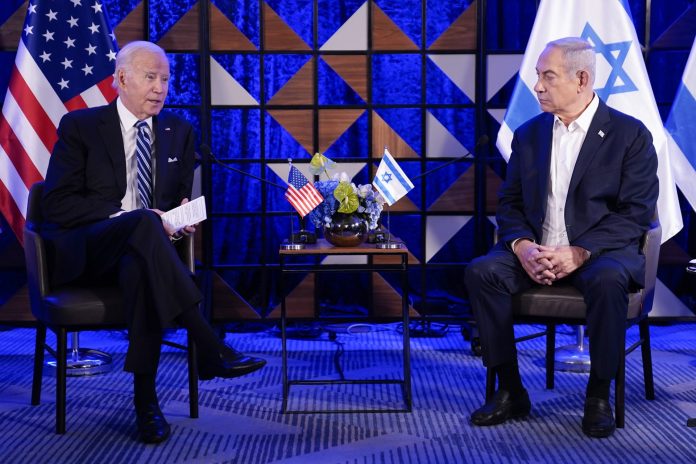
Biden says Israel losing support for Gaza war, suggests Netanyahu make change

Biden Netanyahu

Biden reiterated his support for Israel amid the war but told a group of donors at a fundraiser in Washington, D.C., that Israeli Prime Minister Benjamin Netanyahu “has to change, and with this government, this government in Israel is making it very difficult for him to move”.

“Bibi’s got a tough decision to make,” Biden stated, referring to Netanyahu.

“This is the most conservative government in Israel’s history,” he continued, adding the government “doesn’t want a two-state solution.”

Biden on Monday called his commitment to Israel “unshakeable”, but he stressed, “They have to be careful. The whole world’s public opinion can shift overnight. We can’t let that happen.”

While the White House has supported Israel’s military campaign against Hamas, it has increasingly stressed concerns over causalities in Gaza and the need for humanitarian aid. It has also made clear its support for a two-state solution, a concept Biden has long advocated for.

Meanwhile, Netanyahu on Tuesday said that while he appreciates the support from Biden for destroying Hamas, there are disagreements between them about potential next steps for the region after the war.

“Yes, there is disagreement about ‘the day after Hamas’ and I hope that we will reach agreement here as well. I would like to clarify my position: I will not allow Israel to repeat the mistake of Oslo,” he added, referring to the Oslo Accords that were signed at the White House in 1993 for Palestinians and Israelis to recognize the other’s right to exist.

He vowed to block any attempt to install the Palestinian Authority (PA) in Gaza after the war with Hamas, putting him in direct opposition to the US, which wants to see the body rule the coastal strip after the war.

Biden, during the Tuesday fundraiser, reiterated his support for Israel and his stance against antisemitism in the US and elsewhere.

“The safety of the Jewish people [is] literally at stake,” Biden stated.

Prior to the conflict, Biden had called Netanyahu’s government the most conservative in Israel’s history and urged the prime minister to pull back on the nation’s controversial judicial overhaul.

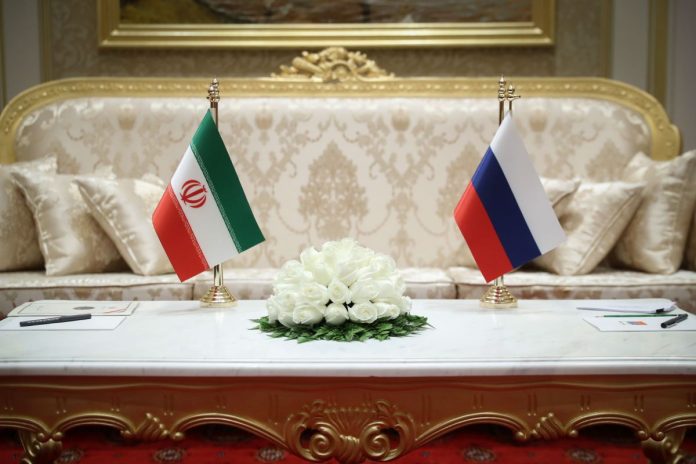
Russia says working on ‘major new deal’ with Iran

Iran and Russia Flags

The Russian Foreign Ministry broke the news in a short statement on Tuesday and said the two countries’ foreign ministers had agreed in a phone call to expedite work on the agreement, which was at “a high stage of readiness.”

The statement did not detail the scope of the agreement, but it comes amid growing political, trade and military ties between Moscow and Tehran, both of which are under US sanctions and opposed to Western unilateralism.

In 2001, Tehran and Moscow signed a 10-year cooperation deal that was lengthened to 20 years through two five-year extensions.

The two countries are planning to ink a document on bilateral long-term strategic cooperation, which may determine their future relations for the next twenty years.

Last week, Iranian President Ebrahim Raisi and his Russian counterpart held extensive talks in the Kremlin, with Vladimir Putin lauding Tehran-Moscow ties as “very good”.

Iranian Foreign Minister Hossein Amirabdollahian and his Russian counterpart Sergei Lavrov also signed an agreement last week to make joint efforts to counter unilateral sanctions imposed on the two countries.

Iran and Russia, as two close and strategic allies, have over the past years deepened their relations in various fields, including military and defense, despite being under heavy Western sanctions.

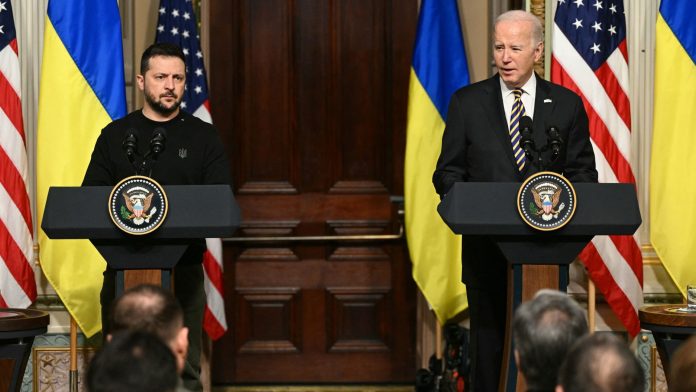
Biden and Zelensky push back on assertion Ukraine’s counteroffensive against Russia stalled

Biden Zelensky

Biden first reiterated a figure mentioned earlier in the joint news conference by Zelensky that Ukraine has taken back 50% of the territories seized by Russia. He also pointed to Ukraine’s move to push back the Russian navy so it could export grain in the Black Sea.

Zelensky’s talks in Washington come at a critical moment, as the White House warns American aid to Ukraine could imminently dry up and talks over new assistance are stalled in Congress.

Zelensky, speaking Ukrainian, stated the successes on the battlefield were “not an easy success,” but his country has made “serious steps forward.”

“Yes, we had a lot of problems, but nonetheless, we were able to do this. Moreover, Russia was not able to stay (in) any part of our territory, any village, any town,” Zelensky said, according to a translator.

He clarified that this doesn’t necessarily apply to big cities, but assured that they had a clear plan to move forward. He declined to give details of those plans publicly.

Biden also said that it was because of bipartisan support from more than 50 countries that Ukraine was able to accomplish these things.

“We need to ensure Putin continues to fail in Ukraine and Ukraine to succeed and the best way for that… to do that is to pass the supplement,” Biden continued, referring to additional funding that is stalled in Congress.

Biden has long vowed American support for Ukraine will persist “as long as it takes”.

But on Tuesday, Biden appeared to revise that commitment, saying that the US would “continue to supply Ukraine with critical weapons and equipment as long as we can”.

It was a shift that reflected the major headwinds in approving new American assistance to Ukraine. After Zelensky’s meeting with lawmakers on Capitol Hill, it appeared no clearer that new aid would be forthcoming before the end of the year.

Opening his news conference, Biden stated Russian President Vladimir Putin was “banking on the United States failing to deliver” new aid, and said American divisions on providing new aid was playing into Russia’s hands.

“We must, we must, we must prove him wrong,” Biden added.

He noted the host of a Russian state television program had praised Republicans for blocking the passage of new Ukraine aid last week.

“If you’re being celebrated by Russian propagandists, it might be time to rethink what you’re doing.”

Biden later defined US expectations for Ukraine as the war approaches the end of its second year.

“We want to see Ukraine win the war,” Biden said, adding, “Winning means Ukraine is a sovereign, independent nation. And it can afford to defend itself today and deter further aggression. That’s our objective.”

Zelensky gave a thankful message of unity at the joint news conference with Biden.

“We’ve already made significant progress. We’ve shown that our partnership is stronger than any Russian hostility,” Zelensky said, adding that Ukraine has freed 50% of the territories Russia occupied.

He pointed out that Ukrainian soldiers have been “defending freedom” for nearly two years and “thanks to Ukraine’s success in defense, other European nations are safe from the Russian aggression unlike in the past.”

“When freedom is strong in one country, it is strong everywhere,” Zelensky said.

“We stand firm, no matter what Putin tries. He hasn’t won any victory,” the Ukrainian president added.

Earlier, Biden promised another $200 million in emergency military aid for Ukraine. He made the pledge during an Oval Office meeting with Zelensky on Tuesday.

The meeting comes after a bill intended to provide $60 billion in aid for Kiev was blocked in the US Senate last week, as Republicans demanded tougher immigration control on the southern US border in exchange for approving Ukraine assistance.

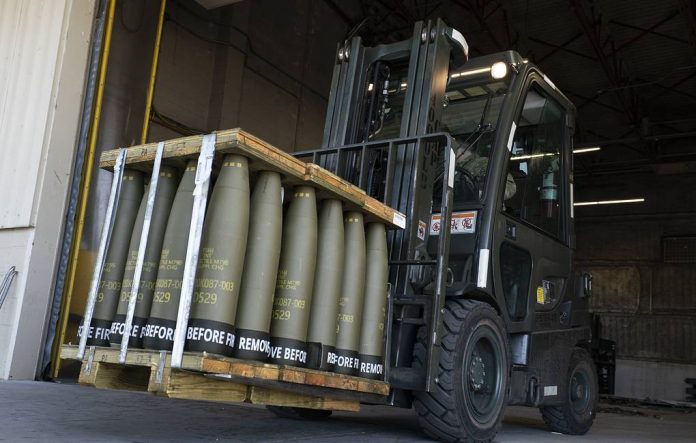
EU counties consider ‘Plan B’ for Ukraine aid

Western Weapons Russia Ukraine War

The European Commission is seeking to provide the funding over the next four years through the so-called Ukraine Facility. The money is intended to help Kiev with its conflict with Russia, as well as for its reconstruction efforts.

Hungary, which has been highly critical of Brussels’ approach to the Ukraine crisis, has indicated that it would veto the decision during a summit of leaders on Thursday.

The Ukrainian government is counting on the money for its 2024 budget and has warned of “devastating consequences” if the EU comes up short, Foreign Minister Dmitry Kuleba told journalists on Monday ahead of a meeting with his European counterparts in Brussels.

Ukraine’s Deputy Prime Minister Olga Stefanishina said a failure to allocate the money would be “a failure of the entire European Union” that would impact Kiev’s chances of getting more aid from the US as well.

According to the FT, Kiev’s supporters in Brussels want to sweeten the deal for Budapest by releasing EU budget funds that were frozen due to Hungary’s perceived lapses in the rule of law and corruption.

The alternative is to have the other 26 members pool resources, the newspaper said, citing people familiar with the talks on what one of the sources called a “plan B.” Diplomats are privately discussing “the feasibility and technical details” of such a move.

EU foreign policy chief Josep Borrell urged national leaders to “stubbornly support” Ukraine for the sake of bloc unity after the ministerial meeting.

Hungarian Minister for EU Affairs Janos Boka told the FT that his government was not likely to change its position. He claimed that the reported consent-for-frozen-funds deal would amount to “political blackmail not from Hungary, but against Hungary” by Brussels.

However, he added that it was feasible for assistance outside of the EU budget to be provided. This would involve “member state contributions, mutual member state guarantees, a much shorter planning period of one year instead of four years,” and would be “under the clear political leadership of the member states.”

Budapest has argued that the tens of billions of dollars and euros poured into Ukraine by Western donors have failed to end the bloodshed. Nations should instead pressure Kiev and Moscow into peace talks, the Hungarian government believes.

Russia says Ukraine’s uncompromising position and refusal to accept the reality on the ground is standing in the way of resolving the crisis. Moscow wants its neighbor to be “neutral, non-aligned and nuclear-free” as well as respectful of the rights of its ethnic Russian minority, Foreign Ministry spokeswoman Maria Zakharova stated last week.

Iran: Israeli PM life hinges upon continuation of Gaza war

Gaza War

Amirabdollahian held talks with his Chinese counterpart Wang Yi over multilateral and regional relations, especially the recent developments in Palestine.

The Iranian minister expressed displeasure with the US veto of a UN Security Council resolution that demand an end to the genocide in Gaza, appreciating China’s constructive efforts to establish peace and stability in the region.

He also underlined the need to play an active role in stopping the war on Gaza.

“The security of the region is important for all of us, and to this end, the Islamic Republic of Iran has held several rounds of consultations with regional countries”, the top diplomat underscored.

He once again stressed that the war has expanded in the region and if the attacks on Gaza are not stopped immediately, there is a possibility that an explosion will occur and things will spiral out of control. Amirabdollahian maintained that unfortunately, the US side does not soundly understand the danger posed by the spillover of the war across the region.

He added that the life of Israeli Prime Minister Benjamin Netanyahu, an ally of the White House, is only intertwined with the continuation of the war and genocide, but the current situation in the region is not sustainable.

The Chinese foreign minister also voiced regret over the veto of the ceasefire resolution by the US.

Wang Yi said the establishment of a ceasefire and immediately sending humanitarian aid into Gaza are important for China.

He expressed hope that the upcoming meeting of the UN General Assembly will be an opportunity to establish a ceasefire in the region.

The two diplomats haves expressed satisfaction with the trend of bilateral ties. They stressed the need to continue consultations and strengthen multilateral cooperation.