Saturday, December 27, 2025
Home Blog Page 1114

Saudis overwhelmingly say Arab countries should severe ties with Israel amid Gaza war

Israel Saudi Arabia Flags

The result of the poll, conducted by the Washington Institute for Near Eastern Affairs, a pro-Israel think tank based in Washington, shows the difficulties the United States faces as it pushes for Saudi Arabia to normalise ties with Israel.

Prior to the war in Gaza, the US was actively working towards achieving an agreement that would see Israel and Saudi Arabia normalise relations.

Such a deal would build upon existing normalisation agreements such as those between Israel and Bahrain, Morocco, and the United Arab Emirates which were brokered under the Donald Trump administration.

During an interview with Fox News that aired in September, Saudi Crown Prince Mohammed bin Salman stated that the two countries were getting closer to such an agreement “every day”.

Since then, however, Riyadh has put a pause on talks of normalisation and has publicised its diplomatic outreach as one that seeks “to stop the ongoing escalation”.

While the kingdom has a monarchial system, public opinion plays a factor in the decision-making of Arab leaders, according to analysts.

Friday’s survey also found that 40 percent of Saudis expressed positive attitudes toward Hamas, compared with just 10 percent according to a poll carried out months before the war began.

The poll further found that the majority of respondents in Jordan, Lebanon and Egypt held favourable views towards Hamas.

The poll’s findings highlight large-scale outrage in the Arab world over Israel’s military assault on Gaza, which came in response to the 7 October attack on southern Israel.

That attack saw 1,200 Israelis and foreign nationals killed, and around 240 people taken captive by Hamas and other Palestinian armed groups.

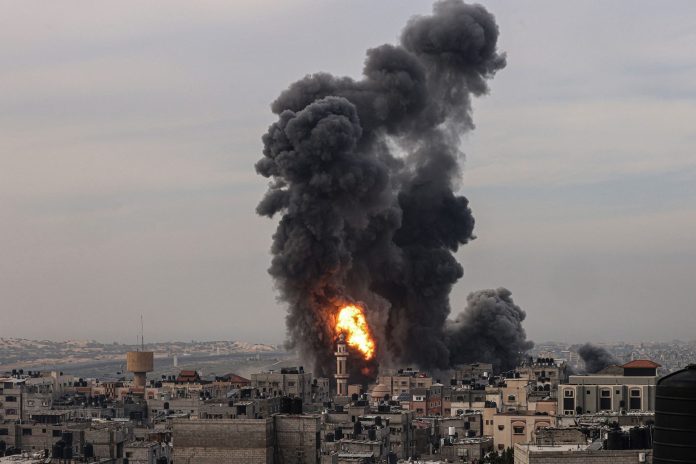
Israel responded by imposing a full siege on the already blockaded enclave. It then launched a devastating aerial bombing campaign followed by a ground invasion that has killed more than 20,000 Palestinians, the majority of whom are women and children.

As a result, mass protests have erupted across the Arab world in support of the Palestinians in Gaza. In addition to the demonstrations in the streets, citizens across the Middle East are boycotting Israeli-linked businesses.

The survey further found that 87 percent of Saudis believe “Israel is so weak and internally divided that it can be defeated some day”.

US ‘alert to risks’ of Houthi strikes on global economy

Brainard told reporters that the US economy was proving resilient, with inflation having come down faster than even the more optimistic forecasts had indicated, the labor market rebounding, and growth remaining solid.

But she stated the administration remained keenly alert to risks, including issues such as Russia’s ongoing war in Ukraine and its potential to disrupt grain markets, and the evolving situation in the Red Sea.

“Geostrategic risks remain elevated. We see that also in the Red Sea, where we’re closely monitoring and we’re working with partners,” she said, adding that there was no evidence thus far to suggest an impact on prices or the availability of products.

Brainard stressed Biden’s national security team was “very focused” on the situation in the Red Sea, given its importance to global shipping, and remained in constant communication with ocean shippers and countries in the region to ensure freedom of navigation and to bolster regional security.

Asked about the potential inflationary impact of the attacks, Brainard stated: “Based on the information we have, diversion of vessels from the Suez Canal to the Cape of Good Hope is not anticipated to have a large effect on the availability of products for holiday shopping, but of course we will continue to monitor that.”

The Yemenis have declared their open support for Palestine’s struggle against the Israeli occupation since the regime launched a devastating war on Gaza on October 7. The Yemeni armed forces have also launched missile and drone attacks on targets in the Israeli-occupied territories of Palestine after the occupying regime’s aggression on Gaza.

The Houthis have also defended their strikes as justified retaliation for “the oppression of the Palestinian people”. They have vowed to “prevent the passage” of any ship headed to Israel or otherwise connected to Tel Aviv, stressing such vessels are legitimate targets as long as West Jerusalem carries out “ugly crimes … against our brothers in Gaza and the West Bank”.

Two-thirds of Israelis want Gaza ceasefire agreement: Poll

Israel Hamas Hostages

About 22 percent of respondents said they were opposed to making a deal in exchange for a ceasefire while 11 percent of respondents said they were unsure.

The poll, done on a random sample of 502 Israelis with an estimated error rate of 4.3 percent, also said that 73 percent of Israeli agree to a ceasefire only after a deal has been reached, and only 11 percent agree to a ceasefire while negotiating.

The poll also showed that 67 percent of Israelis support Israel “continuing with the current ceasefire framework in exchange for the daily release of hostages”, while 22 percent are in opposition.

It comes amid growing international pressure on Israel to pause its assault on Gaza and to allow more humanitarian aid into the besieged territory.

At least 20,000 people have been killed in the besieged Gaza Strip since Israel began bombarding the enclave more than 10 weeks ago, according to Palestinian officials. At least 8,000 children and 6,200 women are among those killed, Gaza’s Government Media Office reported on Wednesday.

The war has flattened large parts of northern Gaza and driven most of the population to the southern part of the besieged territory, where many are in crowded shelters and tent camps. Some 1.9 million Palestinians – about 90 percent of Gaza’s population – have fled their homes.

France, the United Kingdom and Germany on Sunday added their voices to calls for a ceasefire, while US President Joe Biden last week called the bombing “indiscriminate”.

Iran says UNSC resolution on Gaza positive step, but insufficient

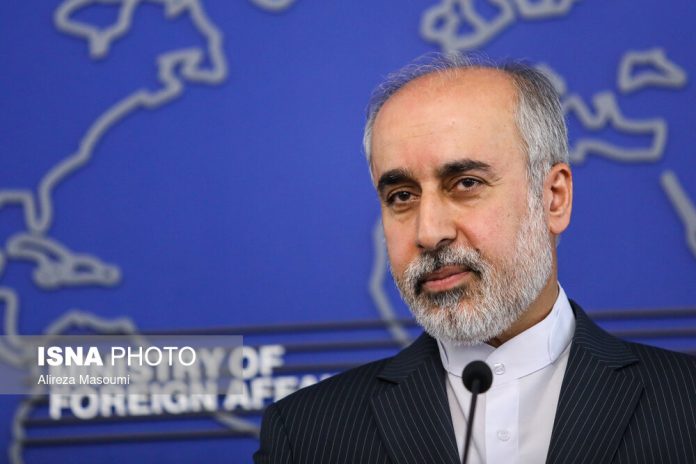
Nasser Kanaani

Kanaani described the approval of UN Security Council Resolution 2720 on the dispatch of immediate humanitarian aid to Gaza as a positive, but insufficient move.

“It is highly regrettable that 77 days into the Zionist regime’s lunatic strikes on defenseless people in Gaza, the US government still blocks the passage of a binding resolution at the United Nations Security Council to stop the war and put an end to the Zionist regime’s war crimes and genocide in Gaza,” he said.

“It is practically impossible to send in effective humanitarian aid amid ongoing bombardments and military attacks by the Zionist regime against people who have been subject to the most unprecedented war crimes in contemporary history over the past 77 days at a time when more than 60 percent of their homes as well as urban and service infrastructure have been destroyed. And remarks made by the UN secretary general after the adoption of this resolution are based on this very bitter reality,” the spokesman explained.

“The approval of this resolution does not lessen the UN Security Council’s responsibilities, and the US government remains the one that is mainly responsible for the continuation of the Israeli regime’s brutal attacks and war crimes against Palestinian citizens in Gaza and the West Bank in Palestine,” he added.

The UN Security Council has finally adopted a resolution calling for aid deliveries to desperate Palestinian civilians in Gaza to be sped up, after the US delayed the vote for days and pushed the members to strip the text from any direct calls for a ceasefire or suspension of hostilities between Israel and Hamas.

The 15-member council backed the watered-down text in a 13-0 vote on Friday, with both Washington and Moscow abstaining. Just prior to the final vote, the US used its veto power to vote down a Russian amendment that sought to reintroduce the call for an “urgent suspension of hostilities,” instead of a vague plea to “create conditions” for eventual peace.

Veteran Iranian journalist urges Russia to apologize for stance on three Iranian islands

Lavrov Putin

“The Arab states were not expected to adopt any stance other than animosity toward Islamic Iran and alignment with the Zionist regime, but the Russian government should be held accountable for its wicked and illegal move against the Islamic Republic of Iran,” said Hossein Shiratmadari in an editorial on Saturday.

“Russian Foreign Ministet Sergei Lavrov knows about the numerous documents that signify Iran’s definite and undisputed sovereignty over the three islands,” he added.

“Accordingly, even if the Russian government’s move was an error, it smacks of betrayal, and our country’s diplomacy apparatus is expected, at least, to ask the Russian government to officially and openly apologize for its move against the territorial integrity of Islamic Iran and, given the undeniable documents which exist, emphasize Iran’s sovereignty over the three mentioned islands,” he added.

Russia has recently sided with the United Arab Emirates over the Persian Gulf islands in the sixth Russian-Arab Cooperation Forum held in Morocco.

Iran Leader: U.S. shamelessly vetoed UN resolution on ceasefire in Gaza

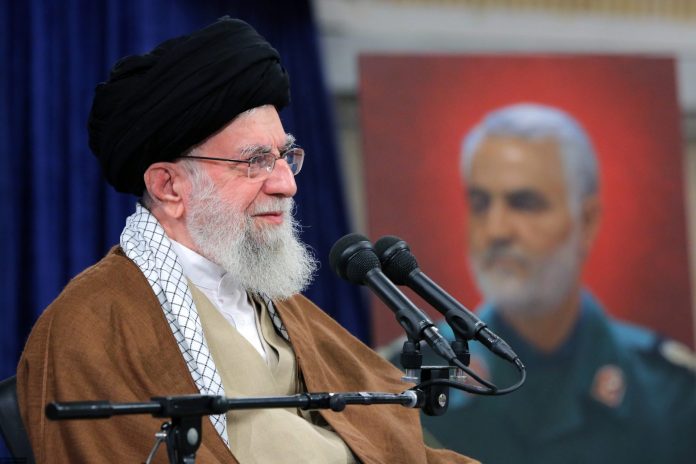
“The United States shamelessly vetoes the UN resolution on the stopping of Israeli bombardments and the establishment of a ceasefire in Gaza,” said Ayatollah Seyyed Ali Khamenei in a meeting with people from all walks of life from the provinces of Kerman and Khuzestan.

“What does this veto mean? It means the U.S. is an accomplice to the Israeli]l bombardments of children, women, the sick, the elderly and defenseless people,” the Leader explained.

Ayatollah Khamenei added the U-S has been disgraced as the true face of the Western-style civilization has been unmasked during the Israeli war on Gaza. He said, the Palestinians’ great victory lies in the fact that they debunked the West and the United States’ false claim of being human rights advocates.

Ayatollah Khamenei underlined that there is no difference between the Israeli regime, the United States and Britain as they are all one and the same.

He said, there is no doubt that one day the Israeli regime will be wiped off the face of the earth.

The UN Security Council passed a resolution to facilitate aid deliveries to Gaza.
The resolution, however, failed to call for a ceasefire.

Over 20,000 Palestinians have been killed in Israeli onslaught against Gaza since early October.

Analysis shows Israel has dropped hundreds of 2,000-pound bombs on Gaza

Satellite imagery from those early days of the war reveals more than 500 impact craters over 12 meters (40 feet) in diameter, consistent with those left behind by 2,000-pound bombs. Those are four times heavier than the largest bombs the United States dropped on Daesh in Mosul, Iraq, during the war against the extremist group there.

Weapons and warfare experts blame the extensive use of heavy munitions such as the 2,000-pound bomb for the soaring death toll. The population of Gaza is packed together much more tightly than almost anywhere else on earth, so the use of such heavy munitions has a profound effect.

“The use of 2,000-pound bombs in an area as densely populated as Gaza means it will take decades for communities to recover,” said John Chappell, advocacy and legal fellow at CIVIC, a DC-based group focused on minimizing civilian harm in conflict.

Israel has come under pressure internationally over the scale of the devastation in Gaza, with even staunch ally US President Joe Biden accusing Israel of “indiscriminate bombing” of the coastal strip.

Israeli officials have argued that its heavy munitions are necessary to eliminating Hamas, whose fighters killed more than 1,200 people and took more than 240 hostages on October 7. They also claim that Israel is doing all it can to minimize civilian casualties.

Since Oct. 7, the Israeli army has been waging a destructive war on Gaza, resulting in at least 20,057 deaths and 53,320 injuries, most of whom are children and women.

Israel has dropped more than 22,000 guided and unguided bombs on the Gaza Strip in the first six weeks of its war on the besieged enclave, a report has recently revealed.

Citing intelligence data supplied to Congress by the US administration, The Washington Post reported that weapons developed by the United States have played a central role in Israel’s brutal onslaught on Gaza, one of the most densely populated areas on Earth.

In just six weeks into the onslaught, the US supplied the occupying regime with at least 15,000 bombs, including 2,000-pound (900 kilograms) bunker busters, as well as 50,000 155mm artillery shells.

The figures suggest Israel dropped roughly one American-made bomb on Gaza for every 100 people living there.

Iranian MP reacts strongly to Russia’s support for Arab states’ stance on three Iranian islands

“This is the second time that the Russians are not watching their mouths and are interfering in Iran’s territorial integrity,” said Ahmad Naderi on the X social media network.

“Russia should first be answerable for its occupation of Crimea and imposing a war on, and killing Ukrainian people,” he added.

“Kissing up to the United Arab Emirates (UAE) officials does not water down the issue of the Russians’ occupation,” he explained.

“The three islands are and will remain Iranian,” said the MP.

Earlier, Iranian Foreign Minister Hossein Amirabdollahian had, in a phone conversation with his Russian counterpart Sergey Lavrov, reiterated that the three islands are “integral parts” of the Iranian territory.

Amorabdollahian said Iran “rejects any claim by any party” on the three islands.

Russia has recently sided with the United Arab Emirates in its territorial dispute with Iran over the three Iranian islands.

UN Security Council passes resolution on Gaza aid delivery as US, Russia abstain

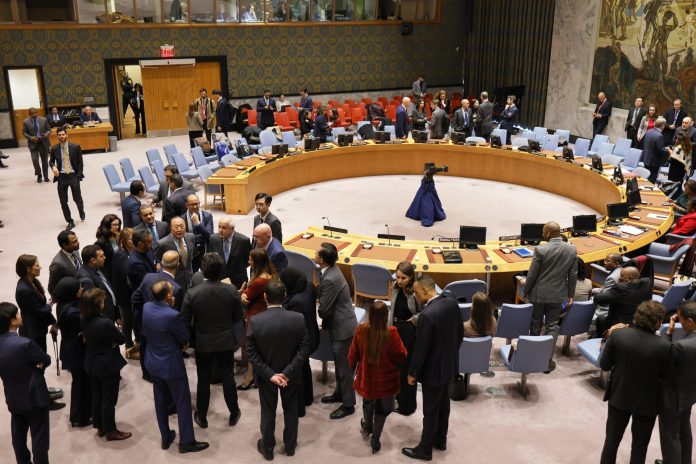
The resolution, which calls for steps “to create the conditions for a sustainable cessation of hostilities”, passed on Friday with 13 votes in favour, none against, and the US and Russia abstaining.

The vote came amid international calls to bring the months-long conflict to an end, as Israeli soldiers pummel Gaza with one of the most destructive campaigns in modern history and humanitarian conditions in the besieged strip reach critical levels.

More than 90 percent of Gaza’s 2.3 million residents have been displaced, and conditions under Israeli siege and bombardment have been described by UN officials as “hell on earth”.

Intense negotiations took place over the last week, with other member states searching for language that would avoid US objections that have doomed previous resolutions on Gaza in the 15-member body, where the US is one of five countries that hold a veto.

The original draft called for “an urgent and sustainable cessation of hostilities” and gave the UN increased control over aid deliveries into Gaza. The adopted resolution opts for less equivocal language on a ceasefire and maintains Israel’s control over all aid.

“This was tough, but we got there,” US Ambassador to the UN Linda Thomas-Greenfield said following the vote.

While a trickle of aid trucks have delivered much-needed assistance to Gaza, aid groups say that truly addressing the strip’s humanitarian crisis will not be possible as long as hostilities continue.

“The real problem is that the way Israel is conducting this offensive is creating massive obstacles to the distribution of humanitarian aid inside Gaza. An effective aid operation in Gaza requires security, staff who can work in safety, logistical capacity, and the resumption of commercial activity. These four elements do not exist,” UN chief Antonio Guterres told reporters following the vote.

Before the vote, Russia proposed an amendment strengthening the language around a ceasefire, saying that the draft resolution had been “neutered” by the US.

“By signing off on this, the council would essentially be giving the Israeli armed forces complete freedom of movement for further clearing of the Gaza Strip,” Russia’s UN Ambassador Vassily Nebenzia told the council before the vote.

Thomas-Greenfield accused her Russian counterpart of hypocrisy, pointing to Russia’s own destructive invasion of Ukraine that began in February 2022.

But the US has faced accusations of a double-standard over its position on Gaza, with critics saying that the US has spent months railing against Russia for violations of international law in Ukraine while providing Israel with weapons and diplomatic support, even as it faces similar accusations over its conduct in Gaza.

The US vetoed a UNSC resolution calling for a ceasefire earlier this month, and was one of the few dissenting votes when the UN General Assembly passed a ceasefire resolution by an overwhelming margin last week.

Earlier this week, the UN called for an investigation into allegations of the killing of unarmed Palestinians by Israeli troops in the strip, and hospitals, UN schools, medical workers, mosques, and churches have also been targeted.

Israel has said that it is working to dismantle Hamas, the Palestinian armed group that governs Gaza and launched a deadly attack on southern Israel on October 7 that killed more than 1,000 people, most of them civilians, and took more than 240 captive.

More than 20,000 Palestinians, most of them women and children, have been killed since the current round of fighting began.

Hamas announced the UN Security Council resolution on Gaza is “an insufficient step”, given that it did not include an international resolution to stop the war.

In a statement released on its official website, Hamas said the UN resolution “does not meet the requirements of the catastrophic situation” created by Israel, “especially since it did not include an international resolution to stop the genocidal war waged by the terrorist occupation entity against our Palestinian people in the Gaza Strip”.

Hamas has repeatedly called for Israel to end its military operation in Gaza.

Hamas also slammed the position of the United States, which abstained from the UNSC vote.

“During the past five days, the American administration has worked hard to empty this resolution of its essence, and to issue it in this weak formula,” the statement read.

“It is the duty of the UN Security Council to oblige the occupation to bring aid in sufficient quantities into all areas of the Gaza Strip, especially the areas of the northern Gaza Strip,” Hamas added, claiming that Israel has caused “daily massacres” in northern Gaza and created conditions for starvation.


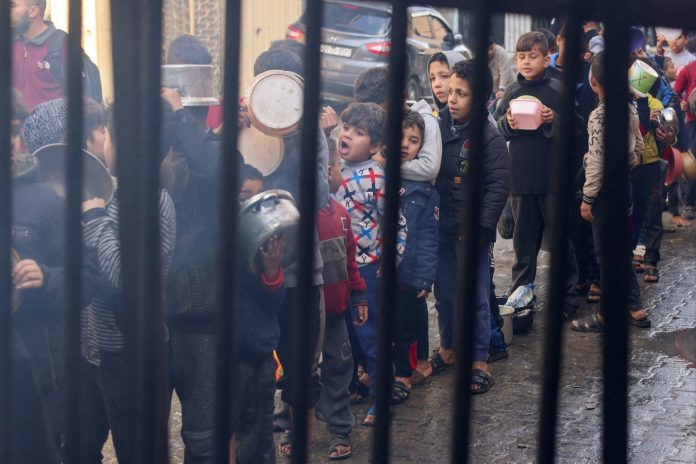
335k kids in Gaza Strip at high risk of preventable death due to food insecurity: UNICEF

In the coming weeks, “at least 10,000 children under five years will suffer the most life-threatening form of malnutrition, known as severe wasting, and will need therapeutic foods”, according to UNICEF.

“This means for many families in Gaza, the threat of dying from hunger is already real,” UNICEF added.

The UNICEF statement comes after the Integrated Food Security Phase Classification (IPC) reported Thursday that approximately all of Gaza’s 2.2 million residents are now facing acute hunger. The entire population of the Gaza Strip is classified in a state of crisis, according to IPC.

That’s the highest share of people facing catastrophic levels of acute food insecurity that the IPC initiative has ever classified for any given area or country, the report stated.

“Many adults go hungry so children can eat,” according to IPC, calling for humanitarian access to be restored throughout the region to enable the rapid delivery of life-saving aid.

UNICEF also announced it is particularly concerned about the nutrition of more than 155,000 pregnant women and breastfeeding mothers, as well as more than 135,000 children under the age of 2, given their specific nutrition needs.

The organization added that “the IPC has emphasized that these conditions do not have to persist. Yesterday’s warning of famine in the coming weeks and months can still be averted. But we must act now”.

Since Oct. 7, the Israeli army has been waging a destructive war on Gaza, resulting in more than 20,000 deaths and over 53,000 injuries, most of them children and women. It has caused immense damage to infrastructure and an “unprecedented humanitarian catastrophe”, according to Palestinian and international organizations.