Saturday, December 27, 2025
Home Blog Page 1014

CIA started training people in Ukraine to work against Russia before 2014: Moscow

CIA

The CIA started working in Ukraine before the coup in 2014, training people to carry out sabotage work against Russia, Peskov said at a news conference.

The New York Times earlier reported that the CIA actively engaged in work in Ukraine after 2014 and even created a network of bases along the border with Russia.

“The CIA, other relevant US agencies, they started working actively in Ukraine even before 2014; started actively recruiting people, training these people for sabotage work against our country,” Peskov stated.

“This is not a secret.”

“The work of the so-called American advisers, most of whom were CIA staff, is well known,” Peskov said.

“They had fine workplaces in the building of the Ukrainian presidential administration,” he added.

Zelensky says EU gave Ukraine fewer shells than claimed as Russian military makes new gains in Donbass

Russia Ukraine War

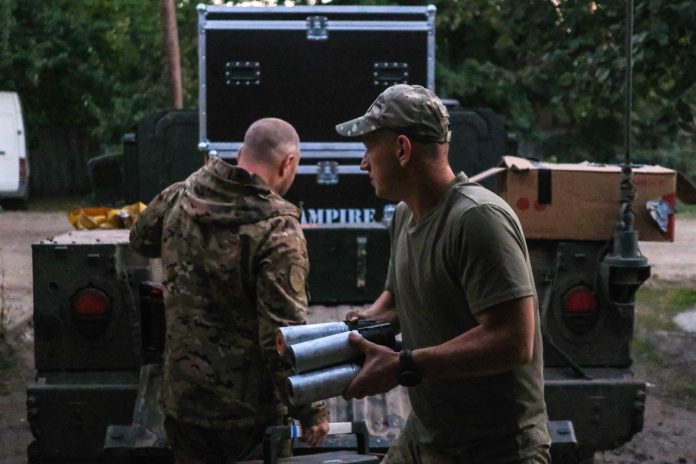
EU foreign policy chief Josep Borrell admitted last month that the bloc would not fulfil its promise to deliver a million 155mm artillery shells to Kiev by March. Due to delays in production, Borrell said that 52% of that number would reach Ukraine by next month, with the remainder due by the end of the year.

Speaking at a press conference in Kiev on Monday, Zelensky stated that “out of the million shells that the European Union promised us, not 50% came, but 30%, unfortunately”.

If Zelensky’s figures are accurate, no shells have been delivered since November, when Bloomberg reported that 30% of the one million had been sent to Ukraine. Again assuming that is the case, the EU now has only three days to hand over 220,000 shells in order to meet Borrell’s already revised target of 520,000.

With a $60 billion military aid bill stalled by Congress in the US, and with Europe’s military industry unable to scale up production to meet the demand, Kiev’s forces have struggled for several months with a shortage of ammunition.

Western media outlets have warned that the ammo deficit could lead to a complete “collapse” of the Ukrainian military, while President Zelensky claimed last week that his troops were forced to abandon the key Donbass stronghold of Avdeevka due to an “artificial shortage of weapons” seemingly imposed by the West.

Speaking at a conference on Sunday, Ukrainian Defense Minister Rustem Umerov alleged that half of all the weapons and ammunition promised by the West have shown up late.

“Allies are supposed to deliver aid on time during this war,” Umerov said, adding, “We have a plan. We’re working to execute the plan. We’re doing everything possible – and impossible – but we struggle without timely supplies.”

Without these supplies, Ukraine will “lose people, [and] lose territories,” the minister continued.

Russian forces have continued to advance westwards following the capture of Avdeevka, with the Russian Defense Ministry announcing the liberation of the nearby village of Lastochkino on Monday. Lastochkino fell just days after the ministry reported that the village of Pobeda was also in Russian hands.

Meanwhile, Russian troops have entered the village of Rabotino in Zaporozhye Region, local official Vladimir Rogov told TASS on Sunday. Notably, this was one of a handful of settlements taken by Ukrainian forces during their ill-fated summer counteroffensive. The entire offensive cost Kiev more than 160,000 men and thousands of pieces of heavy equipment, according to the Russian Defense Ministry.

Israeli bombs eastern Lebanon for first time since start of Gaza war, kills senior Hezbollah officer

Israeli Fighter Jet

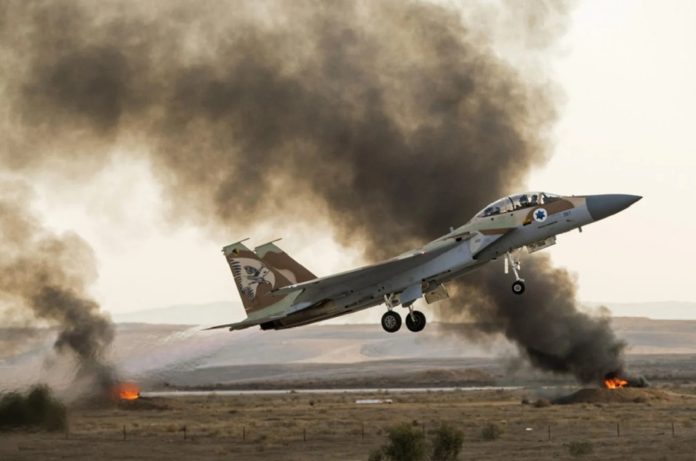
At least two people were killed on Monday after Israeli military planes carried out three air strikes on the outskirts of Buday village near Baalbek, a Hezbollah stronghold in the Bekaa Valley about 100km (62 miles) from the Israel-Lebanon border.

The attacks targeted a convoy of trucks, with the Israeli military saying it struck “Hezbollah terror targets deep inside Lebanon”.

Confirming the strikes, Israel’s army said its jets targeted sites used by Hezbollah for its aerial defence system, adding that they came “in response to the launch of a surface-to-air missile” that downed an Israeli drone earlier on Monday in southern Lebanon, where most Israeli attacks had happened so far.

A Hezbollah official told the Reuters news agency the Israeli strikes hit a warehouse, killing two people. The warehouse is part of Hezbollah’s Sajjad Project that sells food products to people in its stronghold at prices lower than the market.

A video posted by Lebanese media outlets showed a plume of smoke rising from the vicinity of the Aadous plain in Buday, west of the city of Baalbek.

Two separate videos showed a destroyed area with a burned-out and overturned truck and a damaged SUV lying next to a road, as well as a huge pile of rubble from what seems to be a building.

The air strikes came hours after Hezbollah said its fighters shot down an Israeli drone over its stronghold in a province in southern Lebanon. Another missile fired by Hezbollah towards the drone was intercepted by Israel and landed near a synagogue in a town close to Nazareth in northern Israel. There were no injuries or damage.

The strike on Baalbek, because of its location deep inside Lebanon, is the most significant since the strike in early January on Beirut that killed top Hamas official Saleh al-Arouri.

Later on Monday, Hezbollah announced it fired a volley of rockets at an Israeli military base in retaliation.

“In response to the Zionist aggression near the city of Baalbek”, Hezbollah fighters targeted the base in the occupied Golan Heights “with 60 Katyusha rockets”, the group added in a statement.

The Israeli military confirmed that dozens of rockets were launched from Lebanon towards Israel on Monday afternoon.

The Israeli military said later on Monday evening it had killed Hassan Salami, a senior officer of Hezbollah, in the Hujair Valley region in southern Lebanon, adding that he was responsible for carrying out rocket attacks on northern Israel.

Salami had been driving a vehicle in the village of Majadel when he was hit by the missile fired by an Israeli fighter jet, according to a separate statement by the Israeli Air Force.

Hezbollah confirmed Salami’s death in an Israeli attack, but gave no details of his rank or function. Israel said he was the equivalent of a brigade commander.

Hezbollah and Israeli forces have been trading fire nearly daily along the border since the war in Gaza started on October 7, killing dozens of civilians.

The armed group, with deep ties with Hamas, says it will stop its attacks on Israel after a ceasefire is reached in Gaza. But Israeli Defence Minister Yoav Gallant on Sunday stressed anyone who thinks a temporary truce for Gaza will also apply to its northern front is “mistaken”.

Israel has killed nearly 30,000 Palestinians and displaced 80 percent of Gaza’s 2.3 million population after Hamas launched an unprecedented attack into southern Israel on October 7, killing more than 1,100 people and taking about 240 captive.


Iranian daily slams Russia for ‘mass killing’ in Ukraine

Russia Ukraine War

In a Tuesday article, Jomhouri-e Eslami wrote, “Russia has caused a massive massacre of hundreds of thousands of people with military aggression against Ukraine, destroyed cities, left a large number of people homeless, and in the end, some Russian statesmen shamelessly talk about taking over the lands of other countries and threaten others with atomic bombs.”

The daily, however, meted out the West the fair share of the blame, nothing, “The European and US governments are also trying to gain their own interests in this inhumane campaign and they do not pay any attention to the concerns of the nations who warn the Third World War may occur and humanity is in danger.”

Jomhouri-e Eslami held the West as well as the ‘silent and indifferent governments’ accountable for the crimes committed in Ukraine against people ‘in the modern world.’

Russia launched its military invasion of Ukraine on February 24, 2022 for siding with the West and bringing NATO to its doorstep.

Western countries backed Ukraine with heavy flow of cash and weaponry and imposing draconian sanctions on Russia.

History will not erase US disgraceful complicity in Gaza crimes: Hamas

Joe Biden

Hamas’ Political Bureau Chief Ismail Haniyeh made the remarks on Monday following a meeting with Qatari Emir Sheikh Tamim bin Hamad Al Thani.

The Israeli regime launched the war on October 7, 2023 following al-Aqsa Storm, a surprise operation staged by Gaza’s resistance movements against the occupied territories.

As part of its consistent political patronage for the regime, the US, which is Tel Aviv’s main benefactor, has so far vetoed three United Nations Security Council resolutions that have called for implementation of an immediate ceasefire in the Israeli onslaught. The Israeli aggression also enjoys unreserved military and intelligence support on the part of Washington.

So far, nearly 30,000 people have died as a result of the aggression and a simultaneous siege that the regime has been employing against the coastal sliver.

Haniyeh said the US was providing a “cover” for the Israeli regime’s “war of starvation” against Gaza. He was apparently referring to American officials’ lamenting the situation in Gaza at the same time that Washington retained its unbridled support for the war.

“The American cover for the crime of starvation that the occupation uses as a weapon to achieve political goals is a disgrace to humanity that history will not erase, even if the American administration hides behind misleading statements about the humanitarian situation in the Gaza Strip,” Haniyeh stated.

“It will not absolve it (the US) of its responsibility and participation in war crimes committed against defenseless civilians,” the Hamas’ leader added.

Haniyeh also denounced, what he called, the Israeli regime’s refusal to provide decisive responses to mediators’ efforts to broker a ceasefire.

Hamas, he stated, “responded to the efforts of the mediator brothers, agreed to the course of negotiations on stopping the aggression, and showed great seriousness and flexibility, but it believes that the Zionist enemy is stalling, which the movement (Hamas) will not accept in any way.”

UN chief warns Israeli onslaught on Rafah would put ‘final nail in coffin’ to humanitarian aid

António Guterres

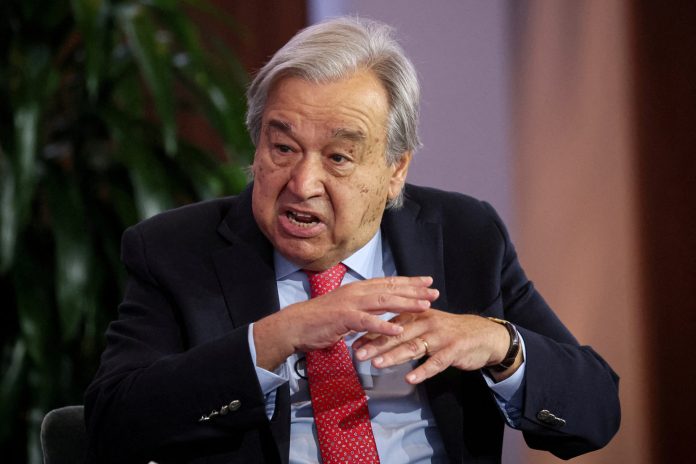
“Rafah is the core of the humanitarian aid operation, and UNRWA is the backbone of that effort,” Guterres told the Human Rights Council in Geneva on Monday.

“An all-out Israeli offensive on the city would not only be terrifying for more than a million Palestinian civilians sheltering there; it would put the final nail in the coffin of our aid programs.”

“I repeat my call for a humanitarian ceasefire and the immediate and unconditional release of all hostages,” he urged.

Stressing that the UN Security Council is often “deadlocked, unable to act on the most significant peace and security issues of our time,” he added: “The Council’s lack of unity on Russia’s invasion of Ukraine, and on Israel’s military operations in Gaza following the horrific terror attacks by Hamas on 7 October, has severely – perhaps fatally – undermined its authority.”

The UN chief emphasized that the council needs “serious reform” to its composition and working methods.

“We urgently need a new commitment to all human rights – civil, cultural, economic, political and social – as they apply to peace and security, backed by serious efforts at implementation and accountability.”

“We cannot, we must not, become numb to appalling and repeated violations of international humanitarian and human rights law,” Guterres continued.

He stated that the Summit of the Future – where the new agenda for peace is to be discussed – in September is the opportunity for such a recommitment.

The agenda applies a human rights lens to preventing and ending violence in all its forms, according to the secretary-general.

Iran FM to UN chief: US escalating tensions in West Asia

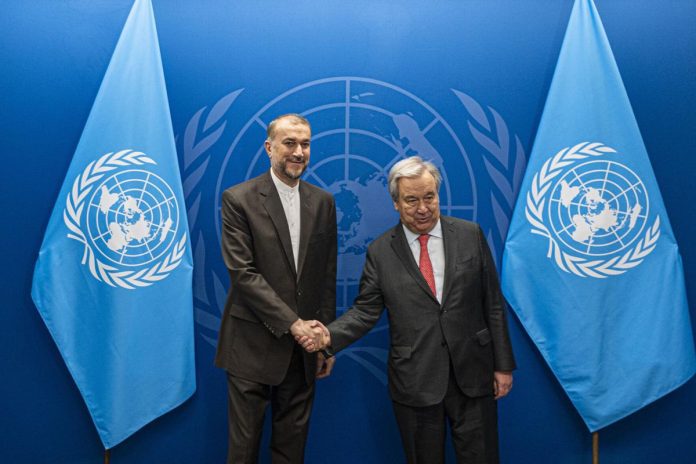
Guterres and Amirabdollahian

During the meeting with Guterres in Geneva, Switzerland, on Monday, Amirabdollahian thanked the UN chief for his efforts on important global issues, including the Palestinian issue and the ongoing crisis in the Gaza Strip.

Referring to his own recent meetings with the leaders of the Palestinian resistance in Beirut and Doha, Amirabdollahian said that the situation of the resistance in terms of military ability to continue confronting the Zionist regime’s warmongering is very good, but the Israeli regime is engaged in crimes against Palestinian citizens and the humanitarian situation in the Gaza Strip, especially in its north, is very catastrophic.

The Iranian foreign minister also highlighted the support of the Palestinian groups for a permanent ceasefire, saying that unfortunately, the Israeli regime insists on continuing the war with the support of the US, but of course this approach will not produce any results for the Zionists.

Amirabdollahian described the humanitarian crisis in the Gaza Strip, especially in the north of the enclave, very worrying and stated that the Zionists have bombed thousands of people to their deaths and want to destroy the remaining population by starvation.

While appreciating the efforts of the UN and its secretary general in sending humanitarian aid to Palestinian citizens, the top diplomat added that the scale of the disaster in Gaza is way greater than the UN relief aid and the US still does not want to end the war, and seeks an escalation in the Red Sea and Yemen, and is bent on deepening the crisis.

The Iranian minister also spoke about the efforts of Iran and the UN to end the crisis in Yemen, saying US military actions against Yemen could endanger the results of joint efforts by Tehran the world body.

Amirabdollahian noted that Iran supports the UN chief’s efforts to end the war on Gaza and the genocide against Palestinians. He said the UN can still count on Iran’s assistance in stabilizing the region.

Guterres for his part said he was pleased to meet Amirabdollahian in Geneva. The UN chief then expressed concern about the humanitarian crisis in Gaza and strongly opposed the collective punishment of Palestinians by the Zionist regime.

He added the situation is very complicated and worrying in Gaza and it is necessary to end this dire condition as soon as possible.

Guterres further described the regional situation as explosive, adding that all sides must avoid any action that would aggravate and cause the crisis to spill over across the region.

The UN secretary general noted that despite the harshness of the situation and the complexity of the crisis, the UN will continue its efforts to control and manage the crisis.

Guterres thanked Iran’s diplomatic efforts to help find a political solution to the crisis in Palestine and defuse the crisis in the wider region.

Gaza death toll nears 30k

Gaza War

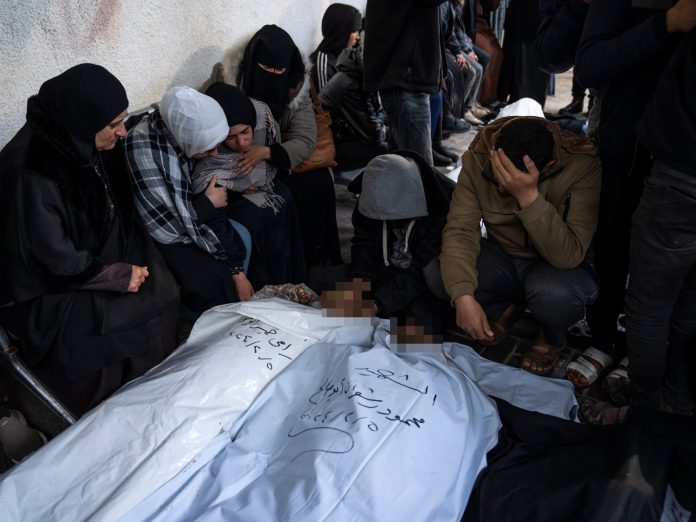
The ministry said in a statement that 70,043 Palestinians have also been injured in the ongoing Israeli army onslaughts.

It added that in the past 24 hours, Israeli forces committed 10 massacres across the territory, killing 90 people and injuring 164 more.

“Many people are still trapped under rubble and on the roads and rescuers can’t reach them,” the ministry added.

Israel has pounded the Gaza Strip since a cross-border attack by Palestinian group Hamas in October, in which nearly 1,200 Israelis are believed to have been killed.

The conflict has pushed 85% of the territory’s population into internal displacement amid acute shortages of food, clean water, and medicine, while most of the enclave’s infrastructure has been damaged or destroyed.

Israel stands accused of genocide at the International Court of Justice, which in an interim ruling in January ordered Tel Aviv to stop genocidal acts and take measures to guarantee that humanitarian assistance is provided to civilians in Gaza.

Tel Aviv now plans a ground offensive in the southern city of Rafah, where 1.4 million people have taken refuge.

Palestinian Authority PM resigns

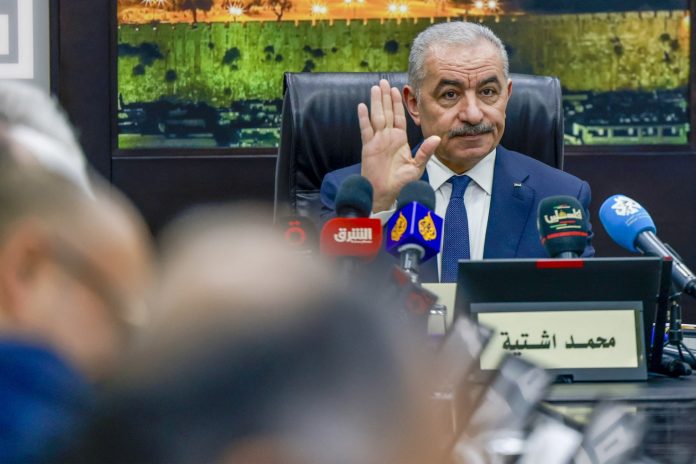
Palestinian Prime Minister Mohammad Shtayyeh

“The decision to resign came in light of the unprecedented escalation in the West Bank and Jerusalem and the war, genocide and starvation in the Gaza Strip,” Shtayyeh, who submitted his resignation to President Mahmoud Abbas on Monday, said.

“I see that the next stage and its challenges require new governmental and political arrangements that take into account the new reality in Gaza and the need for a Palestinian-Palestinian consensus based on Palestinian unity and the extension of unity of authority over the land of Palestine,” he added.

Shtayyeh’s comments come as US pressure grows on Abbas to shake up the Palestinian Authority [PA] and begin work on a political structure that can govern a Palestinian state following the war.

However, Israeli Prime Minister Benjamin Netanyahu has on numerous occasions rejected calls for the PA under Abbas to take control of a Palestinian state and govern over Gaza.

Last week, Israeli lawmakers backed Netanyahu’s rejection of any “unilateral” recognition of a Palestinian state.

“The Knesset came together in an overwhelming majority against the attempt to impose on us the establishment of a Palestinian state, which would not only fail to bring peace but would endanger the state of Israel,” stated Netanyahu.

But the Palestinian Foreign Ministry slammed the vote and accused Israel of holding the rights of Palestinians hostage due to the occupation of Palestinian territories.

“The ministry reaffirms that the State of Palestine’s full membership in the United Nations and its recognition by other nations does not require permission from Netanyahu,” it announced in a statement.

Since the signing of the Oslo Accords in the early 1990s, little progress has been made towards achieving a two-state solution.

As the International Court of Justice hears from about 50 countries on the legal implications of Israel’s occupation of the West Bank, the far-right Israeli Finance Minister Bezalel Smotrich on Thursday announced plans to build more than 3,300 new homes in response to a shooting that killed one Israeli civilian.

Smotrich said the decision would begin an approval process for 300 new homes in the Kedar settlement and 2,350 in Maale Adumim, where the attack occurred.

US Secretary of State Antony Blinken stated he was “disappointed” to hear of the Israeli announcement of the new settlements.

“It’s been longstanding US policy under Republican and Democratic administrations alike that new settlements are counter-productive to reaching an enduring peace,” he stressed in Buenos Aires.

“They’re also inconsistent with international law. Our administration maintains a firm opposition to settlement expansion and in our judgement this only weakens, it doesn’t strengthen, Israel’s security,” he added.

Violence in the occupied West Bank has escalated significantly after the October 7 Hamas attack on southern Israel that killed 1,139 people. Israel’s retaliatory bombardments on Gaza have killed almost 29,800 Palestinian civilians, according to Gaza’s health ministry.

Palestinian health officials also say that 401 people have been killed by Israeli fire in the occupied West Bank during the same period.

IMF revises up economic growth projection for Iran in 2023

Iran Oil

Releasing its latest quarterly report, known as World Economic Outlook, the IMF said Iran’s economy grew 5.4 percent in 2023 showing a remarkable boost compared to the preceding year. The international agency had previously predicted a three-percent growth for the country’s economy in that year.

The IMF also forecast a 3.7 percent economic growth for Iran in 2024, while its previous projection in October 2023 had put the figure at 2.5 percent.

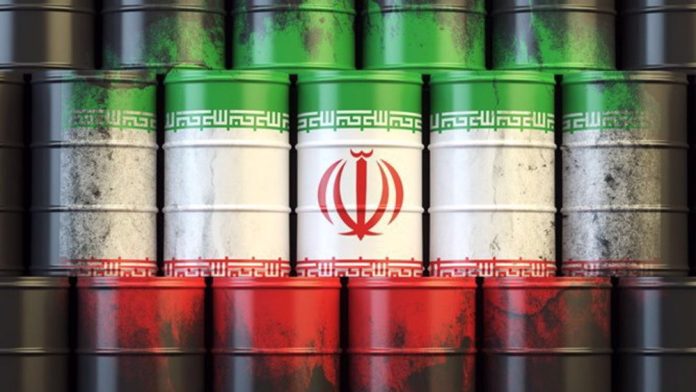
The world body attributed the hike in Iran’s growth rate to a surge in the country’s oil output, which it said has surpassed 2.7 million barrels per day so far in 2024.

IMF’s figures confirm reports by the Iranian government agencies suggesting that the country is on a path to control inflation and restore economic growth to levels seen before 2018 when the United States withdrew from an international deal on Iran’s nuclear program and re-imposed sanctions on the country.

The sanctions initially affected Iran’s oil revenues and led to periods of negative economic growth in the country. However, Iran started to recoup the losses in the second half of 2022 after it implemented a series of economic reform programs to offset the impact of sanctions.