
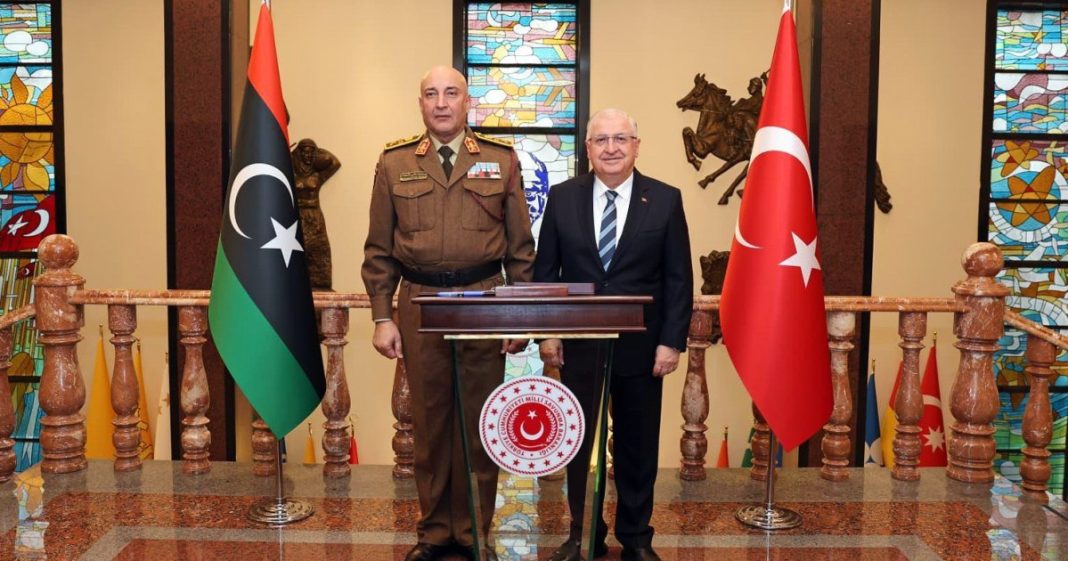
The crash on Tuesday killed everyone on board.
The other victims were four high-ranking Libyan military officials as well as three crew members.
Turkish officials told Al Jazeera that initial investigations have ruled out sabotage and instead point to a technical failure as the cause of the crash.
Libyan Prime Minister Abdul Hamid Dbeibah confirmed al-Haddad’s death in a statement on Facebook, saying the “tragic accident” took place as he and his delegation were returning home.
“This great tragedy is a great loss for the nation, the military establishment, and all the people,” he stated, adding, “We have lost men who served their country with sincerity and dedication and were an example of discipline, responsibility, and national commitment.”
Al-Haddad was the top military commander in western Libya and played a crucial role in the ongoing United Nations-brokered efforts to unify the country, which has been divided since 2014 following the NATO-backed revolt that toppled and killed longtime ruler, Muammar Gaddafi.
The four other officers who died in the crash were General Al-Fitouri Gharibil, the head of Libya’s ground forces; Brigadier General Mahmoud Al-Qatawi, who led the Military Manufacturing Authority; Muhammad Al-Asawi Diab, an adviser to the chief of staff; and Muhammad Omar Ahmed Mahjoub, a military photographer with the chief of staff’s office.
The Libyan delegation was in Ankara for high-level defence talks aimed at boosting military cooperation between the two countries, according to Turkish officials.
Dbeibah’s UN-recognised Government of National Unity (GNU) in Tripoli announced official mourning across the country for three days. The GNU statement said that all state institutions would fly flags at half-mast, while official ceremonies and celebrations would be suspended.
Turkiye’s Minister of Interior Ali Yerlikaya said on X that al-Haddad’s plane took off from Ankara’s Esenboga airport at 8:10pm local time (17:10 GMT) en route to Tripoli, and that radio contact was lost about 40 minutes later.
He added that authorities found the plane’s wreckage near the Kesikkavak village in Ankara’s Haymana district.
Yerlikaya noted that the Dassault Falcon 50-type jet had made a request for an emergency landing while over Haymana before all communication ceased.
Burhanettin Duran, the head of the Turkish presidential communications office, said the plane notified air traffic control of an electrical fault and requested an emergency landing. The aircraft was redirected back to Esenboga, where preparations for its landing began.
The plane, however, disappeared from the radar while descending for the emergency landing, Duran added.
Security camera footage aired on local television stations showed the night sky over Haymana suddenly lit up by what appeared to be an explosion.
Turkish Minister of Justice Yilmaz Tunc said that the Ankara chief prosecutor’s office has launched an investigation into the incident.
In a statement to Al Jazeera, a Turkish official stated that “initial reports from the investigation rule out any sabotage to the Libyan Army Chief plane crash”.
The initial cause is technical failure, the official added.
According to the GNU, Libya will send a team to Ankara to work with Turkish authorities on investigating the crash.
Walid Ellafi, the GNU’s state minister of political affairs and communication, told the broadcaster Libya Alahrar that it was not clear when a crash report would be ready.
He said the jet that crashed was a leased Maltese aircraft and that officials did not have “sufficient information regarding its ownership or technical history”.
Eastern Libya commander Khalifa Haftar issued a statement expressing his “deep sorrow over this tragic loss”, while the House of Representatives in Benghazi offered their condolences to the families of al-Haddad and his delegation.
Al-Haddad had been the army’s chief of general staff since August 2020, and was appointed by then-Prime Minister Fayez al-Sarraj.
Turkiye’s Ministry of National Defence had announced the Libyan chief of staff’s visit to Ankara earlier this week, saying he had met his Turkish counterpart, Selcuk Bayraktaroglu, Turkish Minister of National Defence Yasar Guler, and other Turkish military commanders.
The crash occurred a day after Turkiye’s parliament passed a decision to extend the mandate of Turkish soldiers’ deployment in Libya by two more years.
Ankara has close ties with the UN-recognised government in Tripoli, which it provides with economic and military support.
In 2020, it sent military personnel there to train and support the government, and later reached a maritime demarcation accord.
In 2022, Ankara and Tripoli also signed a preliminary accord on energy exploration.
Turkiye has recently switched course under its “One Libya” policy and ramped up contacts with Libya’s eastern faction as well.
