
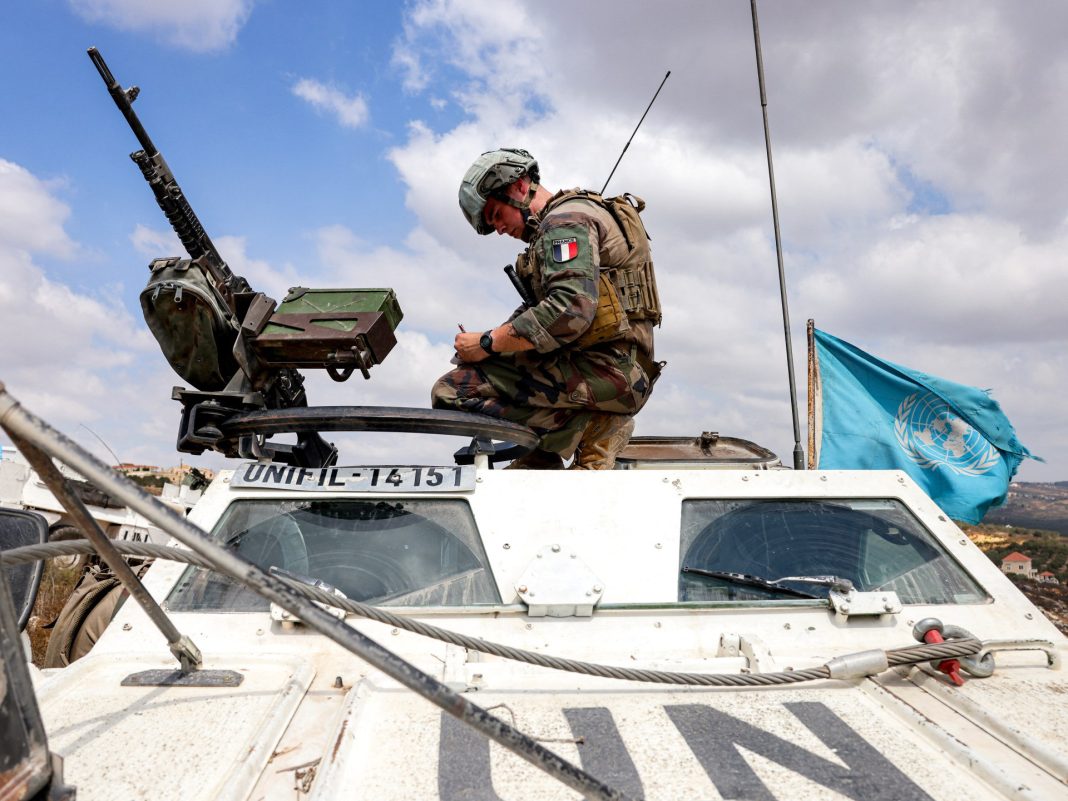
“This is one of the most serious attacks on UNIFIL personnel and assets since the cessation of hostilities agreement of last November,” UNIFIL said in a statement on Wednesday.
“One grenade impacted within 20 metres [22 yards] and three within approximately 100 metres [110 yards] of UN personnel and vehicles.”
The peacekeepers were working on Tuesday to clear roadblocks that were hindering access to a UN position, UNIFIL added.
Israel has been violating the November ceasefire it reached with Hezbollah, carrying out near-daily attacks on Lebanon, claiming to target Hezbollah sites and members but also killing large numbers of civilians, displacing communities, and destroying infrastructure and residential buildings.
UNIFIL said the Israeli army was informed in advance of its road clearance work in the area, southeast of the village of Marwahin.
“Any actions endangering UN peacekeepers and assets, and interference with their mandated tasks are unacceptable and a serious violation of Resolution 1701 and international law,” UNIFIL added, referring to the resolution adopted at the end of a 2006 war to stop hostilities between Israel and Hezbollah.
The Israeli military said it did not intentionally target the peacekeepers but dropped several sonic bombs near a suspect in a border area without providing evidence. It added that contact was made with the peacekeeping force and it explained details of what had happened.
The UN has expressed “serious concern” about the Israeli grenade attack. UN chief Antonio Guterres’s spokesman Stephane Dujarric said: “Whether or not they meant to do it or didn’t mean to do it, … the Israeli [military was] fully informed in advance of the work that we were doing on road clearance in that area.”
“They knew exactly where we were, when we were going to be there,” Dujarric stated, adding, “And obviously, we’re relieved that no one was hurt, but this could have been very tragic indeed.”
Established in 1978, UNIFIL patrols Lebanon’s southern border with Israel.
Last week, the UN Security Council unanimously extended the peacekeeping mission in Lebanon until the end of 2026, after which a yearlong drawdown and withdrawal is to commence.
The winding-down of UNIFIL has been pushed heavily by Israel and the United States, who accuse the peacekeeping force of providing political cover for Hezbollah since the 2006 war, which ended in an impasse, and of failing to work to disarm Hezbollah – despite that not being the UN body’s stated mission.
Meanwhile, Israel continues to occupy at least five points in Lebanese territory after its invasion of southern Lebanon in October. The ceasefire reached in November stipulates that Israeli forces should withdraw from southern Lebanon, but that has not yet happened.
Hezbollah Secretary-General Naim Qassem has rejected growing pressure to disarm the group, warning that Lebanon’s sovereignty could be achieved only by ending Israeli “aggression”.
Qassem said last month that the Lebanese government must first ensure Israel complies with the ceasefire agreement before talks on a national defence strategy can take place.
“The resistance will remain as a strong barrier, preventing Israel from achieving its goals, and Israel will not be able to remain in Lebanon or achieve its expansionist project through Lebanon,” the Hezbollah chief added.
He dismissed Lebanese government and foreign proposals to integrate Hezbollah’s arsenal into a national defence strategy, insisting that Israel must first withdraw from Lebanese territory, release prisoners and halt its attacks.
