
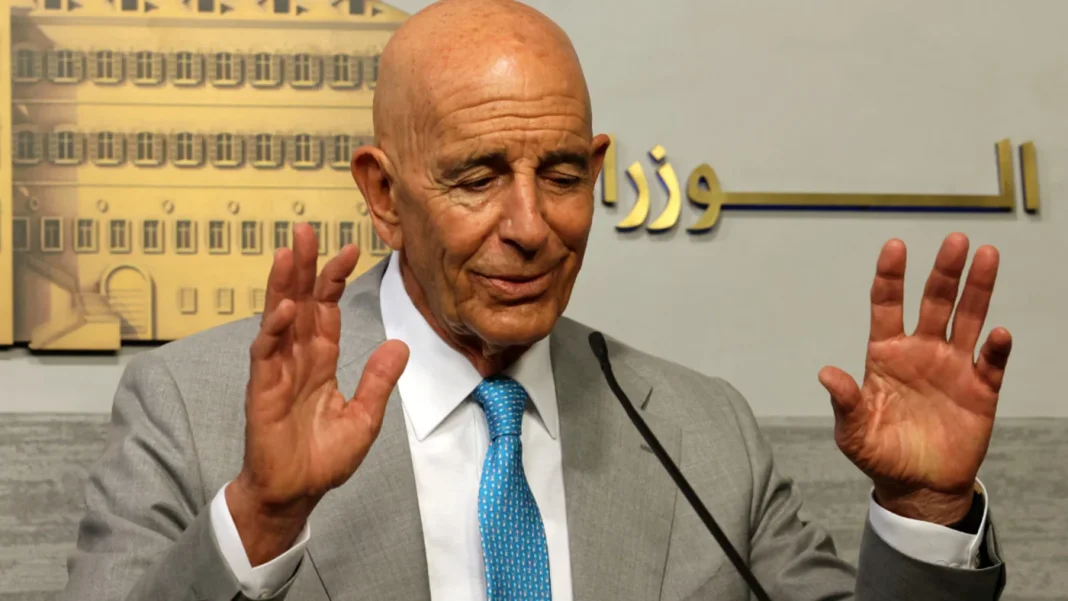
“America is not here to compel Israel to do anything,” Barrack told reporters on Monday.
“We are here to use our influence to bring calm minds together… America can only influence… we are not going to have more boots on the ground.”
The 78-year-old billionaire, who officially serves as US ambassador to Turkey and special envoy to Syria, has been shuttling across the Middle East as Israel continues to launch wars on several fronts.
Despite the Lebanese movement Hezbollah agreeing to a ceasefire with Israel in November, Israel has continued to strike the group and occupy five strategic border “points” in the country’s south.
For months, Lebanon has been asking the US to help secure a full Israeli withdrawal and an end to air strikes, in return for Hezbollah handing over its weapons.
But on Monday, Barrack told reporters that the US was not going to force Hezbollah to disarm, or sanction the country if progress is not achieved.
“There’s no consequence, there’s no threat, there’s no whip,” he added.
The former real estate mogul and close Trump advisor, who lived in Beirut during the 1970s and enjoys close ties to Persian Gulf rulers, has said the US president’s promise of economic gain for the region is enough motivation.
“I honestly think that they are going to say ‘the world will pass us by.’ Why? You have Israel on one side, you have Iran on the other, and now you have Syria manifesting itself so quickly that if Lebanon doesn’t move, it’s going to be Bilad al-Sham again,” Barrack stated earlier this month, using the name for the historic region of Syria that once comprised Lebanon.
Since taking office, Lebanon’s President Michel Aoun has said Beirut is moving to disarm the powerful movement in exchange for a complete withdrawal of Israeli troops from southern Lebanon and an end to Israeli air strikes.
His government has reduced its sway in parts of the south as well as its hold over Beirut’s port and airport, but US officials have been asking for swifter and broader action.
The Lebanese Armed Forces, the country’s non-sectarian military, has moved into positions Israel has evacuated in southern Lebanon and where Hezbollah has withdrawn from – mainly south of the Litani River.
For its part, Hezbollah insists its arms are necessary because Israel continues to occupy Lebanese territory.
In an interview with reporters in New York earlier this month, Barrack noted the US was not concerned with Hezbollah’s small arms, but larger systems like missiles and rockets.
“Everybody in Lebanon is packing a 357 Magnum. I mean, it’s like having a belt. So we’re not talking about small arms. We’re talking about the weapons that could affect Israel,” he added.
And on 11 July, Barrack told reporters that the US only had “issues with” Hezbollah’s armed wing, not its political party, Amal, which represents most of Lebanon’s Shia Muslims in parliament.
At the beginning of the year, the US dangled reconstruction funds from Saudi Arabia to Lebanese lawmakers to lobby for them to vote in favour of former Lebanese army chief Aoun as president.
Those funds have not materialised, with US officials insisting on a full dismantlement of Hezbollah’s heavy arms arsenal.
Barrack said Persia Gulf states “are ready to provide [funding]” once Hezbollah is disarmed.
“Saudi Arabia, Qatar, and now the UAE are coming in and saying, ‘If we can get to where everybody can just calm down, we will help redevelop that portion of Lebanon,’ which is huge.”
