The US pared back the original plan over the weekend following criticism from Kyiv and Europe, but has not yet released the new version.
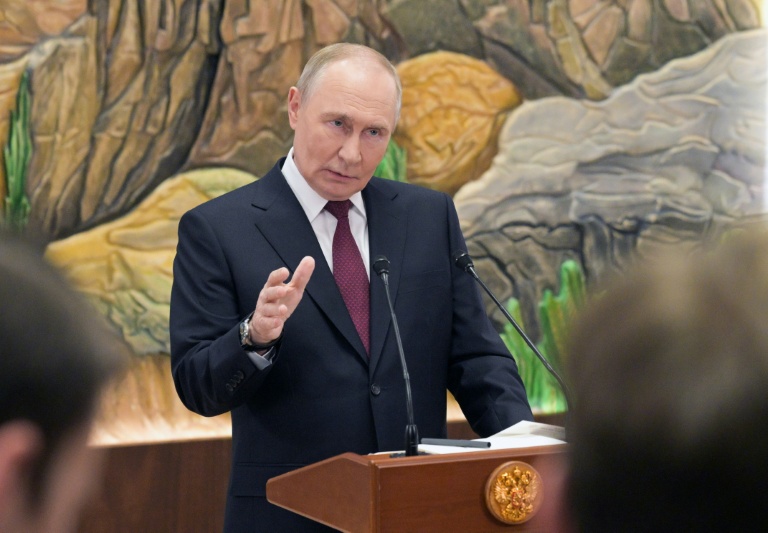
Putin, who has seen the new plan, stated it could be a negotiation starter.
“Overall, we agree that it could form the basis for future agreements,” he said of the latest draft, which the United States is thought to have shortened to about 20 points. But Russia was still seeking international recognition of the occupied territories, Putin added.
Ukrainian President Volodymyr Zelensky’s top aide, Andriy Yermak, strongly denied that in an interview with US outlet The Atlantic published on Thursday.
“As long as Zelensky is president, no one should count on us giving up territory. He will not sign away territory,” Yermak stated.
“All we can realistically talk about right now is really to define the line of contact,” he continued, referring to the sprawling 1,100 kilometre (700 mile) front line.
US negotiator Steve Witkoff was expected in Moscow next week to discuss the revised document, Putin stated.
US Army Secretary Dan Driscoll is meanwhile due to visit Kyiv later this week, according to Yermak.
In his remarks Thursday, Putin repeated the claim that Russia had encircled the Ukrainian army in Pokrovsk and Myrnograd in Ukraine’s eastern Donetsk region — the most fiercely embattled area and a key target for Moscow’s forces.
“Krasnoarmeysk and Dimitrov are completely surrounded,” he said, using the Russian names for the cities.
Moscow was also advancing in Vovchansk and Siversk, as well as approaching the important logistic hub of Guliaipole, he added.
The Russian offensive “is practically impossible to hold back, so there is little that can be done about it”, Putin noted.
Ukraine has denied that Pokrovsk and Myrnograd are encircled, insisting its forces continue to hold the enemy along the front line.
According to data analysed by AFP from the US-based Institute for the Study of War (ISW), Russian forces have conquered an average of 467 square kilometres (180 square miles) each month in 2025 — a step up from 2024.
Moscow launched its full-scale invasion of Ukraine in February 2022, triggering the worst armed conflict in Europe since World War II.
The war has killed hundreds of thousands of people and forced millions to flee their homes.