Monday, December 22, 2025
Home Blog Page 925

Olfati wins 2024 Olympics spot, makes history in Iran’s gymnastics

Mehdi Olfati

The federation website shows that Olfati has been placed second in the ranking with 62 points, therefore qualifying for the Olympic Games.

The achievement is unpresented in the history of Iran’s gymnastics.

Olfati will be the only gymnast from Iran to take part in the event. He will compete in the vault apparatus with of 318 gymnasts from across the world.

The 2024 Olympics is scheduled to be held from July 26 to August 11 in the French capital.

EU FMs agree to expand Iran sanctions over retaliatory attacks

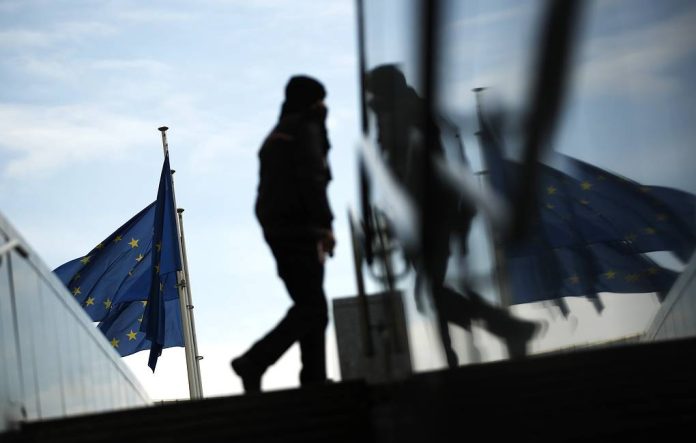
European Union Flag

“We have reached a political agreement in order to enlarge and expand the existing drone (sanctions) regime in order to cover missiles and their potential … transfer to Russia,” Borrell told reporters after a meeting of EU foreign ministers in Luxembourg.

The sanctions would also be expanded beyond Russia to cover drone and missile deliveries not only to Russia but also to proxies in the region, he added.

Iran has repeatedly dismissed baseless claims that it supplied Russia with weapons to be used in the war in Ukraine.

Tehran has also stressed regional armed groups do not take orders from Iran, nor does the Islamic Republic have a role in their decisions to carry out military operations against the US and Israel, and rejected unfounded claims about delivering weapons to them.

The EU’s decision came after Tehran targeted the occupied territories with a barrage of drones and missiles in retaliation for Israel’s assassination of several Iranian military advisors in Syria.

Earlier Monday, Iranian Foreign Ministry Spokesperson Nasser Kanaaani cautioned that the EU would be “rewarding the aggressor” if it slapped such measures against Tehran.

“Should they take [such] measure, it would go down in Europe’s history as a reprehensible action,” he added.

He reminded the EU that its previous sanctions against Iran had failed to hinder the country’s progress.

“The policy of sanctions is a failed policy,” Kanaani said, advising the bloc to “learn from the past”.

Israeli opposition leader calls on Netanyahu to resign over failures to predict Hamas attack

Israel Hamas Attack

Maj. Gen. Aharon Haliva, the head of the Israeli army’s Military Intelligence Directorate, resigned early Monday over his failure to predict the Hamas attack.

”The resignation of the military intelligence chief is justified and honorable. It would have been appropriate for Prime Minister Netanyahu to do the same,” Lapid wrote on X.

A poll showed on Sunday that two-thirds of Israelis do not believe Netanyahu’s claim that Israel is close to achieving an imminent victory in its ongoing war in Gaza for over six months, according to Israeli Channel 13.

The poll also found that 63% of respondents support holding early elections, while 33% prefer holding the vote as scheduled in October 2026.

Israel has pounded the Gaza Strip since the Hamas attack on Oct. 7 last year, which Tel Aviv says killed nearly 1,200 people.

At least 34,150 Palestinians have since been killed, mostly women and children, and 77,000 others injured amid mass destructions and severe shortages of necessities.

The Israeli war has pushed 85% of Gaza’s population into internal displacement amid acute shortages of food, clean water and medicine, while 60% of the enclave’s infrastructure has been damaged or destroyed, according to the UN.

Israel stands accused of genocide at the International Court of Justice. An interim ruling in January ordered Tel Aviv to stop genocidal acts and take measures to guarantee that humanitarian assistance is provided to civilians in Gaza.

Turkey’s president in Iraq to push for reset of bilateral ties, cooperation against PKK

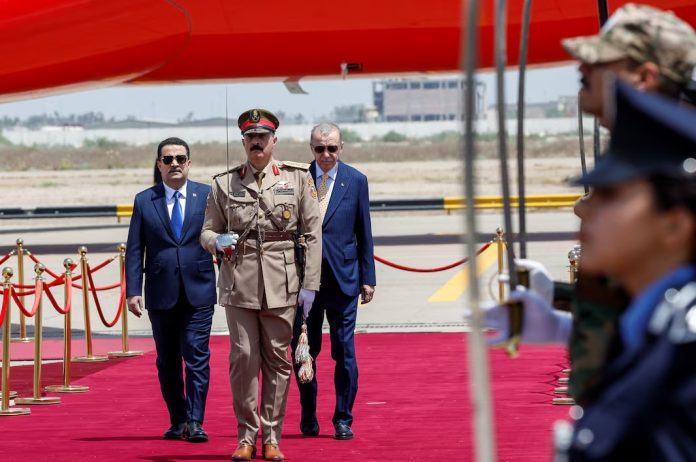
Erdogan and Sudani

Erdogan’s long-awaited visit is the first by a Turkish leader since 2011 and follows years of strained relations as Ankara ramped up cross-border operations against PKK militants based in mountainous, mainly Kurdish northern Iraq.

“President Erdogan stated that Turkey had expectations from Iraq in the battle with the PKK terrorist organisation, that Iraq must eradicate all sorts of terror,” the Turkish presidency said in a statement after Erdogan’s talks with Iraqi President President Abdul Latif Rashid.

Rashid – the most senior Kurdish official in Iraq – stated Iraq supported joint work to fight terrorism and was against its territory being used to attack any neighbours, the Iraqi presidency added. But Rashid also said Iraq opposed any attacks on its territory.

Iraq has announced Turkish operations violate its sovereignty and have killed civilians. Ankara says it must protect itself against the PKK, which Turkey and its Western allies designate as a terrorist group.

Turkey plans a new swoop on the militants this spring and has sought Iraqi military cooperation, in the form of a joint operations room, as well as recognition by Baghdad of the PKK threat.

Cooperation on big economic projects are also on the table.

Iraq last year launched a $17 billion Development Road project, which seeks to turn the country into a transit hub, connecting Asia and Europe with a link between Iraq’s Grand Faw Port in the oil-rich south and Turkey in the north.

Baghdad is also seeking a deal to secure a larger share of water from the Tigris and Euphrates rivers, both of which originate in Turkey and are the main source of freshwater in drought-stricken Iraq.

Rashid told Erdogan that Iraq was entitled to its “fair share” of that water, the Iraqi presidency noted.

Iraqi and Turkish officials say more than 20 memorandums of understanding would be signed during Erdogan’s one-day visit.
Bilateral trade was worth $19.9 billion in 2023, down from $24.2 billion in 2022, according to official Turkish data. In the first three months of 2024, Turkish exports to Iraq rose by 24.5%, while imports fell by 46.2%.

Erdogan is set to meet Prime Minister Mohammed Shia al-Sudani in Baghdad, then travel to Erbil, the provincial capital of Iraq’s semi-autonomous Kurdistan region, for talks with Iraqi Kurdish officials.

The PKK took up arms against the Turkish state in 1984 and more than 40,000 people have been killed since then.

Since 2019, Turkey has conducted a series of cross-border operations in northern Iraq against the PKK dubbed “Claw”.

About 85 percent of Israelis have little or no trust in government: Poll

Israel Hamas Attack

About 64 percent of respondents believe Israel faces an existential threat, and 65 percent have not been sleeping well since the outbreak of the war, it said.

At least 73 percent of Israelis have grown anxious in the past six months.

As Israel continues its military onslaught on the Gaza Strip, Netanyahu’s party popularity continues to decline, with a recent opinion survey favoring the National Unity Party led by Benny Gantz to take over the Knesset, the parliament.

A poll published in early April by the Israeli daily newspaper Maariv highlights a consistent decline in the Likud Party’s popularity, led by Netanyahu, similar to previous polls conducted after Oct. 7, 2023, the date the devastating war on Gaza commenced.

The latest poll, conducted by Lazar Institute on a random sample of 528 Israelis with an estimated error rate of 4.4%, showed that if elections were held today, the National Unity party would secure 32 seats in the 120-seat Knesset up from its current 12 seats.

In contrast, the poll indicated that the Likud party would only secure 17 seats, down from its current 32 in the parliament.

The opposition Yesh Atid party led by opposition leader Yair Lapid would obtain 15 seats, the poll said.

Meanwhile, the opposition New Hope party led by Gideon Sa’ar, which withdrew from the National Unity party, would obtain four seats.

The opinion poll showed the group supporting Netanyahu would win 44 seats, while the group against him would win 66 seats.

To form a government in Israel, at least 61 votes are required in the Knesset. This suggests that if elections were held today, Netanyahu would not be able to form a government.

Given Netanyahu’s reluctance to hold early elections, there is no imminent prospect of a vote in Israel.

The poll also showed that 42% of participants support holding elections now, while 50% say that elections must be held after the war.

Regarding the protests demanding a hostage exchange deal with Hamas, 46% of the participants considered that the escalation of protests “does not promote” the return of Israeli hostages, while 31% of the protests supported the escalation, at a time when 23% did not specify their opinions.

Lapid has recently labeled Netanyahu and his government as an “existential threat” to Israel.

“If we don’t move this government, it will bring destruction upon us,” Lapid wrote on social media platform X in mid-April.

Iran warns of ‘stronger response’ to another Israeli act of aggression

Iran Missile Attack

“Iran provided a decisive and legitimate response to an illegal action by the [Israeli] regime against [our] diplomatic premises that took place in violation of the international laws,” Foreign Ministry spokesman Nasser Kanaani said in a weekly press conference on Monday.

“But if another mistake takes place, Iran’s response will be stronger,” he added.

On April 1, the Israeli regime committed a terrorist attack against Iran’s diplomatic premises in the Syrian capital Damascus.

The Israeli attack resulted in the martyrdom of Brigadier General Mohammad Reza Zahedi, a commander of the Quds Force of Iran’s Islamic Revolution Guards Corps (IRGC), his deputy, General Mohammad Hadi Haji Rahimi, and five of their accompanying officers.

In retaliation, the IRGC targeted the occupied territories on April 13 with a barrage of drones and missiles. The retaliatory strikes, dubbed Operation True Promise, have inflicted damage on Israeli military bases across the occupied Palestinian territories.

Kanaani addressed a plan announced recently by the European Union to impose more sanctions on Iran over the retaliatory strikes, saying the bloc would be “rewarding the aggressor” if it slapped such measures against the Islamic Republic.

“Should they take [such] measure, it would go down in Europe’s history as a reprehensible action.”

The official expressed surprise that Brussels could go ahead with sanctioning Tehran over its legitimate retaliation against the Zionist regime, but had so far stopped short of levying any punitive measures against Tel Aviv over the latter’s unspeakable atrocities in the Gaza Strip.

Kanaani, meanwhile, reminded the EU that its previous sanctions against the Islamic Republic had failed to hinder the country’s progress. “The policy of sanctions is a failed policy,” Kan’ani said, advising the bloc to “learn from the past”.

The spokesman pointed to the shooting down of three foreign quadcopters by the Islamic Republic’s air defense near the central city of Isfahan that caused no damage or injuries.

He said Iran and the United States had exchanged “some messages” following the development, but dismissed the incident as only a “vexatious” measure that “was not worth any follow-up on this level”.

Elsewhere in his remarks, Kanaani commented on Iran’s nuclear activities, saying “Iran’s nuclear doctrine is completely clear. We consider peaceful use [of nuclear energy] to be our absolute right.”

The Islamic Republic would keep up its peaceful nuclear activities within the framework set by the International Atomic Energy Agency, the agency’s safeguards, and the Nuclear Non-Proliferation Treaty (NPT), he stated.

“Nuclear weapons have no place in Iran’s defensive doctrine.”

Concluding his remarks, the spokesman identified the Israeli regime as a “threat to all regional countries”, adding that the regime’s October-present war on the Gaza Strip showed that “the usurping regime is no partner to peaceful plans, and thinks of nothing other than genocide and forced displacement of Palestinians.”

“Iran is definitely faced with a far-reaching view on the level of the international spheres that the issue of Palestine would not be resolved other than through putting an end to the [Israeli] occupation.”


Iran, Pakistan set to promote ties during Raisi’s visit to Islamabad

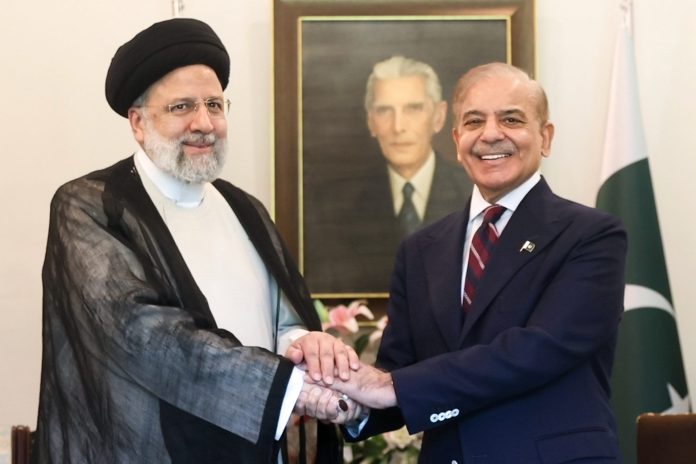
Raisi and Sharif

Ebrahim Raisi, who is in Islamabad at the invitation of his Pakistani counterpart Asif Ali Zardari, made the remarks in a joint press conference on Monday with Pakistan’s Prime Minister Shehbaz Sharif.

Raisi told the media that the Political interactions between Iran and Pakistan have been below expectations, “So we have decided to improve the relations in the political, economic and commercial, cultural fields at all levels.”

He also said both countries have similar positions in fighting terrorism and drugs, and boosting border security.

Many Iranian security forces have fell victim to terrorist attacks by Pakistan-based militants, who have been a source of spat between the two countries.

The Pakistani premier, welcomed President Raisi in Iran’s official language Persian, saying he was pleased to meet the first high-ranking foreign official since the new administration took office in Islamabad in February.

Meanwhile, both sides called on the international community, especially the Muslim world, to stand up for the people of Gaza amid the months-long Israeli carnage in the besieged Palestinian enclave.

The Iranian president arrived in Pakistan’s capital earlier on Monday at the head of high-ranking delegation to shore up bilateral relations in several areas, with trade high on the agenda.

President Raisi was welcomed by the country’s Foreign Minister Mohammad Ishaq Dar in Islamabad.

Upon arrival, the Iranian president said the two countries were “more than mere neighbors.”

He said, “Although the strengthening of the Iran-Pakistan relations is not desired by some foreigners, considering the diverse, numerous and mutually existing capacities of the two Islamic countries, their relations should be further expanded in order to secure the interests of the two nations.”

US ‘not funding’ war in Ukraine: Zelensky

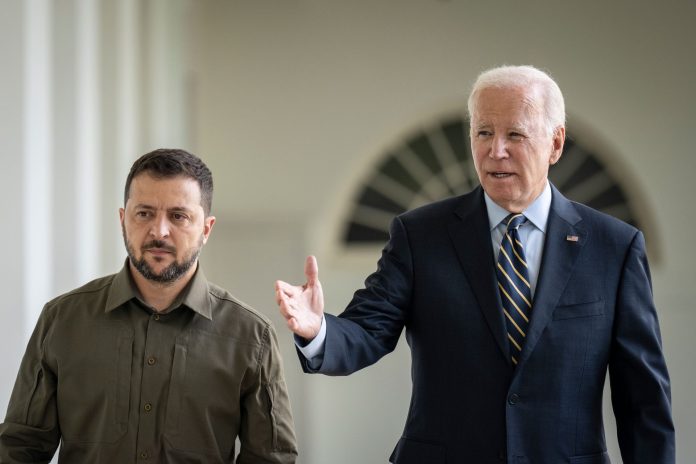
Biden Zelensky

NBC host Kristen Welker asked Zelensky on “Meet the Press” how long Americans can expect to fund the war in Ukraine, noting that there has been some strong opposition to sending additional aid to the country. Zelensky emphasized that Ukraine is doing the fighting and the U.S. is only providing the munitions.

“The Americans are not funding the war in Ukraine. They foremost protect freedom and democracy all over Europe. And Ukraine is fighting. And Ukraine is sending their best sons and daughters to the front line. And this reduces the price for all Europe, for all NATO,” Zelensky said, speaking through a translator.

“It reduces the price for everyone, including the U.S. as the leaders in NATO. U.S. Army now does not have to fight protecting NATO countries. Ukrainians are doing that. And it’s only the ammo that the civilized world is providing. And I think it’s a good decision. That is why we do need to keep supporting,” he continued.

The House approved a massive foreign aid package to send to the Senate on Saturday. The package includes roughly $61 billion for Ukraine, $26 billion for Israel and $8 billion for allies in the Indo-Pacific.

Zelensky urged the Senate to pass the aid package for Ukraine.

“And today, we definitely need this aid. And Kristen, we really need to get this to the final point. We need to get it approved by the Senate. And then we want to get things as fast as possible so that we get some tangible assistance for the soldiers on the front as soon as possible, not in another six months, so that they will be able to move ahead,” he added.

Zelensky emphasized that his country needs a “crucial” weapons system to help win its war against Russia.

Welker asked Zelensky if Ukraine could win the war now that the House approved additional foreign aid. He stated his country could win the war if it gets the weapons systems it needs, including long-range weapons and air defense systems.

“I think this support will really strengthen the armed forces of Ukraine. And we will have a chance for victory if Ukraine really gets the weapon system, which we need so much, the thousands of soldiers need so much. And this aid should not be just spread into layer all over, but it has to end up in tangible weapon systems,” Zelensky stressed.

“Some really crucial weapon systems, which are hard to get. The long-range artillery. And I really appreciate that it mentions ATACMs, long-range weapons. And it’s important because we need long-range weapons to not lose people on the front line. Because we have casualties because we cannot reach that far. Our weapons are not that long-range. So, we need it, and air defense. This is crucial. These are the priorities now,” he continued.

Global military expenditure reaches all-time high of $2,443bn in 2023: Report

Russia Ukraine War

“World military expenditure rose for the ninth consecutive year to an all-time high of $2,443 billion,” SIPRI said.

Moreover, military expenditure increased in all five of the geographical regions defined by SIPRI, the institute added.

The US remained the world’s biggest military spender with a 37% share of the world total and $916 billion spent in 2023. It is followed by China with a 12% share and an estimated $296 billion spent on the military and Russia with a 4.5% share and an estimated $109 billion spent on defense last year, which represents a 24% increase compared to 2022.

Ukraine, the eighth largest spender in 2023, increased its military spending by 51% year-over-year to $64.8 billion, which is 58% of the country’s total government spending.

The Middle East has seen a 9% surge in military spending, with Israel’s spending growing by 24% to $27.5 billion amid its operation in the Gaza Strip, the institute noted.

Israel’s monthly military spending more than doubled to $4.7bln by the end of 2023, according to the report.

The increase from an average of $1.8bln per month before October 2023 was “mainly driven by Israel’s large-scale offensive in Gaza in response to the attack. on Southern Israel by Hamas in October 2023”, SIPRI reported.

NATO chief says member states have military personnel in Ukraine

NATO Chief

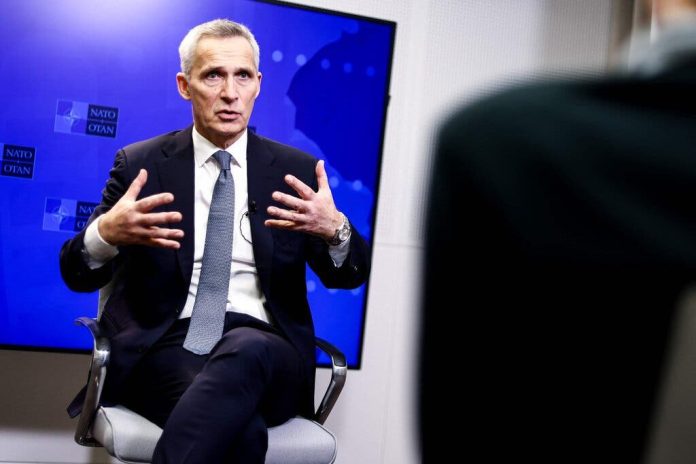
In an interview on Sunday, Stoltenberg was asked whether NATO was planning to send additional personnel to help Kiev in its fight against Russia.

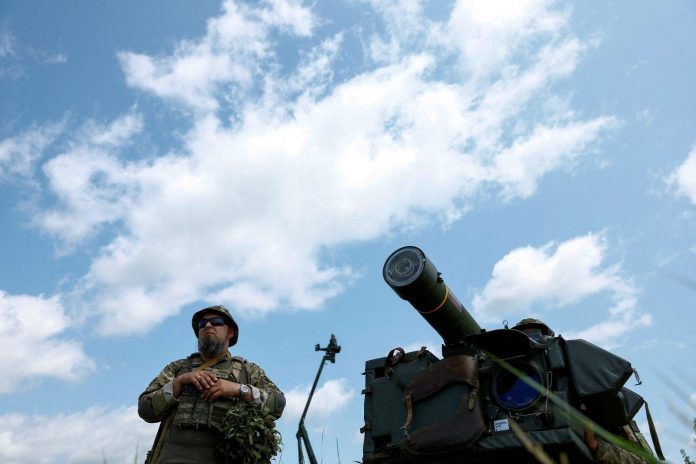
“There are no plans for any NATO combat presence in Ukraine. But, of course, several NATO allies have men and women in uniform at the embassies giving advice,” he said.

The comments came after Pentagon spokesman Major General Pat Ryder told Politico that the US is considering deploying more advisers to its embassy in Kiev. According to the outlet, the advisers could be tasked with handling logistics and helping with the maintenance of US-supplied weapons systems.

Although French President Emmanuel Macron and several other European leaders have refused to rule out placing NATO boots on the ground in Ukraine in the future, the alliance has so far maintained that it is not a direct participant in the conflict.

Stoltenberg hailed the $61 billion aid package for Kiev passed by the US House of Representatives on Saturday, but warned that “delay has had real consequences” on the battlefield.

“The Ukrainians have now for months been outgunned.”

The much-needed aid, which includes money for the purchase of weapons for Ukraine, was stuck in the House for months due to political wrangling. Ukrainian President Volodymyr Zelensky has complained that dwindling American aid caused ammunition shortages on the front line, and warned that Kiev could lose if the delays continue. US President Joe Biden blamed the fall of the Donbass stronghold of Avdeevka to Russia in February on “congressional inaction”.

Moscow has warned that deliveries of Western arms and equipment to Ukraine will not stop Russia from achieving its military goals, including the abandonment of Kiev’s plans to join NATO. Further deliveries from the West only “cause more Ukrainians to die because of the Kiev regime”, and make Western states a de facto party to the conflict, the Kremlin has stated.