Tuesday, December 30, 2025
Home Blog Page 920

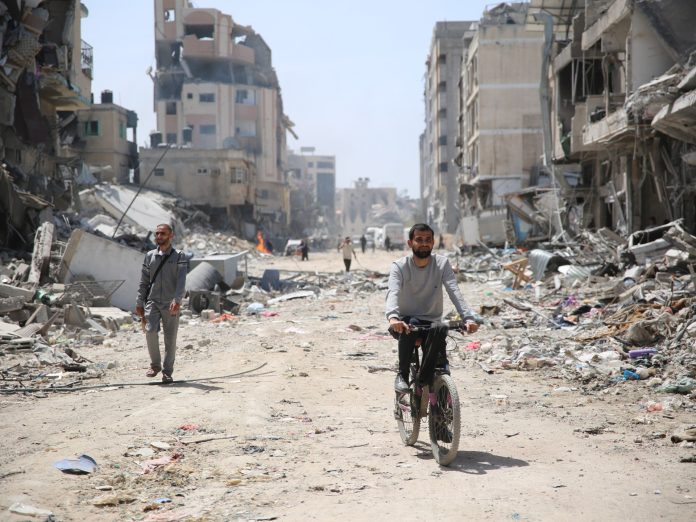
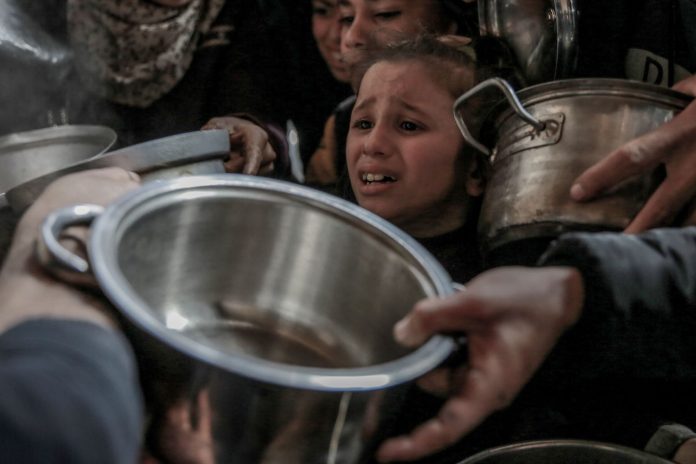
UN warns northern Gaza in ‘full-blown famine’

Gaza War

In an interview with NBC News set to air on Sunday, Cindy McCain said that her remarks are based on what the WFP has seen and experienced on the ground. UN officials and aid agencies have for months warned of such a scenario.

“It’s horror. It’s so hard to look at and it’s so hard to hear,” McCain told the US broadcaster’s Meet the Press programme.

“What we are asking for and what we continually ask for is a ceasefire and the ability to have unfettered access, to get in safe through the various ports and gate crossings,” she added, according to a video clip of the interview.

On Saturday, a delegation from Palestinian group Hamas was in Egypt to continue negotiations on a ceasefire amid an uptick in international pressure for a deal to be reached.

Hamas’s spokesman Osama Hamdan said there had been “some forward steps”.

Yet Israel has threatened to launch its ground invasion of Rafah in the southernmost tip of the enclave, which is home to more than 1.4 million displaced Palestinians who have fled the Israeli military’s relentless bombardment in other parts of the Gaza Strip.

Israel has severely restricted the entry of critical humanitarian supplies into Gaza despite warnings from its allies and the United Nations of a looming famine in parts of the Palestinian territory. Its military has also repeatedly attacked and killed Palestinian civilians waiting to collect aid in the Strip.

This week it reopened the Beit Hanoon (Erez) crossing into northern Gaza, but Israeli settlers attacked two aid convoys sent by Jordan. The UN has announced the amounts remain insufficient to meet the vast and growing needs of Gaza’s starving population.

The UN-backed Integrated Food Security Phase Classification has previously warned that more than 70 percent of Gaza’s 2.3 million population is facing “catastrophic hunger” any time between mid-March and May.

On Saturday, Gaza’s Ministry of Health said at least 34,650 Palestinians have been killed and 77,900 wounded in Israeli attacks on Gaza since October 7.
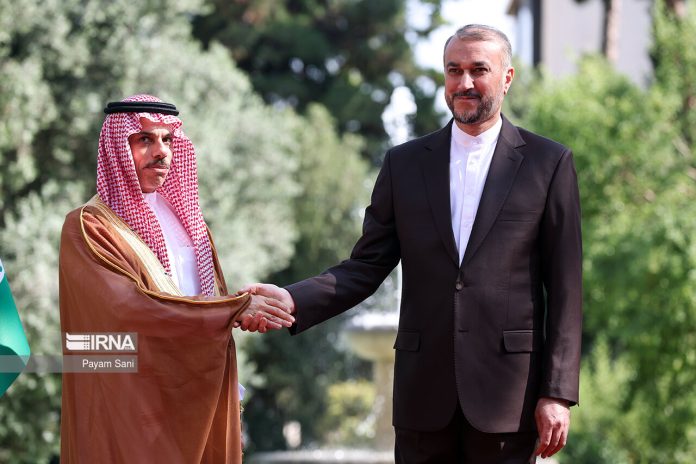
Saudi Arabia calls for Riyadh-Tehran cooperation to defuse Netanyahu’s warmongerings

Iran and Saudi FMs Amirabdollahian and bin Farhan

He made the remarks in a meeting with his Iranian counterpart Hossein Amirabdollahian on the sidelines of an Organization of Islamic Cooperation (OIC) summit in the Gambian capital Banjul on Saturday.

Both sides stressed that the ties between the two countries are on the right track and underlined the significance of their joint economic and commercial cooperation.

Amirabdollahian and bin Farhan discussed and agreed on facilitating issuing business visas and establishing direct flights between the two countries.

The Iranian foreign minister shed light on Iran’s principled stance in meting out a punishment for the aggressor Zionist regime after it struck the Iranian embassy in Damascus in a terrorist move, which triggered a strong response by the Iranian armed forces by targeting the Zionist regime’s military and intelligence bases that were used to launch the missile attack on the Iranian diplomatic site.

Amirabdollahian said Iran supports any agreement that guarantees the restoration of the Palestinian people’s rights, stating, “We believe that the Palestinians themselves should decide about the fate of Palestine.”

Meanwhile, the top Iranian diplomat touched on the recent US activities in the region, saying, “The historical records and our experiences show that the US continues to renege on its promises and it does not abide by any deal or promise.”

He said joint efforts should be made to stop the war in Gaza which serves the interests of the Palestinian people and the regional countries.

Amirabdollahian noted, “We believe that the restoration of stability and security to the region and the cessation of the war are in the interest of all the countries in the region.”

For his part, the Saudi foreign minister expressed his satisfaction over the meeting and the continuous talks and interaction between the foreign ministers of the two countries in bilateral, regional and international fields.

He stated, “The important thing is that the leaders of the two countries have the will to expand and deepen bilateral ties.”

Bin Farhan stressed that active economic, cultural and people-to-people relations are among the basic factors that can further boost the ties in line with the interests of both countries, citing resumption of Umrah Hajj pilgrimage and its positive effects among the people of both countries as one of them.

The Saudi foreign minister also elaborated on his country’s views on the regional developments and emphasized the kingdom’s special efforts to help restore the Palestinian people’s rights and establish an independent Palestinian state.

Expressing hope that a ceasefire would be achieved in Gaza at this stage, he said stopping the war is in the interest of the Palestinian people and can set the stage for the delivery of humanitarian aid to Gaza.

Meanwhile, bin Farhan said the continued interaction between Iran and Saudi Arabia is indispensable in confronting Israeli prime minister Benjamin Netanyahu’s war-mongering plots in the region.

The Saudi foreign minister also reiterated that Riyadh condemns Israel’s strikes on the Iranian Embassy in Damascus as a diplomatic site, stating, “Such an attack is in no way acceptable or justified.”

Russia puts Ukraine president on wanted list

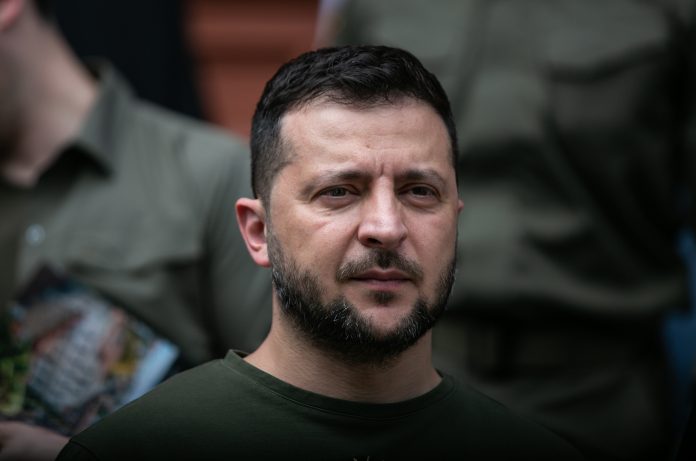
President Of Ukraine Volodymyr Zelensky

The ministry’s website says the Ukrainian president is wanted under an article of Russia’s Criminal Code and contains his full name and photograph, as well as his date and place of birth. No data has been released about criminal proceedings against him.

The development comes a day after the head of the Ukrainian National Security and Defense Council, Aleksandr Litvinenko, was also put on Russia’s wanted list. He took the position over from his predecessor Aleksey Danilov in March. In this instance, too, no charge details have been specified.

In April, Litvinenko claimed it was necessary to launch drone strikes deep inside Russian territory, to exert “pressure” on Moscow. He described this tactic as a key element of Kiev’s strategy.

Moscow has repeatedly accused Kiev of employing terrorist methods throughout the ongoing conflict between the two neighbors. Last month, Kremlin spokesman Dmitry Peskov said threats by Zelensky to destroy Russian civilian infrastructure were proof of his government’s terrorist intentions.

Peskov was responding to the president’s statements concerning the Crimean Bridge, which has already been targeted in two major bomb attacks, each leading to several civilian deaths.

Former Ukrainian President Pyotr Poroshenko was also placed on the wanted list on Saturday. Again, no details about a case against him have been made public so far.

Poroshenko took office in June 2014, as the post-Maidan coup Ukrainian government was using military force in its attempt to quash a rebellion in Donetsk and Lugansk Regions. He was also the one to sign the Minsk Agreements, aimed at reconciling Kiev with the two Donbass republics that refused to recognize the post-coup government.

In 2023, Poroshenko claimed that the accords were used to buy extra time to arm Ukraine. The former president said that he turned to NATO to prepare for a conflict instead of following the Minsk Agreements’ peace roadmap.

On Friday, Ukraine’s former finance minister, Aleksandr Shlapak, and the nation’s former central bank head, Stepan Kubiv, were also put on Russia’s list of wanted persons. Although details about their criminal cases remain unclear, the Russian Investigative Committee had earlier charged both former officials with financing Kiev’s military crackdown on Donbass back in 2014. The operation marked the beginning of the Ukrainian Armed Forces’ shelling of populated areas of the Donetsk and Lugansk People’s Republics.

US admits recent military aid to Ukraine won’t stop Russian advances: Report

Russia Ukraine War

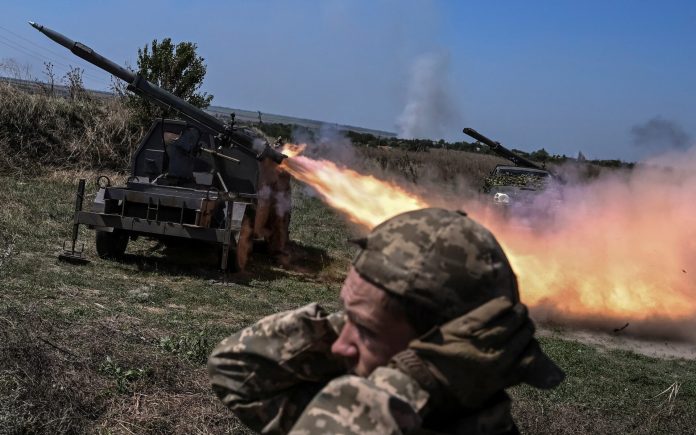
At the same time, Sullivan said that in 2025, Ukraine intends to launch another offensive, the report said on Saturday.

“Sullivan said that he still expects ‘Russian advances in the coming period’ on the battlefield, despite the new US funding package approved last month,” the daily reported.

US President Joe Biden signed last week a supplemental package passed by Congress that provides $61 billion in additional aid for Ukraine.

News outlet admits that “resolving Ukraine’s personnel shortages is crucial to its chances against Russia”.

Russian forces are steadily advancing in the Ukraine conflict, the US Director of National Intelligence, Avril Haines, told senators on Thursday. She also accused China of providing Russia with dual-use components, which has “tilted the momentum on the battlefield in Moscow’s favor”.

During a hearing at the US Senate Armed Services Committee on Global Threats on Thursday, Haines stated Russia “is making incremental progress on the battlefield with the potential for tactical breakthroughs along the front lines in areas such as Donetsk and Kharkiv”.

The intelligence official added that Moscow’s economic position and rearmament efforts have led Russian President Vladimir Putin to believe that “domestic and international trends are in his favor”.

“Putin has for months indicated a willingness to enter into talks with Ukraine and the United States about the future for Ukraine but without any indication that he is willing to make significant concessions.”

She further claimed that an intensifying campaign of Russian airstrikes is designed to break Kiev’s will and demonstrate there is no “plausible path to victory” for Ukraine.

This strategy is also disrupting Kiev’s military logistics and defense industry capabilities, Haines explained, adding that aerial bombardments are “likely to continue, and the war is unlikely to end any time soon”.

The US intelligence chief told senators that President Putin continues to see NATO enlargement and Western support to Ukraine as proof that the US and its European allies “seek to restrict Russian power”. This perception supposedly translates into an ever-growing military budget for Moscow.

Last month, Russian Defense Minister Sergey Shoigu stated that Moscow’s forces had seized the initiative on the battlefield and had been making territorial gains in Donbass.

Around the same time, Kremlin spokesperson Dmitry Peskov insisted that the recently approved $61 billion US aid package for Ukraine “won’t change the dynamics on the front line”.

In an interview with The Economist published on Thursday, Vadim Skibitsky, the deputy head of Ukraine’s GUR military intelligence agency, predicted that Russia would launch a major offensive by the end of May or the beginning of June, with Kiev still suffering from weapons shortages. He also acknowledged that the fall of Chasov Yar, a major Ukrainian stronghold in Donetsk Region, was only a matter of time.

Russia claims NATO using war games to ‘prepare for conflict’

NATO

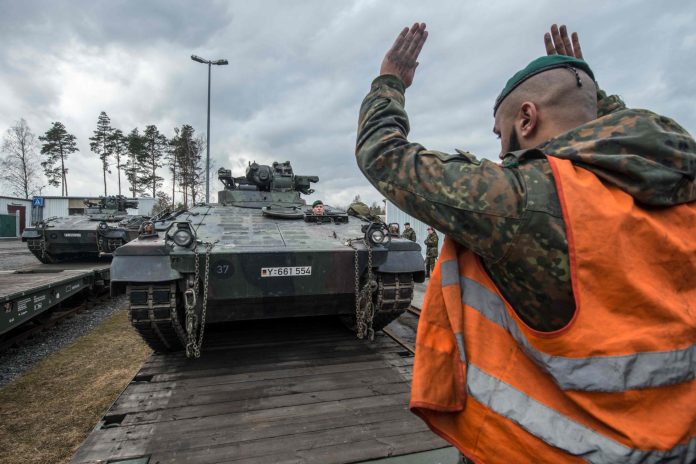
The Steadfast Defender drills, featuring some 90,000 troops from all 32 NATO member states and 1,100 combat vehicles, started in late January and will end in May.

According to the wargame scenario, “the coalition’s actions against Russia are being practiced using all the instruments, including hybrid and conventional weapons”, Zakharova said in a statement on Saturday.

”We have to admit that NATO is seriously preparing for a ‘potential conflict’ with us,” Zakharova added.

The diplomat was commenting on accusations made by NATO earlier this week that Russia was allegedly carrying out “hybrid activities” on the member countries’ soil, which they insist constitute a threat to their security. These actions include “sabotage, acts of violence, cyber and electronic interference, disinformation campaigns, and other hybrid operations”, the bloc claimed in a statement on Thursday.

Zakharova dismissed the allegations as “disinformation” and an attempt to shift public attention from NATO’s own activities.

The bloc and the leadership of individual member states are “increasing the degree of anti-Russian hysteria in order to justify the unprecedented scale of militarization in Europe”, the official stated.

According to the diplomat, it was NATO that launched “a hybrid war against Russia in all operational environments and in all geographic directions”. In addition, the bloc members are actively involved in the Ukraine conflict. They are providing Kiev not only with financial support, but also with weapons and intelligence data – which are then used “to strike civilians and civilian infrastructure in Russia”, Zakharova continued.

Back in March, Russian Security Council Secretary Nikolay Patrushev said that NATO’s Steadfast Defender 2024 exercises were “increasing tensions and destabilizing the situation in the world” by simulating a military confrontation with Moscow. The official described the bloc as an “important tool” employed by the US to exert pressure and influence on other nations. NATO has come directly to Russia’s western border and is preparing for future conflicts, he stressed.

In recent months, multiple senior officials from NATO member states claimed that Moscow was planning to launch an attack against the military bloc in the coming years.

Russia has repeatedly denied those claims, with President Vladimir Putin saying the country “has no interest … geopolitically, economically or militarily … in waging war against NATO”.

Some EU states still consider Russia ‘good friend’: Top diplomat

Kremlin

Borrell said that he sees “more confrontation and less cooperation” in world affairs, and brought up instances of dissent among EU members. When it comes to Russian President Vladimir Putin and the conflict in Ukraine, some countries are failing to fall in line with Brussels, he added.

“Today, Putin is an existential threat to all of us. If Putin succeeds in Ukraine, he will not stop there,” Borrell stated, adding that Russia’s victory would undermine the security of Europe. However, “not everybody in the European Union shares this assessment”, he stressed.

“Some European Council’s members say: “Well, no, Russia is not an existential threat. At least not for me. I consider Russia a good friend,’” Borrell continued, without calling out specific counties.

“In a union governed by unanimity, our policies on Russia are always threatened by a single veto – one is enough.”

The EU imposed multiple rounds of sanctions on Moscow after Russia launched its military operation in Ukraine in February 2022. However, Prime Ministers Viktor Orban of Hungary and Robert Fico of Slovakia have refused to send weapons to Ukraine and stressed that the conflict should be resolved through negotiations.

Hungary blocked the EU’s $54 billion Ukraine aid package for months until Orban lifted the veto in February 2024.

Earlier this week, French President Emmanuel Macron once again refused to rule out sending NATO troops to Ukraine, arguing that “the survival of the continent” is at stake. His remarks were heavily criticized by Hungarian Foreign Minister Peter Szijjarto, who said that NATO boots on the ground in Ukraine could spark a all-out global war.

Moscow, meanwhile, blasted Macron for the continuation of dangerous “verbal escalation” that could lead to the conflict spiraling out of control.

Official says Qatar considers future of Hamas office in Doha

Hamas

The Persian Gulf state was weighing whether to allow Hamas to continue operating the political office, and the broader review includes considering whether or not to continue mediating in the seven-month conflict, the official told Reuters.

Qatar announced last month it was reevaluating its role as mediator in indirect talks between Israel and Hamas, citing concerns that its efforts were being undermined by politicians seeking to score points.

“If Qatar isn’t going to be mediating, they won’t see a point in keeping the political office. So that is a part of the reassessment,” the official said, speaking on condition of anonymity.

The official did not know if Hamas would be asked to leave Doha if the Qatari government did decide to close the group’s office. However, the official did say Qatar’s own review of its role would be influenced by how Israel and Hamas act during the ongoing negotiations.

In a report on Friday, The Washington Post cited an unnamed U.S. official as saying Washington had told Doha to expel Hamas if the group continues to reject a ceasefire deal with Israel.

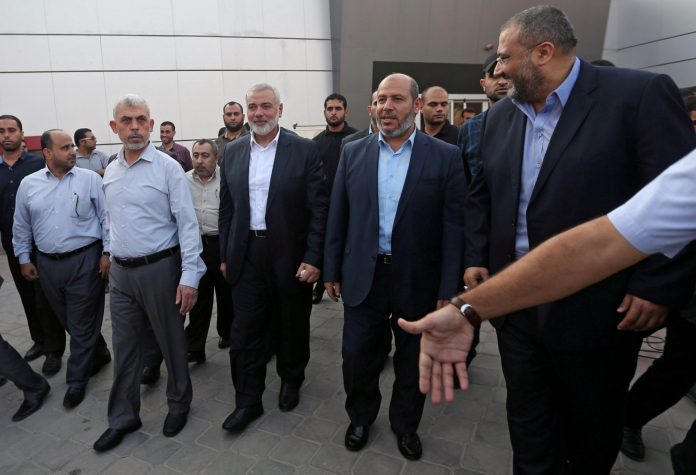
Hamas negotiators arrived in Cairo on Saturday for intensified talks on a possible Gaza truce that would see the return to Israel of some hostages, a Hamas official told Reuters.

Qatar has hosted Hamas’ political leaders since 2012 as part of an agreement with the U.S.

Ismail Haniyeh, the group’s leader, lives in Doha and has traveled frequently, including to Turkey, since the Hamas military operation on Oct. 7.

Qatar, an influential Persian Gulf state that is designated as major non-NATO ally by Washington, has come under criticism from within the United States and Israel over its ties to Hamas since last year.

Some U.S. lawmakers have called on President Joe Biden’s administration to reevalaute its ties with Qatar if it does not pressure Hamas to make a deal to release hostages. Others have urged Qatar to cut ties with Hamas.

Israeli Prime Minister Benjamin Netanyahu has also called for Qatar to pressure Hamas. Qatar and Israel do not have formal ties but their officials meet to discuss the mediation efforts.

Israel weighing sharing power with US, Arab states in postwar Gaza: Report

Gaza War

In a report, the newspaper cited anonymous sources who claimed that Israeli Prime Minister Benjamin Netanyahu is avoiding detailed public discussions about Gaza’s post-war future, but that behind the scenes officials have been developing an “expansive plan”.

Three Israeli officials, and five people who have discussed the proposal with the Israeli government, told the daily that Israel would offer to share oversight of Gaza with the US and three Arab countries – Egypt, Saudi Arabia and the United Arab Emirates.

According to the sources, Israel would do so in exchange for a normalization of ties with Saudi Arabia.

Under the plan, local leaders in Gaza, who would be tasked with rebuilding the territory, reforming its education system and maintaining order, would to be appointed by Israel and the Arab nations in cooperation with Washington.

After seven to ten years, people in the enclave would be allowed to vote on whether to be absorbed into a united Palestinian administration that would control both the West Bank and Gaza, according to the proposal.

The NYT stressed that the plan does not specify whether this united administration would constitute a sovereign Palestinian state. Netanyahu has publicly rejected a two-state solution, despite such a path being supported by many world powers, including Israel’s key ally, the US.

The proposal also states the Israel Defense Forces (IDF) can continue to operate inside Gaza after the conflict with Palestinian armed group Hamas concludes, the officials added.

The NYT report comes amid intensified international efforts to persuade the sides to reach a ceasefire, which could pave the way for a permanent truce in Gaza.

Israel launched its military operation in the Palestinian enclave in response to the October 7 cross-border attack by Hamas, in which at least 1,200 people were killed and 250 taken hostage. According to Gaza’s health ministry, more than 34,600 Palestinians have so far been killed and 77,900 others wounded in the IDF’s airstrikes and ground offensive.

Iran FM urges Egypt assistance for sending in aid to Gaza, welcomes promotion of ties

Amirabdollahian Shoukry

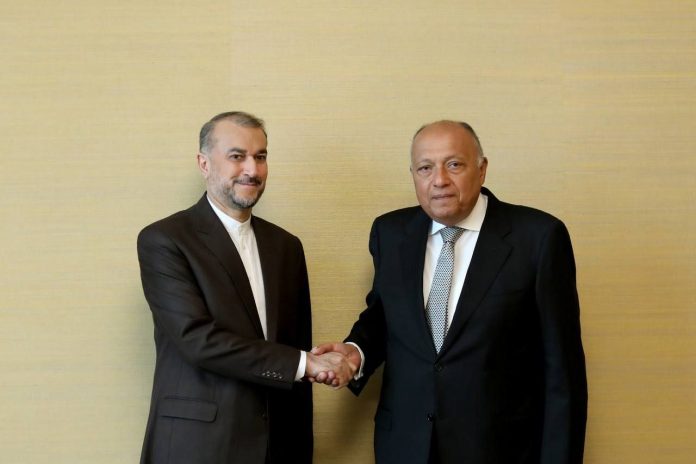
Hossein Amirabdollahian, in a meeting with his Egyptian counterpart Sameh Shoukry, said the Islamic Republic is ready to send humanitarian aid to Gaza and requested Cairo’s assistance for this purpose.

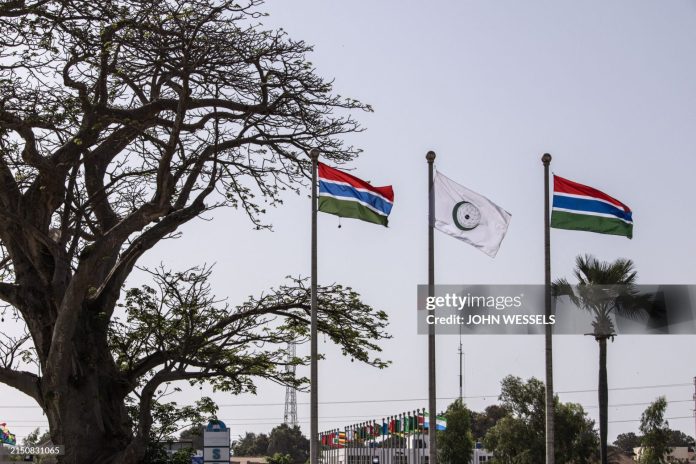
The meeting was held on the sidelines of the 15th summit meeting of the Organization of Islamic Cooperation (OIC) in the Gambian capital, Banjul.

The two top diplomats discussed the latest developments in the region, especially the situation in Gaza.

They also held talks over the ongoing efforts to stop the crimes of the Zionist regime against the Palestinian people.

The Iranian and Egyptian foreign ministers underlined the need for special efforts by the two countries to pursue the strengthening of bilateral relations.

While explaining the Israeli regime’s terrorist attack on the Iranian embassy in Damascus and the response of the Iranian armed forces in line with the principle of legitimate defense, the Iranian foreign minister thanked Egypt for condemning the terrorist act by the Zionist regime.

Sameh Shoukry, Egypt’s Foreign Minister, for his part expressed pleasure with the meeting, saying his country is always interested in dialogue and contacts between Egypt and Iran as two countries with deep-rooted civilizations.

He also pointed to the consequences of the continuation of the war in Gaza and the Israeli attacks against the Palestinian people and the high human and material losses, especially the killing of civilians by the Zionist regime.

Shoukry underscored that his country believes efforts must continue in order to prevent the escalation of tension in the region.

OIC conference kicks off in Gambia

OIC

Iranian Foreign Minister Hossein Amirabdollahian is representing the Islamic Republic of Iran in the meeting.

Amirabdollahian is going to outline Iran’s stance on the developments in the Muslim world as well as on regional and international issues, especially the Zionist regime’s war on Gaza.

Also, in the meeting, which is held with the main theme of “enhancing unity and solidarity through dialogue on sustainable development”, various issues and challenges facing the Muslim world, especially the issue of Palestine and the current situation in the Gaza Strip, are discussed.

Meanwhile, three documents including the draft of the Palestinian resolution, the draft of the Banjul statement and the draft of the final document of the conference will be presented to the Council of Foreign Ministers of the OIC and then the summit of heads of states for approval.

The preparatory meeting of senior officials for the 15th conference of Muslim leaders in Banjul has started on April 30, 2024 (Tuesday).

Gambia will take over the presidency of the OIC from Saudi Arabia for three years.