Sunday, December 28, 2025
Home Blog Page 900

Arab League calls for UN peacekeepers in occupied Palestinian territory

Arab League

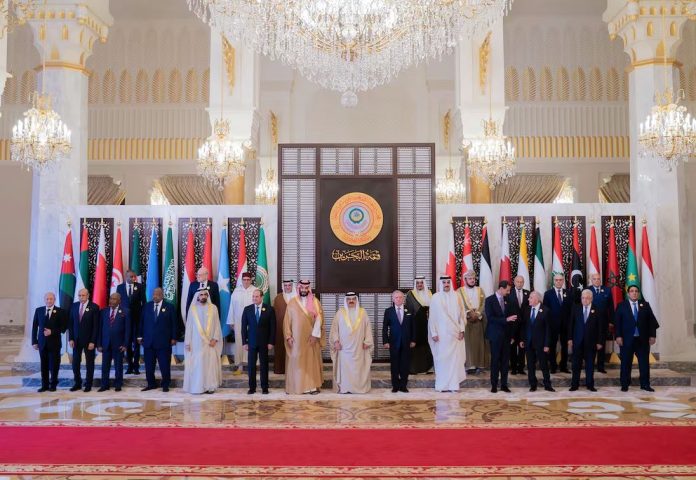
The “Manama Declaration” issued by the 22-member bloc called for “international protection and peacekeeping forces of the United Nations in the occupied Palestinian territories” until a two-state solution is implemented.

The meeting is the first time the bloc has come together since an extraordinary summit in Riyadh, capital of neighbouring Saudi Arabia, in November that also involved leaders from the 57-member Organisation of Islamic Cooperation.

At that meeting, leaders condemned Israeli forces for their “barbaric” actions in the besieged enclave.

Arab leaders and UN Secretary General Antonio Guterres have attended the 33rd Arab League summit in Manama on Thursday, with the talks to include a call for an international peace conference to resolve the Palestinian-Israeli crisis.

The leaders specifically condemned the Israeli takeover of the Palestinian side of the Rafah border crossing, aimed at tightening the blockade on civilians, which has halted the operation of the crossing and the flow of humanitarian aid.

They demanded an immediate and permanent ceasefire in Gaza, an end to all pushes at forced displacement, the lifting of all forms of the Israeli siege, and the unimpeded and sustained access to humanitarian aid for the Gaza Strip. The leaders also called for the immediate withdrawal of Israeli troops from Rafah.

Additionally, the leaders denounced the targeting of humanitarian and UN organizations in Gaza by Israeli soldiers, the obstruction of their operations and the attacks on aid convoys.

The Arab leaders urged the international community and influential global powers to move beyond political calculations and double standards in addressing international crises.

They called on these entities to uphold their ethical and legal responsibilities in confronting Israeli aggressive practices and to clearly characterize them as flagrant violations of international and humanitarian law.

Israeli forces have killed more than 35,000 Palestinians and wounded nearly 80,000 in Gaza since the war started on 7 October, following the Hamas-led attack on Israel that left nearly 1,200 Israelis killed and 250 taken captive.

But more than seven months later, Israel has failed to achieve its declared goals of dismantling Hamas’ military and governance capabilities, or returning the captives.

Hamas and other Palestinian factions previously rejected the presence of any foreign forces in Gaza after the war, stressing that governance of the strip was an internal Palestinian matter.

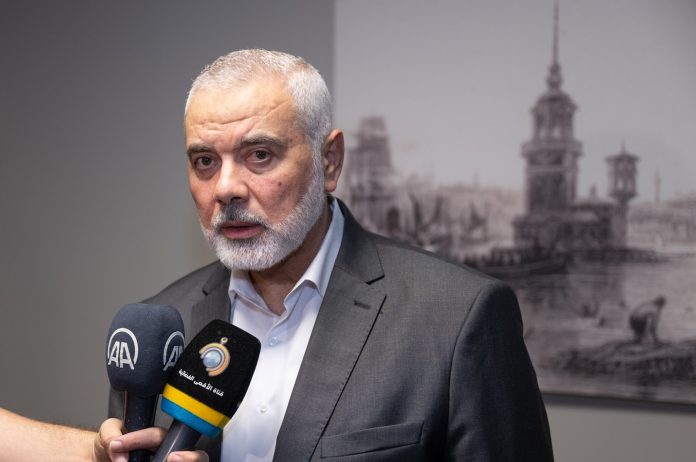
On Wednesday, Hamas chief Ismail Haniyeh downplayed any post-war plans that exclude the Palestinian movement, saying “Hamas was here to stay”.

He added that the post-war administration of the Gaza Strip will be decided by Hamas in consultation with other Palestinian parties.
Zelensky says military situation in Kharkiv ‘extremely difficult’

Russia Ukraine War

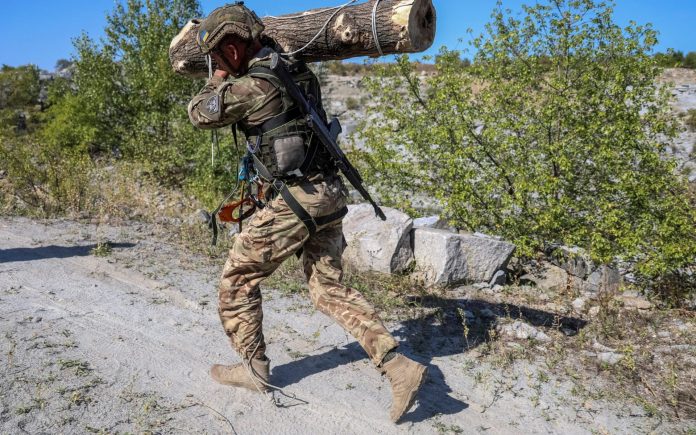
Zelensky met with senior military officials in the city of Kharkiv on Thursday, as Russian forces push deeper into the northeastern region. He also met with the senior officials from other border and frontline regions.

The Ukrainian leader described an “extremely difficult” outlook for Kyiv’s troops on the ground, where “we are strengthening our units”.

“The situation in the Kharkiv region is generally under control, and our soldiers are inflicting significant losses on the occupier. However, the area remains extremely difficult.”

Efforts to bolster Ukrainian forces were concentrated in Lyptsi and Vovchansk; a town located about 60 km (37 miles) northeast of Kharkiv city and the site of some of the most intense battles near the border.

At the same time, Lt. Col. Nazar Voloshyn warned combat in the Kharkiv direction “remains complicated and is changing dynamically”.

“Our forces are preventing the occupiers from gaining a foothold in certain areas in the northern Kharkiv region,” Voloshyn said in a television interview.

“The enemy’s advance in certain settlements has been stopped. However, the enemy is trying to ensure conditions for further advancement in order to take advantageous positions,” Voloshyn added.

Russian troops have taken control of several villages close to the border since they launched a surprise attack on May 10.

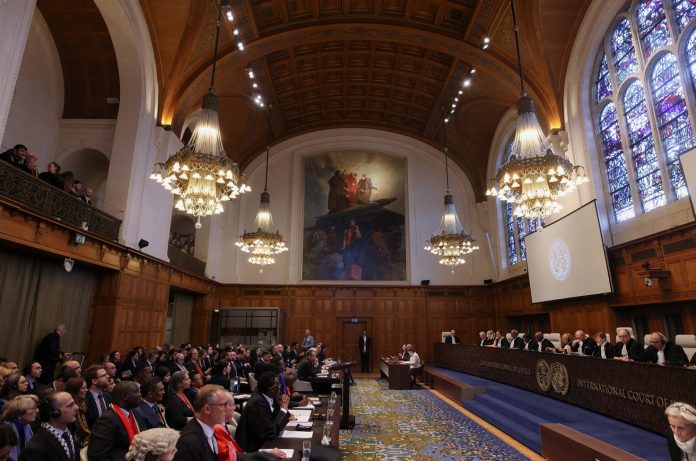
South Africa calls on ICJ to halt Israel’s ‘genocidal’ Rafah invasion

ICJ

Speaking at the court in The Hague on Thursday, South Africa’s ambassador to the Netherlands, Vusimuzi Madonsela, said that Israel’s “genocide” in Gaza had “reached a new and horrific stage”.

“South Africa had hoped, when we last appeared before this court, to halt this genocidal process to preserve Palestine and its people,” Madonsela told the ICJ.

He noted, however, that the attack on the enclave had “continued apace”.

Following the original application by South Africa last year, the ICJ ordered that Israel take all measures within its power to prevent genocide in Gaza, as well as allow aid to enter the enclave, along with a number of other measures.

However, South Africa and many other analysts say Israel has failed to comply with the ICJ orders.

South African delegate Max du Plessis on Thursday told the ICJ that instead of complying with the orders it issued in January, Israel had defied the court by “trapping, besieging and bombarding overcrowded Rafah”.

He added that Israel’s current offensive on the city, where more than a million Palestinians have sought refuge, is the “deadliest phase of this ongoing genocide”.

Du Plessis stated the court’s initial orders were made because the right of existence of the Palestinian population in Gaza is currently at risk of prejudice, and the only effective way of preserving this right was through prevention.

South Africa is seeking these new measures before it is too late for prevention to be possible, he continued.

Echoing the UN’s previous assessment, du Plessis emphasised that “no one in Gaza is safe”.

Some 600,000 Palestinians have fled Rafah following Israeli orders last week for Palestinians in the eastern parts of the city to leave.

They were instructed to relocate to the nearby “humanitarian zone” of al-Mawasi, an area that the aid agency UNRWA says is already overcrowded and lacks basic services.

Last week, South Africa called on the ICJ to order additional emergency measures against Israel over its military assault on Rafah.

In a 10-page document submitted to the ICJ, South Africa asked it to order Israel to “immediately withdraw and cease its military offensive in the Rafah Governorate” and to facilitate “unimpeded access” to humanitarian aid and assistance to the population of Gaza, the document reads.

It also demanded the entry of “internationally mandated bodies or officials, investigators, and journalists into the country” for the purpose of “retaining evidence” and also for Israel to submit an open report to the ICJ within one week of Friday, detailing the measures Israel has taken to comply with “all previous provisional measures” detailed by the court.

Israeli Prime Minister Benjamin Netanyahu has repeatedly stressed he would push on with his plans to invade Rafah in order to uproot Hamas, which was responsible for an attack in Israel on 7 October that killed 1,200 people and saw hundreds of captured Israelis and others taken to Gaza.

More than 35,200 Palestinians have since been killed, the vast majority of whom have been women and children, and over 79,200 others injured since last October.

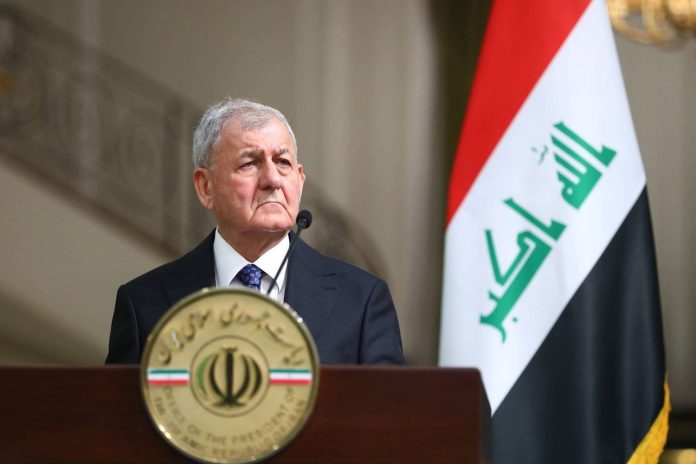
Iraqi president denies Iranian interference in Iraq, voices support for Palestinian statehood

Iraqi President Abdul Latif Jamal Rashid

Speaking in support of an independent Palestinian state, President Rashid called for international pressure to halt the violence in Gaza and ensure humanitarian aid reaches those in need.

He condemned Israeli regime’s Prime Minister Benjamin Netanyahu for disregarding international calls to end the war in Gaza.

President Rashid announced plans for Arab leaders to convene in Manama to address the ongoing aggression by the Israeli regime against the Palestinian people.

He highlighted the improving relations between Iraq and Arab nations, underscoring the complexity of regional issues, particularly the Palestinian cause.

Addressing border disputes, President Rashid revealed that Iraq and Iran have resolved their differences through dialogue.

He also criticized media silence on other countries violating Iraq’s borders and security.

Regarding Turkey, President Rashid expressed a commitment to finding a diplomatic solution to address “ongoing interventions” in Iraq’s affairs.

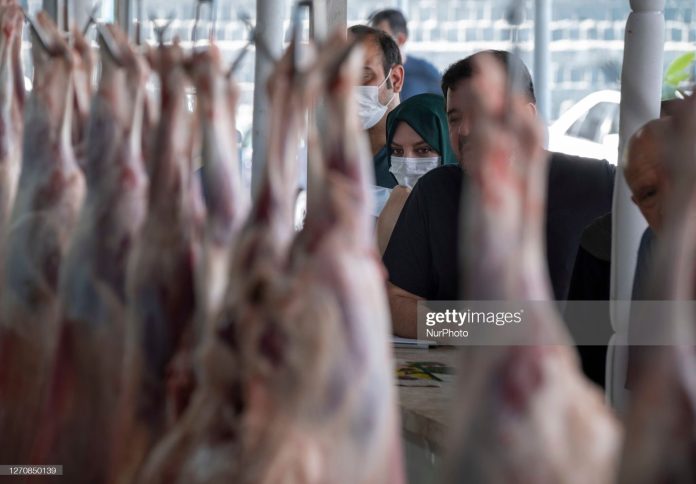
Iranian daily: Hyperinflation breaking people’s back, gov’t just keeps watching

Iran Economy

In its Thursday edition, the daily wrote, “These days, people are fed up with the extreme rise of prices that breaks their back, and it has also made economists and parliamentarians cry over the issue.”

Jomhouri-e Eslami also continues, “But unfortunately, the executive officials and government managers, who should be promoted by the warnings, have turned into great and passive spectators, whose words only add insult to injury.”

The daily argues that the economic disorder in the country has prepared the grounds for the formation of wide embezzlement networks and has created corruption in the structural process of the country, citing the recent mega-scale $3.5bn Debsh tea corruption case.

“People are asking how this large amount of financial corruption happened that the government did not notice and now that it has been exposed, according to the head of the judiciary, 45 people are involved in the case, including the minister, deputy minister and high-ranking directors of the executive officials,” the daily added.

The scathing article comes a day after the Iranian Government Spokesman Ali Bahadori Jahromi told a cabinet meeting that “the government’s approach is to be the first to deal with corruption at any level.”

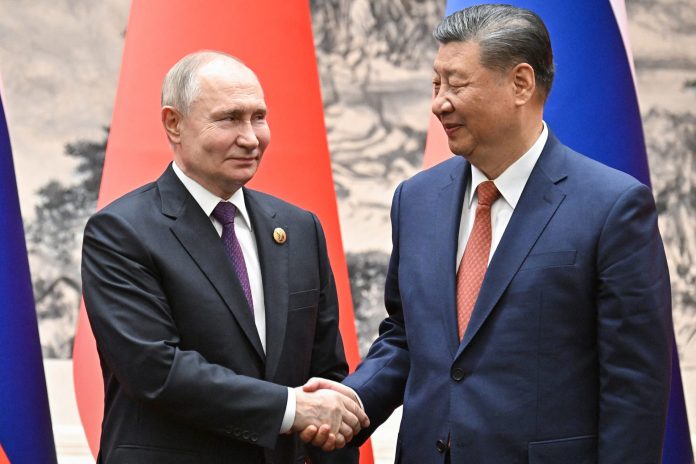
Putin meets Xi in Beijing as China, Russia pledge to deepen partnership

Putin Xi

The leaders shook hands outside the Great Hall of the People on Tiananmen Square and listened to a military orchestra that performed the two countries’ national anthems. They later posed for photographs before leaving for a meeting between delegations from the two nations.

Putin is being accompanied by multiple state ministers, who will participate in negotiations on projects aimed at deepening bilateral ties.

The close ties between Russia and China should not be viewed as a threat against any other country, Putin stated during a meeting with Xi.

“It is absolutely crucial that Russian-Chinese relations are not ad hoc contacts and are not aimed against anyone,” Putin said.

“Our cooperation in world affairs is one of the main stabilizing factors on the international stage. Together, we defend the principles of fairness and the democratic world order based on the multipolar realities and international law,” he added.

During the meeting, Xi said relations between modern-day China and Russia, which span nearly 75 years, have been “tempered in difficult conditions [and] stood the test of a fickle international situation”.

Ties between Beijing and Moscow are a “model of relations between large powers and neighboring states, characterized by mutual respect, trust, friendship and mutual benefit”, the Chinese president stated, adding that this cooperation is in the best interests of the world.

The Russian president agreed, saying, “our cooperation in world affairs is one of the main stabilizing factors on the international stage”.

China and Russia both “defend the principles of fairness and the democratic world order based on the multipolar realities and international law,” he stressed, adding that relations between the two countries “are not aimed against anyone.”

According to Xi, the fact that he has met with Russian officials on so many occasions during the past few years has helped Beijing and Moscow plan ahead strategically and develop cooperation.

The Chinese leader added Beijing “highly appreciates” Putin’s choice of China for his first foreign visit in his new term in office.

600,000 Palestinians left Gaza’s Rafah due to Israeli strikes: UN

Gaza War

Farhan Haq, a spokesperson for UN Secretary-General Antonio Guterres, gave the figures during his office’s daily news briefing.

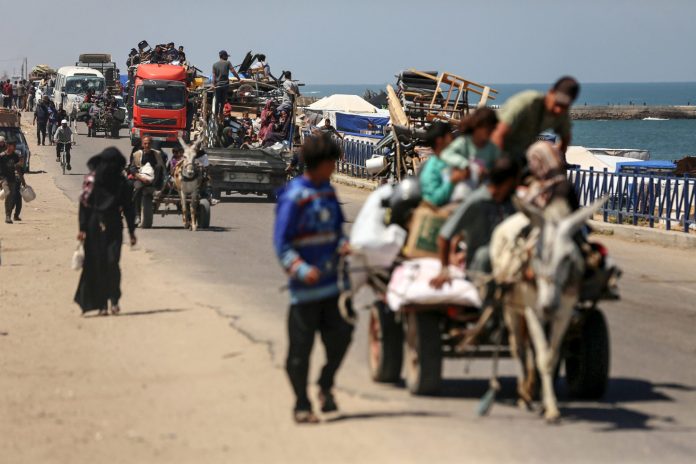
“As of today, some 600,000 people, a quarter of Gaza’s population, have been displaced from Rafah since the 6th of May as the Israeli ground operation there continues,” he stated.

Additionally, the UN’s Office for the Coordination of Humanitarian Affairs has issued a flash update on the displacement of Palestinians from the southern Gaza city.

“On 14 and 15 May, the Israeli military issued two new evacuation orders for all or part of 19 neighbourhoods in northern Gaza, bringing to five the number of orders issued since 6 May in Rafah and northern Gaza”, the update said.

Of the nearly 600,000 displaced since May 6, UN figures say, approximately 150,000 of that number have fled Rafah in the past 48 hours.

The Israeli army continues to move ground troops into Rafah, despite warnings from the US and others among its closest allies.

More than 35,000 Palestinians have since been killed in Gaza, mostly women and children, and 79,000 others injured, according to Palestinian health authorities.

Over seven months into the Israeli war, vast swathes of Gaza lay in ruins, pushing 85% of the enclave’s population into internal displacement amid a crippling blockade of food, clean water, and medicine, according to the UN.

Israel stands accused of genocide at the International Court of Justice. An interim ruling in January said it is “plausible” that Israel is committing genocide in Gaza and ordered Tel Aviv to stop such acts and take measures to guarantee that humanitarian assistance is provided to civilians in Gaza.

E3 warned after deploying fighter jets to defend Israel against Iran aerial attack

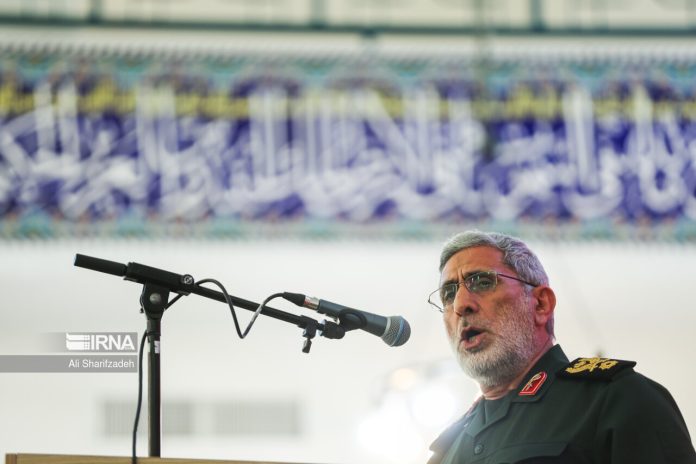
Esmail Qaani

“All criminals should know [this] that their measures and crimes have been chalked up to their accounts,” Qa’ani said on Wednesday.

“France, Germany, and the UK should not think that they deployed the planes that night and that the issue was over. Yes, that night was over, but they will be held accountable in due course,” he added.

The commander was addressing a ceremony held to mark 40 days since the martyrdom of the IRGC’s General Mohammad Hadi Haji Rahimi.

Haji Rahim, Brigadier General Mohammad Reza Zahedi, an IRGC Quds Force commander, and five of their accompanying officers were all martyred on April 1 in an Israeli terrorist attack against Iran’s diplomatic premises in the Syrian capital Damascus.

In retaliation, the IRGC targeted the occupied territories late on April 13 with a barrage of drones and missiles. The retaliatory strikes, dubbed Operation True Promise, inflicted heavy damage on Israeli military bases across those territories.

According to Qa’ani, the United States and the entire Western military alliance of NATO contributed all of their military capabilities towards defending the occupying regime against the Iranian operation.

“[Up to] seven to eight naval groups were deployed to the Black Sea to prevent the [Iranian] operation,” he said, adding that more than 200 aircraft were also scrambled across the region’s skies during the night of the operation.

The commander described the aerial expanse, where the operation was conducted, as “the most condensed spot in the world as far as [the issue of] air defense is concerned,” billing the operation as “unprecedented and historically unachievable.”

Qa’ani reminded that the Islamic Republic had previously informed various concerned parties about the pending operation.

“True Promise was an overt operation… The time of the operation was [already] clear as daylight to the Zionist regime and the United States,” he continued, noting that the Islamic Republic “displayed its strength, steadfastness, and power to the whole world” during the operation.

“The [Operation] True Promise’s victory is not [simply] limited to the number of missiles and drones that reached the occupied territories,” the commander stated. “There are so many secrets within this operation that would take one a long time to analyze,” he added.

Qa’ani hailed the role that was played by Leader of the Islamic Revolution Ayatollah Seyyed Ali Khamenei in the operation.

“Who in the world dares to take such a decision?” he asked, reminding that even the United States — Israel’s biggest ally — had announced following the Israeli terrorist attack that it would not enter the fray.

The commander, meanwhile, advised regional and extra-regional countries to learn from the US’s inability to protect the Israeli regime during the Iranian operation, calling on them not to take much comfort in relying on Washington.

Blinken’s visit to Kiev shows US concerned over Ukrainian failures on frontline: Russia

Blinken

“On May 14-15, the US Secretary of State visited Ukraine,” the diplomat noted.

“It is obvious that the state of affairs on the frontline and the military failures of the Ukrainian army are triggering more and more serious alarm in the Biden administration.”

The spokeswoman stated that the Washington Post said that Blinken arrived at a critical moment for Kiev, calling on it to hold on for as long as possible.

“He sang a song, ate some pizza and left.”

During the visit, Blinken vowed more help for Ukraine from the West and asserted that “the coming weeks and months will demand a great deal of Ukrainians”. Kremlin Spokesman Dmitry Peskov said that the Kremlin was aware of the visit and the “edginess now felt not only in Kiev itself but also in European capitals”.

On Wednesday, Blinken announced $2bn in additional military aid for Ukraine as he visits the country at a crucial phase in the war, with Russia striking deeper into Ukrainian territory and claiming to have seized three more settlements.

Speaking at a joint news conference in Kyiv alongside Ukrainian Foreign Minister Dmytro Kuleba on Wednesday, Blinken said the support, which comes on top of $61bn in US support approved by Congress last month, would be aimed at investing in Ukraine’s industrial base.

He announced that the United States and Ukraine had already done the “heavy lifting” on a bilateral security agreement, which could be signed within weeks. He said the US was rushing ammunition, armoured vehicles, missiles and air defences to Ukraine in order to ensure their speedy delivery to the front line.

His remarks came as Ukrainian forces are being stretched across the long front line, struggling to fend off a renewed Russian offensive. On Wednesday, Russia’s Ministry of Defence said Russian forces had taken control of the settlements of Hlyboke and Lukyantsi in the northeastern Kharkiv region, and Robotyne in the southern Zaporizhzhia region, the latest in a run of incremental gains that have alarmed Kyiv.

Ukraine announced that it had pulled back some troops in the Kharkiv region, where Russian troops launched a surprise offensive earlier this month, pounding settlements along the border.

“In certain spots in Lukyantsi and Vovchansk areas, due to the fire impact and assault actions of the enemy, manoeuvres were carried out in order to save the lives of our soldiers, units were removed to advantageous positions,” a military spokesman noted on state television.

Ukrainian officials have said that more than 30,000 Russian forces have been deployed to the northeastern region. Emergency services have evacuated about 8,000 people, most of them women, elderly people, people with reduced mobility, and people with disabilities and children.

As Russia intensifies its attacks, Ukraine President Volodymyr Zelenskyy’s press secretary announced the leader had postponed all upcoming foreign visits. The president had earlier cancelled a visit to Spain and Portugal.

Israel’s insistence on Rafah invasion forces negotiations into unknown fate: Hamas

Ismail Haniyeh

In a televised speech on the occasion of the 76th anniversary of the Palestinian “Nakba” on Wednesday, Haniyeh stated that Hamas “positively engaged with the efforts of mediators in Egypt and Qatar to reach an agreement to stop the fighting in Gaza and hostage swap” with Israel.

He added that “the occupation responded to our acceptance of the cease-fire proposal (presented by Egypt and Qatar) by entering Rafah city and northern areas” in the Gaza Strip.

Haniyeh continued that “the occupation’s modifications to this proposal have put negotiations at an impasse.”

He also considered that “Israel’s insistence on proceeding with the Rafah operation puts negotiations in an unknown fate”.

“We agree with our brothers in Egypt on the necessity of the enemy’s immediate withdrawal from the Rafah crossing and all areas of the strip”, he continued, emphasizing that “Israel has no right” to interfere in the management of the crossing.

His remarks came as Israeli opposition leader Yair Lapid has said that as long as the Benjamin Netanyahu government is in power, Israel will not be able to win the war in Gaza.

His comments came after Defence Minister Yoav Gallant rejected the possibility of Israeli civil or military governance of post-war Gaza.

“The government has lost control,” Lapid wrote in a post on X.

“Soldiers are being killed every day in Gaza and they fight among themselves on television. The cabinet is disassembled and non-functional. Ministers protest in front of cabinet meetings.”

“One cabinet sends humanitarian aid convoys and the other burns them,” he continued, adding, “Relations with the US are collapsing, the middle class is collapsing, they have lost the north”.

“We can’t go on like this. We will not win with this government.”

Since Oct. 7, 2023 after a Hamas attack killed nearly 1,200 Israeli citizens, Israel has launched a deadly offensive on the Gaza Strip.

Gaza’s Health Ministry reported on Wednesday that the death toll has hit 35,230 with nearly 80,000 people injured.

Seven months into the Israeli war, vast swathes of Gaza lay in ruins, pushing 85% of the enclave’s population into internal displacement amid a crippling blockade of food, clean water and medicine, according to the UN.

Israel is accused of genocide at the International Court of Justice. An interim ruling in January said it is “plausible” that Tel Aviv is committing what has been referred to as the “crime of crimes” in Gaza, ordering it to stop such acts and take measures to guarantee that humanitarian assistance is provided to civilians in Gaza.

But Israel has continued its offensive, and aid deliveries remain far short of pre-war levels. Even then, the coastal territory was heavily reliant on external assistance due to Israel’s 17-year blockade.