Saturday, December 27, 2025
Home Blog Page 566

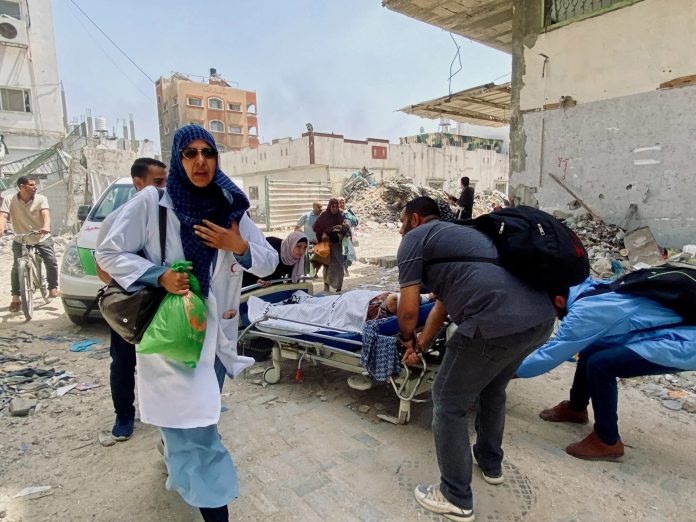
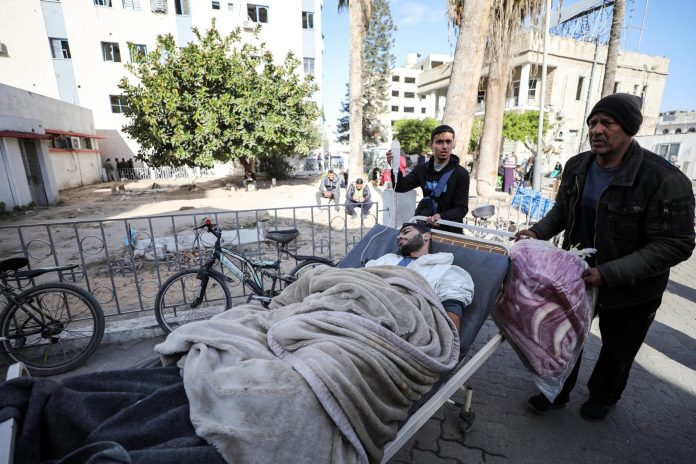
UN report warns ‘pattern’ of destruction of hospitals in Gaza by Israel

Gaza War

The report, covering the period from 7 October 2023 to 30 June 2024, found that “22 out of 38 hospitals across Gaza had been rendered non-functional”.

Its publication comes after the most recent destruction of Kamal Adwan Hospital, the last remaining in northern Gaza. Israeli forces stormed the hospital last week, following nearly three months of a blockade and constant air strikes on its departments.

Although not within the remit of the report’s time period, this attack followed the same pattern highlighted, which includes “missile strikes on hospital buildings, the destruction of hospital facilities, shooting of civilians, sieges, as well as temporarily taking over the hospital buildings”.

The report cited the first major attack against al-Shifa Hospital in Gaza City, which took place in November 2023, as an example of such an incursion.

During the attacks on both al-Shifa and Kamal Adwan, Israeli forces began by bombarding the area outside the hospitals, cutting off supplies, rendering the generators out of service, and sparking fires in several departments – including the surgery, intensive care and maternity wards.

Troops then stormed the hospitals, forcing many of the remaining staff and patients to strip almost naked and detaining them, including the hospital directors.

The director of al-Shifa Hospital, Dr Mohammed Abu Salmiya, has since been released after seven months of incarceration. However, the head of orthopaedic medicine, Dr Adnan al-Bursh, was tortured to death in Israeli custody.

Likewise, the director of Kamal Adwan Hospital, Dr Hussam Abu Safiya, was arrested and is currently missing despite calls for his release.

The same procedure is mirrored in incursions against al-Amal Hospital, the Palestine Red Crescent Society (PRCS) facilities in Khan Younis and al-Awda Hospital in northern Gaza, among others, as documented in the report.

In many cases, but most prominently in the bombardment of al-Shifa, the Israeli government justified its actions by alleging that Palestinian armed groups used the hospitals to run their operations, holding captives, stealing fuel provided by the Israeli army and treating the patients and medical personnel as human shields.

“However, insufficient information has so far been made publicly available to substantiate these allegations, which have remained vague and broad, and in some cases appear contradicted by publicly available information,” the UN report found.

The report called for an “independent, credible and transparent investigations of these incidents, and full accountability for all violations of international humanitarian and human rights law which have taken place”.

Israel also ignored pleas from the World Health Organization (WHO) to stop attacking medical facilities in northern Gaza, with a medical worker telling Middle East Eye on Thursday that heavy shelling and gunfire from unmanned quadcopters was taking place in the direction of the war-battered Indonesian Hospital.

Dr Rawia Tambour told MEE that Israeli forces were firing heavy artillery shells in the vicinity of the facility in Beit Lahia, while quadcopters shot at anything that moved.

“Israeli military vehicles are advancing towards the hospital,” Tambour said in an audio message, as the sounds of blasts echoed in the background.

The Indonesian Hospital, one the biggest health facilities in northern Gaza, has been out of service for weeks due to ongoing Israeli attacks and a debilitating siege put in place since early October.

Earlier this week, Tedros Adhanom Ghebreyesus, the head of the WHO, called on Israel to cease its attacks on Gaza’s beleaguered hospitals and medical centres and offer a brief reprieve to exhausted Palestinians.

“Hospitals in Gaza have once again become battlegrounds and the health system is under severe threat,” Tedros stated, adding: “We repeat: stop attacks on hospitals. People in Gaza need access to healthcare. Humanitarians need access to provide health aid. Cease fire!”

A day later, the UN Human Rights Office released a report saying Israeli forces had “destroyed the healthcare system in Gaza”, with the situation reaching “catastrophic levels”.

The report added that Israel’s 15-month offensive had resulted in the “killing of hundreds of health and medical professionals”, as well as patients and civilians.

“It is essential that there be independent, credible and transparent investigations of these incidents, and full accountability for all violations of international humanitarian and human rights law which have taken place,” according to the report by the Office of the United Nations High Commissioner for Human Rights.

Israel has repeatedly targeted Gaza’s healthcare system since declaring war, with videos, investigations and witness testimony documenting relentless attacks on hospitals, ambulances and doctors.

Israeli forces previously raided the two largest hospitals in the strip, al-Shifa Hospital in Gaza City and Naser Hospital in Khan Younis, destroying them in the process.

Since 7 October, Israel has killed over 1,150 healthcare workers and detained 300, according to the Palestinian health ministry.
French, German top diplomats meet Syria’s de facto rulers in Damascus

German French FMs Syria

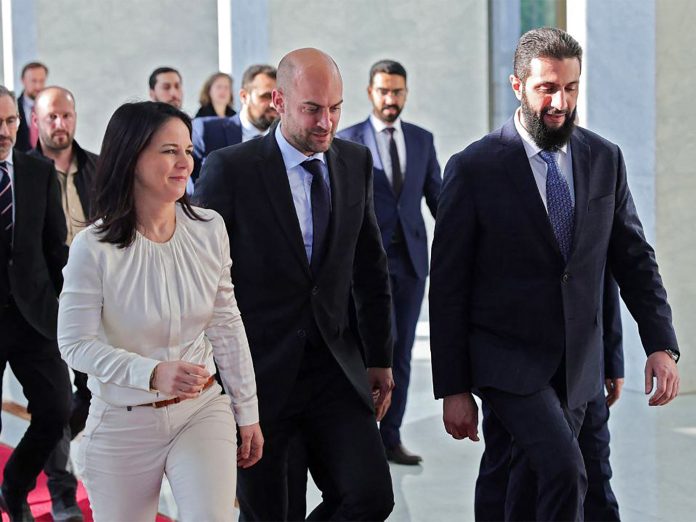
Germany’s Annalena Baerbock and France’s Jean-Noel Barrot held talks with Syria’s de-facto leader Ahmed al-Sharaa, also referred to as Abu Mohammed al-Julani, in the Syrian capital on Friday.

Their visit comes as Western governments open channels with al-Sharaa’s Hayat Tahrir al-Sham (HTS) – a group with past links to al-Qaeda that led the rebellion against al-Assad – debating whether to remove its terrorist designation.

Barrot landed first in the Syrian capital on Friday morning, having posted on social media platform X that France and Germany stood with the Syrian people “in all their diversity”, voicing support for a “peaceful and demanding transition in the service of the Syrians and for regional stability”.

“A political solution must be reached with France’s allies, the Kurds, so that they are fully integrated into this political process that is beginning today,” Barrot said after meeting civil society representatives in Damascus.

In a news briefing after meeting the new Syrian administration, Baerbock stated: “In our talks today we made clear Europe will support [Syria] but Europe will not be a financier of Islamist structures.”

“Ethnic and religious groups involving men as well as women … must be involved in the constitutional process and in a future Syrian government,” she added.

The ministers also visited Sednaya Prison, the site of extrajudicial executions, torture and forced disappearances during the al-Assad family’s decades-long rule.

“What the Assad regime has meant we saw today in Sednayah … This gave only a faint idea of the unimaginable physical and mental torment that took place there,” Baerboek said, adding that an “accountability mechanism could help the people of Syria to slowly heal the deep wounds”.

Before her visit to Syria, Baerbock had specifically asked the new government to avoid “acts of vengeance against groups within the population”, to avoid a long delay before elections, and to avert attempts to introduce religious content into the judicial and education systems.

The new Syrian authorities have already announced curriculum changes, including scrapping poetry relating to women and love and references to “Gods” in ancient history courses.

On governance, al-Sharaa recently stated that it could take about three years to present a new draft constitution, and another year until elections.

Baerbock noted Germany wanted to overcome “scepticism” about HTS and help Syria return to being “a functioning state with full control over its territory”.

Al Jazeera reproted that the German and French foreign ministers came with a “long list of demands” for the new administration.

“They say that HTS has to renounce acts of vengeance against its opponents and embrace a moderate path. It has to allow an inclusive government where minorities will be represented and it also has to present the Syrian people and international community with a clear path to a transition that should start in March,” it said.

“They also made it clear they would not tolerate the presence of radical groups here. They said that there’s a huge concern about the IS taking advantage of the volatile situation in Syria to pose a serious threat to the entire region,” it added.

UN experts urge Israel to stop ‘blatant disregard’ of right to health in Gaza

Gaza War

“For well over a year into the genocide, Israel’s blatant assault on the right to health in Gaza and the rest of the occupied Palestinian territory is plumbing new depths of impunity,” UN special rapporteur on the right to health, Tlaleng Mofokeng, and UN special rapporteur for Palestine, Francesca Albanese, said in a statement.

“We are horrified and concerned by reports from northern Gaza and especially the attack on the healthcare workers including the last remaining of 22 now destroyed hospitals: Kamal Adwan Hospital,” they added

“We are gravely concerned with the fate of Dr Hussam Abu Safiya, yet another doctor to be harassed, kidnapped and arbitrarily detained by the occupation forces, in his case for defying evacuation orders to leave his patients and colleagues behind. This is part of a pattern by Israel to continuously bombard, destroy and fully annihilate the realisation of the right to health in Gaza.”

“More disturbing reports indicate that Israeli forces allegedly conducted extrajudicial executions of some people in the vicinity of the hospital, including a Palestinian man who was reportedly holding a white flag,” they stated.

More than 1,057 Palestinian health and medical professionals have been killed and many arbitrarily arrested, according to the experts.

They urged Israeli authorities, as the occupying power, to respect and protect the right to life and the right to health in Gaza and the whole occupied Palestinian Territory by ensuring unhindered access to necessary health care and urgently restoring the continuity of essential health services in Gaza.

“Under occupation, intentional assaults on healthcare facilities have the potential to expose individuals to cruel, inhuman, and degrading treatment and may constitute a war crime,” they said.

“In Gaza, this is clearly part of a well-established pattern of genocide, for which Israeli leaders will have to be held accountable,” they added.

Several members of UN Security Council on Friday expressed concern over Israeli attacks on the hospitals in the Gaza Strip.

Israel has killed more than 45,600 victims, mostly women and children, in Gaza since a Hamas attack on Oct. 7, 2023.

In November, the International Criminal Court issued arrest warrants for Prime Minister Benjamin Netanyahu and his former Defense Minister Yoav Gallant for war crimes and crimes against humanity in Gaza.

Israel also faces a genocide case at the International Court of Justice for its war on the enclave.

Biden considered attack on Iranian nuclear facilities: Axios

Joe Biden

The discussions were reportedly part of contingency plans for scenarios in which Iran moves closer to developing nuclear weapons before Biden leaves office on January 20.

National Security Adviser Jake Sullivan presented various options to Biden during the meeting, but the president has not authorized any action, and no active discussions on military strikes are currently underway, the sources added.

A US official speaking anonymously clarified that the meeting was not prompted by new intelligence but was aimed at assessing “prudent scenario planning” if Iran enriched uranium to weapons-grade levels.

Biden’s advisers discussed whether the situation in the Middle East justified an intervention or gave Biden an “imperative and an opportunity to strike”, Axios wrote. Despite some internal arguments favoring a swift attack while Iranian defenses and regional influence are weakened, no recommendation was made, according to the US official.

On Thursday, the Iranian government reiterated its position of pursuing peaceful nuclear energy while remaining open to negotiations, as long as Tehran is treated with “respect”, according to Foreign Minister Abbas Araqchi.

The foreign minister warned that sanctions would not work with Iran, referring in particular to the ‘maximum pressure’ policy employed by the US during President Donald Trump’s first term.

“The more they impose sanctions and pressure on Iran, the more Iran will show resistance,” Araqchi said, calling on Western nations to treat his country with respect.

“If they opt for fair, just, and dignified negotiations and speak with the language of respect, we will respond in kind.”

Iran has long denied having ambitions to develop nuclear weapons, maintaining that its nuclear activities only serve civilian purposes. In 2015, the country reached a nuclear deal with major world powers, known as the Joint Comprehensive Plan of Action (JCPOA), which limited Iran’s nuclear program in exchange for partial sanctions relief.

In 2018, however, the US unilaterally withdrew from the agreement under Trump. Since then, Iran has stepped up its enrichment capabilities, and efforts to revive the deal have thus far failed.

Ukraine claims Russia lost 430k soldiers in 2024

Russia Ukraine War

Russia’s gradual, grinding advance in parts of Ukraine’s eastern region of Donetsk succeeded in wresting away 4,168 sq km (1,609 square miles) of fields and abandoned villages in 2024 – equivalent to 0.69 percent of the country.

That was the assessment of the Institute for the Study of War, a Washington-based think-tank, based on satellite imagery and geolocated video footage.

“Russian forces have seized four mid-sized settlements – Avdiivka, Selydove, Vuhledar, and Kurakhove – in all of 2024, the largest of which had a pre-war population of just over 31,000 people,” said the ISW.

Russian forces spent four months taking Avdiivka, and two months each for Selydove and Kurakhove.

“Seizing these settlements has not allowed Russian forces to threaten any notable Ukrainian defensive nodes,” noted the ISW, adding that Moscow’s troops failed to conduct the kind of rapid, mechanised manoeuvre necessary to convert these “tactical gains into deep penetrations of Ukraine’s rear”.

At this rate, Russia would need two more years to complete its conquest of Donetsk alone, the ISW assessed – something Russian President Vladimir Putin had ordered his commanders to do by October 1.

Russia’s sacrifices to achieve these advances have been immense, as Ukrainian forces used their defender’s advantage to inflict high casualties, especially in urban settings where they fought building-to-building, street-to-street.

Ukrainian Commander-in-Chief Oleksandr Syrskii stated on Monday that Russian forces had suffered an estimated 427,000 wounded and killed in 2024. A few days later, Ukraine’s Ministry of Defence put Russia’s losses last year at 430,790 soldiers – the equivalent of 36 Russian motorised rifle divisions – outnumbering its losses in 2022 and 2023 combined.

These losses amounted to an average of 1,180 a day, but casualty figures rose substantially towards the end of the year, as Russian forces increased their assaults in an apparent effort to influence the US election.

The highest monthly losses, the Defence Ministry said, came in November and December – 45,720 and 48,670 respectively – as Russia intensified its attacks in Donetsk.

“This year, the Russians paid the highest price for the war against Ukraine, as our army and all of our defence and security forces of Ukraine destroyed more enemy equipment and manpower than in any of the previous years of the war,” Syrksyi told his forces in an address on December 31.

Russia did manage to increase its daily land grab from 14 sq km (5.4 square miles) in October to 28 sq km in November but fell back to 18 sq km (11 square miles) a day in December. Apparently, its losses did not fall commensurately.

“Over the past week, the invaders have been losing about 1,700 people killed and wounded every day,” Syrksyi said on Monday.

December also produced two possible Russian casualty records.

On December 29, Ukraine’s general staff said Russian forces lost 2,010 people. They suffered a possible all-time record of 2,200 daily casualties in a total of 191 combat clashes on December 19.

Ukraine also estimated it had taken out 3,689 Russian tanks, thousands of armoured combat vehicles, and more than 13,000 artillery pieces. Ukraine’s navy said it sank five ships and 458 smaller craft.

Russia recruited North Korean fighters in an effort to relieve pressure on its manpower, but Ukrainian President Volodymyr Zelensky stated a quarter of them had been wiped out.

“According to preliminary data, the number of killed and wounded North Korean soldiers in the Kursk region already exceeds 3,000 people,” Zelensky added in his evening address on December 23.

He more recently claimed Russia was killing North Koreans in danger of falling into the hands of Ukrainian forces.

“Everything is arranged in a way that makes it impossible for us to capture the Koreans as prisoners – their own people are executing them, there are such cases,” Zelensky noted in an evening address on December 27.

Ukraine’s military intelligence, GUR, announced more North Koreans were being brought to Kursk to replace losses.

Putin appears to have prioritised manpower for the war over workers for the economy.

He signed a decree on Monday forcing all undocumented migrants to depart Russia by the end of April, but joining the military allows them to circumvent normal legal status requirements.

Ukraine’s Foreign Intelligence Service estimated Russia suffered from a labour shortage of 1.5 million people last year, as the available labour force declined by a million. Yet Putin’s decree would suck foreign workers out of the economy and put them on the front lines.

Putin acknowledged shortages of “hundreds of thousands” in an end-of-year news conference on December 19, but did not connect those shortages to the war. Instead, he proposed bringing more migrant workers from Central Asian countries.

He dwelled on the need “to develop a network of Russian schools there, to study the Russian language, to introduce people who are going to come to work here” and spoke of the need to increase labour productivity through higher technologies.

Ukraine and Russia have both transitioned to war economies, Russia’s financed by income from fossil fuels and Ukraine’s by aid from its Western allies.

Both have sought to become as weapons-autonomous as possible.

In his New Year’s address, Zelensky said 30 percent of the weapons Ukraine used last year were domestically made.

“I felt ashamed as a citizen that since the 90s, the state hadn’t noticed such people of ours,” he continued, adding, “And I am proud… that Ukraine is once again building its own, its own missiles. And for the first time, it produces over a million drones in a year.”

Ukraine has used aerial and naval drones of its own design to strike deep inside Russia and across the Black Sea.

Ukraine’s military intelligence said on Tuesday it used a SeaDragon missile launched from a Magura V naval drone to down a Russian Mi8 helicopter.

“Today, for the first time, a helicopter was shot down, it fell into the water. That is, the fact of the destruction of an air target over the Black Sea has been recorded,” Kirill Budanov, Ukraine’s intelligence chief, told a telethon.

GUR released footage of the strike. Previously, Russian helicopters struck in this war had managed to reach an airfield, he added.

Russia has also invested in drones, though it is hampered by Western sanctions on imports of sensitive technology.

Its drone plant in Alabuga, 1,000km (620 miles) east of Moscow, produced 5,760 drones in the first nine months of last year, Ukrainian intelligence sources told CNN, double its 2023 output.

Ukraine’s air force said in 2024, it faced a much greater missile and drone threat against critical infrastructure than in 2023, partly because Russia was also using decoy Shahed drones that do not carry explosives but confuse and overwhelm air defences.

“The enemy is trying to complicate the air situation as much as possible, overload our air defences and exhaust our sky defenders,” the air force added.

Throughout last year, Ukraine announced it shot down 11,200 “attack” drones, of which 7,800 were Shaheds.

Kyiv alone faced 200 aerial assaults last year, the municipality said, involving 1,300 drones, more than 200 cruise missiles and 46 ballistic missiles.

Ukraine’s prosecutor general reported a civilian death overnight on New Year’s Eve, after a Russian drone crashed into a residential building in Kyiv. Another drone caused a fire at the National Bank of Ukraine.

The drones were part of a huge attack involving 111 Shahed kamikaze drones, Ukraine’s air force said, 63 of which it said it shot down.

Despite its rising weapons output, Ukraine remained highly dependent on supplies from its allies.

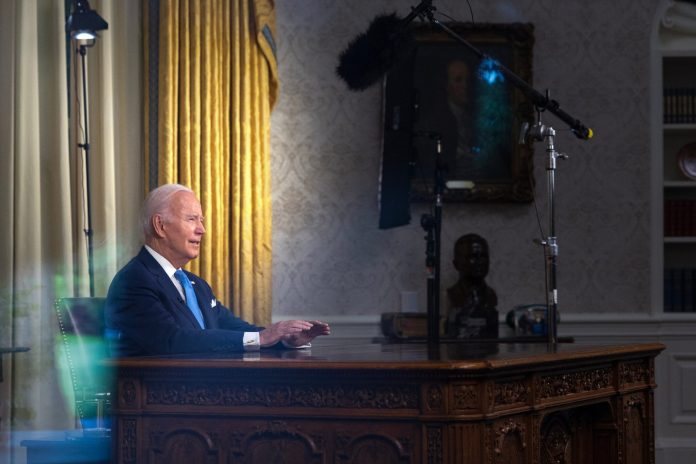
United States President Joe Biden on Monday announced $2.5bn in military aid to Ukraine, half of it in immediately drawdown capability.

Biden stated the package represented the remainder of the $60bn in aid he signed into law for 2024, and included “hundreds of thousands of artillery rounds, thousands of rockets, and hundreds of armored vehicles” as well as air defence equipment.

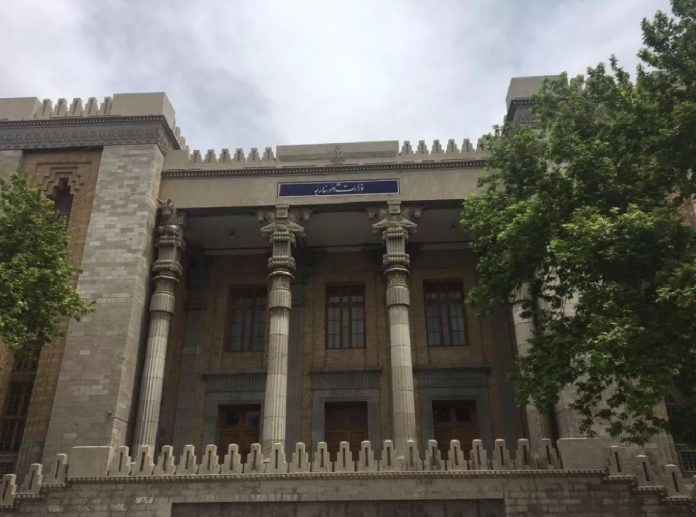
Italy’s ambassador to Tehran summoned to Foreign Ministry over detention of Iranian citizen

The Iranian Foreign Ministry

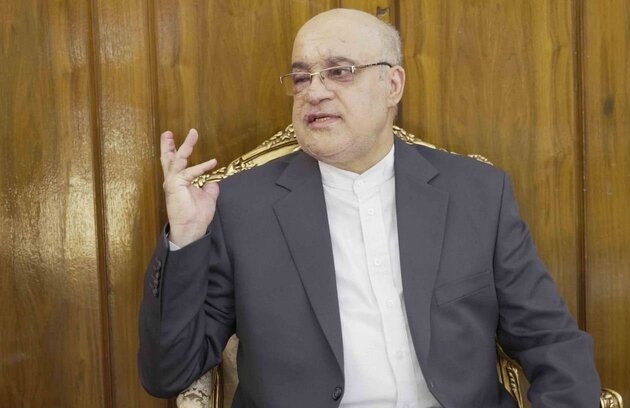
During the meeting, Majid Nili Ahmadabadi, Director General for Western Europe at the Foreign Ministry, described the arrest of Iranian citizen Mohammad Abedini as an illegal act carried out at the request of the U.S. government.

The Iranian official stated that Abedini’s detention reflects Washington’s ongoing political and hostile approach of targeting Iranian citizens worldwide through the extraterritorial application of U.S. domestic laws.

Nili emphasized that the detention not only undermines the long-standing relations between Iran and Italy but also violates international legal principles, including human rights standards, and constitutes a form of arbitrary detention.

He urged Italy to reject the U.S. policy of hostage-taking and called on Rome to take immediate steps to secure Mr. Abedini’s release, thereby preventing any harm to bilateral relations caused by external pressures.

In response, the Italian ambassador assured that she would convey Iran’s protest and concerns to her country’s Foreign Ministry in Rome.

Envoy: Iran wouldn’t have supported resistance for 45 years if it intended to withdraw 

Amani made the remarks during a visit to the southern suburbs of Beirut, stating, “If Iran had intended to withdraw its support for the resistance, it would not have continued this effort for 45 years.”

The envoy made the assertion in response to rumors that Iran has changed its stance regarding the resistance in the region.

Iran has repeatedly reaffirmed its support for the anti-Israel resistance movements, describing it as among its unchanging foreign policy principles.

Four countries place orders for Iranian-made advanced polymer production equipment

In an interview with ISNA news agency, Alireza Naeimi, head of research and development at the company, shared that their research focuses on designing and manufacturing various polymer process equipment, such as extruders, plastic injection machines, and hot presses, for both laboratory and industrial-scale polymer product manufacturing.

Naeimi noted that extruders can simulate industrial production processes with minimal error on a laboratory scale, providing reliable results with very small quantities of raw materials.

He also highlighted the flexibility of the devices, which can produce a wide range of polymer shapes, from filaments to blown films, by altering the arrangement of screws and extrusion molds.

One of the primary activities of the company is polymer material processing, especially in the production of masterbatches and polymer compounds, which are essential for manufacturing polymer parts.

The system, connected to gearboxes and shafts designed and built domestically, eliminates the need for imports.

The company has also designed and implemented a production line for a French client in Iran, which is now operational.

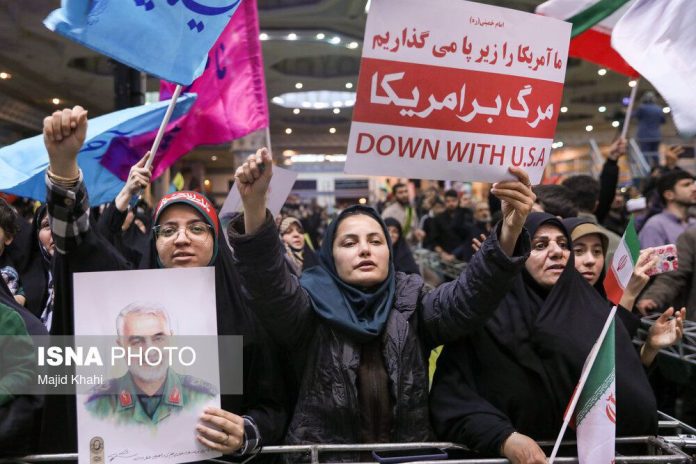
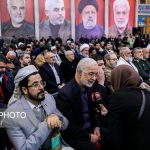
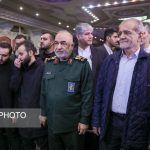
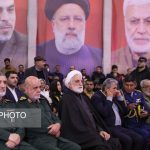
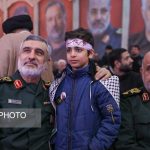
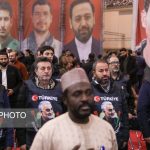
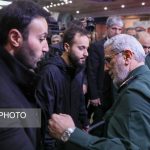
Pictures: 5th anniversary of General Soleimani martyrdom commemorated in Tehran

The event was attended by Martyr Soleimani’s family, political and military officials, and thousands of people from various walks of life.

General Soleimani, commander of the Quds Force of Iran’s Islamic Revolution Guards Corps (IRGC), and his companions were assassinated in a US drone strike near the Iraqi capital Baghdad’s International Airport on January 3, 2020.

More in pictures:

Iran deputy parliament speaker: President has no opposition to military operation against Israel

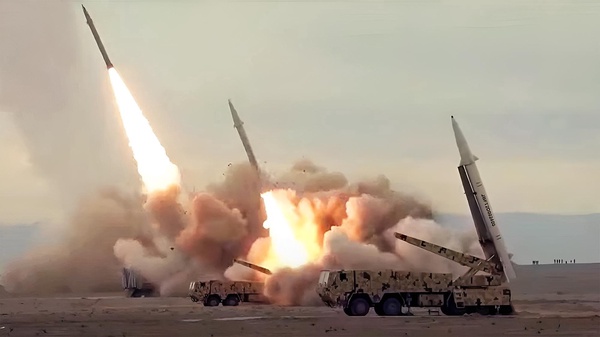
Ali Nikzad, speaking on Thursday evening to commemorate the fifth anniversary of Lieutenant General Qassem Soleimani’s martyrdom in Ardabil, northwest Iran, said the Supreme National Security Council has reviewed all matters and is seeking to properly implement True Promise 3.

He strongly refuted the allegations of the military commanders seeking comfort, or opposition from the government and the President regarding the implementation of True Promise 3, emphasizing that these claims have no basis.

Nikzad also referred to two military operations by the Iranian armed forces against Israel, stating that there was no disagreement among the branches of power regarding Operation True Promise 2, and the different information and tactics in that operation resulted in over 85% effectiveness of the missiles launched at the occupied territories.

He pointed out: “The child-killing Zionist regime assassinated our guest, who had come to Iran by official invitation, and we will definitely take revenge for the blood of our martyrs.”

Nikzad’s reference was to the martyrdom of Ismail Haniyeh, the former leader of Hamas, who was assassinated by the Zionist regime in Tehran.

In another part of his speech, the Deputy Speaker criticized recent statements by Joulani, the commander of the Al-Nusra Front, who claims to be the ruler of Syria, saying Joulani has handed Syria over to Israel; he is an officer and spy for Israel.

He also praised the character and sincerity of General Soleimani, stating that he was a national hero and an unparalleled, unique personality.