Wednesday, December 24, 2025
Home Blog Page 5071

Iran welcomes Saudi foreign minister: Zarif

Iran-Mohammad Javad Zarif

In a joint press conference with Finnish Foreign Minister Erkki Tuomioja on Sunday in Tehran, Mohammad Javad Zarif said he is also prepared to visit Saudi Arabia.

He added that Iranian Deputy Foreign Minister for Arab and African Affairs Hossein Amir-Abdollahian have had positive talks with Faisal during his recent visit to in the western Saudi city of Jeddah.

“I am also prepared to cooperate with him (Faisal) for boosting our relations and also improving the current situation in the region,” the Iranian foreign minister stated.

He added that Tehran and Riyadh have common interests and face common dangers including extremism and sectarianism in the region.

The meeting between Amir-Abdollahian and Faisal was the first in high-level bilateral talks between the two countries after Iranian President Hassan Rouhani took office last year.

In March, President Rouhani emphasized Tehran’s determination to improve ties with neighboring Muslim countries, saying cooperation between Iran and Saudi Arabia would be vital for regional security.

The two countries have remained divided on a number of key regional issues, including the Bahraini uprising and the crisis in Syria.


Iran Loses to Host Spain in FIBA World Cup

Iran-Spain-Basketball

In the match held at the Palacio Municipal de Deportes de Granada, Pau Gasol scored 33 points in Spain’s victory and Mehdi Kamrani led Iran with 18 points.

“I am satisfied with our performance since I believe that Spain and the United States will advance to the final. We played against a great team,” Iran coach Mehmed Becirovic said.

Iran is scheduled to face Brazil on Sunday.

Results:
US 114, Finland 55
Spain 90, Iran 60
Brazil 65, France 63
Croatia 81, Philippines 78
Slovenia 90, Australia 80
Turkey 76, New Zealand 73
Ukraine 72, Dominican Republic 62
Argentina 98, Puerto Rico 75
Lithuania 87, Mexico 74
Serbia 85, Egypt 64
Greece 87, Senegal 64
Angola 80, Korea 69

Pigeon Houses, Iranian Architectural Elegance

Pigeon Houses, Iranian Architectural Elegance

The Game-keeping and Nature Magazine in its summer issue (July-September 2014) published a report headed “Iranian Architecture in Pigeon Houses”, which revolved around the architecture of dovecots in Iran that have unfortunately lost their status with the advance of urbanization. The following includes a brief look at amazing features of these artistically built structures and a trip down the memory lane to their glory days when many of them still offered safe haven and comfort to pigeons:

Pigeon Houses, Iranian Architectural EleganceIt is an Iranian-designed nest for Iranian pigeons. Iranians did not keep homing pigeons in captivity. In fact, such nests were intended to function as a place of rest and refreshment where pigeons could stay, drink water and peck at seeds and then fly back to the blue sky.

Pigeon houses are fairly large adobe structures built by farmers. They have numerous timbers in their upper section and there is a honeycomb and porous network in the interior which provides birds with suitable accommodation. Their interior architecture is exceptional. These buildings are magnificent thanks to their substantial size, glory and diversity in design. Thanks to careful consideration of climate and biology by Iranian architects, fascinating wonders in the name of pigeon houses appeared on earth, beautiful and terracotta-colored structures which survived long and rightly deserve to be viewed as superior to the Seven Wonders of the World.

Farmers used pigeons as biological pest controllers and collected their droppings as natural fertilizer for their farms. Pigeon manure is rich in nitrogen and thus was used as potent fertilizer in farming and gardening. Also, farmers kept the birds for their eggs. The agricultural method popular with farmers in the suburbs of Isfahan and Yazd shows advanced farming, a method known today as organic agriculture. Biological pest control without the use of chemicals is a main feature of such farming. In the past, pigeon droppings were used in different industries like the process of tanning leather and production of gunpowder. For the very reason, Shah Abbas I (a Safavid dynasty ruler) imposed a rather heavy tax on pigeon houses.

It is an Iranian-designed nest for Iranian pigeons. Iranians did not keep homing pigeons in captivity. In fact, such nests were intended to function as a place of rest and refreshment where pigeons could stay, drink water and peck at seeds and then fly back to the blue sky.

Small and big pigeon houses across Iran offered accommodation to about 1,000-40,000 birds based on their size. The design and function of such structures were so interesting that their architects seemed to have put to use all sciences to attract pigeons and present them with a safe environment. Geometry and mathematics employed to maximize the area of the structure and adoption of aesthetic principles in their design are remarkable.

If, for one reason or another, pigeons get into a panic and thousands of them start flapping simultaneously, the vibrations will hit the cylindrical body of the structure and consequently the intensified waves will result in the collapse of the building. Iranian architects have decreased the column’s effective length and shored up the structure to push down the vibration amplitude of the tower. So if vibrations from the movement of their wings while flying have the same amplitude as the tower vibrations, a change and an increase in the tower’s vibration amplitude will be negligible and the devastating phenomenon of Resonance could be averted. Pigeon houses are among the first manmade earthquake-resistant structures, if not the first ones.

Pigeon Houses, Iranian Architectural EleganceTimbers pass horizontally through the structure and join the opposite walls. Therefore, walls are held firmly together and wide vertical cracks which could lead to the collapse of the tower won’t appear. Pigeon houses are designed and constructed in a way that the least building material and surface area translate into the most efficient use of space and hence the largest number of pigeon holes. Nesting holes are arranged in a way that offer equal access to birds. Besides, all nests are the same in terms of sunlight exposure and ventilation, and pigeons have an equal amount of space to fly back and forth; no pigeon hole has an advantage over another. Nests pierced in the lower levels are the most suitable ones for reproduction, for pigeons need a dimly-lit place for that purpose.

For about 50 cm above the ground, there is no pigeon hole in the tower. Pigeon manure is accumulated in this space and after one year, sealed openings at either side of the house open to let the amassed droppings out. The structure is designed to provide security, peace and comfort to the birds. Pigeon holes made in the domed cupolas known as “pepper-pots” are of a specific external diameter, so they can only allow entry to pigeons and sparrows and deny access to birds of prey.

Traditional Pigeon Places in IranTo attract pigeons and scare predators away, the smell of animals such as wolves and hyenas or of some herbs such as frankincense is used in the building.

One of the most ingenious architectural techniques adopted to keep snakes away from pigeon houses is a coat of stucco around 50-60 cm above the tower base. The smooth, evenly-coated surface prevents their ascent to the nesting holes. This plaster band widely known as “plaster shawl” can be seen in most pigeon houses and what is interesting is that pigeons show more interest in towers that have the plaster band at the base.

Local enforce a ban on hunting within a 500-meter radius of pigeon houses so that the safety of the area can attract more pigeons to such houses.

Unfortunately, with time and outbreaks of rows among estate owners, pigeon houses have been abandoned and their restoration has faded into oblivion. In addition, farmers’ failure to spread seeds, especially in the winter, for the birds has led to their gradual migration from towers, leaving the structures in a state of disrepair. Over the past century, expansion of cities, a rise in population, and sound pollution caused by different modes of transport have left no farm where birds can peck at seeds with peace of mind.


Roster of Iranian national basketball team

Iran Basketball Team

The 12 men Mehmed Becirovic, the Slovenian coach of Iran’s national basketball team, has picked for the 2014 FIBA World Cup include: Samad Nikkhah Bahrami, Hamed Haddadi, Mehdi Kamrani, Oshin Sahakian, Hamed Afagh, Arsalan Kazemi, Mohammad Jamshidi, Asghar Kardoust, Sajjad Mashayekhi, Behnam Yakhchali, and Arman Zanganeh.

Iran’s World Cup opener pits them against hosts Spain on Saturday August 30.

Iran’s basketball team in Spain in quest of world glory

FIBA 2014-Groups
FIBA 2014-Groups

The Iranian basketball team, in Spain to take part in the 2014 FIBA World Cup, will line up against hosts Spain in Granada on Saturday (20:00 GMT).

Iran and Spain are in Group A of the games along with France, Serbia, Brazil and Egypt. To find their way into the round of 12, Iran need to finish among the top three teams in the group stage. The following is the schedule of Iran’s games in the FIBA World Cup:

Iran – Spain (Saturday August 30)   20:00 GMT

Iran – Brazil (Sunday August 31)     16:00 GMT

Iran – Serbia (Monday Sept. 1)         13:30 GMT

Iran – Egypt (Wednesday Sept. 3)   13:30 GMT

Iran – France (Thursday Sept. 4)     16:00 GMT


Iran Basketball Team

No expense is spared to pitch Iranian carpets internationally

Iranian Carpets-20

On August 24, a report in Asia, a Tehran-based daily, took a brief look at the stature of Iranian carpets on the international stage. Since a week-long hand-woven carpet exhibition opened on August 23, the paper found it suited to publish the comments of some officials including First Vice President Eshagh Jahangiri, Minister of Industry, Mine and Trade Mohammad Reza Nematzadeh, and Head of the National Center for Iranian Carpet (NCIC) Hamid Kargar, who delivered speeches on the opening day of the fair. About 120 foreign businessmen and researchers were invited to attend the event. What comes next is a report that the paper carried:

“Iranian carpets bear the huge responsibility of reflecting Iranian culture, civilization, and history, that’s why hurdles in the way of their production and trade need to be cleared,” said the vice president on the opening day of the exhibition, hailing carpets as a commodity that throws the economy a lifeline when non-oil revenues drop.

Taking a swipe at the lackluster performance of those who advertise hand-woven carpets on international broadcasting networks, the minister of industry, mine and trade told a large number of Iranian carpet producers and foreign businessmen in attendance, “This ministry stands ready to allocate the budget necessary to introduce and promote Iranian carpets. With government backing, the extensive promotion of hand-woven carpets across the world can see better days.”

Stressing the fact that creativity and innovation should not take a toll on the originality of Iranian carpets, he added: “In markets abroad, hand-woven carpets made in other countries are passed off as Iranian with the label of “The Islamic Republic of Iran” thanks to our highly-accredited carpets. It seems that we need to preserve our exemplary record. The government vigorously supports extensive TV advertisements aboard, especially in Europe. Unlike us, some companies trumpet their tiniest products. Anyway, as for carpet advertisement, there is a void in international TV networks that needs to be filled.”

Later the head of NCIC said: “The National Center for Iranian Carpet cannot afford to introduce and pitch Iranian carpets thanks to its limited budget, that’s why the ministry should attach special attention to the industry. As a result of sanctions, over the past four years, Iranian carpets have been banned from the American market and consequently, Iranian producers and tens of thousands of carpet weavers have taken an additional hit. I hope that the thaw in Iran’s political relations on the international front will make up for such losses.”

Hamid Kargar further stated: “One-on-one talks with foreign hand-woven carpet businessmen during the exhibition can help overseas trade boom and offer an opportunity to reach out to wholesale buyers.”

Special carpet trade training workshops covering topics such as electronic commerce, International Trade Law, transport, insurance, systems of purchase and storage, and techniques of trade negotiations are among other programs of the event, he concluded.


Sanctions oppression, aggression against Iran

Iran-Hassan Rouhani
Iran-Hassan Rouhani

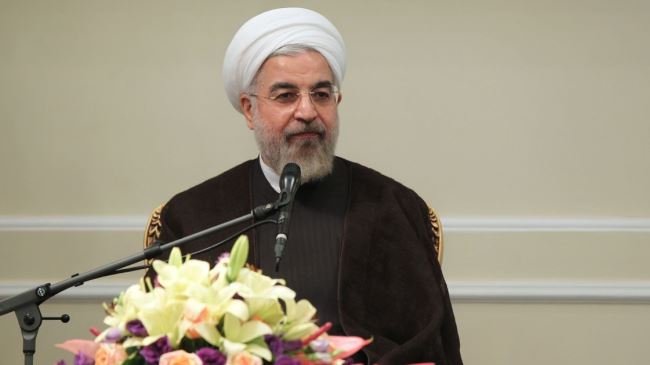
“Sanctions are oppression and infringement upon a nation’s rights and we must stand up to them and keep aggressors on the back foot,” Rouhani said on Saturday.

He added that despite the existence and continuation of sanctions, his administration has managed to carry out its tasks over the past year.

The Iranian president voiced his support for the nuclear negotiating team, stressing that Tehran would not waste time in its negotiations with the P5+1 countries and would put all its efforts and power into the path of nuclear talks.

“This does not mean that we have been scared of sanctions or will be scared. This does not mean that we cannot live with sanctions,” Rouhani stated.

He said efforts should be made to keep anti-Iran sanctions from continuing.

Rouhani’s remarks come a day after the US imposed sanctions on over 25 Iranian individuals and companies, including shipping firms, oil companies, airlines and six banks.

This is while Iran and the five permanent members of the UN Security Council – Russia, China, France, Britain and the US — plus Germany are in talks to reach a final agreement aimed at resolving the standoff over Tehran’s civilian nuclear work.

The two sides signed a historic interim deal in Geneva last November. The agreement entered into force on January 20 and expired six months later. In July, Tehran and the six states agreed to extend their discussions until November 24 in a bid to work out a final accord.

The new US sanctions violate the terms of the Geneva deal.


Iranian carpet-weaver replaces loom with canvas

By Monavar Ramezani
By Monavar Ramezani

Application of varied colors and perfect juxtaposition of them are the standout features of the paintings by Monavar Ramezani, also known as Naneh Hassan. Inspired by Mother Nature and the designs of Persian rugs, these paintings take you by surprise because you don’t expect a self-taught painter to be so good at putting the brush to canvas. A career in weaving carpets that spans almost 70 years should be partly credited for the delicate designs and perfect choice of colors in her works.

According to a 280th issue of Tandis Biweekly which appeared on newsstands in mid-August Ramezani, whose failing eyesight has forced her to quit weaving, put her paintings on display at an exhibitionin Tehran. The photo gallery below features some of her paintings:


Paintings that are a nostalgia trip for many Iranians

Hossein Soltani-paint-peyan-1

Paykan, which means arrow in Persian, was an automobile produced by the Iranian carmaker Iran Khodro Industrial Group. The design of the car, which was very popular in Iran from the late 1960s to the late 90s, was based on the 1967 Hillman Hunter originally manufactured by the British Rootes Group. Less than a decade after the production of Paykan came to a halt the sight of the car, which was once referred to as the “Iranian chariot”, makes many people feel nostalgic.

A 280th issue of Tandis Biweekly out in mid-August featured an interview with a painter Paykan has been a fixture of every painting of his. Hossein Soltani, 36, says he is inspired by the paintings of English painter John Salt. The photo gallery below features some of Soltani’s paintings:


US imposes more sanctions on Iranian individuals, companies

US-Treasury Department

The Treasury Department said on Friday that the sanctions’ targets include shipping firms, oil companies, airlines and six Iranian banks.

The Treasury Department also blatantly accused the Iranian businesses and individuals of ‘supporting terrorism’ and trying to evade previous sanctions.

Despite the additional measures, the White House National Security Council (NSC) on Friday reaffirmed Washington’s commitment to working with the five permanent members of the UN Security Council – the United States, France, Britain, Russia and China – plus Germany in seeking a comprehensive deal with Tehran over its nuclear energy program.

“Just as we announced these measures and continue to enforce pre-existing sanctions on Iran, the United States remains committed to working with our P5+1 partners toward a long-term, comprehensive solution that provides confidence that Iran’s nuclear program is exclusively peaceful,” said Caitlin Hayden, the NSC spokeswoman.

The new sanctions come as Iran and the five permanent members of the UN Security Council plus Germany are in talks to reach a final agreement aimed at resolving the standoff over Tehran’s civilian nuclear work.

The two sides signed a historic interim deal in Geneva last November. The agreement entered into force on January 20 and expired six months later. In July, Tehran and the six states agreed to extend their discussions until November 24 in a bid to work out a final accord.

Iran has previously slammed similar sanctions stating that the measures are contrary to the spirit of ongoing negotiations.

Tehran calls anti-Iran sanctions illegal and wants them to be lifted as part of a final nuclear agreement.