Friday, December 26, 2025
Home Blog Page 5056

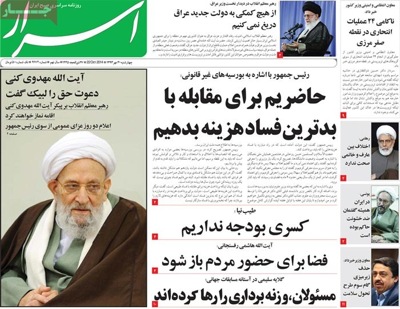
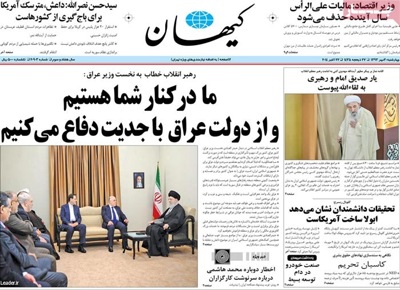
America is a hostile rival: Kayhan newspaper

Hossein Shariatmadari-Kayhan Newspaper

With nuclear talks between Iran and P5+1 in full swing in New York, the following might help you appreciate why the Iranian top negotiator recently said both sides need to make a “hard decision”.

Kayhan newspaper ran an opinion piece by Hossein Shariatmadari on September 22 under the title of “The rival’s new dream”. This brief title indicates a change in the tone used by the daily’s managing editor – his replacement of signature “enemy” with “rival”.

Shariatmadari, a theoretician and analysttrusted by part of the Principlist faction’s policymakers and politicians, politely, yet in critical tone, warns Iran’s nuclear negotiators and officials at the helm of the Islamic Republic’s diplomacy machine not to handle the ongoing New York talks in a fashion similar to last November when they inked the Geneva Interim Agreement – which produced no result – just three months after President Rouhani’s government came to office.

In a word, Kayhan assesses the Geneva deal as “a generous in-cash concession in exchange for on-credit promises”. It reminds the country’s negotiating team of the unreliability of the “rival”, citing an attempt by the US secretary of state at flexing American muscle.

The daily refers to remarks by John Kerry, hours after the conclusion of the Geneva Interim Agreement, who described “the suspension and shutdown of uranium enrichment” as commitment on the part of Iran and quite an achievement [for the West], something which – in Shariatmadari’s words – came across as shocking even to members of Iran’s negotiating team led by Mohammad Javad Zarif.

Kayhan underlines its concern about “making a non-nuclear decision” for which the nuclear challenge could be an excuse, citing an assessment on July 24, 2014 by Jofi Joseph, a former director in the non-proliferation section of the National Security Council at an Atlantic Council meeting.

This is how Shariatmadari explains the reason behind his concern, “… Whispers have been circulating in recent months among US politicians and policymakers, those who are under the illusion that any support for the Iranian government could bring Washington closer to its main objective, which has been defined outside the nuclear challenge.

“They are predicating their assumption on the presence of certain Western-inclined elements in the Iranian government and its close ties with members of the Sedition Camp [the Green Movement which emerged following the 2009 presidential elections in protest at the election results. The Sedition Camp is a metaphorical reference to reformists and the current affiliated to former President Seyyed Mohammad Khatami].

“They believe if the current government leaves the talks empty-handed, the reformist camp suffers a heavy blow in the court of public opinion.”

The columnist wants to warn the “rival” to stop harboring illusions that it can use the nuclear deal to secure non-nuclear goals. In other words, the talks do not provide an opportunity for the Islamic Republic of Iran to fall back under American domination, although, as Kayhan puts it, some members of the Sedition Camp have urged the United States not to miss out on the “golden opportunity that arose with the rise to power of moderates”.

Given the likelihood of misinterpretation of his comments by the readers, Shariatmadari then says, “No doubt, just like members of the Iranian negotiating team, Rouhani is part of the Islamic establishment and knows that in the talks ahead, he’s leading the people many of whom have made sacrifices and fallen martyr in quest of securing glory for their country.”

In the final paragraph, though, the columnist once again uses the term “enemy” instead of “rival” and says, “In the nuclear standoff the enemy is not simply dealing with the esteemed government; rather, it is dealing with a great nation that follows the instructions of its Imam [a reference to the Supreme Leader]. So the latest ploy of securing a nuclear deal for the sake of non-nuclear objectives will fail just like dozens of even more sophisticated ploys in the past.”

On the same day President Rouhani departed for New York, the daily had the following advice for the moderate president and his colleagues:

“At this point, in order to prevent the enemy from getting greedier, the political terminology the esteemed president and the Iranian nuclear negotiating team employ should be more compatible with our firm revolutionary principles. For instance, at a time when the US does not miss out on any opportunity to bring its grudge and hostility to bear against Iran and evade its commitments, our dear brother Dr. Zarif should not have said, ‘If President Obama makes a promise, we’ll trust him,’…”

It should be noted that the column ends in ellipsis dots which seem to suggest that more criticism will come along.

The newspaper opens another column by explaining why it has not aimed more criticism at the performance of the Iranian diplomacy machine. “We thought it would not be expedient to talk about what comes next. We believed and still believe that the Iranian negotiating team and Iranian officials are too smart to let the rival keep its new ploy under wraps.”

In another column by Mohammad Imani on Tuesday the daily’s new opinion piece adopts a more open tone and does nothing to hide the ongoing hostility between Iran and the United States.

He says, “No one can deny the fact that the US has been constantly hostile to the Iranian nation over the past six decades. Besides, no one can doubt the fact that the United States has either attacked or staged coups against 50 countries around the world. So everyone should regard the US as an irreconcilable enemy of nations, one which does not believe in fair deals, and one that cannot be trusted as a partner. Identification of the hegemonic, acquisitive and deal-breaking US administration as a normal government and a diplomatic partner is the first mistake.”

The piece later recalls the readers who are in favor of talks with the US of seven rounds of inconclusive talks between Iran and P5+1 which have seen trust hit the rock-bottom and says, “The Americans think about nothing but Iranian surrender.” It warns that any submission in foreign policy is bound to result in further audacity, acquisitiveness and aggressiveness on the other side.

The piece suggests the fact that Iran’s permanent seat at the UN has remained vacant over the past eight months thanks to American failure to grant a visa to Hamid Abutalebi, who according to a report by Fars News Agency on Sept. 22 seems to hold views similar to Javad Zarif, amounts to insistence on the part of the American administration to insult and humiliate Iran.

Mohammad Imani further says American insistence on continuing to insult and humiliate the Iranians is an attempt to prompt miscalculations among Iranian policymakers and decision-makers so that in dealing with America Iranian diplomats ignore the country’s local potential and speak from a position of weakness rather than strength. The author goes on to suggest that over the past three decades, Iran’s authority both at home and abroad has increased and at the same time the American influence has been on the wane.

The author then reminds the Iranian negotiators that they have a responsibility not to fall prey to the American strategy to downplay the Iranian power.

It says what is important is to maintain enrichment on an industrial scale, not have a collection of useless centrifuges that are good for nothing but display. In conclusion Imani expresses his concern by saying “What is alarming is that the Americans might assume that one year after rising to power and months after striking the Geneva deal, the Iranian government is ready to strike another agreement, just like that.”

“The rival’s new dream” and “what’s happening in New York?” were the original headlines of the editorials in Kayhan.

The New York Times misunderstood US stance on talks

NYTimes
NYTimes

Dismissing news by some Western media about a new US nuclear plan, an official close to Iran’s nuclear negotiating team told Entekhab [Choice] website that The New York Times had a misunderstanding of the US stance on the talks.

He went on to say that over the past few days, there has been a positive, constructive atmosphere prevailing in the talks, although disagreements over some key matters persist and the two sides are trying to winnow them down.

“Unfortunately, some media seek to poison the atmosphere of the talks,” the official added.

Referring to the recent article by The New York Times – U.S. Hopes Face-Saving Plan Offers a Path to a Nuclear Pact with Iran on September 19, 2014 – the official said the newspaper acknowledged that it had quoted some American sources about the centrifuges. However, such claims are false and are not a proper understanding of where America stands on the nuclear talks.

“Interestingly, overwhelmed by such a commotion of media, some Senate lawmakers wrote a letter to President Obama and lashed out at him. In fact, it’s crystal clear that there is no affinity between such reports and what is going on in the negotiations, and therefore they are nothing but media attempts to disturb the atmosphere of the talks,” he pointed out.

It’s worth noting that a few days ago, The New York Times and The Associated Press released a report on a new US plan which requires Iran to disconnect enriching machines from feeds of uranium. The unsubstantiated plan would let Iran have its centrifuges only if many of the pipes that connect the nuclear centrifuges are taken away.

Aftabe, an Iranian app downloaded 1.5 million times and counting

Iranian apps-Aftabe
Iranian apps-Aftabe

Iran-e Javan, an addendum of Iran, on Tuesday September 16 featured an interview with Iranian developers of a game app which has been downloaded more than 1.5 million times in less than six months. The following is the translation of the lead of the interview:


Aftabeh-app-programmers

The name of the app is bizarre [in Farsi Aftabe means ewer which has been widely used in the past and is still used in some places as a water container in toilets]. It strikes everyone as surprising that a group of app developers has named their app Aftabe.

Why have they given the app such a name? What is it good for? These are the questions that spring to your mind when you hear the name. If you are familiar with the guess game, you probably know why the app is named what it’s named.

Mohammad Amin Moradi, 19, who studies Mechanical Engineering at Imam Khomeini University, Seyyed Hamed Valizadeh, who is also 19 and studies Software Engineering at Sharif University of Technology, and Amir Ala Masoumi, who is 20 and is studying Architecture at Tehran University, have jointly developed the app.

They seem to enjoy plunging gamers into deep thought for hours. The game they have developed is simple and complicated at the same time. In this app an image appears on screen and the gamer must guess what word that image refers to in order to advance to the next round.

[During the interview the three young programmers told the interviewer that the Aftabe they had in mind in naming the app was the contracted form of Aftab Ast which means “It’s sunny.” in Farsi and not ewer.]

Nuclear talks have reached a critical point

rafsanjani -chairman of Iran's Expediency Council

Chairman of the Expediency Council Ayatollah Akbar Hashemi Rafsanjani has once again backed Iran’s nuclear team, wishing them success and saying the talks have reached a critical point.

In an interview with Entekhab news website on Tuesday, Rafsanjani said nuclear talks are at a critical stage and this has made the conclusion of a final deal [with P5+1] more likely than before.

The top councilor said at a time when some have pinned much hope on the conclusiveness of the talks and some others are totally pessimistic, one needs to wait and see what will unfold in the coming sessions.

“Iran has proved, both in words and in deeds, that it – like other nations – is after peaceful use of nuclear energy, the knowhow of which has been indigenized in Iran,” he said, adding that Tehran showed its resentment of the employment of weapons of mass destruction during the Iran-Iraq war [in the 1980s].

Rafsanjani went on to say with nuclear talks under way, what is done at home should not force Iranian negotiators to express views which could harm what they have achieved so far.

In conclusion, he expressed hope that the nuclear team could make big gains in the talks.

Iranian Wushu Athlete Wins Bronze Medal in Asian Games

Sajad Abasi Wushu Asia games

Iran’s Sajad Abbasi won a Bronze medal in Wushu competitions in the 2014 Asian Games in Incheon, South Korea, on Tuesday.

Sajad Abbasi stood third in the 70kg category of men’s Sanda.

Earlier Abbasi was knocked out by his Korean opponent in the -70kg category of the Sanda section and lost his chance for a gold medal of the competitions.

[…]

Iranian Women Win Gold, Silver in Incheon Asian Games

Iranian women asia games

Iran’s Najmeh Khedmati and Narjes Andevari Emamgholinejad won the gold and silver medals in 10m Air Rifle competitions in the 2014 Asian Games in Incheon on Monday.

Eighteen-year-old Khedmati scored a total of 207.9 points, while Andevari Emamgholinejad scored 206.6 points.

“I feel very happy. I practiced hard to compete in these games,” Khedmati said.

Andevari, the runner up, said, “I did my last two shots not through my skills, but with much excitement because I felt deeply sensational to find us, two Iranians, in the final.”

China’s Zhang Binbin settled for bronze on 186.3 points.

The 17th Asian Games Incheon are underway in South Korea from September 19 to October 1, 2014. Iran’s squad consists of 282 athletes of which 224 are men and 58 are women.

Iranian children to draw paintings for the disabled

Iranian Children paint for disabled

Iran Paralympics Committee has invited Iranian children to take part in a national drawing contest dubbed “Disability is not Limitation”.

Iran Sports Federation for the Disabled holds the drawing contest “Disability is not Limitation” for children of age 4-12.

The contest is designed to mark Paralympics Week and select works will be awarded on Islamic holiday Eid Ghadeer on October 13.

The paintings should be about the disability and overcoming limitations.

UN must play impartial role in Syria

Iran-Mohammad Javad Zarif

Iran’s Foreign Minister Mohammad Javad Zarif says the United Nations should play an active and impartial role in Syria and help the country reach a national consensus.

In a meeting with new UN Special envoy to Syria Staffan de Mistura in New York on Tuesday, Zarif hailed his proper measures to confer with Syrian officials and groups to arrive at political reconciliation.

He stressed the importance of battling Takfiri ISIL militants and said, “The fight against terrorism, whose priority has always been stressed by the Islamic Republic of Iran, has today turned into a priority for the international community.”

The UN envoy, for his part, said it is important to exchange views with all sides in Syria in order to reach broad-based reconciliation in the Arab state.

De Mistura added that he would pay visits to regional states to hold consultations and reach a better understanding of the countries’ views including Iran about main approaches to broad-based political reconciliation in Syria.

Powers hegemony world’s biggest problem

Rouhani-Iran-UN-Banki moonRouhani-Iran-UN-Banki moon
Rouhani-Iran-UN-Banki moon

Iran’s President Hassan Rouhani says the hegemony imposed by world powers is the biggest problem facing the world.

In a meeting with United Nations Secretary General Ban Ki-moon in New York on Tuesday, Rouhani said, “Today’s world is faced with many problems, namely terrorism, violence, and environmental threats.”

“But the biggest problem is the great powers’ hegemony and injustice in today’s world.”

Criticizing some countries’ double standards, the Iranian president said, “When some countries find terrorists’ actions in their interest, they choose silence vis-à-vis killing of humans, and when they find these actions damaging to themselves, they start to retaliate. However, great powers today cannot hide truths from nations.”

The UN chief said, ”Unfortunately, common people have lost trust in the international community’s capability in fighting terrorism, and we seek more serious presence and strategic and constructive role on the part of Iran in this regard.”

Referring to nuclear talks between the Islamic Republic and the five permanent members of the UN Security Council – Russia, China, France, Britain, and the US – plus Germany (P5+1), Rouhani said it is a great mistake to think Iran has come to the negotiating table under pressure.

“Iran entered negotiations with serious resolve and in order to serve the interests of itself and others. As long as the Iranian nation’s rights are not damaged, we are prepared for agreement,” added the Iranian president.

Ban praised Iran’s fruitful interaction with the International Atomic Energy Agency and its active participation in negotiations with the P5+1.

West must understand Iran is a power

Rouhani-Hollande-UNGA69

Iran’s President Hassan Rouhani says “Iran is an influential power in the region and the West must understand this reality.”

The Iranian chief executive made the remark during a meeting with his French counterpart Francois Hollande at the United Nations headquarters in New York on Tuesday.

Referring to Iran’s talks with the five permanent members of the UN Security Council plus Germany (P5+1), Rouhani said, “With the commencement of the talks, when it became clear that Iran has a serious resolve, the atmosphere, which was created against the Iranian nation in the West, dissipated and a real and trust-building atmosphere was created.”

He said the most important message of the talks was that important global issues can be resolved through negotiations.

“These days’ negotiations between Iran and the P5+1 are highly important for building the future, and we hope that, by taking the rights and concerns of the Iranian nation into consideration, the nuclear issue would be resolved in a balanced way and win-win results come about for both sides.”

For his part, the French president acknowledged Iran’s special role in fighting terrorism in the region, and expressed hope that considerable collaboration between the two countries in other fields would follow a comprehensive nuclear agreement.