Thursday, December 25, 2025
Home Blog Page 5047

Iran’s Foreign Ministry, EU Foreign Policy Council Hold Meeting in Tehran

IPIS
IPIS

Iran’s Institute for Political and International Studies and the EU Foreign Policy Council held a third meeting in Tehran on Monday in the presence of Iranian Foreign Minister Mohammad Javad Zarif.

Along with Zarif, Iran’s former Ambassador to the International Atomic Energy Agency (IAEA) Ali Asghar Soltaniyeh and several members of the EU Foreign Policy Council, including the former Italian foreign minister, were on hand for the meeting.

Addressing the meeting, a member of the EU Foreign Policy Council referred to the issues discussed in the previous round of talks between the two sides and said new developments have since unfolded around the world including the crisis in Ukraine.

The official underlined that Iran’s nuclear talks was one of the most important pivots of discussions between the two sides in the two previous rounds, and expressed hope that the two sides could find good solutions to the problem in the upcoming round of high-profile multifaceted talks.

[…]

Iran, P5+1 need non-stop talks for nuclear deal: Russia

Sergei Ryabkov

“Almost no time is left. To meet a deadline set until November 24, non-stop talks are needed,” Russia’s Deputy Foreign Minister Sergei Ryabkov said on Monday.

He added that Tehran and the P5+1 group of countries would hold a new round of nuclear talks after several contacts by Iran’s Foreign Minister Mohammad Javad Zarif, expressing hope that a “concrete date and intensity of further work” would be determined within the next 10-14 days.

“We are keeping in contact with the EU foreign policy chief’s office, are waiting for specific signals and are stimulating partners to settle the issue as quickly as possible,” Ryabkov added.

He further noted that the Iranian foreign minister is likely to meet with the EU foreign policy chief, Catherine Ashton, saying, “It is still unclear in which way this will be done.”

After the possible meeting between Zarif and Ashton, a full-format round of talks would be held in the presence of all delegations, including experts, but the work would be done in different ways, the Russian official said.

He added that all possibilities have been envisaged, stressing, “We are ready for work in any format.”

Iran and the five permanent members of the UN Security Council – Russia, China, France, Britain and the US – plus Germany held their latest round of talks in New York on September 18-26, to work out a final agreement aimed at ending the longstanding dispute over Tehran’s civilian nuclear energy program before a November 24 deadline.

Last November, Iran and the P5+1 clinched an interim nuclear accord, which took effect on January 20 and expired six months later. However, they agreed to extend their talks until November 24, as they remained divided on a number of key issues.

ISIL flag in Hajj indicates KSA supports terrorism: Iran MP

ISIL-Arafat-Flag
ISIL-Arafat-Flag

“The nature of Saudi Arabia and countries which claim to fight the ISIL is to support terrorism and they have created ISIL themselves,” a member of the Majlis National Security and Foreign Policy Committee Mohammad Saleh Jokar said on Monday.

He added that the raising of the ISIL flag at the Arafat Plain shows that Saudi Arabia legitimizes and supports the ISIL terrorist group, noting that previous evidence also revealed that Riyadh had created Takfiri and extremist groups and provided them with the greatest financial aid.

The legislator emphasized that ISIL Takfiris carry out acts of terror in the name of Islam to deceive public opinion, saying the move serves Western interests.

“Muslim nations should know that all these acts of sedition and crimes are conducted by enemies of Islam,” Jokar added.

The lawmaker’s remarks came after social media posted photos showing the ISIL flag being carried by a pilgrim during the Hajj rites on Jabal ar-Rahmah Mountain on the Arafat Plain on Friday.

The Saudi television aired footage of the pilgrim with the ISIL flag for just a few seconds before it stopped broadcasting the video.

ISIL controls large areas of Syria’s east and north. The group sent its militants into Iraq in June, seizing large parts of land straddling the border between Syria and Iraq.

The West and its regional allies, including Qatar, Saudi Arabia and Turkey, are giving financial and military support to the ISIL militants.

Saudi Arabia and its former intelligence chief, Prince Bandar Bin Sultan, have played a leading role in the establishment and rise of the ISIL terrorist group.


Wildlife in Khorasan Razavi Province in photo-1

Iran-khoraasan-Shir-Ahmad Wildlife Sanctuary
Shir-Ahmad Wildlife Sanctuary - Photographer: Babak Mousavi

Khorasan Razavi Province has one national park, three national natural monuments, three wildlife sanctuaries and 21 protected areas. Those preserves, home to a wide diversity of fauna, give the province a special place in the country’s natural environment.


Michel Setboun, from war to arts

Michel Setboun
Michel Setboun

Michel Setboun is a famous French photojournalist. At age 26 he was overtaken by events and ended up a professional photographer. The time the founder of the Islamic Republic spent in Neauphle-le-chateau, a Paris suburb, in exile seems to have played an important role in his career. Michel Setboun was on board the same Air France flight that brought Imam Khomeini back home after 15 years in exile.

That was the beginning of a journey which eventually saw Setboun become a war photojournalist. That is why in an interview with Jamejam daily on September 10, he said he owes his career to Iran’s Islamic Revolution. Of course he seems to be paying a price for his comment: he says his friends call him an Iranian spy!

Setboun, now 60 years of age, retired from war photojournalism a few years ago and is now involved in artistic photography. In the interview with the Iranian newspaper he blames his age – read a decline in bravery levels – as the reason behind his decision to quit photojournalism. For him, other factors are also involved, among them a growing number of reporters covering conflicts, declining wages and more on-the-spot risks journalists face in today’s battlefields.

As Setboun puts it he has depicted war events from his camera’s point of view in Lebanon, Afghanistan, El Salvador and Guatemala as well as any other conflicts which raged on in the 1980-1989 period.

A recent Iran visit is his fourth trip after the 1979 Islamic Revolution. This time around he is in Iran to serve as a judge in an artistic photo festival and Jamejam daily has seized the opportune moment to put some questions to the lensman who himself captures the right moments.

What you went through were the standout points of the second part of his interview. What comes below is the translation of the first half of the interview:

How many times have you travelled to Iran before your current trip?

This is my fourth time after the revolution, excluding those times I came here when the revolution was in the making. Back then I was repeatedly moving back and forth between Iran and France.

How much has the city changed compared with those days?

From which aspect do you mean? For sure, the city has grown bigger and bigger.

I mean from a cultural perspective.

Outside Iran, the established feeling is that nobody knows what is happening in Iran. For them Iran is a strange country. But Iran is like other countries with similar attractions. My friends find it odd when I tell them I’m going to Iran. They think I’m going to embark on a space voyage.

From what I see here in Iran – the technology people employ together with what the young individuals and photographers do and the showing of those who are involved in artistic work, I conclude that Iran is like any other places in the world. I do not see so much difference.

How much do you try to convey such mindset to your friends?

Anyway, there are many out there who hold negative views [of Iran]. To change this negativity is not an easy task. I explain to them what I see. I tell them Iran has not waged war in this last century, least to say, but the US has launched many wars and meddled in the internal affairs of and relations between many countries. The US is to blame for the uncertainty gripping a couple of nations. […]

I always say that the countries in the Middle East and the Persian Gulf have produced in recent years nothing but [crude] oil, but Iran has produced many things, including art and artists.

It has helped photographers, graphic designers and artists and caricaturists grow. It has produced plenty of cultural items. It is far from fair to focus on a nation and say freedom is challenged there, but the very matter in question, which is freedom, remains out of focus in a county like Saudi Arabia. It is not fair.

Since I started out on my professional career as a photojournalist in Iran I feel a deep sense of debt to your country. So as I travel to Iran I try my best to talk with my friends in other countries over the changes I’ve seen in Iran [over time] to let them know that Iran is not what the outside world thinks it is.

For years you’ve been involved in media work. How much do you think media, especially the Western outlets, have had a role in painting such a negative image of Iran in the minds of people around the world?

Media coverage alone cannot be a key player. Such a negative picture stems from a handful of reasons among them political causes. Iran’s diplomatic ties with its neighbors and with the wider world determine how it is looked at from the outside, but I do not deny the fact that a flurry of negative news stories about Iran has been a factor in determining the negative views people air of Iran internationally.

People see no sense or justifiability in what unfolds. For instance, Iran and France had very close relations before the [1979 Islamic] Revolution but two years after the revolution, suddenly France changed course, lent support to Iraq in the war it waged against Iran, and this strained the amicable relations [between Tehran and Paris].

These events are not quite transparent in the eyes of ordinary people. The reason could be this: France establishes better ties with its friends and its interests determine which nations are its friends, so it backs them. In today’s world, the interests of nations define the ties they hold with each other.

My friends find it surprising that I defend Iran and talk about positive events in Iran. They even call me a spy for Iran. Outside Iran, all government decisions are associated with the public. This could be a reason why people out of Iran adopt a negative attitude toward it.

However the fact is that Iran is not the Satan. The Satan is the very country which has caused so many wars and destruction [across the globe] over the last century.
[…]

IFP has added its own introduction and headline to the interview by Jamejam’s Sajad Roshani. The original interview has been translated by Ms. Javidfar.

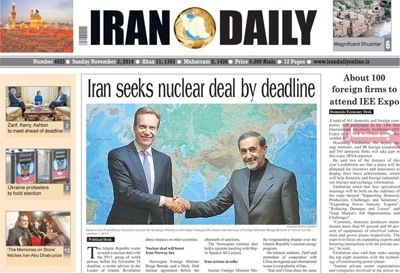
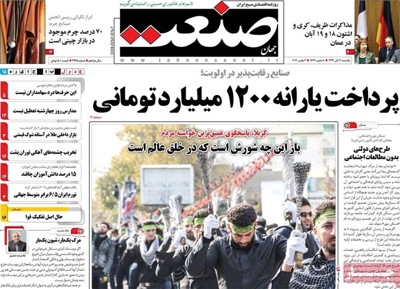
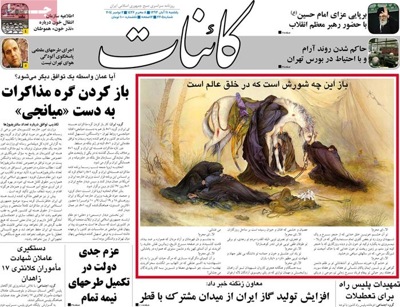
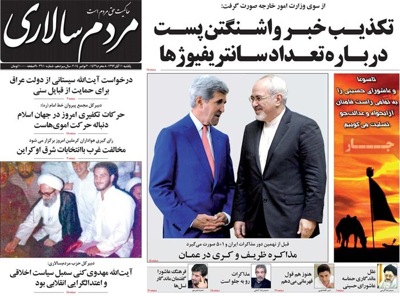
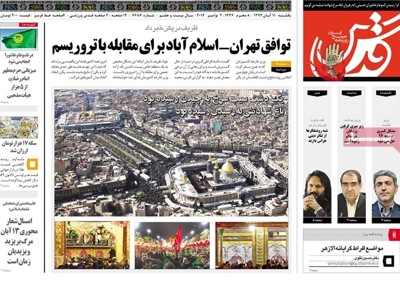
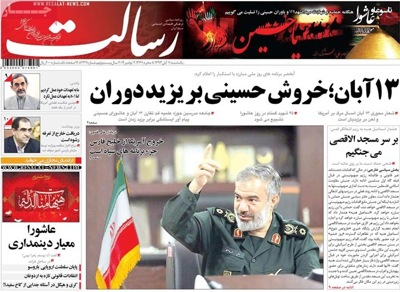
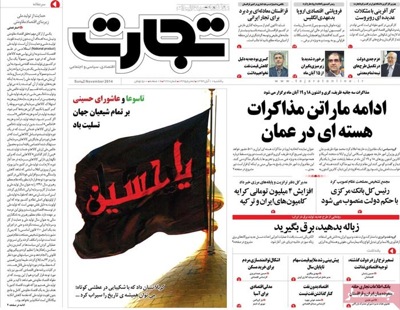
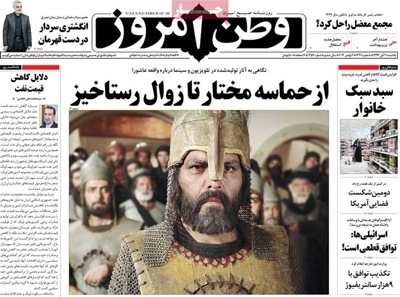
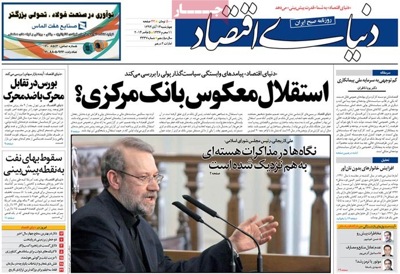
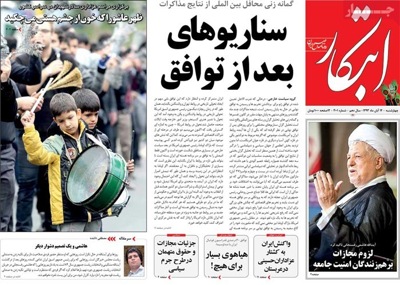
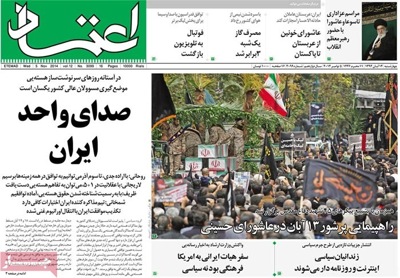
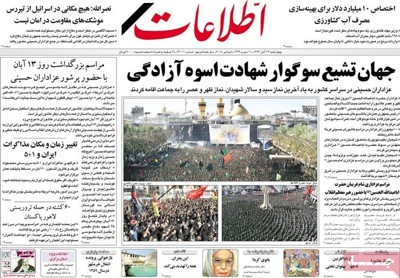
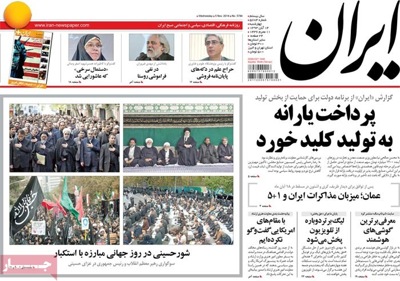
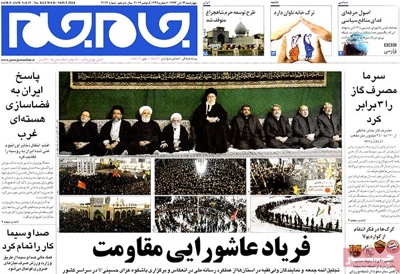
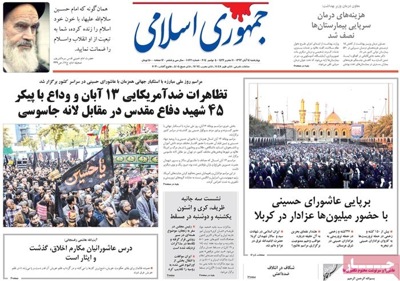
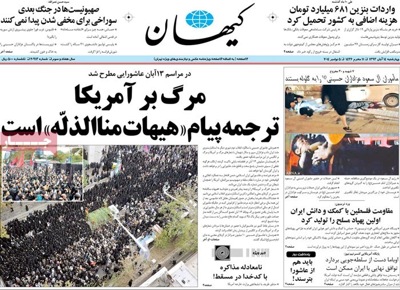
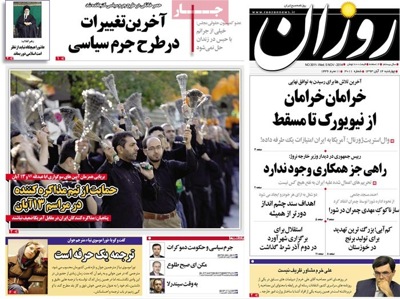
A look at Iranian newspaper front pages on Oct. 6

Iranian Newspapers Headlines

Two top stories were under the Iranian newspaper spotlight on Monday. The response by Vice-President for Supervision and Strategic Affairs Mohammad Bagher Nobakht to those who had questioned government stats about economic growth was splashed across the front pages of dailies. Drawing as much attention was the repeal by the UK of an asset freeze on five Iranian entities and a businessman following an EU court verdict.

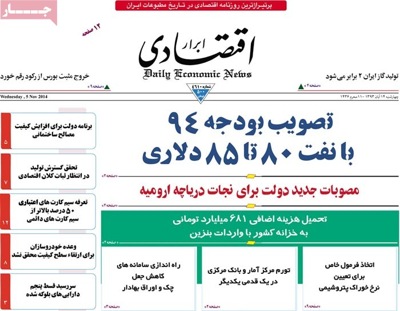
Abrar-e Eghtesadi: “General Electric – a US corporation – is set to do business with Iran.”


Abrare eghtesadi newspaper 10 - 06


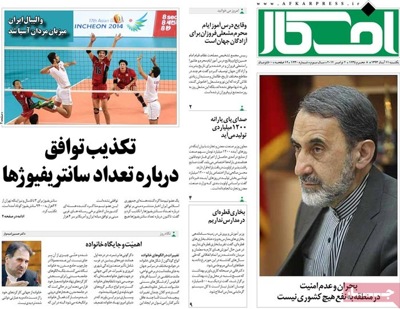
Afkar: “President Rouhani is to visit Tehran University.” His visit on Tuesday October 7 is to mark the opening of the academic year.


Afkar newspaper 10 - 06


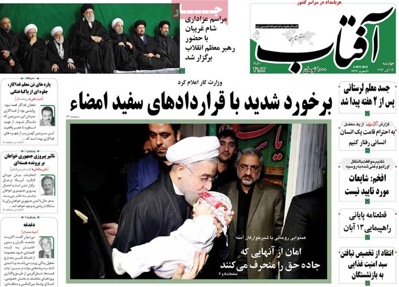
Aftab-e Yazd: Allegations that Foreign Minister Mohammad Javad Zarif does not have the best interests of the Islamic Republic at heart are invented by those who are afraid of a final deal between Iran and P5+1 as nuclear talks approach a crucial stage.


Aftabe yazd newspaper 10 - 06


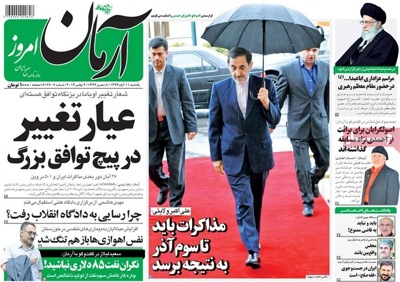
Arman-e Emrooz: “There is a good relationship between Khatami and the Supreme Leader,” said Sadegh Kharazi, an advisor to former President Mohammad Khatami.

Arman-e Emrooz: “Throwing obstacles is the result of apprehension on the part of those who are concerned,” said Mohsen Safaei Farahani, a senior reformist.


Armane emruz newspaper 10 - 06


Asr-e Iranian: “Sharif Satellite [an Iranian-built satellite] is poised for liftoff.”


Asre iranian newspaper 10 - 06


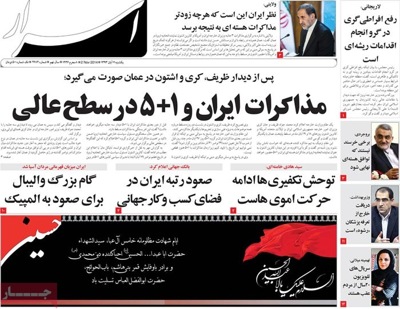
Asrar: “It would take a miracle to unite principlists under the leadership of Ayatollah Mesbah-Yazdi,” a principlist politician said.

Asrar: “A majority of MPs back Iran’s nuclear negotiating team,” said the deputy foreign minister.


Asrar newspaper 10 - 06


Ebtekar: The change in Ahmadinejad’s attitude toward Seyyed Hassan Khomeini may stem from his ambitions to return to power and win over the reformists along the way.

Ebtekar: “‘Navaei, Navaei’ [a hit record by Gholamali Poor-Ataei] died away.”The headline refers to the passing of the Iranian folklore singer and Dotar player on October 4.

Ebtekar: “The Islamic Revolution Stability Front flexes its muscles for the critics.”


Ebtekar newspaper10-06


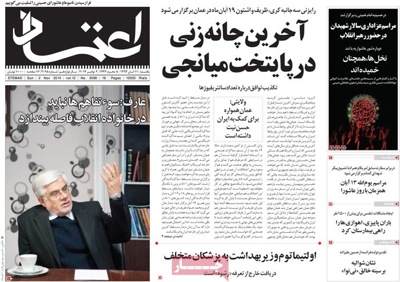
Etemad: “The name of Ahmadinejad has lost its novelty,” said principlist Deputy Speaker Mohammad Reza Bahonar.

Etemad: “We have not held any talks with America about Afghanistan,” said the Iranian ambassador to Afghanistan.


Etemad newspaper 10 - 06


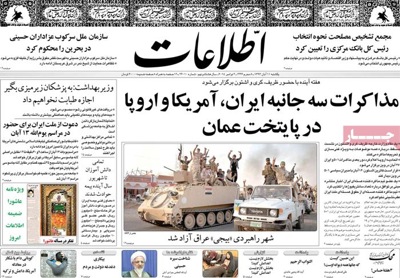
Ettela’at: In a phone conversation with the Emir of Qatar, President Rouhani invited leaders of regional nations to take coordinated action against terrorism.

Ettela’at: “The liquidity growth in Iran has lost steam.”

Etela’at: “The retired who are insured by the Welfare and Social Security Organization are to get free healthcare.”


Etelaat newspaper 10 - 06


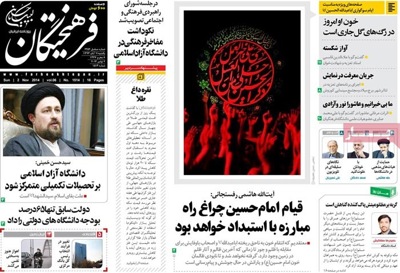
Farhikhtegan: Those whose interests at Islamic Azad University took a hit when its leadership was replaced [under the new government] are calling for sit-in strikes rather than research.


Farhikhtegan newspaper 10 - 06


Hadaf va Eghtesad: “Iran’s air fleet needs 300 new airliners.”


Hadafo eghtesad newspaper 10 - 06


Haft-e Sobh: “The number of medals [secured in the Asian Games in Incheon] suggests that Iranian sportswomen have an edge over their male counterparts.”


Hafte sobh newspaper 10 - 06


Hemayat: “The public should not be worried about Ebola,” said the health minister. His comment came in reaction to worries that the infectious disease may fly its way into Iran on board planes carrying back Hajj pilgrims from Saudi Arabia.

Hemayat: “With supervision tightening, we won’t let the image of the Judiciary be tarnished,” said Judiciary Chief Ayatollah Sadegh Larijani.


Hemayat newspaper 10 - 06


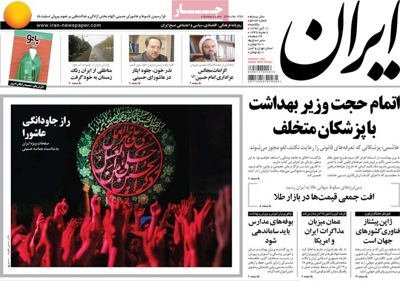
Iran quoted the government spokesperson as saying that $1.7 billion is to be allocated to bolster production.


Iran newspaper 10 - 06


Jamejam: “[Male] gold medalists of Incheon are exempted from military service.”


Jame jam newspaper 10 - 06


Javan: “The countdown is on to a humanitarian crisis in Kobani in spite of US-led coalition attacks against ISIL; 45,000 Kurds are besieged by ISIL and Turkey.”


Javan newspaper 10 - 06


Jomhouri Islami: “A comprehensive deal between Iran and P5+1 is in the offing,” said a number of international observers.


Jomhurie eslami newspaper 10-06


Kaenat: “Divisions are deepening between Obama and Netanyahu over Iran.”


Kaenat newspaper 10 - 06


Kayhan: “The license of polluting industries will be revoked.”


Kayhan newspaper 10 - 06


Shahrvand: “Two provinces are inundated; [the much-anticipated] rainfall came down in buckets.”


Shahrvand newspaper 10 - 06


Sharq: “Iran’s nuclear dossier will come to a good end,” said the speaker of the Irish Upper House of Parliament.


Shargh newspaper 10 - 06


Tafahom: “The wind power plant of Manjil [a city in Gilan Province] becomes the largest wind farm in the Middle East.”

Tafahom: “Mohammad Bagher Nobakht reacts to comments by those who doubt the authenticity of government economic growth statistics.”


Tafahom newspaper10-06

Iran Khodro has accelerated car production in Iraq

Iran Khodro Car Factory

Iran Khodro Industrial Group (IKCO) says it has raised the daily number of cars it manufactures in Iraq to 50 and that the figure will climb to around 100 as it plans to increase the shifts its personnel work at the request of the Iraqi side.

In the 348th issue of its weekly Irankhodro Auto Magazine (on October 4), the leading car manufacturer quoted Ali Elmi, the deputy head of Iran Khodro for exports, as saying that Iran Khodro produces a variety of cars such as Runna, Samand, Soren, Peugeot Pars and Peugeot 405 in Iraq.

He went on to say that a group of IKCO’s well-experienced engineers are based in a factory in Iskandariya, central Iraq, to monitor the production process and quality of the cars.

He also praised the high quality of Iran Khodro’s automobiles and proper distribution of its after-sale outlets in different Iraqi cities for the willingness the Iraqis display to purchase IKCO cars.

Recalling the failure of foreign carmakers, including those of China, in the Iraqi market, he said the fact that Iran and Iraq share borders is a good opportunity for Iranian carmakers to upstage their rivals in the Iraqi market.

A drop in transportation fees and supply of spare parts in the shortest time possible are also among reasons as to why the Iraqis are more inclined to buy cars from Iran, he concluded.

Iran planning to boost economic relations with Caspian Sea nations

Valiollah Afkhami
Head of the Trade Development Organization of Iran

A senior Iranian trade official has underlined the country’s resolve to boost trade ties with all the neighboring countries, especially the Caspian Sea littoral states.

Head of the Trade Development Organization of Iran Valiollah Afkhami Rad said that many countries have thus far expressed willingness for expansion of cooperation with Iran, and the country is determined to seize this good opportunity and boos trade ties with them, especially with neighboring states in the Caspian Sea.

The Caspian Sea’s large fish resources and oil and gas deposits have made it a subject of territorial negotiations among the five states that include Russia, Azerbaijan, Iran, Kazakhstan and Turkmenistan.

The leaders of Russia, Azerbaijan, Iran, Kazakhstan and Turkmenistan met in Astrakhan, Southern Russia, on September 29 for the 4th Caspian Summit which focused on key issues concerning cooperation among countries bordering the Caspian Sea, as well as implementing decisions approved at the previous summit in Baku in 2010.

Multilateral agreements were also signed at the summit.

The Caspian Sea is the largest enclosed body of water by area, and is variously classed as the world’s largest lake or a full-fledged sea.

Iran more progressive than neighbors in aerospace industry

Iranian Vice-President Mohammad Shariatmadari

Iranian Vice-President Mohammad Shariatmadari said he is delighted to see that Iran is playing a pioneering role in aerospace advancements among the neighboring states.

“Currently we are witnessing activities in the region in the field of aerospace, which had no record in the past years,” Shariatmadari said on Saturday.

“Fortunately, we are more progressive in this concern compared to our neighbors in the region and if we use this ability with correct planning and appropriate management, we will be able to use global opportunities in the field of aerospace,” he added.

The VP said that Iran is interested in creating convergence for world peaceful goals and by such approach wants to have constructive cooperation with all regional countries in the field of peaceful aerospace technology.

‘Hush’ scoops main awards at San Francisco Iranian Film Festival

Pouran Derakhshandeh-San Francisco

Iranian filmmaker Pouran Derakhshandeh’s social drama Hush! Girls Don’t Scream has swept several main awards at the Seventh Annual Iranian Film Festival in San Francisco.

The film took Best Film, Best Director, Best Actress and Best Screenplay awards of the year’s event.

The leading Iranian director Derakhshandeh was also paid tribute during a ceremony held at the event.

The film tells the story of abused children and ignorant families who do not make enough time in their day to listen and solve their children’s issue.

Sponsored by Iran’s Farabi Cinematic Foundation, the film won Best Film Award at the 2012 Fajr International Film Festival.

The movie competed at the 2014 edition of Irvine International Film Festival (IIFF) in the United States.

Derakhshandeh’s drama received a great attention from the movie goers in Canada and the United States.

The film also garnered the Best Feature length Award of the fourth edition of London Iranian film festival.

Oscar Academy had earlier requested a copy of screen script of the movie during a letter signed by the center’s Script Librarian Gregory Walsh.

The 2014 San Francisco Iranian Film Festival also honored the Iranian actor Faramarz Qaribian with the Best Actor award for his role in Sinners.

Eleven countries have participated in this year’s festival including Iran, United States, Germany, United Kingdom, Japan, Denmark, Norway, Sweden, Afghanistan, Sudan, and Iraq.

The Seventh Annual Iranian Film Festival in San Francisco was held from September 27 through 28.