Friday, December 26, 2025
Home Blog Page 5039

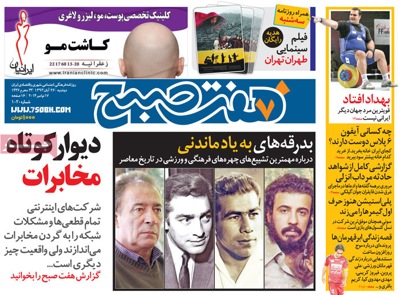
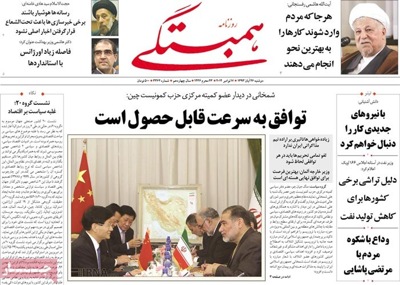
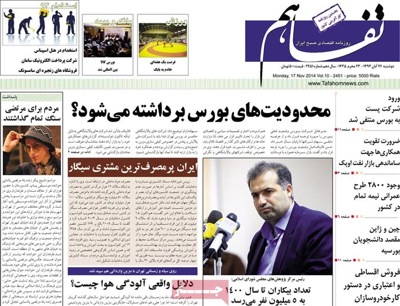
A look at Iranian newspaper front pages on Oct. 16

Iranian Newspapers Headlines

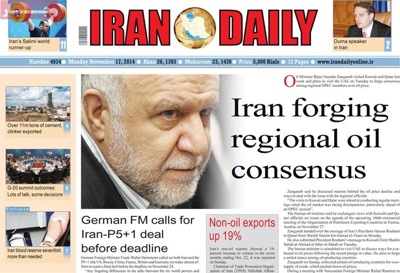
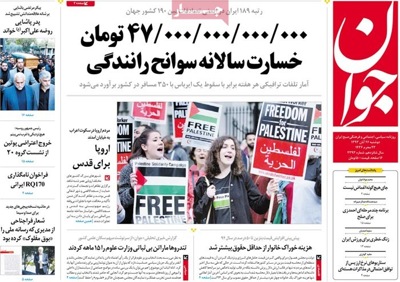
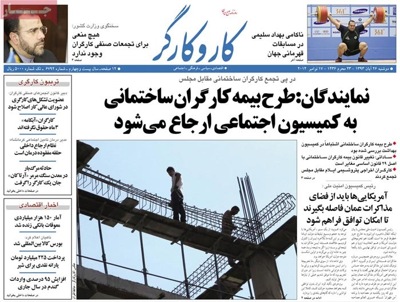
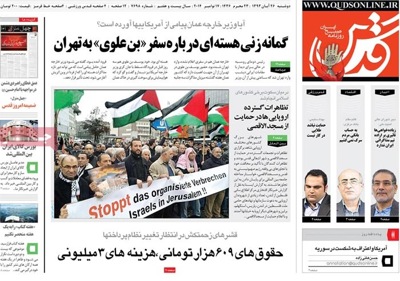
A rise in the amount of housing loans young couples in metropolises can take out dominated the front pages of the Iranian newspapers on Thursday. Hours-long meetings between representatives from Iran and the EU in Vienna were in the news too. Also drawing attention was the death sentence a Saudi court has handed down against a Shiite cleric for what is described as sedition.

Abrar-e Eghtesadi: A top Iranian carmaker seeks partnership with a “non-Asian, non-European” company. That raises the likelihood of a joint venture involving an American company.


Abrare eghtesadi newspaper 10 - 16


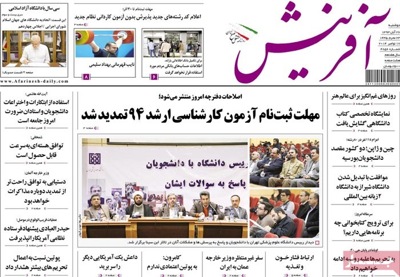
Afarinesh: A court in Saudi Arabia has sentenced [Shiite cleric] Nimr al-Nimr to death.


Afarinesh newspaper 10 - 16


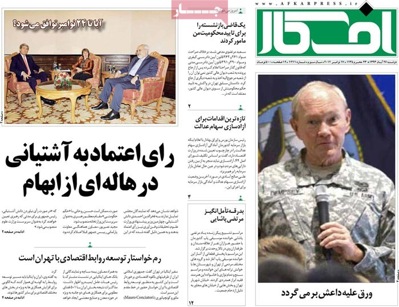
Afkar: “A nuclear deal is in the best interest of everyone,” the Iranian top MP told a news conference on the sidelines of the 131st Assembly of the Inter-Parliamentary Union in Geneva, Switzerland.


Afkar newspaper 10 - 16


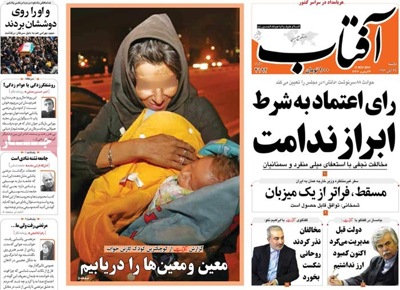
Aftab-e Yazd: A number of MPs have floated a motion that calls for fines and jail terms for individuals who access satellite channels.


Aftabe yazd newspaper 10 - 16


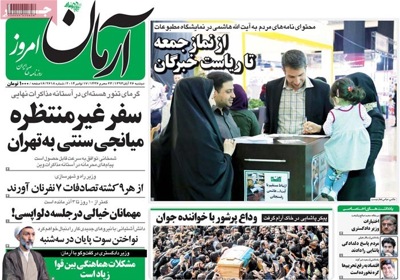
Arman-e Emrooz: Mohammad Hashemi [the brother of the chairman of the Expediency Council] said he decided to quit the Executives of Construction Party because of a lack of cohesion as far as thinking is concerned between him and new members of the party’s administrative committee.


Armane emruz newspaper 10 - 16


Asr-e Eghtesad: “Levying a transaction fee on debit-card readers is inevitable,” the governor of the Central Bank of Iran said.


Asre eghtesad newspaper 10 - 16


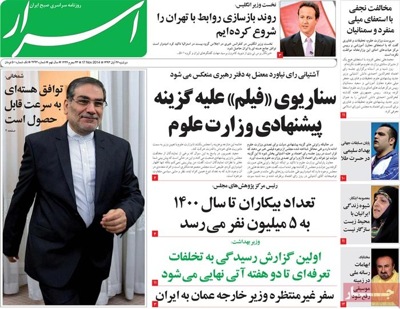
Asrar: “The performance of those who have served in the past should be analyzed without prejudice,” Mohammad Reza Aref, a former vice-president said.

Asrar: “The prospects of relations between Iran and the West are bright,” Ayatollah Akbar Hashemi Rafsanjani tells the Swiss envoy in Tehran.


Asrar newspaper 10 - 16


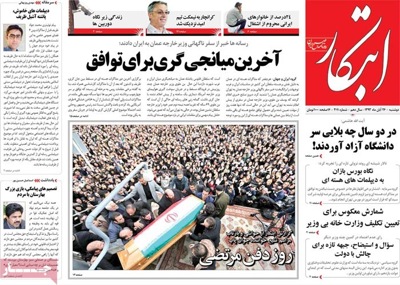
Ebtekar: Iran’s former OPEC envoy has blamed a new coalition between the US and Saudi Arabia to keep crude prices low and deal a blow to Iranian and Russian economies as the reason behind a recent drop in oil prices.

Ebtekar: “The West should not allow the opportunity [to strike a deal with Iran] to slip away,” Chairman of the Expediency Council Ayatollah Akbar Hashemi Rafsanjani told the Swiss ambassador to Tehran.


Ebtekar newspaper 10 - 16


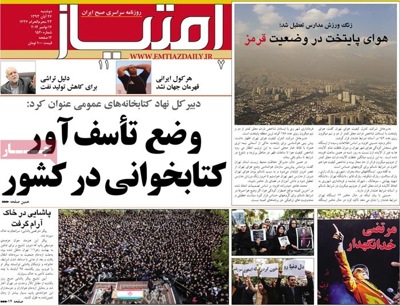
Emtiaz: “The Chinese have agreed to finance five Iranian petrochemistry projects,” the Iranian deputy oil minister said.


Emtiaz newspaper 10 - 16


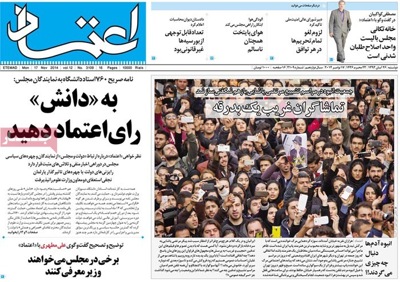
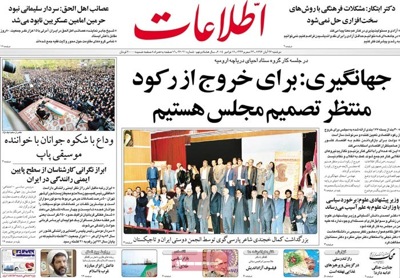
Ettela’at: The Iranian health minister has warned about an alarming rise in cooking oil and sugar consumption.

Ettela’at: “Considerable differences remain, but that does not mean they are not solvable,” Iranian Foreign Minister Mohammad Javad Zarif said after talks with EU’s Catherine Ashton.

Ettela’at: “One cannot eliminate terrorism through occupation,” Iranian Parliament Speaker Ali Larijani tells CNN.


Etelaat newspaper 10 - 16


Farhikhtegan: The president has ordered [science ministry] officials to deal with those who sell dissertations.


Farhikhtegan newspaper 10 - 16


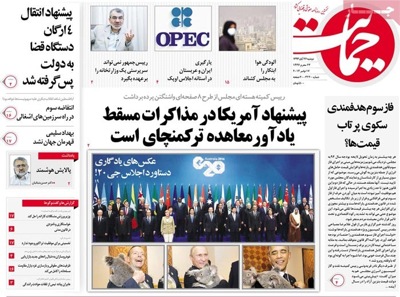
Hemayat: “The fuss over human rights is part of a war of words; the Judiciary will continue to act in accordance with laws,” the Iranian Judiciary chief said.


Hemayat newspaper 10 - 16


Iran: Iran and the West have signaled satisfaction with the trend of talks in Vienna.


Iran newspaper 10 - 16


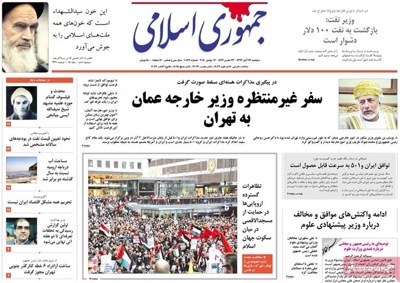
Jomhouri Islami: Although sanctions remain in place, an Italian firm has purchased Iranian crude for the first time in two years.


Jomhorie eslami newspaper 10 - 16


Kaenat: The IS terrorists have enslaved 7,000 Yazidi women and massacred 5,000 men in Sinjar.


Kaaenat newspaper 10 - 16


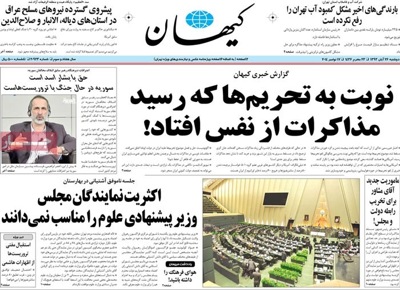
Kayhan: “IS suffered a blow in Kobani after locals put up fierce resistance against terrorists [in the Syrian border town].”


Kayhan newspaper 10 - 16


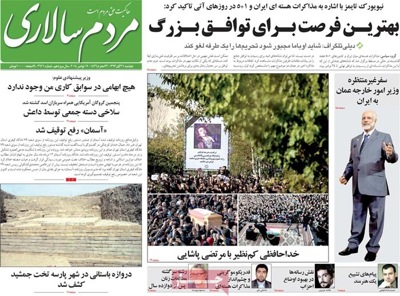
Mardomsalari: The International Court of Justice has rejected a lawsuit by Turkcell, Turkey’s top mobile operator, against Iran.


Mardom salari newspaper 10 - 16


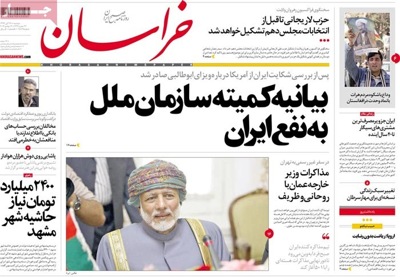
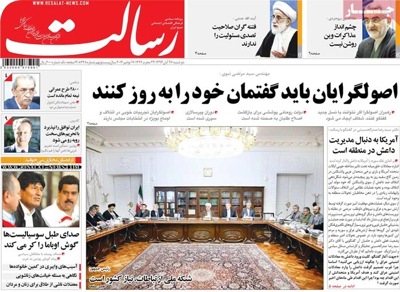
Resalat: “Reconstruction of Gaza and promotion of the defense capabilities of the [Palestinian] resistance are on the agenda,” the secretary of the Supreme National Security Council said.


Resalat newspaper 10 - 16


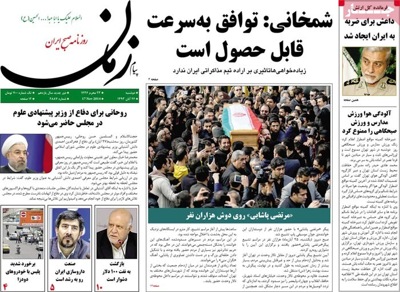
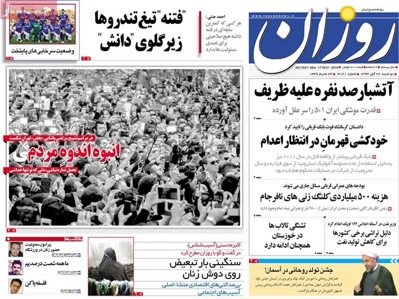
Roozan: Former First Vice-President Mohammad Reza Aref says he wishes to become the chancellor of the University of Tehran.


Ruzan newspaper 10 - 16


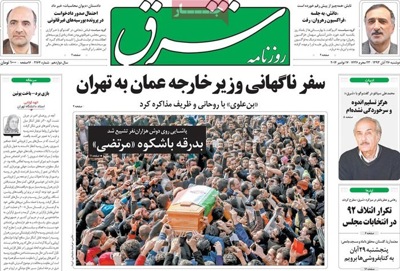
Sharq: An Iranian female fencer has bagged a silver medal in the Asian under-23 Fencing Championships in the Philippines.


Shargh newspaper 10 - 16


Iran deal benefits all, boosts regional stability

Iran-Larijani-nuclear

Iran’s Parliament Speaker Ali Larijani says a final agreement over the Islamic Republic’s nuclear energy program will benefit all sides and boost regional stability.

Larijani made the remarks at a presser held on the sidelines of the Inter-Parliamentary Union’s General Assembly in the Swiss city of Geneva on Wednesday.

“I think a nuclear deal will benefit everyone and this agreement will bring about the capacity to resolve some problems hampering regional stability,” said the Iranian parliament speaker.

He added that the talks between Iran and the Sextet of world powers were moving ahead towards a comprehensive deal.

Iran and the six powers – Russia, China, France, Britain, the US, and Germany – are in talks to work out a final agreement aimed at ending the longstanding dispute over Tehran’s nuclear energy program.

Iranian President Hassan Rouhani said on Monday that the two sides would “certainly” reach a deal on the issue.

Larijani further commented on the US-led coalition against the ISIL militants, saying the coalition would not bear any results unless its members stop sponsoring the terrorists.

On Monday, Iraqi Prime Minister Haider al-Abadi slammed supporters of the Takfiris, referring to Saudi Arabia, Turkey, and some Persian Gulf Arab states.

The terrorists, who currently control parts of Syria and Iraq, have committed widespread acts of violence, including mass executions, abductions, torture and forcing women into slavery in the areas they have seized in the two countries.

Israel’s proposal to arm Iran with atomic weapons

Israel
Israel

“Thirty Years of Silent Endeavors” an addendum of Hamshahri newspaper was published on October 12 to mark the 30th anniversary of the establishment of Iran’s Intelligence Ministry.

What comes below is the exact translation of a document which appeared in the online edition of the addendum focusing on the depth of Iran-Israel ties in the 1970s:

The Israeli government has defended efforts to equip Iran with nuclear weapons, says one of the documents held by SAVAK [the Organization of Intelligence and National Security, Iran’s secret police prior to the 1979 Islamic Revolution]. According to this document which dates back to the time when Prime Minister Yitzhak Rabin was in office (1974-77), Uri Lubrani, the then Israeli ambassador to Iran, had called for atomic cooperation between his respective government and Iran, and for arming Iran with atomic weapons.

The following is the report SAVAK complied:

“This is to respectfully notify Your Majesty that following talks with Israeli Prime Minister Mr. Yitzhak Rabin, his letter on the Egyptian president’s offer for holding separate talks with Israel was submitted to Your Majesty. And your Royal orders were as follows:

“As it is said earlier, Egypt has agreed to enter talks through the US or the United Nations on the restitution of part of the Sinai [Peninsula] without taking into account the viewpoints of Syria and those of other Arab states. The Shah has underlined again that we need to seize this opportunity not to let the Soviet Union get reengaged in Egypt.”

Head of the Israeli mission in Iran, Mr. Lubrani, was said (in a meeting with the representative of Israel’s intelligence service in attendance) to communicate [Shah’s] order to his boss, the Israeli premier. These are what Mr. Lubrani said in response. (Mr. Lubrani said his words come after his private talks with the Israeli premier):

1. The Israeli government is ready to enter talks with Egypt under any circumstances.

2. Any formula which is put forward to settle the Palestinian question would, if materialized, put an end to the reign of King Hussein [of Jordan]. In principle, the creation of a Palestinian state would be politically and economically unachievable without violating the Jordanian sovereignty.

3. Currently, King Hussein and his supporters make up a small minority in Jordan. It is unclear what would become of him if the Palestinian state is formed.

4. All measures King Hussein is to take will be coordinated beforehand through his constant contact with us.

5. Since we have come to realize that Iran’s Shah will never overlook the interests of King Hussein, I should say that Iran’s support for the formation of the Palestinian state would translate into the removal of King Hussein from power.

6. As you know, the majority of the Palestinian people are now living in Israel’s territories, so they are under our control. Israel hosts more Palestinians than any other Arab country.

7. What Israel has done in the West Bank of the Jordan River is to help Hussein’s kingdom survive. Israel is very much interested in seeing King Hussein’s regime continue to reign.

8. In my view, cooperation between Iran and Israel on the economic front could help fulfill what should be done in agricultural, petrochemical, financial and arms-related areas.

9. Israel’s economic delegation could visit Iran after a date is fixed for their trip and after the Iranian team is named by General [Nematollah] Nassiri [the director of SAVAK] (who’s been tasked with the job through a Royal order).

10. I suggest a coordinator who is in charge of the administrative affairs and appointed by SAVAK be included in the board of directors of the two countries’ mutual economic cooperation [committee] so that he could coordinate with SAVAK which has been charged with the implementation of this plan.

11. Areas of cooperation between the two countries should be precisely determined by their economic delegations.

12. If we’ve provided you with a detailed description of a certain plane which is manufactured in Israel, it doesn’t mean we are going to sell it to Iran. It means if you want this plane to meet your needs, we can cooperate with you to produce it.

13. We are well aware that you cannot buy planes, missiles and tanks from Israel on political grounds, but we will give you what you need through our advanced technology if you seek to produce these weapons inside Iran. At the moment, there are some Jews living in Israel who have come to Israel with a background in NASA and have been employed by the government.

14. We are at the ready to have atomic cooperation with Iran on all fronts. A while ago, the Iranian prime minister summoned me (Mr. Lubrani), calling for atomic cooperation [with Israel]. After I got my respective government’s approval, I met Dr. Etemad who had been appointed by the Iranian prime minister and promised to do what I could to help, but nothing else came about. You are exclusively dependent on Western countries for building nuclear power plants and supplying uranium fuel for them. We have practical experiences in this regard and can share them with you.

15. The students Iran sends to Europe and the US to study nuclear physics return to the country as ultra-leftist elements after they finish their studies. However, if Iran sends its students to Israel, we promise to take extra care not to let these students be exposed to political deviations.

16. We can produce atomic weapons for you if Iran wants us to. To separate uranium 235 from 238 to be used for making atomic weapons is a very easy task in Israel, after all, when the separation is complete developing atomic weapons is not very difficult. (1)

At the end, I would like to respectfully state that based on incoming reports from Iran-based coordinator of the Israeli intelligence service, General Zvi Zamir, the former Mossad chief has been named by the Israeli prime minister to take charge of economic and military cooperation with Iran.

His majesty reviewed the items and stated, “I just talked about the question of Egypt. The separation in matter should be done ahead of a trip by Brozhenit to Cairo.


The Organization of Intelligence and National Security (2)

Cited in Israel’s Periphery Strategy

By Mohammad Taghi Taghipour, Political Studies and Research Institute


Footnotes:

1. As Western sources have put it, it was back in spring 1977 when Shimon Peres, the then Israeli defense minister, inked the so-called Project Flower, an agreement on Iran’s cooperation with Israel’s atomic ballistic missile program. As payment, Iran was to give Israel $1 billion in crude oil and make an airport and launching pad available for Israel’s long-range missile test and a place for assembling the missile. The Shah of Iran hoped Iran could use Israel’s experience in the development of weapons in return for what was given to Israel. When Iran’s revolution brought Project Flower to a halt and the other elements which had made [Yaghub] Nimroudi a millionaire, he complained that he had lost $6 million: Cockborn, p.171

2. SAVAK document, numberless and dateless. The document dates back to the period when Yitzhak Rabin was the Israeli prime minister (July1974-July 1977).

Straw describes Iran as a key regional power

Jack-Straw
Jack-Straw

Former British Foreign Secretary Jack Straw said on Thursday that the role of Iran as a key regional power should be recognized.
Straw made the remarks in the 1st Europe-Iran Forum currently underway in London.
He said Iran should be recognized as a good potential partner.
He also said that all should admit the fact that Iran is a major part of a large number of UK strategic interests.
The UK has hurt itself by following the policy of discouraging trade with Iran, Straw added, hoping that Iran and the G5+1 could reach an agreement before the deadline ends.
Straw further underscored that Iran’s role is growing in the Middle East.
Iran and the West enjoy strategic interests in many areas including the increased terrorist threat of ISIL to the security of the region and the international community, he added.
With the prospect of improved political relations and a new business climate between Europe and Iran, the 1st Europe-Iran Forum kicked off in London on Wednesday morning.
The two-day event, organized by European Voice aims to “properly prepare and evaluate the post-sanctions trade framework and investment opportunities”, according to a brochure released by the organizers.
Following the historic Joint-Action Plan agreement between Iran and the P5+1 in November 2013, a series of economic sanctions were lifted, rekindling commercial interest in Iran throughout Europe.
On July 18th in Vienna, Iran and P5+1 (United States, United Kingdom, France, Russia, China and Germany) announced the continuation of their negotiations regarding the Islamic Republic’s nuclear program, through to November 24th 2014.

Iran urges KSA to reverse cleric’s death ruling

Hossein Amir-Abdollahian

“Relevant Saudi [judicial] officials are expected to adopt a realistic approach and prevent the execution of the [death] sentence and keep tensions in the Muslim world from escalating,” said Iranian Deputy Foreign Minister for Arab and African Affairs Hossein Amir-Abdollahian.

He said the death ruling could raise Muslims’ sentiments and trigger international outcry.

“If the news [that the cleric has been sentenced to death] is true, that will undoubtedly hurt Muslims’ feelings and provoke international reaction,” the top diplomat noted.

He underlined that such moves will, by no means, help restore peace and tranquility to the restive Middle East region.

The senior Saudi Shia cleric is accused of delivering anti-government speeches and defending political prisoners.

Nimr was attacked and arrested in the Qatif region in July 2012. His arrest sparked widespread protests in Saudi Arabia, leaving several people dead.

There have been numerous demonstrations in the kingdom’s oil-rich Eastern Province since 2011, with the protestors calling for political reform and an end to what they call widespread discrimination. Several people have been killed and many others injured or arrested during the demonstrations.

The Persian Gulf monarchy has come under fire from international human rights organizations, which have criticized it for failing to address the rights situation in the kingdom. Critics say the country shows zero-tolerance toward dissent.

The last moderate standing

Rouani and Zarif
Rouani and Zarif

Comments of President Rouhani aimed at America in New York are reminiscent of remarks by Mehdi Bazargan – the head of Iran’s Freedom Movement fighting the monarchical dictatorship –addressing the judge and Mohammad Reza Shah Pahlavi in court. “We are the last group who speak with you in a language prescribed by law, after us a generation comes who will take up arms to communicate with the government […].”

The weekly journal of “Seda [Voice]” in its 7th issue ran a piece by its editor Mohammad Ghoochani [a journalist who represents technocrats and is a member of the Central Committee of the Executives of Construction Party] titled, “The last moderate standing”. What comes next is the translation of the report which was filed before the latest round of talks between Iran and world powers in Vienna. In light of the fact that the piece retains its relevance, we publish its translation in its entirety:

As a matter of fact, today Hassan Rouhani in the capacity of Iran’s president is a symbol of moderate politicians in the Middle East; the ones whose voice has been drowned out by the ballyhoo of extremist militants. In a region where governance is inherited and governments are changed by coups, in the eyes of dictators and the general public, an elected president is nothing but the head of a caretaker government for a maximum of four years in office. Such a mindset defies the logic of democracy, but we cannot alter the fact that in the Middle East, a safe haven for extremists, there is no room for the world of moderation.

However, President Rouhani is not hopeless. As he did not give up hope in in domestic policy and rose to power when criticisms from left- and right-wing radicals were at its peak, there is hope that he could open up a new horizon for foreign policy.

America is going through an era which is fraught with miscalculations. Obama has failed to make a strategic transition from what he inherited from President Bush. Bush planned to rule the world by establishing an empire whose center was America and other governments and nations were meant to be its states. The 2003 invasion of Iraq and the appointment of a governor for it were a reflection of such a strategy.

However, such a poor strategy could not last long and finally led to new discourse floated by Zbigniew Brzezinski. The US thinker had a new definition of America’s role in the world. Instead of leading an empire, he believes America should take on the role of world leadership and apparently the nomination of Barack Obama was an indication of such a change in strategy in the US. Yet, Obama has failed to come through so far.

Obama’s failure began when he started addressing the world of Islam. In Egypt, America lost its autocratic and modernist ally – the regime of Hosni Mubarak. It can be said that Mubarak’s downfall came with the US green light and in line with its change of tack, but finally thanks to negligence and confusion on the part of America, no alternative was found for Mubarak.

In a showdown between the Muslim Brotherhood and the military as the only entities with political clout in Egypt, it was the legacy of Mubarak which prevailed and made a comeback. However, the difference was that his successor – Abdel Fattah al-Sisi – is more religious than Mubarak and his wife wears Islamic head cover; he is also skeptical about the Americans and has a tendency toward Russia.

US performance in Iraq is not impressive either. The Iraq we know today is not directly ruled as a colony, nor is it a genuinely independent country. A fragile government and a [war] weary nation is a precise definition of the state of affairs in Iraq which has set the stage for violence, acts of terror and extremism.

Another US strategic misstep was taken in Syria when America undermined the secular yet independent Syrian government and consequently turned the Assad government from a despotic government to a wobbly regime with no prospect of making a transition to democracy. Rather, the stage has been set for far worse dictatorship: an amalgamation of tyranny and reaction.

A similar process has taken place in Afghanistan. The Afghan government is so fragile that to reach an agreement over presidency, it had to invent a new political position by the name of chief executive, a concession that it had to make to be able to rule the country.

A transition to democracy – if that is America’s plan to counter terrorism – cannot take place through shaky governments. A transition from autocracy requires mighty governments which are independent not despotic. The Americans claim that in the post-Cold War era, they are no longer advocates of autocratic governments with Western leanings. Rather, they support emerging democracies, citing the fact that a democracy won’t fight another democracy, nor will it pose a threat to the security of America – the world’s largest democracy.

If America is honest about its claim, it should be reminded that nowhere in the world a country has turned democratic through democratization. As President Rouhani told the UN General Assembly in New York, democracy cannot be delivered in a backpack!

Democracy has subjective and objective fundamentals from which growth and development is the first palpable rudiment. In a region where the old colonialism has bled it dry and there is no sign of growth and development, nor is there a middle class, how can one raise the concept of democracy?

Of course, President Rouhani like other moderate elites in the region such as Bazargan is not neglectful of domestic impediments to development in the world of Islam and does not pin all the blame on colonialism for the backwardness of the Middle East. In fact, he is mindful of the threat of tyranny at home, yet perhaps it is true to say that never before in history have these two political chasms overlap.

Today, in reaction to the regional developments the West can repeat two approaches which have roots in two different historical experiences: The first one goes back to World War I after which Germany and its allies which were defeated in the war were humiliated and squeezed for damages to the point that the German economy landed on the brink and the German people were driven in a direction from which Fascism surfaced.

The second experience was World War II after which efforts were made to involve and integrate the defeated nations to prop up their economies through the Marshall Plan. The US initiative was intended to transform Germany, Italy and Japan from enemies of the West – in fact America and Britain – to US and British allies to stem the tide of extremism in Europe.

We do not expect the West to behave on an ethical basis; rather we want it to adopt a logical reaction. Logic suggests that the West support growth and development in the Middle East to serve its own national security interests, because violence stems from poverty, humiliation and ignorance.

If ISIL is not the direct product of the West, it’s certainly the indirect result of Western actions, a product of colonialism, stupidification and dictatorship that the West supported and now its fruit has come back to haunt it in movements which are in quest of their identity and fundamentals like ISIL, the Taliban and al-Qaeda.

Yet, today American leaders are following in the footsteps of their predecessors, remaking their historical mistakes. They have adopted the most superficial stance on the fight against ISIL, unmindful of the fact that the terrorist group is not a minor injury to simply require outpatient procedure. Far from that, in fact it’s a historic infectious abscess which can be cured by a transformation in history and the treatment should be provided no later than today through support for moderation in the Middle East. The striking example of moderation in Iraq is Ayatollah Ali al-Sistani – Iraq’s top Shiite cleric. If it wasn’t for him, the whole Iraqi territory would be under the control of ISIL today.

As a matter of fact, moderates are not puppets of the West. In terms of opinions and views, they are independent and never trade the independence and freedom of their countries for anything. As for many theoretical and intellectual matters, they might have their own boundaries with the West, yet they can reach a practical agreement with it over peace and development and that seems to be enough for the West.

The comment of Barack Obama should be thrown back at him [“This can only help if Iran takes this historic opportunity…”]: Iran’s nuclear dossier and the package offered by President Rouhani is a historic opportunity for America, a means to verify Western determination to hammer out a solution to the historic crisis of extremism and reach an agreement with the Islamic moderation manifested by Ayatollah Sistani and President Rouhani.

Mohammad Reza Shah did not take Mr. Bazargan’s warning seriously and eliminated moderates from the political battleground. As a result, he helped extremists get an edge in confrontation with the Pahlavi regime and as Bazargan put it the king turned into the [second] leader of the revolution [whose opposition and crackdown helped the revolution gather momentum]. However, Barack Obama still has a chance to listen to the remarks of President Rouhani and prove that he is different from Bush; he should show that the fight against ISIL should not be confined to air strikes; rather he should go underground to uproot the scourge of ignorance, poverty and humiliation which have replaced moderates with extremists.

If the voice of Rouhani goes unheard, those who replace him might not ride in the vehicle of words, rather they might drive armored vehicles. Rouhani is going to be the last president who speaks with America in a language consistent with international law. You never know, the voice that replaces his might be that of a colonel not a jurist! Maybe…

Human rights political tool in West hands: Iran VP

iran-vietnam
iran-vietnam

The Iranian official made the remarks in a meeting with Vietnamese Deputy Prime Minister Nguyen Xuan Phuc in Tehran on Tuesday.

Jahangiri also called on independent countries to confront the West’s double standards towards the issue of human rights.

He expressed misgivings over the emergence of violent militant groups in the Middle East, which pose challenges to regional nations, and voiced hope that the international community would take action to settle the issue.

Jahangiri also called for further development of all-out ties between Tehran and Hanoi and said Iran considers no restrictions to the expansion of ties with Vietnam.

The Vietnamese official, for his part, said his country attaches great significance to ties with Iran and seeks constructive relations with the Islamic Republic.

As the rotating president of the Board of Governors of the International Atomic Energy Agency (IAEA), Vietnam supports the ongoing talks between Iran and the P5+1 group over Tehran’s nuclear energy program, he added.

He also backed Iran’s access to peaceful nuclear technology.

Iran and the P5+1 kicked off a new round of nuclear talks in the Austrian city of Vienna on Tuesday.

The two sides have agreed to extend the talks for the third day on Thursday.

This round of talks is the eighth this year between Iran and the six countries of Russia, China, France, Britain, the US and Germany.

Trilateral meeting on Iran nuclear program starts in Vienna

Zarif-Ashton-Kerry
Zarif-Ashton-Kerry

Nothing has yet come out on the agenda of the Wednesday meeting, but the participants are expected to discuss obstacles in the way of a final agreement aimed at ending the longstanding dispute over Iran’s civilian nuclear work.

Zarif, who heads the Iranian negotiating team in nuclear talks with the five permanent members of the UN Security Council – the United States, Britain, France, Russia and China – plus Germany, arrived in Vienna on Tuesday.

He met with Ashton, who represents the six world powers in the talks over Iran’s nuclear energy program, on Tuesday, to discuss preliminaries for continuing the nuclear talks.

Also on Tuesday, Zarif’s deputies held meetings with their US and European counterparts for technical talks.

Iran will meet the representatives of the six world powers in Vienna on Thursday to discuss outstanding issues related to Tehran’s nuclear program.

Zarif has said that the Thursday talks will be attended by “political directors” from the P5+1 group as part of efforts to find “common ground.”

According to the top Iranian diplomat, talks with all members of the P5+1 group are scheduled upon a request by Iran.

“It was the Islamic Republic of Iran’s request that in addition to talks with Ms. Ashton and the US, we have negotiations with all members of the P5+1 group. Therefore, the talks have extended to Thursday, which indicates political will on all sides [to the talks],” he added.

Iran and its negotiating partners have a deadline of November 24 to clinch a final accord and end the dispute over Tehran’s nuclear energy activities.

One forum; two views

Sheikh Nimr al-Nimr
Sheikh Nimr al-Nimr

Alef has posted on its website a news report from Tasnim News Agency on a death sentence issued for Sheikh Nimr al-Nimr, a top Saudi Shiite cleric who has been so far detained and imprisoned three times by Saudi security forces. The following is the translation of the report and of two comments Iranian viewers posted:

“ … The Saudi prosecutor general called, on March 25, for the implementation of the Moharebeh [waging war against God] sentence for Ayatollah Sheikh Nimr al-Nimr on unfounded charges such as fanning the flames of religious sedition, meeting with people who are wanted by the government, inciting people to kill [fellow] citizens and security forces, and destroying mosques, during his sermons at Friday prayers.”

Sheikh Nimr al-Nimr was first arrested in 2006 when he was returning from Bahrain for attending an International Koran competition. The second arrest came on August 23, 2008, when he was in Al-Qatif [in Eastern Province, Saudi Arabia] for instigating Saudi Shiites to ask for the secession of the Shiite-majority governorate from the federal government. The top Shiite cleric was apprehended and placed behind bars for a third time in July 2012 after he was attacked by Saudi security forces. He received a leg injury during the attack.

The Saudi prosecutor called in the first hearing for capital punishment in the case of the Shiite cleric.

What motivated IFP to release this report were online comments by two Alef visitors in reaction to the story:

Hamid: We don’t meddle in the internal affairs of other countries. Saudi Arabia carries out only about 60 executions per year and this is not a high number.

Unnamed: Hamid, [Now that you so avidly support Saudi Arabia] why don’t you ask if the Saudi embassy is hiring?          

However, it should be noted that most viewers who posted a comment have expressed dismay and objection to the death sentence handed down in the case.

You may share this idea that the release of such comments could help the audience develop a better understanding of the atmosphere of Iranian society, its media and more importantly how Iranians think about world affairs.

Imam Ali can serve as a model to unite Shias and Sunnis

Mohammad Khatami
Mohammad Khatami

Former President Mohammad Khatami is of the opinion that in terms of analysis and philosophy, regardless of Shiism or Sunnism, Ali [the cousin and son-in-law of the Prophet Muhammad who was in charge of the Islamic Caliphate from 656 to 661 AD] is a criterion and his stance is clear guidance to everyone. Khatami’s comments came in a meeting with members of the public to mark Eid al-Ghadeer [which marks the day the Muslim Prophet named Imam Ali as his successor]. What appears next is the translation of part of his remarks reported by the Iranian Labor News Agency (ILNA) on its website on October 14:

Among other things, exercising justice and equality before law for everyone, complying with the standards of social and more importantly political morality, being open to criticism, instilling courage in the public to call officials to account, being tolerant of one’s opponents, keeping a lid on conflicts and violence, stressing consultation and representing the deprived without trampling on the rights of the rich were some of the criteria Imam Ali paid scrupulous attention to. Taking such points into consideration could serve as a good example for Islamic countries as far as stability and unity are concerned.

In his meeting with members of the public to mark Eid al-Ghadeer, Khatami underlined the greatness and magnificence of the auspicious occasion and said that Imam Ali is a role model, a source of inspiration and a mentor. “Saints are given as much right to divine leadership as they have secured human perfection. For instance, Prophet Muhammad was educated by God, and likewise the Prophet taught Ali lessons in life. In other words, Ali was indirectly trained by God.”

“Regardless of Shiism and Islam, in terms of analysis and philosophy, Ali is a criterion and his stance is clear guidance in everyone’s life. Ali stood out from the crowd of the Prophet’s companions and other great characters of the time and at last was at the helm of the government for a few years. So following in his footsteps in this momentous situation is the right thing to do.”

The director of BARAN Foundation laid emphasis on the fact that Islam emerged to introduce success in society as a paradigm for everyone and added, “Islam emerged to encourage the idea that humans should not serve anyone but God and that commitment to Him is sheer freedom. Islam surfaced to suggest that the foundation of social relations should rest on promotion of justice, morality and virtue. It came to demonstrate that human beings have dignity and wisdom.”

As for the era after the demise of the Prophet Muhammad, he said, “Over this period, the core principles of Islam were not practiced and the ignorance that many Arabs displayed [before the advent of Islam] made a comeback. Among other things, the accumulated wealth, especially from Muslim conquests, bad behaviors, and infatuation with worldly matters caused a deepening chasm between people and the ruling system. Deeply dissatisfied with the performance of the government, people turned to Ali.”

Khatami added: “At first Imam Ali turned down the public demand and advised them to pick someone else. He said, ‘We are heading for a colorful future when peace of mind will be elusive, dark clouds will blacken the sky of humanity and the right path will be blurred, so you should know that if I take you up on your offer, I will lead you in the way that I know well; I won’t listen to objections and criticisms of some [whose personal interests are at stake] and will only do what is right.

“If you leave me alone, I will be a citizen like you and I will be even the most obedient one in the community and I will obey whoever you choose. It will be much better for me to be your advisor rather than your Emir.’ However, people insisted and Imam Ali took the helm of the government.”

Recalling his proposal of Dialog among Civilizations, the former president stated, “In current conditions where aggression, violence and acts which are contrary to the spirit of Islam take place, I want to put forth a new way to address such issues and crises. As Muslims we deserve a good life with security and freedom which has eluded us so far. We deserve a forward-looking society on political, cultural and social fronts; we have the required human and natural resources. Nonetheless, we are deprived of such society.

“In terms of human and financial resources, we Muslims live in the most enriched region of the world; the region that is the most strategic part of the world as far as politics and geography are concerned. That’s why our foes seek to find their way into it and destroy it.”

He went on to say, “Unfortunately, the region is home to some governments which are either stooges of others, despotic or inactive in dealing with their enemies. These governments are mainly to blame for squandering the financial resources of the region. We witness the emergence of division in the world of Islam. There are revolutionary groups which will push society toward ossification if they rise to power, and if they are denied the chance to rule, they resort to violence and terrorism.

Highlighting the need to exercise vigilance to realize what is going on, he reiterated, “The solution is a democratic government which respects the rights of the public, paves the way for political and economic growth and seeks a free society.”

“Some concepts like the separation of the branches of government, civil liberty and human rights were nonissues in the past. However, still, based on the criteria and principles of the past, such notions can be appreciated. We can carry on our lives in this day and age in compliance with today’s requirements and yet adhere to the principles of the past. Today, human life is in grave peril and the governments which do not represent the public are throwing obstacles in the way of people,” he added.

“As a human and the smallest part of society, I recommend we choose Imam Ali, who was a shining example of a perfect human in his personal, moral and political life, as our role model, because his behavior and manners could act as a moral compass showing us the right path,” he said.

Addressing Shia and Sunni Muslims, he cited, “For our Sunni brothers, it is clear that Ali was the legitimate caliph of the Prophet. Accounts by the companions of the Prophet suggest that Ali was a special and close follower of the Messenger of God. Using Ali as a yardstick can promote unity and stability in Islamic communities in the face of non-democratic governments and violent groups.”

Recalling some of the characteristics and the stance of Imam Ali when it came to ruling a country, he pointed out, “From Imam Ali’s perspective, public satisfaction was the pillar of a legitimate government, public demands and desire were incumbent on governments; efforts to respect people and their rights, instilling courage in the public to call officials to account, being open to criticism, being tolerant of one’s opponents, keeping a lid on conflicts and violence, censuring dictatorship in words and actions, stressing consultation and representing the deprived were also part of his important criteria.”

“According to the policies that Imam Ali adopted, defending the rights of the oppressed amounted to defending the rights of other people. Today’s extremists wrongfully think that defending the rights of the needy and oppressed amounts to annihilating capitalists and capitalism.

“Insistence on justice in all communities was another point Imam Ali paid attention to. Today, from the viewpoint of politicians on the left [Communists] justice is an economic concept which can be distributed like dole, whereas Ali’s definition of justice covers all matters, in particular freedom of speech and the right to self-determination,” he concluded.