Friday, January 2, 2026
Home Blog Page 5027

Iranian MPs reject Rouhani’s 4th nominee for minister of science

Majlis-Iran
Majlis-Iran

Iranian lawmakers have voted down President Hassan Rouhani’s fourth nominee for minister of science, research and technology.

Fakhroddin Ahmadi Danesh-Ashtiani, who was proposed by Rouhani on November 11, failed to win the vote of confidence on Tuesday.

Of 257 lawmakers who participated in the voting process, only 70 MPs voted in favor of Danesh-Ashtiani, a professor of civil engineering at Khajeh Nasiruddin Tousi University of Technology.

A total of 171 parliamentarians voted against Danesh-Ashtiani and 16 abstained.

Before the voting, President Rouhani defended the record of Danesh-Ashtiani who also served as a deputy science minister in the cabinet of former President Mohammad Khatami.

On October 29, Iranian lawmakers rejected Rouhani’s candidate for minister of science, research and technology Mahmoud Nili Ahmadabadi.

Back in August, Iran’s parliament had voted former minister Reza Faraji-Dana out of office in an impeachment session.

Rouhani’s first choice, Mohammad Ali Najafi, also was rejected by MPs over his alleged ties to 2009 post-election unrests.

Will it be a comprehensive deal or a step-by-step agreement?

Nuclear Talks
Nuclear Talks

With a November 24 deadline for Iran and P5+1 to reach a final deal on Tehran’s nuclear program approaching fast, there are widespread speculations on whether parties to the talks will meet the deadline or the negotiations will be extended. The Iranian Student Correspondents Association (ISCA) posted an analysis on the issue on its website on November 13. The following is the translation of the analysis:

One year on since Iran and P5+1 launched intense nuclear talks, conclusion of a comprehensive deal is still anything but certain. On November 24, 2013, Iran and six world powers inked an agreement under which Tehran was to limit part of its nuclear program in exchange for targeted reduction of sanctions.

Several rounds of talks have since been held between Iran and permanent members of the UN Security Council and Germany, and extensive efforts have been made to narrow the gaps. As part of those efforts, 13 days ahead of the deadline US Secretary of State John Kerry, his Iranian counterpart Mohammad Javad Zarif and EU coordinator Catherine Ashton flew to Oman – a mediator – and met at a luxury hotel in Muscat in their bid to clinch a deal.

Muscat, the capital of neutrality in the Middle East, once again served as a go-between in relations between Iran and the US in order to play a role in the nuclear deal and thus make its presence felt on the international stage, score a victory on the diplomatic front, and win a trump card at home.

High-level talks in Muscat were tough and there were no media reports on what was going on in the negotiations. Although, the Omanis believed that the talks were making progress, after the talks the Iranian foreign minister said eventually progress would be made. His American counterpart said efforts were underway, but characterized the talks as neither good nor bad. But the Russians said that a final deal was now possible and that unprecedented results had been achieved.

Anyway, John Kerry, Mohammad Javad Zarif and Catherine Ashton held intense talks to patch up differences over the removal of sanctions and enrichment levels. All efforts in Muscat were meant to pave the way for a final deal. Some French diplomats said that an agreement would be reached. Asharq al-Awsat [an Arabic international newspaper headquartered in London] reported the Oman talks showed that a deal was near and that the agreement would be made public in due time: November 24.

Still some experts believe that the agreement that will likely be struck in Vienna on November 24 won’t be a comprehensive one; rather it will be part of a step-by-step deal which will allow the two sides to put forth more proposals in the course of coming months. It will come as an interim deal based on limited easing of sanctions is signed. A deal which is more detailed than the Geneva Interim Agreement.

A look at Iranian newspaper front pages on Nov.18

Iranian Newspapers Headlines

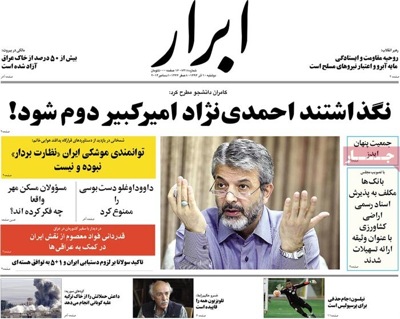
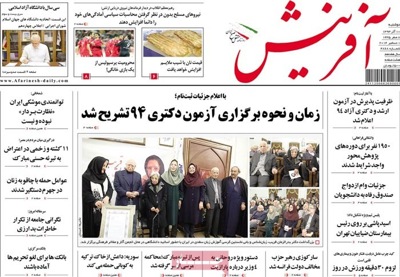
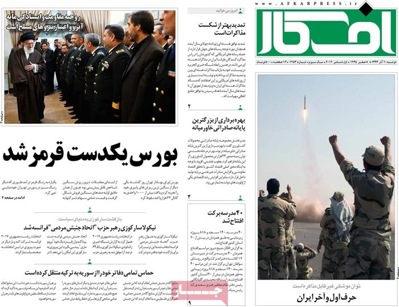
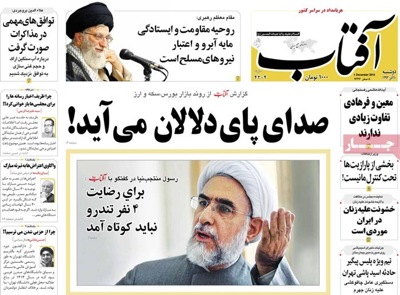
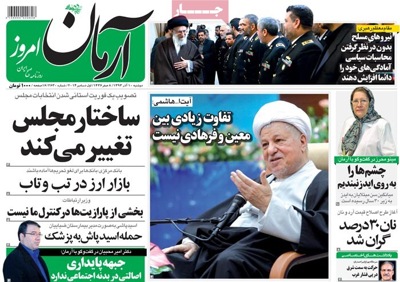
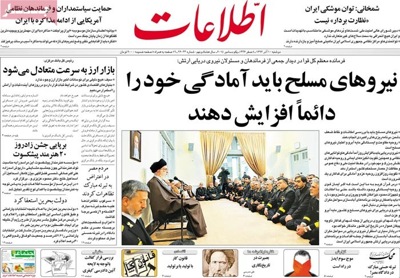
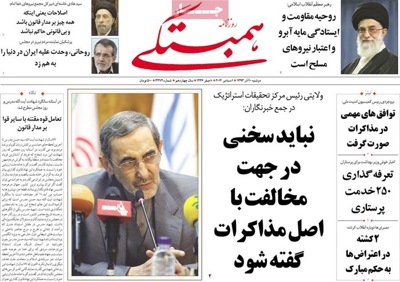
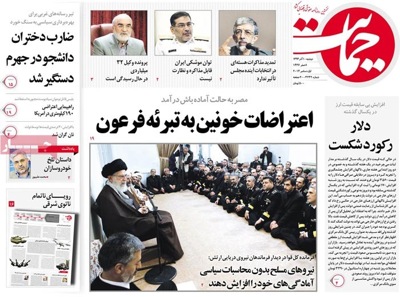
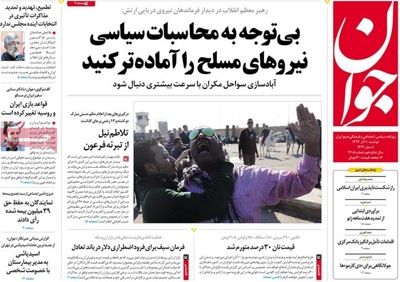
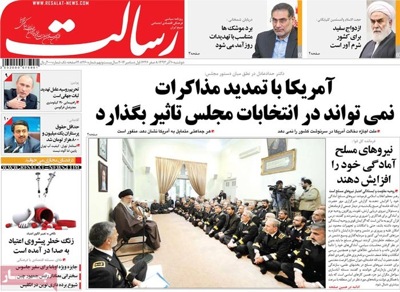
Comments of the Supreme Leader at a commencement ceremony at Imam Ali Military Academy appeared on the front pages of Iranian dailies on Tuesday. Considerable newspaper coverage was also given to whether or not Danesh Ashtiani [President Rouhani’s pick for science minister] will get the approval of parliament. On the international front, the last round of nuclear talks between Iran and P5+1 and speculations as to whether a final deal will be clinched by a November 24th deadline grabbed headlines and generated several analyses in today’s newspapers.

Abrar: “Mahmoud Dowlatabadi, a well-known Iranian author, has been awarded the prestigious French award of Chevalier of the Ordre des Arts et des Lettres.”


Abrar newspaper 11 - 18


Afkar has quoted the governor of the Central Bank of Iran as stressing that an economic growth of 4.6 percent has been fulfilled and that the statistics released by the bank are accurate.


Afkar newspaper 11 - 18


Aftab-e Yazd: “Where were those who keep criticizing the government of Rouhani for the poor quality of Tehran air when Ahmadinejad was in power?” is the question the daily has posed on its front page in a report about the barrage of criticism aimed at the Environment Protection Organization.


Aftabe yazd newspaper 11 - 18


Arman-e Emrooz: “Access to information is a public right; the intelligent filtering plan will get ready in one month time,” said the minister of communications and information.


Armane emruz newspaper 11 - 18


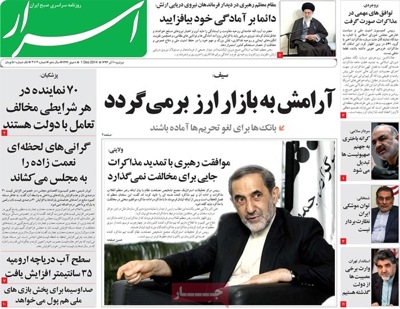
Asrar: “Inflation will land in the single-digit territory in the year which starts on March 21, 2016,” said First Vice President Eshagh Jahangiri.

Asrar: “The home stretch of marathon nuclear talks; foreign ministers of P5+1 are likely to join the Vienna negotiations.”


Asrar newspaper 11 - 18


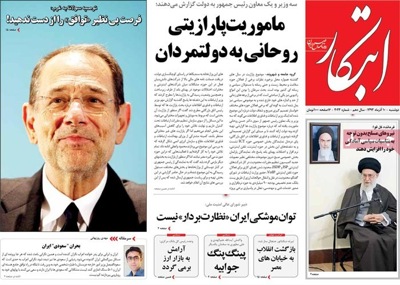
Ebtekar: “Reformism is in quest of strengthening the establishment,” said former President Mohammad Khatami.


Ebtekar newspaper 11 - 18


Ettela’at: “Empowering women is a prerequisite of sustainable development,” said Vice President for Women and Family Affairs Shahindokht Molaverdi.


Ettelaat newspaper 11 - 18


Farhikhtegan: “Air travel has seen a 12-percent growth between March 21 and October 22, 2014.”


Farhikhtegan newspaper 11 - 18


Hambastegi: “By setting up armed groups and massacring people, enemies give rise to Islamophobia,” said the Supreme Leader at a commencement ceremony at Imam Ali Military Academy on Monday.


Hambastegi newspaper 11 - 18


Iran: “Cancer claims 30,000 lives in Iran on a yearly basis.”


Iran newspaper 11 - 18


Javan has put its speculation about the result of nuclear talks in Vienna under “Partial agreement rather than a comprehensive deal is the most likely nuclear scenario in Vienna”.


Javan newspaper 11 - 18


Jomhouri Islami: “Establishment of sustainable security in the region requires closer cooperation between Iran and Russia,” said Chairman of the State Expediency Council Hashemi Rafsanjani in a meeting with visiting Speaker of Russian State Duma Sergei Naryshkin.


Jomhurie eslami newspaper 11 - 18


Kar va Kargar: “Public healthcare should not turn into a political or partisan concept,” said the health minister.


Karo kargar newspaper 11 - 18


Mardomsalari: “Iranian young pop singer Morteza Pashaei has been buried overnight.” His burial was delayed for hours as a huge number of people turned up for his funeral.

Mardomsalari: “Reformism is committed to the religion which regards public viewpoints as valid, “said former President Mohammad Khatami.


Mardom salari newspaper 11 - 18


Resalat: “The flimsy excuses that the West turns to have thrown obstacles in the way of nuclear talks,” said Speaker of the Islamic Consultative Assembly Ali Larijani in a meeting with visiting Speaker of Russian State Duma Sergei Naryshkin.

Resalat: “Extending the term of the acting science minister [until the president’s pick finally secures a vote of confidence from parliament] requires a decree by the Supreme Leader,” said Elias Naderan, a principlist MP.


Resalat newspaper 11 - 18


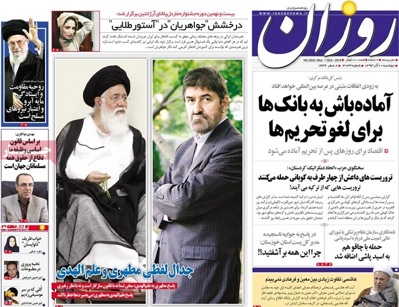
Roozan: “Secretary of the State Expediency Council Mohsen Rezai might field his candidacy for parliamentary elections next year.”


Ruzan newspaper 11 - 18


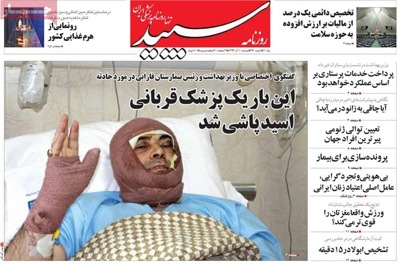
Sepid: “Medicine imports are six times more than exports,” said the director of Iran’s Food and Drug Administration.


Sepid newspaper 11 - 18


Shahrvand: “Iran is enveloped by air pollutants; air quality in seven cities has reached an alarming level.”


Shahrvand newspaper 11 - 18


Two endangered species roam in search of real protection

Iran-Laristan Wildlife

Laristan Wild Sheep, a rare species, lives exclusively in the Hormod Protected Area in Fars province, southern Iran. Also known as Laristan mouflon (Ovis orientalis laristanica), the wild sheep is believed to be the smallest of its kind in the world and that spells out why “miniature” is frequently used to describe it.

The number of the sheep has sharply declined in recent decades, landing mouflon on the red list of threatened species.

The Persian onager is another animal which is listed as “critically endangered” and “extremely rare”. Also called the gur, Persian wild ass or zebra, it is a subspecies of onager native to Iran. Poaching for meat or hide is to blame for the sparse population of the mammal.

The following are the photos Tasnim News Agency put on its website on October 27 of the two rare animals. Take a look.


Iran’s Mahmoud Dowlatabadi wins French prestigious award

Mahmoud Dolat Abadi
Mahmoud Dolat Abadi

French ambassador to Iran, Bruno Foucher, has presented Mahmoud Dowlatabadi, a veteran Iranian writer, with the prestigious award of France’s Chevalier of the Ordre des Arts et des Lettres.

The Islamic Republic News Agency (IRNA) reported on November 17 that the award which bears the signature of France’s culture minister was handed to the Iranian author in a ceremony in the residence of Ambassador Foucher in Tehran.

The French ambassador, Dariush Shayegan – a prominent thinker – and Mariam Asgari – the translator of Missing Soluch, a novel written by Dowlatabadi – took the stage in the event and talked about the different aspects of Dowlatabadi’s literary works.

The French envoy said that the intellectual society and book lovers in his country have gained greater familiarity with the Iranian writer since the release of his works in France. He also highlighted the standout features of Dowlatabadi’s play, story and novel writing.

Shayegan, for his part, said, “Dowlatabadi is undoubtedly one of the biggest novelists in contemporary Iran. To create his works, he did not drink 50,000 cups of coffee – like what Honoré de Balzac did in the matter of 20 years at the expense of his life to create The Human Comedy, a literary masterpiece of the 19th century.

He further said, “However, Dowlatabadi penned Kelidar – one of the most attractive and biggest rural epics of modern Iran – in the course of 15 years after going through many ups and downs.”

Dowlatabadi hails from Khorasan, the birthplace of Iran’s literature and philosophy, Shayegan said, adding that the great writer has embodied both the greatness of this land and its scars.

He further hailed Dowlatabadi’s intellectual honesty and world-class novelty in a media-addled world and said, “Like any other true artist, Dowlatabadi is sensitive and full of stress. He’s been hurt by something from inside, and is concerned about those individuals whose brave dreams always stay in conflict with petty realities in a world which looks the other way when it comes to the internal and heartfelt desires of truth and freedom seekers.

“This unknown, or less-known, Sphinx – who knows, perhaps he is widely known. – is a man in exile in his internal quest of self-enlightenment.”

Mariam Asgari was the next speaker who explained how she rendered Missing Soluch from Farsi into French.

“A translator is always dissatisfied and I had a dissatisfied feeling all the way as I translated the book. For me, translating Missing Soluch was equal to translating an entire region; it was the translation of a culture and a history. […]”

Later France’s Chevalier of the Ordre des Arts et des Lettres was conferred upon Dowlatabadi, who in turn thanked the French culture minister, the French ambassador in Tehran and France’s cultural attaché.

The veteran Iranian writer talked about writing and the pain associated with it, and then read parts of Eugène Ionesco and Marcel Proust’s works, raising some points about the French civilization and literature.

The ceremony was attended by big literary and art names such as: Dariush Shayegan, Nasrollah Pourjavadi [a university professor], Kambiz Derambakhsh [a cartoonist and graphic designer], Omid Rouhani [an actor and film critic], Taraneh Shayegan, Sedigh Tarif [a traditional singer], Leili Golestan [a translator], Mahdi Ra’fat, Javad Mojabi [a poet, writer and researcher], Kianush Ansari, Media Kashigar, and Fakhreddin Fakhreddini [a painter], as well as Davood Mousaei and Hassan Kiaeyan (publishers of Dowlatabadi’s works).


Mahmoud Dowlatabadi, born on August 1, 1940, is an Iranian writer and actor, known for his realist depictions of rural life based on personal experience. He has penned great novels, among them:
Kelidar is a saga about a Kurdish nomadic family. The ten-volume book is praised for its heroic, lyrical, and sensual language as well as its detailed portrayal of political and social upheaval. Dowlatabadi spent over a decade writing the book.
In Missing Soluch, an impoverished woman raises her children in an isolated village after the unexplained disappearance of her husband, Soluch. It was his first work which was translated into English.
Thirst (Persian: Besmel) is a novel on the Iran-Iraq war (1980-1988). It is written mostly from the perspective of an Iraqi.
The Colonel is a novel about nation, history, and family. It is the story which unfolds during and after the Islamic revolution in Iran in the 1980s. This book, whose translations into German and English are available in international markets, has yet to be published in Iran. The Ministry of Culture and Islamic Guidance says that the content of The Colonel needs to be revised before it is given the go-ahead to go to press.
Dowlatabadi said in a ceremony also attended by a deputy culture minister on November 16 that he has some complaints to make about his authorship rights which have been trampled for years.
In August 2014, Iran issued a commemorative postage stamp for Mahmoud Dowlatabadi.

Iran to build hydroelectric power plant in Armenia

Iranian Energy Minister Hamid Chitchian

Iranian Energy Minister Hamid Chitchian has announced that Tehran and Yerevan have finalized an agreement on the construction of a hydroelectric power plant in Armenia.

“The Memorandum of Understanding (MoU) for building a hydroelectric power plant in Armenia has been finalized and the Iranian companies will start construction of the power plant soon,” Chitchian said in Tehran on Monday.

Recalling the hi-tech capabilities and the international reputation of Iranian water and power firms, he said Iranian water-management and power plant construction companies are active in 41 countries around the world and export a large amount of related products to other countries.

Iran and Armenia have taken major strides toward deepening their relations in recent years, particularly in the economic sector.

Chitchian and his Armenian counterpart Yervand Zakharian in a meeting in Tehran in October voiced willingness to enhance bilateral relations, particularly in the energy sector.

[…]

Iran’s FM, EU’s Ashton to attend working lunch in Vienna

Zarif-Ashton
Zarif-Ashton

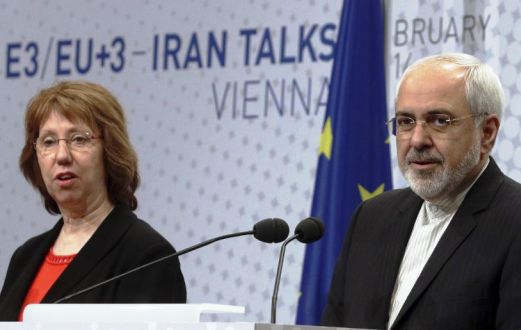
Iranian Foreign Minister Mohammad Javad Zarif has traveled to the Austrian capital, Vienna, to take part in a new round of nuclear talks with P5+1.

On Tuesday morning, Zarif, who heads Iran’s negotiating team, left Tehran for Vienna, where he is scheduled to attend a working lunch with Catherine Ashton, the chief negotiator of the six world powers, later in the day.

The two senior diplomats are expected to review the progress of ongoing talks on Tehran’s nuclear issue and look into ways to continue the discussions.

The new round of talks between Iran and the world powers in Vienna is slated to last for one week from November 18 to 24.

Representatives from Iran and the P5+1 group – Russia, China, France, Britain, the US and Germany – wrapped up their latest talks over Iran’s nuclear energy program in the Omani capital, Muscat, on November 11.

The extent of Iran’s uranium enrichment and the timetable for the removal of anti-Iran sanction were high on the agenda of Muscat negotiations.

Iran and its negotiating sides are in talks to work out a final deal aimed at ending the longstanding standoff over the Islamic Republic’s civilian nuclear work as a November 24 deadline draws near.

Sources close to the Iranian negotiating team say the main stumbling block in the way of resolving the Western dispute over Iran’s nuclear energy program remains to be the removal of all the bans imposed on the country, and not the number of centrifuges or the level of uranium enrichment.

Tehran wants the sanctions entirely lifted while Washington, under pressure from the pro-Israeli lobby, insists that at least the UN-imposed sanctions should remain in place.

Iran’s non-oil exports rise 28 percent

non-oil exports
non-oil exports

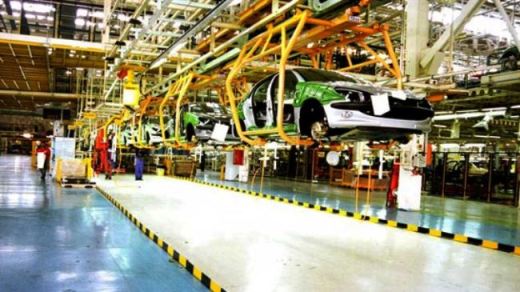
Iran’s non-oil exports since the beginning of the Iranian calendar year (March 21, 2014) have increased 28 percent compared with the same period last year.

“The value of non-oil exports since the start of the current year has increased by over 28% compared with the same period last year,” Hossein Tajour, the director-general of the Trade Promotion Organization of Iran for Renovation and Administrative Development, told a forum in North Khorasan Province on Monday.

He said the figures also included gas condensates.

Noting that the technical-engineering, tourism, workforce and transit services constitute the bulk of Iran’s non-oil exports, he said the Asian countries have been the destination of 93% of the country’s exports this year.

Iran’s Customs Administration announced earlier this month that the country’s non-oil exports have witnessed significant growth in the first seven months of the year, bringing in over $27 billion.

It noted that 55 million tons of commodities have been exported during the same period.

[…]

Basij supports the nuclear negotiating team: General

General Reza Naqdi
General Reza Naqdi

The Iranian people and Basij [volunteers] support the nuclear negotiators whether they strike a deal that would safeguard the Iranian rights or leave the negotiating table without clinching an agreement, the Islamic Republic News Agency (IRNA) quoted Commander of the Basij Force Brigadier General Mohammad Reza Naqdi as telling a news conference Monday. The following is the translation of the report the official news agency filed on his comments:

Failure to stick to Iranian rights is what no one supports, the commander said as he likened the nuclear issue to the borders of the country. “If a single kilometer of the Iranian border is violated, the military, in its entirety, will step in to retake the Iranian territory. Nuclear energy is an Iranian entitlement.”

He went on to say, “We won’t allow anyone to bargain over the rights of the Iranian people and leave a black mark on it. Of course, we know that the government won’t acquiesce to a deal that does not protect Iranian rights.”

The general further said thanks to his busy schedule he cannot follow the detail of the nuclear case. “What is obvious, though, is that the Iranian nuclear negotiators have upheld the dignity of the nation and have taken the right stand in recent days.”

We expect the US to drop its excessive demands and sign a fair deal, he said.

[…]

A National Moderation Conference is to be held at Iran’s National Library

Salehi Amiri

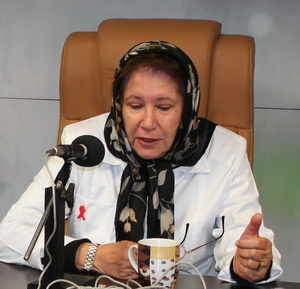
The Islamic Republic News Agency (IRNA) on November 17 quoted Seyyed Reza Salehi Amiri, the current director of the National Library of Iran (NLI) and the head of the Policymaking Council of the Moderation Conference, as saying that Seyyed Hassan Khomeini, the grandson of the late Imam Khomeini, will deliver a keynote speech at the National Moderation Conference which will be held on November 19.” What comes below is the translation of part of his comments at a press conference:

At the conference, a number of state and scientific figures will deliver speeches and expert-level meetings will be held.

The conference, which is organized by the Strategic and Policymaking Council, is comprised of three scientific, executive and media committees. The get-together is intended to study the concept of moderation from philosophical, religious, cultural, political and economic perspectives.

Articles submitted to the secretariat have been published in seven volumes. […]

The ministries of Science and the Interior, the Center for Strategic Research, affiliated with the Presidential Office, and a number of scientific associations are among 30 bodies contributing to the event.

Not a penny from the government coffers has been spent on organizing this conference which is going to be held extravagance-free.

After speeches by a number of scientific figures, six expert-level round tables with different topics will be held, namely ‘Moderation from the perspective of Islamic thinking’, ‘Moderation from the viewpoint of Iranian thinkers’, ‘Moderation and women’, ‘Theoretical foundations’, ‘The sociology of moderation’, ‘Thinking and the political behavior of moderation’ and ‘The approach of moderation and development’.

On August 10, IFP posted the translation of an interview Mosalas magazine conducted with Salehi Amiri under the heading of ‘Role of National Library in turning moderation into a discourse’.