Monday, December 22, 2025
Home Blog Page 4968

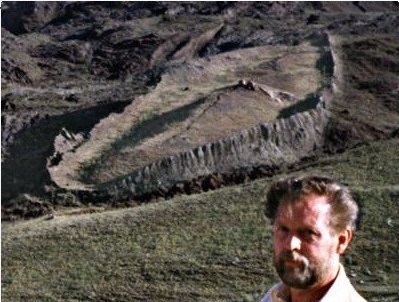
Researcher claims Noah has been laid to rest in Nahavand, Iran

grave of Noah
grave of Noah

In 2000 an Iranian researcher claimed that he had found the place where Noah had been laid to rest. Although his research drew a lot of attention abroad, his assertion went largely unnoticed at home. It came despite the fact that if his story had proven true, the discovery could have given Iran’s tourism an unprecedented shot in the arm. To know more about Ali Akbar Afrasiabpour’s research which has spanned 15 years and involved evidence collected during the course of centuries, an August 4th issue of Mardomsalari Newspaper featured an interview with Afrasiabpour (Ph.D.), who is a member of faculty at Shahid Rajaei University and is the managing editor of Islamic Mysticism Quarterly and the editor in chief of Central Research Culture. Afrasiabpour has been teaching at centers of higher education for 20 years and has released 18 books and 80 articles in the process. The following is an excerpt of the interview:

Why did you choose to focus on Noah?

The first book I penned was called The Chronicle of Nahavand, which is about my ancestral hometown. In the process of writing the book, I tried to determine why the city was called what it was called. So I studied the works of prominent geologists of the Islamic era. What I came across was that all of them had described Nahavand as Nooh-Avand, which means the city of Noah in modern-day Farsi. […]

For instance, in Mojmal al-Tawarikh va al-Qasas (The Collection of Histories and Tales), the author suggests that Noah built a town and named it Nooh-Avand after himself and that city is the modern-day Nahavand. […] Dehkhoda [a very famous Persian] dictionary, too, asserts that Nahavand has been built by Noah. […] There are scores of documents in this regard, almost half of them in Arabic and the other half in Persian. Some are in European languages and in Indian. […]

What is your claim that you have found Noah’s tomb based on?

There is a mountain range in the vicinity of Nahavand called Garrin. One of its peaks is called Sar-Keshti, which is said by locals to be the place where Noah’s Ark came to rest after the Deluge. I studied the site and found ample evidence that suggested Noah had been there. I collected the documents and handed them to a publishing house which has yet to publish the book I want to be called Discovery of Noah’s Grave. […]

At the peak of the mountain, I found two very old graves one of which is referred to as the Grave of Big Father in history books. Local people too use the same name to refer to that grave and pay frequent pilgrimage visits to it. I built on the evidence I had at my disposal to suggest that the grave in question belonged to Noah. After the release of my paper, a couple of foreign teams visited the site. Unfortunately, three years ago, when I visited the site, to my surprise, I found the Grave of Big Father sign replaced. […]

Pilgrims were as stunned as I was when they laid their eyes on the new site. When I inquired as to what had happened to the old doors and the tomb, the custodian of the site said, “Forget those splintered doors, I have ordered top-quality metal doors for the site.” My protests led nowhere, but I had filmed the site before it underwent transformation. I still have that film. […]

Six countries claim that the Ark has landed somewhere in their territory. Why do you say Nahavand is the site the vessel has come to rest?

The evidence I have put forth in my book is compelling. Those countries have no convincing reason to present. For example, Turkey says the Ark has come to rest in Anatolia and Yemen claims the resting place of the ship is somewhere along the coast of the Yemen Sea. One of the reasons I am building my case on is that in Mesopotamia winds always blow in the direction of the east, they never have blown in a northerly or southerly direction to have pushed the ship to those places. […]

You have looked at the Deluge from three different angles. Tell us about these three angles.

The first angle is religious. The holy books of Christianity, Judaism and Islam have all made reference to the Deluge. The second angle is mythology. The Deluge has been mentioned in the myths of Mesopotamia, Persia, China and Tibet and even in the mythical stories of Native Americans. The third aspect is scientific. There is geological evidence that such a flooding has definitely taken place.

Has the holy Koran made any mention of Nahavand or any mountain in its vicinity?

Verse 44 of Hud, a Surah in the Koran, states that the Ark landed in the vicinity of Mount Judi. In my studies I found out that a tribe called Judaki, also known as Judi, still lives near Nahavand. […]

How can you scientifically prove that the Deluge is a historical reality rather than a myth?

The scientific evidence that the Deluge has taken place is so compelling one can hardly doubt this historical fact. In my book, I have built on the research of a geologist which proves massive floods and or monster surfs have once swept across the area. In my studies I have also tried to prove that geological realities do not run counter to what is mentioned in religious scriptures. […]

Noah, a recent Hollywood release, has drawn criticism from the Vatican which alleges that the movie fails to take account of the Scripture. What’s your take on that?

I have watched that movie. As I said one can look at the Deluge from three angles. The movie is based on the mythical angle of the story. The script has turned a blind eye to the religious aspect of the story. That a movie is based on a myth rather than religion is acceptable, but in such movies myths should not be pitted against religion. Noah has done that and has drawn flak from the Church. […]

How was your discovery received when you made it public 12 years ago?

Just like any other discovery it first met with silence. Some tried to ignore it. When they found out that their approach was not effective, they turned to indirect denial. They translated an article from Turkish suggesting that what remained of the Ark had already been found in Turkey. Some suggested that from a scientific perspective such a thing is impossible. And finally they tried to remove the physical evidence that was instrumental in substantiating my theory. For instance, they renamed the local grave that has been mentioned in books and dates back centuries. They also persuaded my publishers to put the project on the shelf. […]

My prediction is that if I present more hard evidence some time down the line, they would argue that the finding is nothing new and that they have known about it for decades. That is a routine we are accustomed to.

What are your plans for the future?

The theory I presented was a scientific case I wanted international scientists to know about. For more than a decade I have been denied the chance to put it under the international spotlight. A US and a British delegation came here to investigate my claims, but I was not allowed to present my evidence to them.

A number of European and American scientists have shown interest. They have told me that if I managed to prove my theory, this region would become the biggest tourist attraction in the world. As many as two billion followers of the Christian faith and other religions would want to visit Noah’s burial site. Unfortunately the Tourism Organization has ignored my theory and some people systematically cast doubt on it without letting me prove it. Is this the way you treat a researcher?

Black Sun wishes the world an ocean of peace and a mountain of wealth


Rights organizations, statesmen and diplomats are not the only people who spring into action when a cycle of violence like the one which has been raging in the Middle East of late hits a region. Activist artists, including musicians, too roll up their sleeves to do something to advance the cause of peace and prompt the international community to do something to alleviate the sufferings of innocent people. A 7th issue of Kelid-e Melli (National Key) has published an interview with members of one such music band: Black Sun. The following is an excerpt of the interview:

Black Sun is a band widely known for its environmental activism. Most recently you have released Bring Back Our Girls and Stop Killing Your Fellow Beings, which are in English and have an anti-war, humanitarian theme? Why the change of heart?

Jahangir Raha: The kind of art that is associated with the environment is not an abstract discipline bent on distancing itself from social woes and political tensions. Environmental activism is one of the most intellectual ways of political struggle in the contemporary world. Human wounds are no different from those of other beings. In our songs, we have analyzed environmental problems in association with society and humanity and incorporated them into aesthetics. One cannot react to violence against animals and remain indifferent to human catastrophes.

Taher Aliramezani: From the beginning, our concerts, our album titled the “Baluchi Black Bear” included, featured exclusively social and even romantic songs. Because environmental demands are more under the spotlight, songs with environmental themes have drawn more attention. Sustainable peace does require a sound environment.

Stop Killing Your Fellow Beings

Stop Killing Your Fellow Beings is too general a theme. Why haven’t you been more specific?

Taher Aliramezani: It is a dovish phrase launched by Nasrin Sotudeh and Asghar Farhadi on the web. We wanted to work on an anti-war song. When that theme was brought to our attention we decided to release a song with the same title which calls for an end to the killings of humans in any shape and form.

Jahangir Raha: The song focuses on things that go beyond political, ethnic, ideological and geographical disputes which could trigger bloody wars that rage on for a long time. Regardless of the color of their skins and ethnic backgrounds humans should respect each other and live a peaceful life alongside others on our green planet.

Why is it in English?

Taher Aliramezani: When you want your message to be heard by the international community it should be in a universal language understood by as many members of the community of nations as possible.

Who has written the song’s lyrics?

Taher Aliramezani: Arash Eslami, which plays electric guitar in the band, has written the lyrics in English.

Tell us more about the video of Stop Killing Your Fellow Beings.

Taher Aliramezani: We were moved by the crimes committed against the people of Syria and Iraq and the massacre of innocent women and children in Gaza and decided to make a song. Arash wrote the lyrics and I tried to prepare the music. […] A week later Arash told us he had written the lyrics. Two days after an initial recording, the final version was recorded. In light of the fact that the band is not well-off, we had to do all the things on our own. We took care of everything including mixing, musical mastering, filming, directing and editing, you name it. In all, I believe the final product turned out to be good.

Can music go beyond the realm of words and really help advance the cause of peace?

Jahangir Raha: Music is the primary language shared by humans and all beings, thus it can set the stage for peace which requires the skills and contribution of all humans to become a reality. If music is unable to advance that cause, certainly others cannot either.

Is this song a means to ease the pang of guilt, or is it a real reaction to a real incident like war?

Jahangir Raha: Both. All of us are wrestling with the pang of guilt your just mentioned. Who is not responsible for the things that are going on around the world? No one is perfect in playing their human role. All our actions and reactions cover both aspects.

Although simple, the lyrics narrate the whole story. Who is this song aimed at? What are questions about love and hate meant to do?

Arash Eslami: It is aimed at all those who play a role, one way or another, in war. The aggressors and the victims, those who kill and those who are killed along with those who want an end to war and favor peace are the audience. The questions which have to do with love and hate are directed at the aggressors and killers. The song asks soldiers as to why they have picked up arms. Is it merely because they are patriots and love their countrymen or because they hate the other side? This is the question that the listener can answer depending on his understanding of the things around him.

[…] Can we hope to see people build on music in order to develop a sense of coexistence and mutual understanding? If yes, do you know of any foreign songs that appeal for an end to war and hostility?

Arash Eslami: In addition to music as entertainment, all countries have music which aims to advance a certain cause. Such music pursues diverse goals such as peace. The anti-war music has a long history in the world. The Woodstock Festival in 1969 was the most prominent anti-war musical event. Songs such as Imagine by John Lennon and Blowing in the Wind by Bob Dylan are examples of such music. They all believed that the language of music which is shared by all humans can be used to urge people to promote peace and be compassionate. Many artists pursue a similar objective.

Is what you are doing a nice social move which is not aimed at financial gains? Do you want others to help you along the way?

Jahangir Raha: As for the first part of your question, I would say this beautiful social move is designed to make the world a better place. But that does not mean we don’t expect others to help us. We wouldn’t be satisfied if we were given millions and billions. We wish an ocean of peace and a mountain of wealth for the world. Anyone who can help us walk down the path of peace and prosperity is more than welcome.

In conclusion, tell us about your future plans.

Taher Aliramezani: Since the band was created, each year we hold a concert on September 11 in cooperation with Animal Rights Watch to mark the day to prevent cruelty against animals. Unfortunately we were unable to book a concert hall for the coming September, so the event is called off this year. We have two things on the agenda. We hope to release our next album “Black Teardrop” by the end of summer. As you know the Baluchi Black Bear, which was sponsored by Mr. Saman Golriz, Animal Rights Watch, and the Iranian Cheetah Society, was released in March 2014. It took us almost two full years to release it because of a lack of budget.

The second thing on the agenda is to complete a few singles to be released on the web by the end of the summer. These songs focus on forest fires and on poaching. That is what we are focusing on for now.


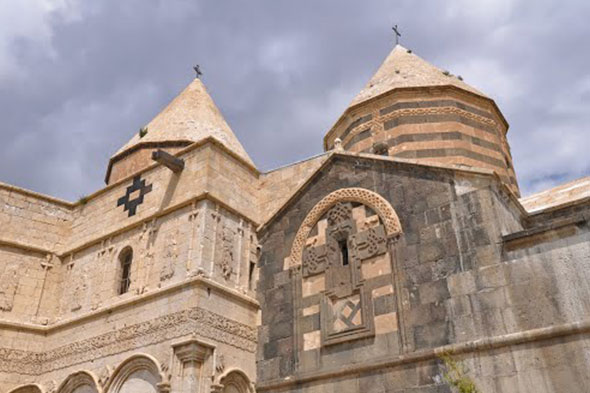
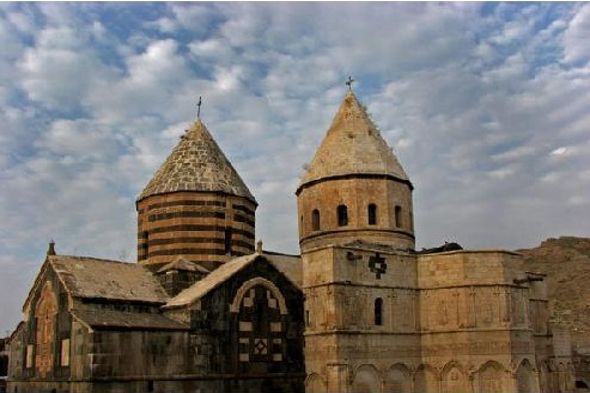
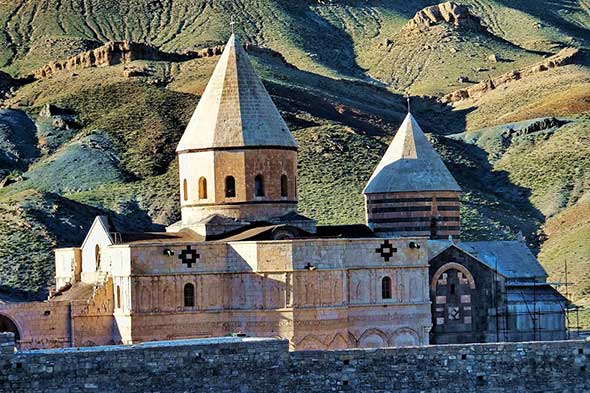
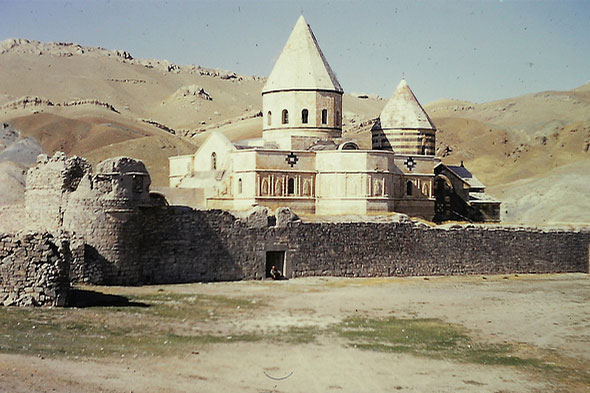
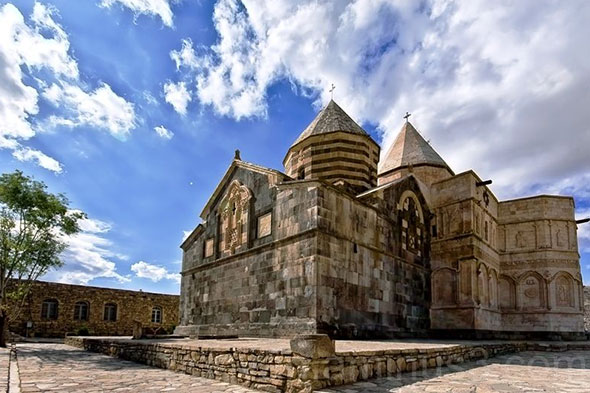
60 Years of Pilgrimage Visits to Saint Thaddeus Monastery, Iran

Monastery in Iran

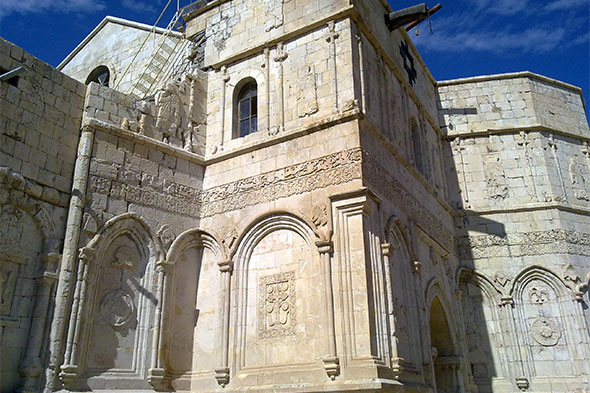
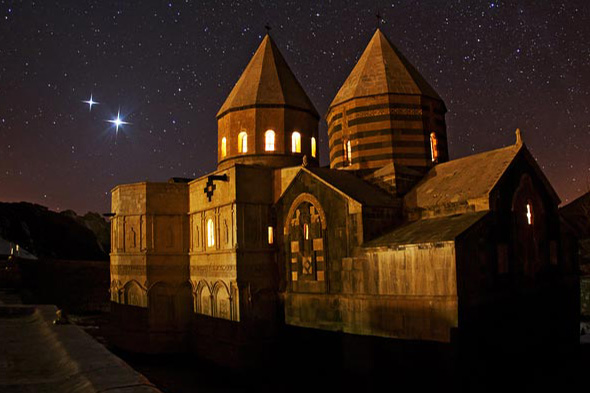
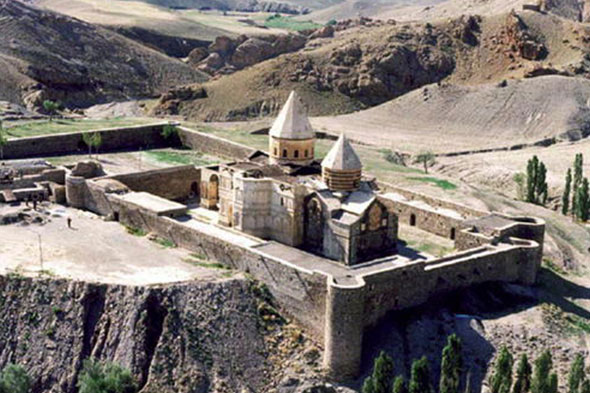
A 3-day ceremony (July 31 – August 2) marked 60 years since Christians began to pay regular yearly visits to the Saint Thaddeus Monastery or Ghara Kelisa – Literally “The Black Church” – in West Azerbaijan province, northwestern Iran. The following is an excerpt of a report on the event by the online edition of Alik Newspaper available at alikonline.ir.

Between 6,000 and 7,000 people took part in the three-day event which is organized annually by Azerbaijan Armenian Caliphate Council. Pilgrims and tourists from around the country attended the ceremony at the church complex run by the Cultural Heritage Organization.

60 Years of Pilgrimage Visits to Saint Thaddeus Monastery, Iran
Saint Thaddeus Monastery – Ghara Kelisa – Location Map

The panel organizing the event had set up a tent town nearby to accommodate the visitors during their three-day stay in the province. Organization of a photo exhibition and artistic programs on the sidelines of the event made it more attractive, particularly for the youth.

On August 1, Chaldoran Governor Karim Hosseinzadeh and a number of provincial officials visited the site of the ceremony and held talks with Grigor Chiftchian, the Bishop of Armenians in Western Iran.

In a speech, the Armenian bishop said the signal these yearly visits send to the world is that followers of the Muslim and Christian faiths are living side by side in peace in Iran. “Don’t act contrary to what your conscience orders you to do. Like in the past, we can have peaceful coexistence. That is what we are doing now in the Islamic Republic of Iran. Countries are not meant to be exclusively inhabited by followers of a single faith,” he said.

“Let’s respect each other’s religious differences. Let’s join hands to turn up the heat on terrorism, murder, massacre and destruction.” – Bishop Chiftchian

The bishop went on to say, “Let’s practice patience in accommodating those who hold opposing views. Let’s respect each other’s religious differences. Let’s join hands to turn up the heat on terrorism, murder, massacre and destruction. Thanks to the support the Islamic Republic of Iran has lent to the Saint Thaddeus Monastery, it is now back on its feet. I would like to thank all state officials including the Supreme Leader, the president and the governor for their backing.”

At the close of the ceremony, the torch of the Armenian games, which are to open in Tabriz on August 14, was lit by Bishop Chiftchian before it began its journey to the capital of East Azerbaijan Province.

Iran extols Maliki for efforts to bolster unity in Iraq

Iraq-Nouri Maliki
Iraq-Nouri Maliki

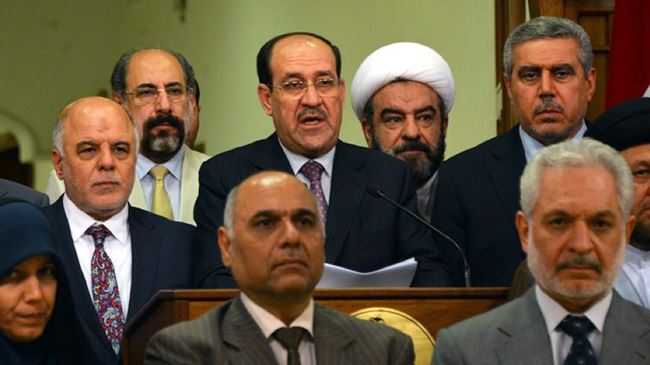
Iran’s Deputy Foreign Minister for Arab and African Affairs Hossein Amir-Abdollahian said on Friday that over the past eight years, Maliki made all efforts to establish a united, secure, developed and free Iraq and he is now an asset in new Iraq.

Maliki stepped down on Thursday to make way for Prime Minister-designate Haider al-Abadi, saying his decision to give up the position to Abadi shows his desire to “safeguard the high interests of the country.”

Amir-Abdollahian said Iran strongly supports Iraq’s new government in its fight against terrorism.

He also gave a positive assessment of Maliki’s contribution to the development of strategic relations between Tehran and Baghdad during his tenure.

Iraq has been fighting ISIL Takfiri terrorists since they took control of the city of Mosul on June 10. Tribal fighters have joined the Iraqi army in the battle against the terrorists.

The ISIL Takfiri terrorists have been committing heinous crimes in the captured areas across Iraq, including the mass execution of civilians and security forces.

The United Nations refugee agency said on Thursday that tens of thousands of Izadi Kurds in Iraq have fled the ISIL-fueled violence in their homeland and sought refuge in northern Syria.

Thousands of Izadi Kurds have reportedly been killed or displaced since the ISIL terrorists attacked the mountainous Sinjar region in northern Iraq in early August.


Early Iran-P5+1 nuclear deal unlikely: Iranian FM

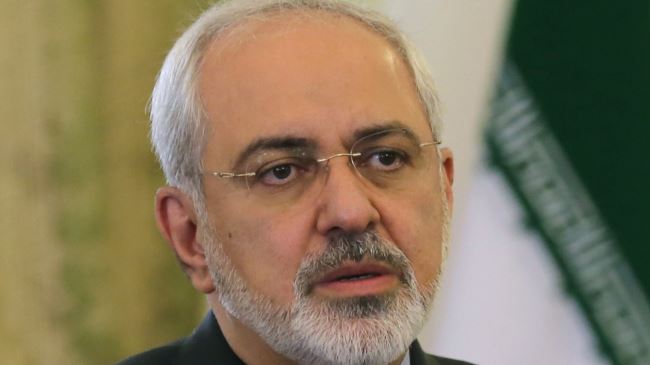
Iranian Foreign Minister Mohammad Javad Zarif

“If a general agreement is reached on different issues in the nuclear talks, we still need more time to negotiate the details. Therefore, it is unlikely that we will reach a final deal earlier than the four-month deadline of the talks,” Zarif said on Friday.

He said that Iran and the P5+1 group have made overall progress in the course of nuclear negotiations over the past seven months, adding, however, that the six countries have taken a more “cautious” approach to the talks.

“From the very beginning, we have been of the contention that if there is a strong willpower on the side of the West, nuclear negotiations can bear fruit very soon,” he added.

Iran and the five permanent members of the UN Security Council – the US, France, Britain, Russia and China – plus Germany have been holding talks to sort out their differences and achieve a final deal that would end the decade-old dispute over Iran’s nuclear energy program.

They sealed an interim deal in Geneva, Switzerland, on November 23, 2013. The deal came into force in January and expired six months later.

In July, the two sides agreed on the extension of their discussions until November 24 in an effort to achieve a permanent nuclear deal.

Iran’s Foreign Ministry Spokeswoman Marzieh Afkham said earlier this month that the two sides will meet ahead of this September’s UN General Assembly meeting in New York.


Except in certain cases, talks with U.S. have no value: Leader

Iran-Supreme Leader
Iran-Supreme Leader
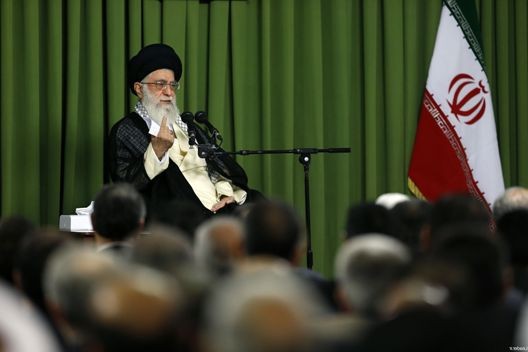
Ayatollah Khamenei made the remarks during a meeting with Foreign Minister Mohammad Javad Zarif and Iranian ambassadors and foreign envoys in Tehran on Wednesday.
“Relations with the U.S. and negotiations with this country, except in certain cases, not only have no value for the Islamic Republic, but are harmful,” the Leader stated, adding no wise person seeks something which is of no value.
The Leader said some believe that “if we sit on the negotiating table with the Americans, many problems will be resolved,” but the negotiations that have been held since last year have proved the opposite.
There were no relations between Iranian and U.S. officials in the past, but last year it was agreed that both countries’ officials would hold talks up to the level of foreign ministers due to the sensitivity of the nuclear issue, and during this time no benefit was gained, and even the tone of U.S. officials became “harsher and more offensive,” the Leader said.
He went on to say that the U.S. did not lessen its enmity and even tightened the sanctions imposed on Iran.
But Ayatollah Khamenei also stated that the nuclear talks the foreign minister and his negotiating team have started will continue.
As long as the U.S. government and Congress continue making hostile remarks about Iran, there is no reason for direct interaction with them, he said.
The Leader also confirmed President Hassan Rouhani’s remarks on Monday, in which he said Iran is seeking interactions with the entire world.
“There are only two exceptions, the Zionist regime and the United States,” he stated.
Ayatollah Khamenei also likened diplomacy to a battlefield, saying if one does not begin the task with serious determination, he will eventually be defeated.
He pointed to the world’s animosity toward the U.S. due to its complicity with the Israelis, saying the entire world knows that the U.S. is complicit in the Zionist regime’s war crimes and acts of genocide in the Gaza Strip.
He cited “diplomatic cleverness and professionalism”, “flexibility at the proper time”, “impenetrability at the necessary time” and “sincere and deep commitment to goals” as the cornerstones of successful diplomacy.
The Leader also said that he agrees with the Palestinians, who say the Zionist regime should pay them reparations for its crimes, which should include the lifting of the blockade of the Gaza Strip.
In a month-long war against the besieged Gaza Strip, over 1950 people have been killed and thousands injured. About half a million people have also been made homeless as a result of the war.
Commenting on the situation in Iraq, he expressed hope that with the naming of a new prime minister-designate, the country’s problems will be resolved and a government can be formed which will teach a good lesson to those who are trying to create a crisis in the country.
On Monday, Iraqi President Fouad Masoum asked Haidar al-Abadi, a Shia coalition’s nominee for the post of prime minister, to form a new government.
Iraq’s National Alliance parliamentary bloc has nominated al-Abadi for the post of prime minister to replace Nouri al-Maliki.

Iranian theater troupes to perform at Swiss festival

theater

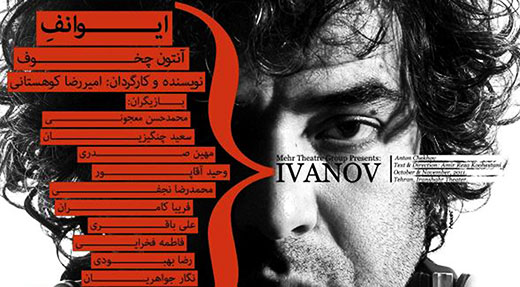
The Mehr Theater Group led by director Amir-Reza Kuhestani will stage Russian playwright Anton Chekhov’s “Ivanov”.

Mohammad-Hassan Majuni, Negar Javaherian and Saeid Changizian will be among the cast of the play.

The Papatiha Theater Troupe will premiere “Second like Year” at the festival, which will be held from August 14 to 31.

Hossein Abadi, Maryam Heidari, Tina Yunestabar and Sahar Saba will star in the play, which will be directed by Hamid Purazari.

Each year, the festival gathers 35 to 40 individuals and companies whose creations are marked by formal independence, innovative character and artistic ambition.

President Rouhani Congratulates Iranian Fields Medal Winner

Iran president - rouhani

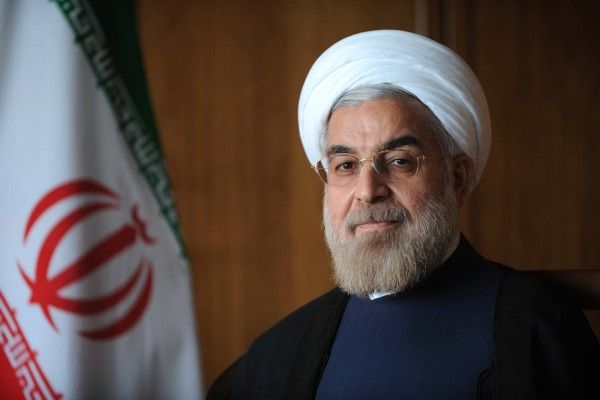
“I congratulate you on winning the world’s topmost award in the field of mathematics,” said President Hassan Rouhani in a message published on Wednesday.

“Today, Iranians can justly feel proud that the first woman to win the Fields Medal is their fellow citizen. Yes, the most competent should verily sit at the highest position and enjoy respect. On behalf of the Iranian nation, I value your scientific endeavors,” Rouhani said, adding all Iranians across the world are seen as the county’s national asset.

The award recognizes Mirzakhani’s sophisticated and highly original contributions to the fields of geometry and dynamical systems, particularly in understanding the symmetry of curved surfaces, such as spheres, the surfaces of doughnuts and of hyperbolic objects.

Although her work is considered “pure mathematics” and is mostly theoretical, it has implications for physics and quantum field theory.

Mirzakhani became known to the international math scene as a teenager, winning gold medals at both the 1994 and 1995 International Math Olympiads.

After earning her bachelor’s degree from Tehran’s Sharif University of Technology in 1999, she began work on her doctorate at Harvard University under the guidance of Fields Medal recipient Curtis McMullen.

She possesses a remarkable fluency in a diverse range of mathematical techniques and disparate mathematical cultures, including algebra, calculus, complex analysis and hyperbolic geometry. By borrowing principles from several fields, she has brought a new level of understanding to an area of mathematics called low dimensional topology, according to Stanford University website.

From 2004 to 2008, she was a Clay Mathematics Institute Research Fellow and an assistant professor at Princeton University. In 2008, she became a professor of mathematics at Stanford.

Iranian woman wins Fields Medal

Iranian woman Maryam Mirzakhani wins Nobel Prize of mathematics

The Iranian woman, Maryam Mirzakhani, a Harvard educated mathematician and professor at Stanford University in California, has been awarded the 2014 Fields Medal in recognition of her contributions to the understanding of the symmetry of curved surfaces.

Officially known as the International Medal for Outstanding Discoveries in Mathematics, the Fields Medal was presented to Mirzakhani, one of four candidates, by the International Mathematical Union on August 13 at the International Congress of Mathematicians (ICM), held this year in Seoul, South Korea.

In a statement, the ICM announced that fluent in a remarkably diverse range of mathematical techniques and disparate mathematical cultures, Mirzakhani embodies a rare combination of superb technical ability, bold ambition, far-reaching vision, and deep curiosity.

“This is a great honor. I will be happy if it encourages young female scientists and mathematicians,” Mirzakhani said. “I am sure there will be many more women winning this kind of award in coming years.”

Born in 1977 in Tehran, Mirzakhani got her bachelor’s in math from Iran’s prestigious Sharif University of Technology in 1999 and received her master’s and PhD degrees from Harvard University in the United States in 2004.

She has also won the Blumenthal Award for the Advancement of Research in Pure Mathematics and the Satter Prize of the American Mathematical Society.

She became full professor of Mathematics at the age of 31 in 2008 at Stanford University, where she is currently working.

Her research interests mainly include hyperbolic geometry, Teichmüller theory, ergodic theory, and symplectic geometry.

The Fields Medal, officially known as International Medal for Outstanding Discoveries in Mathematics, is a prize awarded to two, three, or four mathematicians not over 40 years of age at each International Congress of the International Mathematical Union (IMU), a meeting that takes place every four years. The Fields Medal is often viewed as the greatest honor a mathematician can receive. The Fields Medal and the Abel Prize have often been described as the “Mathematician’s Nobel Prize” (but different at least for the age restriction). – Wikipedia.org

Protests Rage in US over Brown’s Death

Shooting-black

The fatal shooting of 18-year-old Michael Brown by an officer on Saturday in Ferguson– a predominantly black suburb a few miles north of downtown St. Louis County — has sparked large protests, clashes and looting across the county.
After two nights of violent protests, President Barack Obama called the fatal shooting a tragedy and urged Tuesday for a thoughtful response.
“I know the events of the past few days have prompted strong passions, but … I urge everyone in Ferguson, Missouri, and across the country, to remember this young man through reflection and understanding,” Obama said in a statement.
Police officers, some in military-style uniforms, some carrying high-powered rifles and wearing balaclavas, fired teargas, rubber bullets and wooden baton rounds into the crowds, The Guardian reported Wednesday.
“We have a right to assemble, a right to freedom,” said Paul Muhammad, a protestor. “But here we are facing what looks like a military imposing martial law. It is not acceptable.”
The Police Department in the city of Ferguson refuses to reveal the name of the officer responsible for Brown’s death, citing threats to his safety.
Amidst the current unrest, a second police-involved shooting was reported overnight in Ferguson.
About 1:00 AM on Wednesday, multiple shots were fired and four or five armed individuals were seen, wearing ski masks, running near the intersection of Chambers Road and Sheffingdel Court in Ferguson, St. Louis Post-Dispatch, reported.
Police responded to the shootings and shot and injured one of the suspects. The man was in critical condition in hospital, a police spokesman said.
This is while a woman was shot in the head with a projectile about 12:20 AM in a drive-by shooting. Police said they were looking for four or five men. The woman was shot once and is expected to survive.
The Federal Aviation Administration approved a no-fly zone over Ferguson after police said one of their helicopters came under fire on “three or four occasions.” The no-fly zone is expected to remain in place until Monday.
Rev Al Sharpton, veteran civil rights leader and TV host, appeared alongside Brown’s parents on Tuesday to appeal for calm after two nights of protest in which about 50 people were arrested.
Vigils are being planned across the US for Thursday night in response to recent incidents of police brutality – including the death of Michael Brown.
Organizers say the vigils are part of the National Moment of Silence (#NMOS14), and that ceremonies will be held in more than 50 cities across 30 states.
Brown’s death has invoked the outrage after the 2012 racially-charged shooting of 17-year-old Trayvon Martin by a Florida neighborhood watch organizer who was later acquitted of murder charges.
The incident has once again raised questions about excessive police force when confronting black suspects.


#Michael Brown, #Ferguson police, #violence against blacks