Wednesday, December 24, 2025
Home Blog Page 4958

Iran congratulates Iraq on forming new government

Iraq parliament
Iraq parliament

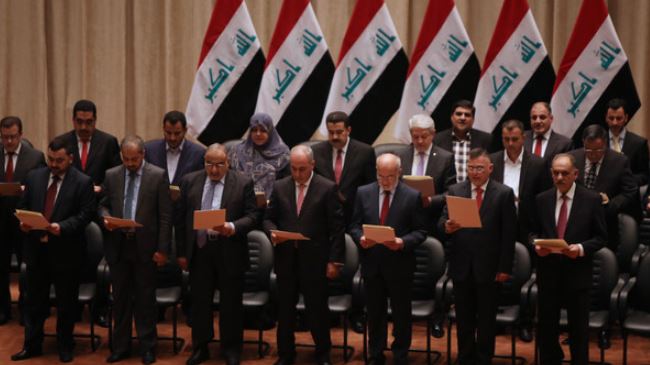
On Monday, the Iraqi parliament approved the new cabinet proposed by Prime Minister Haider al-Abadi, with the majority of lawmakers backing the prime minister’s programs and his cabinet line-up.

Iranian Deputy Foreign Minister for Arab and African Affairs Hossein Amir-Abdollahian said the Islamic Republic supports the Iraqi parliament’s decision, which was in keeping with the Iraqi constitution.

He further reiterated Iran’s backing for the Iraqi government under the premiership of Abadi.

Emphasizing the need for respecting Iraq’s independence, sovereignty, national unity and territorial integrity, the Iranian official called on regional countries to help Iraq uproot terrorism.

The Iraqi nation as well as the country’s political and religious leaders proved that they will not allow the enemies of the region as well as Takfiri and Ba’athist terrorists to endanger regional security, he added.

[…]

No deal with P5+1 unless Iran demands are met: Araghchi

Iran-Araqchi
Iran-Araqchi

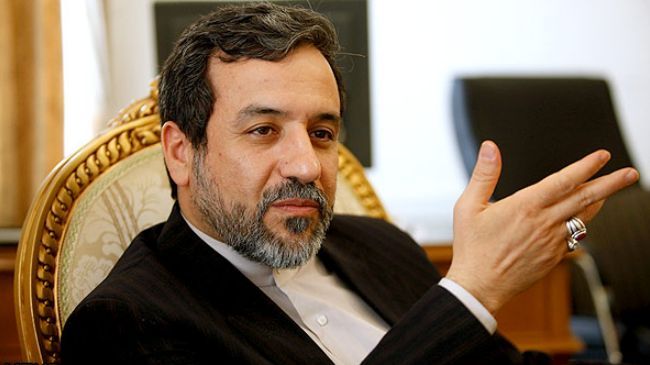
Deputy Foreign Minister for Legal and International Affairs Seyyed Abbas Araghchi said late Monday that Iran will continue the nuclear talks seriously and in good faith, but will not give up its rights.

Araghchi stated that although there is an understanding about the concerns on both sides, deep disagreements remain.

The senior diplomat added that a major persisting difficulty is agreement on a timetable for the lifting of illegal sanctions against Iran.

Araghchi also stated that the recent anti-Iranian sanctions imposed by the United States violate the Geneva Interim Deal and if repeated, Iran will respond.

On August 29, the US government announced the imposition of a new round of sanctions on 25 individuals and companies, including shipping firms, oil companies, airlines and six banks despite the fact that Iran and the six world powers are still in talks to resolve the nuclear dispute.

He added that it will only be possible to reach a nuclear agreement by the November deadline if everyone remains committed to the objective of the negotiations.

The senior Iranian negotiator said that the next round of nuclear talks will be held in New York on September 18.

He added that bilateral discussions are also scheduled to be held before and after those talks.

[…]

Last November, Iran and the United States, Britain, France, Russia, China as well as Germany signed the interim deal in Geneva which took effect on January 20 and expired six months later on July 20.

In July, Tehran and the six countries agreed to extend negotiations until November 24 after they failed to reach common ground on a number of key issues.

[…]


Spanish firms ready to cooperate in Iran mining sector

Iran Mining
Iran Mining

The International Relations Director of Spanish Confederation of Employers’ Organizations (CEOE) Jose Garcia Morales made the remarks on Monday as he along with Spanish Ambassador to Iran Pedro Villena met in Tehran Mehdi Karbasian, the head of the Iranian Mines and Mining Industries Development and Renovation Organization (IMIDRO).

Morales said Spanish companies involved in steel manufacturing and mining are ready to cooperate with Iran.

Villena pointed to the Iranian economy’s exit from the state of stagnation and the country’s success in curbing runaway inflation, and expressed the Spanish government’s interest in cooperating with Iran in the mining sector.

For his part, Karbasian referred to the easing of Western sanctions against Tehran as an opportunity for the Spanish firms to form joint venture projects with Iran’s mining sector.

IMIDRO’s development plans, including the production of 55 million tons of steel, 1.5 million tons of aluminum, 200 million tons of minerals and 800,000 tons of copper, provide suitable opportunities for investment, Karbasian said.


Iran wins three medals in World Wrestling Championships

borna ghasemi
borna ghasemi

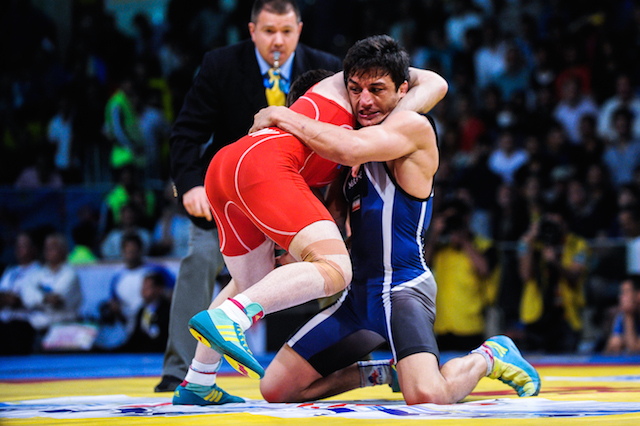
On day one of the 2014 Freestyle World Wrestling Championships in Tashkent, Iranian wrestlers won two bronze medals and a silver on Monday (September 8).

In the 57-kg weight category Hossein Rahimi beat his Japanese rival to secure Iran’s first medal of the event, a bronze.

Later, Mohammad Hossein Mohammadian defeated an Azeri wrestler to win a bronze in the 86-kg category.

And in the 125-kg category Komeil Ghasemi lost to a Turkish heavyweight wrestler to win a silver.

Fight against terror should be free of political considerations: Iranian security official

Iran-Denmark-Shamkhani

“Any action in the fight against terrorism should be sincere, genuine, based on regional potential and cooperation, should not violate the sovereignty of nations and should be devoid of hegemonic political and security objectives,” Secretary of Iran’s Supreme National Security Council (SNSC) Ali Shamkhani said in a meeting with Danish Foreign Minister Martin Lidegaard in Tehran Monday.

“The Islamic Republic of Iran has always been the standard-bearer of the fight against terrorism and is currently playing the most effective role in the fight against this ominous phenomenon by supporting the oppressed Iraqi people [against ISIL terrorists],” he added.

He emphasized that Iran feels religiously obligated to support the Palestinian resistance as well as the Syrian and Iraqi nations’ fight against terrorism.

The SNSC secretary stressed the importance of closer cooperation among Muslim countries to counter security challenges faced by the Muslim world.

The Danish foreign minister, for his part, said Iran has always played an important role in the regional fight against terrorism and called for regional and international cooperation to eradicate this phenomenon.

In addition to effective military measures, the world should do something to cut the access of terrorist groups to financial aid, equipment and human resources, Lidegaard added.

He warned that a lack of adequate attention to anti-terrorism efforts can result in unpredictable ramifications for international security and stability.

[…]


Ayatollah Khamenei’s prostate surgery was successful

Supreme Leader Ali Khamenei in Hospital

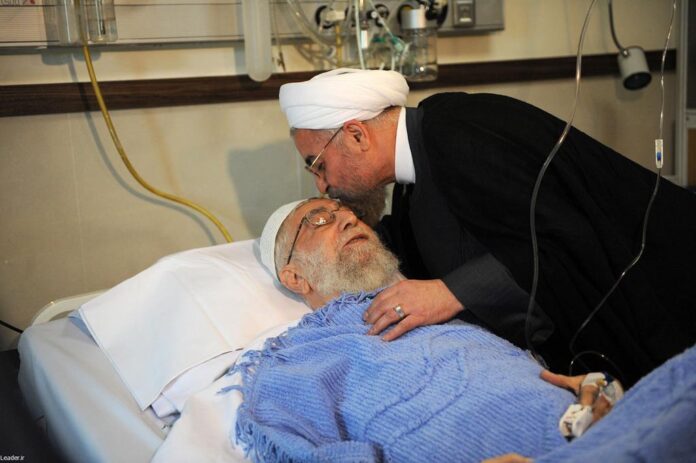
Leader of the Islamic Revolution Ayatollah Seyyed Ali Khamenei underwent successful prostate surgery in Tehran on Monday (September 8).

According to Tasnim News Agency, after the operation President Hassan Rouhani paid a bedside visit to the Supreme Leader.

In an interview afterward, the president said the leader was doing well and there is no reason for concern about the leader’s health.

As for his Tajikistan trip to attend a Shanghai Cooperation Organization Summit which was scheduled well in advance of the leader’s hospitalization and surgery, the president said, “I wanted to stay in Tehran, but the Supreme Leader asked me to go on the trip according to schedule.”

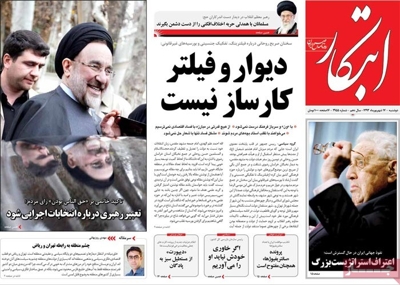
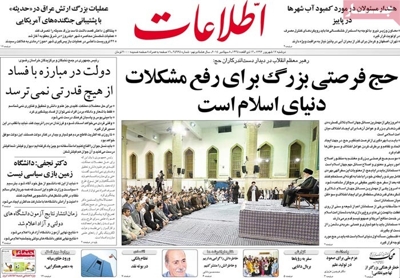
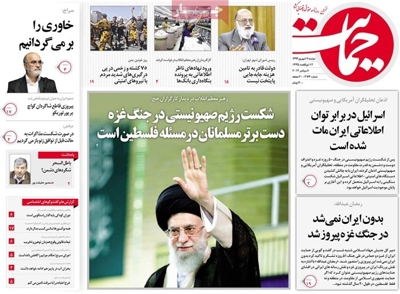
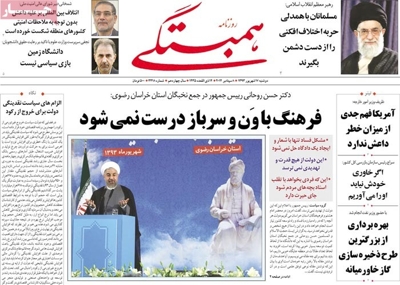
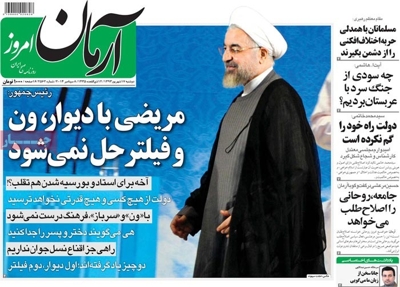
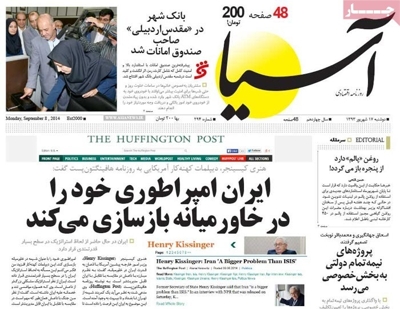
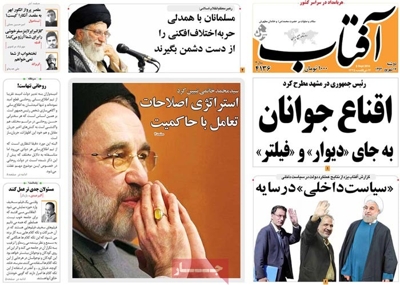
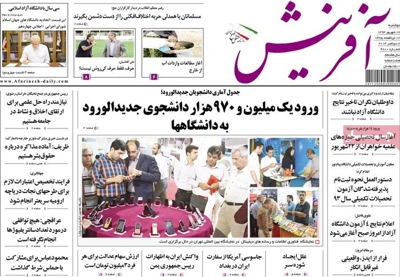
A look at Iranian newspaper headlines across the country on September 8

Iran Newspapers-09-08

The visit Hajj Organization officials paid to the Supreme Leader appeared on the front pages of almost all Iranian newspapers on Monday. “Muslims should stick to unity to foil enemy plots to divide them.” was the headline most Iranian dailies used to cover the leader’s remarks. The president’s comments on culture and local politics also grabbed headlines.

Ebtekar: “Erecting walls and introducing Internet filtering won’t work,” the president says at a meeting with the elite in Mashhad on the second day of a visit to Khorasan Razavi Province. “In this day and age we should be convincing in dealing with the younger generation. Building walls [to separate the sexes] and introducing filtering [aimed at content control] won’t solve our problems.” That headline is placed at the top of the front page next to “The statement of the leader that free and fair elections are an obvious right of the public should be upheld,” former President Mohammad Khatami said. The juxtaposition of the two stories seems to suggest that reformists are gaining the upper hand and reasserting their authority on Iran’s political landscape.

Ebtekar: “The number of centrifuges Iran will keep operational has yet to be decided,” Iranian Deputy Foreign Minister Abbas Araghchi said in reaction to reports that Tehran has agreed to decrease the number of its nuclear centrifuges.

The front page of Ebtekar also features a photo of Henry Kissinger under its masthead. It is captioned “‘Iran’s influence is on the rise, the great strategist admits’”. The article seems to refer to recent comments by the former US secretary of state that he considers “Iran a bigger problem than ISIS”.


Ebtekar newspaper-09-08


Ettela’at: “In the fight against corruption, my government is afraid of no force,” the president says in a speech in Khorasan Razavi.

Ettela’at: The Iraqi military launches a major offensive in Haditha with US air cover. The US Defense Department says IS militants sought to capture the Haditha Dam.


Ettelaat newspaper-09-08


Hemayat quotes State Inspector GeneralNasser Seraj as saying, “If Khavari failed to return home to face corruption charges, we’d force him to.” Khavari is the former managing director of Bank Melli who is wanted in connection with embezzlement. He retired his position in 2011 and fled to Canada before an investigation was launched into his role in the financial scandal.


Hemayat newspaper-09-08


Hambastegi: “The international coalition against IS which has failed to take account of security considerations in the region has failed,” said the secretary of the Supreme National Security Council.


Hambastegi newspaper-09-08


Arman-e Emrooz: “I hope a brave moderate parliament which brings together experts will emerge [in the wake of next parliamentary elections]” former President Mohammad Khatami said.

With the annual Hajj pilgrimage on the horizon Arman-e Emrooz quotes Chairman of the State Expediency Council Akbar Hashemi Rafsanjani as asking, “What good has the cold war with Saudi Arabia done to us?”


Armane Emrooz newspaper-09-08


Asia quotes The Independent in Britain as reporting, “David Cameron hopes to meet Iran’s President Hassan Rouhani [in New York]” and says the British premier seeks to transform a political alliance through the meeting.


Asia newspaper-09-08


Aftab-e Yazd: “Interaction with the state is the pillar of reformist strategy,” former President Mohammad Khatami said.


Aftabe Yazd newspaper-09-08


Afarinesh: “Some 1.97 million new students will be admitted to universities (across the nation) this new academic year.”

Afarinesh: An exhibition on the role of Information Technology in Digital Media is under way in Tehran.


Afarinesh newspaper-09-08


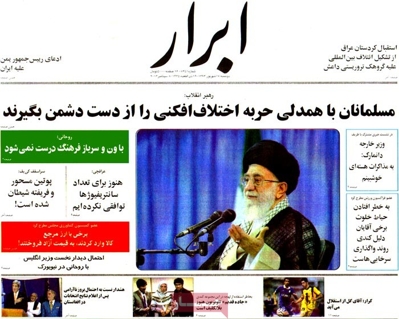
Abrar: “I am optimistic about nuclear talks [between Iran and the world powers],” said Danish Foreign Minister Martin Lidegaard at a joint press conference with his Iranian counterpart Mohammad Javad Zarif.

Abrar: The Iraqi Kurdistan Region welcomes the formation of an international coalition to fight IS terrorists.


Iran-Abrar newspaper-09-08


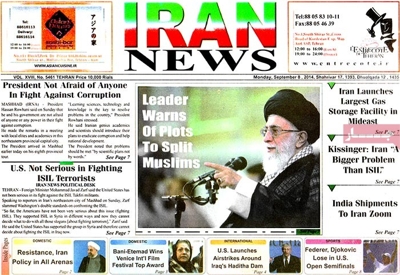
Iran News, an English-language newspaper, “Iran launches largest gas storage facility in Mideast.”


Iran news newspaper-09-08


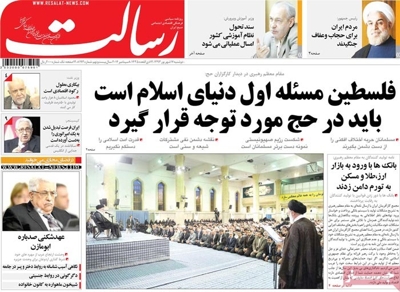
Resalat: “Banks have fanned the flames of inflation by getting involved in the foreign currency, gold and housing market,” a number of manufacturers said in a letter to the Supreme Leader.


Resalat newspaper-09-08


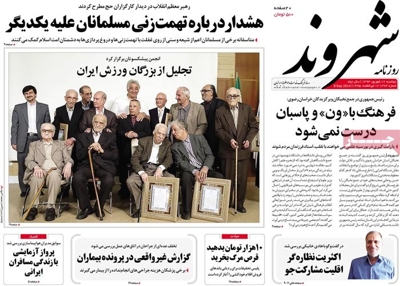
Shahrvand: “Use of soldiers and police does not help promote culture,” President Hassan Rouhani said.


Shahrvand newspaper-09-08


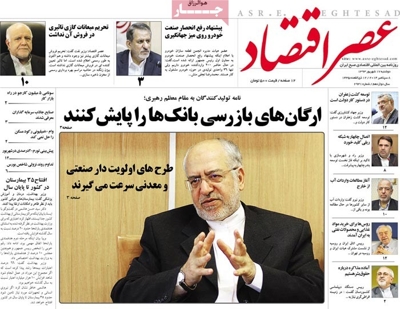
Asr-e Eghtesad: “A Russian delegation has come to Iran to pursue food and oil purchases,” the head of Iran-Russia Chamber said.


Asre Eghtesad newspaper-09-08


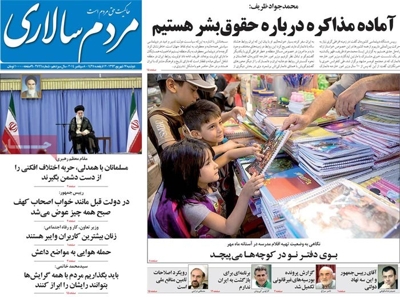
Mardom Salari: “Iran stands ready to talk about human rights,” announces Foreign Minister Mohammad Javad Zarif.


Mardom Salari newspaper-09-08


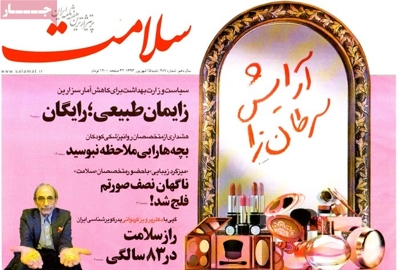
Salamat: As part of a government strategy to reduce birth by C-Section, government is to offer free-of-charge hospital services for natural childbirth.


Salamat Weekly


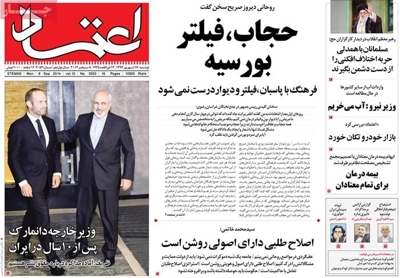
Etemad: The State Expediency Council paves the way for provision of healthcare insurance to all drug addicts.

Etemad: “Principles of reformism are obvious…. I don’t detect any U-turn in President Rouhani’s policies…. Society does not turn democratic overnight…. We need to support the government and understand its problems…. The State should be tolerant and not get agitated,” Mr. Khatami tells a host of reformist students.


Etemad newspaper-09-08


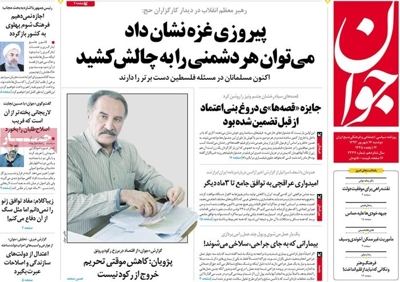
Javan leads on the comments of the Supreme Leader under the title of “The victory Palestinians scored in Gaza showed [Muslims] can take on any enemy. Muslims have gained the upper hand in the Palestinian conflict.”

Javan has expressed displeasure over the award prominent Iranian film director Rakhshan Bani-Etemad has scooped in the Venice Film Festival in an article titled, “The award for the fabricated Tales by Bani-Etemad was guaranteed in advance.” The newspaper claims that it is not the first time Iranian movies which are designed to “paint a gloomy picture” are welcomed with open arms in international festivals. In order to lend credence to its claims that Bani-Etemad does not care about social norms and values, the paper digs out a one-year-old statement of the director: “I am not born at a time when anyone can prevent me from directing movies.”


Javan newspaper-09-08


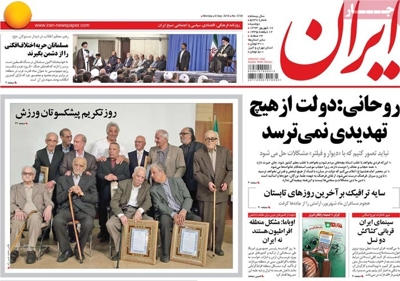
Iran quotes US President Barack Obama as saying that extremists, and not Iran, are the problem of the Middle East region.

Iran: The services of veteran Iranian athletes are praised at a ceremony.


Iran newspaper-09-08


Iran’s Largest Gold Mine

Zarshuran Gold Mine
Zarshuran Gold Mine

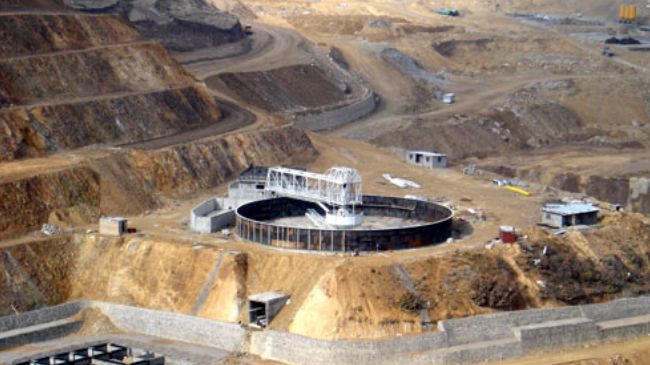
A 99th issue of the weekly journal Tejarat-e Farda [Tomorrow’s Trade] out in early August had a column by the Project Manager of Zarshuran Gold Mine: Hossein Ghavanloo. What follows is the translation of the column which was titled “How does Zarshuran Produce Gold Bullions?”

Leaving behind a period when Iran was not equipped to extract gold from mines and mostly made investment in other mines, Iran seems to have enhanced its ability to explore and run gold mines over the last decade. Therefore I think a promising future is on the horizon. Given the amount of investment in this area, the estimated lifespan of this mine which stands at 20 years, the experience of Iranian experts, and ecological considerations, things will look up down the road.

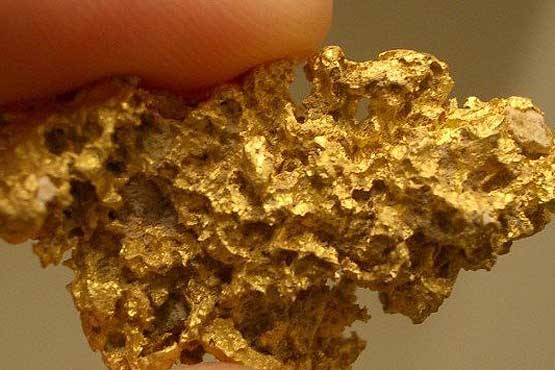
The operation of the mine will give a 3-ton rise to Iran’s production of gold bullion. In other words, Zarshuran Mine will produce 10 kg of pure gold on a daily basis.

Zarshuran Geographical Map

In terms of foreign investment in operating the mine, domestic investment stands at as much as 84 billion tomans, and an additional 15.2 million euros has been provided by foreign investors. On average, approximately 20-30 percent of machinery used in production line is imported from aboard and the rest is manufactured in Iran. The operation of the mine will give a 3-ton rise to Iran’s production of gold bullion. In other words, Zarshuran Mine will produce 10 kg of pure gold on a daily basis.

The mine has a proven reserve of at least 110 tons of pure gold. In the first phase of operations yearly production will amount to three tons and in the second phase it will rise to six tons. That means the mine’s lifespan is estimated to be 20 years. We hope that with further exploration activities, more untapped reserves will be located so that efforts to extract gold in Zarshuran, a region near the city of Takab in West Azerbaijan Province, can carry on.

As far as safety procedures are concerned, Zarshuran Mine is a surface mine and thus deals with fewer safety issues. The processing facility has addressed environmental problems and abided by safety regulations. In the process of bullion production, cyanide is used to treat gold concentrates. Oxidation and leaching processes produce some toxic gases too, that’s why we have considered the environmental concerns of the project. For instance, to prevent damage to the environment, we have invested as much as six billion tomans in Zarshuran tailings dam to preserve natural resources and the environment.

Iran’s gold production hovers around 2.5 tons a year and with the opening of this plant during Government Week, the country’s gold bullion production will see a two-fold rise.

The last point is that there are no official statistics about gold consumption or production in the country, because the only official figures belong to Mooteh Mine [in Isfahan Province] which is a state-owned facility. As for private mines like Agh Dareh Mine in the vicinity of Zarshuran, we have no official stats. Nonetheless, based on the figures released by the Ministry of Mines, Iran’s gold production hovers around 2.5 tons a year and with the opening of this plant during Government Week, the country’s gold bullion production will see a two-fold rise.

Iranian political experts praise Nouri al-Maliki’s decision

Nouri Al-Maliki
Nouri Al-Maliki

Designation of Haider al-Abadi as Iraqi prime minister following the resignation of Nouri al-Maliki from premiership in August drew a lot of attention in the region. Iran and Iraq share a long border. Naturally, as neighbors the repercussions of political developments in one country can be felt in the other. That is particularly true about a major shift as such. A 207th issue of Panjereh (Window) weekly, which focuses on political, cultural, economic and social news, featured an interview with foreign policy expert Dr. Hassan Hanizadeh and Dr. Hossein Sheikholeslam, a political expert and a foreign policy advisor to the parliament speaker. The following is a translation of the answers they provided in response to the weekly’s questions:

What is going on in Iraq at the moment indicates that the country is still in a state of disarray. Given the ambiguous handover of power from Nouri al-Maliki to Haider al-Abadi, how would you analyze the current developments in Iraq?  

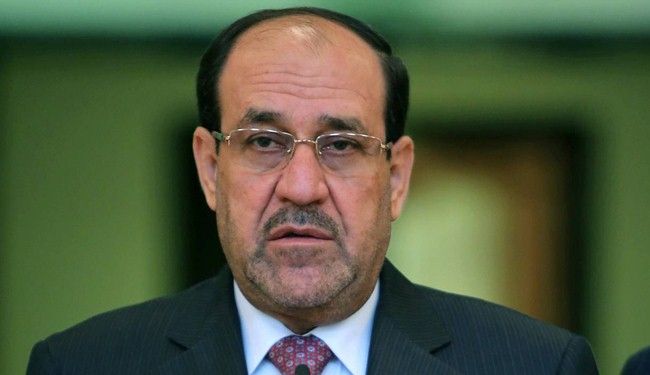
I praise Mr. Maliki for his far-sightedness and selflessness. In spite of securing more votes than the previous election, he decided to waive his right just because of Iraq’s conditions and restore national cohesion between Shiites, Sunnis and ethnic groups. In fact, he put Iraqi unity ahead of his personal interests.
Sheikholeslam

Sheikholeslam: At a time when Iraq is under attack by terrorist insurgents of the Islamic State (IS), I praise Mr. Maliki for his far-sightedness and selflessness. In spite of securing more votes than the previous election, he decided to waive his right just because of Iraq’s conditions and restore national cohesion between Shiites, Sunnis and ethnic groups. In fact, he put Iraqi unity ahead of his personal interests. I hope that Mr. Abadi will build on support and cooperation offered by Maliki and other ethnic groups as well as Shiites to forge a government that can restore security.

Hanizadeh: The appointment of Haider al-Abadi came at a time when Iraq faced a political void after the legal deadline of 15 days to name a prime minster by major parliamentary caucuses expired, so Iraqi President Fouad Massoum exercised his right to pick Mr. Abadi as prime minister, a figure who is well respected by tribes and parties across the political spectrum. Shiites, Sunnis, and Iraqi Kurds view him as an influential political figure. Also, his relationship with religious leaders is fairly good. So it seems that when his cabinet make-up is determined and the new government takes charge, it will be able to address the present challenges in Iraq and turn things around in favor of the Iraqi nation.

What are the characteristics of Mr. Abadi that have made many Iraqi major players welcome his nomination? How will his appointment help Iraq as far as the political process is concerned?

That Western countries endorse Mr. Abadi is because of his 35-year political activity in Europe, especially in Britain, which has made him famous in the West.
Hanizadeh

Hanizadeh: His appointment can usher in pleasant interaction among all parties across the political spectrum, lift Iraq out of its security and political woes and direct it toward the formation of an inclusive government. His designation is the result of a consensus over a common need among all political parties. That Western countries endorse him is because of his 35-year political activity in Europe, especially in Britain, which has made him famous in the West.

Another thing is his respect for all political parties and clerics. With regard to such matters, it seems the prime minister-designate will pull off a lot of security and political accomplishments through the formation of a national unity government in the months to come. It’s worth noting that the support from the United Nations, the US, and Europe for Abadi can be rather helpful from a regional and international perspective. Of course, the Islamic Republic of Iran also expressed pleasure over Mr. Abadi’s appointment.

Certainly, a change of prime minister in Iraq will have a direct impact on Tehran-Baghdad interactions. What are your thoughts on it?

Sheikholeslam: Iran attaches immense significance to Iraq. To fathom the importance, we can point out the suffering Iran experienced under Saddam, or the 8-year war imposed on Iran by Iraq (1980-1988) which carried a heavy price tag for Iran. The significance underlines the fact that in interaction with Iraq, Iran should not let catastrophes like war repeat themselves. Iraq is our ally in the region, its cooperation with Iran to establish stability and peace along its border can help restore peace to the whole region.

For the time being, IS presence on Iraqi soil is the second biggest threat after the Zionist regime. In fact, IS follows the same approach, though in the name of Islam, yet they both have the same objectives: dividing Muslims, and fanning the flames of Islamophobia in the region.
Sheikholeslam

For the time being, IS presence on Iraqi soil is the second biggest threat after the Zionist regime. In fact, IS follows the same approach, though in the name of Islam, yet they both have the same objectives: dividing Muslims, and fanning the flames of Islamophobia in the region. These are the goals that the Zionists, Americans and arrogant powers pursue. I do not think the transition in Iraq will have much impact on relations between the two nations although we need to wait and see. We need to have close cooperation with Iraq and give a hand to the ruling current.

Supreme Leader Ayatollah Ali Khamenei in his Eid al-Fitr address stated that Iran has disagreement over some matters with other Islamic nations. However, Iran stands ready to set aside such differences in order to address the issue of Palestine. One of the questions over which there is disagreement is Iraq. We hope that both sides appreciate this move toward unity and respond positively.

Hanizadeh: Mr. Abadi lived in the West and Britain for 35 years and his approaches are not confined to his country and nation. He’s tapping into his experience on the political front to maintain and even beef up his ties with Iran and other Arab countries in the region.

At the moment, the incoming prime minister is faced with a series of grave domestic challenges on security, political and economic fronts. He will try to give priority to the consolidation of security and a crackdown on IS fighters. In light of the danger IS poses to the Iraqis, Abadi will use his cachet in the region and the world to quell the marauding group.

Aside from that, Iraq will come across some serious challenges such as the Kurdistan Region which Abadi should overcome with tact and maturity. Experience acquired over the last 11 years in Iraq suggests that some countries, including Saudi Arabia and Qatar, are not willing to see stability in the region. Since Iran shares a long border with Iraq, it always keeps its finger on the pulse of the latest developments in Iraq. Iraq should at all times heed its consultations with Iran over security, military and security matters.

The enormous challenge facing Iraq is IS. Do you think we will see any change in the fight against the terrorist group during Abadi’s premiership?

Sheikholeslam: On no account should concessions be made to those behind violence and murder in Iraq. IS militants should lay down arms and leave the Iraqi soil. I think if Iraqi volunteers called by Grand Ayatollah Ali al-Sistani [to combat the insurgents] are organized by the government and its allies, Iraq will be able to deliver a heavy blow to the terrorist group. Such counterattack is only attainable through the unity of all Iraqi forces.

Hanizadeh: If Haider al-Abadi preferred his ethnic tendencies to religious ones, he would not notch up any success. Abadi should put Iran’s experience to good use and should not come under pressure by Saudi Arabia and Qatar. He should crush IS with international assistance and ensure long-lasting security in the region. Also, he needs to clarify relations between the Iraqi Kurdistan and the central government, and the Iraqi Kurdistan should abide by the law. In case Kurdistan adopts a go-it-alone approach to establishment of ties with the West and the US, Iraq will definitely move toward breakup.

What are other political obstacles standing in the way of Iraq?

Hanizadeh: Iraq’s Constitution has some flaws. It’s necessary to fix them, so the Constitution should be reviewed now. Under Iraq’s law, the winning party in the parliamentary vote has no more than 15 days to name a prime minister. That was what annoyed Nouri al-Maliki and triggered a reaction from him.

instability in Iraqi Kurdistan and northern Iraq, extensive presence of IS in the north, and the remnants of Baathist generals in the structure of the Iraqi armed forces are hurdles that the Mr. Abadi needs to clear.
Hanizadeh

Today Iraq is mired in multiple security and political problems. Among other things, instability in Iraqi Kurdistan and northern Iraq, extensive presence of IS in the north, and the remnants of Baathist generals in the structure of the Iraqi armed forces are hurdles that the prime minister-designate needs to clear.

Another thing is that top religious leaders in Iraq have always tried to foster an interactive atmosphere on the political front, regardless of their political leanings. For instance, the recent warning by Ayatollah Sistani about putting a halt to political disputes was to that end. These leaders have always taken the expediency and interests of all different ethnic groups into consideration, that’s why the incoming premier should heed the advice of grand religious leaders.

Fighting terror is West pretext for intervention: Iranian official

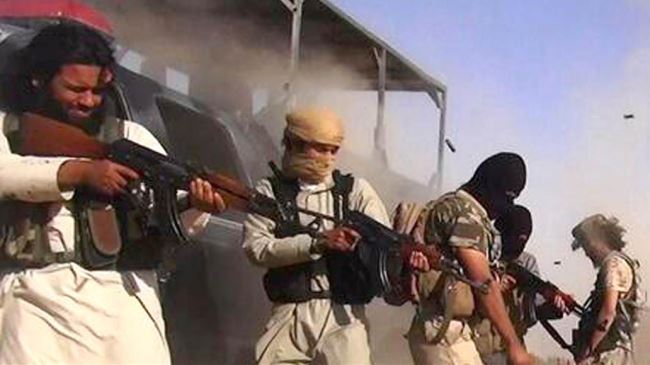
ISIL-Takfiri-militants

Secretary of Iran’s Supreme National Security Council Ali Shamkhani said on Sunday that fighting terrorism must not serve as a pretext for Western interference in the region.

The senior official also said that the international coalition against terrorism will succeed only if it takes into account the interests and concerns of regional states.

“Any regional and international coalition under the pretext of fighting terrorism without considering the regional countries’ interests and political and security considerations is doomed to failure,” he added.

Shamkhani added the presence of the United States and some Western countries in the region has resulted in the escalation of insecurity and the emergence of new terrorist groups.

He further noted that Western governments are not sincere in their anti-terrorism campaign as it is evident by their measures and stance regarding the current developments in Iraq.

Shamkhani also dismissed allegations over the cooperation between Iran and the US against terrorism in Iraq, saying the nature of Iran’s anti-terrorism campaign is not similar to that of the US.

[…]