Thursday, April 23, 2026
Home Blog Page 4957

Iran expects China to help settle nuclear dispute with P5+1

Rouhai-China-FM

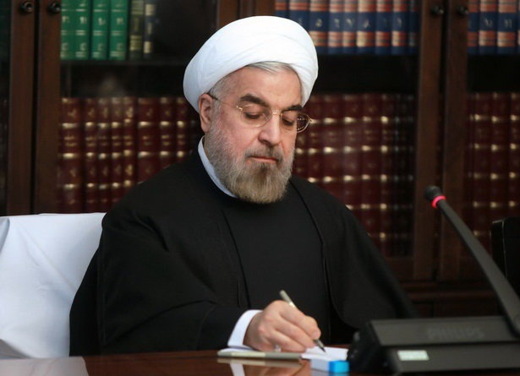
President Hassan Rouhani on Sunday said that Iran expects China to help settle the nuclear dispute with the Western governments. He said that they must show political will for the purpose.

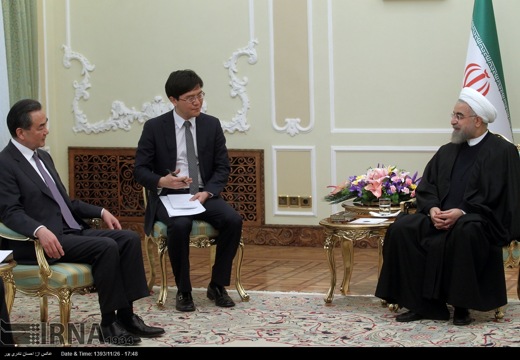
President Rouhani made the remarks in a meeting with Chinese Foreign Minister Wang Yi.

He said that the strategic Tehran-Beijing cooperation is of significance for expansion of regional security and stability.

“China has always had close cooperation with the Islamic Republic of Iran, and at this juncture, we need to lead the relations towards the establishment of comprehensive strategic cooperation,” said the Iranian president.

He expressed hope that China’s cooperation in the framework of the Iran-P5+1 (UN Security Council permanent members plus Germany) will lead to the realization of the Iranian nation’s rights in a comprehensive agreement.

The Chinese foreign minister conveyed the Chinese president’s warm greetings to his Iranian counterpart and emphasized Beijing’s strong will for boosting comprehensive, long term, and strategic relations with Iran.

Foreign Minister Wang Yi referred to the upcoming visit to Tehran by the Chinese president, and said the visit can transform bilateral relations in a historic way and open a new chapter in Iran-China ties.

On Iran’s nuclear activities and some governments’ counterproductive efforts to block its path, the Chinese top diplomat said that the Leader of Islamic Revolution and President Rouhani have both many times emphasized that the Iranian nuclear activities are merely for peaceful purposes, and not for manufacturing nuclear weapons.

‘This approach is very effective in resolving Iran’s nuclear dispute,’ he added, hoping for near future signing of a comprehensive agreement on the issue.

He said that such an agreement will end foreign interference in Iran’s development drive. As a very important country, Iran can play a more important role in regional and international arenas.

Rouhani condemns horrific crime against US Muslim students

Rouhani issues

President Hassan Rouhani has condemned the heinous killing of the three US Muslim students in North Carolina.

The president’s message called for global action to address the root causes of violence and hatred toward religion. The president also offered condolences to the bereaved families, and ‘all free men and women and supporters of human rights.’

It is expected that all authorities do their best to protect the rights of all citizens including Muslims; the horrific crime is a despicable act worthy of condemnation, and a manifestation of the spread of violence and extremism, the message read in part.

“The preliminary reports are very disturbing because they depict hatred of Islam and religion in general as the motives behind the crime. Violence and violation of human glory and honor, whether in the name of religion or through anti-religious acts fly in the face of ethical principles and religious teachings of all heavenly religions,” the message emphasized.

“Those who cultivate hatred of Islam will stir up violence in society; the time has come for thinkers, reformers, the civil society and the governments to fight violence and examine the roots of crimes fed by hatred of religion and to rid the international community of the burden of this shame,” said the president.

Ebtekar reacts to firestorm following dust storm

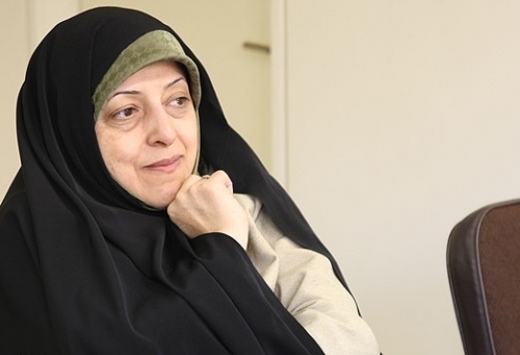
Masoumeh Ebtekar

The director of the Environment Protection Organization has come under fire in recent days for what is perceived to be her agency’s failure to fulfill its responsibility when it comes to tackling the problem of particulates in southern and western provinces. The protest has also found its way into social networking sites.

On February 15, Sharq daily published an interview with the environment chief in which she fired back at her critics. The following is a partial translation of the interview:

[…]


You think the barrage of criticism coming your way is politically motivated?

I think most of what these individuals raise is sentimental and those who raise them have an ax to grind. Everyone knows that people of Khuzestan have gone through a lot of late. It is below politicians to make political gains of the plight of some of our fellow citizens.

It is not just Khuzestan. Other provinces such as Ilam and Sistan and Baluchestan are grappling with similar problems. These problems are not unique to Iran. Dust storms have recently swept areas from West Africa to the Middle East including Egypt, Palestinian territories, Lebanon, etc.

Am I to blame too for what has happened in Cairo and West Africa? Those who seek to find fault don’t care where the blame lies. At the end of the day, they put the blame at our door.

[…]


How much budget has been envisioned to fight the problem of dust storms in next year’s spending package?

That is a good question. A number of the very same MPs who are going out of their way to target the Environment Protection Organization these days,eliminated all the budget the government has allocated to the fight against air pollution in parliament just three days before the first storm hit southwestern Iran. They sought to reallocate the same budget to what they favor.


How much exactly did the government seek to allocate to the problem?

What they did drew an angry response from my agency. Part of the budget – around $20 million – that came from the tariffs government places on polluting industries was supposed to be allocated to monitoring and fighting dust storms. Specifically we wanted around $18 million to revive lagoons which was eliminated from the budget bill. What is ironic is that the same people who are criticizing me and my department have been behind efforts to remove the envisioned budget.

[…]

We are close to a nuclear deal: Former Iranian negotiator

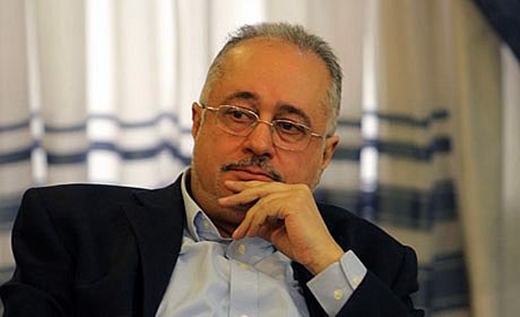
Siroos Naseri

With nuclear talks between Iran and P5+1 growing more sensitive by the day, any comment by officials from either side of the bargaining table could upset the existing balance. Iran has said it favors a one-stage deal which encompasses general outlines as well as details. That idea does not seem to sit well with the Americans. What would come next if the talks collapsed?

In an interview with Khabaronline, Sirous Nasseri, a former Iranian nuclear negotiator when Hassan Rouhani was the secretary of the Supreme National Security Council, answered that question and more posed by the news website’s Saeed Jafari Pouya. The following is the translation of the interview the website posted online on February 14:


How would you evaluate the guidelines of the Supreme Leader and the reaction they drew from local and international circles?

The comments of the Supreme Leader came at a time when nuclear talks were at a sensitive stage. I believe more than anything else, they set the stage for progress. What the Leader said was wise and conforming to the path the negotiating team has been going down. That the Leader pointed out that no deal is better than a bad deal is another major point worth taking into account. All in all, in my opinion, now that the talks have arrived at a crucial stage, the Leader’s speech will have positive results for both the establishment and the public.


Following the Leader’s statement, Secretary of State John Kerry showed a rather harsh reaction and threatened that if the two sides failed to reach a political agreement by March 1, they would not carry on with the talks. President Obama, however, took a milder stance, yet he threw the ball in Iran’s court and blamed Tehran for the probable failure of the negotiations. What is your take on the American reaction?

Basically, there has been general concern that after a deal on general outlines, talks about the details could run into trouble, setting the stage for the other side to take advantage of it. As you may remember, in November 2013, an agreement on general issues was clinched and a series of commitments were defined for either side. But in January when details were being hammered out, the Americans and Europeans took advantage of any term which was open to interpretation.

In other words, anything which was interpretable was exploited by the Westerners. So, I believe specification of the details in the talks and correspondence between our measures and their behavior are of immense importance.

Because there is no international arbitration entity to refer to, we have to make correspondence between all measures [by both sides]. If we take a step, the other side has to do something which is commensurate with it, or if the other side fails to honor a part of its commitments, we should put a fitting response on our agenda. Of course, it is not an easy task. So the Supreme Leader’s comment that he did not approve of a general deal and wanted general outlines and details worked out together, is a concern shared by both the public and our experts.

As for your question, I must say that although the Americans have indirectly displayed negative reactions to the statement by the Leader, I think the negotiations have reached a stage that we will leave these issues behind. There is general agreement and details will be worked out through diligence of both sides. I have to reiterate it is tough.


So, are we getting closer or farther away from a nuclear deal?

I believe that we are close to a nuclear accord. I think in the coming weeks, the general outlines which are not necessary to be put on paper will be hammered out. Afterward, the two sides will discuss the details. I believe that the sooner we enter this stage, the better it will be.


Earlier you said that by March 21, we will clinch a deal, do you still stick to that statement?

I still believe that an agreement on general issues can be reached by March 21, and afterward the sensitive period of discussions about details will start. At present, common ground is there when it comes to many major questions. However neither side has officially accepted it. As for details, it is natural that things turn more sensitive, that’s why we should not rush; we must deny the other side the chance to take advantage [of the deal].


What is your prediction about the estimated duration of the second stage and the settlement of details?

In the New Year [starts March 21] talks will probably shift into high gear and grow more intensive. As the talks will be held at an expert-level, it will be easier to bring the nations together; such a trend will be more sustainable.

If such tenacity persists, conclusion of a deal by the deadline is within reach and probably at the beginning of the summer the talks will produce a deal.

Once more I have to stress that at this stage, our attention should be more focused on details and the measures by the other side rather than on the deadline. What matters most is that the commitments by the both sides should be determined and in case of failure by the Western side to honor its obligations, we should take a fitting response.


But the new [Republican-majority] Congress has threatened to slap fresh sanctions against Iran if no deal was reached by March.

I am not much concerned about political gimmicks. It is obvious to me that eventually the US administration won’t run the risk of putting an attainable deal at stake and take the consequences. If the US seeks to repeat and step up its past hostile measures, Iran will accordingly put harsh responses on its agenda.


For instance what?

I am not willing to elaborate on that. If fresh sanctions were imposed by America, our reaction would not be confined to a return to where we were prior to the Geneva deal. Iran would definitely take much stronger action which would cost America dearly and bring Washington back to the negotiating table.


Is the American side poised to clinch a one-stage deal?

I think they are. In light of efforts made and costs paid by both sides to get where they are now, they cannot afford to make miscalculations and miss this opportunity.


If no deal was struck, what scenario would lie ahead for our country? Should we expect fresh sanctions?

If it happened, which I think is highly unlikely, the general situation would take a turn for the worse for a short period of time. If the Americans opt for fresh sanctions, we can also put new measures on our agenda. For instance, we can deny the International Atomic Energy Agency (IAEA) access to our nuclear facilities. So we have some tools at hand to use in response. That’s why I believe escalation of the crisis won’t serve the interests of the other side.

Even if for a short period of time such a critical situation persisted, the Americans themselves or other international players would intervene to bring both sides back to the negotiating table. Still, sound reasoning, pure logic and deft diplomacy require grasping every opportunity. I am of the conviction that both sides are determined to strike a deal. I am also optimistic that their efforts will produce the intended results.


Over the past few days, with no exception, American newspapers and magazines, both Democrat and Republican, have warned President Obama against making any new concession; they have unanimously warned that in case of the collapse of talks, Iran will be to blame. But no measure has been taken by Iran to manage the public sentiments and media reports. There seems to be shortcomings in our public diplomacy. So in case of the probable failure of the talks, wouldn’t the sentiment turn against Iran? And wouldn’t that in turn render a return to the negotiating table more difficult?

We have to acknowledge that the American propaganda machine is firing on all cylinders and is present on the scene with a lot of ammunition. Naturally, it is difficult to compete with such a well-oiled machine. On the other hand, we have to admit that during the nuclear talks, we have failed to make the most of public diplomacy and media coverage both at home and abroad.

Officials at Iran’s Foreign Ministry and Foreign Minister Mohammad Javad Zarif have played an effective role in making things clear on the international stage, yet making speeches and official measures are not enough.

Foreign media keep working on the issue, releasing analyses and reports. It even seems that they [foreign media] at times pursue a single line of thinking. We should do the same thing. We need to demonstrate steely determination to fill the void.

Of course, the Foreign Ministry is performing well on the international front and has filled different countries in on the progress of the negotiations. However, as you said we haven’t fully tapped into our potential on the foreign media front.

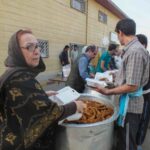
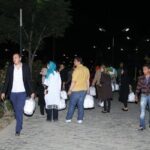
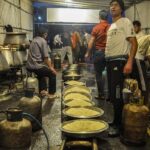
A charity gives out the extra food of feasts to the homeless

Iran-charity

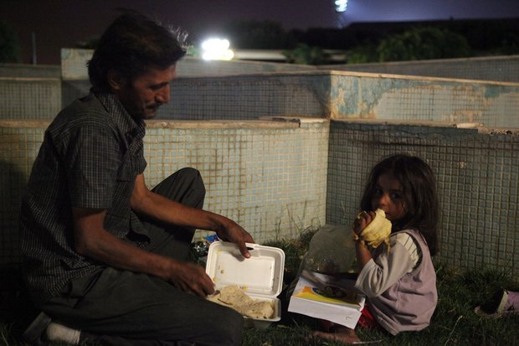
After almost a decade of activity, the Toloo Bineshanha (Emergence of the Unknown) Society has turned into a leading institution in supporting those who sleep rough and addicts who want to kick the habit.

The society has launched a new campaign to collect extra food form feasts in a bid to prevent waste and satisfy the hunger of the needy who cannot afford to buy food. Thanks to social networks, the campaign has drawn a lot of attention from the public and prompted many to offer help to the society.

What comes below is the translation of an interview that Mehr Magazine has had with the head of the Public Relations Office of the society, Sara Chartabiyan, about the massive campaign:

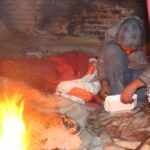
The main activities of the society come in seven stages. In the first stage which is aimed at showing kindness, we try to give out food to the addicts who sleep rough and encourage them to be reintegrated to society. Then, during the treatment stage, they are detoxified and receive psychological and medical treatment like dental care.

The education stage which paves the way for creating jobs and completing the treatment process comes next. Vocational training and educational workshops on psychology are among the courses that the society offers. Afterward, we try to create jobs for those who beat their addiction so that they can make money. Our society has different [training] workshops designed to enable people to get jobs.

Although squandering is generally frowned on by many Iranians, a large amount of food, which can meet the needs of many of our needy fellow countrymen, ends up in garbage can on a daily basis.

Because addicts and those who sleep rough have distanced themselves from society, not very often do people try to personally give their extra food to them. Given this problem, with the help of a number of research groups, the places where they usually stay have been identified and confidence-building measures have been taken.

It has been a decade since the society started giving out food to the needy and those who sleep rough. Based on the studies carried out, the society has come to the conclusion that it can act as a bridge linking citizens to the homeless and get food from them and give it out to the needy.

The introduction of a campaign on social networks was mainly aimed at getting restaurants and banqueting halls involved. Of course, we collect extra food from houses if the number of portions reaches at least 20. When the campaign met with a broad welcome, we swiftly drew up a second phase for the plan which is dubbed “Tehran; A City with No Hungry Resident” and submitted to Tehran Municipality which I hope will be soon implemented.

Based on this plan, food-collecting centers will be set up in five main parts of the city so that citizens can easily refer to the nearest center and hand in food. Every night, the society will collect the food and give it out to the needy. On average, some 2,000 individuals receive food through this plan.

Nothing was better than the massive response from the public in reaction to the campaign and the fulfillment of the objective of the society which is to urge people not to be indifferent to others, especially those who sleep rough.

It is worth noting that since the plan was made public, a number of big restaurants and banqueting halls in Tehran have been cooperating closely with the society. Some in other cities have expressed readiness to implement similar plans.


Iran MPs take symbolic dust storm protest to parliament floor

Parliament-Khuzestan

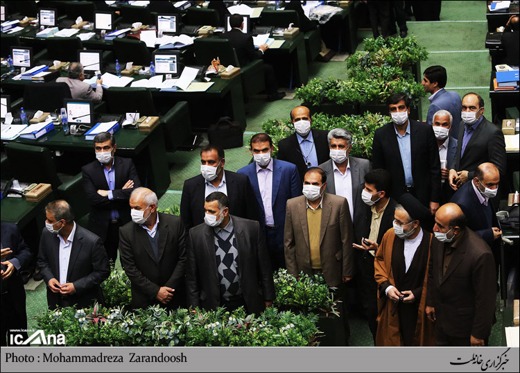
MPs representing Khuzestan, Ilam and Kermanshah provinces attended an open session of the chamber on Sunday with protective face masks on in a symbolic move to protest against poor air quality in southern cities and what they called the poor performance of the related government bodies.

Meanwhile, in remarks on the quality of air in southern Iran, top MP Ali Larijani said that officials should pay serious attention to the question of particulates which has created pain for people in southern and western provinces, although the problem has its roots in the deserts of neighboring countries.

The parliament speaker also said that it takes extensive measures by the government to make up for certain shortcomings at home and pursue an active diplomacy to galvanize the collective will of neighboring countries.

A dust storm which has disrupted life in Khuzestan Province over the past two weeks has prompted the government to order schools closed for three days and to shut down public offices for one day.

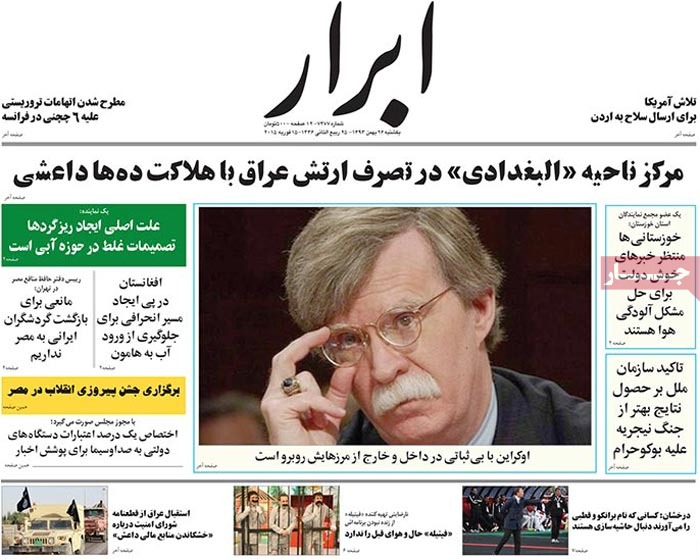
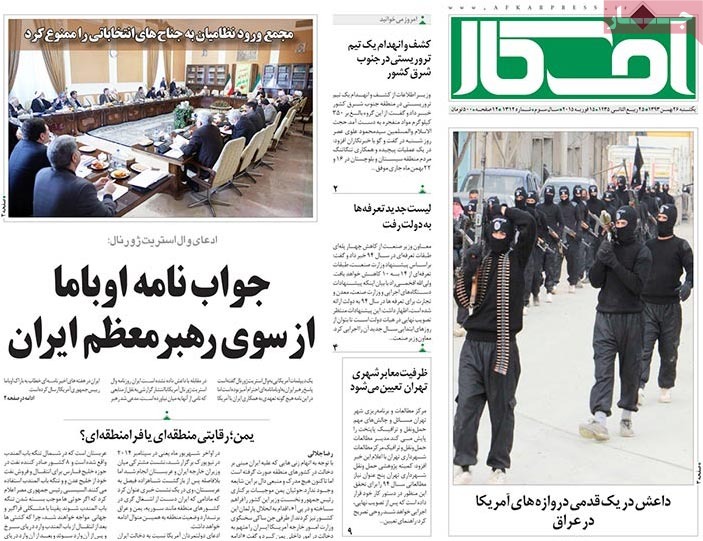
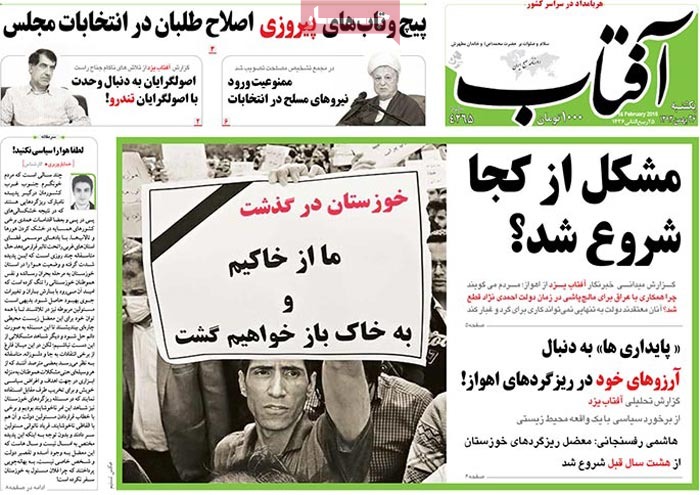
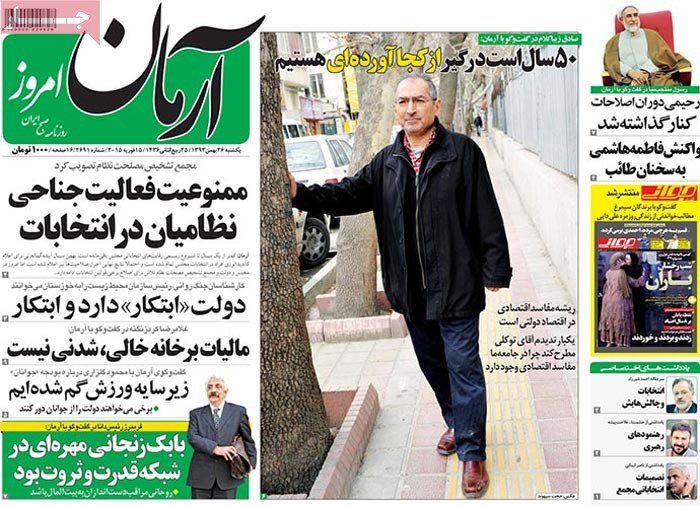
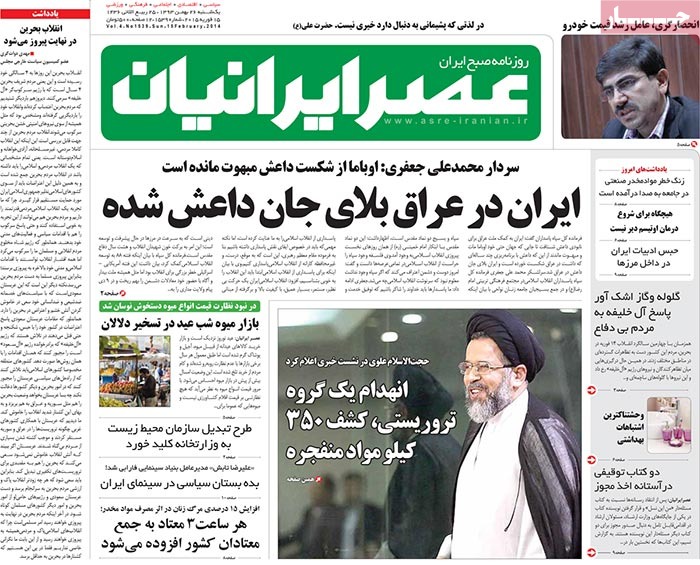
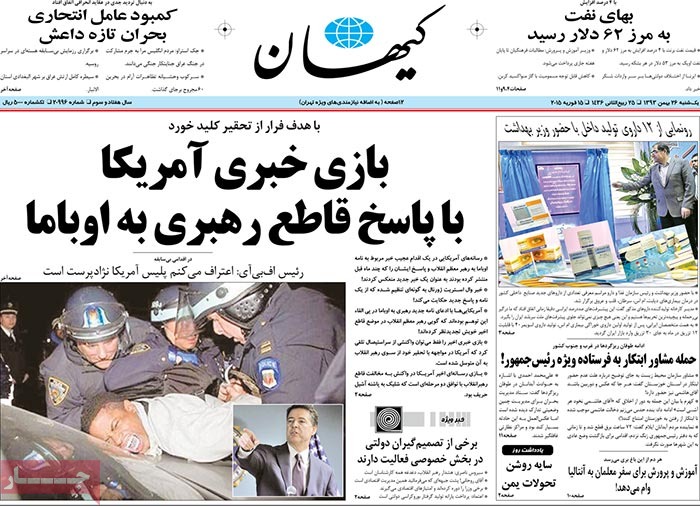
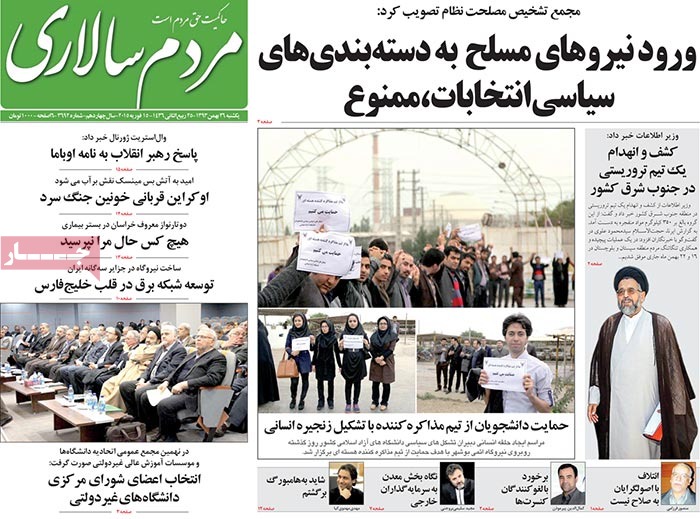
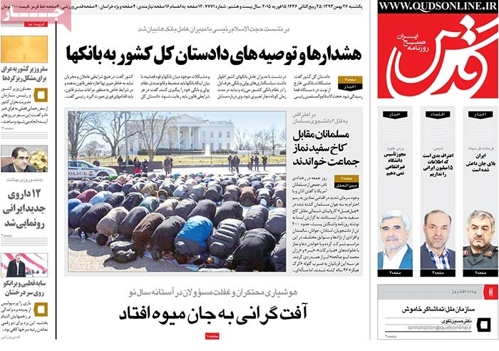
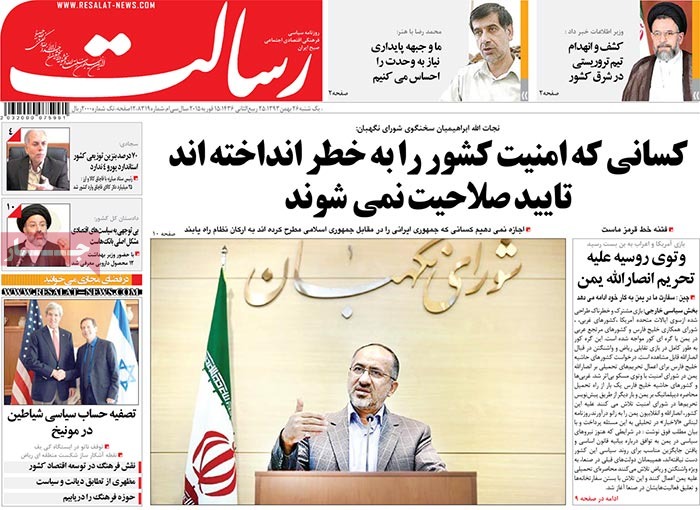
A look at Iranian newspaper front pages on Feb. 15

Iranian Newspapers Headlines

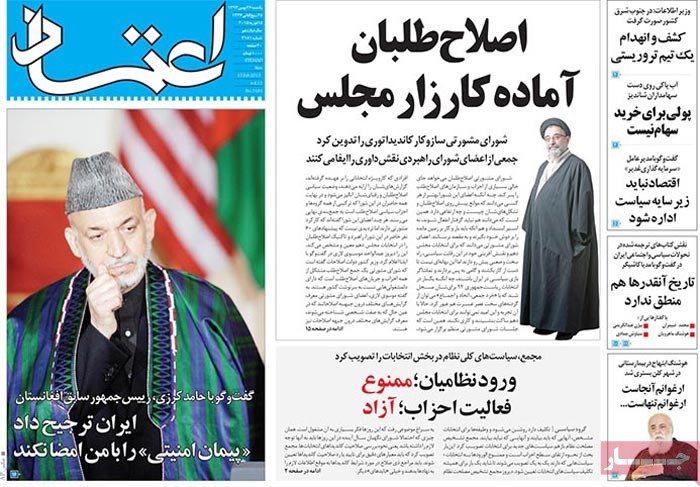
An Expediency Council decision to ban the military from getting involved in electoral campaigns dominated the front pages of Iranian newspapers on Sunday. Also on the covers of dailies were the comments of the intelligence minister that a terrorist cell has been busted in the southeast.


Abrar: “Iranian tourists face no problem going to Egypt,” said the head of the Egyptian Interest Section in Tehran.


A look at Iranian newspaper front pages on Feb. 15


Afkar: “A terrorist cell has been busted in the southeast,” said the intelligence minister.


A look at Iranian newspaper front pages on Feb. 15


Aftab-e Yazd: “The problem of particulates started some eight years ago,” said Ayatollah Hashemi Rafsanjani [in an indirect swipe at the Ahmadinejad administration].


A look at Iranian newspaper front pages on Feb. 15


Arman-e Emrooz: Military officials have been banned from factional politics in elections.


A look at Iranian newspaper front pages on Feb. 15


­­Asr-e Iranian: Each hour the number of addicts increases by three. Female deaths as a result of drug abuse have increased 15 percent.
 

A look at Iranian newspaper front pages on Feb. 15


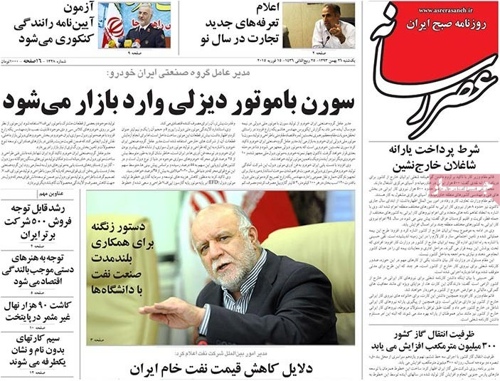
Asr-e Rasaneh: The oil minister has ordered the industry to launch long-term cooperation with universities.


Asre resaneh newspaper 2 - 15 - 2015


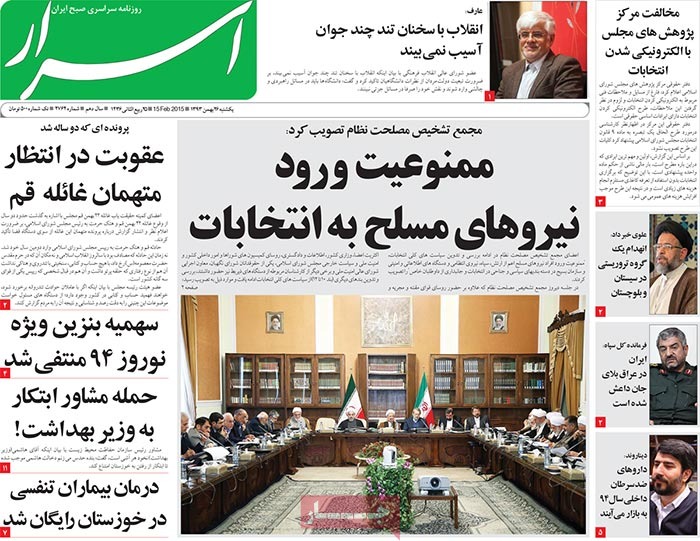
Asrar: Parliament’s Research Center is opposed to holding electronic elections.


A look at Iranian newspaper front pages on Feb. 15


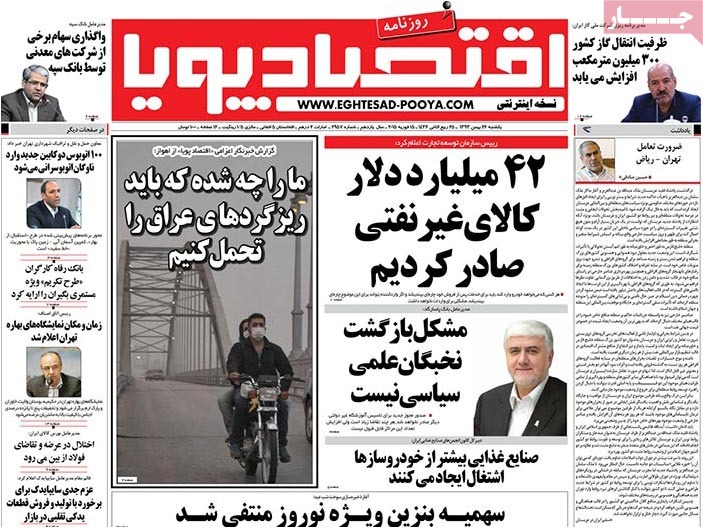
Eghtesad-e Pooya: “Iran has exported $42 billion in non-oil products,” said the head of the Trade Promotion Organization of Iran.


A look at Iranian newspaper front pages on Feb. 15


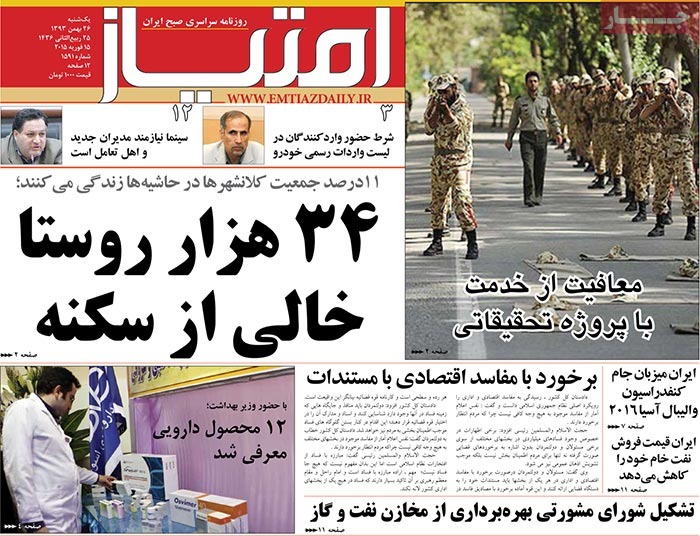
Emtiaz: Some 34,000 villages are now empty.

An estimated 11 percent of the metropolitan population lives on the edges of major cities.


A look at Iranian newspaper front pages on Feb. 15


Etemad: Iranian poet Houshang Ebtehaj has been hospitalized in Cologne, Germany.


A look at Iranian newspaper front pages on Feb. 15


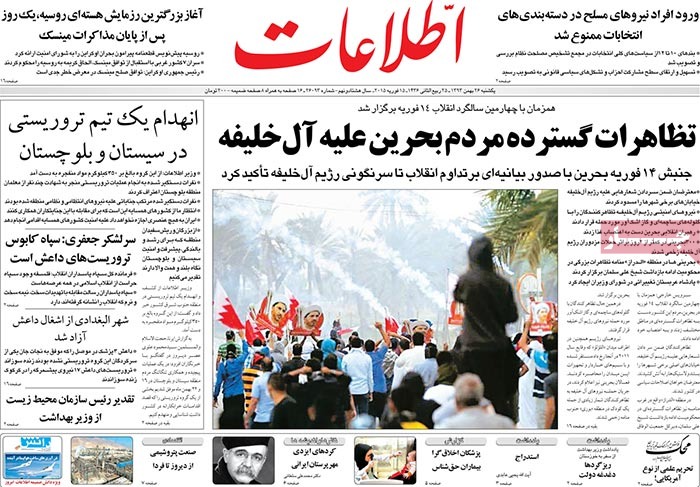
Ettela’at: “IRIG has turned into a nightmare for IS terrorists in Iraq,” said the commander of the Iranian Revolution Guards.


A look at Iranian newspaper front pages on Feb. 15


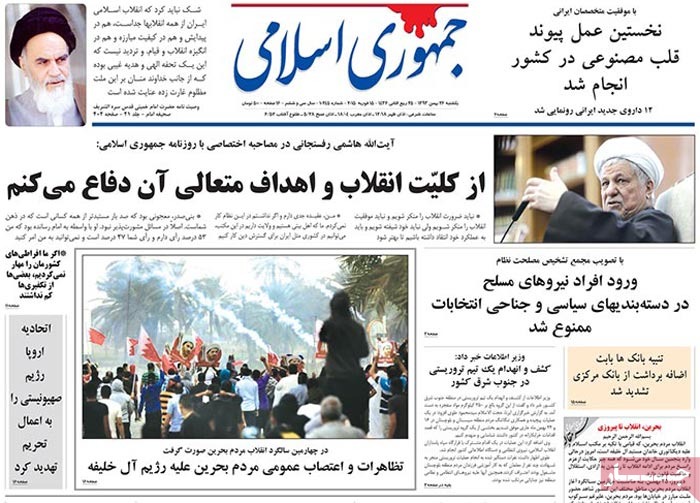
Jomhouri Islami: A first artificial heart transplant in Iran has been conducted successfully.


A look at Iranian newspaper front pages on Feb. 15


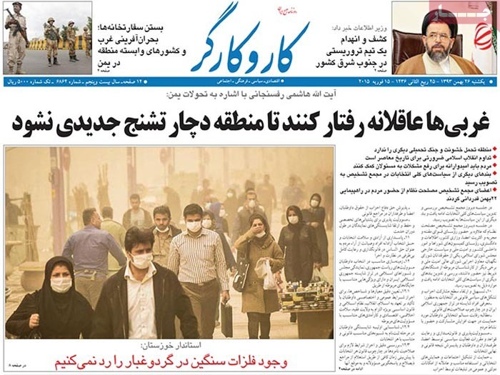
Kar va Kargar: “Westerners should act wisely to prevent tension sweeping the region,” Ayatollah Rafsanjani said on developments in Yemen.


Karo karegar newspaper 2 - 15 - 2015


Kayhan: An advisor to the director of the environment organization has criticized the president’s special envoy.

The advisor has said the health minister pops up in affairs which are unrelated to his specialty.

Kayhan: The Education Ministry is offering loans to teachers to visit Antalya, Turkey!


A look at Iranian newspaper front pages on Feb. 15


Mardomsalari: In a symbolic move, students have formed a human chain around the Bushehr Nuclear Power Plant to support the Iranian nuclear negotiators.


A look at Iranian newspaper front pages on Feb. 15


Qods: ”Admitting that 15 million Iranians are not in government databanks is unpleasant,” said a member of parliament.
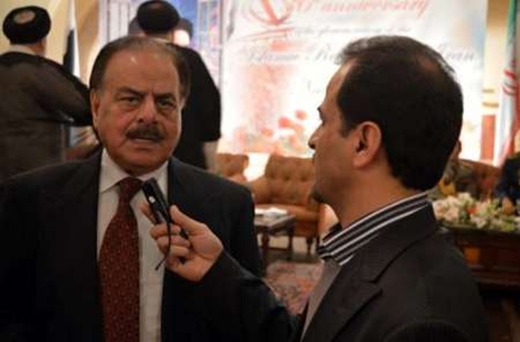
[The comment came after a government official said the names of millions of people who receive cash subsidies are not in databanks.]


Ghods newspaper 2 - 15 - 2015


Resalat: “Those who have endangered the country’s security won’t be allowed to run for public office,” said the spokesman of the Guardian Council.
 

A look at Iranian newspaper front pages on Feb. 15


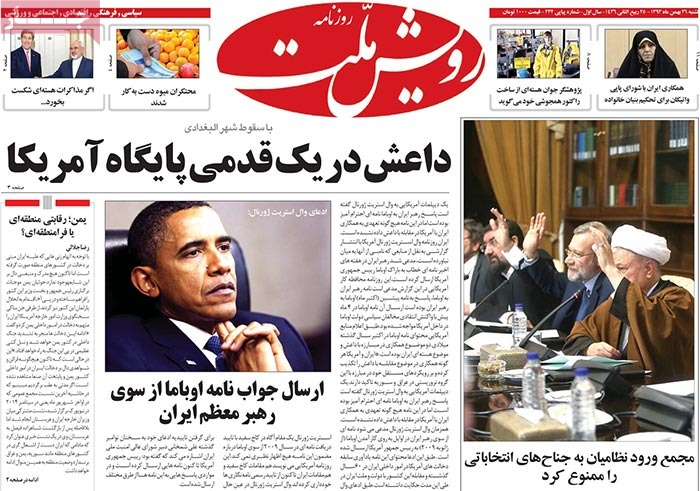
Ruyesh-e Mellat: Following the fall of the Iraqi town of Al-Baghdadi, IS is only a short distance away from a US base.


A look at Iranian newspaper front pages on Feb. 15


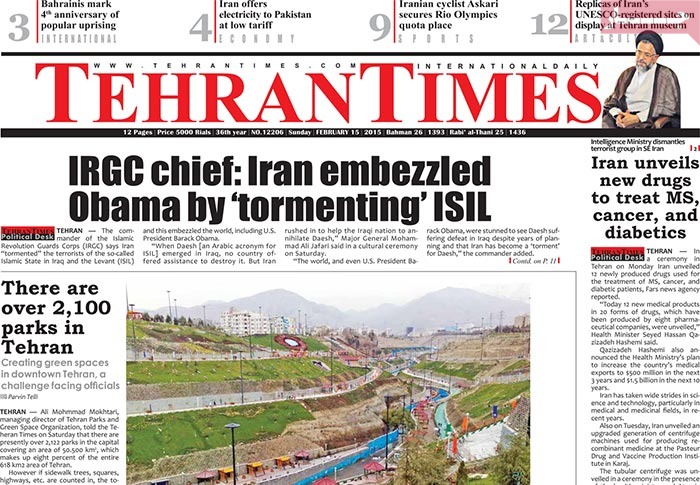
Tehran Times: Iran unveils new drugs to treat MS, cancer and diabetes.


A look at Iranian newspaper front pages on Feb. 15


US has not killed Bin Laden: Former Pakistani spymaster

Hamid Gol

Recent comments by Pakistan’s lieutenant general Mohammad Asad Durrani that the Inter-Services Intelligence (ISI) has helped the United States in tracking down Bin Laden and later killing him in a covert operation are not true, said retired Pakistani lieutenant general Hamid Gul, who once sat at the helm of ISI. The following is a partial translation of an interview the Islamic Republic News Agency conducted with the former Pakistani official.


On Bin Laden

“That the US claims it has killed Bin Laden is basically untrue. Bin Laden died of natural causes in 2005. The individual the US claims it has killed in 2011 in Abbottabad was not Bin Laden,” lieutenant general Hamid Gul said. “The Americans are not trustworthy and their claims are not true.”


On IS

“The reason why IS terrorists have been unable to make their way into Pakistan is that they face a big hurdle called Iran,” the former director general of the Inter-Services Intelligence said, adding, “The terrorist grouping knows no boundaries and seeks to expand the area under its control at any cost. But for the group to infiltrate Pakistan, it has to cross Iran and Afghanistan. We all know that crossing Iran is impossible.”


On Iran-Saudi Ties  

“In the years since the victory of the Islamic Revolution, Iran has had some disagreements with Arab countries, but with the rise to power of King Salam in Saudi Arabia new developments have been set in motion which could narrow the gap between Tehran and Riyadh,” the former Pakistani official said.

“Because of American plots, Arabs have always been baselessly concerned about Iran,” he said, adding, “Tehran should now reach out to Arab countries, especially Saudi Arabia, and convince them there is nothing to be worried about and that the fears the US has instilled in their ranks are groundless.”

Sepandarmazgan, Persian Feast to Respect Women, Earth, Life

Sepandarmazgan

Sepandarmazgan is a day Iranians observe in honor of love, affection and earth, each year.

Traditionally, the earth is praised and women are venerated during this day which is celebrated on the 29th of Bahman in the Persian calendar [February 18] . But does it have anything to do with the Western Valentine’s Day?

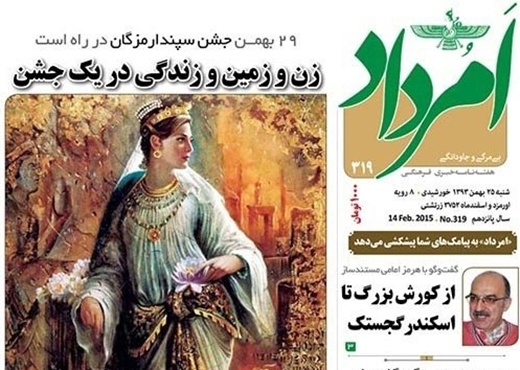
In its Feb 14th issue, Amordad weekly ran an opinion piece by Mobed Ardeshir Khorshidian, the head of Tehran’s Mobeds Association. He speaks about about the Persian Day of Love in this article, trying to clear up the confusion surrounding the Iranian celebration and the similar Western feast.

The following is a partial translation of the piece:

Sepandarmazgan Isn’t Equivalent to Valentine Day

An underlying principle of Zoroastrianism – which is one of the foundations of this land’s [Iran] culture – is the equality of the rights of all humans, including men and women.

Sepandarmazgan is a Zoroastrian festival. The date of the festival as observed in the Sassanid era was on the 5th day of the month Spandarmad. Iranian always held “name-feast” celebrations when the name of the day and the month of the day coincided.

That said, Bahman 29 [February 18] has been designated as Mozdgiran [Esfandgan] or Sepandarmazgan; a day to show respect to mothers and women. Men would seat their beloved wives and daughters on the highest place on this day; offering them generous gifts which were spiritually invaluable. Persian men expressed their gratitude and love for the nearest and dearest in their lives this way.

Women in Persian Culture

On such an auspicious day, women were relieved of household chores. Instead, men would take charge of the housework to learn more about the importance of big responsibilities women shoulder in their lives, develop an understanding of women’s status, and express thankfulness for what women usually take care of.

In the Iranian culture, zan (woman), zamin (earth) and zendegi (life) have one root which means zayandegi (reproduction). Accordingly, [ancient] Iranians used to believe that “woman” is the embodiment of reproduction in the world.

Persian men used to call their wives as hamsar (spouse) which – in Farsi – means the one who is equal with her husband; as well as kadbanoo (housewife; the one who is good at housekeeping) which means the light and manager of the house. In the eyes of Iranians, women – like life and the earth – are of high and lofty value.

Recently, certain Iranian theoreticians have tried to call Sepandarmazgan* as the Iranian Day of Love in a bid to prevent people from marking the Valentine’s Day, which has nothing in common with the Iranian culture and religion. Although such a move is appropriate and conscientious, it has been pursued out of a lack of knowledge.

Mehregan; the Persian Day of Love

Iranians should know that the Day of Love for Persians is the day of Mehr in the month of Mehr which is celebrated as “Mehregan” [an Iranian festival celebrated in honor of Mithra, the divinity of covenant, and hence of interpersonal relationships such as friendship, affection and love. The festival falls on the 196th day of the Iranian year or 10th Mehr and 2nd October].

Mehr means love which comes with loyalty to [one’s] promise, and it cannot be confined to Jashne Esfandgan [the Esfandgan Feast is celebrated on Sepandarmaz Day] in which women [and mothers] are honored.

Iranians believe that beside harboring love for women and life, people should love the whole universe and its single and unique Creator. Therefore, the Iranians celebrate Mehregan- the Persian Day of Love- to honour the love for family members, relatives, coreligionists, fellow countrymen, fellow humans and all the symbols of goodness in nature.

Trees are sacred to Iranians

Trees in Iran

Trees were regarded as holy in ancient Iran. They have been also respected in Islam. But the way they are treated today shows no trace of sanctity or respect whatsoever.

Etemad newspaper on Feb. 3 ran an opinion piece by Ali Yachkaschi – a professor of environmental science, environmental activist and author – on the sanctity of trees in ancient Iran and the place of trees in Iranian culture. What appears below is a full translation of the piece:


Professor_Ali_YachkaschiTress and forests were of immense significance in Iranian mythology which hails trees as good humans who have turned into trees after their death and have been given an eternal life. So cutting huge fruit trees was a practice widely frowned upon.


Ancient Iranians believed that anyone who cuts a tree would lose a loved one in the same year. Unlike what the Food and Agriculture Organization of the United Nations (FAO) claims, designation of a tree-planting day dates back to [the Prophet] Zoroaster’s time in a bid to protect and develop green space and forests. Zoroaster himself would plant a sapling on the tree planting day each year.

Platanus, cedar and Ziziphus were among the trees which were popular with the Iranians. The huge platanus tree has a wide leafy shade. People used to say that it would help prevent a breakout of fever and infectious diseases.

They held a similar belief about cedars which have had a key role in [ancient] Iran’s literature and art. Today medicine has proved that certain trees help kill microbes by emitting different kinds of essence into air.

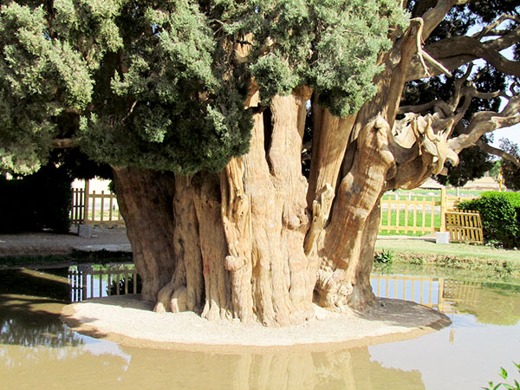
Cedars hold a special place among tree species in Iran. Ancient Iranians always showed respect for them. Cedar was sacred for the Persians who showed high esteem for the tree. They also believed that eating cedar’s pollen, leaves and buds would lead to greater longevity. According to Persian myths, cedar had originated from the paradise, so it was called the Minoo [Paradise] tree.

The spiritual impact of this tree on Iranians was so much that its signs are still evident in all manifestations of the civilization. Islam too attaches vital significance to trees and forests. The Prophet Muhammad (PBUH), for instance, said that breaking a tree branch amounts to cutting an angel’s wing. The Prophet has even stressed – in different hadiths – the spiritual reward associated with planting trees and the scolding that comes with cutting them, or their branches.

Several hundred years Before Christ, Xerxes [of Persia, a king of the Achaemenid Empire] created the world’s first protected area. During a military offensive in which he took his troops to Asia Minor, Xerxes delegated the protection of a cedar forest to a royal guard.

According to reliable historic texts, Iranians made considerable practical efforts to take care of tree planting, forestry and forest management 445 years Before Christ, and drew up codified and legally binding laws in this regard.

Sperber holds that Iranians were the first people who established a forestry organization and paid special attention to sustainable development. “Others planted [trees] and we ate the fruits; we are expected to plant [this time] so that others can eat the fruits” is the meaning of “sustainable development” an Iranian old village man said in response to Anooshiravan [Khosrau] 14 centuries ago.

Von Hagen, a renowned German forester in the 19th century who was inspired by the old village man’s words, writes, “Exploit the forest as much as its trees grow and hand it over to posterity at least the way you got it from those living in the past.”

These comments which have been known as Hagen’s “golden words” mark the start of scientific thinking about sustainable development in Europe and the world. Later laws were passed on the exploitation of natural resources based on economic interests of European countries.

The International Union for Protection of Nature was held for the first time in Bern, Switzerland in 1913, and 35 years later the International Union for Conservation of Nature (IUCN) was formed. It set the stage for the establishment of the first world park.

In 1972, the United Nations Conference on the Human Environment was held in Stockholm, Sweden and designated Dasht-e-Arjan National Park in south-western Iran as an international park where researchers from all over the world could do studies. For the first time the conference took into account the whole universe whose resources should be tapped into based on the principle of sustainable development.

An important question arises here: how come the wide expanses of forests are being destroyed in a country which attaches so much significance to the trees and forests, and treats them as holy things? As a case in point one can make mention of 2 million hectares of forests in northern Iran which were cut down in the first half of the 20th century.

The answer to this question cannot be offered here in this article, but we can in brief point to a change of attitude and consumption patterns in modern times, something which has resulted in irregular exploitation of natural resources, among them forests.

I hope I can elaborate on this topic in another piece and provide an answer to this vital question.