Thursday, December 25, 2025
Home Blog Page 4951

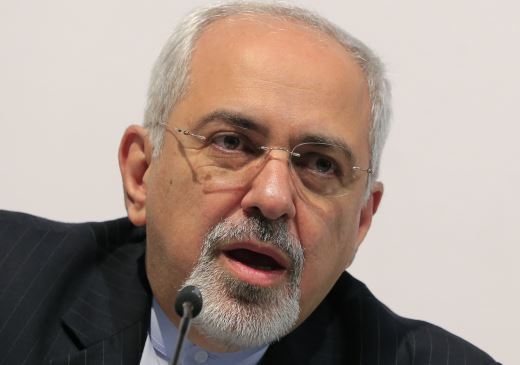
Iran not to join US-led fight on ISIL: Zarif

Mohammad Javad Zarif Iran FM

Iran will not team up with the US against ISIL because “we were not convinced that the United States government was serious” in its claim to fight terrorism, Zarif said in an interview with PBS NewsHour in New York on Friday.

He also criticized the US Congress plan to finance “moderate Syrian militants” in the fight against the extremists, saying the decision does not correspond with the so-called efforts to fight terrorism.

“You do not fight terrorism by weakening the central government which is the most important element in rejecting and opposing these terrorists. If you undermine the central government in Syria, that would enable the IS (ISIL) terrorists to gain even more territory,” he added.

Touching on the situation in Iraq, Zarif said that the Iraqis themselves are capable of defending their territory.

In a nationally televised address on September 10, US President Barack Obama said the United States will join “our friends and allies to degrade, and ultimately destroy, the terrorist group known as ISIL.”

On Friday, Obama also signed into law a piece of legislation authorizing the military to arm and train anti-Syria militants.

Earlier this week, Leader of the Islamic Revolution Ayatollah Seyyed Ali Khamenei described as “absurd, hollow and biased” remarks by US officials regarding the formation of a US-led international coalition to battle the ISIL terrorist group.

The ISIL terrorists control large parts of Syria’s east and north. ISIL also sent its militants into Iraq in June, seizing large swathes of land straddling the border between Syria and Iraq.

A creeping current seeks to distort the history of revolution

Dr Hossien Entezami
Dr Hossien Entezami

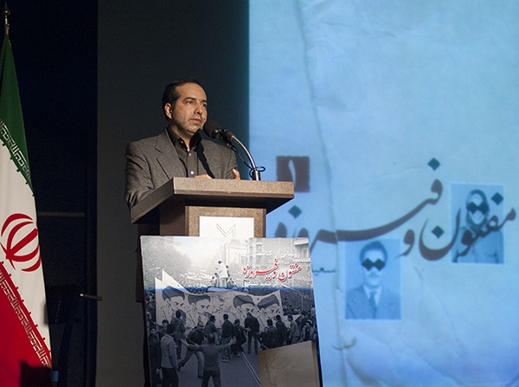
A creeping current is distorting the facts of the revolution and painting an imprecise picture of revolutionary developments in oral history books and in interviews, Mehr News Agency quoted Deputy Minister of Culture and Islamic Guidance Hossein Entezami as saying Wednesday (September 17).

Speaking at the launch of a book, which is an account by cultural activists of what happened during the Islamic Revolution [of 1979], the deputy culture minister said the current in question seeks to play down the role of the founding father of the Islamic Republic Imam Khomeini in the revolution and put it on par with factors which pale in comparison.

Iran says ‘very good’ atmosphere prevails in nuclear talks

Nuclear-Talks
Nuclear-Talks

“In general, a very good atmosphere prevails in the talks,” Iranian Deputy Foreign Minister for Legal and International Affairs Seyyed Abbas Araqchi told reporters in New York on Friday.

The senior Iranian nuclear negotiator also stated that differences on some issues exist but the two sides have expressed determination to continue the negotiations.

He expressed optimism that over the next days the two sides manage to sum up some of the existing issues and, if possible, they can make some tangible progress in the talks.

Araqchi pointed to the level of uranium enrichment, activities of Iran’s Arak and Fordow nuclear sites, and the manner in which the anti-Iran sanctions would be removed as some of the major bones of contention.

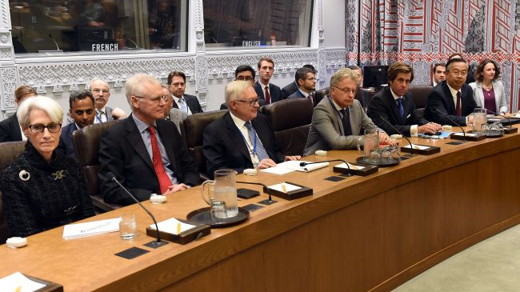
The latest round of nuclear talks between Iran and the six countries – Russia, China, the United States, Britain, France and Germany – started at the UN headquarters in New York on Friday morning.

The Iranian delegation is headed by Foreign Minister Mohammad Javad Zarif and the EU foreign policy chief, Catherine Ashton, leads the other party.

The two sides signed a historic interim deal in Geneva, Switzerland, last November. The agreement came into force on January 20 and expired six months later. In July, they agreed to extend the negotiations until November 24.


There will be either two winners or two losers

Francois Niccolo
Francois Niccolo

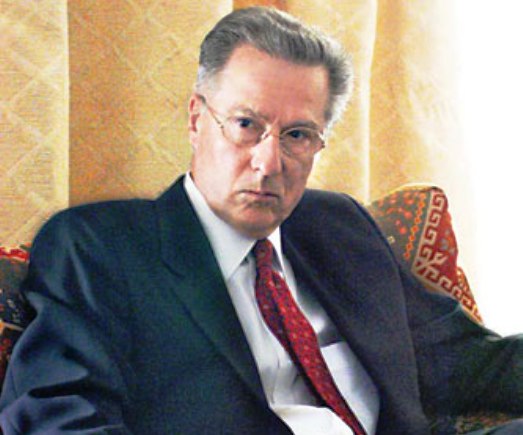
Francois Nicolo was a very active French diplomat between 1964 and 2005, the French consul general in Chile, Germany and India and the French ambassador to Hungary and Iran. The veteran politician has also been the French ambassador to the United Nations. His presence in Tehran and on the French nuclear negotiating team in 2005 have turned him into an expert in the fields associated with nuclear matters.

Entekhab [Choice] website has recently had an interview with him about different questions Iran is dealing with in terms of nuclear talks with P5+1 and the regional threat of ISIL. What comes below is an excerpt of his answers in the interview:

  • As long as Iran continues its tangible yet covert assistance to Iraq to take on ISIL, it does not matter whether or not Iran is officially included in the trumpeted coalition.
  • Everyone in the region, Europe, America and Iraq knows well that Iran’s support in the combat against ISIL is essential.
  • After ten years of fruitless wrangling, the most important distinction between nuclear talks now and 2005 is that the need for a solution has taken on urgency.
  • No one has the upper hand in the talks. In the end, there will be either two winners or two losers.
  • Unfortunately, sanctions keep delivering a blow to Iran which needs to have free interaction with the world to make progress on social and economic fronts. To get there, sanctions have to be lifted.
  • I am of the idea that the nuclear talks are extremely technical and have got nothing to do with regional and political matters, but it’s a fact that regional crises will all benefit from a successful solution to Iran’s nuclear dossier.
  • Over the years, France has adopted a tough position on non-proliferation of nuclear weapons and the effects of such stance are clear at the present talks. Depending on conditions and time, such an approach can please some and upset others.
  • Do not bet on the disagreement and probable division between Europe and America over Iran’s nuclear case. No matter how high the tensions, Europe won’t put its relations with America on the line over Iran.
  • I hope that Mr. Zarif was right [when he said that he is optimistic about the outcome of talks in New York]. However, a momentous thing has to happen before a deal is cut, and I have confidence in Mr. Zarif and his team to do their part wholeheartedly.
  • To reach an agreement, Iran and P5+1 have to make some changes to their stance. They should take the risk of coming under fire at home. In fact, both sides are in difficult conditions, but there is no option except reconciliation.
  • Nothing good will come out of the failure of the talks. Hawks are the only ones who might benefit from it for a short time.

Remarks [by former Secretary of State Henry Kissinger that Iran wants to rebuild an ancient empire] might sound somewhat sensible, but Mr. Kissinger blew a perfect opportunity to stay silent.

Wildlife ambulance service launched in Sistan and Baluchestan

Iran wildlife ambulance

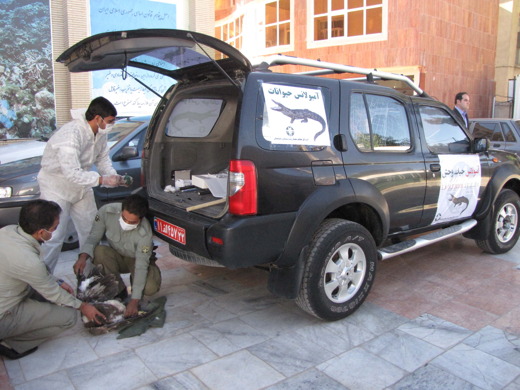
The provincial environment department in the southeastern Iranian province of Sistan and Baluchestan has launched a wildlife ambulance service.

On September 17, Iran newspaper quoted Saeed Mahmoudi, the head of the environment department as saying that the move is primarily designed to save protected species such as bears, cheetahs, foxes, etc. that are injured in road accidents.

In parallel, a messaging service has been launched to allow residents to easily report accidents to authorities, he said.

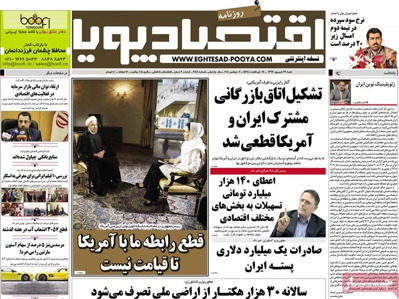
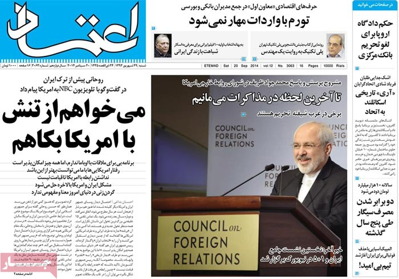
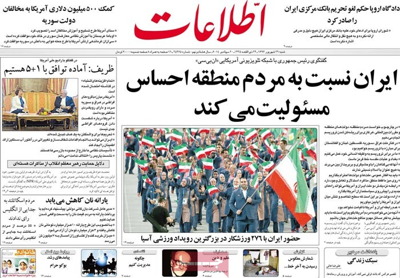
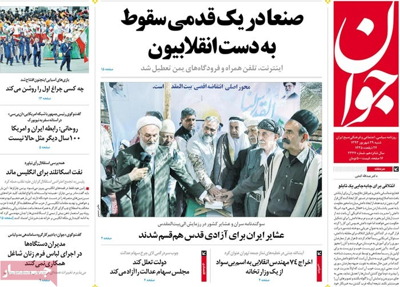
A look at Iranian newspaper front pages on Sept. 20

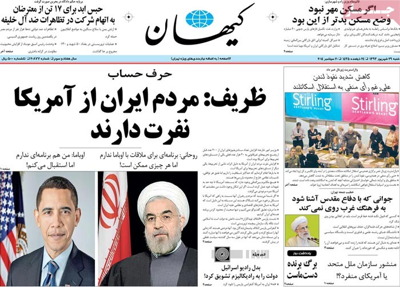
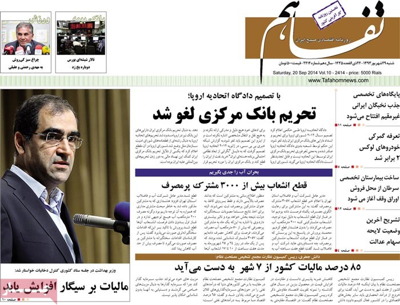
Iranian Newspapers headlines
Iranian Newspapers Headlines

A few stories dominated the front pages of Iranian dailies on Saturday. The most headline-grabbing story was President Rouhani’s interview with NBC News – prior to his visit to New York to attend the United Nations General Assembly – which covered a lot of questions including Iran’s approach to ISIL, and the likelihood of a thaw in Iran-America relations. Another big story was the opening ceremony of Asian Games 2014 in Incheon, South Korea on September 19. On the international front, news of the Scottish no-vote in a referendum to break away from the United Kingdom and the reaction to the outcome was also among front-page reports.

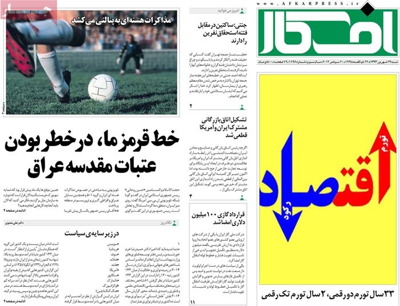
Afkar: The National Iranian Gas Company signed a contract worth $100 million with a European firm. The deal is intended to eventually boost gas pipeline pressure across Iran.


Afkar Newspaper-09-20


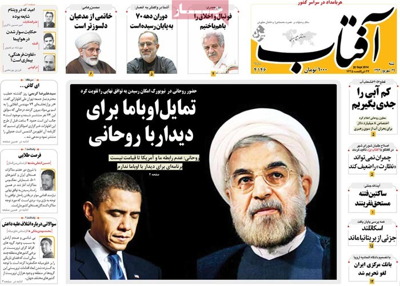
Aftab-e Yazd published comments by Cultural Advisor to President Rouhani Hessameddin Ashena addressed to Secretary General of Ansar Hezbollah Abdolhamid Mohtasham. “The 1990s are in the past.” It came after Ansar Hezbollah announced that it will send motorbike patrols to the streets – like in the 90s – to promote virtue and prevent the violation of the Islamic dress code.

Aftab-e Yazd quoted Secretary General of the Islamic Association of University Professors Mohsen Rahami as saying, “Khatami is more caring than those who claim [to be concerned about the establishment].” His comments came as a letter addressed to the Supreme Leader by former President Mohammad Khatami drew outcry from the rivals of reformists. In the letter Khatami expressed pleasure over the leader’s recovery following his prostate surgery.


aftabe yazd Newspaper-09-20


Asia: “US President Barack Obama is open to a meeting with President Rouhani [in New York during the United Nations General Assembly].”

Asia: “Great Britain remained great,” was the headline of a report which referred to the results of a referendum in Scotland on Sept. 18 in which Scots said no to independence from the United Kingdom. NATO and the European Union expressed delight over the outcome of the plebiscite.


asia Newspaper-09-20


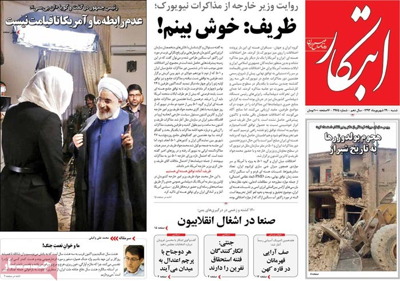
Ebtekar quoted Iran’s Foreign Minister Mohammad Javad Zarif as saying, “I am optimistic [about negotiations between Iran and P5+1 in New York].

Ebtekar: “The break in our relations with the US will not last forever,” said President Rouhani in an interview with NBC News.

Ebtekar: “An attack by bulldozers on historical sites” is a headline that the daily put on its front page to report unauthorized destruction overnight of some historical houses in the vicinity of Shah Cheragh – a funerary monument and mosque in Shiraz, housing the tomb of the brothers Ahmad and Mohammad, sons of the seventh Shiite Imam. In a letter addressed to the Supreme Leader, head of Iran’s Cultural Heritage, Handcrafts and Tourism Organization Masoud Soltanifar called for the leader’s intervention in the issue.


ebtekar Newspaper-09-20


Eghtesad-e Pooya: “The Iran-America joint chamber of commerce is bound to be forged.”

Eghtesad-e Pooya quoted Deputy Minister of Agriculture Mohammad Ali Tahmasbi as saying, “Annual pistachio exports standat $1 billion. Among other countries, China, India, Russia, and Commonwealth countries are the main importers of Iran’s pistachio.”


Eghtesade Puya Newspaper-09-20


Etemad: “I want to ease tensions between Iran and America,” President Rouhani said in an interview with America’s NBC.

Etemad: “Cigarette consumption has seen a 2-fold rise over the past 5 years, meaning over $3.3 billion has gone up in smoke on a yearly basis.”


Etemad Newspaper-09-20


Ettela’at: “A European court has struck down sanctions on Iran’s Central Bank.”

Ettela’at quoted Deputy Minister of Industry, Mine and Trade Ali Ghanbari as saying, “A plan is under examination to push down bread subsidies by almost 30 percent.”

Ettela’at: “Iran’s presence in the biggest sporting event of Asia with 276 athletes” was the daily’s report on the opening of 2014 Asian Games in Incheon, South Korea.


Etelaat Newspaper-09-20


Hadaf va Eghtesad: “A creeping current is trying to play down the role of the founder of the Islamic Republic Ayatollah Khomeini in the 1979 Revolution,” said Hossein Entezami, the deputy minister of culture and Islamic guidance.


Hadafo Eghtesad Newspaper-09-20


Javan: “Sana’a is one step away from fall to the revolutionaries.”


Javan Newspaper-09-20


Kayhan: “Seventeen were sentenced to life imprisonment in Bahrain on charges of taking part in anti-government protest rallies.”


Kayhan Newspaper-09-20


Tafahom: “Taxes on cigarettes should rise,” Health Minister Hassan Hashemi said in a first meeting of the National Headquarters for Tobacco Control, citing the fact that a tax rise can stem the inflow of contraband cigarettes.


Tafahom Newspaper-09-20

Tehran and Ankara have patched up differences: Iran’s envoy

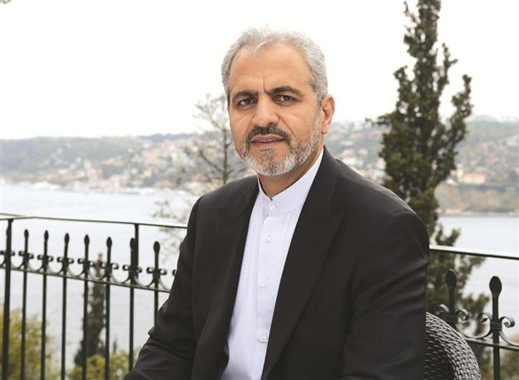
Alireza bigdeli Iran’s ambassador to Turkey

Recep Tayyip Erdogan is a man who has played different roles at the top of Turkey’s hierarchy of power since March 2003. He was sworn in on August 28, 2014 as the 12th president of Turkey.

Erdogan, who was Turkish prime minister between 2003 and 2014, is the first president of the republic to have been directly elected into office in a popular vote. His presence on the political scene in the capacity of president comes at a time when strategies employed by his ruling Justice and Development (AK) party have undergone unpredictable changes as a result of recent developments in the region.

His presidency might either see the policies of the past carry on, or it may usher in reforms which could, in turn, prolong the years his party will remain in power. Turkey has experienced ups and downs in its relations with Iran over the years Justice and Development has been in power.

Prior to recent developments in the Arab world, Tehran and Ankara had common ground on many regional matters. However, following popular uprisings in Tunisia and Egypt which later found their way to Bahrain and Libya, the interests of the two countries diverged.

When Hassan Rouhani, who ran on a platform of moderation and détente, emerged victorious in Iran’s presidential vote, an opportunity to improve Tehran-Ankara relations presented itself.

Over the past year, many Iranian and Turkish officials have met at different levels. That’s why the two countries are likely to leave behind their regional disagreements and seek close cooperation to serve bilateral interests.

Etemad [Trust] newspaper has interviewed Iran’s Ambassador to Turkey Alireza Bigdeli to assess the likely impact of recent changes in Turkey on the country’s diplomatic apparatus, Tehran-Ankara ties under President Rouhani and the new Turkish government, and the probable effects of the Syrian crisis on Iran-Turkey relations. Etemad’s Sara Masoumi has conducted the interview the translation of which comes below:

Following the recent presidential election in Turkey, some officials have been replaced, although the leadership structure and strategy have stayed the same. From your perspective, what are the implications of Recep Tayyip Erdogan’s presence in the capacity of president and Ahmet Davutoglu at the helm of premiership for Turkey’s macro foreign policy?

Turkey’s foreign relations mostly depend on diplomacy which is a pillar of governance in the country, because it is capable of smoothly taking the country in the direction of national objectives at a low cost.

In my opinion, with Mr. Erdogan as president and Mr. Davutoglu as prime minister, former Minister of European Union Affairs and Chief Negotiator Mevlut Cavusoglu, who has now become foreign minister, is the only new key player on the diplomatic front.

Because of his previous position, Cavusoglu is well aware of foreign policy, so I think his presence in Davutoglu’s government can introduce some changes to Turkey’s foreign policy. He is pragmatic and can create new opportunities in Turkey’s diplomacy to ease tensions.

Davutoglu is well known among journalists for his zero-problems policy with neighbors, a theory which has at least faced a lot of challenges over the past few years. To what extent, will Turkey’s foreign policy change following its failure to deliver?

After the dissolution of the Ottoman Empire after in the wake of the First World War, politicians who rose to power in Turkey resorted to introversion in response to crucial threats to their country.

Given the trends which emerged in Turkey in the ‘80s and ‘90s, Mr. Davutoglu reached the conclusion that Turkey could only avert existential threats if it adopted a policy of extroversion and paid more attention to its surroundings.

In line with such policy, Turkey needed to first start with its neighbors. In other words, as a first step it had to settle its differences with its neighbors.

Iran-Turkey ties have seen ups and downs since the Revolution of 1979. At times, Turkey has been a close ally of some Iranian administrations and even sought to get involved in Iran’s nuclear talks. At other times, it has been a regional rival Iran has had to live with. From your perspective, what changes have Tehran-Ankara relations undergone since President Rouhani took office?

I think one should use caution in saying that Iran-Turkey ties have not been the same under different governments. Relations between countries are not subject to change that easily, because ties have roots in national interests and more importantly in national goals.

In fact, different governments have moved in different directions to obtain their national interests. Over the past year, ties between the two countries in the realm of hardware have moved in the direction of overcoming the obstacles created by sanctions. In the domain of software, efforts have been made to protect bilateral relations against the effects of the Middle East crisis.

Over the past year, the influence of media on the public opinion of Turkish people has, on the one hand, improved the image of Iran in Turkey and on the other hand, has presented Iran as a regional competitor.

The Geneva deal has taken the additional psychological pressure away from Tehran-Ankara relations. Nonetheless, it has raised concerns about the future of ties between the two nations when Iran finds a way out of this unfair atmosphere.

Turkey has made a lot of efforts to surpass sanctions and establish robust economic relations with Iran, either through negotiations or by winning over the Western countries. However, the private sector which handles much of Turkey’s economy has not taken the risk or has been reluctant to do so.

Of course, I should mention some examples of further interaction between the two countries which played a key role in maintaining and cementing the ties.

The following are just some of the high-level contacts: the Turkish prime minister’s visit to Iran in January 2014 and the preferential trade deal signed between the two nations, President Rouhani’s visit to Turkey in June 2014 and the first meeting of Iran-Turkey Supreme Strategic Cooperation Council, numerous meetings between officials of the two countries, three visits by the Turkish parliament speaker since President Rouhani took office, 12 meetings between the top diplomats of the two nations, the 24th joint Iran-Turkey Economic Commission and two visits by the special representatives of the presidents of Iran and Turkey.

To what extent, has the Syrian crisis had an impact on Tehran-Ankara relations? During the recent visits by Iranian officials to Turkey, has any effort been made to narrow the gap between the two countries on Syria?

The crisis in Syria is a symbol of geopolitical challenges during the period of transition. Even prior to the eruption of the crisis in Syria, there were conflicts over Damascus in the region.

I mean, since the matter of US troop withdrawal from Iraq was raised, Iran-Turkey relations were affected. Such assumptions can be substantiated by documents released by WikiLeaks.

The developments in the Middle East, especially after what happened in Libya, transformed the conflicts in Syria and gave them a military nature. Given the significance of Tehran-Ankara ties, and their interest in ensuring regional security at a minimum cost, the two countries agreed not to let their relations be influenced by regional conflicts.

Anyway, disagreement over Syria has come at a security cost, but the two countries know well that if such security complications found their way into mutual ties, the damage would be irreparable.

Aside from talks at presidential and foreign ministerial levels, there have been regular negotiations between deputy foreign ministers and diplomats of the both countries in Tehran, Ankara, and Baghdad. These talks are intended to boost common ground and minimize disagreements.

I think, these developments have set the stage for further cooperation and both sides are determined not to let their relations fall victim to regional developments.

Since the Syrian crisis began in 2011, we have seen Shiite-Sunni divisions deepen from Syria to Iraq to Bahrain. In your opinion, to what extent does Turkey follow the policy of containing the Axis of Resistance [a reference to Iran, Syria and the Lebanese Hizbollah] and Shiite currents in the region?

First of all, when we talk about Turkey, we should bear in mind that there are different lines of thinking and different political currents in this country.

Considering the parliamentary-party system there, people support three or four main parties and some 85 percent of those eligible to vote cast their ballots.

Given the regional concerns and threats, each country naturally adopts policies and implements them. At times, such political and economic concerns are coupled with security problems and could pose an existential threat to the country. […]

The approach by the Turkish government to developments in Iraq over the recent years has been far from neutral. At multiple critical junctures, Turkey has contacted Iraqi Kurds and even granted asylum to fugitive Iraqi Vice President Tariq al-Hashemi. Why are there open tensions in Ankara-Baghdad relations?

Such an approach stems from a mentality which we should not try to evaluate. In fact, we need to get to know it, because such a mentality will have an impact on Iran’s interests, and affect Iran’s ally: Iraq, the enter region, and the Muslim world at large.

In my estimation, developments in Syria have their roots in what is going on in Iraq. I already told you that after the idea of US troop withdrawal from Iraq was floated, things changed for Syria. The reason is crystal clear. Developments in Iraq have an effect on stability and security in Turkey. […]

I stress one more time that I do not intend to assess how things are being handled and describe it as either right or wrong. Given the great deal of uncertainty in the transition period, definitely whoever enters the scene to take action is sure that what he is doing is what must be done and only with time one will figure out whether such a policy has been right or not.

Many intelligence agencies brought up Turkey’s inaction against IS (the Islamic State) and raised the prospects of it supporting the terrorist group. Why did Ankara fail to take action when Kurds in Sinjar came under IS attack?

It is assumed that election campaigns and the kidnapping of Turkish diplomats at the hands of IS in Mosul have played a significant role in Turkey’s reaction. IS is a notorious group doomed to failure and only dysfunctional and failed governments can stay in touch with it. From my perspective, the Turkish government has nothing in common with IS.

How do you think the interaction between Erdogan’s government and the Kurdish Workers Party (PKK) will turn out?

The matter goes beyond the interaction with a group. It is part of a solution to which Erdogan and Davutoglu give top priority. I think along with the Turkish economy this matter is of great significance.

This is a major process that our Turkish friends are hoped to go through smoothly, because if they can pull it off, it will ensure stability along our borders with Turkey and develop new markets for Iran. On the contrary, failure of the plan could foment instability along the borders.

Will Turkey throw its weight behind the notion of an independent region ruled by Kurds in a way which Iraqi Kurds wish for?

The Turkish official stance is support for the Iraqi territorial integrity and its constitution.

Ankara-Tel Aviv relations have been tense during the years-long blockade of Gaza. Now that cracks have appeared in ties with Syria and Iraq, do you think Turkey will take steps towards normalizing its relations with Israel?

Turkey has set some preconditions before it normalizes relations with Israel. That indicates normalized ties with Israel are not a taboo from the viewpoint of Ankara, but I don’t think Syria or Iraq will have an affect on Turkey’s decision. In fact, what is important is Turkey’s national solidarity.

In his first address after being sworn in as president, Recep Tayyip Erdogan once more underlined Turkey’s willingness to accede to the European Union. Given the new political equations in the region, do you think the union between Turkey and the EU is likely?

The question has always been part of Turkey’s foreign policy. The current Turkish foreign minister used to be the minister of EU affairs which means the government has set up a ministry for that matter even before its accession to the EU. I think the accession process is constantly monitored and adjusted based on Turkey’s strategic depth in the surrounding region.

As for Turkey’s foreign policy, what sounds to be a more outstanding structure? Secularism or Islamism? If your answer is Islamism, how would you justify Turkey’s ties with Israel and NATO? And if secularism plays a more noticeable role, how would you account for Ankara’s support for the Muslim Brotherhood in Egypt?

In the government of Justice and Development, there are efforts aimed at striking a balance between religious concepts and state in the democratic framework which means that there is a perception that secularism has gone beyond its framework and now there are some who want to bring things back to normalcy.

In the new state of affairs, all matters mentioned will find their place. However, the question is whether or not public demands will be met in a democratic atmosphere. Striking a balance is another matter of essence.

 

IS is neither Islamic, nor a state: Iranian deputy FM

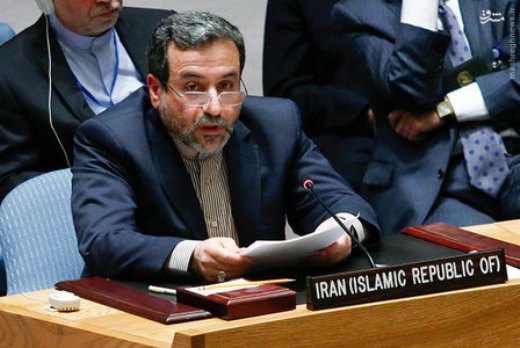
Araqchi in UN
Araqchi in UN

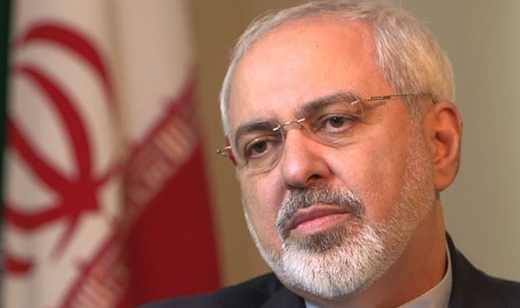
Iranian Deputy Foreign Minister for Legal and International Affairs Abbas Araghchi said Friday “Islamic State is neither Islamic nor a state – rather it is a terrorist entity.”

According to Fars News Agency, the Iranian diplomatwho was speaking at the UN Security Council said Tehran strongly rejects any association between the Muslim faith and acts of violence and savagery “this despised grouping” commits in the name of Islam.

He slammed the so-called Islamic State as a terrorist entity that has emerged from the chaos stoked by support for militant groups in the past decade.

The Iranian deputy foreign minister said failure of extremism is in the best interests of all of us. “Attention should be paid to the conditions and the mentality that have set the stage for the emergence of this terrorist grouping.”

He said IS came into being in the chaotic years that followed the occupation of Iraq. The crisis in neighboring Syria and the support IS received from certain countries helped it become a monster whose name today sends chills down the spine of its creators. […]

“Our past experience makes us believe that any genuine initiative to settle regional problems should be based on regional cooperation. Taking on extremism is no exception,” he said.

[…]


Iran and Austria stress closer agriculture cooperation

Iran Austria agriculture

At a meeting between a delegation from the Austrian Young Farmers’ Association and Secretary General of Iran Chamber of Commerce, Industries, Mines and Agriculture (ICCIMA) Hossein Noghrehkar Shirazi, the two sides put emphasis on expansion of bilateral economic cooperation, the public relations office of ICCIMA reported on September 14, 2014.

The secretary general of ICCIMA underscored the decades-long record of Tehran-Vienna cooperation and said since the 1979 Revolution and Iran-Iraq war, collaboration between the two countries on different fronts has been on the rise. “For a variety of reasons, some European countries have distanced themselves from Iran of late, however Iran-Austria relations are built a solid foundation which won’t be shaken.”

Noghrehkar, who was Iran’s ambassador to Austria in the late 1980s, added in 1987 the volume of trade between the two nations stood at $100 million, but in less than four years it hit the $1 billion mark in the industrial sector.

Reiterating that Austrian agricultural capabilities, unlike its industrial involvement, have not been noticeable in Iran, he expressed hope that the delegation will help forge closer economic cooperation on the agricultural front and that the meeting can produce positive results and lead to exchanges of views and knowledge between those who are active in farming in both countries.

For his part, the director general of the Austrian Yong Farmers’ Association voiced hope that Tehran-Vienna relations and their cooperation on the agricultural front will be shored up and asked for information about Iran’s agriculture, support for young farmers in Iran and its agricultural facilities.

At the meeting, Morteza Hoghoughi, who is in charge of the ICCIMA Office for Agriculture and Irrigation, said that water is the most important factor contributing to agricultural expansion, that’s why based on geographical diversity and the amount of rainfall in different regions, there is immense agricultural diversity across Iran and any agricultural crop can be found in Iran.

He went on to say that technology and current conventional farming practices are of great importance. Without conventional methods, the functionality of technology will be limited and to talk about agricultural matters, a complete understanding of and a pragmatic approach to Iran’s agriculture are imperative.


West can’t counter terrorism via double standards: Zarif

Iran-FM-Mohammad Javad Zarif

“The US and West will be unable to resolve the issue of terrorism by continuing to pursue their past policies,” Iran’s Foreign Minister Mohammad Javad Zarif said in a meeting with his Spanish opposite number José Manuel García-Margallo in New York on Friday.

The top Iranian diplomat added that it is impossible to fight against terrorists in Syria while seeking to weaken the country’s legal government.

“During four months of savage activities by the ISIL in Iraq, the Americans took no effective measure, namely cutting off direct and indirect aid to them (terrorists), in order to counter them,” Zarif added.

The ISIL terrorists control large parts of Syria’s east and north. ISIL also sent its Takfiri militants into Iraq in June, seizing large swathes of land straddling the border between Syria and Iraq.

The Takfiri terrorist group has committed heinous crimes including mass execution of people and beheading of their hostages.

The Spanish foreign minister, for his part, said Madrid stands ready to tap into its potential and hold political consultations with regional states, including Iran, in a bid to work out proper solutions to the existing woes in Iraq and Syria.

García-Margallo commended Iran’s effective role in the region and slammed Tehran’s not having been invited to an international conference in Paris on September 15 to discuss the threat posed by the ISIL Takfiri militants.

France hosted a conference, dubbed the International Conference on Peace and Security in Iraq, to discuss ways of tackling the ISIL terrorists in Iraq and Syria, but under the US pressure did not invite Iran to the event.