Saturday, January 3, 2026
Home Blog Page 4936

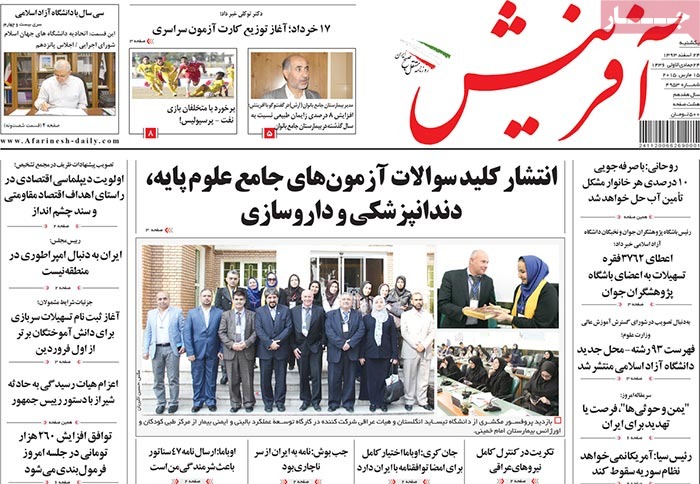
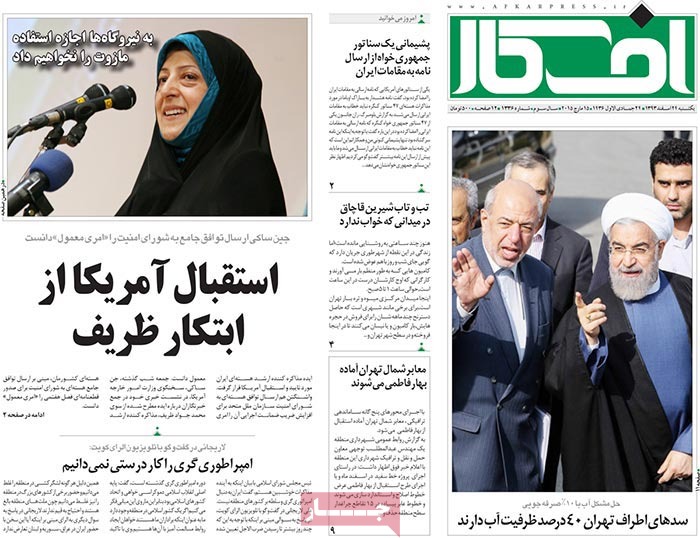
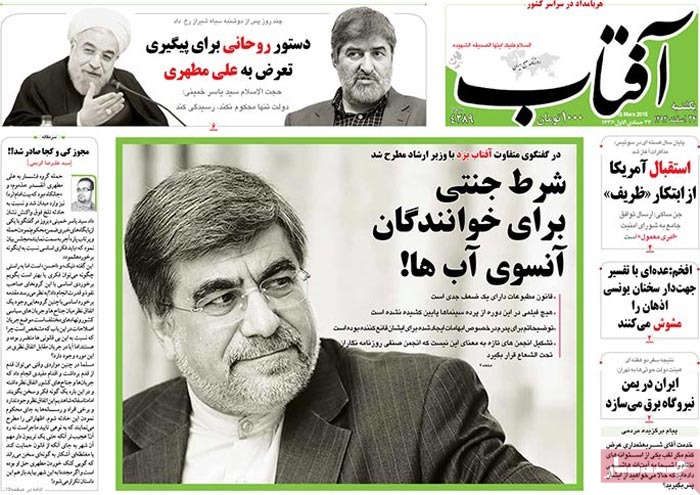
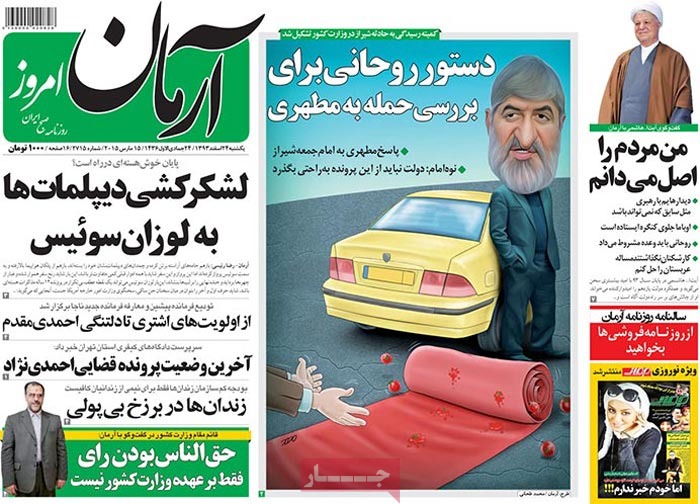
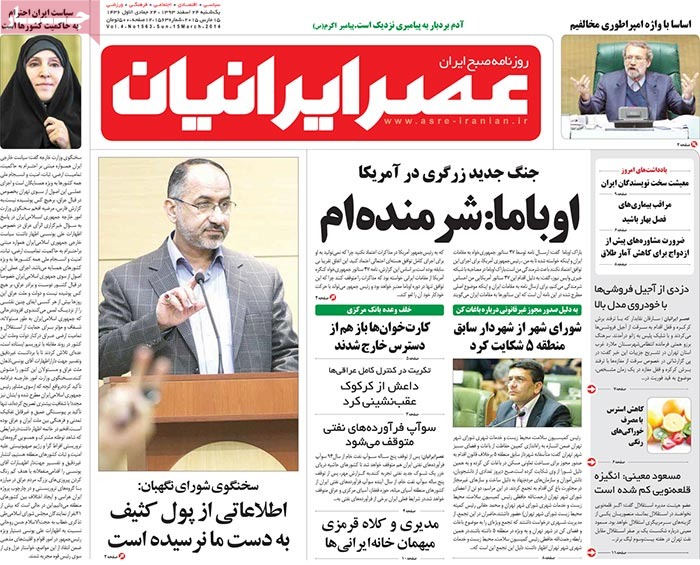
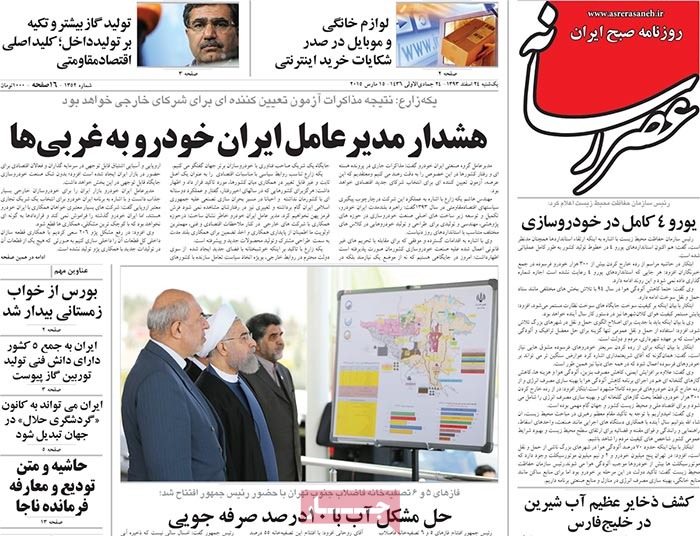
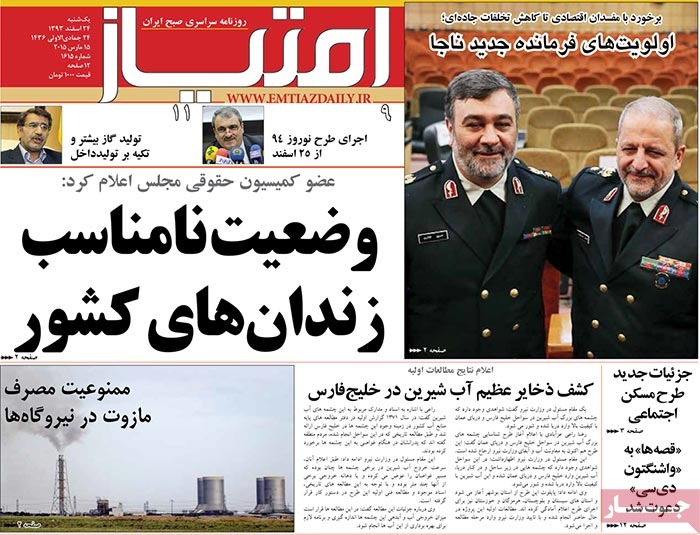
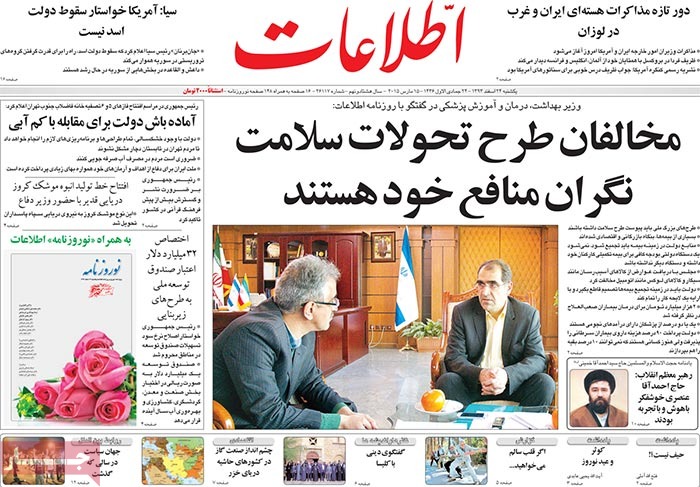
A look at Iranian newspaper front pages on Feb. 28

Iranian Newspapers Headlines

The Qom visit of President Rouhani which featured meetings with senior clerics and their support for the president’s handling of the country’s affairs along with the conclusion of the naval war games of the Islamic Revolution Guard Corps dominated the front pages of Iranian newspapers on Saturday.


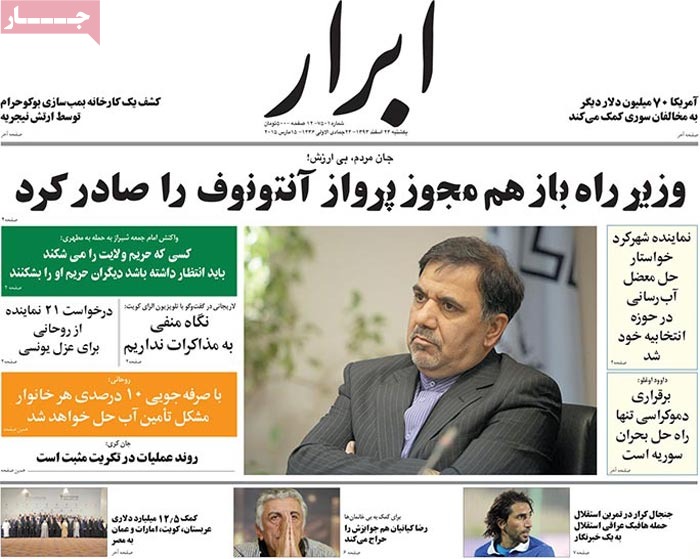
Abrar: “Remarkable progress was made in the most recent round of talks in Geneva,” said Majid Takht Ravanchi, the Iranian deputy foreign minister.

Abrar: The Italian foreign minister will meet with Iran’s Mohammad Javad Zarif on Saturday.


A look at Iranian newspaper front pages on Feb. 28


Arman-e Emrooz: The Turkish Foreign Ministry has described a visit by former President Mahmoud Ahmadinejad to Turkey as personal and unofficial.

Arman-e Emrooz: A few candidates are running for the chairmanship of the Assembly of Experts.


A look at Iranian newspaper front pages on Feb. 28


Asrar: “We got good results in talks with the US,” said the director of the Atomic Energy Organization of Iran.


A look at Iranian newspaper front pages on Feb. 28


Ebtekar: The clergy throw their weight behind the president.

Senior clerics based in Qom and Friday prayer leaders have said that they support President Rouhani.


A look at Iranian newspaper front pages on Feb. 28


Eghtesad-e Pooya: Iran is to launch the world’s largest petrochemical plant.


A look at Iranian newspaper front pages on Feb. 28


Emtiaz: “The average age of stroke has decreased,” said the deputy health minister.


A look at Iranian newspaper front pages on Feb. 28


Etemad: Oil prices are falling again.

OPEC is likely to have an extraordinary meeting.


A look at Iranian newspaper front pages on Feb. 28


Ettela’at: The next meeting of Iran and P5+1 will be held in Switzerland.


A look at Iranian newspaper front pages on Feb. 28


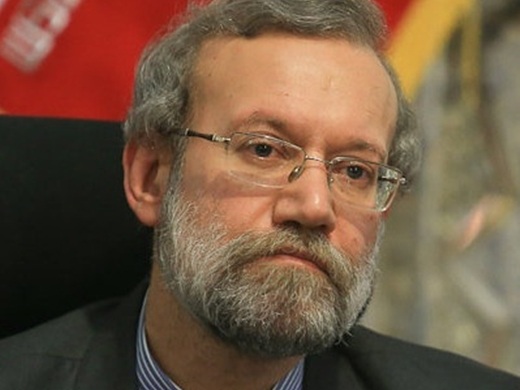
Farhikhtegan: “The promise to take oil money to the houses of people was just a slogan and a mistake,” said Parliament Speaker Ali Larijani.


A look at Iranian newspaper front pages on Feb. 28


Hambastegi: “The US should reverse the missteps it has taken,” said President Rouhani.


A look at Iranian newspaper front pages on Feb. 28


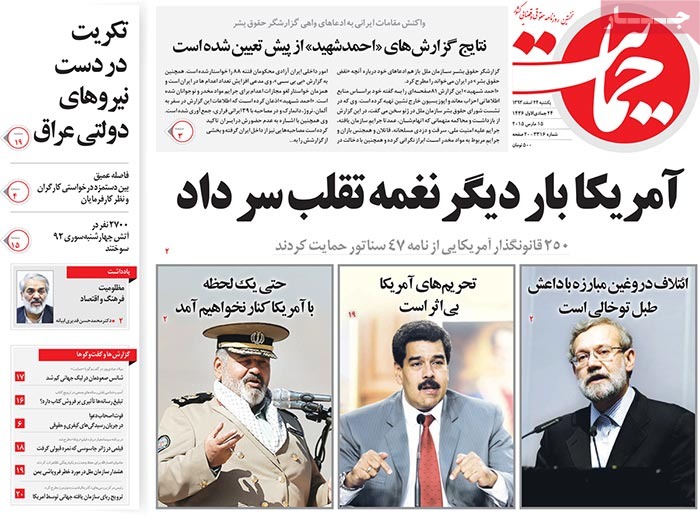
Hemayat: “The country owes its scientific progress to Jihad and martyrdom,” said the Supreme Leader.

Hemayat: Abu Bakr al-Baghdadi is said to have fled Iraq.


A look at Iranian newspaper front pages on Feb. 28


Iran: IS has sledge-hammered the Mesopotamian civilization.


A look at Iranian newspaper front pages on Feb. 28


Jamejam: Car imports are no longer a monopoly.


A look at Iranian newspaper front pages on Feb. 28


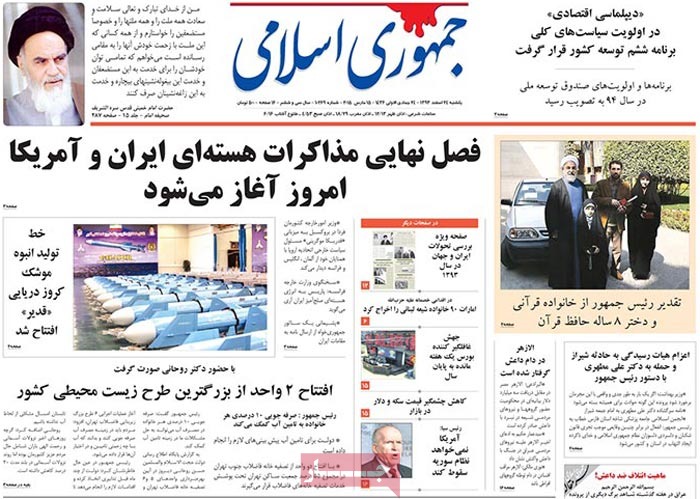
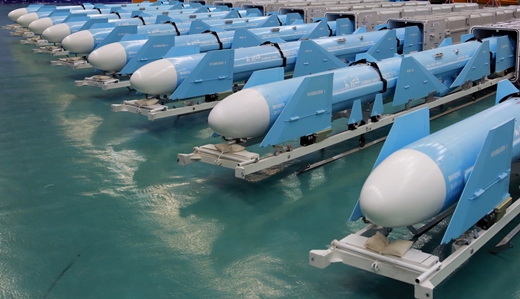
Jomhouri Islami: New strategic naval weapons have been tested in the Great Prophet maneuvers in the south.


A look at Iranian newspaper front pages on Feb. 28


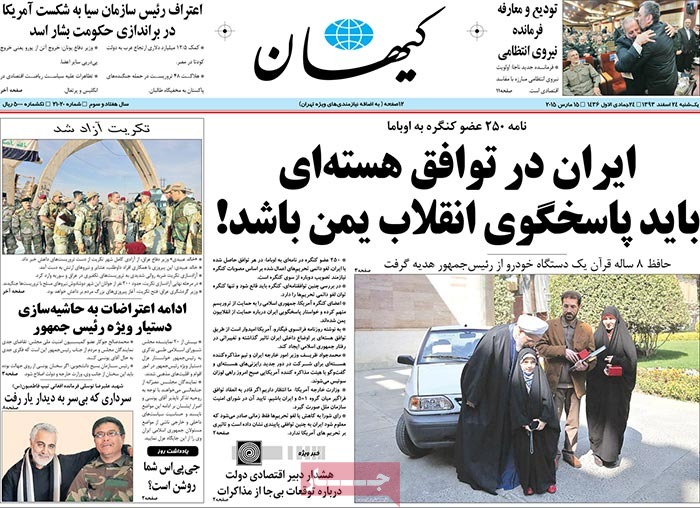
Kayhan: Some 24 percent of the country’s drinking water is wasted.


A look at Iranian newspaper front pages on Feb. 28


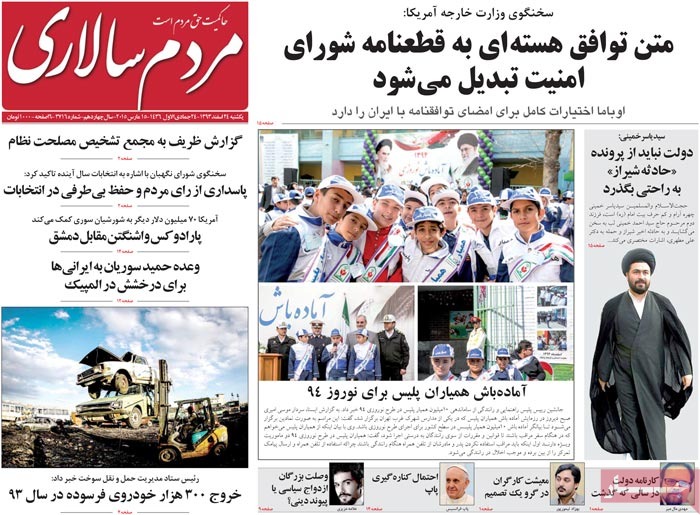
Mardomsalari: Seyyed Sadegh Tabatabai has been laid to rest in the mausoleum of the late Imam Khomeini.


A look at Iranian newspaper front pages on Feb. 28


Sharq: “We could have reached a deal with Europe in 2004 had it not been for the US,” said President Rouhani.


A look at Iranian newspaper front pages on Feb. 28


Taadol: The Iraqi Kurdistan Region is the new destination of Iranian natural gas exports.


A look at Iranian newspaper front pages on Feb. 28


Weapons used by Revolution Guards in Persian Gulf exercise

weaponry IRGC Persian Gulf war games

The Islamic Revolution Guards Corps (IRGC) has concluded major maneuvers code-named Great Prophet 9 in the southern Persian Gulf region.

Various types of weaponry were tested with some of them being introduced for the first time.


RPH drone

The reconnaissance drone known as RPH is capable of flying both during days and nights with a maximum range of 14 kilometers. The unmanned aerial vehicle (UAV) is equipped with advanced cameras enabling it to take images of the enemy’s positions.


Jamarat

The weapon is like an engine-free cruise missile which is launched by a gyroplane. The precision of the short-range missile is about one meter and it can hit targets as far away as 14 km.


weaponry IRGC Persian Gulf war games-1


Ramiat

The roadside mine is used to target armored vehicles with high precision and power. The mine is operated by a remote control and if used, it could destroy armored columns within a radius of 100 to 150 meters. The explosive is capable of penetrating up to 50cm into armor and can affect at least 100 enemy forces.


Sayyad

A bounding mine with a projectile height of 10-15 meters and is good at targeting the enemy’s helicopters.


weaponry IRGC Persian Gulf war games-2


Vassel

The weapon is a rocket-fired minefield sweeper which can clear an area 100 meters long and nearly two meters wide. It hugely improves the defensive capability of forces in confronting the enemy.


Khaybar

The weapon contains explosives which doubles the power of normal TNT and can be used on warheads to improve their destructive capability.


Nasir

A 12.7 mm shoulder-fired weapon with six rotating barrels used to target cruise missiles. Its rate of firing is 2,500-3,500 rounds per minute.


weaponry IRGC Persian Gulf war games-3


Asefeh

A 23 mm rotary cannon, with a firing rate of 900 to 1,200 per minute used against cruise missiles and low-flying drones.


weaponry IRGC Persian Gulf war games-4


Arash

The shoulder-fired weapon is a 20 mm cannon which is used by the infantry.


weaponry IRGC Persian Gulf war games-5


Armed robot

The combat robot is equipped with a 7.62 caliber machine gun, advanced optics and a thermal camera, with an effective operational range of 5-7 km.


weaponry IRGC Persian Gulf war games-6


Multi-cellular walls

The protective layer can be instantly installed to counter explosions or rocket-propelled grenades (RPGs).


weaponry IRGC Persian Gulf war games-7


Final steps in nuclear talks are being taken: Prayer leader

Ayatollah sedighi

The provisional Friday Prayers Imam of Tehran brought up the “final steps toward a comprehensive nuclear agreement” with six world powers and appreciated the wise management of the negotiations by President Hassan Rouhani.

Hojjatoleslam Kazem Seddiqi also thanked President Rouhani for expressing clear and precise stands about the Iranian nuclear program and the nuclear negotiations during his recent visit of the holy Qom City.

“We thank Almighty God that the esteemed president in Qom and during his meetings with the prominent clerics in that city… declared clear and promising stands and announced that Iran will not yield to humiliation, a shutdown (of nuclear facilities) or continuation of the sanctions,’ said Seddiqi addressing thousands of worshippers.

He said that His Eminence the Leader of Revolution in his last address about the nuclear negotiations stated that the Westerners are used to lengthy bargaining, a case in point for 60 years Palestine has been occupied by the usurper Zionist regime, but they are still negotiating while Israel is destroying Palestinian infrastructure and those useless talks keep going on and on and on.

“His Eminence added that if that is going to be the case, we insist that the main points and the minute details need to be resolved all together; but they intend to keep the sanctions in effect and block the path for our country’s progress and prosperity, which is not acceptable as all sanctions need to be lifted and annulled together,” he said.

Seddiqi reiterated that the Westerners are not allowed to interfere in Iran’s internal affairs; neither are they allowed to define the quantity of the fuel that we can produce.

“Such blackmailing was a characteristic of the colonial era, not the Islamic Revolution’s period in which Iran is conquering the peaks of scientific progress,” he stressed.

Hojjatoleslam Seddiqi added that Arak Heavy Water Reactor must be activated; Fordo needs to continue its activities and the extent of enrichment must not be restricted as these are our people’s demands and they will not be content getting anything less.

Iranian diplomats in Kabul safe and sound: Afkham

Marzieh Afkham speakerwoman

Foreign Ministry Spokeswoman Marziyeh Afkham said Thursday that all Iranian diplomats in Kabul are safe and sound after a terrorist incident occurred outside the Iranian embassy in the Afghan capital earlier in the day.

Condemning the terrorist attack, Afkham said no damage has been inflicted on the Iranian embassy.

She underlined the need ‘to confront any act of terror which takes place in any corner of the world by any individual or group.’

The spokeswoman also called for collective efforts to pinpoint the root causes of extremism and terrorism in different countries and deal with the problem with no double standards.

The terrorist attack targeting a vehicle of the Turkish embassy outside the Iranian embassy in Kabul killed one person.

The incident occurred at 8:15 local time when a suicide bomber driving a bomb-laden car tried to hit the diplomatic car belonging to the Turkish embassy while it was passing by the Iranian mission in the Afghan capital.

The driver was killed, said Deputy Interior Minister of Afghanistan General Mohammad Ayoub Salangi.

Salangi told reporters that police have launched an investigation into the terrorist incident.

Rouhani: US must rectify wrong approach on nuclear talks

Rouhani-Qom

Iranian President Hassan Rouhani says the US should rectify its wrong approach vis-à-vis negotiations on Tehran’s nuclear program.

“It is the Americans that should try to rectify the wrong steps they have taken [towards the Iranian nuclear issue],” Rouhani told reporters in the central Iranian city of Qom on Thursday.

The US was behind the dispute over Tehran’s nuclear work as it prevented Iran and the three European countries – Britain, France and Germany – from reaching a nuclear agreement at the end of 2004, Rouhani said.

Iran is seeking the removal of sanctions against the country through nuclear talks with P5+1, the president noted.

“We seek to take away the tool of sanctions from the enemy through negotiations because sanctions are unjust, cruel and in contravention of human rights, and to that end, talks are the best way,” he said.

Even if the ongoing nuclear talks fail to lead to an agreement, said Rouhani, the world community will know that the opposite side is to blame.

American officials have admitted and told Congress that if they fail in nuclear talks with Iran, they will be isolated, Rouhani added.

Representatives from Iran and the United States started nuclear talks earlier this week in the Swiss city of Geneva. They held three rounds of negotiations in an attempt to narrow their differences.

Speaking to reporters in Geneva on Monday after the end of the talks, Iran’s Foreign Minister Mohammad Javad Zarif said negotiators from Iran and P5+1 – Britain, France, China, Russia, and the United States plus Germany – will resume their discussions in the Swiss city next week.

Iran and the six world powers have missed two deadlines so far to reach a nuclear agreement since an interim deal was sealed in November 2013. The two sides have set July 1 as the next deadline for reaching a final deal.

Rafsanjani: Radical ideas are the blight of today’s society

Ayatollah Hashemi Rafsanjani

The chairman of the Expediency Council has said that party politics in Islam differs from what is practiced in the West. Ayatollah Akbar Hashemi Rafsanjani said Islam is seeking to guide society toward religious, revolutionary, ethical and human values, but partisanship in the West is confined to material progress.

Entekhab.ir on February 26 reported what Rafsanjani said in a message to a first congress of Nedaye Iranian (Call of the Iranians) Party on Thursday. The following is a partial translation of his remarks:

[…]

With all due respect for the titles and names of parties as well as their officials and members, I stress that parties should abide by law and feel obliged to build trust and promote public participation in efforts to build better tomorrows [for the country].

Although parties may get involved in coalitions and factions, they should not overlook ethics in political rivalries, neither should they think that national and Islamic interests are necessarily the same as their own interest.

They should not arrogantly discredit others. Unfortunately certain parties and their members build on flimsy excuses to put their own mindset above the law and the Islamic establishment.

[…]

It takes bravery to train experienced and elite people for the country’s future and to safeguard the legacy of the late Imam Khomeini and that of the martyrs of the Islamic Revolution; it takes bravery to express views and analyze the radical ideas, no matter whether they belong to the left or to the right which plague today’s society.

Principlist, reformist, moderate, etc. are simply the titles to distinguish different parties; what all [political] parties and groups should take into account is the need for the presence and role of the youth in partisanship which encompasses the national and Islamic interests of Iran and the future of Iranians who are unique in their allegiance to the ideals of the revolution.

[…]
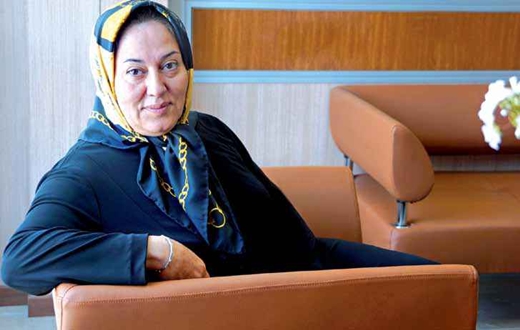
Nedaye Iranian (Call of the Iranians) Party, which is led by Sadegh Kharrazi, a former deputy foreign minister and a former Iranian ambassador to France, is trying to help the reformist youth make a comeback to political and civil activities as it makes every effort to advise them against resorting to extremism.

An Iranian gem by origin, a Turkish stone by name

Iran Firouzeh gem

Turquoise is a bright blue to blue-green mineral that has been used worldwide to produce gemstones and small sculptures for over 6,000 years. Turquoise, which is rare and valuable in finer grades and has been prized as a gem and ornamental stone owing to its unique hue, was first discovered by Iran and Egypt.

Khabaronline on January 26 ran a report on Iran’s turquoise. The following is a partial translation of the report:

A turquoise mine in Neyshabur – in Khorasan Razavi Province – is the world’s largest, but the shining stones extracted from the mine are traded around the world as if they come from Turkey.

The use of traditional extraction methods – explosives – which cause irreparable damage to the mine and reduce the real value of the gemstone is one reason why the Iranian gem has been unable to live up to its name on global markets.

This comes as countries such as India and the US, whose mines are not on a par with Iran’s, use scientific extraction methods, something which has pushed up the added value in extracted products.

After India and Brazil, Iran is the third producer of decorative stones, but Iran’s Firoza [the Persian name of the gem] is known around the world as turquoise [derived from an Old French word for “Turkish”] only because it is traded in Turkey.

Iran is sitting pretty when it comes to decorative and exterior façade stones; it has about four billion tons of decorative stones with an annual production of over 13.5 million tons.

Decorative stones are found in many Iranian provinces, among them East and West Azerbaijan, Isfahan, Khorasan, Fars, Central, Hamadan, Sistan and Baluchestan, and Zanjan.

Behrooz Borna, an official with Iran’s Geological Survey Organization, says that Iran has six stocks of precious and semi-precious stones, but it has yet to make it to the world ranking.

Processed turquoise can earn Iran higher added value. Investment is needed to encourage more turquoise exports and gain more foreign revenues as a result.


IRGC showcases combat, reconnaissance robots in massive drills

IRGC logo

The Islamic Revolution Guards Corps (IRGC) unveiled some of its new robots in the war games underway in Iran’s southern and western regions.

The IRGC’s Ground Force for the first time tested its new combat and reconnaissance robots in the massive military exercises on Thursday.

The first stage of the war games, codenamed The Great Prophet-9, was held Wednesday by the IRGC Navy in the Strait of Hormuz, known as the most strategic waterway in the Persian Gulf.

On the second day of the drills, the focus is on the capabilities and latest accomplishments of the IRGC Ground Force.

The force will fly its reconnaissance drones equipped with powerful cameras and test its weapons including Ramait roadside mine, Sayyad bounding mine, Asefeh 23mm Gatling gun, Arash shoulder-launched weapon and sniper rifle Siyavash.

Over the past few years, Iran’s Armed Forces have held several military drills.

The Islamic Republic has repeatedly assured other nations, especially its neighbors, that its military might poses no threat to other countries, stating that its defense doctrine is based on deterrence.

Iran dismisses Kerry’s remarks over intervention in Yemen

Marzieh Afkham

Iran’s Foreign Ministry has rejected as a blame game recent remarks made by US Secretary of State John Kerry, who accused the Islamic Republic of intervening in Yemen.

Iran’s Foreign Ministry Spokeswoman Marziyeh Afkham said on Wednesday that Kerry’s recent comments accusing Iran of aiding the collapse of the Yemeni government constituted a blame game and contradicted previous remarks made by US officials.

“All sides should allow the Yemeni nation to determine the country’s fate by itself; and all mechanisms should be based on the people’s will and demands,” Afkham said, adding that Iran firmly believes in and respects the right of every nation to determine its fate.

She said any foreign intervention in the course of the political developments in Yemen would complicate the political situation there and would obstruct the realization of political stability in the Arab country.

On Tuesday, Kerry accused Iran of supporting the Shiite Houthi revolutionaries, also known as Ansarullah fighters, in the takeover of the Yemeni capital, Sana’a, and the fall of the government.

“I think it (Iran) contributed to it (the collapse of the Yemeni government),” Kerry said, adding, “But I do know that the Iranians were surprised by the events that took place and are hoping to see a national dialogue take place.”

In September 2014, Ansarullah movement gained control of Sana’a following a four-day battle with army forces loyal to General Ali Mohsen al-Ahmar, the half-brother of the country’s former dictator, Ali Abdullah Saleh.

Before gaining control of the capital, the Houthis had set a deadline for the political parties to put aside differences and fill the power vacuum, but the deadline was missed without any change in the country’s political scene.

On January 22, Yemeni President Abd Rabbu Mansour Hadi and the cabinet of Prime Minister Khaled Bahah resigned. The Yemeni parliament rejected Hadi’s resignation. Hadi sent a letter to the parliament on Monday, withdrawing his resignation.

On February 6, Yemen’s Houthi movement dissolved the Yemeni parliament and announced a constitutional declaration on the Transitional National Council following weeks of clashes with government forces.

The Ansarullah revolutionaries say the Yemeni government has been incapable of properly running the affairs of the country and providing security.

The Houthi movement played a key role in the popular revolution that forced Saleh to step down after 33 years of rule.

Terrorist attack outside Iranian embassy in Kabul

Iranian embassy in Kabul

A bomb attack hit a vehicle of the Turkish embassy outside the Iranian diplomatic mission in Kabul Thursday morning, killing one person.

The incident occurred at 8:15 local time when a suicide bomber driving a bomb-laden car tried to hit a diplomatic car belonging to the Turkish embassy while it was passing by the Iranian mission in the Afghan capital.

The driver was killed, said Deputy Interior Minister of Afghanistan General Mohammad Ayoub Salangi.

However, no damage has been reported to be inflicted on the Iranian embassy and the site of the blast is under tight security measures.No reporter is allowed to enter the area.

Salangi told reporters that investigations are underway to find the cause of the incident.