Friday, December 26, 2025
Home Blog Page 4931

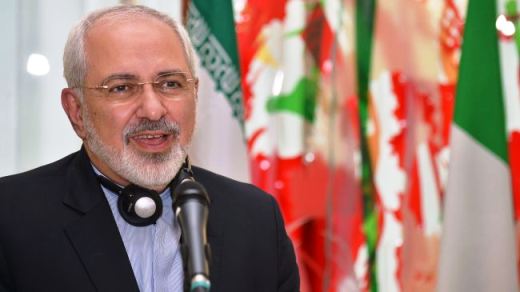
Iran, P5+1 working hard to resolve differences: Zarif

Zarif_Iran-foreign-minister

Zarif made the remarks following a six-hour long trilateral meeting with European Union foreign policy chief Catherine Ashton and US Secretary of State John Kerry in the Austrian capital, Vienna.

Zarif, who heads the Iranian negotiating team in nuclear talks with the six countries, also described the trilateral talks as “very difficult”, but said progress was made and possible solutions discussed.

“It was very difficult, serious and intensive … but instead of focusing on problems, we discussed solutions as well,” Zarif said. “There was progress in all the fields.”

Zarif also told online news site al-Monitor that the gaps were “narrowing, but we still have a long way to go.”

“It is reconcilable, provided everyone makes the tough decisions,” he said.

Tehran and the six major world powers – the United States, France, Britain, China, Russia and Germany – have started a fresh round of negotiations on Tehran’s nuclear energy program in Vienna on Thursday.

Zarif and Ashton jointly lead the negotiations, which will center on outstanding issues related to Tehran’s nuclear program.

Iran and its negotiating partners are currently working to reach a final agreement aimed at ending the longstanding dispute over Tehran’s civilian nuclear work as a November 24 deadline approaches.

Last November, the two sides clinched an interim nuclear accord, which took effect on January 20 and expired six months later. However, they agreed to extend their talks until November 24, as they remained split on a number of key issues.

Palestine resistance should boost defense abilities

Iran-Leader-Khamenei

“The Resistance current should boost its preparedness day by day and reinforce its power resources inside Gaza,” Ayatollah Khamenei said in a meeting with Secretary General of the Islamic Jihad of Palestine Ramadan Abdullah in Tehran on Thursday.

The Leader said the Palestinian resistance’s recent victory against the Israeli regime’s 50-day war indicated the realization of the “divine promise”, which will pave the way for greater triumphs.

The Leader also anticipated a promising future for the Palestinian people, saying, “The outlook of the developments is bright and good.”

Ayatollah Khamenei urged Palestinians in the West Bank to get on board in the fight against the Israeli regime, saying, “Fighting the Zionist regime (Israel) is a war of destiny.”

“The enemy should feel the same worries in the West Bank as it does in Gaza,” the Leader added.

Ayatollah Khamenei further vowed more support for the Palestinian people, stating, “The Islamic Republic and the Iranian people are proud of your victory and resistance, and hope that the back-to-back triumphs of resistance [groups] will continue until final victory.”

Abdullah, for his part, extended to the Leader the greetings of senior officials from Islamic Jihad and other Palestinian resistance groups, and presented a report on the latest Israeli war on Gaza.

“Definitely, the victory was achieved with the assistance of the Islamic Republic,” the senior Palestinian official said, adding, “Without Iran’s strategic and efficient help, resistance and victory in Gaza would have been impossible.”

Abdullah further assessed as strategic and effective the Leader’s guidelines on the necessity of arming the West Bank for countering the Israeli regime’s aggression, saying the remarks have re-energized the Palestinian fighters and raised their spirits.

On July 23, Ayatollah Khamenei said armed resistance by Palestinians is “the only way” to confront the Zionist regime.

“We believe that the West Bank should also be armed like Gaza and those who are interested in Palestine’s destiny should act in this regard,” the Leader said at the time.

Israeli launched a deadly onslaught on the besieged Gaza Strip on July 8. Gaza health officials say over 2,140 Palestinians, including 577 children, were killed in the Israeli onslaught. Over 11,100 others, including 3,374 children, 2,088 women and 410 elderly people, were injured. Tens of Israelis were also killed by the Palestinian resistance retaliatory rockets.

The Israeli aggression ended on August 26 with an Egyptian-brokered truce.

A society which allows a blemish on human dignity is not Islamic

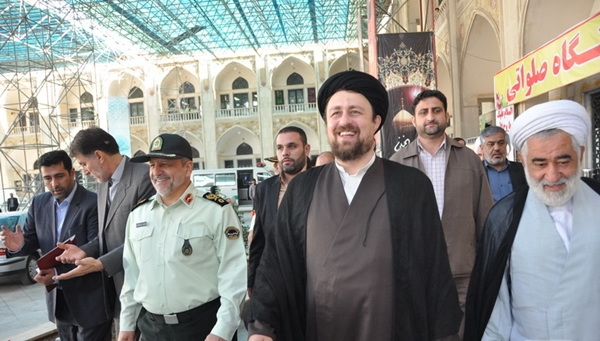
Hassan Khomeini
Hassan Khomeini

Seyyed Hassan Khomeini, the grandson of the late Imam Khomeini, has said that humans realize the importance of health and security only when these two blessings are nonexistent and that in their absence people would find nothing helpful even if they are given the best of everything.

Hassan Khomeini was addressing a ceremony at Imam Khomeini mausoleum where police commanders and personnel pledged allegiance to the ideals of the founding father of the Islamic Republic. The following is the translation of his remarks as reported by Astaan official website:

“Many problems in society are of secondary importance. In other words, health and calm should be in place so that people could think about secondary issues. Health is the biggest blessing God has bestowed upon man. God forbid, if man comes down with pain and illness, he fails to make use of [divine] blessings. So is the case when security is conspicuous by its absence.

“Health and security are definable in terms of individual and social needs. A society which is completely devoid of health and security has lost two real blessings.

“The one who grants security is a divine name. As a blessing, health is of profound significance, but at times it is taken for granted. Sometimes one thing slips through the cracks only because it is all too clear to be seen.

“Security is a manifestation of divine favors and we need to look at the security situation in the surrounding countries. Iran serves as a point of support in many aspects and its security is satisfactory from a political perspective, although we are still far from a desirable level. Certainly, ideals are not totally achievable; if they were, they would no longer have been called ideals. But we have to set foot on the path toward ideals.

“Society owes much of its security to the police whose efforts are appreciated by the people. However, this is not all the perfection a society needs. An Islamic society should enjoy health over and above security. A society is healthy if and when its ills – both on the inside and on the outside – are removed. The word ‘Islamic’ is used for a society which has no outward and inward illnesses.

“Islamic practices should be protected in society because societies in which such practices are not observed are nowhere near desirable. Also, a society in which individuals have easy access to drugs is far from flawless. A society which is gripped by grinding poverty sustains losses from inside and this, in turn, gives rise to insecurity. A society where people have to grapple with discrimination, injustice, nepotism or cronyism and double-standards is not something [the late] Imam and Islam would approve of and a society where human dignity is tainted is not Islamic.

“In an Islamic society, man has mental calm; in this society – as history shows – if a 14-year-old girl set out from Merv to Rey with a trayful of gold coins, her journey would not be marred by any problem or insecurity. For some time the situation was like this in Iran. The non-violent culture of the Iranian nation is one thing that ensures security. Thank God violence has no place in the culture of the Iranians. The violence we witness flaring up among other tribes [in the region] has never existed in Iranian history.

“In the Muslim society where Islamic practices should be observed, [our] children should be assured of mental security. Today as the world has made progress, the tools for committing delinquency have changed too, and this calls on the police to equip themselves with the tools to encounter criminality.

“The patient [a delinquent and wrongdoer are like a patient] should receive treatment in an Islamic society. As it is mentioned in the Islamic Punishment Code, laws are set down to tackle and uproot crimes, not to spoil the wrongdoer’s good mood. Wrongdoers are the children of this society who have gone astray, so Islamic society needs to act as a father to guide offenders and establish mental calm among people.

“Thanks to tireless efforts, today desirable security is in place in this part of the world. Extra efforts should be made to fill the existing gaps, especially in the area of social security. We all know that poverty and greed are the root causes of many crimes.

“Societies which are hit by immoralities are very much prone to unlawfulness and this has been echoed by the Muslim Prophet (Peace Be upon Him) who said, ‘Poverty leads one closer to atheism.’ In other words, if an individual receives proper training and their upbringing is good, he would not go for atheism and injustice even if he is poor. Also we should not ignore the fact that greed lies at the very root of many crimes. There would be a drop in crime rate if society can get rid of human greed.

“The bottom line here is that society’s teachers should correct their behaviors. Our children would clean up their act if they see us behave properly. If a parent does not show good manners, the result would be reverse. I prefer to keep silent on that. Therefore, to promote ethical conduct or practices in society, the greats and religious people should dry up the roots of unethical behaviors and unlawfulness in themselves.

Senior German MP urges lifting of Iran sanctions

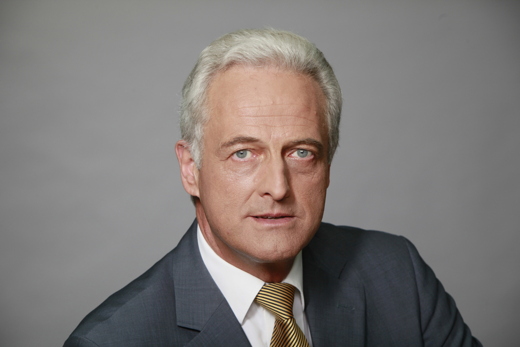
Peter Ramsauer
Peter Ramsauer

A senior German lawmaker of the co-ruling Christian Social Union (CSU) on Wednesday called on his government to lift sanctions against Iran in a bid to spur further economic growth in Germany.

Talking to Deutschland radio, Chairman of the Parliamentary Economic Committee, Peter Ramsauer, said one way to boost economic growth in his country was to remove the economic embargo against Russia and Iran.

The former transportation minister had earlier this year slammed the inaction on the part of his government in forging closer business ties with Iran while other western companies were flocking to Tehran in the wake of last year’s landmark November 24 Geneva nuclear accord.

Ramsauer who had visited Iran earlier this year, urged German government representatives to travel to the Islamic Republic in an effort to act as a ‘door opener’ for German firms in that country.

He stressed Germany could not afford to waste any time once the anti-Iran sanctions are lifted following a likely nuclear deal.

Ramsauer also said that Berlin should seriously consider Iran as a possible strategic gas supplier.

We shouldn’t let the chance of a final nuclear deal slip away

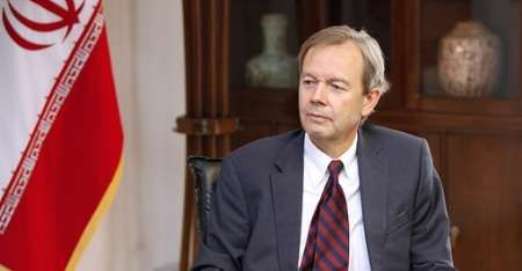
Michael Freiherr von Ungern-Sternberg

Islamic Republic News Agency (IRNA) ran a report on October 16 on a meeting between the German ambassador to Iran and the governor general of Isfahan province in Isfahan, central Iran. Up for discussion were mainly nuclear talks between Iran and P5+1, with the German side stressing the need for the parties to the talks to reach a final agreement and the Iranian side asking for the correct reflection of Iran’s realities. The following is the translation of part of the report.


German Ambassador to Tehran, Michael Freiherr von Ungern-Sternberg, said that European companies, especially those in Germany, attach great significance to cooperation with and investment in Iran, adding Europe needs [to invest in] Iran’s market.

The ambassador said in a meeting with Governor General of Isfahan province Rasoul Zargarpour on Wednesday, that German companies are very much interested to enter partnership with Iran, adding they are all waiting for the final results of the nuclear talks [between Iran and P5+1].

He further said that Foreign Minister Frank-Walter Steinmeier too is willing to see the nuclear talks produce the intended results so that Berlin and Tehran could develop their ties more than before.

“The German government highly hopes to see [tangible] results come out of the nuclear talks,” he said, adding that Iran’s market is a proper venue for the Germans [to invest in]. He said that time has come for the nuclear case of Iran to be fully settled.

“A good opportunity has opened up for the parties to the talks to reach a final deal. If they miss out on this opportunity, it would be uncertain when the two sides would be provided with yet another opportunity,” he stressed.

[…]

Isfahan’s governor general, for his part, said that Germany is expected to reflect the realities on the ground in Iran, adding that the West should seize this opportunity in the best possible manner.

He said Berlin should set the stage for bilateral cooperation on political, economic and cultural fronts.

[…]

He said the cooperation would be established [and pursued] when the West does its fair share in nuclear talks. He added that fortunately German politicians have understood that the Islamic Republic has acted in good faith in the talks, but that some statesmen are far from fair and their stances are subject to misinterpretations [of Iran].

The governor general also said that the eleventh government has paved the way for cooperation with the West, underlining that the West should take up the existing opportunity.

[…]

Outcome of Iran’s nuclear talks outweighing deadline

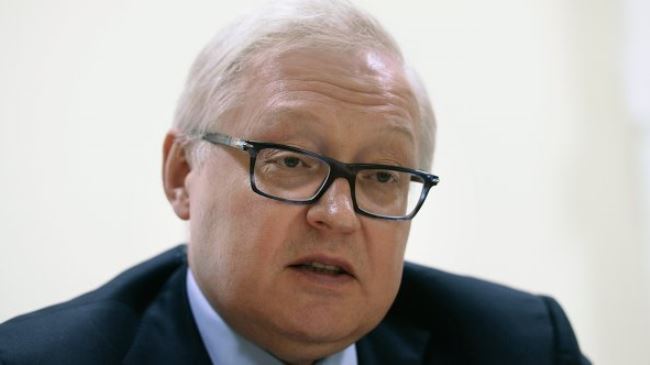
Ryabkov-Russian-diplomat

Russia’s Deputy Foreign Minister Sergei Ryabkov says reaching a sustainable agreement over Iran’s nuclear energy program is more important than meeting a November 24 deadline for a final accord.

“Achieving a sustainable result that would be resistant to international developments is more important than meeting a certain deadline. Though there is no doubt that having a deadline gives a stimulus,” Ryabkov said on Wednesday.

Rayabkov, who is Russia’s chief negotiator in the talks between Iran and the five permanent members of the United Nations Security Council plus Germany, said that the last steps to reach a comprehensive agreement on Tehran’s nuclear issue are the hardest ones, adding that a “political will” would determine the outcome of the talks.

“We have always said that political will matters most for achieving the agreement. If it is there or not, we are yet to find out,” said Rayabkov.

He also said that some unpredictabilities are expected in the talks between Tehran and the six world powers, “but they will be mostly of tactical and technical nature, rather than the change of the entire landscape.”

“But we all are doing our best for the agreement to be worked out by this deadline (November 24),” Ryabkov said.


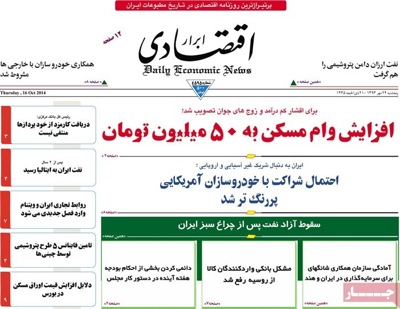
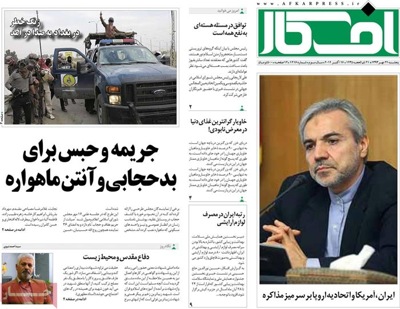
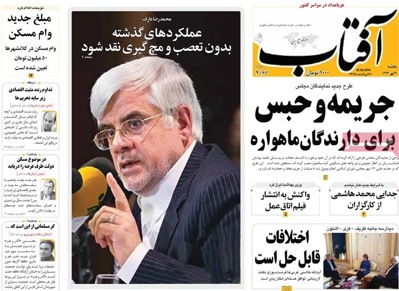
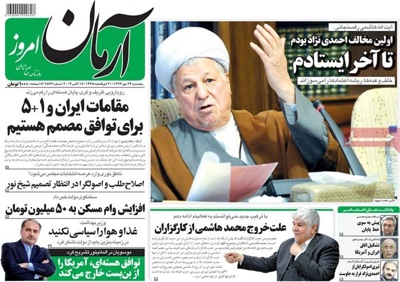
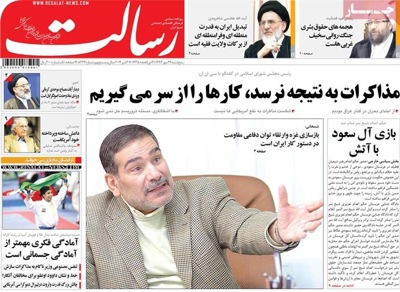
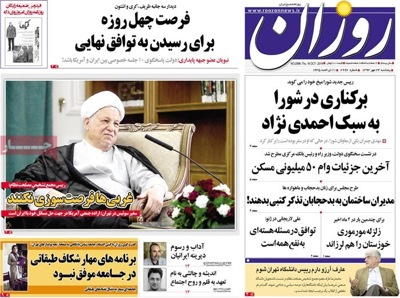
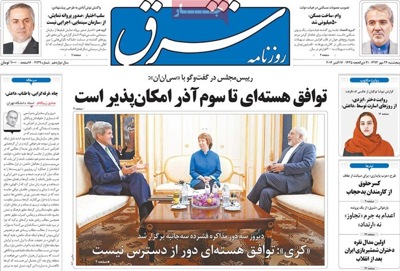
A look at Iranian newspaper front pages on Oct. 16

Iranian Newspapers Headlines

A rise in the amount of housing loans young couples in metropolises can take out dominated the front pages of the Iranian newspapers on Thursday. Hours-long meetings between representatives from Iran and the EU in Vienna were in the news too. Also drawing attention was the death sentence a Saudi court has handed down against a Shiite cleric for what is described as sedition.

Abrar-e Eghtesadi: A top Iranian carmaker seeks partnership with a “non-Asian, non-European” company. That raises the likelihood of a joint venture involving an American company.


Abrare eghtesadi newspaper 10 - 16


Afarinesh: A court in Saudi Arabia has sentenced [Shiite cleric] Nimr al-Nimr to death.


Afarinesh newspaper 10 - 16


Afkar: “A nuclear deal is in the best interest of everyone,” the Iranian top MP told a news conference on the sidelines of the 131st Assembly of the Inter-Parliamentary Union in Geneva, Switzerland.


Afkar newspaper 10 - 16


Aftab-e Yazd: A number of MPs have floated a motion that calls for fines and jail terms for individuals who access satellite channels.


Aftabe yazd newspaper 10 - 16


Arman-e Emrooz: Mohammad Hashemi [the brother of the chairman of the Expediency Council] said he decided to quit the Executives of Construction Party because of a lack of cohesion as far as thinking is concerned between him and new members of the party’s administrative committee.


Armane emruz newspaper 10 - 16


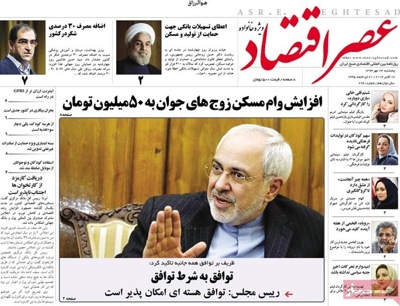
Asr-e Eghtesad: “Levying a transaction fee on debit-card readers is inevitable,” the governor of the Central Bank of Iran said.


Asre eghtesad newspaper 10 - 16


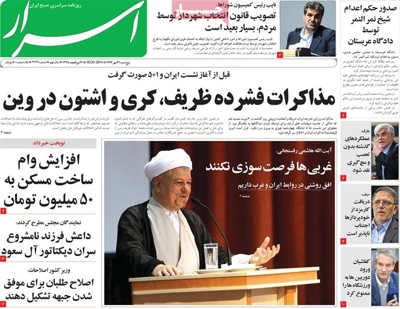
Asrar: “The performance of those who have served in the past should be analyzed without prejudice,” Mohammad Reza Aref, a former vice-president said.

Asrar: “The prospects of relations between Iran and the West are bright,” Ayatollah Akbar Hashemi Rafsanjani tells the Swiss envoy in Tehran.


Asrar newspaper 10 - 16


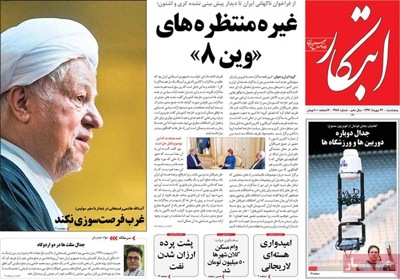
Ebtekar: Iran’s former OPEC envoy has blamed a new coalition between the US and Saudi Arabia to keep crude prices low and deal a blow to Iranian and Russian economies as the reason behind a recent drop in oil prices.

Ebtekar: “The West should not allow the opportunity [to strike a deal with Iran] to slip away,” Chairman of the Expediency Council Ayatollah Akbar Hashemi Rafsanjani told the Swiss ambassador to Tehran.


Ebtekar newspaper 10 - 16


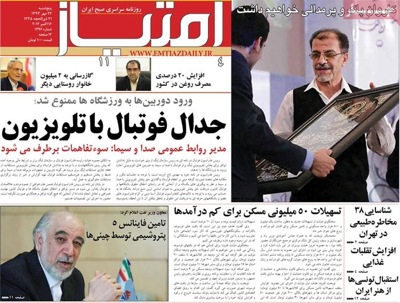
Emtiaz: “The Chinese have agreed to finance five Iranian petrochemistry projects,” the Iranian deputy oil minister said.


Emtiaz newspaper 10 - 16


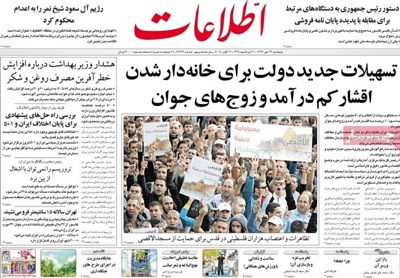
Ettela’at: The Iranian health minister has warned about an alarming rise in cooking oil and sugar consumption.

Ettela’at: “Considerable differences remain, but that does not mean they are not solvable,” Iranian Foreign Minister Mohammad Javad Zarif said after talks with EU’s Catherine Ashton.

Ettela’at: “One cannot eliminate terrorism through occupation,” Iranian Parliament Speaker Ali Larijani tells CNN.


Etelaat newspaper 10 - 16


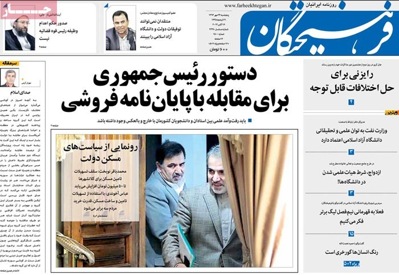
Farhikhtegan: The president has ordered [science ministry] officials to deal with those who sell dissertations.


Farhikhtegan newspaper 10 - 16


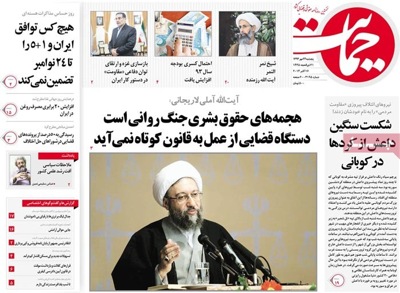
Hemayat: “The fuss over human rights is part of a war of words; the Judiciary will continue to act in accordance with laws,” the Iranian Judiciary chief said.


Hemayat newspaper 10 - 16


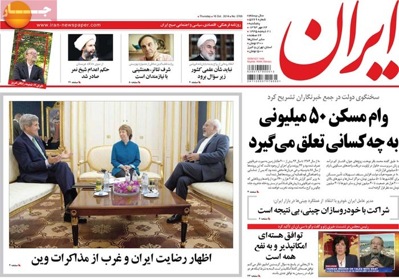
Iran: Iran and the West have signaled satisfaction with the trend of talks in Vienna.


Iran newspaper 10 - 16


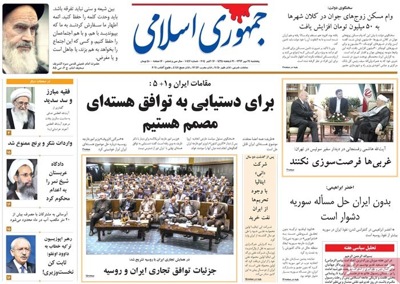
Jomhouri Islami: Although sanctions remain in place, an Italian firm has purchased Iranian crude for the first time in two years.


Jomhorie eslami newspaper 10 - 16


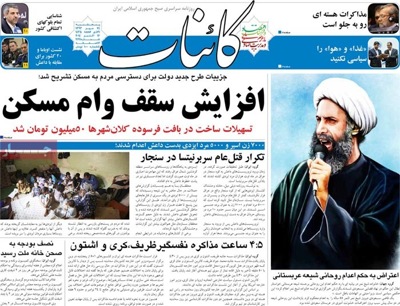
Kaenat: The IS terrorists have enslaved 7,000 Yazidi women and massacred 5,000 men in Sinjar.


Kaaenat newspaper 10 - 16


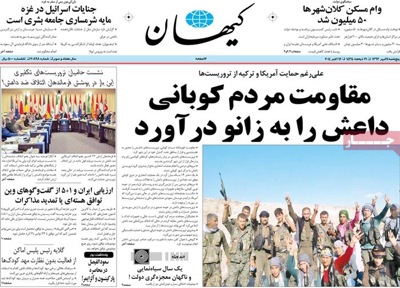
Kayhan: “IS suffered a blow in Kobani after locals put up fierce resistance against terrorists [in the Syrian border town].”


Kayhan newspaper 10 - 16


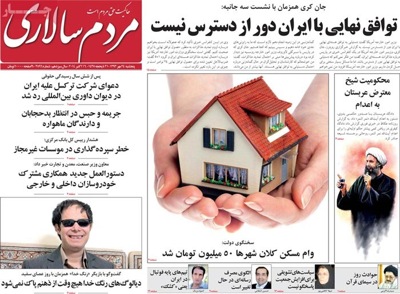
Mardomsalari: The International Court of Justice has rejected a lawsuit by Turkcell, Turkey’s top mobile operator, against Iran.


Mardom salari newspaper 10 - 16


Resalat: “Reconstruction of Gaza and promotion of the defense capabilities of the [Palestinian] resistance are on the agenda,” the secretary of the Supreme National Security Council said.


Resalat newspaper 10 - 16


Roozan: Former First Vice-President Mohammad Reza Aref says he wishes to become the chancellor of the University of Tehran.


Ruzan newspaper 10 - 16


Sharq: An Iranian female fencer has bagged a silver medal in the Asian under-23 Fencing Championships in the Philippines.


Shargh newspaper 10 - 16


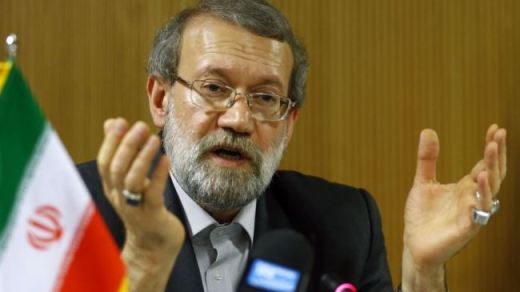
Iran deal benefits all, boosts regional stability

Iran-Larijani-nuclear

Iran’s Parliament Speaker Ali Larijani says a final agreement over the Islamic Republic’s nuclear energy program will benefit all sides and boost regional stability.

Larijani made the remarks at a presser held on the sidelines of the Inter-Parliamentary Union’s General Assembly in the Swiss city of Geneva on Wednesday.

“I think a nuclear deal will benefit everyone and this agreement will bring about the capacity to resolve some problems hampering regional stability,” said the Iranian parliament speaker.

He added that the talks between Iran and the Sextet of world powers were moving ahead towards a comprehensive deal.

Iran and the six powers – Russia, China, France, Britain, the US, and Germany – are in talks to work out a final agreement aimed at ending the longstanding dispute over Tehran’s nuclear energy program.

Iranian President Hassan Rouhani said on Monday that the two sides would “certainly” reach a deal on the issue.

Larijani further commented on the US-led coalition against the ISIL militants, saying the coalition would not bear any results unless its members stop sponsoring the terrorists.

On Monday, Iraqi Prime Minister Haider al-Abadi slammed supporters of the Takfiris, referring to Saudi Arabia, Turkey, and some Persian Gulf Arab states.

The terrorists, who currently control parts of Syria and Iraq, have committed widespread acts of violence, including mass executions, abductions, torture and forcing women into slavery in the areas they have seized in the two countries.

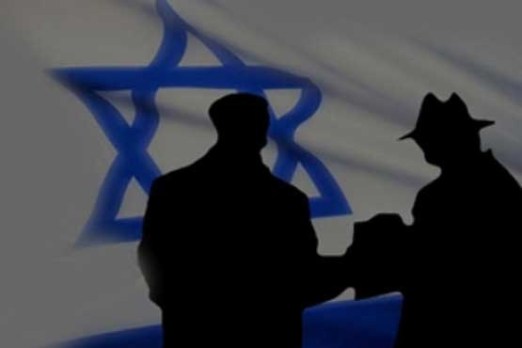
Israel’s proposal to arm Iran with atomic weapons

Israel
Israel

“Thirty Years of Silent Endeavors” an addendum of Hamshahri newspaper was published on October 12 to mark the 30th anniversary of the establishment of Iran’s Intelligence Ministry.

What comes below is the exact translation of a document which appeared in the online edition of the addendum focusing on the depth of Iran-Israel ties in the 1970s:

The Israeli government has defended efforts to equip Iran with nuclear weapons, says one of the documents held by SAVAK [the Organization of Intelligence and National Security, Iran’s secret police prior to the 1979 Islamic Revolution]. According to this document which dates back to the time when Prime Minister Yitzhak Rabin was in office (1974-77), Uri Lubrani, the then Israeli ambassador to Iran, had called for atomic cooperation between his respective government and Iran, and for arming Iran with atomic weapons.

The following is the report SAVAK complied:

“This is to respectfully notify Your Majesty that following talks with Israeli Prime Minister Mr. Yitzhak Rabin, his letter on the Egyptian president’s offer for holding separate talks with Israel was submitted to Your Majesty. And your Royal orders were as follows:

“As it is said earlier, Egypt has agreed to enter talks through the US or the United Nations on the restitution of part of the Sinai [Peninsula] without taking into account the viewpoints of Syria and those of other Arab states. The Shah has underlined again that we need to seize this opportunity not to let the Soviet Union get reengaged in Egypt.”

Head of the Israeli mission in Iran, Mr. Lubrani, was said (in a meeting with the representative of Israel’s intelligence service in attendance) to communicate [Shah’s] order to his boss, the Israeli premier. These are what Mr. Lubrani said in response. (Mr. Lubrani said his words come after his private talks with the Israeli premier):

1. The Israeli government is ready to enter talks with Egypt under any circumstances.

2. Any formula which is put forward to settle the Palestinian question would, if materialized, put an end to the reign of King Hussein [of Jordan]. In principle, the creation of a Palestinian state would be politically and economically unachievable without violating the Jordanian sovereignty.

3. Currently, King Hussein and his supporters make up a small minority in Jordan. It is unclear what would become of him if the Palestinian state is formed.

4. All measures King Hussein is to take will be coordinated beforehand through his constant contact with us.

5. Since we have come to realize that Iran’s Shah will never overlook the interests of King Hussein, I should say that Iran’s support for the formation of the Palestinian state would translate into the removal of King Hussein from power.

6. As you know, the majority of the Palestinian people are now living in Israel’s territories, so they are under our control. Israel hosts more Palestinians than any other Arab country.

7. What Israel has done in the West Bank of the Jordan River is to help Hussein’s kingdom survive. Israel is very much interested in seeing King Hussein’s regime continue to reign.

8. In my view, cooperation between Iran and Israel on the economic front could help fulfill what should be done in agricultural, petrochemical, financial and arms-related areas.

9. Israel’s economic delegation could visit Iran after a date is fixed for their trip and after the Iranian team is named by General [Nematollah] Nassiri [the director of SAVAK] (who’s been tasked with the job through a Royal order).

10. I suggest a coordinator who is in charge of the administrative affairs and appointed by SAVAK be included in the board of directors of the two countries’ mutual economic cooperation [committee] so that he could coordinate with SAVAK which has been charged with the implementation of this plan.

11. Areas of cooperation between the two countries should be precisely determined by their economic delegations.

12. If we’ve provided you with a detailed description of a certain plane which is manufactured in Israel, it doesn’t mean we are going to sell it to Iran. It means if you want this plane to meet your needs, we can cooperate with you to produce it.

13. We are well aware that you cannot buy planes, missiles and tanks from Israel on political grounds, but we will give you what you need through our advanced technology if you seek to produce these weapons inside Iran. At the moment, there are some Jews living in Israel who have come to Israel with a background in NASA and have been employed by the government.

14. We are at the ready to have atomic cooperation with Iran on all fronts. A while ago, the Iranian prime minister summoned me (Mr. Lubrani), calling for atomic cooperation [with Israel]. After I got my respective government’s approval, I met Dr. Etemad who had been appointed by the Iranian prime minister and promised to do what I could to help, but nothing else came about. You are exclusively dependent on Western countries for building nuclear power plants and supplying uranium fuel for them. We have practical experiences in this regard and can share them with you.

15. The students Iran sends to Europe and the US to study nuclear physics return to the country as ultra-leftist elements after they finish their studies. However, if Iran sends its students to Israel, we promise to take extra care not to let these students be exposed to political deviations.

16. We can produce atomic weapons for you if Iran wants us to. To separate uranium 235 from 238 to be used for making atomic weapons is a very easy task in Israel, after all, when the separation is complete developing atomic weapons is not very difficult. (1)

At the end, I would like to respectfully state that based on incoming reports from Iran-based coordinator of the Israeli intelligence service, General Zvi Zamir, the former Mossad chief has been named by the Israeli prime minister to take charge of economic and military cooperation with Iran.

His majesty reviewed the items and stated, “I just talked about the question of Egypt. The separation in matter should be done ahead of a trip by Brozhenit to Cairo.


The Organization of Intelligence and National Security (2)

Cited in Israel’s Periphery Strategy

By Mohammad Taghi Taghipour, Political Studies and Research Institute


Footnotes:

1. As Western sources have put it, it was back in spring 1977 when Shimon Peres, the then Israeli defense minister, inked the so-called Project Flower, an agreement on Iran’s cooperation with Israel’s atomic ballistic missile program. As payment, Iran was to give Israel $1 billion in crude oil and make an airport and launching pad available for Israel’s long-range missile test and a place for assembling the missile. The Shah of Iran hoped Iran could use Israel’s experience in the development of weapons in return for what was given to Israel. When Iran’s revolution brought Project Flower to a halt and the other elements which had made [Yaghub] Nimroudi a millionaire, he complained that he had lost $6 million: Cockborn, p.171

2. SAVAK document, numberless and dateless. The document dates back to the period when Yitzhak Rabin was the Israeli prime minister (July1974-July 1977).

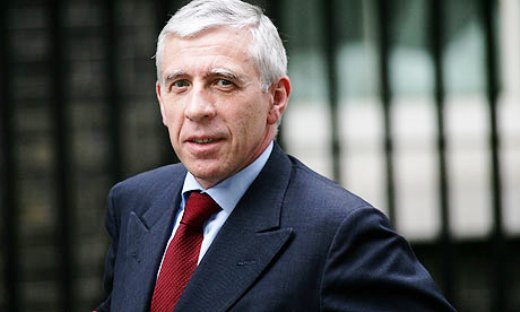
Straw describes Iran as a key regional power

Jack-Straw
Jack-Straw

Former British Foreign Secretary Jack Straw said on Thursday that the role of Iran as a key regional power should be recognized.
Straw made the remarks in the 1st Europe-Iran Forum currently underway in London.
He said Iran should be recognized as a good potential partner.
He also said that all should admit the fact that Iran is a major part of a large number of UK strategic interests.
The UK has hurt itself by following the policy of discouraging trade with Iran, Straw added, hoping that Iran and the G5+1 could reach an agreement before the deadline ends.
Straw further underscored that Iran’s role is growing in the Middle East.
Iran and the West enjoy strategic interests in many areas including the increased terrorist threat of ISIL to the security of the region and the international community, he added.
With the prospect of improved political relations and a new business climate between Europe and Iran, the 1st Europe-Iran Forum kicked off in London on Wednesday morning.
The two-day event, organized by European Voice aims to “properly prepare and evaluate the post-sanctions trade framework and investment opportunities”, according to a brochure released by the organizers.
Following the historic Joint-Action Plan agreement between Iran and the P5+1 in November 2013, a series of economic sanctions were lifted, rekindling commercial interest in Iran throughout Europe.
On July 18th in Vienna, Iran and P5+1 (United States, United Kingdom, France, Russia, China and Germany) announced the continuation of their negotiations regarding the Islamic Republic’s nuclear program, through to November 24th 2014.