Friday, December 26, 2025
Home Blog Page 4932

Iran urges KSA to reverse cleric’s death ruling

Hossein Amir-Abdollahian

“Relevant Saudi [judicial] officials are expected to adopt a realistic approach and prevent the execution of the [death] sentence and keep tensions in the Muslim world from escalating,” said Iranian Deputy Foreign Minister for Arab and African Affairs Hossein Amir-Abdollahian.

He said the death ruling could raise Muslims’ sentiments and trigger international outcry.

“If the news [that the cleric has been sentenced to death] is true, that will undoubtedly hurt Muslims’ feelings and provoke international reaction,” the top diplomat noted.

He underlined that such moves will, by no means, help restore peace and tranquility to the restive Middle East region.

The senior Saudi Shia cleric is accused of delivering anti-government speeches and defending political prisoners.

Nimr was attacked and arrested in the Qatif region in July 2012. His arrest sparked widespread protests in Saudi Arabia, leaving several people dead.

There have been numerous demonstrations in the kingdom’s oil-rich Eastern Province since 2011, with the protestors calling for political reform and an end to what they call widespread discrimination. Several people have been killed and many others injured or arrested during the demonstrations.

The Persian Gulf monarchy has come under fire from international human rights organizations, which have criticized it for failing to address the rights situation in the kingdom. Critics say the country shows zero-tolerance toward dissent.

Human rights political tool in West hands: Iran VP

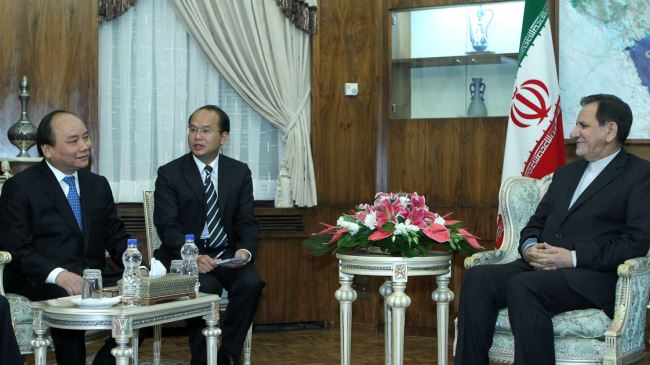
iran-vietnam
iran-vietnam

The Iranian official made the remarks in a meeting with Vietnamese Deputy Prime Minister Nguyen Xuan Phuc in Tehran on Tuesday.

Jahangiri also called on independent countries to confront the West’s double standards towards the issue of human rights.

He expressed misgivings over the emergence of violent militant groups in the Middle East, which pose challenges to regional nations, and voiced hope that the international community would take action to settle the issue.

Jahangiri also called for further development of all-out ties between Tehran and Hanoi and said Iran considers no restrictions to the expansion of ties with Vietnam.

The Vietnamese official, for his part, said his country attaches great significance to ties with Iran and seeks constructive relations with the Islamic Republic.

As the rotating president of the Board of Governors of the International Atomic Energy Agency (IAEA), Vietnam supports the ongoing talks between Iran and the P5+1 group over Tehran’s nuclear energy program, he added.

He also backed Iran’s access to peaceful nuclear technology.

Iran and the P5+1 kicked off a new round of nuclear talks in the Austrian city of Vienna on Tuesday.

The two sides have agreed to extend the talks for the third day on Thursday.

This round of talks is the eighth this year between Iran and the six countries of Russia, China, France, Britain, the US and Germany.

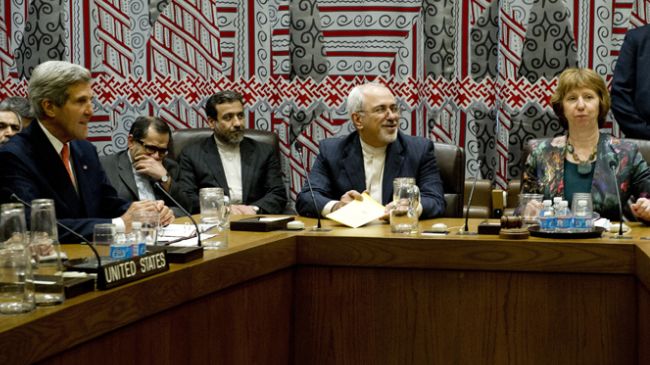
Trilateral meeting on Iran nuclear program starts in Vienna

Zarif-Ashton-Kerry
Zarif-Ashton-Kerry

Nothing has yet come out on the agenda of the Wednesday meeting, but the participants are expected to discuss obstacles in the way of a final agreement aimed at ending the longstanding dispute over Iran’s civilian nuclear work.

Zarif, who heads the Iranian negotiating team in nuclear talks with the five permanent members of the UN Security Council – the United States, Britain, France, Russia and China – plus Germany, arrived in Vienna on Tuesday.

He met with Ashton, who represents the six world powers in the talks over Iran’s nuclear energy program, on Tuesday, to discuss preliminaries for continuing the nuclear talks.

Also on Tuesday, Zarif’s deputies held meetings with their US and European counterparts for technical talks.

Iran will meet the representatives of the six world powers in Vienna on Thursday to discuss outstanding issues related to Tehran’s nuclear program.

Zarif has said that the Thursday talks will be attended by “political directors” from the P5+1 group as part of efforts to find “common ground.”

According to the top Iranian diplomat, talks with all members of the P5+1 group are scheduled upon a request by Iran.

“It was the Islamic Republic of Iran’s request that in addition to talks with Ms. Ashton and the US, we have negotiations with all members of the P5+1 group. Therefore, the talks have extended to Thursday, which indicates political will on all sides [to the talks],” he added.

Iran and its negotiating partners have a deadline of November 24 to clinch a final accord and end the dispute over Tehran’s nuclear energy activities.

One forum; two views

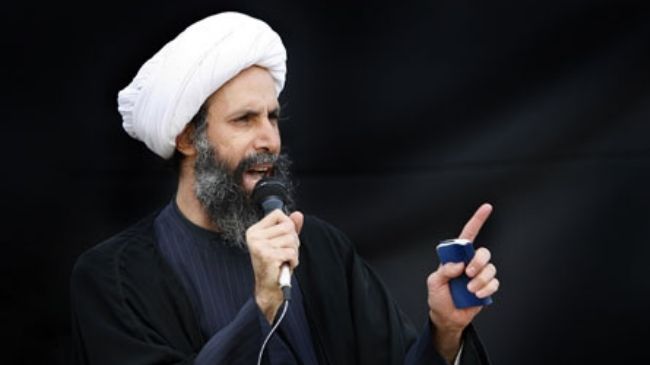
Sheikh Nimr al-Nimr
Sheikh Nimr al-Nimr

Alef has posted on its website a news report from Tasnim News Agency on a death sentence issued for Sheikh Nimr al-Nimr, a top Saudi Shiite cleric who has been so far detained and imprisoned three times by Saudi security forces. The following is the translation of the report and of two comments Iranian viewers posted:

“ … The Saudi prosecutor general called, on March 25, for the implementation of the Moharebeh [waging war against God] sentence for Ayatollah Sheikh Nimr al-Nimr on unfounded charges such as fanning the flames of religious sedition, meeting with people who are wanted by the government, inciting people to kill [fellow] citizens and security forces, and destroying mosques, during his sermons at Friday prayers.”

Sheikh Nimr al-Nimr was first arrested in 2006 when he was returning from Bahrain for attending an International Koran competition. The second arrest came on August 23, 2008, when he was in Al-Qatif [in Eastern Province, Saudi Arabia] for instigating Saudi Shiites to ask for the secession of the Shiite-majority governorate from the federal government. The top Shiite cleric was apprehended and placed behind bars for a third time in July 2012 after he was attacked by Saudi security forces. He received a leg injury during the attack.

The Saudi prosecutor called in the first hearing for capital punishment in the case of the Shiite cleric.

What motivated IFP to release this report were online comments by two Alef visitors in reaction to the story:

Hamid: We don’t meddle in the internal affairs of other countries. Saudi Arabia carries out only about 60 executions per year and this is not a high number.

Unnamed: Hamid, [Now that you so avidly support Saudi Arabia] why don’t you ask if the Saudi embassy is hiring?          

However, it should be noted that most viewers who posted a comment have expressed dismay and objection to the death sentence handed down in the case.

You may share this idea that the release of such comments could help the audience develop a better understanding of the atmosphere of Iranian society, its media and more importantly how Iranians think about world affairs.

Iran’s Iron Lady

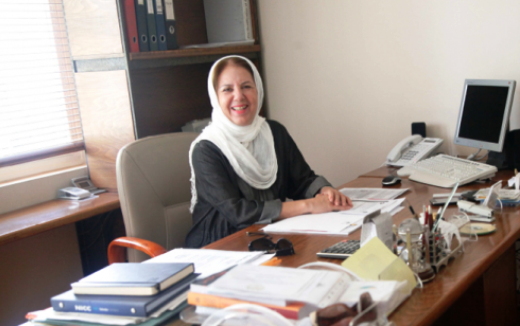
Faryal Mostofi
Faryal Mostofi

In September Tejarat Farda (Tomorrow’s Trade), a weekly magazine which mainly focuses on economic and business news, published an interview with a woman it called the Iranian Iron Lady. The following is an excerpt of the interview and its lead which appeared in the 101st issue of the magazine:

Our appointment was at 9 p.m.; she arrived home a few minutes earlier than our appointment time and exhaustion was written all over her face. That’s why she asked us for a short interview. Female entrepreneur Faryal Mostofi, who is originally from Dezful [a city in Khuzestan Province], with her husband run a few national and international firms.

By assuming the executive responsibility of seven out of eight steel projects, she has probably stepped into one of the most challenging managerial eras of her career. She is a member of Tehran Chamber of Commerce, Industries, Mine and Agriculture. She is also the president of Kazeroon-Dez-Dasht (KDD) Company.

Aside from those positions, she is at the helm of a number of Iranian and foreign firms based in England, China, and Hong Kong. Trade, industry and mining are her specialty. The interview below focuses on her career since its early days and on her education, activities, experience, failures and accomplishments. Mrs. Mostofi’s husband Seyyed Reza Ghotb, who has always kept her company at work and in married life, was also on hand for the interview and talked in detail about their everyday family and working life.

As far as I know, you studied economics at university. I hardly know a manager whose academic education has focused on economics. What made you go abroad to study economics?

When I was a primary school student, I planned on having my academic education abroad. I studied at an Italian high school – Soheyl High School – and then I went to England because I knew English and was also familiar with the country. There I chose the University of Manchester.

Back then, engineering courses were popular and subjects like economics were not, especially among girls. Why did you pick economics?

From the very beginning, I wanted to be self-employed. In other words, I sought to set up my own business. I decided to carry on my education in a field which could later help me with management and corporate planning. I thought I had to know management. I believed that if I was a competent manager, good at what I was doing, I could take on engineers in different technical fields. That’s why I wanted to know economics inside out and opted for it. For my master’s degree, I went for economics and statistics and came first in the subject of statistics and was given a gold medal.

A gold medal?!

It is a kind of certificate awarded to a student who has secured perfect scores in a subject, that’s why it’s called gold medal.

What difference between Iranian universities and those abroad made you go for education abroad?

At foreign universities, interactions between professors and university students are different, at least in the past they were very different. I experienced the difference firsthand. After studying at the University of Manchester for a few years, I returned to Iran and for about three years I taught at two different universities.

Since I left high school at 16 and then immediately got a place at university, when I graduated and started teaching at university, I was almost the same age as my students. I treated them like my friends. Back then, I shared an office with an experienced professor and my students came to my office and we talked about different subjects ranging from lessons to life and social matters.

Why did you quit your job at university after three years?

As I told you, from the very beginning, I set my sights on building my own business. When I returned to Iran, I was a graduate with no experience under my belt. I needed to acquire some experience before I stepped into the world of business. Since I have never liked to work under anyone, I applied for the position at the university which offered me more flexibility.

Besides, the 1979 revolution moved into high gear, university students were involved in a frenzy of revolutionary activities. Universities were almost shut down and following the revolution, the actual closure of universities took place. I was not a kind of person who could stand doing nothing, so I left Iran for England.

Did you manage to start your business in England?

That’s what I did. I established a business there. Given my interest in management, I entered the field of management. Business by itself was unable to gratify me, and I was more after project management. It was 1983 when solar energy was new and AEG (Allgemeine Elektricitäts- Gesellschaft Aktiengesellschaft [General Electricity Company]) was working on it. I went to Germany and held talks with the company and developed an interest in this field.

One of the reasons why solar energy caught my attention was that Iran is a sunny country and enjoys a lot of regions which are suitable to harness this source of power. We also carried out some projects in the Middle East and Africa. One and a half years after the opening of my business in England, I set up a branch in Paris.

When did you come back to Iran? Did you face any difficulty?

In the meantime, of course, I traveled to Iran from time to time, but I liked to be able to be based in Iran. Even when I was studying abroad, I kept thinking about returning home and serving my country.

When the [Iran-Iraq] war came to an end and the stage was set for economic activities, and the so-called Reconstruction Period got underway, we returned to Iran. Of course, prior to my return, I had been told that things were not set for business, and women faced numerous difficulties and limitations. However, no door was closed to me; I was back and started my own business. Since I set up my first business in Iran 20 years ago, I have not come across any major problem.

What was the first business you set up in Iran?

A few months after my return to Iran, my husband and I founded KDD (Kazeroon-Dez-Dasht) Company.

To what extent did your husband’s presence play a role in your accomplishments?

My husband was the one who encouraged me; a helper and a colleague. As a matter of fact, I think no one else except him could have been my husband. We established the business together and worked together. In some companies, I am the CEO and my husband is the chairman of the board and in others the reverse is true.

Considering your dislike for working under someone, what are you like as a boss?

You should ask this question of my employees, but in my relationship with my employees, regardless of their position, I have avoided behaviors which I did not like others display in dealing with me. I believe that in a company we do team work. Every individual in the company has special expertise, and I need all of my employees. I never say I am the boss and things should be the way I want them to be. My company’s atmosphere is so welcoming and friendly.

What got you so involved in steel industry? Your firm has been assigned seven major steel projects?

My firm focuses on project management and we manage projects in different fields, but since I have worked on a considerable number of projects in connection with steel and mining, I have mastered such projects. In other words, we have not chosen to work just on steel projects. Our field of activity could have been any other industry, including oil, natural gas or cement.

The first project that we secured two years after our return to Iran was a coke production project in Zarand [a city in Kerman Province]. The next project was at Isfahan Steel Mill in which we offered the lowest bid to reconstruct its furnace and won the contract.

Weren’t you concerned about taking over a project that you did not specialize in?

No! We specialized in project management not in implementation of it. Besides, we have foreign partners who help us get things down. Another thing is that the technology adopted in the steel sector is not domestic. What’s more is that we have a consortium which is responsible for different aspects of projects, including technical matters, and providing the equipment necessary.

You should bear in mind that in such projects management is more important. There are a few companies in the world that make iron melting furnaces, so you have a limited range of choices in front of you and it’s the point where you should negotiate confidently and mange things at a reasonable cost and with high efficiency.

How do you make partners with foreign businesses?

Part of it comes down to our work background and the connections that we have developed over these years. Another thing is that I am completely above board in my negotiations. I have never sought to make an uncertain comment to get a company involved in a project. We make comments without pulling punches and say no frankly. Whenever I assume responsibility for a task, I am after reasonable benefits. I do not like to do a project which results in losses – which might happen at times – nor do I seek to make astronomical profits.

What is the contribution of Chinese firms to such projects? It is said that you are adept at negotiating with Chinese companies!

As I told you before, I do not mince my words. Holding talks with Chinese firms is so tough, because they do not give you a frank response. If they want to turn you down, they keep you waiting for ages. However, I know well how I should negotiate with them.

As for the steel projects for which China provided finance, it’s typical to import 60 percent of the equipment from the country which bankrolls the project. Nevertheless, with a great deal of attempts through negotiations, we pushed it down to 50 percent, so that Iran can get a 50 percent share. For some projects, we have raised Iran’s share of equipment provision to 80 percent. Although Chinese firms have financed the project, they have only a 20-percent cut.

Do you know Chinese? Of course, it can help you in marathon talks with the Chinese!

No, I do not know the language. I am fluent in English; and know French and Arabic to some extent.

Time management is of great importance to a manager. You are at the helm of a number of firms and projects and aside from your responsibilities at work, you have other commitments at home. What time do you get up and start your day?

In our house, we get up at either 6 or 6:30 in the morning. If I do not have an early morning meeting, I prefer to stay home for an hour or two to take care of some personal matters. I will leave home for work at 9 or 9:30 a.m. Mind you, during the time I am at home, I receive some business phone calls from abroad or other local firms. My working time is supposed to end at 4 p.m. However, my work never finishes on time and even if it does, I won’t return home at that time to avoid rush hour traffic. I often leave work for home at either 8 or 9 at night when my workload lightens and traffic thins.

What newspaper do you usually read?

As for national papers, I read Iran and Donyay-e Eghtesad. My husband and I read the weekly journal of Tejarat Farda. I take a cursory look at the headlines of other publications too. I must say that when I am at work, I do not have much time to read newspapers, that’s why I usually take them home. I am used to reading at bedtime and have a flick through papers and try to cherry-pick the best reports and read them.

Do you read foreign newspapers?

Yes, I read The Times and International Herald Tribune on the Internet.

Given your busy schedule, do you read books?

Yes, I should always have a book to read. Whenever the number of books that I have not read goes down, I will add more books to them in order not to run out of books. That’s why I always have books which I can plan on reading.

What’s your favorite sport?

Swimming, tennis and horse riding are my favorites.

Ms. Mostofi, what kind of perfume do you usually wear?

Italian perfume is my favorite.

Are you more interested in Iranian or foreign food?

I like them both. I am interested in variety. Kebab is my favorite among Iranian dishes. I must point out that I often skip lunch or eat little food at noon. My main meal of the day is dinner.

[…]

How long have you been living in this house?

Mr. Ghotb: We bought this house before the Revolution, in 1976 to be exact. We were abroad for a few years and the house was empty. We love it. It is secure and the facilities necessary are close by, plus the location of the house allows easy access to different parts of the city.

For the time being, how many firms are under your management?

Four or five. But it is worth noting that they are not all active at the same level. KDD Company, which manages the steel projects, is the most active one.

Are all these companies active in the field of industry or trade? Are you also active in investment?

Mr. Ghotb: It has been a while since we bought 48 percent of the Mehdiabad Mine’s shares. The mine, which is located in Mehriz – a city in Yazd Province – is the largest mine of lead and zinc in Iran. As for deposits, it might be the world’s second largest zinc mine. However, the degree of zinc purity in this mine is low and it is not like that of the Angooran Mine – a zinc mine in Zanjan Province. That’s why the process of exploitation is costly.

Who owns the remaining 52 percent of shares?

Mr. Ghotb: Twenty-five percent of the shares are purchased by the Australians which they have delegated to Omani contractors. An Iranian-Austrian company is the owner of the other 25 percent. The remaining two percent of the shares are owned by two Iranian companies, but our company is the main shareholder.

At what stage is the exploitation of the mine?

Mr. Ghotb: The process of exploration is complete, so its deposits are known. Exploitation comes in tandem with building a factory in the vicinity of the mine. Overall, the mine needs some $1 billion in investment. It is located in a protected area and we made a lot of efforts to get an exploration license from the Environment Protection Organization. Another major issue is the water supply. Fortunately, we made a contract for water supply and need to lay 100 kilometers of pipeline. We have also signed a contract for the construction of power lines.

So, the mine is yet to be operational and turn a profit.

Mr. Ghotb: The exploitation process is also one of the expensive stages and because the purity of zinc in this mine is low, to have it extracted, we need to adopt a special technology which is employed by a few firms in the world.

How long do you think it will take to have the mine operational?

Mr. Ghotb: I think it will take us another three years to get there.

[…]

Which banks do you usually work with?

Mostly Mellat and Saderat. I must say that we have not taken out any loans from Iranian banks at all, whereas we have received some from banks abroad. On no account have we applied for a loan from an Iranian bank and we will never ask for it in the future, but we have been told by our friends that it’s a lengthy process.

Do you run the other four firms from the KDD head office?

Yes, of course, each of them has its own CEO who gets things done and sends us reports at the final stage. These firms are often run by our family. For instance, my brother is the CEO of one of these companies. Nonetheless, our focus is more on KDD and its projects. We also have companies in China, Hong Kong and England. These firms carry on the business that we started in the past. The enterprises in China and Hong Kong support our projects in Iran.

Iranian research involving DNA

DNA researchers
DNA researchers

Iranian scientists have conducted considerable research involving Deoxyribo-nucleic Acid (DNA). The research conducted by some has brought them international fame. Just like scientists in fellow developing countries, the Iranian scientists’ work mostly has to do with decoding the DNA. The following is the translation of part of a report Zanan-e Emrooz (Today’s Women) weekly has run on the endeavors of Iranian researchers:

The important Iranian research involving DNA has probably been conducted by Arman Fathizadeh, a physicist at Sharif University of Technology in Tehran, and his colleagues who have created a model showing how proteins move along DNA.

The problem is that until now, scientists did not clearly understand the physical mechanisms of how to open the book and read the genetic text contained in DNA. Dr. Fathizadeh and his colleagues have developed a basic computer model of the nucleosome which introduces flexible binding sites of the DNA to the protein core, and thus provides a more physical representation of the system. Their research was published in the European Physical Journal in March.

In another research, scientists at Isfahan University of Technology have developed a new technique to examine the destructive effects of elements, say metals, on DNA.

It allows scientists to develop an insight into how drugs work and what impact chemical and biological reactions leave on DNA. Pollution, anxiety, stress, etc. can lead to genetic mutations inside the body and eventually cause cancer. The new technique can help doctors identify the disease at an early stage and take more effective measures to halt its progression.

In yet another research, Iranian bacteriologists have made recombinant proteins in a bid to prevent urinary tract infections and developed a FimH vaccine.

Some studies have been carried out by Iranian scientists abroad, still they should be regarded as Iranian. For instance, Dr. Ali Khadem-Hosseini, a full professor at Harvard University, and his assistant Majid Sadoughi, have carried out research in the area of biomedical micro-devices and biomaterials.

Khadem-Hosseini has developed a number of methods for controlling the stem cell microenvironment using microscale devices and for engineering biomaterials to be used in tissue engineering.

It is worth noting that all human cells, except for red blood cells and plackets, contain DNA. The Iranian Legal Medicine Organization has set up a genetic identification bank which can be used in crime prevention, identification of people whose Alzheimer’s is at an advanced stage or those who have gone missing, and in inheritance- and immigration-related issues.

Iran has control over ISIL activities

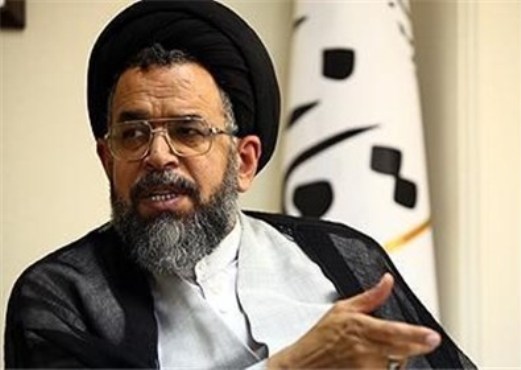
Iran's Intelligence Minister Seyyed Mahmoud Alavi

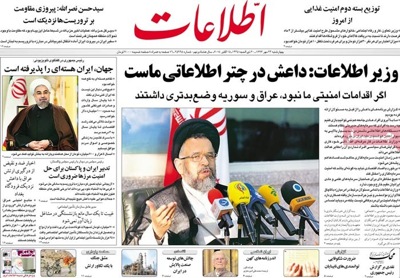
Intelligence Minister Seyyed Mahmoud Alavi said that his ministry has control over Islamic State of Iraq and the Levant (ISIL) activities as well as the group’s elements inside and outside the country.
Speaking in a press conference on Tuesday, he said that the Intelligence Ministry had predicted the rise of extremist groups in Iraq and Syria and had intelligence cooperation with these countries in fighting terrorists.
If Iran had not helped Syria and Iraq, the situation in these two countries would have been different today, Alavi noted.
Referring to the foreign intelligence services’ targets in Iran, he warned against enemies’ divisive plots.
Alavi revealed connections between British intelligence services and a number of Iranian opposition satellite channels seeking to sow division among Muslims.
“According to the information we have, a series of satellite channels, which broadcast programs against the unity of the Islamic Ummah (Nation), are linked to Britain’s [intelligence] services,” he said.
Alavi said that the country’s Intelligence Ministry confronts radical and extremist Shiite and Sunni movements inside the country, which seek to create religious division.
Recently, one of the satellite channels [operating] against the unity of the Islamic Ummah, which was linked to Britain’s spy service, was detected by the Intelligence Ministry, he underlined.
Alavi added that MI6, Mossad and CIA are using cyber space for spying on Iran.
There have been attempts by foreign intelligence services to collect information about Iran’s defensive and nuclear sites, he said.
Alavi added that Iran trades information and cooperates with many foreign intelligence services.
He also announced that the Intelligence Ministry will do its best to facilitate investment in the country and guarantee the investors’ financial security.
Alavi said his ministry will continue its efforts to fight corruption in various sectors including in the economy.
The intelligence minister further said his organization pays great attention to the role of people in the country’s security, noting that people can very well contribute to sustainable security by interacting with the intelligence bodies.
“We believe the Intelligence Ministry is from the people and for the people,” he explained.
He added that any factor that creates a rift between the people and the government could imperil national security.

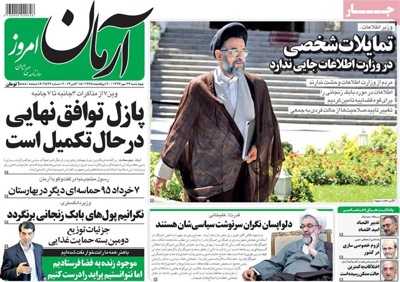
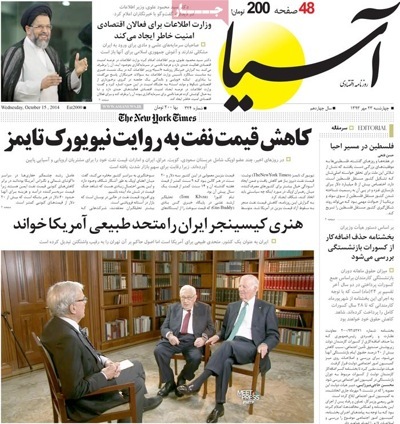
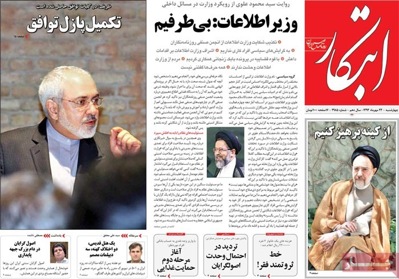
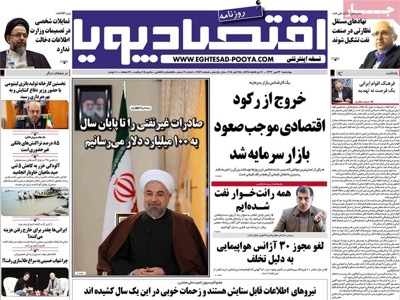
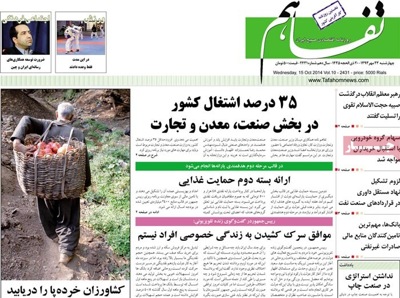
A look at Iranian newspaper front pages on Oct. 15

Iranian Newspapers Headlines

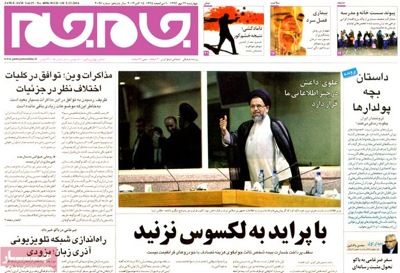
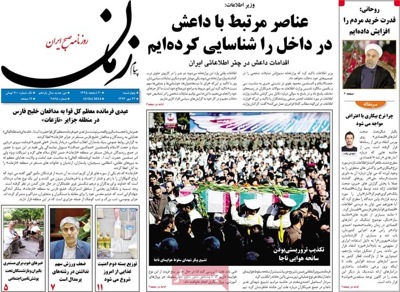
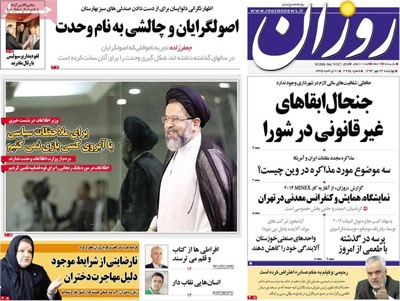
The comments of Intelligence Minister Seyyed Mahmoud Alavi about a wide range of issues such as the ministry’s priorities and the close eye it keeps on IS-affiliated elements dominated the front pages of Iranian dailies on Wednesday. Another story that drew a lot of attention in the newspapers was the resumption of talks between Iran’s Mohammad Javad Zarif and EU’s Catherine Ashton in Vienna. Comments by President Rouhani in a televised interview late Monday also continued to capture front-page headlines.

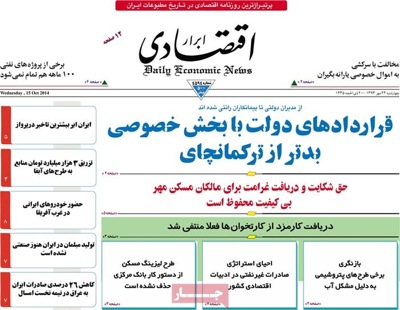
Abrar-e Eghtesadi: “Iran’s exports to Iraq in the first half of the year [started March 21, 2014] have registered a 26 percent drop.”


Abrare eghtesadi newspaper 10 - 15


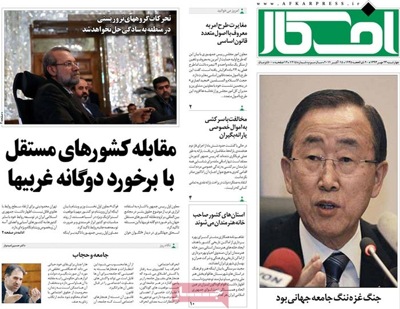
Afkar: “The [parliamentary] motion on promotion of virtue and prevention of vice runs counter to the provisions of the Constitution, Vice-President for Parliamentary Affairs Majid Ansari said.


Afkar newspaper 10 - 15


Arman-e Emrooz: “The so-called Worriers [Ahmadinejad supporters who keep expressing alarm about the state of affairs in the country since the rise to power of the moderate government of Hassan Rouhani] are worried about their own political future,” Ghodratollah Alikhani, a former reformist MP, said.

Arman-e Emrooz: “We managed to send a live animal to space, but we have been unable to fix [the problems of Kia] Pride,” Mohammad Reza Bahonar, a member of the parliament’s presiding board said, as he took a swipe at failure of different governments to streamline the country’s economy.


Armane emruz newspaper 10 - 15


Asia: “The Intelligence Ministry is set to ensure the peace of mind of businesses,” Intelligence Minister Seyyed Mahmoud Alavi said.

Asia: Former US Secretary of State Henry Kissinger has described Iran as “a natural ally” of the United States.


Asia newspaper 10 - 15


Ebtekar: “Iranians need to avoid grudge, rage, prejudice, worldly-mindedness, and violence manifested in the words and deeds of IS,” former President Mohammad Khatami said.

Ebtekar: “There is agreement on the general outline of the case,” Iranian Foreign Minister Mohammad Javad Zarif said of talks between Iran and P5+1 over Tehran’s nuclear program.


Ebtekar newspaper 10 - 15


Eghtesad-e Pooya: “Iran’s non-oil exports will have hit the $100 billion mark by yearend [March 21, 2015],” President Rouhani said.

Eghtesad-e Pooya: “Caspian pollution is to blame for a five ton drop in sturgeon catch.”


Eghtesad puya newspaper 10 - 15


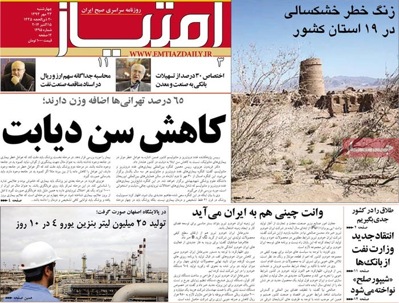
Emtiaz: “Up to 65 percent of Tehran residents are overweight; the age of diabetes has declined.”


Emtiaz newspaper 10 - 15


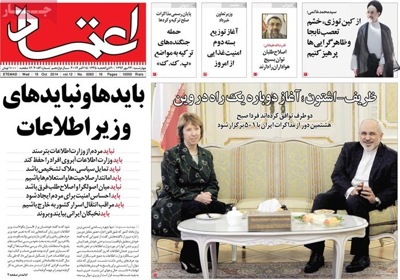
Etemad: “[The Intelligence Ministry] should not distinguish between principlists and reformists,” the intelligence minister said.


Etemad newspaper 10 - 15


Ettela’at: “Iran and Pakistan need to work together to establish border security,” Iranian Parliament Speaker Ali Larijani has told his Pakistani counterpart in Vienna.

Ettela’at: “The world has accepted to live with an Iran which is in possession of peaceful nuclear technology,” President Hassan Rouhani said in a televised interview.


Etelaat newspaper 10 - 15


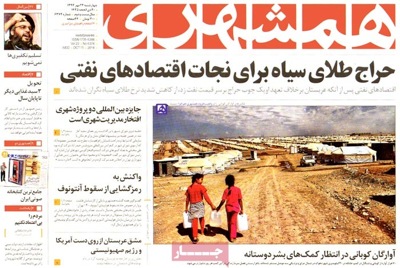
Hamshahri: “After Saudi Arabia decided to act contrary to its OPEC commitments and sell crude at a cheaper price, the drop in oil prices began to worry countries which depend on the black gold for the bulk of their revenues.”


Hamshahri newspaper 10 - 15


Jamejam: The president of the Islamic Republic of Iran Broadcasting, who is in Baku, Azerbaijan, has said IRIB will soon launch a new TV service in Azeri language.


Jame jam newspaper 10 - 15


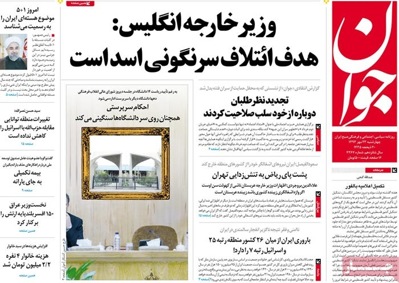
Javan: “Riyadh has turned down Iran’s policy of détente.” Allaeddin Borujerdi, a senior MP has blamed “old age” for the recent comments by the Saudi top diplomat describing Iran as an “occupying” force in Syria.


Javan newspaper 10 - 15


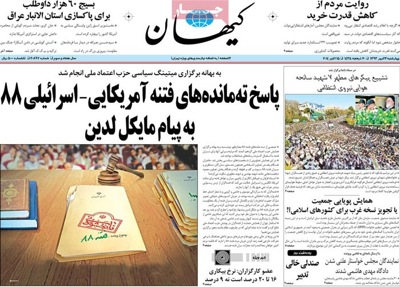
Kayhan: “A funeral procession has been held for seven police personnel who were martyred when their plane went down in the southeast late Saturday.”

Kayhan: “A number of MPs have sent a letter to the judge hearing the case involving Mehdi Hashemi [Ayatollah Hashemi Rafsanjani’s son], to call for the proceedings to be open to the public.”


Kayhan newspaper 10 - 15


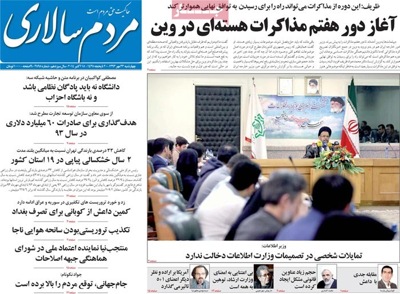
Mardomsalari: “Our plan is to secure $60 billion in revenues from exports [in the 12 months to March 21, 2015],” the deputy director of the Trade Promotion Organization of Iran said.


Mardom salari newspaper 10 - 15


Payam-e Zaman: Police have denied rumors of foul play in a plane crash that killed seven of its personnel in the southeast Saturday night.  

Payam-e Zaman: “We have identified individuals who are linked to IS inside Iran,” the intelligence minister said.


Payame zaman newspaper 10 - 15


Roozan: “My attorney has appealed the verdict,” former Vice-President Mohammad Reza Rahimi said after a court found him guilty of corruption.


Ruzan newspaper 10 - 15


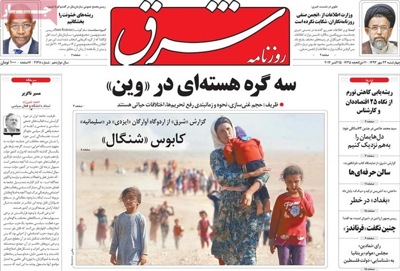
Sharq: The Iranian foreign minister has said the volume of enrichment, the manner of lifting the sanctions and its timing are the fundamental differences that need to be resolved.


Shargh newspaper 10 - 15


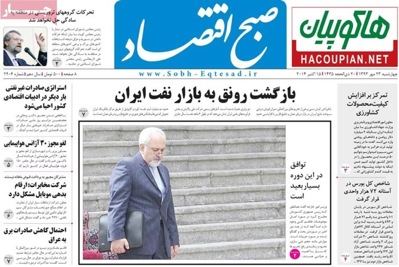
Sobh-e Eghtesad: “The current round of talks [between Iran and P5+1] is unlikely to result in a final deal,” the Iranian foreign minister said.


Sobhe eghtesad newspaper 10 - 15


Tafahom: The Iranian deputy minister of culture and Islamic guidance has underscored closer media cooperation between Iran and China.


Tafahom newspaper 10 - 15


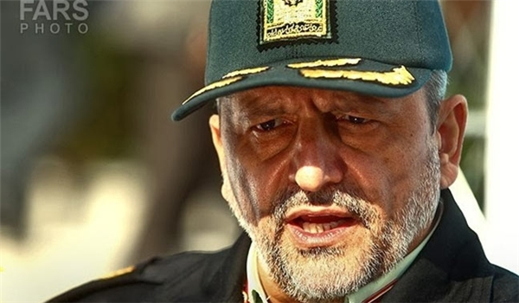
Iran rejects possibility of sabotage in police plane crash

Ahmadi Moqaddam
Ahmadi Moqaddam

Police Chief Brigadier General Esmayeel Ahmadi Moqaddam said the plane crash incident in southeastern Iran that killed several Iranian police officials a few days ago was not the result of a terrorist or sabotage operation.

“It is not correct to blame sabotage for the crash because there has been no fire or blast and the plane engines have just stopped working,” Ahmadi Moqaddam told reporters in Tehran on Tuesday.

He said police have found the remnants of the plane which showed that there has been no possibility for sabotage. “The plane was flying at 19,000 feet and the utmost range of weapons used by a person (to target a plane) is below 12,000 feet and targeting a plane at such an altitude is only possible by large missiles.”

Ahmadi Moqaddam blamed darkness of the night for the crash, and said perhaps, the plane could have landed safely if it had flown during the daylight.

On Sunday, an informed source described technical failure as the most likely cause of the Saturday evening crash of the light plane.

“The Law Enforcement Police’s spur plane which was flying from Tehran to Sistan and Balouchestan province to study the security issues in there, unfortunately crashed due to technical flaws, darkness of the night and the pilot’s unfamiliarity with the region,” the source told FNA.

“All the crew members of the plane have been martyred in the incident,” the source added.

Initial reports said that the Turbo Commander light aircraft went down in the Sabzpoushan mountainous area in Zahedan, the capital of Sistan and Balouchestan province, in southeastern Iran, on Saturday evening.

The airplane was on its route from the capital, Tehran, to Zahedan when the incident happened. The victims include three senior officers, a police employee and three crew members.

The wreckage of the aircraft has been found in Sabzpoushan.

On Sunday, Commander of the Iranian Border Guards Brigadier General Qassem Rezayee in an interview with FNA had also ruled out any possibility of a terror attack.

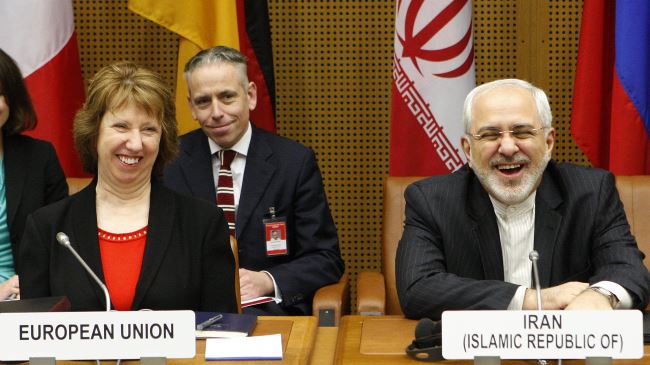
Iran, P5+1 to hold unannounced meeting in Vienna

Ashton-Zarif-Vienna
Ashton-Zarif-Vienna

Iran and P5+1 agree to extend talks over Tehran’s nuclear energy program for another day and will hold an unannounced meeting in Vienna.

The meeting will be jointly chaired by EU foreign policy chief Catherine Ashton, who leads the negotiating team from the P5+1 countries, and Iranian Foreign Minister Mohammad Javad Zarif on Thursday to continue the nuclear discussions.

Zarif and Ashton held a meeting on Tuesday and discussed the preliminaries for continuing the nuclear negotiations.

Earlier in the day, the Iranian foreign minister’s deputies, Abbas Araghchi and Majid Takht-e Ravanchi, US Deputy Secretary of State William Burns, Undersecretary of State Wendy Sherman, a senior advisor to the US government Jacob Jake Sullivan, and deputy to the EU foreign policy chief Helga Schmid discussed the nuclear issue.

Speaking to reporters upon his arrival in Vienna on Tuesday, Iran’s foreign minister said the new round of talks with the P5+1 can further pave the way for a final nuclear deal and vowed all-out efforts to resolve the existing problems.

“We will make our utmost effort to make the best use of the negotiations in these days in Vienna to settle problems,” Zarif added.

In a televised interview on Monday night, Iranian President Hassan Rouhani said that Tehran and P5+1 will “certainly” reach an understanding on Iran’s nuclear program based on the win-win principle.

This round of talks is the eighth this year between Iran and the five permanent members of the UN Security Council — Russia, China, France, Britain, and the US – plus Germany.