Saturday, December 27, 2025
Home Blog Page 4924

Iran, Kuwait stress unity among regional countries

Iran-Kuwait
Iran-Kuwait

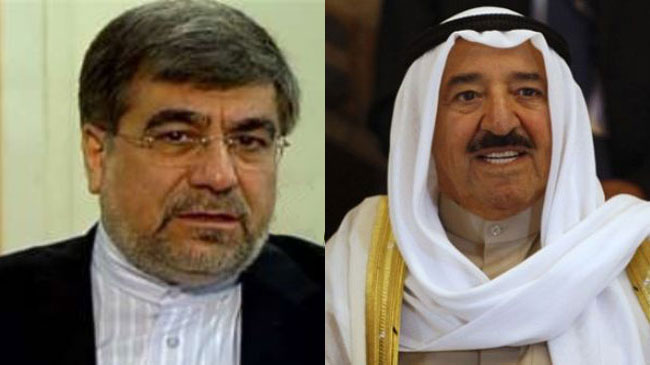
Most of the problems gripping the Middle East, including terrorism and extremism, are rooted in cultural issues, Iranian Culture and Islamic Guidance Minister Ali Jannati said in a meeting with Kuwaiti Emir Sheikh Sabah al-Ahmad al-Jaber al-Sabah in Kuwait City on Wednesday.

“The enhancement of cultural cooperation among Muslim countries can remove many of the ongoing crises,” Jannati said.

The Iranian minister also underscored deep-rooted relations between the two nations, calling for the expansion of cultural and scientific exchanges between Tehran and Kuwait City.

The Kuwaiti emir, for his part, called for the promotion of ties between Iran and Kuwait, saying that strengthening relations between the two counties will contribute to regional peace and stability.

“Kuwait always welcomes unity and convergence among regional countries,” Sheikh Sabah stressed.

The Kuwaiti emir also expressed hope that talks between the Islamic Republic and six world powers will bear good results.

Iran and the P5+1 group – Russia, China, France, Britain, the US and Germany – are in talks to work out a final deal aimed at ending the longstanding dispute over the Islamic Republic’s nuclear energy program as a November 24 deadline approaches.


Iranians remember late cleric; Leader leads memorial prayers

Iran-cleric-demise
Iran-cleric-demise

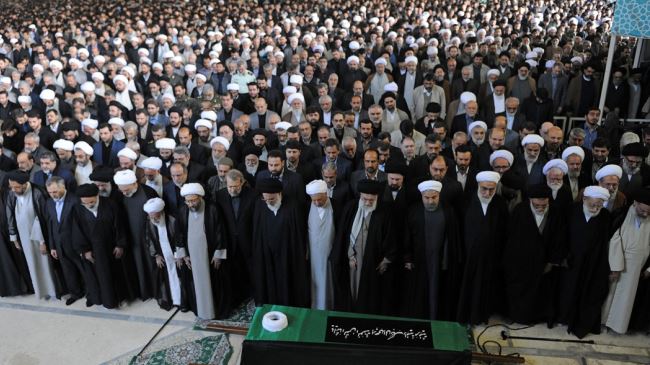
Leader of the Islamic Revolution Ayatollah Seyyed Ali Khamenei has led mass prayers at a ceremony in remembrance of the late prominent Iranian cleric, Ayatollah Mohammad-Reza Mahdavi Kani.

The service was held in the Iranian capital, Tehran, on Thursday.

The prayers were attended by people from all walks of life as well as dozens of senior clerics and high-ranking officials, including President Hassan Rouhani, Head of the Guardian Council Ayatollah Ahmad Jannati, Chairman of the Expediency Council Ayatollah Akbar Hashemi Rafsanjani, Parliament Speaker Ali Larijani, Judiciary Chief Ayatollah Sadegh Amoli Larijani and Intelligence Minister Mahmoud Alavi.

Chief of Staff of the Iranian Armed Forces Major General Hassan Firouzabadi was among the military top brass attending the ceremony.

The prayers were followed by a procession where mourners paid tribute to the late prominent religious figure.

Ayatollah Mahdavi Kani, 83, passed away in Tehran on Tuesday after he went into a coma on June 4 due to a major heart attack.

In a message of condolences following the demise of Mahdavi Kan on Tuesday, the Leader described the deceased cleric as an influential figure in the Islamic Republic and a true companion of the late founder of the Islamic Republic Imam Khomeini.

“This great and pious man appeared always and everywhere in the position of a religious scholar and an honest politician and a candid revolutionary,” Ayatollah Khamenei said.

The late cleric who also was a veteran politician was elected chairman of the Assembly of Experts in March 2011. The high-ranking body of experts elects and oversees the activities of the Leader of the Islamic Revolution.

The senior Iranian official was also a founder and the leader of the Combatant Clergy Association, a prominent religious, cultural and political foundation formed with the objective of protecting the achievements of Iran’s Islamic Revolution.

Iran not to regress to state before nuclear talks

Iran-Rouhani
Iran-Rouhani

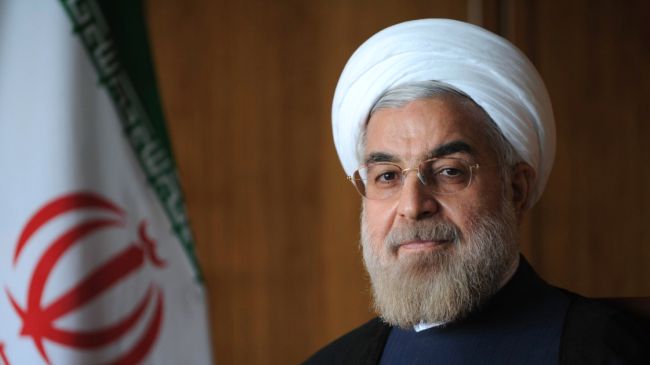
Iran’s President Hassan Rouhani has envisaged a successful ending to the ongoing nuclear talks between Tehran and six major world powers, saying the Islamic Republic will not regress to the state before the negotiations.

“I just want to restate that we will not go back to the situation in the past; the state of affairs in the world and in the region is such that we will not return to the past and this is something that the world also disapproves of,” the Iranian president said on Thursday.

The president also referred to his negotiations with heads of state on the sidelines of the 69th annual session of the United Nations General Assembly in New York, the Shanghai Cooperation Organization (SCO) summit in the Kyrgyz capital city of Bishkek, and the 4th summit of the Caspian Sea littoral states in the Russian port city of Astrakhan, saying, “We found that no one, especially the European countries, wants the present situation (standoff on Iran’s nuclear energy program) to continue.”

“We have made every effort to reach a [final] nuclear deal. It is not an easy task to reach an agreement on a highly significant issue with not only one, but six world powers,” Rouhani further said, adding, “Our initial experience indicated that we can reach a successful agreement with them.”

Highlighting the measures taken to finalize the deal, President Rouhani said, “These steps, though, are less than what we expected.”

“There’s not much time left; however, a final deal could be reached in the remaining period of time,” the Iranian president said.

Iran and P5+1 – Russia, China, France, Britain, the US and Germany – are in talks to work out a final deal aimed at ending the longstanding dispute over the Islamic Republic’s nuclear energy program as a November 24 deadline approaches.

Sources close to the Iranian negotiating team say the main stumbling block in the way of resolving the Western disputes over Iran’s nuclear energy program remains to be the removal of all the sanctions imposed on Iran and not the number of centrifuges or the level of enrichment.

Tehran wants the sanctions entirely lifted while the US, under pressure from the pro-Israeli lobby, insists that at least the UN-imposed sanctions against Iran should remain in place.


Minister: ISIL retreat from Baghdad indebted to Iran

Ali Jannati
Ali Jannati

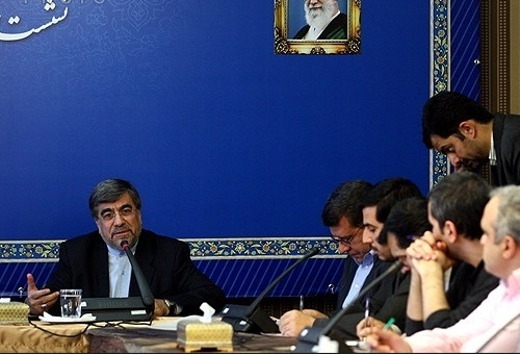
Iranian Minister of Culture and Islamic Guidance Ali Jannati underlined Iran’s all-out fight against terrorists, saying that the country’s aid to Iraq helped stop the march of the Islamic State of Iraq and the Levant (ISIL) terrorists on Baghdad.

“Had there been no support by Iran, the ISIL terrorists would have entered Baghdad by now,” Jannati said, addressing a group of Kuwaiti lawmakers, clerics and university professors in Kuwait City on Wednesday.

He underlined that the Iran-Iraq joint efforts, especially Tehran’s cooperation with the new Iraqi government, resulted in thwarting the terrorist acts, and expressed hope that the Iraqi government could fully get rid of the foreign-backed terrorists.

The Iranian minister of culture and Islamic guidance reiterated that the most important challenge facing the region at present is extremism in Iraq and Syria, and said, “The same countries that supported terrorism and extremism in Afghanistan, Pakistan and Syria have now formed the anti-ISIL front. But this coalition will surely fail to destroy the terrorists and the ISIL in Northern Iraq and Syria.

He pointed to the failure of big powers in Syria, and said, “The big powers have now become disappointed at Syria because they thought they could topple the Syrian government in two months, but four years after the start of this war President Bashar al-Assad won the presidential election in that country.”

In September, Iranian President Hassan Rouhani in a meeting with Iraqi Prime Minister Haider al-Abadi underlined friendly and brotherly ties between the two countries, and said Tehran spares no efforts to help Baghdad in handling the current volatile situation.

During the meeting on the sidelines of a UN General Assembly meeting in New York, President Rouhani stressed that Iran does not seek permission from any one to support Iraq’s security and development, and said, “Tehran considers Iraq’s security and stability as its own security and stability.”

In the strategic Middle East region, development and progress are possible only through consolidation of solidarity, he said.

Hailing Bagdad’s achievements in its fight against the ISIL terrorist group, President Rouhani said Iran would spare no assistance to Iraq in its current ordeal considering it a duty for Tehran both from the religious and neighboring aspects.

President Rouhani stressed any military act in Iraq, including bombarding the ISIL positions, by foreign countries should be made based on Baghdad’s demand and permission.

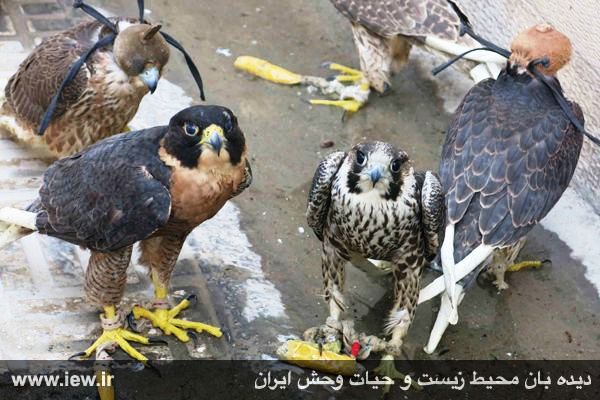
A big haul of birds of prey was seized in Hormozgan Province

bird traffickers from smuggling falcons

The Iranian environmental police have seized two dozen birds of prey from smugglers. What follows is the translation of a report by the website of Iran Environment and Wildlife Watch on the story on October 16:

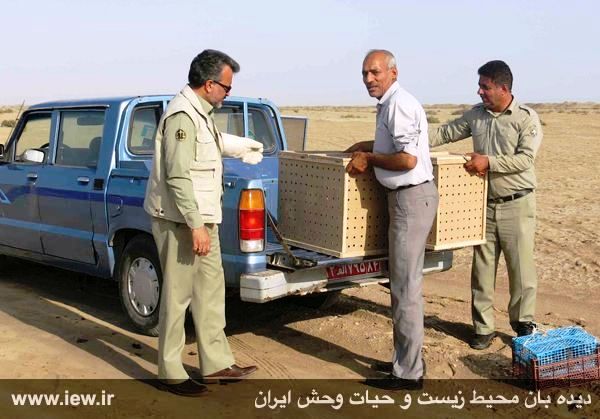
The environment police of Jask, a town in Hormozgan Province [in the south], along with a group of environmental volunteers and officers from Lirdaf Police Station have seized a big haul of smuggled birds of prey.

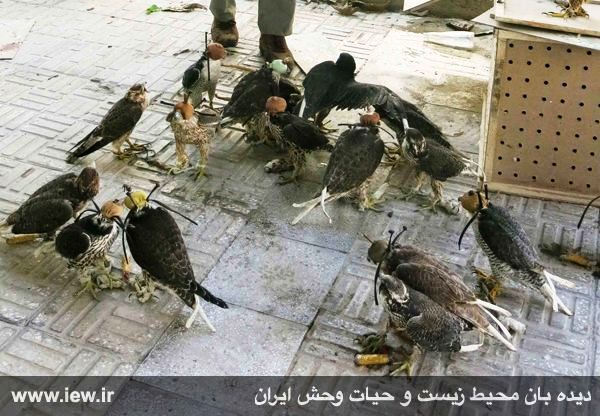
Twenty-four birds of prey, including 19 peregrine falcons and five barbary falcons, were smuggled into Sistan and Baluchestan Province from Pakistan. The traffickers intended to smuggle the birds first to Bandar-e-Jask and then to Bushehr Province.

One individual has been arrested in connection with the case which has been handed over to provincial judiciary officials.

Iran environmentUnfortunately, as a result of improper transfer conditions, two of the invaluable birds died. The rest of them were fed, cared and medically examined by a vet in the presence of the director general of the Environment Protection Organization of Hormozgan and then were set free in the plains of the province.

Birds of prey are protected species in Iran and a majority of them are on the red list of the International Union for Conservation of Nature (IUCN).

Birds of prey are at the peak of the food pyramid and play an important role in controlling the population of reptiles, rodents, and even some animals of the family Canidae.

Hunting, capturing and smuggling such birds into Persian Gulf countries have pushed this precious species to the point of extinction.

Arab falconers are immensely enthusiastic about birds of prey and ready to pay hefty prices for them. Arab sheikhs train falcons to hunt different animals, in particular bustards.

Under Note 2 of Article 13 of the Hunting and Fishing Act, anyone who tries to capture, hunt, sell, buy, carry, keep or smuggle birds of prey such as falcons, barbary falcons, saker falcons, and common kestrels can be sentenced to a maximum jail-term of three years and up to $600 in fines.

Aside from that, the compensation for the damage caused to the environment as a result of illegal hunting of birds of prey including falcons, barbary falcons, northern goshawks, and lanner falcons will be an additional fine of over $6,000.


bird traffickers from smuggling falcons

A look at Iranian newspaper front pages on Oct. 23

Iranian Newspapers Headlines

Instructions by the Supreme Leader that the country should stop relying on oil revenues dominated the front pages of the Iranian dailies on Thursday. Also appearing on the front pages were warnings by President Hassan Rouhani during a visit to Zanjan that promotion of virtue and prevention of vice should not become a source of insecurity in society. Comments by police officials about acid attacks in Isfahan last week drew a lot of front-page attention too.


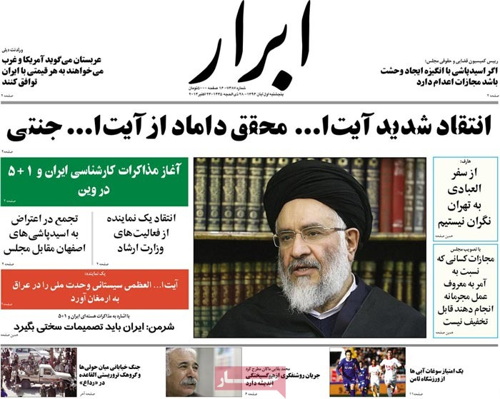
Abrar: “Acid attacks carry the death penalty if they are designed to terrorize the public,” the chairman of parliament’s Judicial and Legal Committee said.
 

Abrar Newspaper-10-23


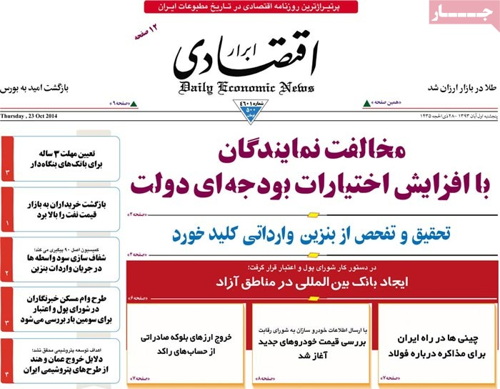
Abrar-e Eghtesadi: MPs have decided not to give the executive branch a freer hand in budgetary affairs.

Abrar Eghtesadi: Establishment of international banks in free trade zones has been placed on the agenda of the Money and Credit Council.
 

Abrar eghtesadi Newspaper-10-23


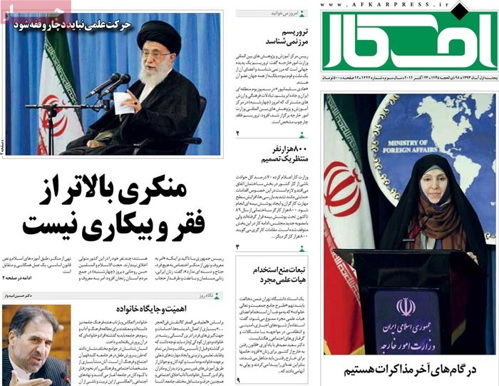
Afkar: “We are in the final stages of [nuclear] talks,” Foreign Ministry Spokeswoman Marziyeh Afkham said.
 

Afkar Newspaper-10-23


Aftab-e Yazd: There are rumors that General Motors may make a comeback to Iran.

Aftab-e Yazd: “We are following new leads in the case involving acid attacks [in Isfahan],” Police Chief Brigadier General Esmail Ahmadi-Moghaddam said.
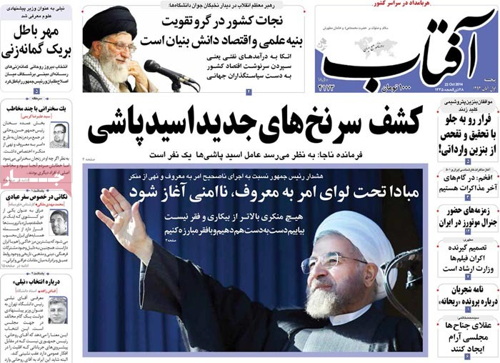
 

Aftabe Yazd Newspaper-10-23


Arman-e Emrooz: “The sale of hunting rifles has stopped,” the defense minister has told a joint meeting of the Environment Protection Organization and the Defense Ministry.

Arman-e Emrooz: “The reformist approach should be public-oriented,” former President Mohammad Khatami said.
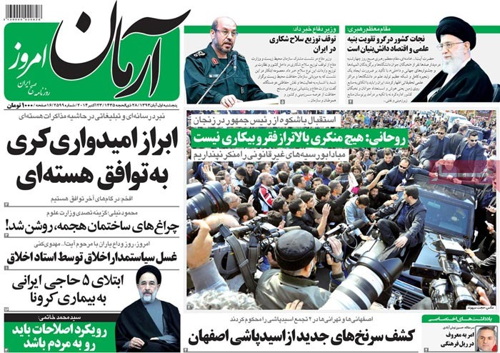
 

Arman Emrouz Newspaper-10-23


Asr-e Iranian: Iran has moved a notch up in the medals table of the 2014 Asian Para Games.
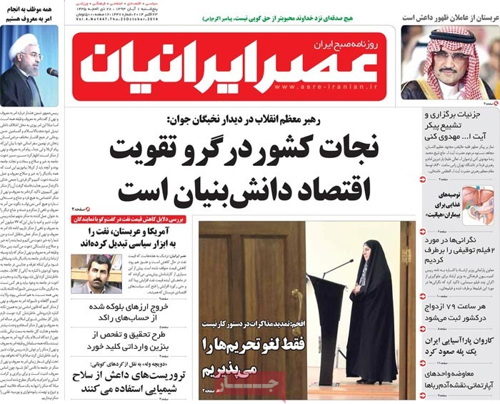
 

Asre Iranian newspaper-10-23


Asr-e Rasaneh: The oil ministers of Iran and Iraq have met to promote cross-border economic cooperation.
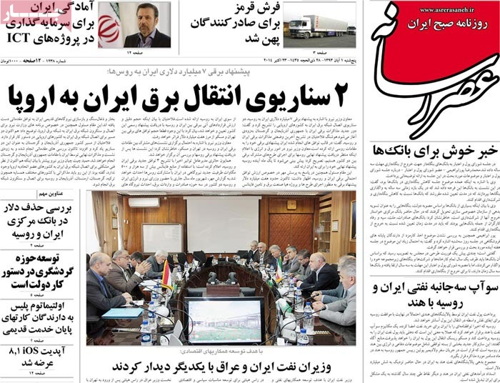
 

Asre Resaneh newspaper-10-23


Asrar: “Promotion of virtue and prevention of vice should not be monopolized by one particular group,” the president said.

Asrar: Former President Mohammad Khatami has urged the “wise members” of both parties [reformists and principlists] to form a “calm and moderate” parliament.
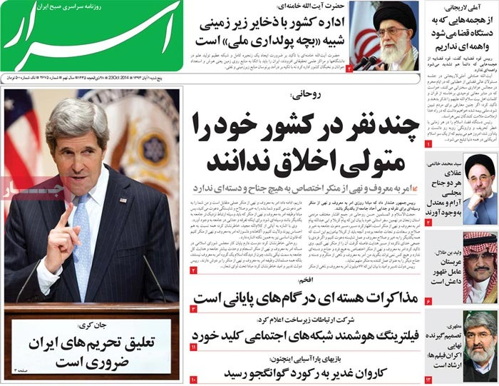
 

ASrar Newspaper-10-23


Ebtekar: President Rouhani has warned against politicization of efforts to promote virtue in society.
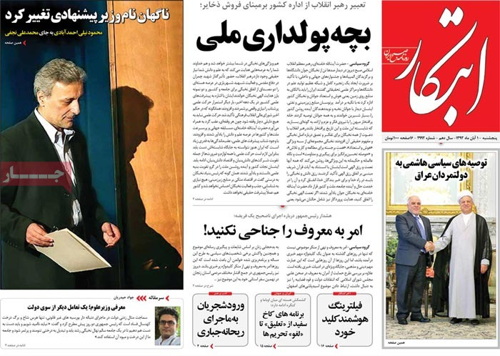
 

Ebtekar Newspaper-10-23


Eghtesad-e Pooya: “The country’s scientific move forward should not stop,” Supreme Leader Ayatollah Seyyed Ali Khamenei said Wednesday.

Eghtesad Pooya: “Recent flooding in Mazandaran has left some $25 million in damage,” the governor general of the Caspian province said.
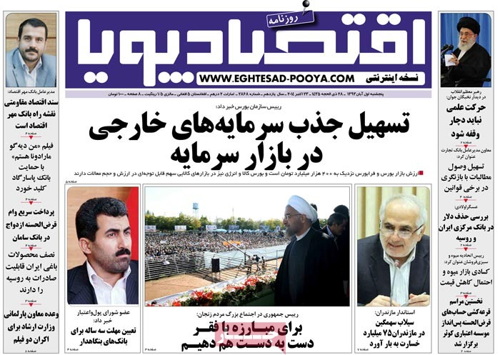
 

Eghtesad pouya Newspaper-10-23


Esfahan Emrooz: “Police investigations into acid attacks are underway. The public should not pay attention to rumors about the case,” said the prosecutor of Isfahan [where a recent spate of acid attacks has put residents on edge].
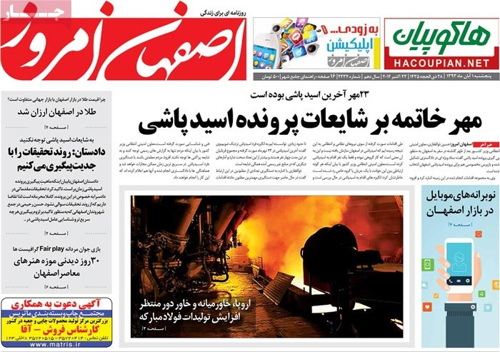
 

Isfahan Emrouz Newspaper-10-23


Etemad: The health minister [who is an ophthalmologist] has examined the eyes of a girl who has suffered serious injuries in a recent acid attack in Isfahan.

Etemad: “We are not denying our past mistakes. Reformists should help eliminate the possible skepticism of the establishment about the [reformist] movement,” former President Mohammad Khatami said.

Etemad: The smart filtering of social networking sites has got underway.
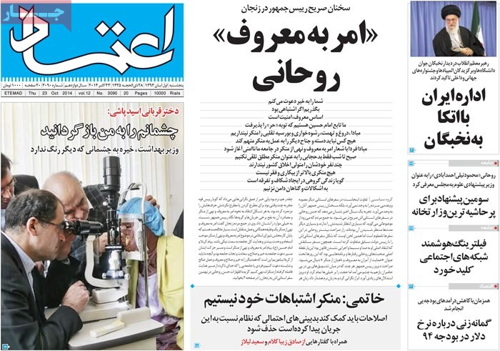
 

Etemad Newspaper-10-23


Ettela’at: In a surprising admission, a Saudi prince has blamed the support Saudi Arabia and a number of other countries have lent to the Syrian opposition for the emergence of ISIL.

Ettela’at: “Unemployment and hunger are the worst of social ills,” President Rouhani said during a visit to Zanjan province.

Ettela’at: “The president has tapped Dr. Mahmoud Nili Ahmadabadi, the current chancellor of Tehran University, for minister of science, research and technology.” It came against the backdrop of speculations that Mohammad Ali Najafi, the acting minister, will be named to seek parliamentary approval.

Ettela’at: “Reliance on oil is equal to giving world politicians a chance to determine the future of our country,” the Supreme Leader has told a host of especially-talented students.
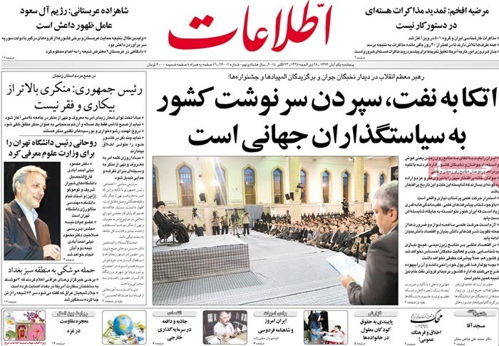
 

Ettelaat Newspaper-10-23


Farhikhtegan: The chairman of the Expediency Council has said that an increase in the number of graduate students is in the best interest of the country.


Farhikhtegan Newspaper-10-23


Haft-e Sobh: Sources say Islamic Republic of Iran Broadcasting will restart airing widely-watched Premier League soccer matches as of next week. A spat over broadcast fees between the national broadcaster and the Football Federation has stopped the former from airing the games live.
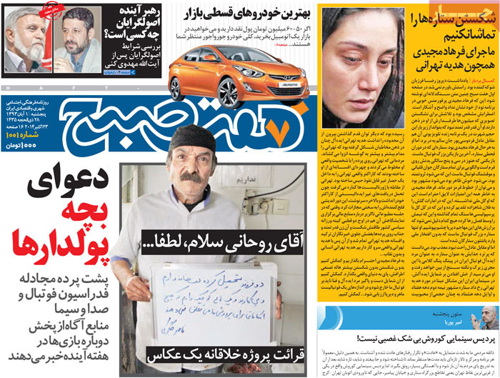
 

Hafte Sobh Newspaper-10-23


Hemayat: “We won’t allow the seditionists to reemerge,” Judiciary Chief Ayatollah Sadegh Amoli Larijani said.
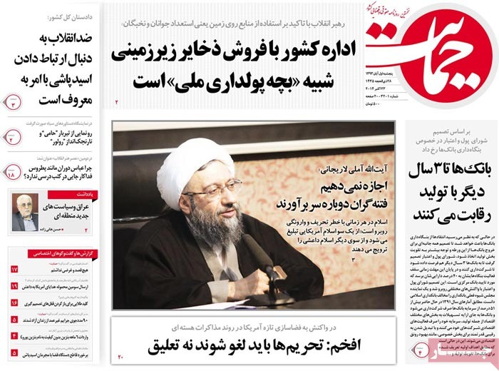
 

Hemayat Newspaper-10-23


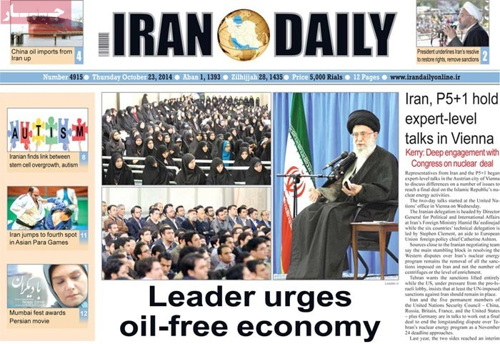
Iran Daily: “Iran and P5+1 hold expert-level talks in Vienna.”
 

Iran Daily Newspaper-10-23


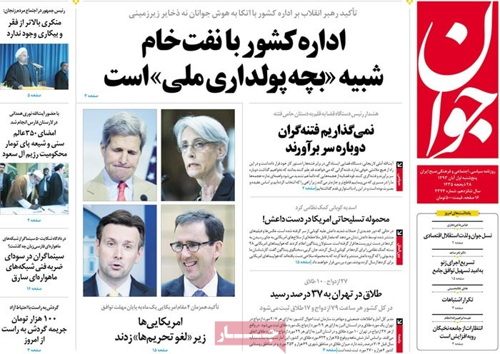
Javan: Divorce rate in Tehran stands at 37 percent.
 

Javan Eghtesad pouya Newspaper-10-23


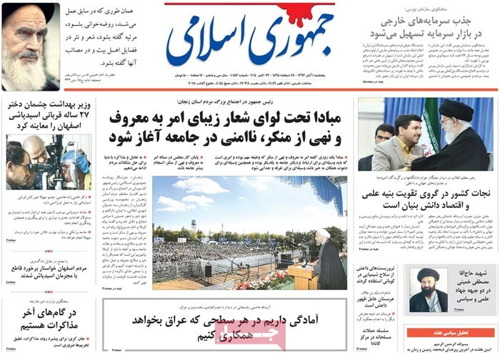
Jomhouri Islami: “The inflow of foreign investment into the capital market will be facilitated,” a spokesman of the Securities and Exchange Organization said.

Jomhouri Islami: “Iran is ready to cooperate with Iraq at any level Iraqi officials want,” the chairman of the Expediency Council has told the Iraqi premier.
 

Jomhouri Eslami newspaper-10-23


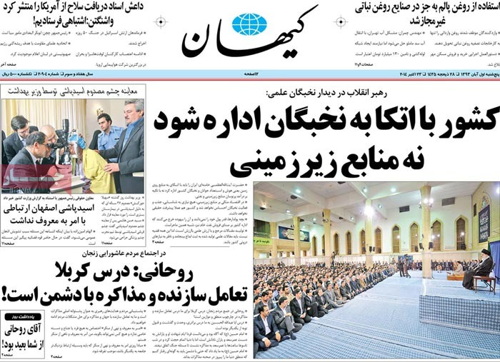
Kayhan: “The acid attacks in Isfahan are unrelated to morality laws,” the vice president for legal affairs said.
 

Kayhan Newspaper-10-23


Mardomsalari: “Iran will continue its constructive interaction with the rest of the world,” the president said.
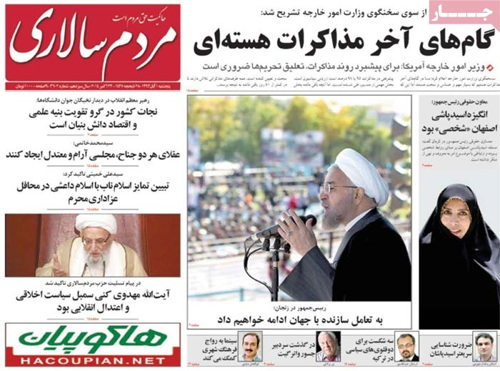
 

Mardom Salari newspaper-10-23


Qods: “Iran is to export electricity to Europe,” the deputy energy minister said.
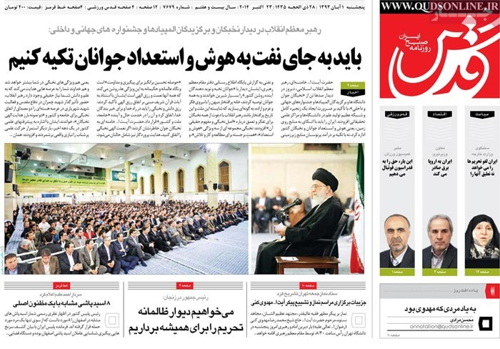
 

quds newspaper-10-23


Roozan: People in Tehran and Isfahan stage rallies to condemn the recent acid attacks.

Roozan: The corruption case involving former Vice-President Mohammad Reza Rahimi is now in the Supreme Court.
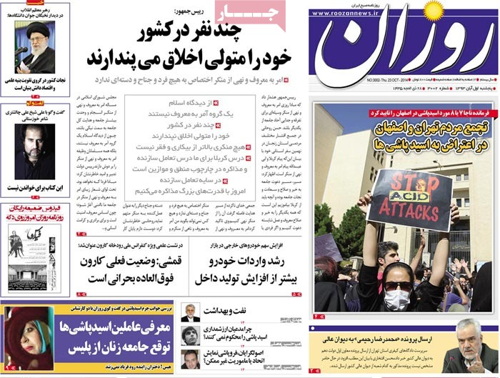
 

Rouzan Newspaper-10-23


Shahrvand: “Five people who are infected with coronavirus have been identified across Iran,” the deputy health minister said.
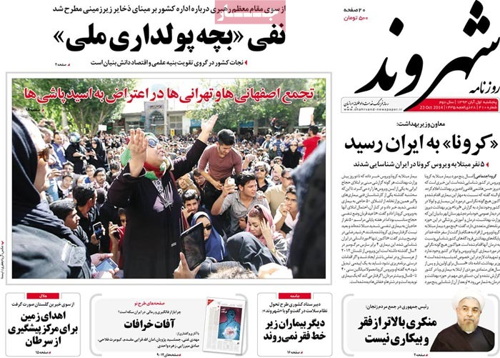

 

Shahrvand newspaper-10-23


IMIDRO: Chinese firms willing to invest in Iran’s steel industry

Iran industry
Iran industry

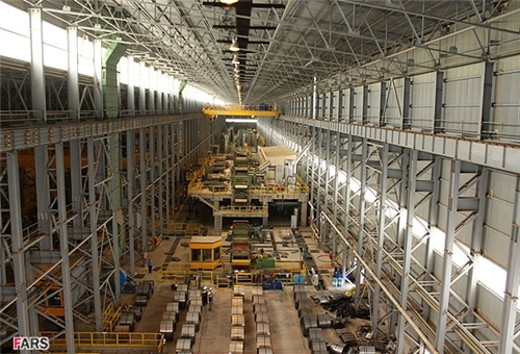
A team of Chinese investors have voiced their willingness to invest in Iran’s steel industry, a senior trade official said Wednesday.

“We will negotiate with the Chinese next week about Miyaneh steel project (one of the seven steel projects to go under negotiation for foreign investment) to pave the way for the start of its operation next year,” Head of the Iranian Mines and Mining Industries Development and Renovation Organization (IMIDRO) Mehdi Karbasiyan said today.

He noted that the seven steel projects of Sepid-Dasht, Neyriz, Qaenat, Sabzevar, Shadgan, Miyaneh and Baft are also ready for foreign investment.

Trade between Iran and China in the past year was estimated at $45bln.

Iran is currently China’s third largest supplier of crude, providing Beijing with roughly 12 percent of its total annual oil consumption.

It marks China’s biggest crude import from Iran since it won a renewal of exemption from the United States’ oil embargo against Iran.

Boeing ends decades-long hiatus in business with Iran

Iran-Boeing
Iran-Boeing

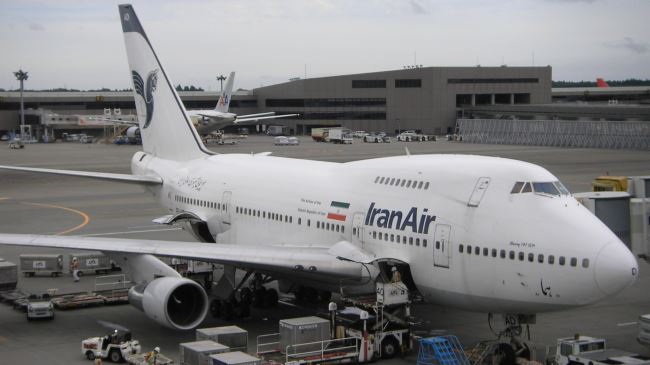
American aircraft-manufacturing giant Boeing has ended a 35-year break in business with Iran, supplying the country’s national flag carrier with a cargo of plane parts.

“During the third quarter of 2014, we sold aircraft manuals, drawings, and navigation charts and data to Iran Air,” Boeing said in its quarterly report on Wednesday.

This is the first time that the American company has sold plane parts to Iran Air since the 1979 Islamic Revolution.

The business deal brought Boeing USD 120,000 in revenues, the report added.

The sales came after the US Treasury Department issued a license in April that allowed Boeing to provide “spare parts that are for safety purposes” to Iran for a “limited period of time.”

Boeing said the plane parts were purchased “consistent with guidance from the US government in connection with ongoing negotiations.”

Boeing, which is still banned from selling new aircraft to the Islamic Republic, said that it could sell more plane parts to Iran Air in the future.

“We may engage in additional sales pursuant to this license,” it added.

In February, two major US aerospace manufacturers, Boeing and General Electric, applied for export licenses in order to sell airliner parts to Iran following an interim nuclear agreement between Tehran and P5+1 in November 2013.

Under the deal dubbed the Geneva Joint Plan of Action, the six countries – the US, France, Britain, Russia, China and Germany – undertook to provide Iran with some sanctions relief in exchange for Tehran agreeing to limit certain aspects of its nuclear activities.

In the past decade, Iran has witnessed several major air accidents blamed on its aging aircraft due to the US sanctions that prevent Iran from buying aircraft spare parts.

Tehran plays host to seasonal flower show

Tehran Fllower show
Tehran Fllower show

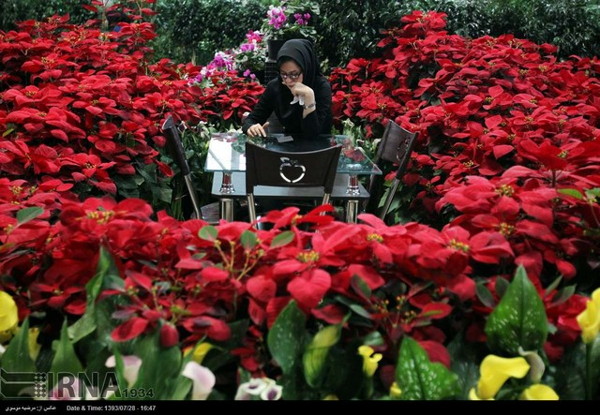
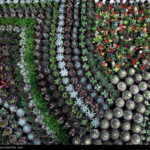
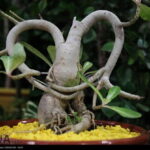
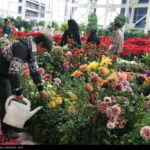
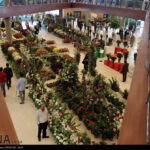
A sixth seasonal Flowers and Plants Exhibition has opened in the capital. The following are some of the beautiful images Islamic Republic News Agency photographers have snapped at the show.


Unity, political requisite for region: Rafsanjani

rafsanjani-abadi-tehran

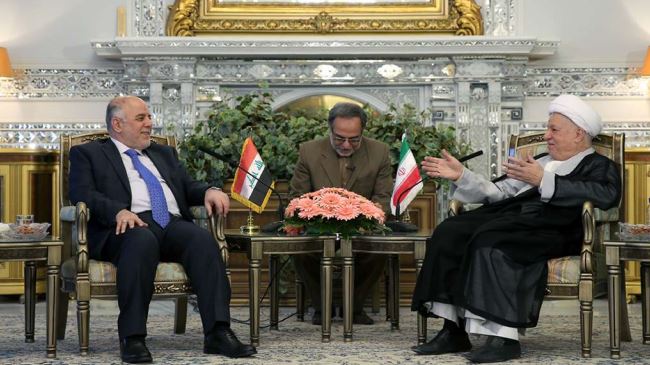
In a meeting with Iraqi Prime Minister Haider al-Abadi in Tehran on Wednesday, Hashemi Rafsanjani said enemies of Islam always use “division and rifts” in order to achieve their own political goals, adding that “the capacities of Muslim countries should not be wasted on groundless rifts.”

Urging the Iraqi government to foster unity among Shias, Sunnis, Kurds, Turkmens and other Iraqi ethnicities, Rafsanjani said unity will prevent enemies from exploiting possible divisions to meet their own political ends.

He noted that “reaching a consensus is hard, but more difficult than that is for the country to be gripped by internal divisions.”

The Iraqi prime minister, for his part, said his country sees Iran as a “reliable neighbor,” expressing hope for the expansion of Tehran-Baghdad relations.

He also termed the ISIL terrorists as false advocates of Islam, adding that they call infidels those Iraqi Shias and Sunnis who do not submit to their views, adding that terrorists have “resorted to massacre under the pretext of sectarianism.”

Iraq has faced brutal violence by the ISIL across the country’s north and west since early June. The ISIL terrorists have threatened all communities, including Shias, Sunnis, Kurds, Christians and Izadi Kurds, during their advances in Iraq.

They have been committing heinous crimes in the areas they have taken, including the mass execution of civilians as well as Iraqi army troops and officers.