Friday, December 26, 2025
Home Blog Page 4924

IRGC showcases combat, reconnaissance robots in massive drills

IRGC logo

The Islamic Revolution Guards Corps (IRGC) unveiled some of its new robots in the war games underway in Iran’s southern and western regions.

The IRGC’s Ground Force for the first time tested its new combat and reconnaissance robots in the massive military exercises on Thursday.

The first stage of the war games, codenamed The Great Prophet-9, was held Wednesday by the IRGC Navy in the Strait of Hormuz, known as the most strategic waterway in the Persian Gulf.

On the second day of the drills, the focus is on the capabilities and latest accomplishments of the IRGC Ground Force.

The force will fly its reconnaissance drones equipped with powerful cameras and test its weapons including Ramait roadside mine, Sayyad bounding mine, Asefeh 23mm Gatling gun, Arash shoulder-launched weapon and sniper rifle Siyavash.

Over the past few years, Iran’s Armed Forces have held several military drills.

The Islamic Republic has repeatedly assured other nations, especially its neighbors, that its military might poses no threat to other countries, stating that its defense doctrine is based on deterrence.

Iran dismisses Kerry’s remarks over intervention in Yemen

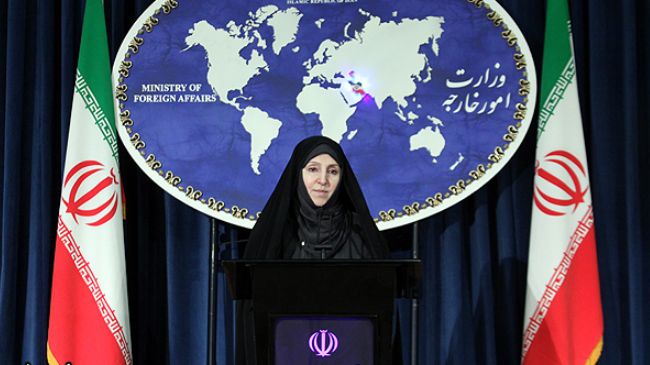
Marzieh Afkham

Iran’s Foreign Ministry has rejected as a blame game recent remarks made by US Secretary of State John Kerry, who accused the Islamic Republic of intervening in Yemen.

Iran’s Foreign Ministry Spokeswoman Marziyeh Afkham said on Wednesday that Kerry’s recent comments accusing Iran of aiding the collapse of the Yemeni government constituted a blame game and contradicted previous remarks made by US officials.

“All sides should allow the Yemeni nation to determine the country’s fate by itself; and all mechanisms should be based on the people’s will and demands,” Afkham said, adding that Iran firmly believes in and respects the right of every nation to determine its fate.

She said any foreign intervention in the course of the political developments in Yemen would complicate the political situation there and would obstruct the realization of political stability in the Arab country.

On Tuesday, Kerry accused Iran of supporting the Shiite Houthi revolutionaries, also known as Ansarullah fighters, in the takeover of the Yemeni capital, Sana’a, and the fall of the government.
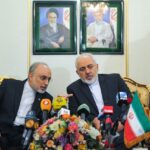
“I think it (Iran) contributed to it (the collapse of the Yemeni government),” Kerry said, adding, “But I do know that the Iranians were surprised by the events that took place and are hoping to see a national dialogue take place.”

In September 2014, Ansarullah movement gained control of Sana’a following a four-day battle with army forces loyal to General Ali Mohsen al-Ahmar, the half-brother of the country’s former dictator, Ali Abdullah Saleh.
Before gaining control of the capital, the Houthis had set a deadline for the political parties to put aside differences and fill the power vacuum, but the deadline was missed without any change in the country’s political scene.

On January 22, Yemeni President Abd Rabbu Mansour Hadi and the cabinet of Prime Minister Khaled Bahah resigned. The Yemeni parliament rejected Hadi’s resignation. Hadi sent a letter to the parliament on Monday, withdrawing his resignation.

On February 6, Yemen’s Houthi movement dissolved the Yemeni parliament and announced a constitutional declaration on the Transitional National Council following weeks of clashes with government forces.

The Ansarullah revolutionaries say the Yemeni government has been incapable of properly running the affairs of the country and providing security.

The Houthi movement played a key role in the popular revolution that forced Saleh to step down after 33 years of rule.

Terrorist attack outside Iranian embassy in Kabul

Iranian embassy in Kabul

A bomb attack hit a vehicle of the Turkish embassy outside the Iranian diplomatic mission in Kabul Thursday morning, killing one person.

The incident occurred at 8:15 local time when a suicide bomber driving a bomb-laden car tried to hit a diplomatic car belonging to the Turkish embassy while it was passing by the Iranian mission in the Afghan capital.

The driver was killed, said Deputy Interior Minister of Afghanistan General Mohammad Ayoub Salangi.

However, no damage has been reported to be inflicted on the Iranian embassy and the site of the blast is under tight security measures.No reporter is allowed to enter the area.

Salangi told reporters that investigations are underway to find the cause of the incident.

Iran’s IRGC holds naval drill in Strait of Hormuz (Photos)

IRGC-Naval-Drill-20

The Islamic Revolution Guards Corps (IRGC) on Wednesday carried out naval operations in the Strait of Hormuz, south of Iran, as part of a military war game, while exercises on the ground are scheduled for Thursday.

The following is a collection of photos Tasnim News Agency posted online of the naval exercise on February 25:


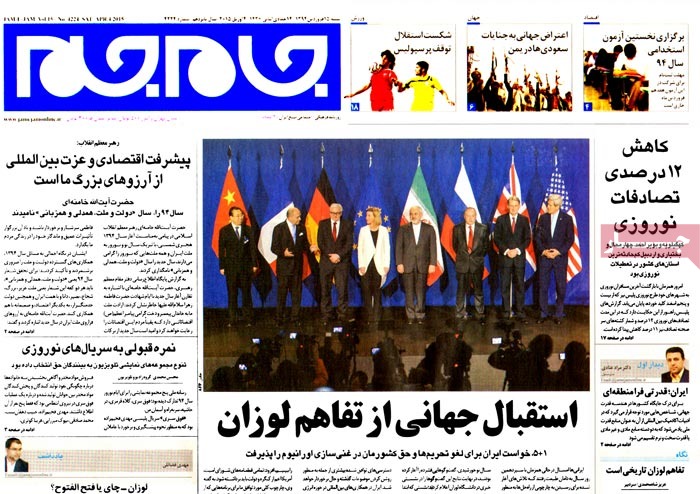
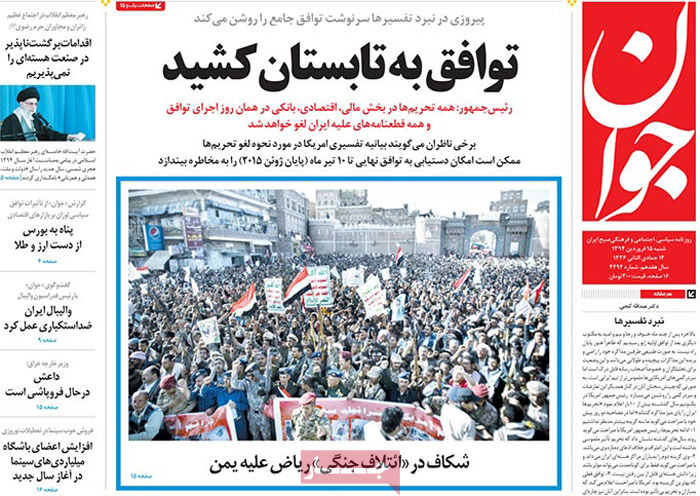
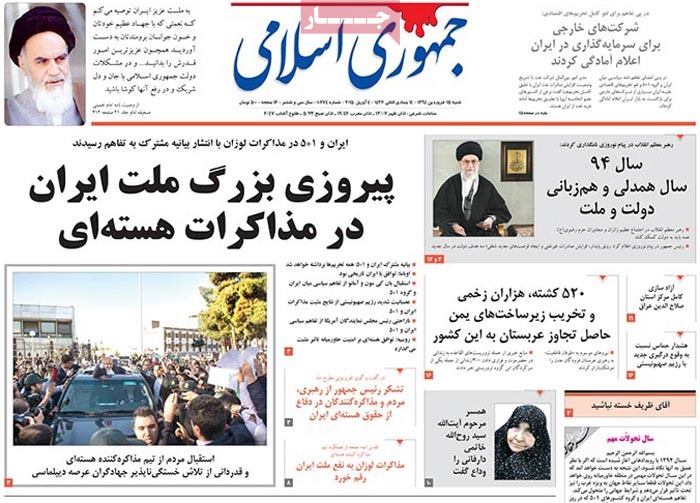
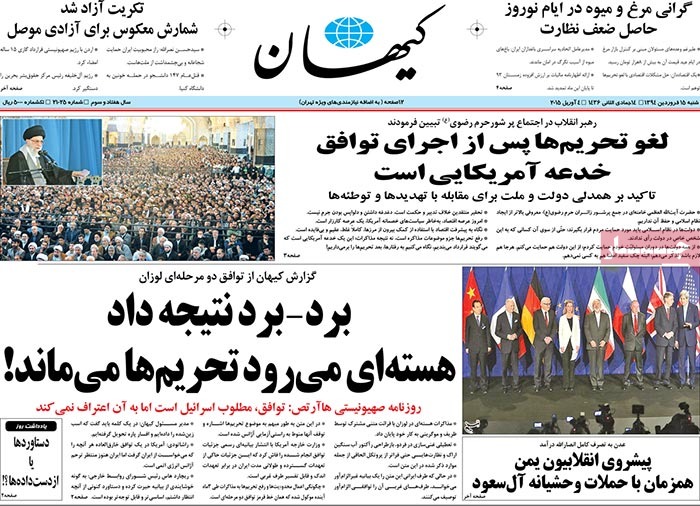
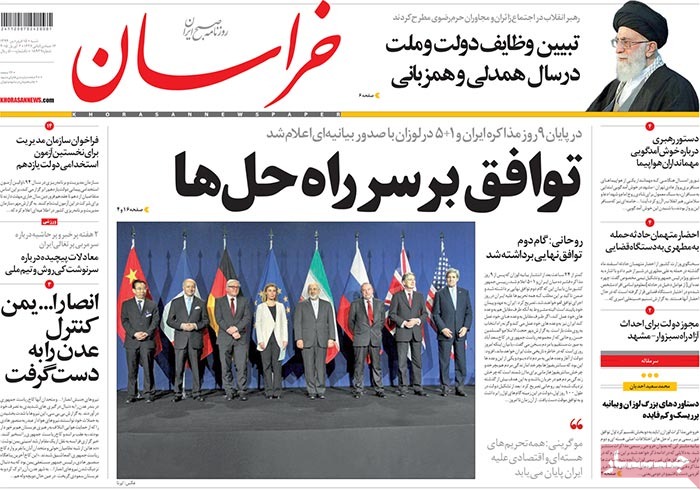
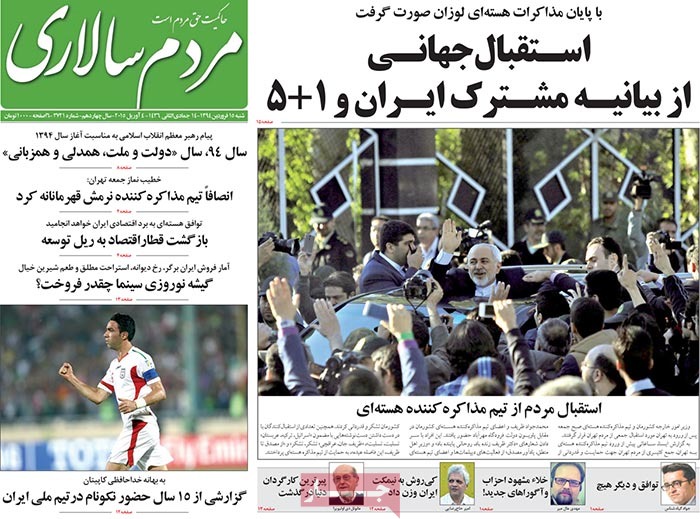
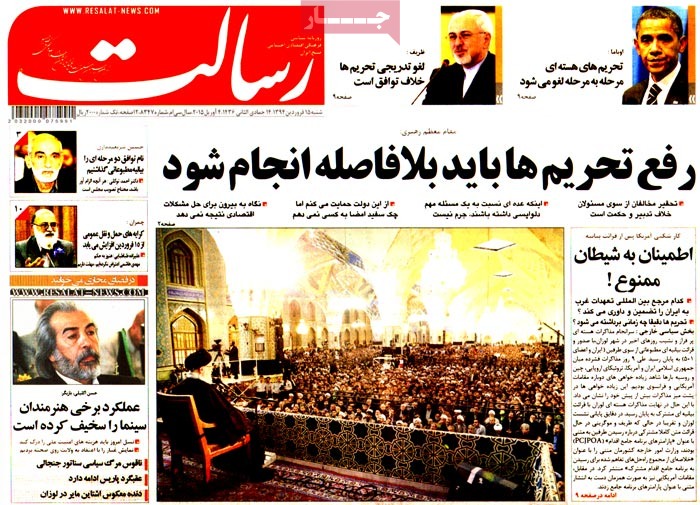
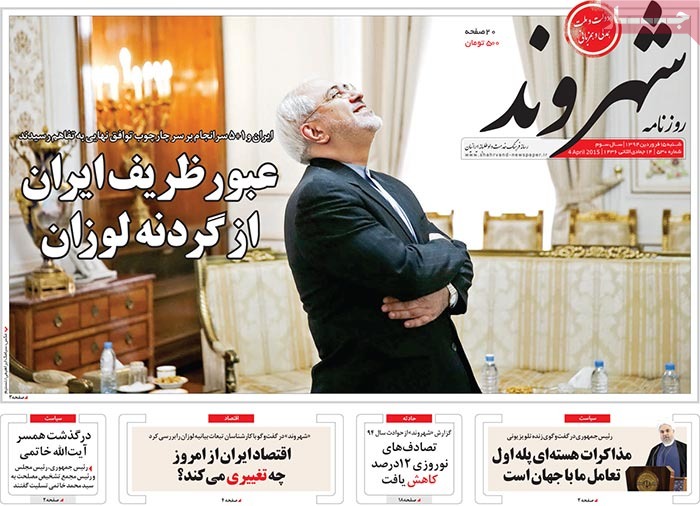
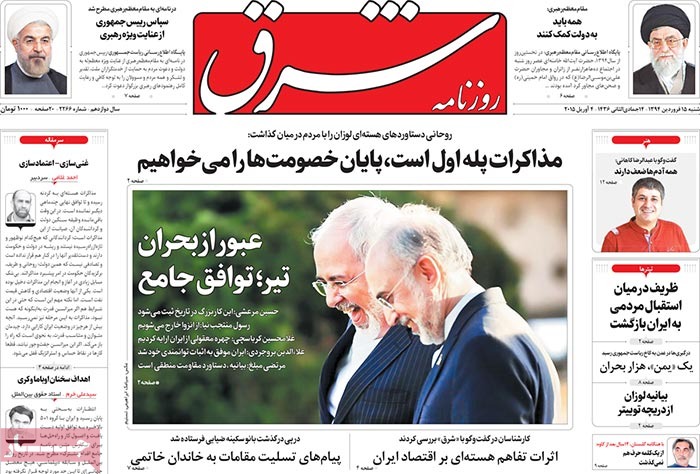
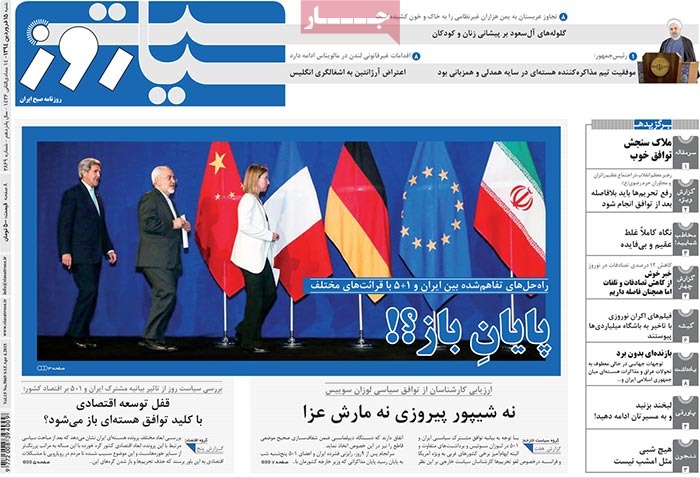
A look at Iranian newspaper front pages on Feb. 26

Iranian Newspapers Headlines

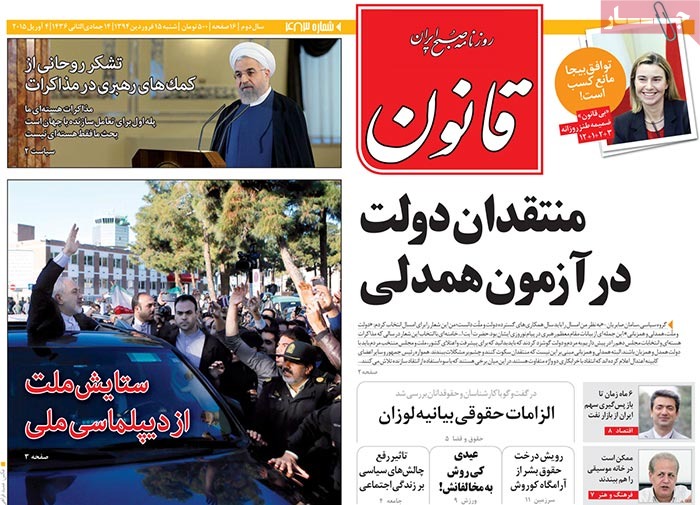
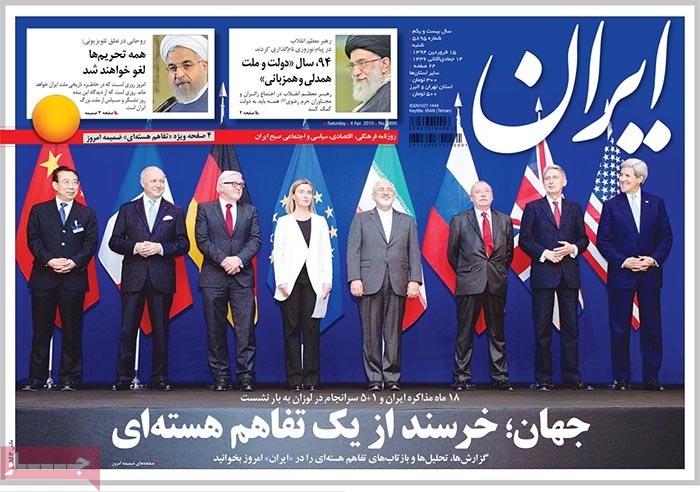
Comments of President Hassan Rouhani in a speech in Qom in defense of the economic performance of his administration and about nuclear talks dominated the front pages of Iranian newspapers on Thursday. “Any deal should see all sanctions lifted.” A naval drill by the Islamic Revolution Guards Corps in the Strait of Hormuz also grabbed front-page headlines.


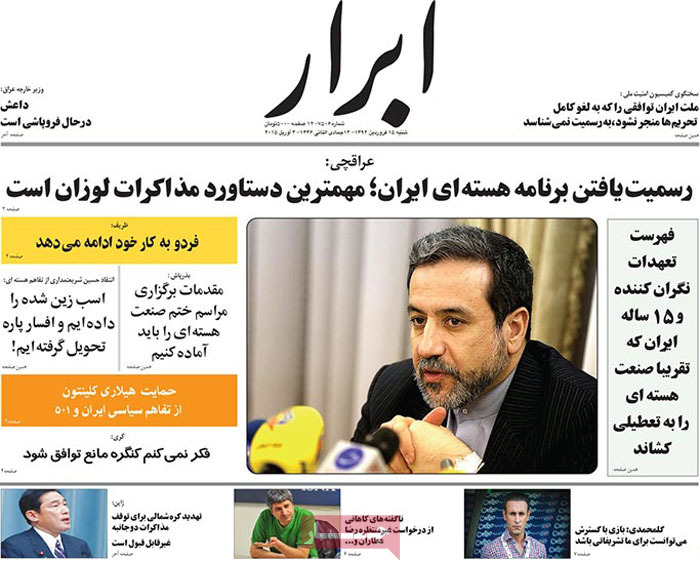
Abrar: Naval Forces of the Islamic Revolution Guards Corps put their power on display in the Persian Gulf and the Strait of Hormuz.

It came during a military drill code-named Great Prophet 9.


Abrar newspaper-2-25-2015


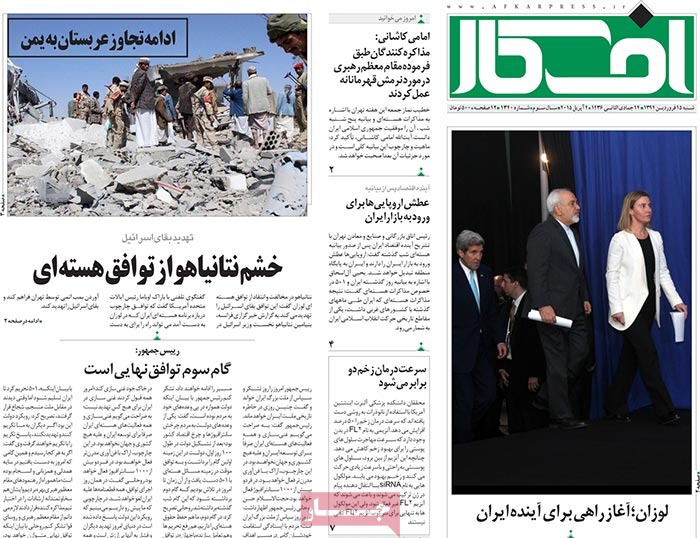
Afkar: “We won’t accept impositions, humiliation and continued sanctions in talks.”

The president made the comment during a visit to the central city of Qom on Wednesday.

Afkar: “Comments by [US Secretary of State John] Kerry that Iran is meddling in Yemen amount to passing the buck,” said Iranian FM Spokeswoman Marziyeh Afkham.


Afkar newspaper-2-25-2015


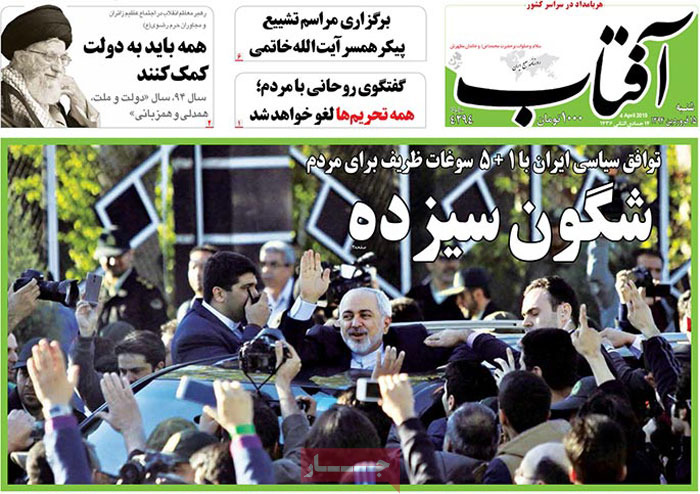
Aftab-e Yazd: Even night letters couldn’t prevent a warm welcome [extended to President Rouhani in Qom].

Aftab-e Yazd: Plans to ration water have been set in motion.


Aftabe Yazd newspaper-2-25-2015


Asrar: The extremely high costs of healthcare have been cut in half.


Asrar newspaper-2-25-2015


Ebtekar: Can’t they see?

President has taken a swipe at his critics who deny the country’s economy is on the mend. “Can’t they see that inflation is contained and economy is posting growth? Can’t they see the improvement in business environment? Can’t they see the economic figures of the past 18 months?”


Ebtekar newspaper-2-25-2015


Emtiaz: “The Interior Ministry has agreed to offers to increase the number of public holidays,” said an advisor to the interior minister.


Emtiaz newspaper-2-25-2015


Etemad: “We want nuclear talks [with P5+1] wrapped up by the end of March,” said the government spokesman.


Etemad newspaper-2-25-2015


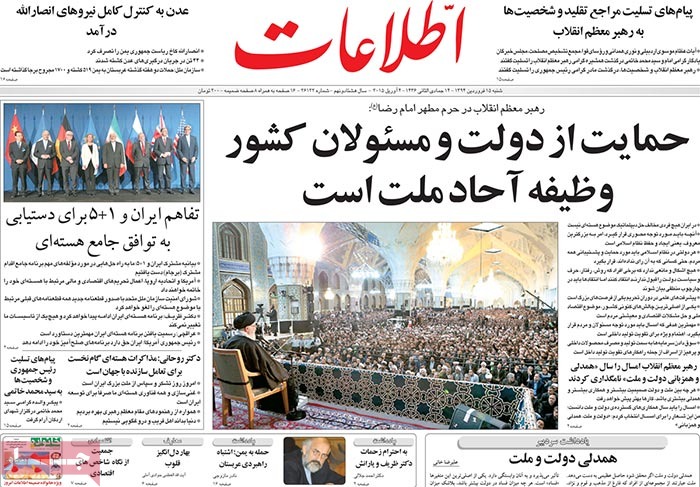
Ettela’at: Revival of the economy and ethics and interaction with the rest of the world are on the government agenda

“Backwardness and extremism destroy faith and the world. Islam is not a religion of violence, prescribing austerity for its followers,” said President Rouhani during a visit to Qom.

Ettela’at: “Provision of cash subsidies was wrong in the first place,” said Grand Ayatollah Nasser Makarem Shirazi.


Ettelaat newspaper-2-25-2015


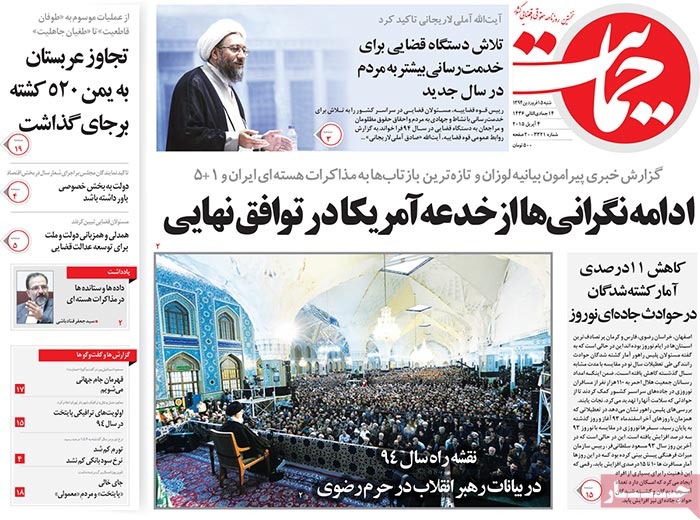
Hemayat: Police Chief Brigadier General Esmail Ahmadi Moghaddam has said that a special police department will be formed to exclusively deal with economic offenses.

Hemayat: The Judiciary supports healthy investment and efforts to remove the obstacles standing in the way of local production.


Hemayat newspaper-2-25-2015


Jamejam: “The Judiciary is after tax evaders,” said Judiciary Chief Ayatollah Sadegh Amoli Larijani.


Jame Jam newspaper-2-25-2015


Jomhouri Islami: Amnesty International has said that Israeli air strikes [on Gaza this summer] amounted to war crimes.

Jomhouri Islami: The Yemeni Judiciary has issued an arrest warrant for [former President] Abd-Rabbu Mansour Hadi.


Jomhouri Eslami newspaper-2-25-2015


Kayhan: Demolition of a mock American aircraft carrier on day one of an IRGC naval drill in the Persian Gulf has grabbed headlines around the world.


Kayhan newspaper-2-25-2015


Resalat: “Powers cannot change regional conditions by deployment of aircraft carriers,” Ali Larijani said.

The parliament speaker made the comment in the south where he oversaw a naval drill by the Revolution Guards.


Resalat newspaper-2-25-2015


Sharq: A special advisor to the president has warned about Shiite-Sunni divisions.


Shargh newspaper-2-25-2015


IRGC missiles destroy mock aircraft carrier in Persian Gulf

IRGC-Naval-7

A mock aircraft carrier was destroyed by the Islamic Revolution Guards Corps missiles during the IRGC Navy’s massive The Great Prophet 9 war games in the Persian Gulf and the Strait of Hormuz on Wednesday.

The model was built in real size and came under attack and was destroyed by missiles and rockets fired from tens of IRGC speedboats.

Also a number of the IRGC cruise and two ballistic missiles were fired at the mock US aircraft carrier.

Also during the drills, a mobile naval target was destroyed by Fateh 110 and Zelzal missiles on a deserted island 270km away from the war games zone.

The IRGC also fired its high precision capability missiles at a carrier during the naval exercise.

During the first moments of the second stage of the drills, enemy drones were also hit and destroyed by shoulder-launched Misaq missiles and artilleries mounted on 100 IRGC’s speedboats.

Speaking with reporters on the sidelines of the war games, IRGC Navy Commander Rear Admiral Ali Fadavi announced that the Ghadir cruise missile with a range of 300km will be delivered to the IRGC Navy in the war games.

“Our missiles will reach the Southernmost regional waters and we can hit mobile targets from offshore waters to the North of the Persian Gulf,” he added.

The IRGC Navy started massive war games, codenamed The Great Prophet 9, in the Persian Gulf and the Strait of Hormuz on Wednesday.

The massive exercises started after IRGC Commander Major General Mohammad Ali Jafari issued the order and in the presence of other high-ranking Iranian officials and military commanders, including Parliament Speaker Ali Larijani, Deputy Chief of Staff of the Iranian Armed Forces Major General Gholam Ali Rashid, Commander of the IRGC Aerospace Force Brigadier General Amir Ali Hajizadeh, Lieutenant Commander of the IRGC Brigadier General Hossein Salami, Commander of the IRGC Ground Force Brigadier General Mohammad Pakpour, Deputy Chief of Staff of the Armed Forces Brigadier General Baqeri and IRGC Navy Commander Rear Admiral Ali Fadavi.

Different IRGC Navy vessels are being used in the exercises staged in the Persian Gulf and the Strait of Hormuz.

Tens of IRGC vessels started high-speed mine-laying operations in a short period of time to get ready for critical situations in times of possible threats.

Fadavi described Iran’s “mine-laying” capability as “the most important concern of the Americans”, and said, “We have the most advanced sea mines which cannot be imagined by the Americans.”

In recent years, Iran has made great achievements in its defense sector and attained self-sufficiency in producing essential military equipment and systems.

Iranian officials have always stressed that the country’s military and arms programs serve defensive purposes and should not be perceived as a threat to any other country.

Iran’s naval power has even been acknowledged by foes. In a Sep. 11, 2008 report, the Washington Institute for the Near East Policy said that in the two decades since the Iraqi imposed war on Iran, the Islamic Republic has excelled in naval capabilities and is able to wage unique asymmetric warfare against larger naval forces.

According to the report, Iran’s Navy has been transformed into a highly motivated, well-equipped, and well-financed force and is effectively in control of the world’s oil lifeline, the Strait of Hormuz.

Since November 2008, the Iranian Navy has also conducted anti-piracy missions in the Gulf of Aden and Bab el-Mendeb Strait to protect the country’s cargo ships and oil tankers against pirates.


Top MP: Neighbors can rely on Iran’s military might

Ali Larijani-Iranian speaker

Iran’s Parliament Speaker Ali Larijani assured the neighboring states on Wednesday that Iran’s military capabilities safeguard regional interests against possible threats.

“Iran’s military technologies can become available for the neighboring countries, and they can count on Iran’s military power,” Larijani told reporters on Wednesday on the sidelines of IRGC naval exercises, underway at the Strait of Hormuz, south of Iran.

He also made it clear that Iran and its neighbors are capable enough to ensure security in the region and there is no need for the presence of foreign forces.

“Iran enjoys a capable and smart military force in the (Sea of) Oman waters and can ensure regional security with the help of the other countries,” Larijani added.

The speaker also gave an assurance that Iran’s defensive power is to safeguard the country and the region against foreign military powers.

“The Iranian armed forces’ capabilities are with the neighboring countries and against the alien military powers,” Larijani added.

“The powers should also know that they cannot change the region’s conditions by increasing (the number of) warships,” he stressed.

Earlier in the day during the naval drills, the IRGC assault speedboats targeted and sank a mock warship, a model of Nimitz-class aircraft carrier at the Strait of Hormuz.

Iranian researchers introduce environment-friendly method to clean up oil spills

Oil spills in Presian Gulf

The biological and chemical methods used around the world to clean up oil slicks at sea often have negative effects on the marine ecosystem and at times are ineffective. Researchers at a science and technology park in Hormozgan Province have recently used three plants native to Iran to work out an environment-friendly solution to dealing with the issue.

On February 25 the Iranian Students News Agency quoted Dr. Maziyar Mohammadzadeh, who is in charge of the project, as saying, “The three indigenous plants have undergone slight changes to be converted to nano-filters for the removal of oil spills. Palm and Asclepias, native to Hormozgan, along with another plant indigenous to Isfahan Province have been used in the project.”

He described the physical absorption of oil spills as a property of the plants and said, “The final product can float in water and remove contamination from saline, brackish and fresh water.”

The product does not interfere with ecosystem, Mohammadzadeh said, adding, “Because the product is derived from plants, after decontamination, it can be used as fuel in industries and bakeries.”

US and Britain are promoting Tatbir: Scholar

US and Britain are promoting Tatbir

Secretary General of the World Forum for Proximity of Islamic Schools of Thought Ayatollah Mohsen Araki says the Americans and Brits who always associate Shiites with Tatbir [The practice of striking oneself with a form of “sword” on the head, causing blood to flow in remembrance of Imam Hussein] are the real promoters of the practice.

On February 25, Aftab-e Yazd daily published a report on Ayatollah Araki’s speech at a gathering on ways of identifying Shiite and Sunni extremist factions in Qom on Tuesday. The following is the translation of what else the secretary of the World Forum for Proximity of Islamic Schools of Thought said:

Ayatollah Mohsen ArakiMembers of the Shirazi Sect work hard to promote Tatbir. They argue to be a true follower of Imam Hussein, you need to practice Tatbir. Simply crying and beating your chest is not enough, they contend. Shiites need to draw blood. They should also administer the ritual on their newborn babies and encourage their spouses to do the same.

They argue that the best place to practice Tatbir is a city like London where the whole world sees you. When I was there, I was told that a Shirazi Sect preacher has told a crowd of worshipers, ‘Today a Christian converted to Islam and has already expressed willingness to join you in practicing Tatbir.’ I told them he might be an MI6 spy.

The Americans and Brits are the real promoters of Tatbir. The books they pen on Shiites, even their textbooks, feature images of Tatbir.

Members of the Shirazi Sect also claim that those who practice Tatbir book a place for themselves in Paradise, and those who stay away are not real Shiites. […]

They go even further and say Tatbir is not enough. ‘As long as you don’t desecrate Sunni sanctities you are not a true Shiite.’ We do not share the sanctities of Sunnis, but we are not allowed to show disrespect for what more than a billion Muslims regard as sacred.

They tell their followers to go to great lengths in desecrating Sunnis and thus prompt them to want to put on a suicide vest and blow themselves up among Shiites.

These folks are free to travel wherever they want. Saudi Arabia does not allow Shiite prayer books to find their way into the country. But for these individuals, Saudi Arabia is like home. They come and go. The only books freely available in Saudi Arabia are their books.

The groups in Kuwait that support them are in touch with British intelligence agencies. Ever since they set up base in Kuwait they have had the support of the British intelligence.

Iran, Iraq stand firm in terror fight

General Hossein Dehqan and his Iraqi counterpart Khalid al-Obeidi

Iranian and Iraqi defense ministers in a telephone conversation on Tuesday reaffirmed their commitment to concerted action against terrorism.

Iranian Defense Minister Brigadier General Hossein Dehghan and his Iraqi counterpart Khalid al-Obeidi discussed the latest developments in Iraq as well as the bilateral and international issues in the conversation.

They both emphasized the need for Tehran-Baghdad cooperation in the fight against terrorism.

Reiterating Iran’s support for the Iraqi nation, government and armed forces, Dehghan said Tehran is ready to speed up the implementation of previous agreements with Iraq.

He also voiced Iran’s preparedness to increase military cooperation with its western neighbor to strengthen stability and security in Iraq and the region.

The Iraqi minister, for his part, called for efforts to accelerate the implementation of agreements.

In December 2014, Dehghan and Obeidi signed a memorandum of understanding (MoU) in Tehran to boost the two neighboring countries’ defense cooperation.

The agreement was aimed at expanding cooperation between the two sides on the establishment of a national army in Iraq to help the Arab country maintain its territorial integrity and security.

The two sides also decided to continue their consultations on finding mechanisms for ensuring security in the region.