Saturday, December 27, 2025
Home Blog Page 4919

The heavens of Iran to become the heaven of flights amid hellacious conflicts

airlines in Iran
airlines in Iran

On October 29, Alef, a news website, filed a report headed “Thirty-three Foreign Airlines Operating in Iran”. The following is the translation of part of what the website posted:

“The willingness on the part of foreign airlines to be present in Iran is on the rise. For the time being, 33 foreign carriers are operating in Iran and the number of passengers transferred by them between March 21, 2013 and March 21, 2014 stood at some three million,” Iran’s Civil Aviation Organization (CAO) reported.

“Iran’s secure airspace is the key reason behind the rise in demand among foreign airlines for having their passenger jets fly over Iran. The ongoing conflicts in some regional countries, in particular Iraq, have prompted them to re-route the flights which originate from or are destined for either the Persian Gulf or East Asia. In fact, among other airlines, British Airways, Lufthansa and their subsidiaries, Emirates, Air France and KLM have stopped flying over the Iraqi sky because of security concerns.

Besides, in the wake of the downing of the Malaysia Airlines MH17 over Ukraine, concerns about flights over conflict zones have been heightened and international airlines are trying to find alternative routes to divert flights away from war-torn areas.

In that respect, Iran’s airspace enjoys high security. That’s why it has seen the largest number of flights over the last month. At the moment, over 950 foreign passenger planes fly into and out of Iran’s airspace on a daily basis which is unprecedented in the history of Iran’s aviation industry. According to stats released last year, flights of foreign carriers over Iran fetched $120 million and the revenues are projected to more than double in the year starting March 21, 2014.

Iran: A booming market for foreign airlines

That foreign passenger jets choose Iran’s airspace is by itself a reflection of security in Iran’s sky and can even promote more security in the country. Aside from demand for routes through Iran’s airspace, willingness on the part of foreign airlines to have flights to and from Iran has also increased.

“Regional and international air transportation is one of the attractions of the aviation industry. Based on estimates by the International Civil Aviation Organization (ICAO) in coming years, regional flights will register the highest growth as opposed to domestic and international flights,” said Deputy Director of Iran’s Civil Aviation Organization Mohammad Khodakarami.

Recalling Iran’s tourist attractions, he added, “Right now, different cities across Iran enjoy a lot of attractions for tourists as well as pilgrims, encouraging foreigners to pay a visit to Iran. Several firms are actively involved in Iran’s air transportation market, and by the same token, foreign air carriers within or beyond the region, schedule flights and get passengers transferred.”

All major global airliners have flights to Iran

“We have had correspondence with some of the airlines which are willing to pick up where they left off,” he said.

“For the time being, all major global airlines have flights to Iran and it is not correct to say large air carriers have flown away from Iran’s [market]. Given the rise in demand on the market, foreign airlines have appealed for flights to Iran. For instance, except for Lufthansa, its fellow German airline, Germani, has recently applied for flights from Germany to Iran and it will shortly run four flights a week from Düsseldorf to Tehran, Hamburg to Tehran, Berlin to Tehran and Berlin to Mashhad,” he underlined.

Describing Iran’s market as thriving for foreign firms, he said, “Airlines are like business firms and economic institutions; they themselves are willing to enter Iran’s market. These companies have no limits to their activities in Iran, because it is an economic and trade concept and if such flights turn out to be profitable, they are not willing to lose them. If there is any limit, it is about economic matters of the firms and the downsizing of their fleet of passenger jets.”

Highlighting that Iran is a booming market for foreign airlines, he concluded, “We want our national airlines to get a share of international flights and for that reason we seek to strike a balance between foreign and domestic firms and have so far been successful on that front.”
Iran Arrests Zahedan Police Killers

Iran police
Iran police

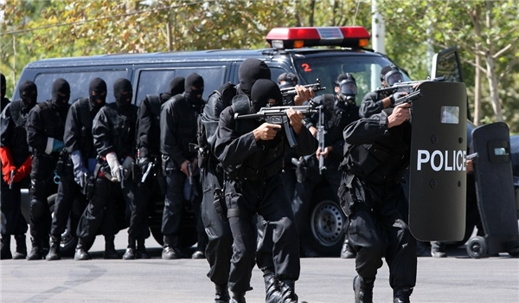
Commander of the Law Enforcement Police in the Southeastern province of Sistan and Balouchestan Hossein Rahimi announced on Saturday that his forces have arrested the terrorists who had killed two police officers in Zahedan city a year ago.

“The crime investigation detectives of the police found some clues about the involvement of a 6-stong gang of armed thieves in this case after months of extensive specialized measures and after gaining enough intelligence,” Rahimi said.

Noting that the members of the gang used forged documents to travel to Pakistan and Afghanistan, he said that the police forces identified the culprits and arrested them in several coordinated operations in Zahedan and Chabahar cities.

Rahimi said that the gang members have already confessed that they had killed the two police officers in Zahedan city on 17 June 2013, wounded two people one month earlier, murdered two individuals in Zahedan’s Park Mellat, robbed the passengers of a car and wounded three people when they sprayed bullet at the people who had approached the car.

Sistan and Balouchestan province which is adjacent to Pakistan has been the scene of a number of terrorist attacks in recent years with most terrorists escaping to the Pakistani territories.

Four Iranian police officers, including a conscript, were killed in two terrorist attacks on a border post in Sistan and Balouchestan in October.

The tragic event took place in the vicinity of the city of Saravan near the border with Pakistan.

Last month, Iranian Deputy Chief of Staff of the Iranian Armed Forces Brigadier General Massoud Jazayeri urged Pakistan to stop terrorists’ cross-border attacks from its soil, warning that the Iranian military will take action to crush such terrorist groups if Islamabad continues its present heedless attitude.

“We hope to be able to prevent terrorist actions with the help of the regional governments, especially the Pakistani government and army,” General Jazayeri told reporters on the sidelines of a ceremony held in Tehran to commemorate the Islamic Revolution Guards Corps (IRGC) martyred commanders.

“Naturally, Iran will not bear such conditions for a long time and if the Islamic Republic feels necessary, it will adopt deterrent measures in this regard,” he stressed with a warning tone.


Also on February 6, Jaish al-Adl terrorists kidnapped five Iranian border guards in Jakigour region in Sistan and Balouchestan and took them to the Pakistani territory.

In a message on April 6, Iran’s Interior Minister Abdolreza Rahmani Fazli said efforts by security and diplomatic bodies as well as locals had borne fruit and four of the abductees were freed and reunited with their families.

On October 25, 2013, Pakistan-based Jaish al-Adl terrorist group killed 14 Iranian border guards and wounded six others in the border region near the city of Saravan in Sistan and Balouchestan province.

In February 2013, Iran and Pakistan signed a security agreement under which both countries are required to cooperate in preventing and combating organized crime, fighting terrorism and countering the activities that pose a threat to the national security of either country.

Iran has repeatedly called on Pakistan to comply with the terms of the agreement.

White House gets hacked; Obama office kept in the dark

White House
White House

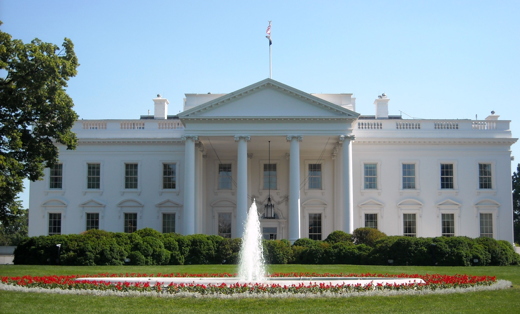
Tasnim News Agency on October 29 reported suspicious cyber activity at the White House, saying that the hacking caused a temporary power outage at the office of the US president. The following is the translation of the report:

US media have disclosed that a computer network used by the White House has been hacked and that the cyber-attack has caused a brief power failure at the Executive Office of the President of the United States.

US media outlets quoted a White House official as breaking the news on the cyber-attack.

According to Reuters, the official, who spoke on condition of anonymity, would not say who might have been responsible for the hacking of what has been described as an unclassified computer network used by the staff of the Executive Office of the President.

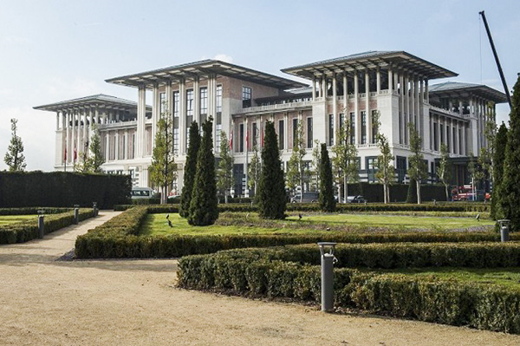
Erdogan’s new palace is a reminder of Iran’s Alighapoo

Turkey-Erdogan-Illegal-100-Room-New-Presidental-Palace

October 29 marked the day the Turkish Republic was founded. President Recep Tayyip Erdogan held a reception in the new presidential palace to celebrate the 91st anniversary of the Republic. Iran’s ambassador to Ankara attended the ceremony. Tabnak news site quoted Ambassador Alireza Bigdeli as writing the following on his Facebook page after his meeting with the Turkish president:

“Today is Turkey’s Republic Day. In the morning we went to Ak Saray, the new presidential palace [on the outskirts of Ankara], to congratulate President Erdogan [on Republic Day]. I was thinking about the striking resemblance between the architecture of this palace and that of Alighapoo in Isfahan. Surprisingly a fellow ambassador [present at the ceremony] said, “This structure reminds me of Aliphapoo in Isfahan.”

Ak Saray is the world’s largest palace.

[The word “Ak,” at the beginning of “Ak Saray” which means “White Palace” in English is a play on the name of Turkey’s ruling Justice and Development Party (AKP) which is known to its followers as the A.K. Party.]


Caption: Alighapoo is a grand palace in Isfahan, central Iran. It is located on the western side of Naqsh-e Jahan Square opposite to Sheikh Lotfollah Mosque. The name Alighapoo, from Arabic Ali, “Imperial”, and Turkish Ghapoo meaning “gate”, was given to this place as it was right at the entrance to the Safavid palaces which stretched all the way from the Naqsh-e Jahan to Chahar Bagh Boulevard.

Iran censures Israel’s desecration of al-Aqsa Mosque

Marziyeh-Afkham
Marziyeh-Afkham

Iran condemned Israel’s latest decision to temporarily close the al-Aqsa Mosque to Muslim worshippers, something that has made it off limits to Palestinians.

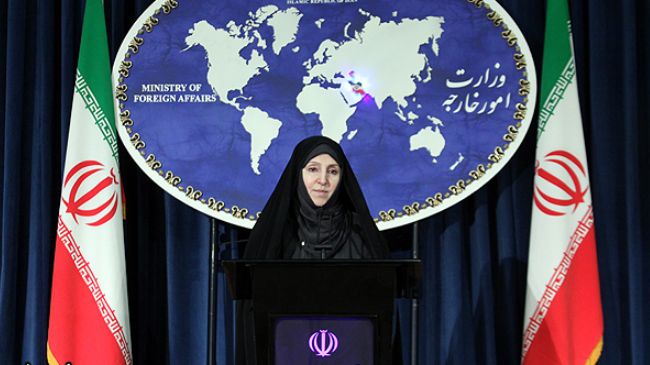
Iranian Foreign Ministry Spokeswoman Marzieh Afkham warned on Friday against the ramifications of the dangerous move and called on all Muslim and regional countries not to remain silent in the face of Tel Aviv’s criminal act and to defend the al-Aqsa Mosque.

Israel closed the al-Aqsa Mosque compound on Thursday to Muslim worshippers after a 32-year-old Palestinian, Moataz Hejazi, on October 29 made an attempt on the life of Yehuda Glick, an American-born Israeli settler.

Mahmoud Abbas, the president of the Palestinian national unity government, has warned that Israel’s move amounts to a “declaration of war.”

The al-Aqsa compound, located in the Israeli-occupied Old City of al-Quds, is a flashpoint holy Islamic site. The location of the compound, known to Jews as the Temple Mount, is the holiest site in Judaism too.

The mosque is Islam’s third holiest site after Masjid al-Haram in Mecca and Masjid al-Nabawi in Medina.

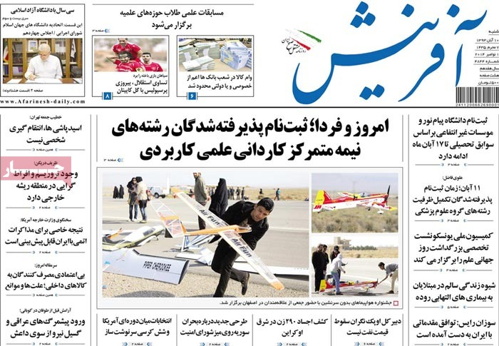
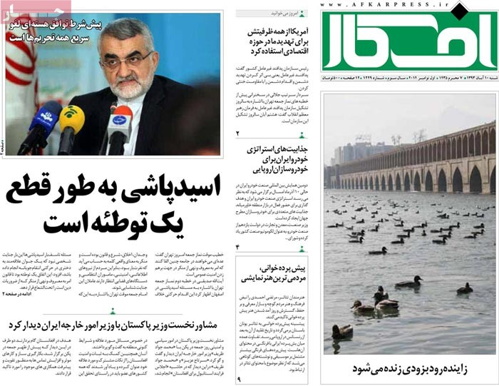
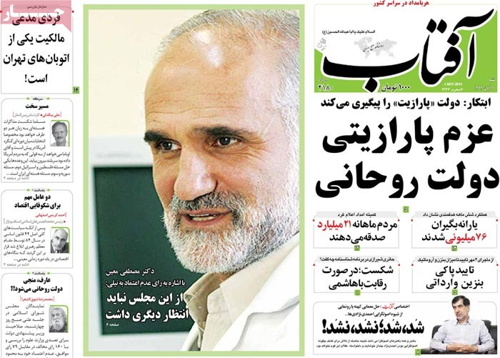
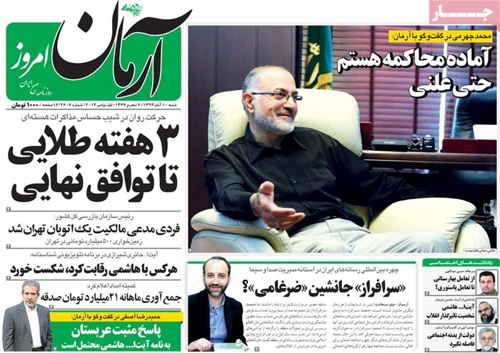
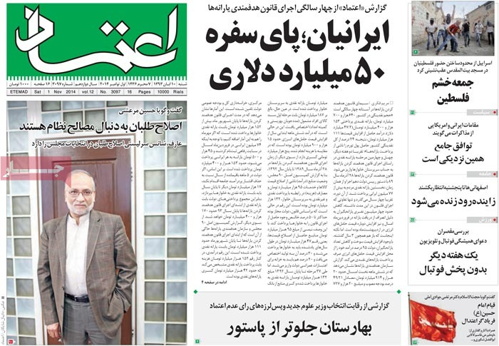
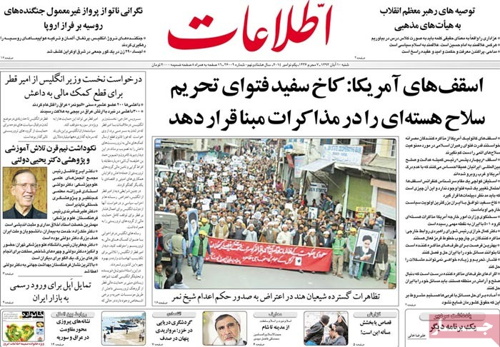
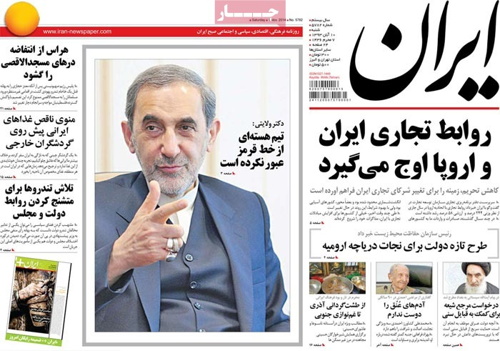
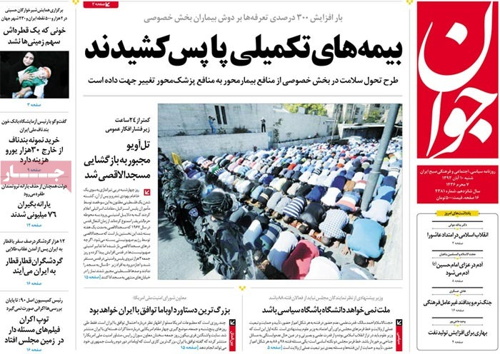
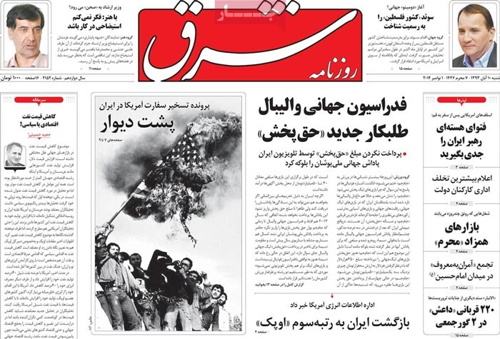
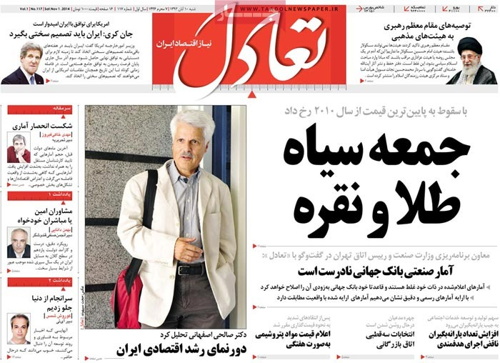
A look at Iranian newspaper front pages on Nov. 1

Iranian-Newspaper-Headlines-02

The countdown for a nuclear deal between Iran and P5+1; the aftershocks of parliament’s failure to endorse President Rouhani’s pick to head the Ministry of Science, Research and Technology; and unrest in Palestinian territories following Israel’s closure of the Al-Aqsa Mosque dominated the front pages of Iranian newspapers on Saturday.

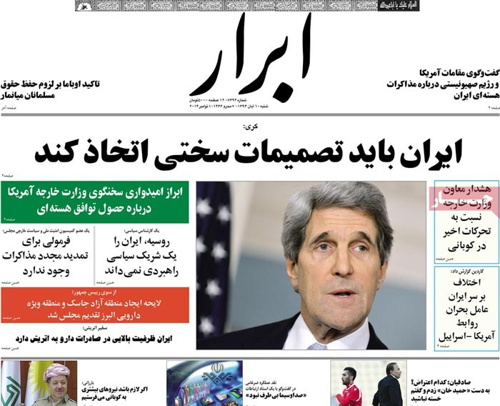
Abrar: “There is no formula to extend the nuclear talks,” said a member of parliament’s National Security and Foreign Policy Committee.

Abrar says the president has sent to parliament a bill that, among others things, lays out plans to create a free trade zone in Jask in southern Iran.

Abrar: “Iran does have good potential for exports of medicinal drugs to Austria,” said the Austrian ambassador to Tehran.


abrar newspaper-11-01


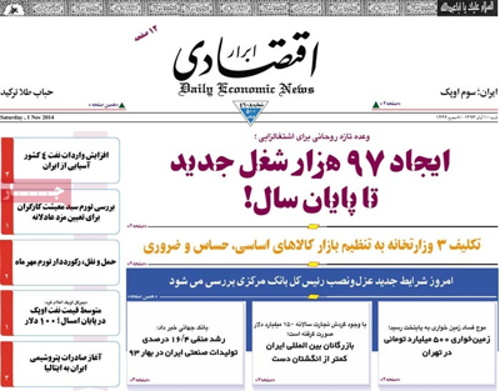
Abrar-e Eghtesadi: Iran has launched exports of petrochemicals to Italy.

Abrar-e Eghtesadi: Imports of crude oil from Iran by four Asian countries have increased.

Abrar-e Eghtesadi: President Rouhani has vowed to create 97,000 jobs by yearend [March 21, 2015].


abrar eghtesadi newspaper11-01


Afarinesh: Isfahan has played host to a festival of remote-controlled small-scale unmanned aircraft.

Afarinesh: “Terrorism and extremism have their roots beyond the region,” Iranian Foreign Minister Mohammad Javad Zarif said.

Afarinesh: President Obama’s National Security Advisor Susan Rice has said that a preliminary deal has been cut with Iran.


afarinesh newspaper-11-01


Afkar: Water is to be rechanneled to the Zayandehrood River in central Iran shortly.

Afkar: “Removal of sanctions is a prerequisite for conclusion of a nuclear deal,” said the chairman of parliament’s National Security and Foreign Policy Committee.


afkar newspaper 11-01


Aftab-e Yazd: “One should not expect anything more than this from this parliament,” Mostafa Moin, a former science minister [under President Khatami] said in a jab at parliament for its refusal to endorse President Rouhani’s pick for the top science post.

Aftab-e Yazd: “The government is determined to pursue the case involving satellite signal jamming,” said Director of the Environment Protection Organization Masoumeh Ebtekar.


Aftab Yazd-newspaper11-01


Arman-e Emrooz: Former Iranian Foreign Ministry Spokesman Hamidreza Asefi says he believes the message Ayatollah Rafsanjani has sent to the Saudi King is likely to produce the desired result: [a stay in the execution of senior Shiite cleric Sheikh Nimr al-Nimr]

Arman-e Emrooz: Mohammad Jahromi, [a former managing director of Saderat Bank and a labor minister under former President Mahmoud Ahmadinejad who is alleged to have played a role in a massive corruption case] says he is ready to stand trial, even if the hearings are public.


Arman newspaper-11-01


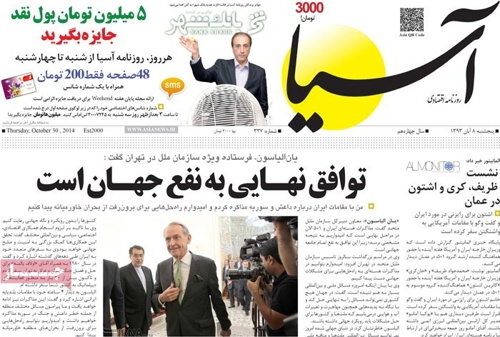
Asia: “Bitcoins are to be launched in Iran,” said the deputy director of the Cyberspace Research Institute.


Asia newspaper-11-01


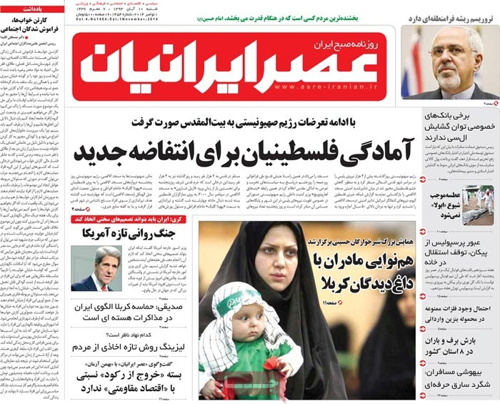
Asr-e Iranian: Rain and snowfall sweep eight Iranian provinces.


Asre Iranian Newspaper11-01


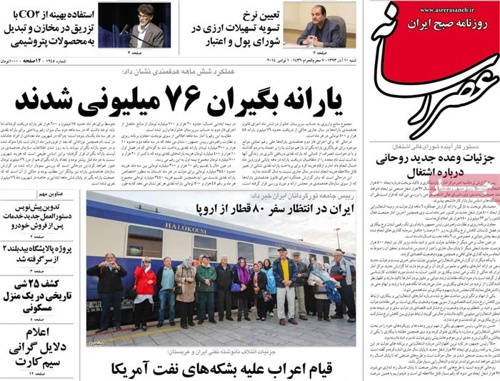
Asr-e Rasaneh: “As many as 80 trains packed with European tourists are expected in Iran.”


ASr resaneh newspaper 11-01


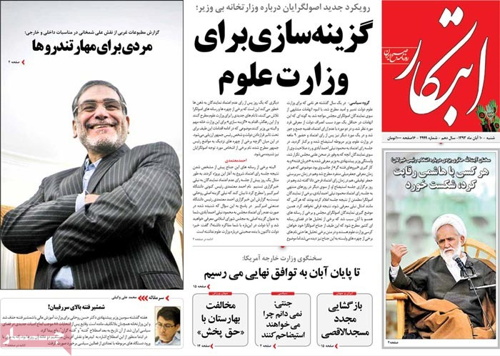
Ebtekar: “I have no idea why they [a reference to MPs] want to impeach me,” said Ali Jannati, the minister of culture and Islamic guidance.

Ebtekar: “Anyone who took on Ayatollah Rafsanjani in a race was defeated,” said Ayatollah Hayeri Shirazi, a member of the Assembly of Experts [in reference to an upcoming meeting of the assembly to replace Ayatollah Mahdavi Kani who passed away in October].


ebtekar newspaper11-01


Etemad: “Reformists seek to serve the interests of the establishment. [Former Vice President Mohammad Reza] Aref stands a good chance to lead the Reformist ticket [in the upcoming parliamentary elections],” said Hossein Marashi, a top Reformist figure.

Etemad: “The race is on to name a new science minister.” In a jab at principlists in parliament, the daily says that it seems MPs are ahead of the government in the race to choose a new science minister.


etemad newspaper 11-01


Ettela’at: “Apple seems willing to make its presence on Iran market official.”

Ettela’at: Indian Shiites stage a large rally to protest the death sentence issued against Saudi Shiite cleric Sheikh Nimr al-Nimr.

Ettela’at: American bishops have called on the White House to base its stance in nuclear talks with Iran on the fatwa [the Supreme Leader has issued] banning the development and use of nuclear arms.

Ettela’at: More than half a century of research by Dr. Yahya Dowlati [a renowned Iranian dermatologist] has been praised.


ettelaat newspaper 11-01


Iran: “The Iranian nuclear negotiators have not crossed the establishment’s red lines,” said Ali Akbar Velayati, an advisor to the Supreme Leader.

Iran: Iran-Europe trade ties are to peak.


Iran newspaper 11-01


Javan: “The number of those who receive cash subsidies stands at 76 million; the governmentcontinues to avoid removing the rich from the list of those eligible to get the monthly handouts.


Javan newspaper 11-01


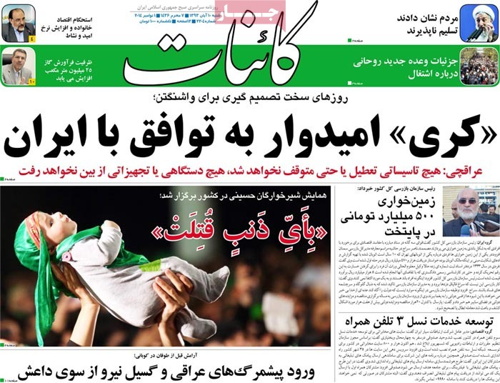
Kaenat: The Inspector General reports a land-grab worth around $160 million in the heart of the capital.


Kaenat newspaper 11-01


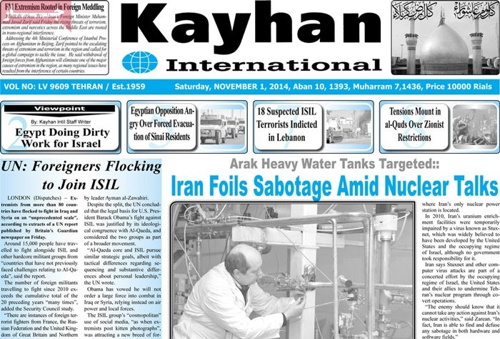
Kayhan International: “Iran foils sabotage amid nuclear talks.”


Kayhan international newspper 11-01


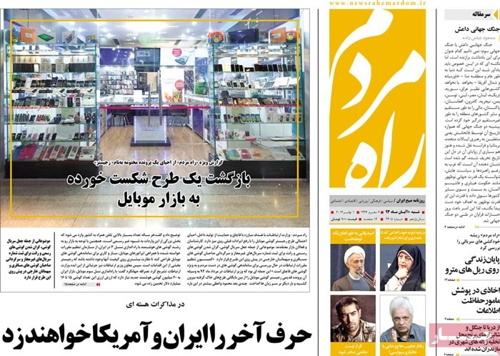
Rah-e Mardom: Tehran Friday Prayers Leader: “Acid attacks are certainly part of a plot.”


Rahe mardom


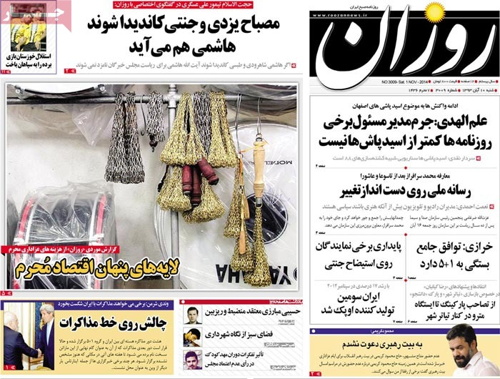
Roozan: “If Ayatollahs Mesbah Yazdi and Ahmad Jannati decide to run for the chairmanship of the Assembly of Experts, Ayatollah Rafsanjani will throw his hat in the ring. But if Ayatollahs Shahroodi and Tabasi run for the top post, Hashemi Rafsanjani will not contest the position,” said Teymour Ali-Asgari, a senior official with the Center for Strategic Research affiliated to the Expediency Council.


Rouzan newspaper 11-01


Sharq: “Sweden has recognized the Palestinian state. A global domino has started to fall.”

Sharq: Failure of the Iranian national broadcaster to pay for the rights to air the FIVB World Championships has resulted in a freeze of the prize money the Iranian national team was promised for participating in the event.


Shargh newspaper 11-01


Taadol: “A black Friday for gold and silver. Prices plunge to four-year lows.”


taadol newspaper 11-01


Mideast extremism rooted in foreign meddling

Mohammad Javad Zarif

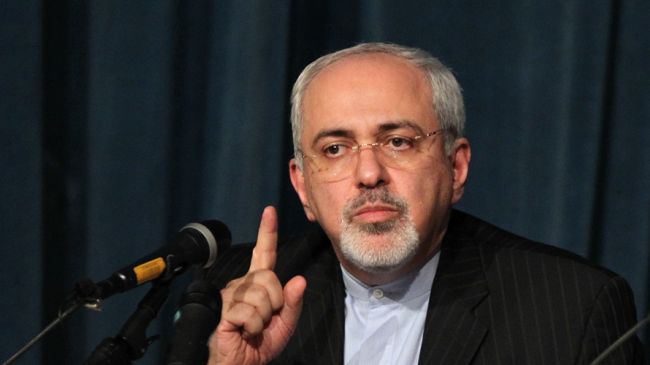
Iran’s Foreign Minister Mohammad Javad Zarif says the rising threats of terrorism, extremism and narcotics across the Middle East are rooted in trans-regional interference.

Addressing the 4th Ministerial Conference of Istanbul Process on Afghanistan in the Chinese capital city of Beijing on Friday, Zarif pointed to the escalating threats of extremism and terrorism in the region and called for a global campaign to tackle the issue.

Extremism and violence have become a major challenge facing Muslim countries, with Pakistan, Afghanistan, Iraq, Syria, Lebanon, Yemen and other Middle Eastern nations becoming the scene of deadly terrorist operations almost on a daily basis.

Zarif argued that the withdrawal of foreign forces from Afghanistan will eliminate one of the major causes of extremism in the region, as many regional issues have resulted from the interference of certain countries.

The Iranian foreign minister called on all world countries to join efforts to help establish peace and security in Afghanistan.

The Conference of Istanbul Process on Afghanistan was first launched in 2011 to help promote coordination between Afghanistan and other regional countries to counter common threats, including terrorism and extremism. It is attended by 14 countries as its members and around 30 others as supporting countries.

The third Conference of Istanbul Process on Afghanistan was held in Almaty, Kazakhstan, on April 26.

Zarif, Kerry, Ashton to meet in Oman in early November

Zarif-Ashton-Kerry
Zarif-Ashton-Kerry

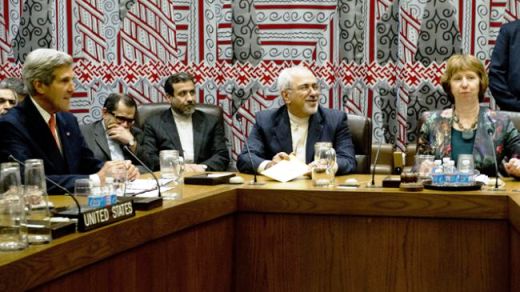
Iran’s Foreign Minister Mohammad Javad Zarif, US Secretary of State John Kerry and outgoing EU foreign policy chief Catherine Ashton will hold talks on Tehran’s nuclear issue in Oman early next month.

US State Department spokeswoman Jen Psaki said on Friday that Zarif, Kerry and Ashton are slated to meet in the Omani capital Muscat on November 9-10 to discuss steps toward a comprehensive final deal on Iran’s civilian nuclear work.

Iran and P5+1 — Russia, China, France, Britain, the US and Germany — are in talks to work out a final deal aimed at ending the longstanding standoff over the Islamic Republic’s nuclear energy program as a November 24 deadline draws near.

Sources close to the Iranian negotiating team say the main stumbling block in the way of resolving the Western dispute over Iran’s nuclear energy program remains to be the removal of all the bans imposed on the country, and not the number of centrifuges or the level of uranium enrichment.

Tehran wants the sanctions entirely lifted while Washington, under pressure from the pro-Israeli lobby, insists that at least the UN-imposed sanctions should remain in place.

On October 28, Iranian Deputy Foreign Minister for European and American Affairs Majid Takht-e-Ravanchi, a top nuclear negotiator, said the Iran-P5+1 talks should lead to the removal of sanctions against the Islamic Republic all at once, adding that Tehran is opposed to any gradual lifting of the bans.

Zarif and his nuclear team have not and will not cross the red lines

Ali Akbar Velayati
Ali Akbar Velayati

Rumors that the Iranian nuclear negotiating team has brushed aside the country’s red lines and clinched a final deal, on the sly, with P5+1 have drawn mixed reactions from Iranian political figures, with some condemning and some others denying the purported deal.

Tasnim News Agency on October 30 ran a brief interview with the head of the Expediency Council’s Center for Strategic Research Ali Akbar Velayati after his meeting with Deputy UN Secretary General Jan Eliasson. The following is the translation of what Velayati, who is also a foreign policy advisor to Supreme Leader Ayatollah Seyyed Ali Khamenei and a former foreign minister, had to tell Tasnim:

Velayati rejected reports on conclusion of a deal between Iran’s negotiators and P5+1 and said, “It is out of the question. We are sure that Mr. Zarif and the nuclear team will not cross the [country’s] red lines.”

He also dismissed speculations that the nuclear team has failed to take into consideration the Islamic establishment’s red lines before cutting the purported deal and said Iran’s negotiators abide by the establishment’s rules and do not overstep what the Supreme Leader has defined as red lines.

“We are sure that [Foreign Minister Mohammad Javad] Zarif and his nuclear team will not overstep the mark and will carry on advancing Iran’s objectives in line with what the Islamic establishment has endorsed,” said the advisor.

Iran, Turkmenistan, Kazakhstan are to be linked via rail in a month

Railway

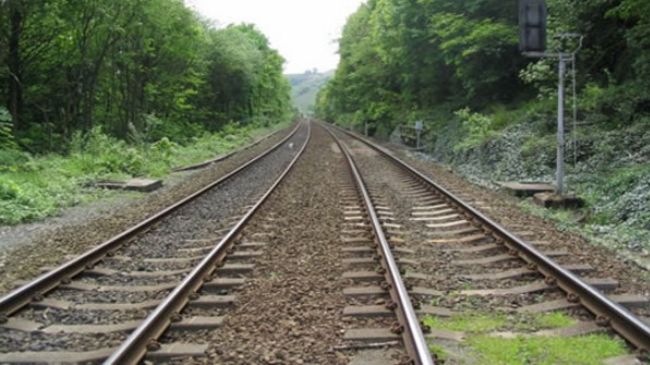
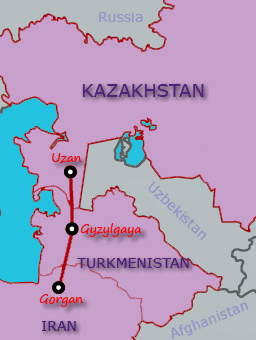
Iran-Turkmenistan-Kazakhstan railway link is part of the North–South Transport Corridor. Over 910 kilometers of rail tracks are laid in three countries to connect Central Asia to the Persian Gulf via Iran. It links Uzen in Kazakhstan to Bereket-Etrek in Turkmenistan and ends at Gorgan in Iran’s Golestan province. Observers say when complete the railroad would be a major milestone in regional cargo transportation as it dramatically reduces freight transfer time and costs.

Mohammad Shariatmadari

Tasnim, an Iranian news agency, on October 30, featured a short interview with Vice-President for Executive Affairs, Mohammad Shariatmadari, in the northeastern city of Gorgan.

On an inspection tour in the capital of Golestan Province, the vice-president was seeking to get a full picture of what was going on in a place where a giant railway project was underway to link Iran with Central Asia. The following is the translation of the progress report Shariatmadari offered on the spot and a brief look at the giant project and its effects on rail travel in the region:

The vice-president said the railway linking Iran, Turkmenistan and Kazakhstan will be inaugurated in a month, adding the eleventh government gives top priority to the development of railroads.

Shariatmadari further said that the government attaches significance to expansion of rail routes across the country and is determined to complete what has remained unfinished from the time of previous governments.

He said the rail expansion will take place in two parts. One will be carried out in big cities which could bolster road security and urban development, and the other will be along Iran’s borders, something which would connect the trans-Iran railroad to those of neighboring countries.

Recalling his inspection of Gorgan-Incheborun railway, the vice-president said that the construction of Incheborun station is progressing at full speed, expressing hope the railway linking Iran, Turkmenistan and Kazakhstan could become operational in a month.

Iran_Turkmenistan-kazakhstan_railway-3

The 910-km railroad would see three million tons of cargo come into or out of Iran in the first phase, he said, adding that the figure will rise to ten million tons in the following phases.

As for a bogie* exchange point, Shariatmadari said it will be constructed across the border in the two countries based on what the two sides have agreed on.

Asked about the exact timing of the inauguration which is expected to be in the presence of the three countries’ presidents, he said the exact timing has yet to be fixed, but it would be made public soon.

International transportation experts say when inaugurated, the 910-km rail link, would cut short the international transit route from the Commonwealth nations to the Persian Gulf and to Europe by more than 600 kilometers.

More than 700 kilometers of rail tracks are laid inside Turkmenistan. The share of Iran and Kazakhstan stands at 82 and 120 kilometers respectively.

The cross-border railroad will also reduce the transportation and transit time by 48 hours, triggering a drop in transportation fees. All in all, 10 to 12 million tons of freight would be carried via the rail link.

*Bogie exchange is a system for operating railway wagons on two or more gauges to overcome difference in the track gauge. It is currently used for freight wagons. Prior to the emergence of variable gauge axles, it was used for passenger trains.