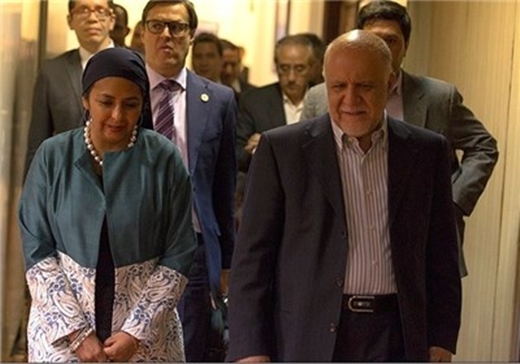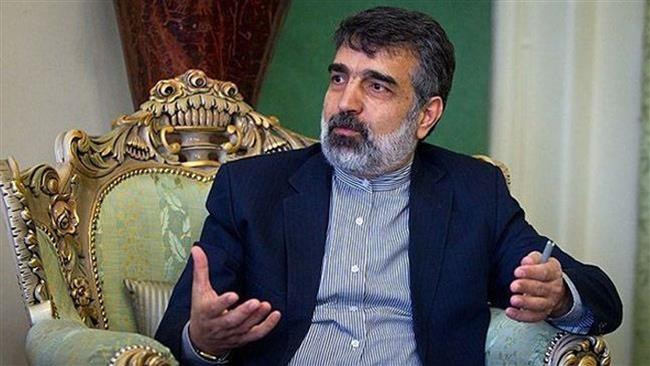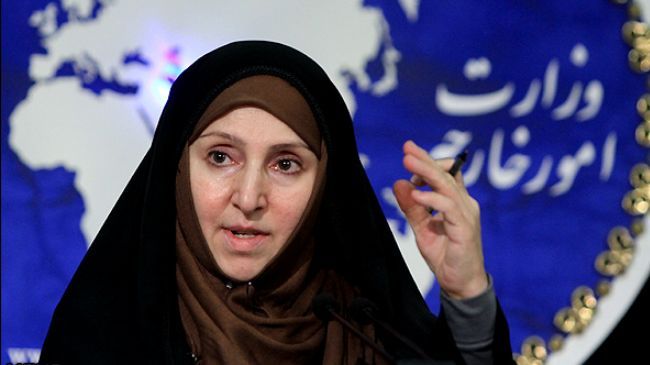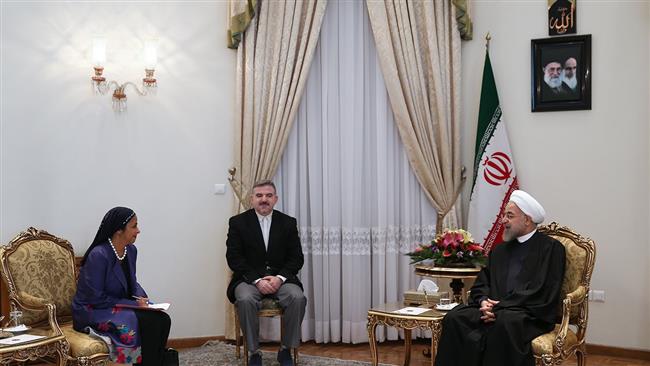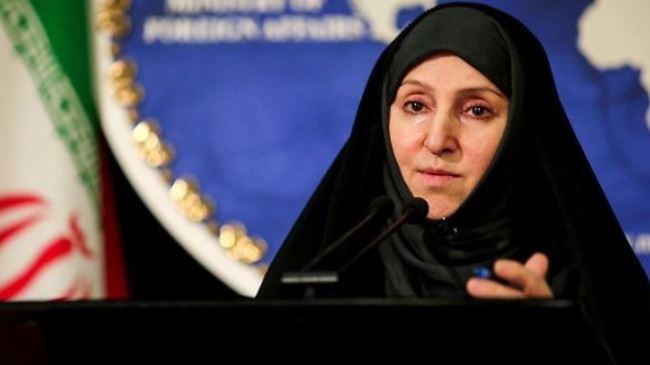
The new ambassadors of Greece, Senegal, Thailand and Algeria presented their credentials to President Rouhani on Monday.
Snapshots of a meeting between President Rouhani and the new foreign envoys to Iran by Mehr News Agency:
The new ambassadors of Greece, Senegal, Thailand and Algeria presented their credentials to President Rouhani on Monday.
Snapshots of a meeting between President Rouhani and the new foreign envoys to Iran by Mehr News Agency:
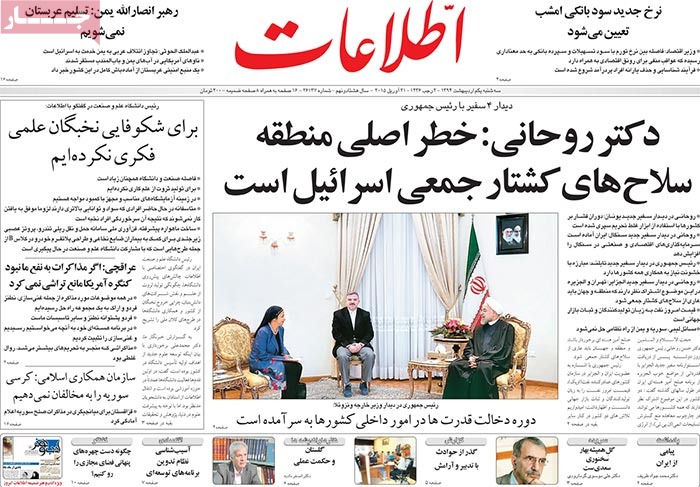
A book entitled The 9th Government and the Zionist Regime, which analyzes the policies of the Iranian government under former President Ahmadinejad in relation to Israel, has been published by the Islamic Revolution Document Center, Khabaronline, a news website, reported on April 18.
The book penned by Mehdi Fardadpour deals with a number of topics, among them: developments in Iran’s foreign policy with regard to the Zionist regime, the foreign-policy strategies of the 9th government and regional policies adopted by Tel Aviv following the rise to power of Ahmadinejad in 2005.
One full chapter of the book is dedicated to foreign-policy strategies of the 9th government, an analysis of its approach to the Holocaust and the reasons behind the president’s doubting it as well as the policies that Ahmadinejad’s government adopted in connection with Iran’s nuclear dossier.
Another chapter addresses the regional polices that Israel adopted after Ahmadinejad took office.
*The 9th government was formed by Mahmoud Ahmadinejad in 2005 after he was elected president. He stayed at the helm of the government for another four years after his contentious victory in the 2009 vote.
Iranian Foreign Minister Zarif held talks with his Venezuelan opposite number Delcy Rodriguez in Tehran.
The Images of the meeting between the two top diplomats by Tasnim News Agency on April 20:

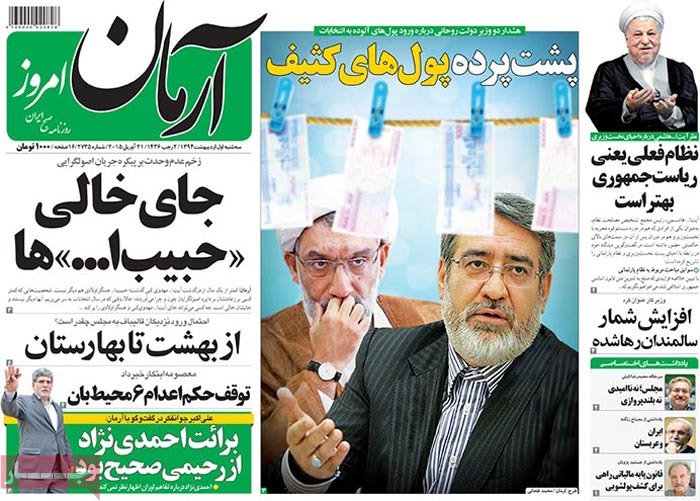
Iran and Saudi Arabia are two key Islamic countries in the region. They have many things in common and at the same time do not see eye to eye over many others. Over the last century, their relations have gone through ups and downs.
At times they have been rivals and at others they have enjoyed friendly relations; sometimes they have been hostile to each other, and sometimes they have had close cooperation.
In short, Tehran-Riyadh relations have been like a roller coaster ride. If we put aside interactive relations between the two nations and the slightly positive results they have produced, what remains is a number of bitter developments that have jolted bilateral ties in the last century.
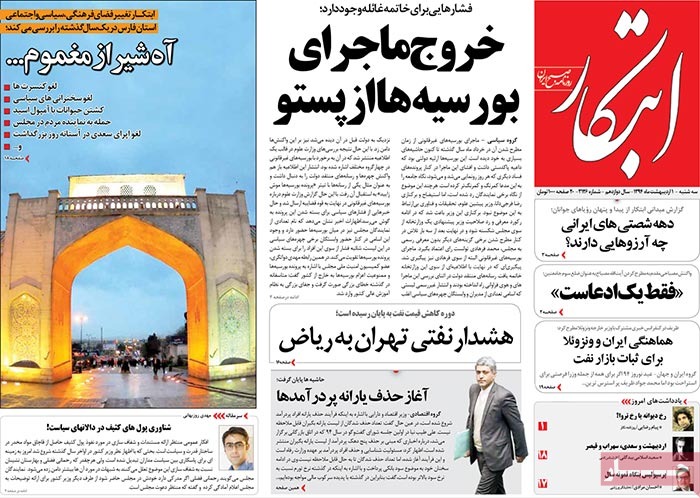
The April 19 editorial of Ebtekar daily, penned by Gholamreza Kamali Panah, has looked back at past incidents that have triggered friction between the two countries. What comes next is the translation of the report which encourages the two countries to reexamine their missteps with the hope that it will turn things in favor of the two nations:
1. The decapitation of an Iranian national in Saudi Arabia: In 1943, Abutalib Yazdi, an Iranian Hajj pilgrim felt sick and puked while circumambulating the Kaaba. He tried to cover his mouth with his Ihram dress, but unfortunately some vomit fell to the ground. A number of Wahhabis took him to Saudi guards.
Because of vile comments by some Egyptian witnesses, Yazdi was convicted of defiling the holy place and was beheaded. The author of Rhythm of Hejaz who was in Mecca at the time of the incident, later wrote in his book, “When I was in Masjid al-Haram, I suddenly saw a flurry of excitement. Arabs were overjoyed, telling each other that an Iranian had been killed. Whenever they came across Iranian pilgrims, they would sign a ‘throat slash’, threatening to slit the throats of all Iranians.”
In the aftermath of the bitter incident, the two countries severed ties and a ban was slapped on Hajj pilgrimage. It was lifted in 1948 when Iran and Saudi Arabia reestablished relations.
2. Iran-Iraq war: In 1980 when Saddam invaded Iran, Riyadh lent political and financial support to Iraq. It did not matter to the Saudis who the aggressor was or that both Iran and Iraq were Islamic countries. What was important to them was that an Arab country was at war with a non-Arab nation. Riyadh had taken it upon itself to back the Arab country at any cost.
Back then, humanity or Islamism was not at issue; rather, ethnic and tribal prejudices were important.
3. Tragic martyrdom of Iranian Hajj pilgrims: In bloody clashes in 1987 in Mecca, 275 Iranian pilgrims were martyred. The killing deeply hurt the sentiments of the Iranian nation. Some in Tehran staged protest rallies outside the Saudi embassy and that led to a breakdown in Iran-Saudi relations.
4. Post-Saddam Iraq and Iran: After the US invasion of Iraq and the ouster of Saddam, Shiites secured an overwhelming vote, rose to power and became more inclined toward Iran, a tendency which annoyed the Saudis, and soured relations between Tehran and Riyadh.
5. Cut off the head of the snake: A few years ago, WikiLeaks, a whistleblowing website, in a report revealed that Saudi King Abdullah appealed to America in 2008 to attack Iran, describing what he called “cutting off the head of the snake” as a necessity. The revelation hurt the sentiments of Iranian nation and authorities, a bitter incident which is still engraved in the memory of the Iranian people.
6. The 33-day war with Israel; the victory of Lebanon’s Hezbollah: Popularity and influence of Hezbollah in Lebanon has always worried Saudi Arabia. During the 33-day war, backed by America, Israel sought to finish off Hezbollah once and for all. Back then, Condoleezza Rice, the US secretary of state, said no to negotiations, to any agreements, and to any ceasefire, only pressing for the disarmament of Hezbollah.
However, following 33 days of fighting, it dawned on them that they should think of a way to save Israel from drowning in the quagmire.
It was the first time that one of the world’s most dreaded armies was brought to its knees. Deep down, Riyadh was dismayed at the defeat.
Resentment toward Iran and Hezbollah can be clearly seen in the harsh statements of Saudi Foreign Minister Saud al-Faisal about Lebanon in a meeting of Arab foreign ministers in 2008 where he said that Iran was running the war and that Hezbollah sought to introduce the Rule of Jurisprudence in Lebanon.
The comments drew strong criticism from Yousef al-Ahmad, the former Syrian minister of state, who objected to Faisal wondering whether the Saudi official wanted to sell his own idea that Iran, not Israel, which killed children daily, was the enemy of the Arabs.
He lashed out at the Saudi foreign minister for sitting on his hands and doing nothing while Israel kept dropping bombs on Lebanon during the 33-day war. Ahmad asked Faisal why he did not favor the notion of dispatching troops to fight off the Israeli aggression.
7. Iran and Oman: Oman is a Persian Gulf Arab state. Basically Riyadh expects Muscat to back the Saudi stand in its relations with Iran.
During President Rouhani’s visit to Oman, a contract on construction of a natural-gas pipeline was signed between the two countries. Bloomberg called the deal the latest sign that Saudi Arabia is failing to bind its smaller Persian Gulf neighbors into a tighter bloc united in hostility to the Islamic Republic.
Christopher M. Davidson in his book, After the Sheikhs: The Coming Collapse of the [Persian] Gulf Monarchies, said that Qaboos, the Sultan of Oman, has opted for a safe path and turned into an intermediary who tries to help Tehran-Washington relations improve.
He goes on to describe Sultan Qaboos as the most intelligent Persian Gulf Arab leader who does not want to unite with Saudi Arabia.
A visit by Iranian Foreign Minister Mohammad Javad Zarif to Oman along with Oman’s failure to join the Saudi-led military campaign in Yemen has exposed the deepening rift between the two regional powers.
8. Bahrain, Iran and Saudi Arabia: Bahrain is a Shiite-majority country, but a Sunni minority backed by Riyadh rules the country.
In line with democratic principles advocated by the West, Bahraini people want their rights respected. But the West has either remained tight-lipped or has backed the minority, and consequently the House of Khalifa has launched a crackdown on the Bahraini people.
Riyadh has sent its tanks to Bahrain to support Manama and has practically taken control of the country. The Saudis claim that Iran plays a role in protests, and Tehran condemns [Saudi] aggression against Bahrain as well as the failure [of minority rulers] to recognize the rights of the majority.
9. Syria’s war: The Syrian government and the opposition have been involved in a bloody and destructive civil war for a few years. Tehran supports Bashar al-Assad, while Riyadh backs the opposition in whose ranks are al-Qaeda and IS fighters and provides financial, political and military aid to them. The Gordian knot is yet to be untied.
10. Sexual assault on two Iranian teenagers: The incident at the Jeddah airport wheretwo Saudi airport guards molested two Iranian teens infuriated the Iranian people and dealt a blow to the reputation of the Saudis, a case which Iranian officials are still vigorously following up.
Unfortunately, disagreement over such issues still persists, but people should be vigilant and avoid moving faster than their officials in pursuit of their rights. The public should stand up for their rights while taking steps in tandem with the government.
Fatemiyeh, a four-decade-old bakery in Birjand [in the eastern province of South Khorasan] is run by women.
In spite of all challenges the job has presented to them, the hardworking women have not given up and work from dawn to dusk to make a living.
Images of Iranian bakers at work released by Mehr News Agency:
The New York Times published an opinion piece on April 20 by Iranian Foreign Minister Mohammad Javad Zarif under the title of Mohammad Javad Zarif: A Message From Iran. The following is the message that the Islamic Republic News Agency released online:
WE made important progress in Switzerland earlier this month. With the five permanent members of the United Nations Security Council plus Germany, we agreed on parameters to remove any doubt about the exclusively peaceful nature of Iran’s nuclear program and to lift international sanctions against Iran.
But to seal the anticipated nuclear deal, more political will is required. The Iranian people have shown their resolve by choosing to engage with dignity. It is time for the United States and its Western allies to make the choice between cooperation and confrontation, between negotiations and grandstanding, and between agreement and coercion.
With courageous leadership and the audacity to make the right decisions, we can and should put this manufactured crisis to rest and move on to much more important work. The wider Persian Gulf region is in turmoil. It is not a question of governments rising and falling: the social, cultural and religious fabrics of entire countries are being torn to shreds.
Endowed with a resilient population that has stood firm in the face of coercion while simultaneously showing the magnanimity to open new horizons of constructive engagement based on mutual respect, Iran has weathered the storms of instability caused by this mayhem. But we cannot be indifferent to the unfathomable destruction around us, because chaos does not recognize borders.
Iran has been clear: The purview of our constructive engagement extends far beyond nuclear negotiations. Good relations with Iran’s neighbors are our top priority. Our rationale is that the nuclear issue has been a symptom, not a cause, of mistrust and conflict. Considering recent advances in symptom prevention, it is time for Iran and other stakeholders to begin to address the causes of tension in the wider Persian Gulf region.
Iranian foreign policy is holistic in nature. This is not due to habit or preference, but because globalization has rendered all alternatives obsolete. Nothing in international politics functions in a vacuum. Security cannot be pursued at the expense of the insecurity of others. No nation can achieve its interests without considering the interests of others.
Nowhere are these dynamics more evident than in the wider Persian Gulf region. We need a sober assessment of the complex and intertwined realities here, and consistent policies to deal with them. The fight against terror is a case in point.
One cannot confront Al Qaeda and its ideological siblings, such as the so-called Islamic State, which is neither Islamic nor a state, in Iraq, while effectively enabling their growth in Yemen and Syria.
There are multiple arenas where the interests of Iran and other major stakeholders intersect. The establishment of a collective forum for dialogue in the Persian Gulf region, to facilitate engagement, is long overdue.
If one were to begin serious discussion of the calamities the region faces, Yemen would be a good place to start. Iran has offered a reasonable and practical approach to address this painful and unnecessary crisis. Our plan calls for an immediate cease-fire, humanitarian assistance and facilitation of intra-Yemeni dialogue, leading to the formation of an inclusive, broad-based national unity government.
On a broader level, regional dialogue should be based on generally recognized principles and shared objectives, notably respect for sovereignty, territorial integrity and political independence of all states; inviolability of international boundaries; noninterference in internal affairs; peaceful settlement of disputes; impermissibility of threat or use of force; and promotion of peace, stability, progress and prosperity in the region.
A regional dialogue could help promote understanding and interaction at the levels of government, the private sector and civil society, and lead to agreement on a broad spectrum of issues, including confidence- and security-building measures; combating terrorism, extremism and sectarianism; ensuring freedom of navigation and the free flow of oil and other resources; and protection of the environment. A regional dialogue could eventually include more formal nonaggression and security cooperation arrangements.
While this cooperation must be kept to relevant regional stakeholders, existing institutional frameworks for dialogue, and especially the United Nations, must be utilized. The secretary general could furnish the necessary international umbrella. A regional role for the United Nations, already envisaged in the Security Council resolution that helped end the Iran-Iraq war in 1988, would help alleviate concerns and anxieties, particularly of smaller countries; provide the international community with assurances and mechanisms for safeguarding its legitimate interests; and link any regional dialogue with issues that inherently go beyond the boundaries of the region.
The world cannot afford to continue to avoid addressing the roots of the turmoil in the wider Persian Gulf region. This unique opportunity for engagement must not be squandered.
A senior Iranian official has reaffirmed Tehran’s support for the national solidarity and territorial integrity of Iraq as the Arab country is grappling with deadly violence fueled by ISIL Takfir terrorists.
“Iran’s fundamental policy toward Iraq is to support the unity and territorial integrity of that country as well as good-neighborliness and to help reinforce its stability and security,” Iran’s Deputy Foreign Minister for Arab and African Affairs Hossein Amir Abdollahian said on Sunday.
He made the remarks in a meeting with Secretary General of Iraq’s Kurdistan Islamic Union (KIU) Mohammed Faraj Ahmad Aziz in Tehran.
The Iranian official described national unity in Iraq as the key factor that will help the country weather the current sensitive situation.
The Iraqi figure, for his part, praised the Islamic Republic’s key role in the region and expressed gratitude to Tehran for backing Iraq in its battle against ISIL terrorists.
He further underlined the need to promote national dialogue and cooperation among all Iraqi tribes and ethnic groups to tackle terrorism.
Iraq has witnessed a surge in violence since the ISIL Takfiri group started its campaign of terror in the Arab nation in early June 2014. The heavily-armed militants took control of Mosul before sweeping through parts of the country’s Sunni Arab heartland.
Iraqi soldiers, police units, Kurdish forces, Shia volunteers and Sunni tribesmen have succeeded in driving the ISIL terrorists out of some areas in Iraq.
Iran has repeatedly stressed that it will not interfere militarily in Iraq, but that it will continue to provide support for the country against ISIL in the form of defense consultation and humanitarian aid.
Aydin Aghdashloo, a contemporary Iranian visual artist, is no longer in Iran. He left the country in March to have a rest in another country and start to write an account of his past experiences and checkered career.
Khabaronline.ir released a report on Aghdashloo and his departure from Iran in late March. What comes next is a translation of the report followed by a collection of photos of his last exhibition in Iran:
The departure of Aydin Aghdashloo was perhaps one of the strangest events in Iran last year [ending March 20, 2015]. Aghdashloo, an artist who stayed in his home country for years despite ups and downs but decided to leave Iran at an old age, says he’s set out for a long journey this time around.
By his own account, Aghdashloo wants to live outside Iran with his children for an indefinite period during which he can write his memoir.
Aghdashloo, 75, has tested various branches of art, and served in different capacities from art critic to painter [to author, art historian and graphic designer]. He has made his name mostly in creating visual artistic works and in establishing his own progressive style in painting.
Years of Fire and Snow and Memories of Destruction are the artist’s two collections [of paintings] which are starkly remarkable in the history of the contemporary visual art.
In spite of his popularity in Iran, he has held only two solo exhibitions over the years: the first one came in 1975 and the second almost 40 years later in 2014. When Tehran’s Museum of Contemporary Art did not agree to organize the second event, Aghdashloo was forced to take care of the whole show single-handedly, something which he says he did out of bad luck.
The fruit of his 40-year-long art career – some of which were borrowed from private art collectors – was eventually put on display at Tehran’s Assar Art Gallery. His fans, young and old alike, had come to see the show. A big crowd had gathered waiting in long lines to take a look at his artworks.
The substantially large number of visitors turned into one of the sideline issues of the artistic event in 2014. Those who had come to visit the show would have never thought that they would one day stand in long lines outside an art gallery.
In a press conference on November 29, Aghdashloo said that his exhibition after 40 years was an attempt to get even with the years he has stayed in the country. “I am downhearted and exhausted. Time has come for me to have some rest.”
He talked about his decision to stay in the country during the [Iran-Iraq] war, about different governments which treated him differently – although he had never expected to become prominent – and about the fact that his depression has internal, reasons such as overworking and old age, and not external.
Aghdashloo seems to have done his fair share of the work by creating Memories of Destruction, a collection of 11 paintings during his stay in Iran. When he was not treated the way he truly deserved in his home country, he did not air any grievances, but decided to abandon canvas, painting and his country for an indefinite period.
He set out on a journey in the last month of the Iranian year [March] to welcome Nowruz [New Year] in a country other than Iran. He talked about his decision to meet his children and write his memoir and about his paintbrush which will be replaced by his pen to depict words in another part of the world.
Afghan President Ashraf Ghani arrived in Tehran on Sunday. In his first state visit to Iran at the invitation of President Rouhani, he met with a number of Iranian officials.
Photos of President Ghani’s Tehran visit by the Iranian Students’ News Agency on April 19:
The following are the snapshots of a local market in northern Tehran where colorful fruit, mouthwatering food and other things are on sale.
Images of a colorful market released online by Tehran Picture Agency on April 18: