Sunday, December 28, 2025
Home Blog Page 4903

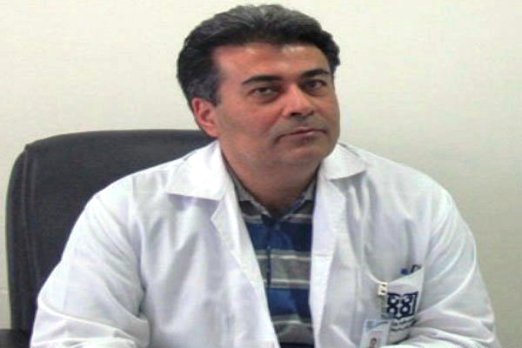
An acid attack on a Tehran hospital administrator

Dr. Anvari
Dr. Anvari

On November 30, the Islamic Republic News Agency (IRNA) posted a brief report which featured an interview with Tehran Police Chief Brigadier General Hossein Sajedinia about an acid attack on Dr. Siamand Anvari, the administrator of the capital’s Ziaeian Hospital. The following is the partial translation of the report:

The capital’s police chief said that the acid attack on Dr. Anvari has caused injury to his eyes and that the Greater Tehran Police have tasked a special team to identify and arrest those behind the assault.

“Around 9 p.m. local time on Saturday [November 29] when Dr. Anvari was on the way home, acid was thrown on him by two assailants on a motorbike,” he said. “Dr. Anvari, who picked up injuries in both eyes, was rushed to Farabi Hospital to get medical care there.”

In the meantime, the head of the Public Relations Office of Tehran Emergency Medical Services said, “Immediately after the acid attack, Dr. Anvari washed his face and eyes with water. That helped minimize the corrosive impact of acid and prevented serious damage to his face and eyes.”

A look at Iranian newspaper front pages on Nov. 30

Iranian Newspapers Headlines

The international news story that made front-page headlines in Iranian dailies on Sunday was the ruling of an Egyptian court that dismissed all charges against the toppled Egyptian ruler Hosni Mubarak, his interior minister and sons Alaa and Gamal [charged with corruption] over the killing of protesters during the 2011 uprising.

Remarks of First Vice-President Eshagh Jahangiri at the induction ceremony of the new minister of science, research and technology came under the spotlight too. The refusal of Hossein Alizadeh, an Iranian musician and composer who is known as the master of tar, to receive France’s Chevalier of Legion of Honor also drew the attention of dailies, as did the presence of Foreign Minister Mohammad Javad Zarif in a closed-door parliament session to brief MPs on what went on in Vienna nuclear talks.

Abrar-e Eghtesadi: “The peace of foreign currency market has been shattered by [falling] oil prices. The Iranian currency is down 1,600 rials against the greenback.”
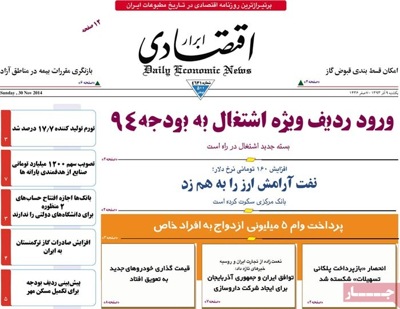
 

Abrare eghtesadi newspaper 11-30


Afarinesh: “The negotiating team did not allow the topics of human rights and Iran’s missile program to be placed on the agenda of the negotiations,” Foreign Minister Mohammad Javad Zarif told parliament in a briefing on the Vienna nuclear talks.
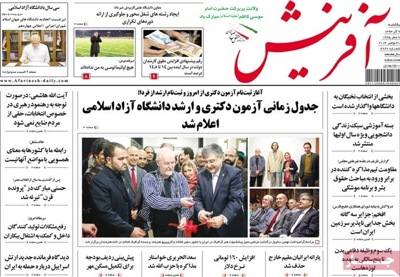
 

Afarinesh newspaper 11 - 30


Aftab-e Yazd: “Cash subsidies granted to Iranian expatriates have been cut.”

Aftab-e Yazd: “To pay its debts to Iran, India is to export steel to Iran! The decision comes as Iran tops the list of steel producers in the region.”
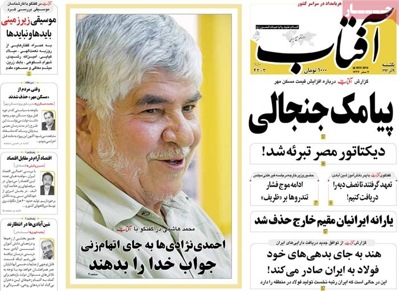
 

Aftabe yazd newspaper 11 - 30


Arman-e Emrooz: “The defendant in the Trial of the Century has been acquitted” is the headline that the daily put on his front page about the verdict handed down in a case against ousted Egyptian President Hosni Mubarak [who was charged with murdering protestors in 2011] along with his sons and the former interior minister.

Arman-e Emrooz: “The number of women contracting AIDS has been on the rise; the disease has claimed 5,000 lives in Iran,” said the UN resident coordinator.
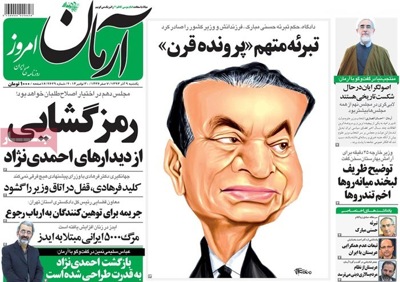
 

Armane emruz newspaper 11 - 30


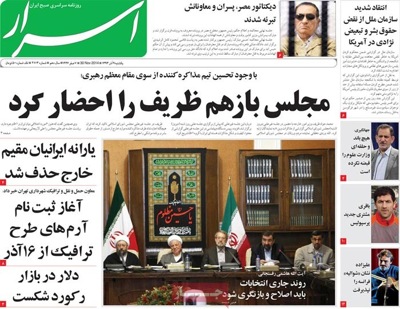
Asrar: “Hossein Alizadeh, an Iranian composer, researcher and tar and setar instrumentalist and improviser, has turned down France’s Chevalier of Legion of Honor.”

Asrar: “The current trend of elections needs to be reformed and reevaluated,” said Chairman of the State Expediency Council Akbar Hashemi Rafsanjani.
 

Asrar newspaper 11 - 30


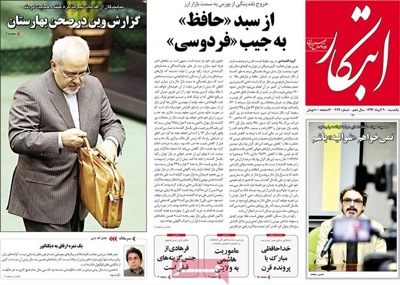
Ebtekar: “Mohammad Farhadi [the minister of science, research and technology who finally secured a vote of confidence from parliament on November 26] has got a lot in common with the previous picks of President Rouhani [who failed to get confirmed by the chamber],” said First Vice President Eshagh Jahangiri.
 

Ebtekar newspaper 11 - 30


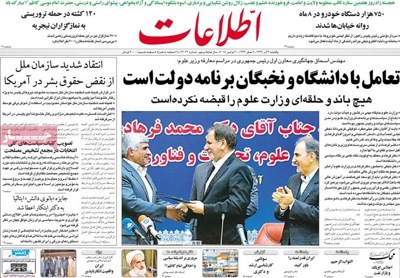
Ettela’at: “Interaction with universities and the elite is the policy of the government; no one group has monopoly over the Ministry of Science, Research and Technology,” said First Vice President Eshagh Jahangiri.

Ettela’at: “The outlines of general election policies have been approved in the State Expediency Council.”
 

Ettelaat newspaper 11 - 30


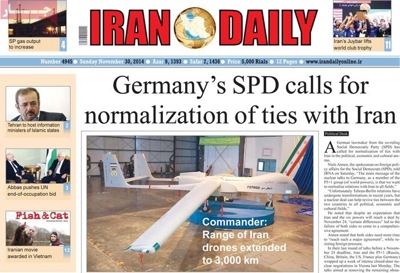
Iran Daily: “Germany’s SPD calls for normalization of ties with Iran.”

Iran Daily: “Tehran to host information ministers of Islamic states.”

Iran Daily: “Iranian movie Fish &Cat awarded in Vietnam.”
 

Iran dayli newspaper 11 - 30


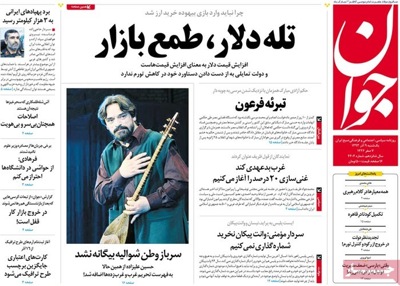
Javan: “The range within which Iranian-built drones can operate has increased to 3,000 km,” said Commander of the Islamic Revolution Guards Corps’ (IRGC) Aerospace Division Brigadier General Amir Ali Hajizadeh.
 

Javan newspaper 11 - 30


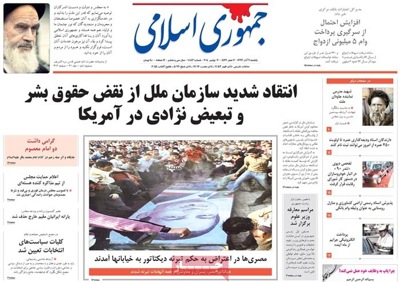
Jomhouri Islami: “The United Nations has harshly criticized the violation of human rights and racial discrimination in America.”

Jomhouri Islami: “Following the decision of parliament, immediate and unconditional medical services must be offered to those injured in car accidents.”

Jomhouri Islami: “An induction ceremony has been held for the new minister of science, research and technology.”

Jomhouri Islami: “Egyptians took to streets in protest against the verdict that cleared former Egyptian strongman Hosni Mubarak of all charges.”
 

Jomhurie eslami newspaper 11 - 30


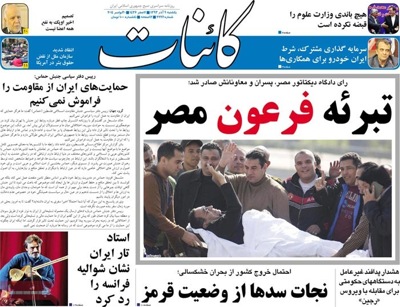
Kaenat: “Joint venture is the condition that Iran Khodro [the leading Iranian carmaker] has set for cooperation with foreign automakers.”
 

Kaaenat newspaper 11 - 30


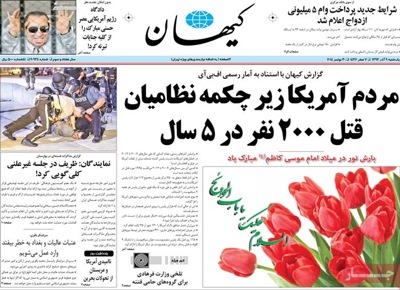
Kayhan: “Foreign Minister Mohammad Javad Zarif only touched upon general outlines in his briefing in parliament on nuclear talks,” said a number of MPs.
 

Kayhan newspaper 11 - 30


Mardomsalari: “We hope to clinch a nuclear deal ahead of the deadline,” said the first vice president.
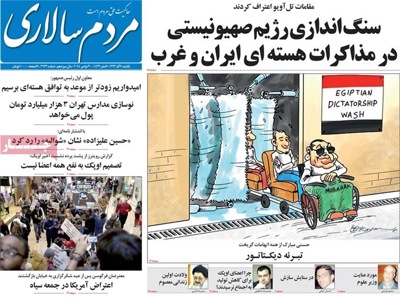
 

Mardom salari newspaper 11 - 30


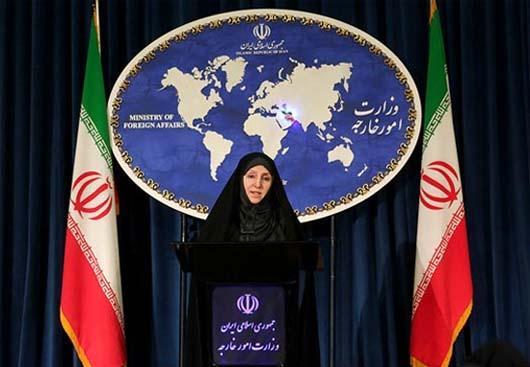
Payam-e Zaman: “The three Persian Gulf islands of Abu Musa, Greeter Tunb and Lesser Tunb are an inseparable part of Iranian territory,” said Foreign Ministry Spokeswoman Marzieh Afkham.
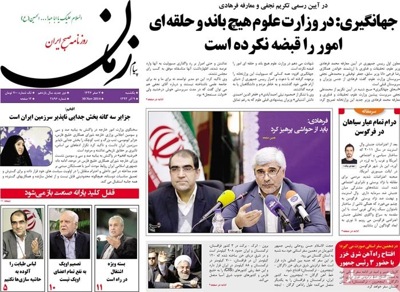
 

Payame zaman newspaper 11 - 30


Siasat-e Rooz: “If Baghdad is threatened, we will take action,” said Deputy Chief of Staff of Iran’s Armed Forces Major General Mohammad Bagheri.
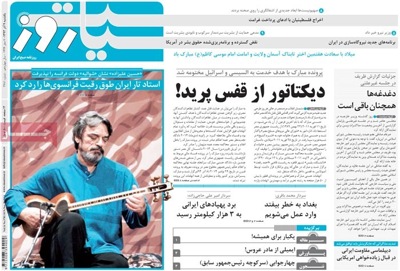
 

Siasate ruz newspaper 11 - 30


Tafahom: “Iran’s population is on the threshold of 78 million,” reported the Statistical Center of Iran.
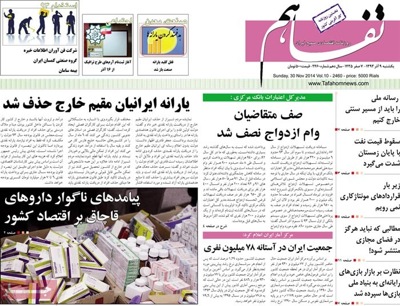

 

Tafahom newspaper 11 - 30


Wars are fought on and off the battlefield

Iran-Basij

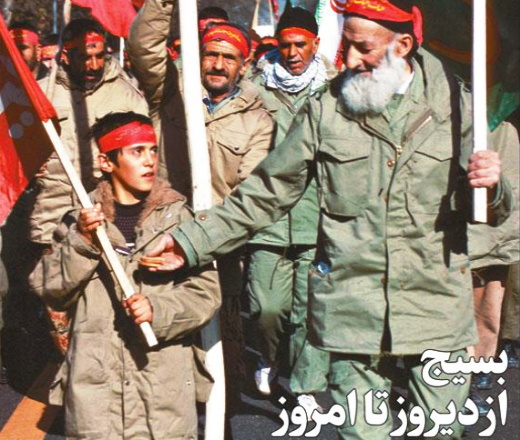
In Iran November 21-27 marks the Week of Basij, a popular force which was formed on November 26, 1979 by order of the late Imam Khomeini. When Saddam’s Iraq waged war against Iran in 1980, Basij forces rushed to the battlefields to defend their homeland along with their comrades in arms at IRGC and the army. After the war, Basij got involved in yet another campaign to help the country pick up the pieces and rise above the conflict.

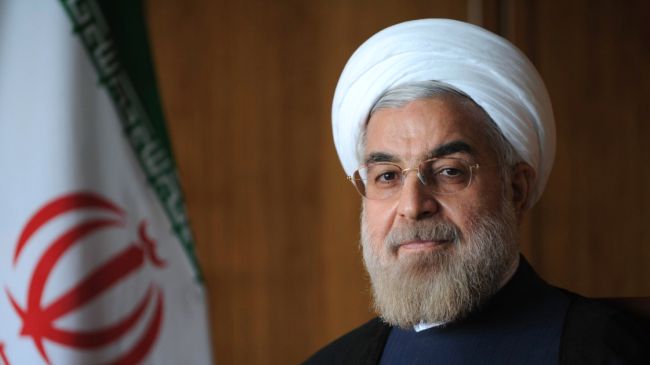
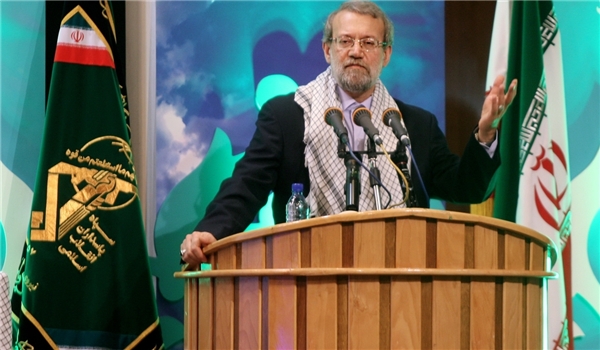
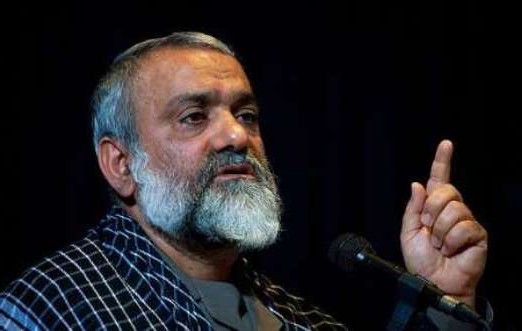
On November 29, Sharq newspaper released a supplement “Basij, Yesterday and Today” to mark the occasion featuring, among other things, the remarks of different political officials on the role of the Basij volunteer force during and after the war. What appears below is the translation – in part – of what Chairman of the Expediency Council Ayatollah Akbar Hashemi Rafsanjani, President Hassan Rouhani, Speaker of the Islamic Consultative Assembly Ali Larijani and Commander of the Basij force Brigadier General Mohammad Reza Naghdi, said in the supplement about the force:


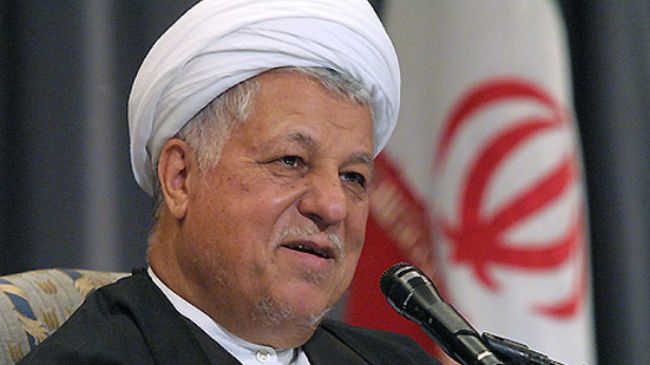
Rafsanjani: Peacetime struggle for reconstruction


Ayatollah-Hashemi-Rafsanjani[…] That we are not engaged in any war does not mean that Basij and its activities are no longer relevant. Battlefields are only one of the fields where Basij can show itself.

We can tap into the potential of Basij to solve any problem that arises in society. The organization of young volunteers can be a big help in efforts to mobilize people to get the job done.

Gratitude makes for a great attitude. We have used the force at high-stakes junctures in the past, now we should not forget them in peacetime when the going is not tough. […]


Rouhani: Basij should go beyond partisan agenda


Iran-Rouhani

[…] The great heroic Basij belongs to the whole nation. It belongs to no specific party. No one can cast a greedy eye on Basij. The volunteer force belongs to every single Iranians and all those who approve of the [Islamic] establishment, revolution, the Constitution and Velayat-e Faqih (the Governance of the Jurist). Iranians of every age are members of Basij. It belongs to all Iranians. […]

Basij is meant to safeguard national and Islamic interests. That means one can say that this country is home to some 75 million Basijis. […]


Larijani: Basij should pursue entrepreneurship to stimulate production


Ali Larijani

[…] The policies of the Resistance-based Economy championed by the Supreme Leader should be carried out. These policies primarily focus on ways of helping production boom and giving the public a bigger role to play in the economy.

The public economy has not been able to mobilize the country’s national potential; nor have the state-run companies been able to pull their own weight. However, Basij can do big jobs in this regard. […]

Entrepreneurship in the agricultural and industrial sectors in rural areas can empower the nation. If Basij is seeking to address the country’s serious challenge, it needs to take care of entrepreneurial efforts which will encourage and maximize production. […]


Naghdi: Basij is ready to cooperate with the government


General Reza Naqdi

[…] In religious democracy, people are not separated from the establishment and government, and they form an integrated whole. The government and its institutions have come from the fabric of society to serve the people. And all people should offer a helping hand when it comes to serving the public. […]

To cut through the red tape people involved in the agriculture and production sectors are tied up in, Basij can enter the scene, muster people and launch redoubled efforts to make the problem a thing of the past.

This mindset is what is usually lacking in governments, and it has nothing to do with where they stand, whether they follow right- or left-leaning doctrines. […]

Iranian musician refuses French Chevalier of Legion of Honor

Hossein Alizadeh
Hossein Alizadeh

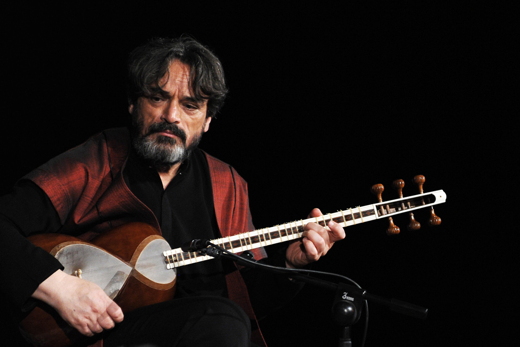
Hossein Alizadeh, a leading Iranian classical composer and musician, has refused to receive France’s Chevalier of Legion of Honor to have his name bereft of any titles.

Hossein Alizadeh is considered as one of the most important figures in contemporary Persian music, exemplifying excellence in traditional Persian music today. He has studied Composition and Musicology at Berlin University, and taught at University of Tehran and Tehran Music Conservatory.

He has been nominated three times for the Grammy Award. He received a nomination for the 2007 Grammy Award along with Armenian musician, Djivan Gasparyan, for their collaboration album, The Endless Vision in the “Best Traditional World Music” category.

He has two prior Grammy nominations for his work with the Persian classical ensemble Masters of Persian Music. Those nominations were for the group’s 2002 debut release “Without You” and their follow-up 2005 live recording “Faryad.”

Alizadeh expressed gratitude to Iranian officials and the embassy of France in a letter, and refused to be awarded the France’s Chevalier of Legion of Honor in order to honor the Iranian patrons of art, and instead chose to be only known as Hossein Alizadeh with no prestigious title.

Other notable Iranian artists who have received France’s Chevalier of Legion of Honor include Iranian filmmaker Dariush Mehrjuii, Iranian author Mahmoud Dowlatabadi, mostly famous for his novel “Kalidar”, Iranian cartoonist Kambiz Derambakhsh, and Iranian vocalists Mohammadreza Shajarian and Shahram Nazeri.

Iran condemns deadly bomb attack in Nigeria

Iranian Foreign Ministry Spokeswoman Marziyeh Afkham

Iran has strongly condemned a recent terrorist attack on a mosque in Nigeria’s northern state of Kano, which left at least 120 people dead.

On Saturday, Iran’s Foreign Ministry spokeswoman, Marzieh Afkham, deplored the spread of terrorism and extremism in Nigeria and underlined the necessity to eradicate these ominous phenomena.

She further called on Nigerians to close ranks and prevent any measures that would cause sectarian and ethnic division in the African country.

On Friday, two explosions took place shortly after hundreds of people had gathered to listen to a Friday Payers sermon at the Grand Mosque in the city of Kano, situated 423 kilometers (262 miles) north of the capital, Abuja.

At least 120 people lost their lives and around 270 others were injured in the explosions.

The blasts at the Grand Mosque of Kano came a week after influential Muslim leader, Mallam Sanusi, who usually leads prayers there, called for people to arm themselves against Boko Haram terrorist group.

There was no immediate claim of responsibility for the blasts. However, Nigerian officials often blame such assaults on the Boko Haram Takfiri militants.

Boko Haram, whose name means “Western education is forbidden,” has claimed responsibility for a number of deadly shooting and bombing attacks in various parts of Nigeria, which have left more than 10,000 people dead so far.

Iran indigenizes flight simulator technology

Manouchehr Manteqi
Manouchehr Manteqi

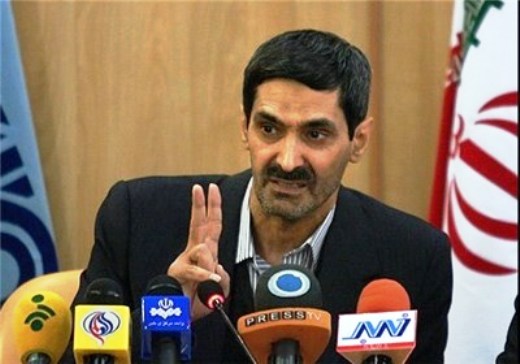
Managing Director of the Iranian Aviation Industries Organization Manouchehr Manteqi said Iranian experts have managed to indigenize flight simulator technology.

“From now on, before building any kind of drone, its simulator will be designed to reduce training costs and boost the capabilities of Iranian pilots,” Manouchehr Manteqi said on Saturday.

Iranian aviation experts have also gained the knowledge to build unmanned helicopters, Manteqi added.

Earlier this month, a home-made flight simulator system, compatible with different types of Unmanned Aerial Vehicles (UAVs), was unveiled at an international aviation exhibition in southern Iran.

The homegrown device was put on display at the 7th edition of Iran’s International Exhibition of Aviation and Aerospace Industries held on the Persian Gulf island of Kish.

Four of such simulators have been manufactured by Iran’s Aviation Industries Organization, an official said.

The new product is specifically helpful in training students in pilot courses.

The one unveiled in the exhibition has been configured to simulate flight conditions of the indigenous Ababil 3 drone.

Ababil 3 is a pilotless aircraft which can be used for military, research, environmental and trade purposes.

The drone can reach altitudes as high as 15,000 feet and has a flight endurance of 8 hours. It was first used in a military aerial exercise back in December 2013.

The Islamic Republic is now in possession of a broad range of UAVs which can be used for both civilian and military purposes.

Iran reaffirms sovereignty on three Persian Gulf islands

iran-islands
iran-islands

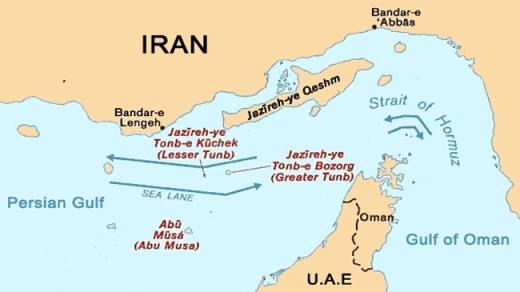
Iran has dismissed as “baseless” a statement by Persian Gulf Arab states supporting United Arab Emirates’ alleged ownership of three Iranian islands, saying the Persian Gulf islands are integral part of the country.

Foreign Ministry spokeswoman, Marzieh Afkham, said on Saturday that repetition of baseless claims to the three Iranian islands would not change historical facts.

Noting that “friendly ties with neighbors based on non-interference policy and mutual respect” top the Islamic Republic’s agenda, she said Iran does not put any limit on the expansion of friendly ties with neighboring countries.

On Tuesday, the six-nation [Persian] Gulf Cooperation Council issued a statement at the end of its 133rd foreign ministerial meeting in the Qatari capital, Doha, reiterating support for the UAE’s claimed ownership to the three islands of Greater and Lesser Tunbs and Abu Musa.

The three islands have been historically part of Iran, the proof of which can be found in and corroborated by countless historical, legal and geographical documents in Iran and other parts of the world.

The United Arab Emirates has, however, repeatedly laid claim to the islands.

A sense of esprit de corps with Palestinians on November 29

Reza Najafi
Reza Najafi

Ceremonies to mark the International Day of Solidarity with the Palestinian People gained added importance this year thanks to UN designation of 2014 as the International Year of Solidarity with the Palestinians.

The Islamic Republic News Agency (IRNA) on November 29 reported that at one such ceremony at the UN headquarters in the Austrian capital government representatives as well as key political and cultural figures delivered speeches on the need to demonstrate solidarity with the Palestinians.

The ceremony opened with a message by UN Secretary General Ban Ki-Moon which was read out by Director-General of the United Nations Office in Vienna (UNOV), Yury Fedotov.

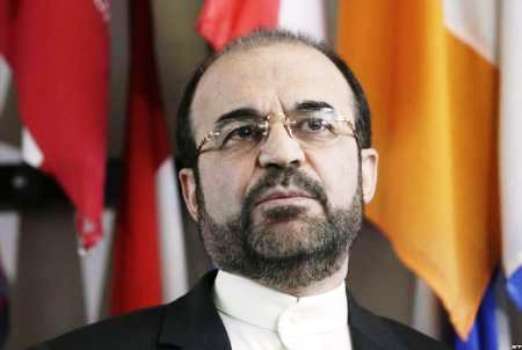
Reza Najafi, the ambassador and permanent representative of the Islamic Republic of Iran to the United Nations and other International Organizations in Vienna, was one of the speakers there. The following is a partial translation of his address:

Over the past 65 years, the question of Palestine has not been a mere Islamic-Arabic issue; rather it has – over time – turned into one of the most complicated political and legal concerns around the world.

For years, the Palestinian people bore the brunt of injustice, displacement, massacre and occupation. They have been constantly deprived of their rights mainly due to the destructive, colonial policies of the Zionist regime, and their homeland has consequently shrunk by the day.

Iran’s democratic proposal for settling the Palestinian crisis helps achieve the broader goal of sustainable peace [in the occupied territories]. To make that goal attainable, these conditions should be met: administration of justice, an end to discrimination as well as to occupation of all Palestinian lands, resort to democracy to help the entire Palestine decide the fate of their homeland and see their dreams come true, and formation of an independent and sovereign Palestinian state with Quds as its capital.

In 1977, the General Assembly called for the annual observance of November 29 as the International Day of Solidarity with the Palestinian People.

What Zarif told MPs in a closed-door meeting of parliament

Zarif-Parliament
Zarif-Parliament

Mehr News Agency posted a report on November 29 about the remarks of a number of parliamentarians after Foreign Minister Mohammad Javad Zarif appeared on parliament floor to brief MPs on the most recent round of nuclear talks in Vienna. The following is a partial translation of the piece:

“A majority of questions posed to the foreign minister by MPs revolved around what the Islamic Republic of Iran offered to the West and what it got in return in Vienna,” said Vahid Ahmadi, a member of parliament’s National Security and Foreign Policy Committee.

“In response to expressions of concern about concessions, Mr. Zarif underlined what he and his fellow negotiators did was in line with the Interim Geneva Agreement,” he added.

Another member of the committee who spoke with the agency on condition of anonymity stated, “During the briefing, Zarif explicitly said that if the other party to nuclear talks did not keep its side of the bargain, Iran would resume 20-percent uranium enrichment.”

“The foreign minister said that Iran will honor its commitments step by step in tandem with fulfillment of the commitments by the West,” the MP added.

He pointed out, “Parliament Vice-Speaker Mohammad Reza Bahonar, who presided over the hearing, told Zarif that parliament will only approve a good deal and on no account will it give the go-ahead to a bad agreement. A good deal should entail the lifting of all sanctions.”

Hassan Sobhaninia, an MP representing Neishabur and a member of the chamber’s Presiding Board said, “The foreign minister briefed MPs for 45 minutes on the disagreement between Iran and the West over Fordow, Arak heavy water plant, the number of centrifuges and the timetable for removal of sanctions.”

“The Islamic Consultative Assembly has lent support to the process of nuclear talks and if Iran’s negotiating team does not cross the red lines and resists the excessive demands of the West, parliament will continue to support the process,” concluded Sobhaninia.

An MP on parliament’s Cultural Committee who did not want his name to be revealed said, “At this briefing, Zarif did not offer any explanation beyond what the media have reported; he only said that no deal has been cut with the West over the number of centrifuges or nuclear facilities in Arak and Fordow.”

“In line with the Supreme Leader’s support for the talks and Iran’s negotiating team, we approve the process of negotiations. We are mostly concerned about likely mischief on the part of the West,” the parliamentarian stated.

“I am not optimistic about nuclear talks and believe that over the past year, Iran has gained little from the negotiations,” he concluded.

“Zarif was of the opinion that over the time left, the prospects of reaching a comprehensive agreement are as strong as the likelihood of failure to strike a deal. That a deal is cut or not depends on how committed both sides stay to what has been agreed, said an MP with a seat on parliament’s Planning and Budget Committee who also spoke on condition of anonymity.

“At this briefing the measures taken by Iran’s negotiating team were elaborated on and MPs appreciated the efforts of the negotiating team by warmly seeing off the foreign minister after the hearing,” the representative concluded.

Iran to host Islamic Countries’ Health Tourism Conference

Iran-Health Tourism Conference

Northeastern Iranian city of Mashhad is slated to host the 2015 Islamic Countries’ Health Tourism Conference.

The program was announced after Iranian Economy Minister Ali Tayyebnia’s proposal for hosting the event was accepted by the Standing Committee for Economic and Commercial Cooperation of the Organization of the Islamic Conference (COMCEC) during a summit held in Turkey.

“Various issues have been discussed in the meeting, including trade and investment, but the issue of the tourism was at the core of the discussions,” Tayyebnia explained.

“I proposed our country’s hosting of the Health Tourism Conference, which was fortunately accepted,” he also added.

Iran had earlier hosted the First International ECO Health Tourism Seminar states in northern Mazandaran Province.

Iran is becoming a destination for Islamic and regional medical tourists. An increasing number of hospitals in Iranian cities offer very advanced medical and healthcare services to foreign medical tourists.