Friday, December 26, 2025
Home Blog Page 4902

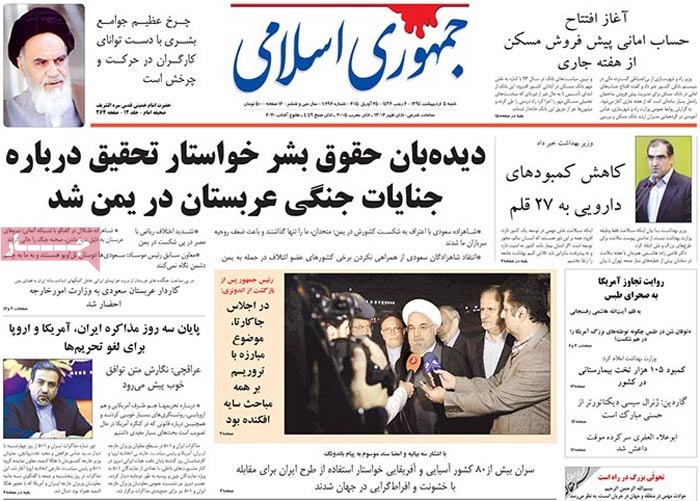
Iranian President’s Yemen message delivered to Iraqi PM

Rouhani

President Hassan Rouhani has appealed for an end to Saudi-led military action against Yemen and for resumption of dialogue among Yemen’s political groups.

According to Mehr News Agency, in a message which was delivered to Iraqi Prime Minister Haider al-Abadi by Deputy Foreign Minister Morteza Sarmadi Wednesday, President Rouhani also urged Iraq and international institutions to try their best to end the aggression and send urgent humanitarian aid to the stricken country.

At the meeting, the president’s special envoy congratulated the Iraqi government for the recent victories it has scored in the fight against IS terrorists and said such victories pave the way for Iraq to fully rid itself of terrorists.

The Iraqi prime minister, for his part, said his country is opposed to any foreign offensive against Yemen and believes such measures will only complicate things and give a shot in the arm to terrorism and extremist elements.

Statement to be issued later Thursday: Iranian FM

Zarif-Laussan

A statement is to be issued later on Thursday, but the exact timing of its release has yet to be determined, Iranian Foreign Minister Mohammad Javad Zarif was quoted by Mehr News Agency as telling reporters in Lausanne Thursday morning after spending the night locked in talks with his US counterpart.

“It is a tough job. We need to talk with these countries which in turn need to make coordination within their own ranks,” the Iranian top diplomat said, adding there are still gaps between Iran and P5+1 and in the overall stance of the powers negotiating with Iran.

He further said if things go ahead according to plan, a joint statement will be issued. “Although good progress has been made, there have been no agreements on the solutions worked out so far. When we reach a framework deal on these solutions, the drafting of the final deal will get underway.”

In conclusion, he said if the two sides clinch a deal by the end of June, that agreement will go to the United Nations Security Council for approval.

Knock on wood; female carpenters have knocked down gender barriers

Iranian Women-wood

A real-life story of women who have dared to venture into a male-dominated field and prove themselves; a story of new challenges and opportunities for two female woodworkers recounted by Akram Ahmadi in Iranbanou, a supplement of Iran newspaper.

The following is a partial translation of a “One Story, One Woman” report in the supplement’s 21st issue (March 15, 2015):

A narrow alley in the middle of an old street is home to seven carpenter shops which have iron doors, no windows and a stack of uncut and unshaped wood, with the sound of chainsaw and air compressor and the smell of paint filling the air.

They are seven old carpentries, but there are new carpenters in one of them; two young women who have changed the mood in the alley. They have placed primrose plants on their table, have tea and sugar storage boxes which are pink with flowery patterns, use red glasses and wear white gloves.

The alley gets cleaned as the pair opens the door of their workshop every day. They sweep the area first thing in the morning, greet their neighbors and then open the shutters and pick up saw and sandpaper to do woodworking.

Negin Nasiri and Shaghayegh Jahanbani are now the familiar carpenters of the alley which is home to [master] carpenters. The two graduates of visual arts used to be journalists, but they have set up shop as carpenters and run their own business.

[…]

Strange carpenters

Shaghayegh says, “There are six other carpentries in this alley. Their owners looked at us with surprise when we were new in the job. They were all old, well-experienced carpenters, wanting to know what we were up to. Their mindset changed when they saw how serious we are going through our paces. Now they all help us. […] They are now accustomed to our presence here. We are now like them, no difference.”

We relish working here

“Here is the place where the action is. It is the place where you enjoy working and get concerned about it.” This is what Shaghayegh said about her preoccupation with the job. […]

“What is interesting for me is producing a new thing. When a table is painted, I become overjoyed thinking that I have made it. […]”

“A feminine look prevails in this place. The old, antique devices play the leading role here.” Negin says about her interest in old works, “Our works fall into two parts: One is about the old, antique works which we renovate. […] The other is related to the orders we take to make new devices. In other words, we should create a new thing. […]

“Since day one, we started to write down our memories which are mostly about how people treat us. In the early days of our business, people used to address us as sirs whenever they walked past our shop. But we turned back, they would say, ‘Do we have female carpenters [in this country]?’ But the reaction of women was different. They would become excited seeing women in this job. Our neighbors would say, ‘The atmosphere has been lightened.’ […]”

A carpenter who has studied art produces different works. S/he employs colors which had been absent in decorations.”

Negin speaks about the footprints of nature and its colors in their works, “[…] The soup your mom cooks is a mix of green and red; a color which looks natural and pleasant. That’s why we use the colors which are always present [in our surroundings], but nobody can think of them as being evident in furniture coverings. […]”

[…]

Art studio

“There is one dreamy, fixed point for any start: what is to be done and what the goal is.” Negin says about her ideals, “I wish to have an art studio. I want to gather a group of people and do the things which are believed to be impossible […]

“Currently, what we’ve done has been seen by others. We’ve been asked to do the interior designing of an auditorium of a residential tower. That is a big step for us. We seek to take our art into people’s lives. […] We need to stay the course. We have lots of things to do. We need to get the show on the road after Nowruz holiday.”

Issues still to be resolved in Iran nuclear talks: Zarif

Mohammad Javad Zarif

“There are a number of issues that are left to be resolved. They require, as I have said, the recognition by all parties that they need to exhibit political will and flexibility in order to move forward. Iran has exhibited that political will. Iran has shown its readiness to engage with dignity,” Zarif told reporters in the Swiss city of Lausanne on Wednesday evening.

The top Iranian diplomat also called upon representatives from the five permanent members of the UN Security Council – the United States, France, Britain, Russia and China – plus Germany to “seize the moment and use this opportunity which may not be repeated.”

He added that the two sides are “just trying to resolve the problems and move forward.”

Zarif told Press TV that he has not yet decided to extend his stay in Lausanne for Iran’s nuclear talks for another day. “We haven’t decided yet, we have to see how much progress we make today and then we will decide based on that.”

He said progress had been made between Iran and major powers over Tehran’s nuclear program, but both sides could have moved forward further.

“I’m not dissatisfied, but we could have made more progress obviously everybody wanted to have resolved this issue by last night, but we still need to do some more work,” Zarif stated.

Meanwhile, as the negotiations have headed into another night of marathon talks, Zarif and US Secretary of State John Kerry have kicked off another round of bilateral negotiations to narrow their differences, and France’s Foreign Ministry has announced that French Foreign Minister Laurent Fabius is returning to Switzerland Wednesday night for further talks.

German Foreign Minister Frank-Walter Steinmeier said earlier Wednesday that Fabius would return to Lausanne to join Kerry and Britain’s Philip Hammond “once (the talks) enter a decisive stage.”

Iranian Deputy Foreign Ministers Abbas Araqchi and Majid Takht-e Ravanchi as well as US Under Secretary of State for Political Affairs Wendy Sherman are also present in the meeting.

Earlier on Wednesday, Araqchi said any deal with the P5+1 group on Tehran’s nuclear program should certainly guarantee the removal of all sanctions.

“It is not possible to have a deal without lifting sanctions, all sanctions must be removed,” he said.

The Iranian official pointed to the difficulty of the task to see all sanctions removed all at once, stressing, however, that the lifting of major economic and oil embargoes constitutes the cornerstone in any agreement.

Iran and the P5+1 group have actually missed a March 31 deadline for reaching a mutual understanding on whether they could continue further talks on Tehran’s nuclear program.

The potential agreement paves the way for a much broader deal by end of June which guarantees the peaceful nature of Iran’s nuclear activities in return for a promise by international powers to lift unfair sanctions against the country.

Yemenis in Iran protest Saudi aggression against their homeland

Yemenis protest

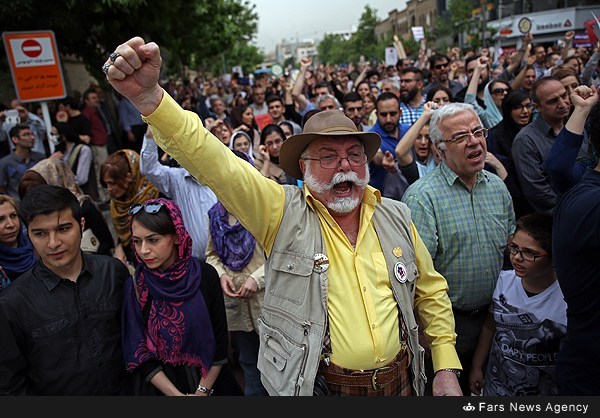
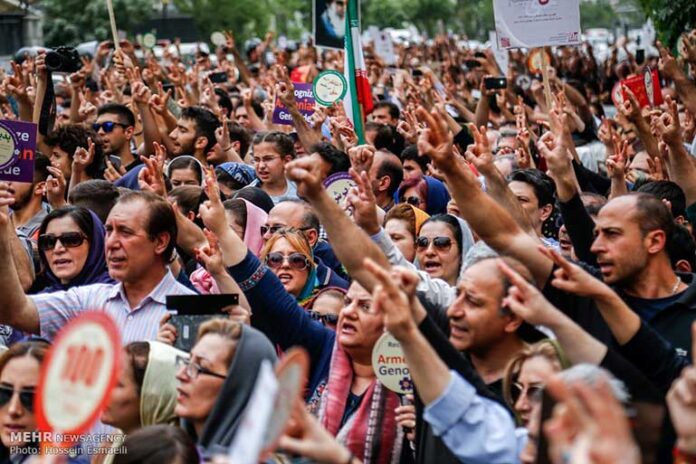
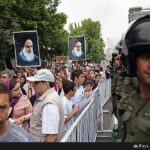
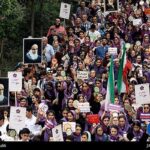
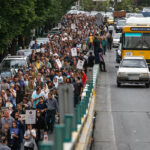
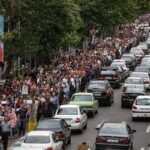
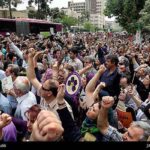
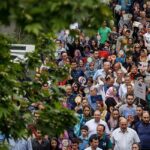
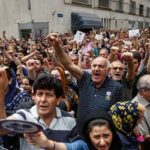
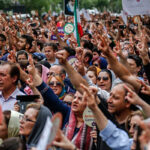
Yemeni nationals living in the Iranian capital, Tehran, have held a protest rally to condemn the ongoing Saudi-led military aggression against their country.

The protesters gathered outside Riyadh’s embassy in Tehran on Wednesday, chanting slogans against Saudi Arabia, the US and Israel to voice their anger at the bloody aerial assault against their homeland.

The demonstrators carried pictures of Abdul-Malik al-Houthi, the leader of Yemen’s Ansarullah movement to express their full support for the revolutionaries in their country.

[…]

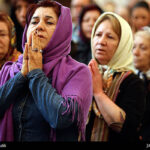
Among the participants were the Yemenis who had been injured in terrorist attacks prior to the Saudi-led war in the Yemeni capital, Sana’a, and later flown to Iran on March 23 for treatment.

Similar anti-Saudi rallies have been also held in several countries over the past days to censure the Saudi attacks.

Meanwhile, large numbers of Yemeni people also took to the streets in the capital, Sana’a, on Wednesday to condemn the Saudi aggression and demand an end to it.

[…]

Zarif on nuclear talks: Hope to start drafting Wednesday

Zarif-Iran Talks

Iran’s Foreign Minister Mohammad Javad Zarif says he hopes parties to the talks over the country’s nuclear energy program could arrive at the expected understanding on Wednesday.

“We’ve been working since 7:30 in the morning and it’s been a very long day for all delegations. We have accomplished quite a bit, but people needed to get some rest and start over early in the morning,” he said in Lausanne, Switzerland.

“I hope that we can finalize the work on Wednesday and hopefully start the process of drafting tomorrow,” he added.

Russian Foreign Minister Sergei Lavrov also said early Wednesday that the world powers had “reached an agreement in principle on all key aspects” of the outlines of a nuclear deal, Russian media reported.

“One can say with relative certainty that we at the minister level have reached an agreement in principle on all key aspects of the final settlement of this issue, which will be put on paper in the coming hours or perhaps within one day,” Lavrov was quoted as saying by Ria Novosti.

Speaking on Tuesday night, French Foreign Minister Laurent Fabius said, “We are making progress. But it’s complicated, it’s long and difficult. And I’m afraid that we may be going through the night.”

A senior member of Iran’s nuclear negotiating team said Tehran and the P5+1 had reached an agreement on the removal of anti-Tehran sanctions, but minor issues still remained.

Hamid Baidinejad, who is the director general for political and international security affairs at Iran’s Foreign Ministry, told a Press TV correspondent in Lausanne that Tehran and the six states were working to minimize the gaps on the remaining minor issues regarding the bans.

“Sanctions have many aspects; there are unilateral sanctions, US sanctions, EU sanctions, UNSC sanctions… I should say that many of these aspects have been resolved, but still there are some limited areas that also need to be resolved, and we are now concentrating on those remaining technical aspects with regard to the sanctions,” he said.

Iran felicitates Iraq on Tikrit liberation

Marzieh Afkham
Marzieh Afkham

Iran has congratulated the Iraqi government and people on the liberation of the strategic northern city of Tikrit from the ISIL terrorists.

Iraqi Prime Minister Haider al-Abadi said on Tuesday that units of government forces, backed by Shia and Sunni volunteer forces, had managed to retake control of the city.

Iran’s Foreign Ministry Spokeswoman Marzieh Afkham congratulated Iraq’s army and popular and tribal forces in Salahuddin province for their courageous victory and for the cleansing of the city and other important areas in the province of Takfiri terrorists.

“The recent victories are considered a landmark in the process of fighting terrorism in the country and herald the cleansing of Iraq’s other areas in near future,” she said.

“The Islamic Republic of Iran has placed atop its agenda effective and unconditional support for the Iraqi government and people in confronting organized and Takfiri terrorism,” Afkham noted.

In his announcement, Abadi said Iraqi forces had raised the country’s national flag over the Salahuddin provincial government headquarters.

Tikrit had been seized by ISIL in June last year. The city’s recapture is crucial for the Iraqi army in its quest to take control of the country’s second-largest city, Mosul.


ISIL started its campaign of terror in Iraq in early June 2014. The heavily-armed militants took control of the country’s northern city of Mosul before sweeping through parts of the country’s Sunni Arab heartland.

Iraqi soldiers, police units, Kurdish forces, Shia volunteers and Sunni tribesmen have succeeded in driving the ISIL terrorists out of some areas in Iraq.

Iran needs guarantees on Western compliance with terms of deal: MP

Mohammad Hassan Asafari

A senior Iranian lawmaker said Wednesday that Tehran should receive sufficient assurances from P5+1 that they would remain loyal to their commitments under a possible final nuclear deal.

“In the first phase of the agreement, the banking and oil sanctions imposed against Iran should be removed and sufficient guarantees should be obtained from the Western side to get assured of their compliance with the agreement in such a way that if they fail to fulfill their commitments under a final agreement, Iran would be able to resume uranium enrichment,” Secretary of parliament’s National Security and Foreign Policy Committee Mohammad Hassan Asafari told Fars News Agency.

He recalled the confidence-damaging action taken in the last several decades by the Western countries in their relations with Iran, and said, “The Iranian negotiators should take the necessary measures and tactics to prevent the Western side’s misuse.”

Iran decries Saudi military intervention in Yemen

Abdullahian-1

Deputy Foreign Minister for Arab-African Affairs Hossein Amir-Abdollahian on Tuesday expressed deep concern about the Saudi intervention in Yemen and subsequent humanitarian plight, saying political means are the only way to resolve the Yemeni crisis.

He made the remarks in a meeting with Qatar’s Foreign Minister Khalid al-Attiyah on the sidelines of the third International Conference on Humanitarian Pledging for Syria.

Amir-Abdollahian said that the Saudi military intervention in Yemen is a strategic mistake and such measures which have created a humanitarian crisis will not help resolve Yemen’s problems.

He said insecurity in the region would lead to growing extremism and terrorism, so the Saudi government must stop any military intervention in Yemen.

He said that political mechanisms provide the only solution to the Yemeni crisis.

Amir-Abdollahian urged all Yemeni political groups and parties to return to the negotiating table based on formerly concluded agreements.

Al-Attiya, meanwhile, expressed concern about escalation of humanitarian crisis in Yemen, terming ‘very difficult and complicated’ the situation in Yemen, calling on the Yemeni political groups to initiate dialogue and national reconciliation.

He said the region needs peace, inviting all regional governments to encourage the Yemeni political groups to initiate dialogue to stop the bloodshed.

Iran commemorates Islamic Republic Day

Islamic Republic Day

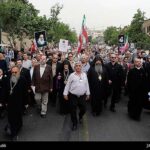
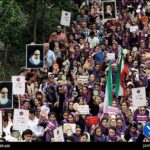
Iran has commemorated the 36th anniversary of the historic referendum in which Iranians overwhelmingly voted for the establishment of the Islamic Republic following the collapse of the US-backed Pahlavi regime in 1979.

In a landmark two-day referendum held on March 30-31, 1979, less than two months after the victory of the Islamic Revolution, over 98.2 percent of eligible Iranians voters voted for the establishment of an Islamic Republic in the country.

The Islamic Republic was established in Iran in line with the popular motto of the 1979 Islamic Revolution that called for “Independence, Freedom and the Islamic Republic” for the country.

Since then, the Iranian nation annually celebrates Farvardin 12 in the solar calendar year, which falls on April 1 in normal years and March 31 in leap years, as the anniversary of the establishment of the Islamic Republic of Iran. The day is referred to as the Islamic Republic Day.

The 1979 Islamic Revolution led to the overthrow of the Pahlavi dynasty and put an end to 2,500 years of monarchic rule in Iran.

The Islamic Revolution, led by late Imam Khomeini, established a new political system based on Islamic values and democracy.