Monday, April 27, 2026
Home Blog Page 4889

Yemeni crisis: Arab media on the same wavelength

KONICA MINOLTA DIGITAL CAMERA

The story of the new Saudi king evokes The Emperor’s New Clothes*; an emperor who comes among people unclothed but the admiration expressed by those surrounding him forces people to praise his new suit, ignorant of the fact that people have had their fill of the king’s indecent manners.

The new outfit King Salman has draped Saudi Arabia’s policies with is unbecoming of all political and human principles, but the fact is that the Arab media are trying to depict the outfit as beautiful and elegant. They are unaware that what they’re earnestly doing has done little to change the impact the Saudi policies have had [in the region].

Alef, a news website, has published a report on the news coverage by foreign and Arab media of the Yemeni crisis, explaining how their biased look at a regional crisis is to benefit the new Saudi king and his odd policies. The following is the translation of excerpts of the report:

These media – which do not see the deadly Saudi airstrikes on Yemen and Riyadh’s undemocratic efforts to form a coalition against popular forces there – aim to counter Ansarullah and the policies of the Houthis in Yemen.

Al Riyadh [a pro-government Saudi daily newspaper] has blamed the Shiites and popular forces for unrest in the country.

To bolster the Saudi coalition against Yemen, this newspaper magnifies Iran’s role in the Yemeni crisis to distract public opinion and conceal the inhuman acts behind the deep-rooted feuds.

[…]

A coalition to divert public attention

Diverting the attention of people is one of the methods media use to manipulate public opinion. When public opinion becomes sensitive to an issue, they [the media] create parallel news stories to push public opinion off course. To that end, they also try to slant the new stories and play up their own policies.

Accordingly, Al Arabiya [a Saudi-owned pan-Arab television news channel] carried headlines such as “Kerry urges Houthis, allies to enter talks”, “Yemen’s [P]GCC membership is rightly back on the agenda” and “Iran tried to break naval blockade, Yemen minister says” to twist the facts.

A closer look at Al Arabiya’s headlines on Yemen – which highlight the killing of Arab soldiers who are fighting the Houthis to bring the Yemeni crisis to an end – shows that the readers get the least information on collateral damage caused by the operations of the Saudi-led coalition.

Irrespective of the true story and the interpretation of the policies provided by the two sides of the conflict, the coverage by the Arab media of the Saudi airstrikes on Yemen reveals one point: an unwritten alliance has been formed among the Arab media to reflect the ground realities in line with the policies of the Al-Saud family.

Al Jazeera [a Doha-based broadcaster funded by the House of Thani, the ruling family of Qatar] is another Arab medium which underscores foreign meddling in Yemen, but it looks as though the editors-in-chief of this broadcaster do not see the Saudi aggression. Al Jazeera carries an item on volunteer forces – who join the fight on ISIL – and picks the following headline for it: “Iraq’s Badr Organization Offers to Join Yemen’s Ansarullah in War against Al-Saud”.

London inflames the situation

The use of “the Yemeni government” for the cabinet of the ousted Yemeni president is another diversion in the media world. The BBC takes a similar stand and uses the term “the government-in-exile” and gives [extensive] coverage to the Yemeni news and views, especially those which are against Iran.

Following remarks by the Iranian foreign minister on [Iran’s four-point initiative for] solving the Yemeni crisis, the BBC picks this headline: “Yemen government rejects Iranian peace plan” to reflect comments by the spokesman of the former Yemeni government [Rajeh Badi] who is in Qatar.

Instead of covering news items on the Saudi aggression on Yemen, the BBC always tries to play up [what it calls] Iran’s interference in the Arab country’s [internal] affairs, releasing undocumented remarks by members of the former Yemeni government or analyses by European and American experts and officials.

The BBC’s use of rebels for the country’s popular front merits attention. Viewers have not forgotten the word “militants” – the BBC’s term of choice for ISIL forces in Syria. The various denotations the British medium uses for the former Yemeni government and the Arab country’s popular front – compared with what it employs for other regional crises – clearly discloses the BBC’s [biased] media policies.

Al Riyadh, Al Arabiya and Al Jazeera in cooperation with the BBC are trying to display the new clothes of the Saudi King’s policies as something beautiful and fancy. They also try to divert public opinion by portraying the Saudi war measures as something that serves the best interests of the region.

They should not forget the fact that the audiences in the new media age are searching for the truth in a more dynamic fashion, and that multiple media have stepped in to break a [media] monopoly over recounting the events. This has rendered their efforts – to influence public opinion – more complex than before.
The Emperor’s New Clothes is a short tale by Hans Christian Andersen about two weavers who promise an Emperor a new suit of clothes that is invisible to those who are unfit for their positions, stupid, or incompetent. When the Emperor parades before his subjects in his new clothes, no one dares to say that he doesn’t see any suit of clothes until a child cries out, “But he isn’t wearing anything at all!”

Iran, UN discuss sending human aid to Yemen

5

Iranian Deputy Foreign Minister for Arab and African Countries Hossein Amir Abdollahian and UN Under-Secretary-General for Humanitarian Affairs Valerie Amos discussed sending human aid to Yemenis.

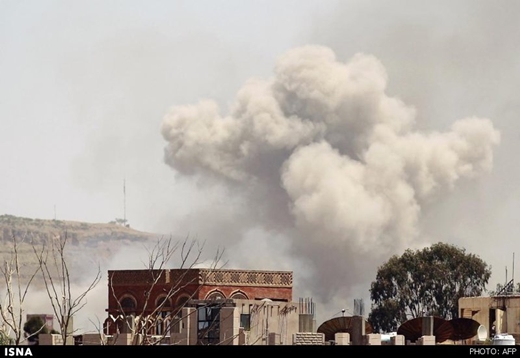
Amir Abdollahian in a phone call with Amos slammed Saudi aggression against Yemen, including attacks on civilian targets in Sa’dah and Amran provinces.

He reiterated that the measures would violate international rules and human rights principles.

“The Islamic Republic of Iran expects the UN envoy in Yemen Ismail Bin Al-Sheikh Ahmed to act urgently and take steps for ending the attacks and preventing the escalation of human crisis,” he said.

He also said Iran is ready for sending fuel and oil products to Yemeni ports, medical teams and establishing field hospitals in Sana’a, Aden and Sa’dah and transferring foodstuff to Djibouti or directly to Yemen after arrangements with the UN.

Valerie Amos, for her part, appreciated Iran’s efforts and supports for sending humanitarian aid to Yemen, and said specialist organizations and workgroups would step up the operations of sending aid to Yemen.

Illusion of ‘Shia crescent’ is a failed scenario: IRGC

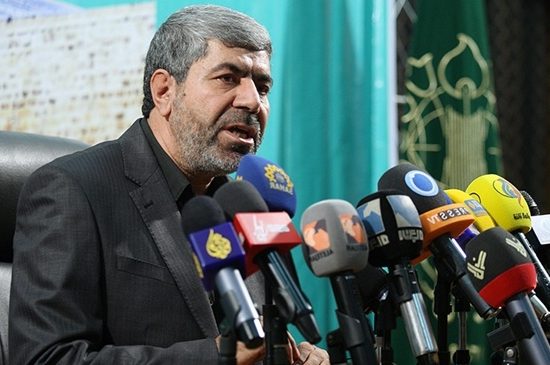
Ramezan Sharif

The director of the Islamic Revolution Guards Corps (IRGC) Public Relations Department said on Saturday that “illusion of a Shia crescent” is a “failed scenario” advocated by the U.S. and the Zionist regime of Israel.

General Ramezan Sharif made the remarks in response to attribution of the sentence “A Shia crescent is being formed” to IRGC top commander Major General Mohammad Ali Jafari.

Attributing this sentence to the IRGC commander is “a partial interpretation” and “distortion” of his analysis of the situation in the Mideast region, Sharif stated.

He added that the U.S. and the Zionist regime of Israel make accusations against Iran in line with their policy of “Iranophobia” and “Shiaphobia” with the aim of causing schism in the Islamic world.

He also slammed the strategy of Shiaphobia and illusion of a Shia crescent as “defeated propaganda”.

Iran’s top MP opposes motion to halt nuclear talks

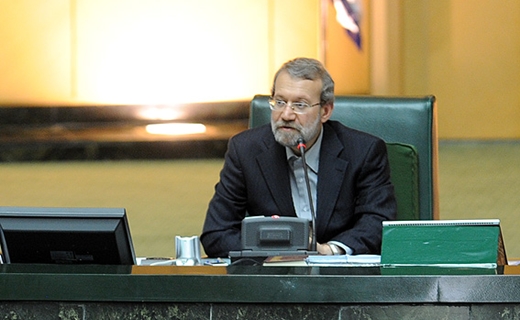
larijani

The Iranian parliament speaker has voiced strong support for the nuclear negotiating team and called on fellow parliamentarians to avoid ill-thought-out reactions to the nuclear issue.

Bagher Hosseini, a member of parliament’s National Security and Foreign Policy Committee, quoted Ali Larijani as making the comment Sunday in a meeting of a Principlist Caucus [the Followers of the Leader (Rahrovan-e Velayat)].

He said that the speaker also expressed bitter opposition to extreme reactions [to the process of nuclear talks], among them the motion – tagged with triple-urgency status – a number of Iranian MPs have signed [asking for a halt to nuclear talks until the US stops issuing threats against the Islamic Republic and apologizes to Iran].

The following is the translation of what else Hosseini quoted Larijani as saying in the meeting as reported by the Iranian Students’ News Agency:

The speaker stressed in the meeting, “We are at odds with the nuclear team over nothing, so we need to stay clear of hasty reactions and let the country’s negotiators successfully advance the objectives of the Islamic Republic of Iran at the negotiating table.

“The Supreme Leader has voiced his support for the nuclear negotiating team, and we in parliament should follow the Leader’s lead, too”.

Larijani also said, “Currently, the US politicians – Democrats and Republicans – are at loggerheads, but we in Iran are not opposed to the country’s nuclear team; rather, we support our negotiators.

“By the same token, parliament should keep its distance from getting carried away and making immature decisions. It should [instead] release a statement in reaction to a Senate bill on Iran nuclear deal”.

Hosseini also said that a statement will be read out on parliament floor in reaction to the US Senate bill later Sunday.

Is a shakeup in the cards?

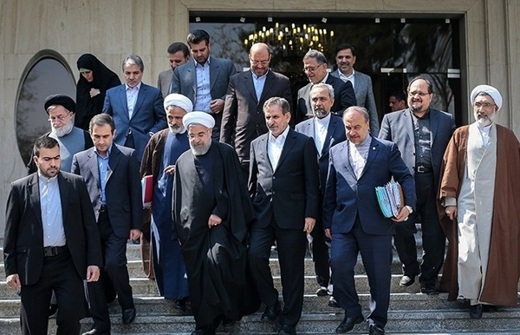
Rohani Government

It has been a while since speculations about a probable cabinet reshuffle by President Rouhani began to swirl, with many believing that some provincial governors and deputy ministers will be the likely targets of the shakeup. The following is the translation of a report released on May 10 by Fararu.ir, a news website, on who is likely to be on the chopping block:

The news was first made public by President Rouhani. During his Shiraz visit, when asked by journalists about the prospects of a cabinet reshuffle, the president said he would do that if necessary.

One week later, the president’s cultural advisor Hessamoddin Ashena said, “Visits to some provinces made it clear to the president that contrary to initial assumptions, some governors are not up to snuff to run provinces. Therefore, some changes are in the offing. Ministers and provincial governors are likely to be replaced as part of the reshuffle.”

Later, in another interview, however, Ashena said, “Any decision by the government will be made public through the government spokesman. My recent remarks were only a personal analysis and I raised the matter as a political analyst,” adding, no decision was made by the government as far as a reshuffle was concerned.

Other officials within the government have no knowledge of such a decision. Now the Cabinet reshuffle has become a talking point, but no one knows where it all started.

Although President Rouhani has granted a half-hearted green-light to a Cabinet shakeup, official news about change has yet to be made public. Over the last 22 months since he took office, except an unofficial report that the president dismissed Borujerd’s governor after he prevented Seyyed Hassan Khomeini, the grandson of the late founder of the Islamic Republic, from making a speech, there have been no other dismissals.

The interior minister in an interview has told a daily that the president favors change and seeks to appoint governors who see eye to eye with his government.

Given what Ashena said, provincial governors are likely to take the brunt of a shakeup. Speculation is rife about the probable dismissal of some provincial governors in a number of cities and there are even reports that decisions on replacements are final.

The provincial governors who failed to deal with those who take the law into their own hands over the last few months seem to be atop the dismissal list.

There are some ministers the government seems to be willing to either dismiss or transfer. Among government officials from the vice president for parliamentary affairs to deputy interior minister, no one had knowledge of the probable reshuffle. Although, speculation is rife about change, it’s still unclear when such change will come.

Change is something which has always been resisted. Appointment of new provincial governors will probably leave many displeased. For the designation of a new provincial governor, one has to please many, something which makes it more difficult for the government to get it done.

We must wait and see whether or not the government will recruit new forces to act differently in the second half of its term.

Bill to halt Iran-P5+1 talks contradicts Iran’s Constitution: MP

Mehdi Davatgari

A senior lawmaker said that a bill that if passed would require a halt to nuclear negotiations between Tehran and P5+1 (the US, Russia, China, France and Britain plus Germany) is against Clause 1 of Article 110 of the Constitution.

“This bill will surely be rejected by the Custodians Council,” member of Majlis (Iranian parliament) National Security and Foreign Policy Committee Mehdi Davatgari said on Saturday.

Davtgari’s remarks came after Javad Karimi Ghoddusi, another member of the National Security and Foreign Policy Committee said that a group of Iranian lawmakers have prepared a bill that if passed would require a halt to nuclear negotiations between Tehran and P5+1 unless the United States stops its threatening rhetoric against the Islamic Republic.

Karimi Ghoddusi said that the bill, with a triple-urgency status, would oblige the government to halt nuclear talks with the six countries until Washington apologizes to Tehran and puts an end to threats against Iran.

Ghoddusi highlighted Iran’s independence and freedom, and said the Iranian lawmakers would not allow the hegemonic powers to undermine the rights of the Iranian nation.

According to the Iranian lawmaker, the bill would be presented to the Presiding Board of the parliament on Sunday.

The move follows Washington’s fresh threats of military action against Iran amid the ongoing talks over Tehran’s nuclear program.

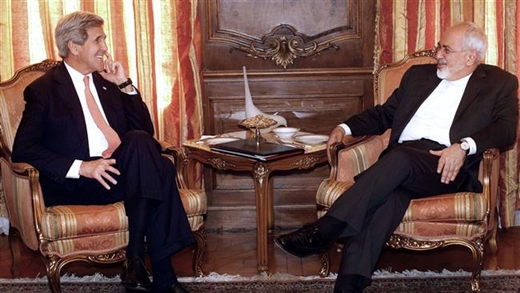
US Secretary of State John Kerry as well as Vice President Joe Biden have recently said that the military option is still on the table regarding Iran.

On May 6, Leader of the Islamic Revolution Ayatollah Seyyed Ali Khamenei described as “unacceptable” the use of threats concurrent with the nuclear negotiations and said that Washington’s need for the nuclear talks is not less than Tehran’s, if not more.

The Leader also cautioned the Iranian negotiators to observe the country’s red lines in the course of the talks.

The US threats come as Iran and P5+1 are seeking to finalize a comprehensive deal on Tehran’s nuclear program by the end of June. The two sides reached a mutual understanding in Lausanne, Switzerland, on April 2.

Iran cites key oil technology success

oil technology

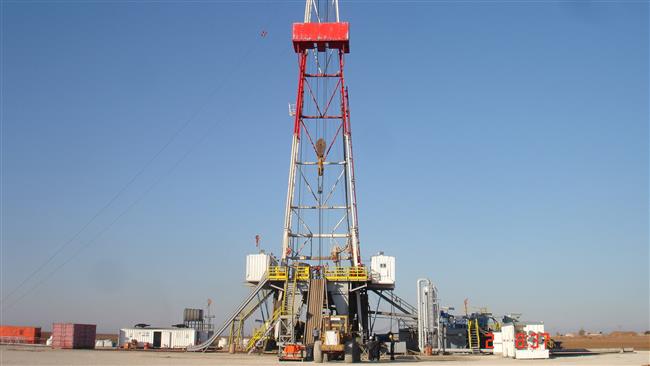
The Oil Ministry said its experts have been able to build a gas microbubble generator which facilitates drillings into oil wells – a technology which has so far been in the hands of the United States.

The generator was officially revealed by the Oil Ministry at the 20th International Oil, Gas, Refining and Petrochemical Exhibition in Tehran.

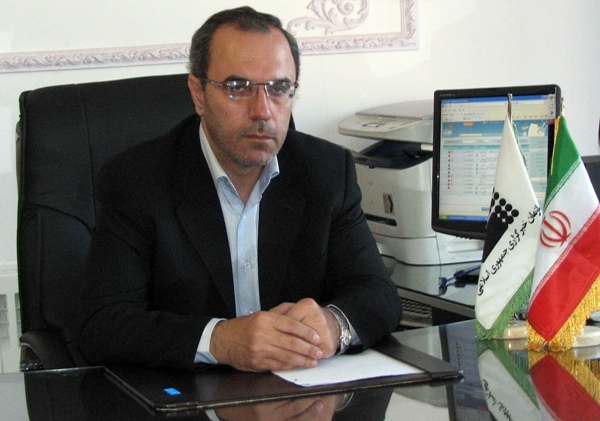
“This technology will be soon tested in one of Iran’s most important oil fields,” said Mohammad Soleimani, a research director from the Oil Ministry.

“It is specifically helpful for fields that have suffered a huge degree of depletion,” Soleimani, who heads the Pardis Pazhuhesh Digging Technology Institute of the Oil Ministry, has been quoted as saying by IRNA news agency.

A majority of Iran’s oil fields are in the second half of their lifespan. Several of the country’s key fields – whose daily production stood in hundreds of thousands of barrels before the 1979 Islamic Revolution – are presently producing only a few dozen thousands as the result of a significant depletion.

A look at Iranian newspaper front pages on May 10

Iranian Newspapers Headlines

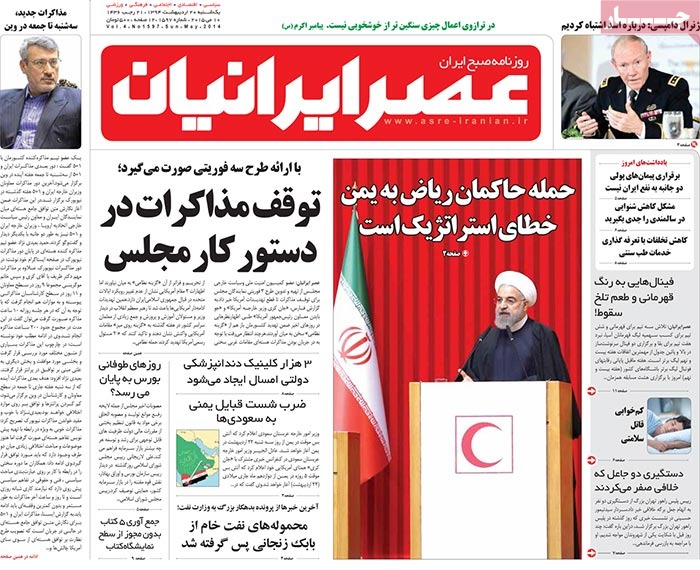
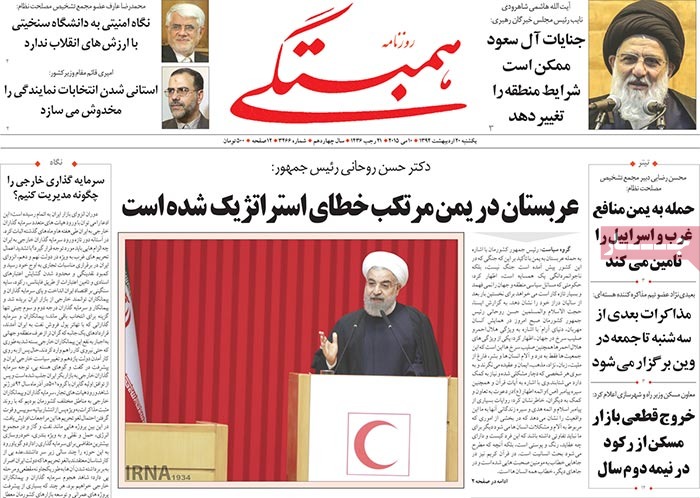
Comments by President Rouhani that Saudi Arabia committed a strategic mistake by launching airstrikes against Yemen dominated the front pages of Iranian papers on Sunday.


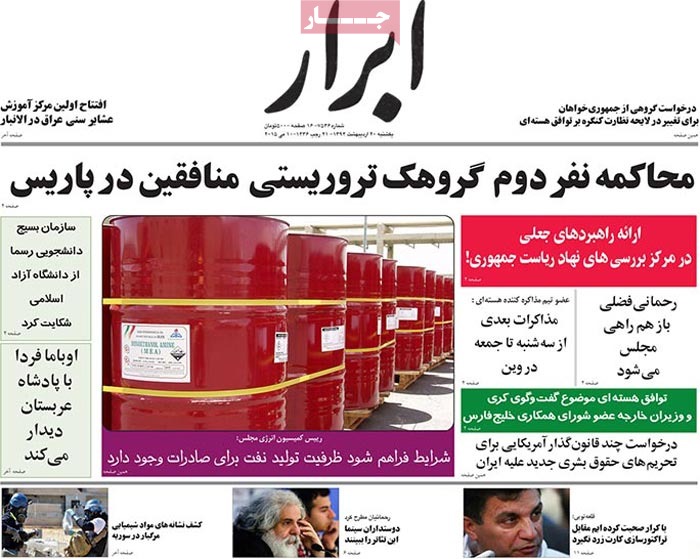
Abrar: The No. two at Mojahedin Khalq terrorist grouping has gone on trial in Paris.


A look at Iranian newspaper front pages on May 10


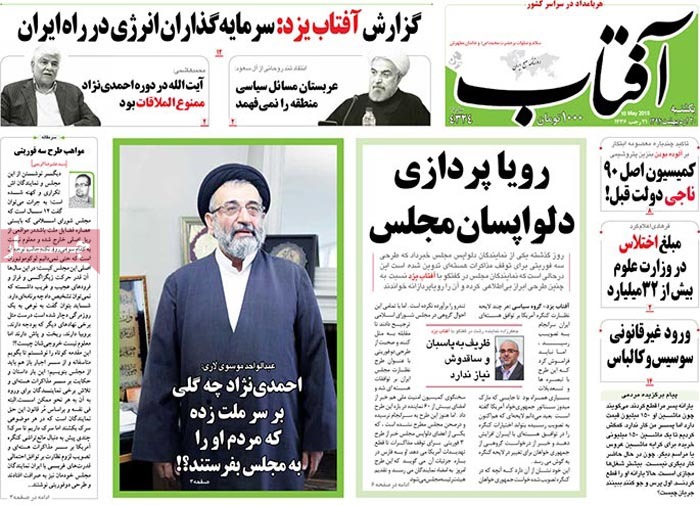
Aftab-e Yazd: “There was a ban on meeting Ayatollah Hashemi Rafsanjani when Ahmadinejad was in office,” said [his brother] Mohammad Hashemi.

“If a Cabinet minister or a governor general went to see Ayatollah Rafsanjani, Ahmadinejad would replace him. Whenever visiting foreign officials wanted to have a meeting with Ayatollah Rafsanjani, they were told the Ayatollah’s schedule was too busy,” he said.

Aftab-e Yazd: Parliament’s Article 90 Committee was there to save the previous government’s skin!

Despite insistence by the director of the Environment Protection Organization that the gasoline produced in petrochemical plants causes cancer and contributes to air pollution, the spokesman of the parliamentary committee says such gasoline [which was widely used when Ahmadinejad was in office] plays no role in air pollution.


A look at Iranian newspaper front pages on May 10


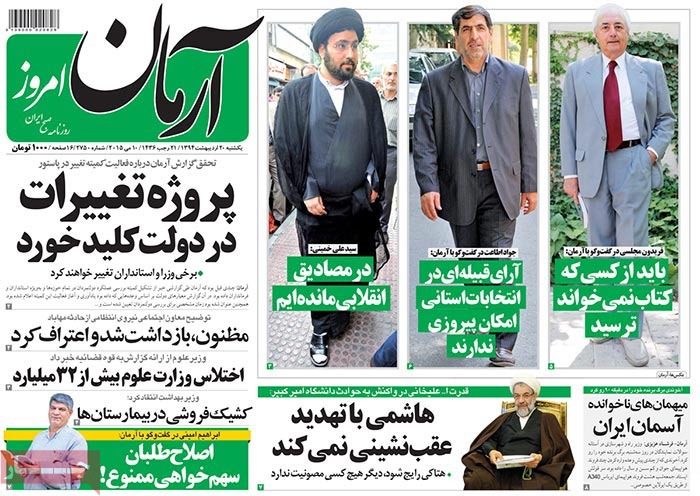
Arman-e Emrooz: Changes in government get underway

According to a report by the daily, some ministers and provincial governors are to be replaced.


A look at Iranian newspaper front pages on May 10


Asr-e Iranian: “The attack by Saudi Arabia on Yemen was a strategic blunder,” said President Rouhani at a gathering to mark Red Crescent Week.


A look at Iranian newspaper front pages on May 10


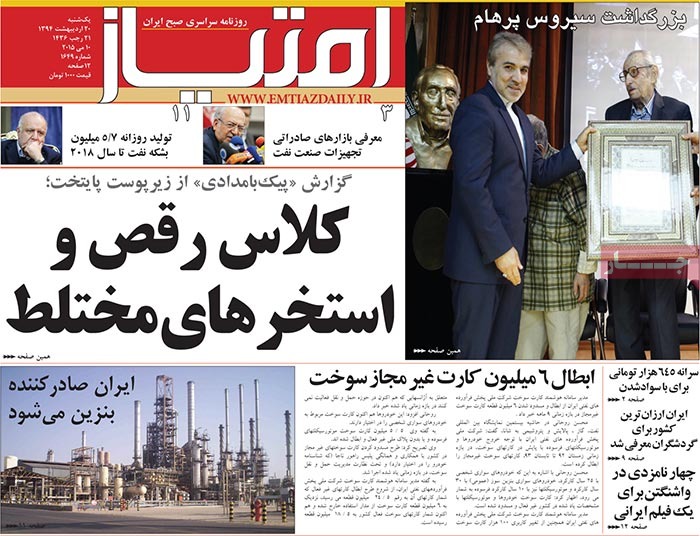
Emtiaz: Iran has been named the least expensive tourist destination.

Emtiaz: An Iranian film has been nominated for four prizes in Washington.

Emtiaz: Iran is to turn into an exporter of gasoline.


A look at Iranian newspaper front pages on May 10


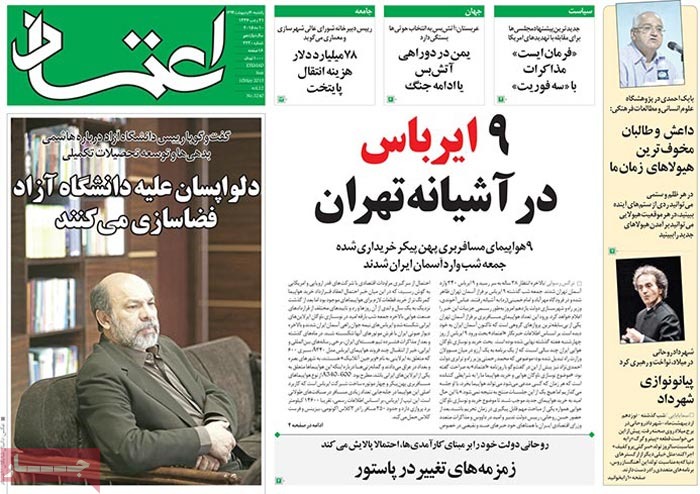
Etemad: Moving [the administrative and political capital] from Tehran will carry a $78 billion price tag.

The announcement was made by the secretariat of the Supreme Urban Development and Architecture Council.

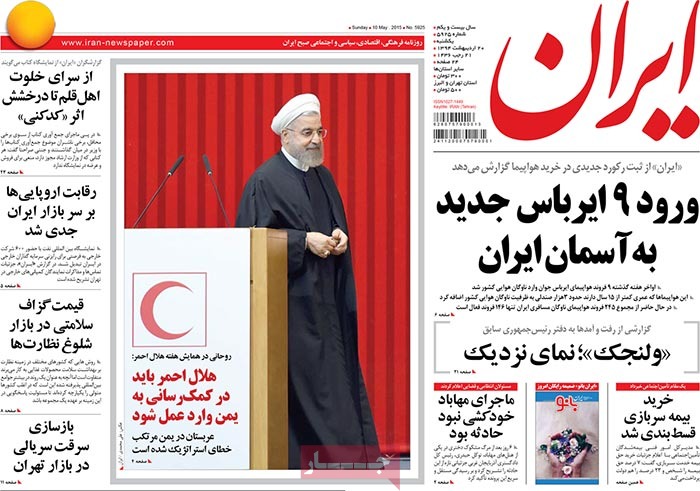
Etemad: Nine Airbus aircraft parked in hangars in Tehran.

Nine wide-body aircraft entered Iranian airspace on Friday.


A look at Iranian newspaper front pages on May 10


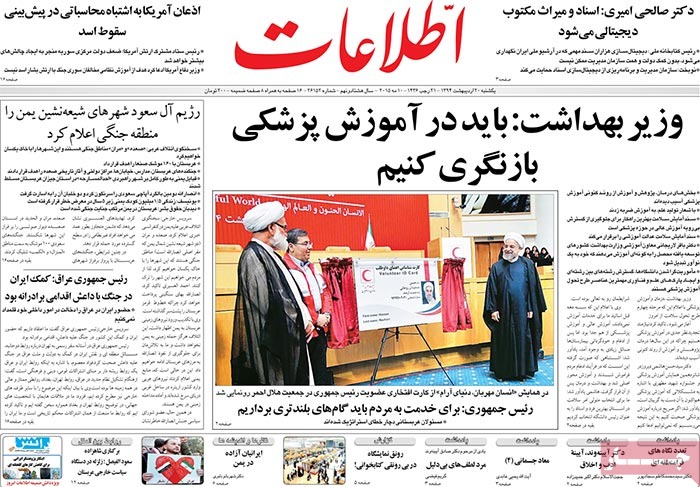
Ettela’at: “Medical training needs to be reviewed,” Health Minister Hassan Hashemi told a gathering on medical training Saturday.


A look at Iranian newspaper front pages on May 10


Hambastegi: “Holding parliamentary elections at a provincial level hurts the principle of representation,” said a deputy interior minister.


A look at Iranian newspaper front pages on May 10


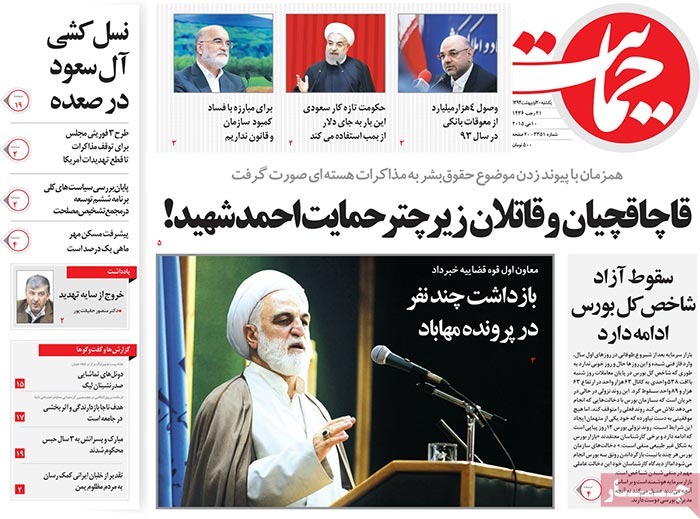
Hemayat: “A number of people have been arrested in connection with the incident in Mahabad,” said the deputy judiciary chief.


A look at Iranian newspaper front pages on May 10


Iran: European rivalry over return to Iranian market is heating up.

Iran: Police officials say the incident [suspicious death of a young woman] in Mahabad was not suicide, but an accident.


A look at Iranian newspaper front pages on May 10


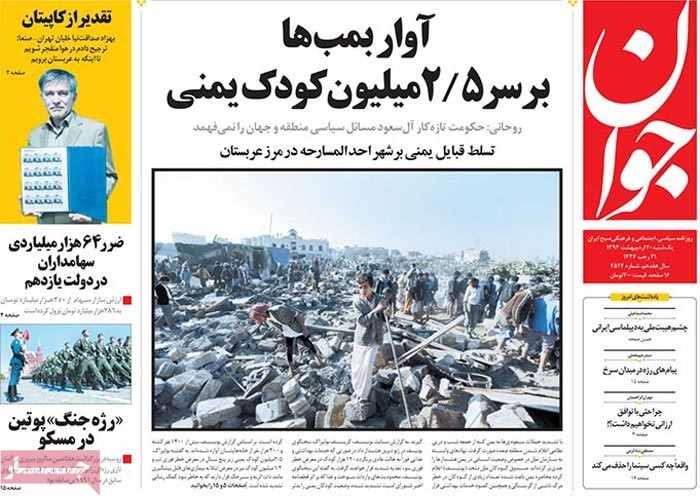
Javan: Praise for the captain.

“I preferred to blow up in the air than divert to a Saudi airport,” said Behzad Sedaghatnia, the captain of the Tehran-Sana’a flight [that took Iran’s humanitarian aid to Yemen].


A look at Iranian newspaper front pages on May 10


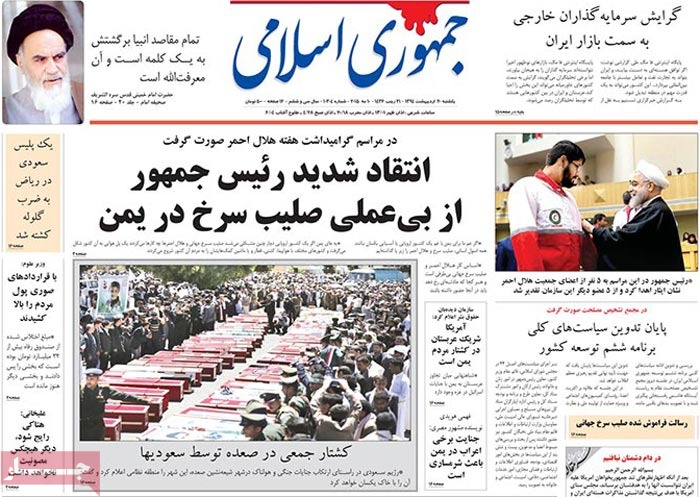
Jomhouri Islami: President Rouhani has criticized the Red Cross for its inaction over Yemen.


A look at Iranian newspaper front pages on May 10


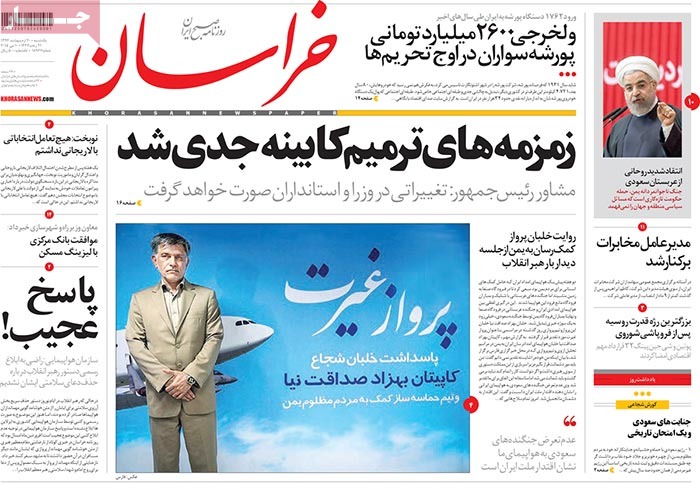
Khorasan: The managing director of the Telecommunications Company has been sacked.


A look at Iranian newspaper front pages on May 10


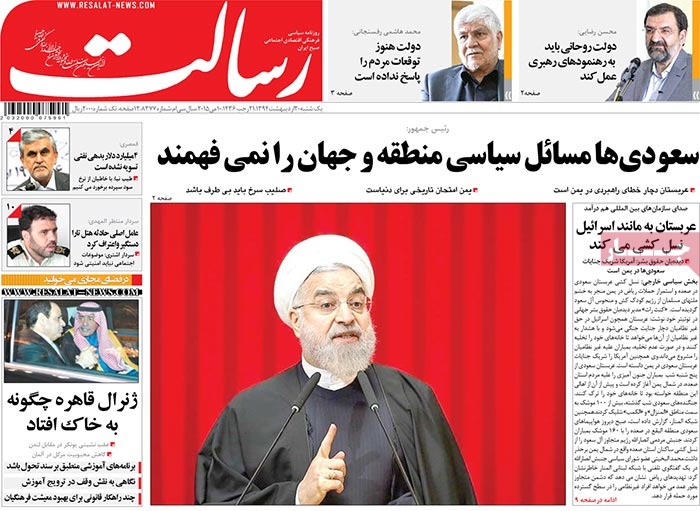
Resalat: Saudi Arabia is pressing ahead with its genocidal acts in Yemen.


A look at Iranian newspaper front pages on May 10


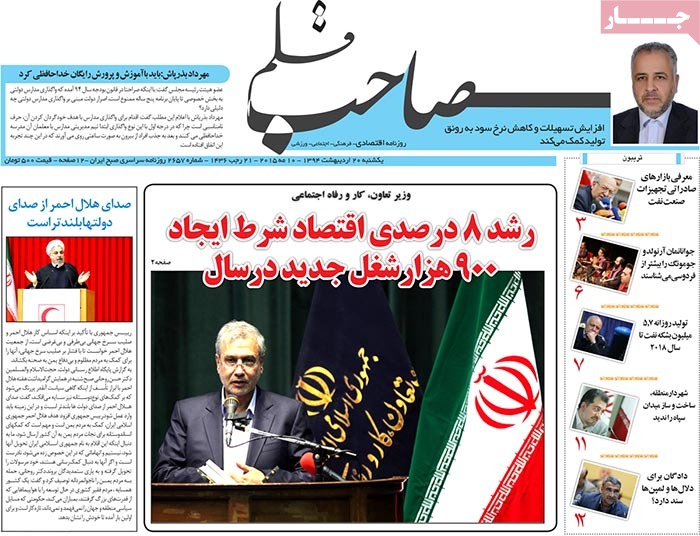
Saheb Ghalam: “To create 900,000 new jobs a year, our economy needs to post an annual growth of eight percent,” said the labor minister.


A look at Iranian newspaper front pages on May 10


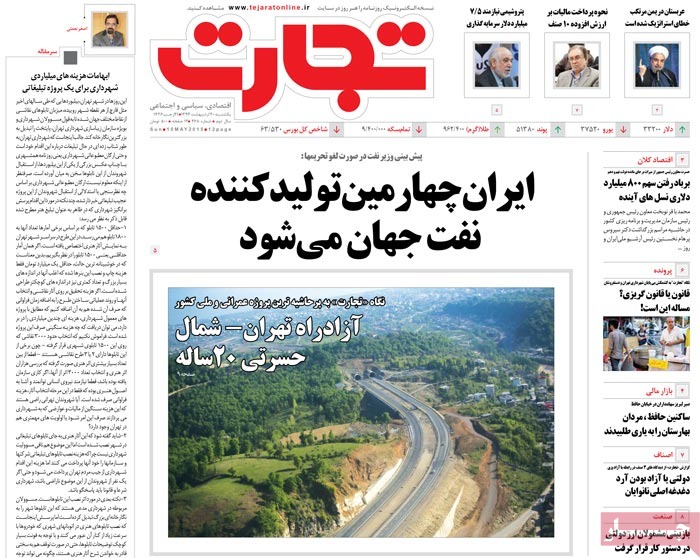
Tejarat: “When sanctions are lifted, Iran will become the fourth largest producer of crude oil in the world,” predicted the oil minister.


A look at Iranian newspaper front pages on May 10


MKO’s No. 2 goes on trial on terrorism, corruption charges in Paris

MKO

Mehdi Abrishamchi, deputy leader of the anti-Iran Mojahedin-e Khalq Organization (MKO also known as MEK, PMOI and NCRI), went on trial in France on terrorism and financial corruption charges.

The court hearing for MKO’s number two was held in a Paris court on May 7 while a large number of former MKO members staged a sit-in outside the courtroom in support of Abrishamchi’s trial, demanding his imprisonment, Habilian Association reported.

The MKO, founded in the 1960s, blended elements of Islamism and Stalinism and participated in the overthrow of the US-backed Shah of Iran in 1979. Ahead of the revolution, the MKO conducted attacks and assassinations against both Iranian and Western targets.

The group started assassination of the citizens and officials after the revolution in a bid to take control of the newly-established Islamic Republic. It killed several of Iran’s new leaders in the early years after the revolution, including the then President, Mohammad Ali Rajaei, Prime Minister, Mohammad Javad Bahonar and the Judiciary Chief, Mohammad Hossein Beheshti who were killed in bomb attacks by the MKO members in 1981.

The group fled to Iraq in 1986, where it was protected by Saddam Hussein and where it helped the Iraqi dictator suppress Shiite and Kurd uprisings in the country.

The terrorist group joined Saddam’s army during the Iraqi imposed war on Iran (1980-1988) and helped Saddam and killed thousands of Iranian civilians and soldiers during the US-backed Iraqi imposed war on Iran.

[…]

Iran rejects link between Interests Section relocation, N-talks

iran5

Iran has rejected a report about a connection between the relocation of the country’s Interests Section in Washington and the ongoing negotiations with the P5+1 on its nuclear program.

Dismissing a recent report by The Washington Post, Head of the Press Office of Iran’s permanent mission to the United Nations Hamid Babaei has said the approval of Iran’s request to relocate its Interests Section was not related to Tehran’s nuclear talks with the six global powers.

The permission to change the mission’s building in Washington was issued last year following correspondence with the US Department of State, he added.

Babaei said the surge in requests for consular services, the limited space and deterioration of the building’s structure were among the reasons behind the request for the building’s relocation.

In a report Friday, The Washington Post claimed that the United States is allowing the Iranian Interests Section in Washington to move to new headquarters in what may be among the first negotiated deals with Iran since relations broke off in 1980.

Iran and the P5+1 group of countries — the United States, Britain, France, Russia, China and Germany — reached a mutual understanding on the parameters of a comprehensive agreement over the Islamic Republic’s nuclear program in Lausanne, Switzerland, on April 2.

They agreed to finalize an overarching deal on Tehran’s nuclear program by the end of June.