Wednesday, December 24, 2025
Home Blog Page 4700

How many women police are there on the beat in Iran?

Women Police

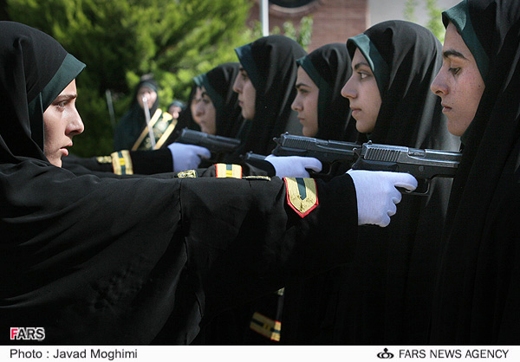
Deputy Head of Iranian Law Enforcement Force for Coordination Brigadier General Mohammad Javad Zadeh Kamand has said that there are as many as 7,200 female police in the country.

Bahar daily on October 14 published a report on what the senior police official has said about women police and their performance in the Law Enforcement Force of the Islamic Republic of Iran. The following is the translation of the report:

The general said that police force attaches special significance to the presence of women in its ranks, adding that currently up to 7,200 women are working as police officers.

He further said that a number of women join the police force each year as some quit their jobs on different grounds, adding that the new recruits work either in the units which have vacancies or the units they prefer such as the Traffic Police, Social Department, Prevention Police, etc., and receive related specialized training.

The senior police official went on to say that women have been given a big number of tough and specialized jobs in the police force, adding that policewomen have played a remarkable role on different fronts, especially crime prevention.

For instance, women police officers got involved in a number of cases built against lawbreakers, offered consultation services, and settled the cases peacefully, he said, adding this has spared the police and the judicial system huge costs.

General Zadeh Kamand also credited female police for great efforts they put in in the line of duty and said that accuracy, precision, integrity and authenticity are the salient features of the female police.


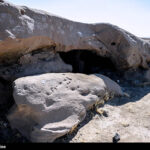
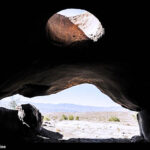
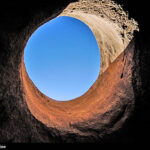
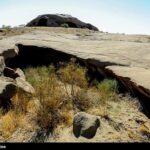
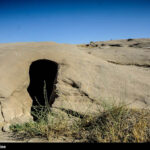
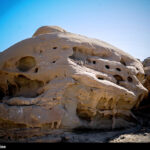
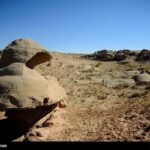
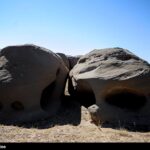
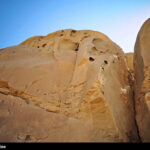
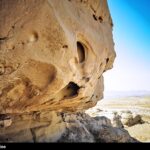
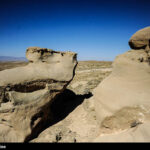
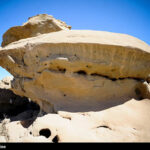
Millennia-old stone houses near Tehran (PHOTOS)

old stone house00

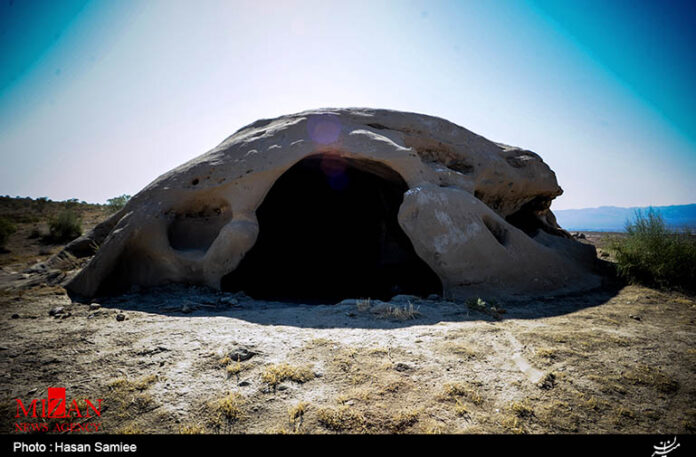
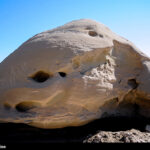
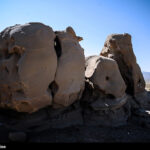
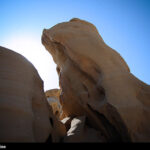
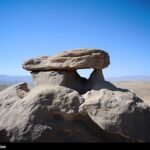
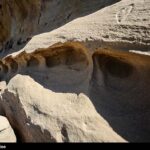
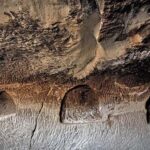
The discovery of stone houses 10 km away from Eshtehard in Alborz Province – to the west of the capital Tehran – indicates humans lived in the area as far back as 2,000 years ago.

The houses which are carved into rocks belong to the pre-Islamic era. Rain and other climatic factors have resulted in the erosion of most of these houses, but some remain almost intact.

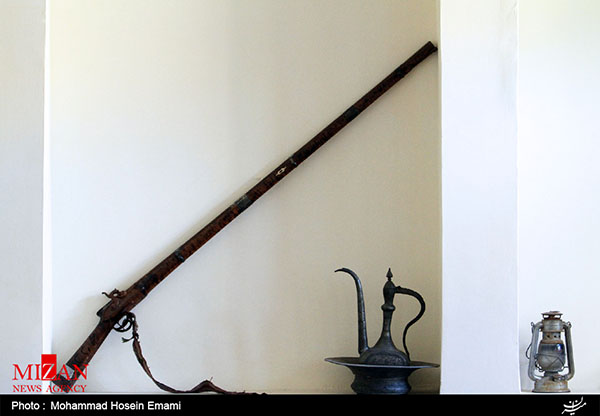
The following are images of the historical site mizanonline.ir has put online:

A look at Iranian newspaper front pages on Oct. 22

Iranian Newspapers Headlines

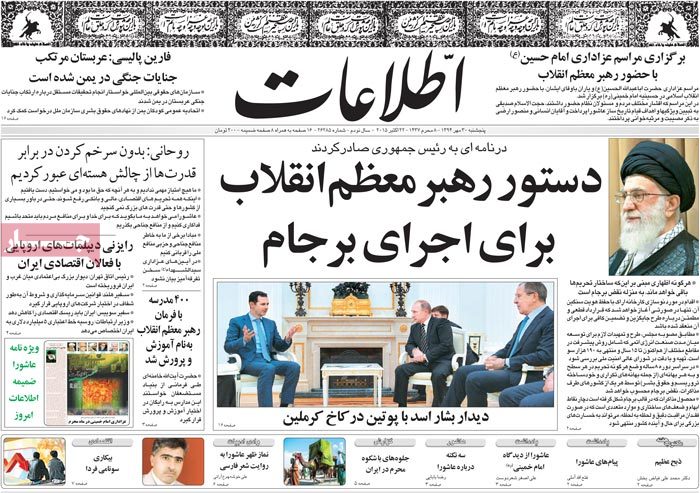
The tentative approval of the nuclear deal by the Supreme Leader dominated the front pages of Iranian newspapers on Thursday. Also on the covers of dailies were images of mourning ceremonies to mark the martyrdom of Imam Hussein, the third Shiite Imam.


Ettela’at: In a letter to the president, the Supreme Leader has ordered the Joint Comprehensive Plan of Action implemented.

Any statements that the sanctions regime remains in place would amount to violation of the Joint Comprehensive Plan of Action, Ayatollah Khamenei said in the letter.

Ettela’at: A mourning service has been held for the grandson of the Prophet Muhammad with the Supreme Leader in attendance.

Ettela’at: Foreign Policy: Saudi Arabia has committed war crimes in Yemen.

It came as an international law organization called for an investigation into allegations of Saudi war crimes in Yemen.

Ettela’at: “Without bowing to powers, we handled the nuclear challenge,” said President Rouhani.

He further said that Iran made no major concessions and stuck to what it wanted and what it was entitled to.

Ettela’at: European diplomats hold talks with Iranian economic players.

The chairman of Tehran Chamber of Commerce has said that the wall of mistrust between Iran and the West has tumbled.

Ettela’at: The Supreme Leader has ordered the Foundation for the Impoverished to give 400 buildings to the Education Ministry to be used as schools.
 

A look at Iranian newspaper front pages on Oct. 22


Abrar: The deputy foreign minister has said that the number of Iranian advisors in Syria has increased.
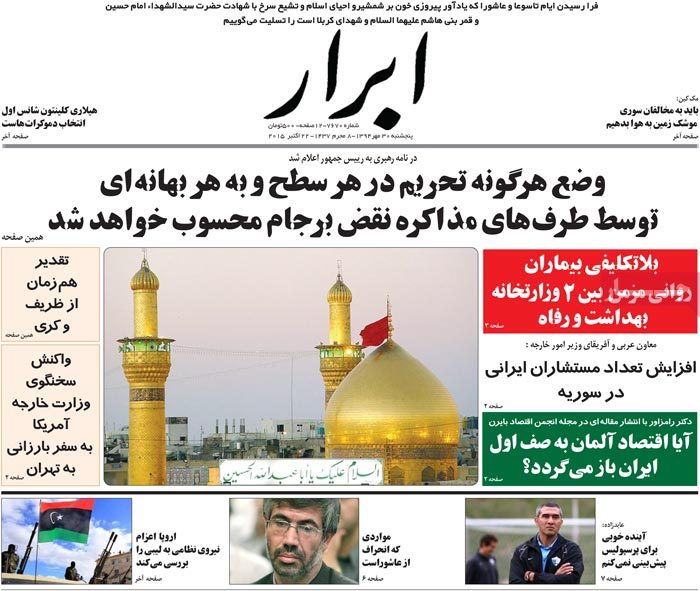
 

A look at Iranian newspaper front pages on Oct. 22


Aftab-e Yazd: An intrigue against the government with a focus on espionage

As the Judiciary is meticulously looking into the case against Washington Post reporter Jason Rezaian without making a fuss, some MPs have alleged that he has had ties with members of the Cabinet and spied on the presidential office.
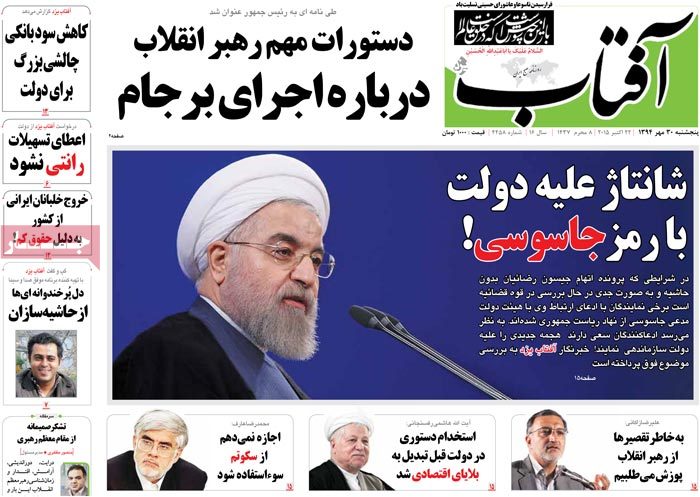
 

A look at Iranian newspaper front pages on Oct. 22


Arman-e Emrooz: Efforts to deceive people amount to populism, said Seyyed Hadi Khamenei, a reformist. 
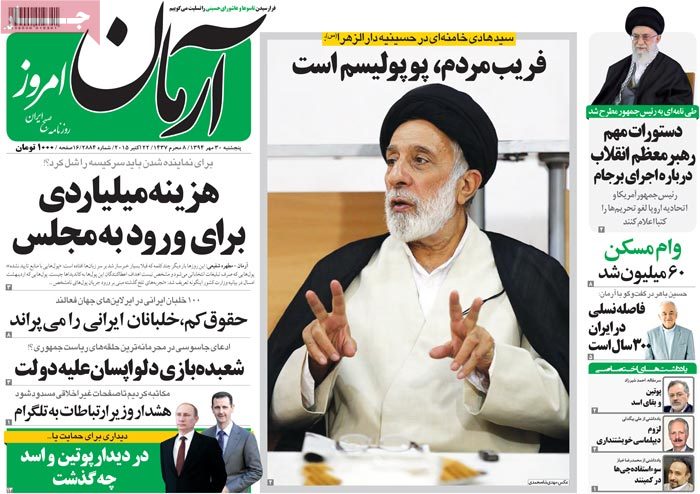
 

A look at Iranian newspaper front pages on Oct. 22


Asr-e Rasaneh: Production of crude oil in western fields has increased by 95,000 barrels.
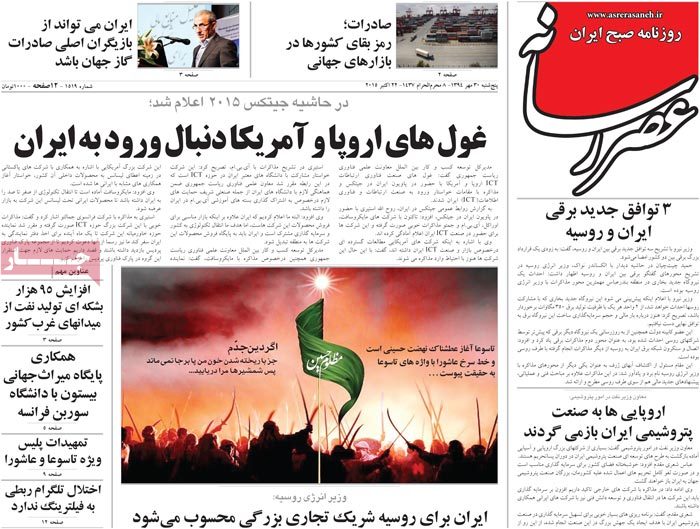
 

A look at Iranian newspaper front pages on Oct. 22


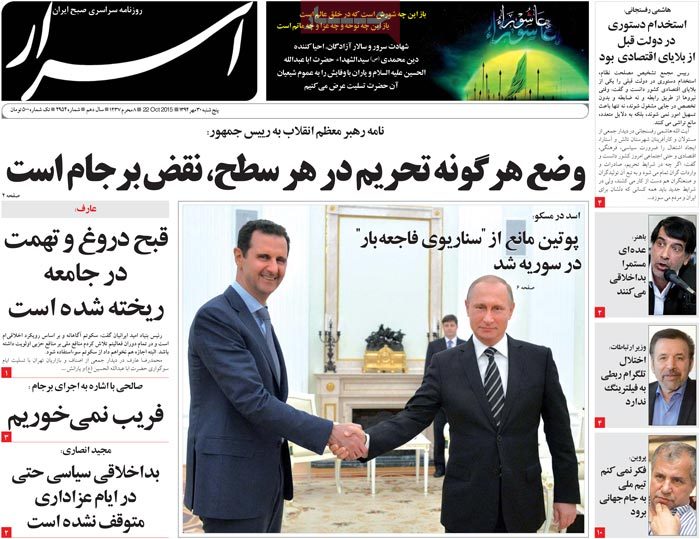
Asrar: The minister of communications has denied reports that current disruptions to Telegram [a very popular social networking app] are the result of filtering.
 

A look at Iranian newspaper front pages on Oct. 22


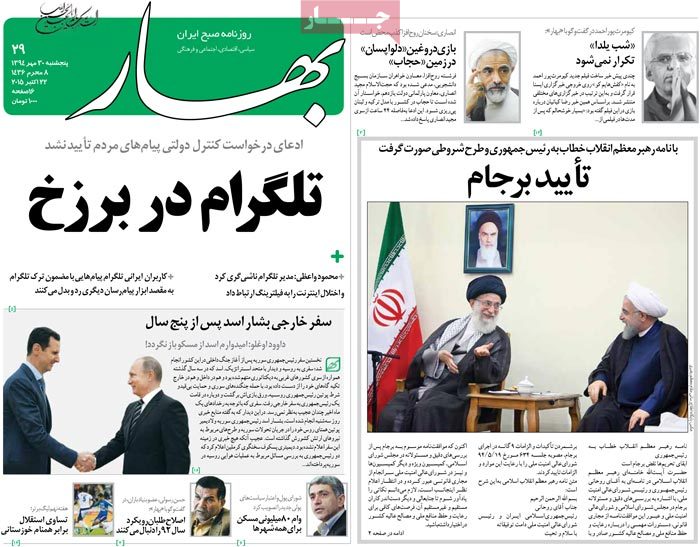
Bahar: President Assad’s first foreign visit in five years

The Turkish prime minister has said that he hopes Assad won’t return home from Moscow.
 

A look at Iranian newspaper front pages on Oct. 22


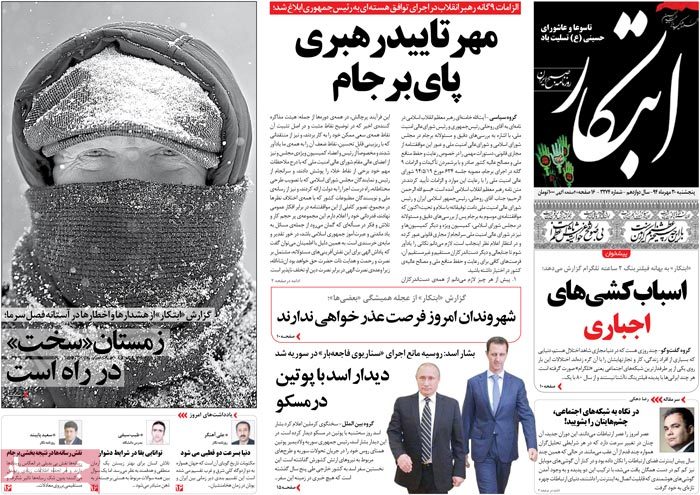
Ebtekar: The Supreme Leader has put a seal of approval on the Joint Comprehensive Plan of Action.

Ayatollah Khamenei has said in a letter to the president that nine requirements should be met in implementing the nuclear deal.
 

A look at Iranian newspaper front pages on Oct. 22


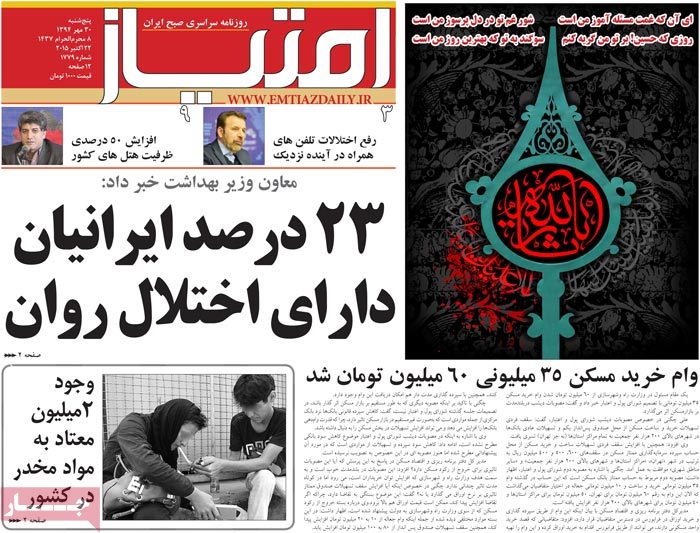
Emtiaz: There are two million drug addicts in the country.
 

A look at Iranian newspaper front pages on Oct. 22


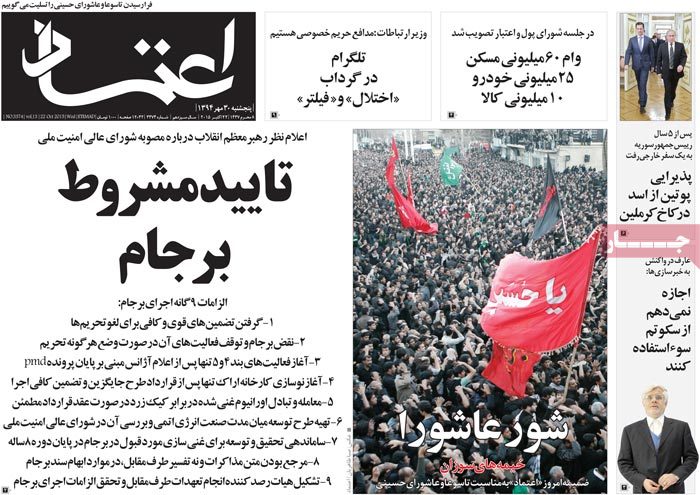
Etemad: “I won’t allow them to take advantage of my silence,” said Mohammad Reza Aref, a reformist leader, in reaction to stories popping up about him.

Etemad: The tentative approval of the Joint Comprehensive Plan of Action

Among other things, the Supreme Leader has said that sufficient, firm guarantees should be secured on termination of sanctions and that imposition of any new sanctions would result in a halt to the implementation of the deal.
 

A look at Iranian newspaper front pages on Oct. 22


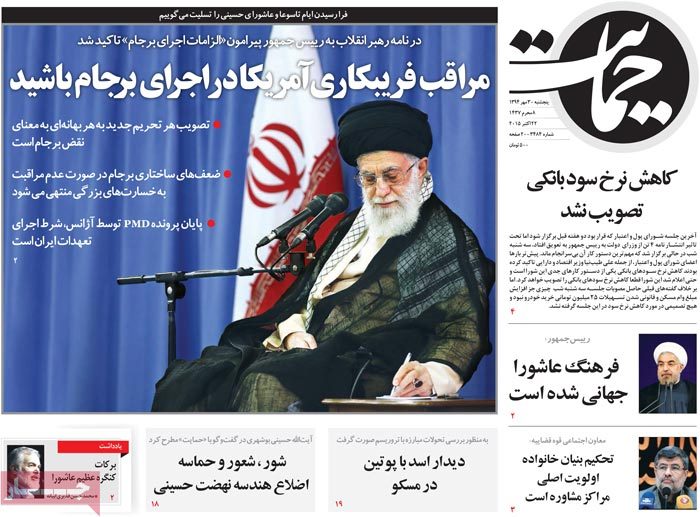
Hemayat: The Supreme Leader has warned officials about the likely American deception in the implementation of the Joint Comprehensive Plan of Action.

Hemayat: Presidents Assad and Putin have met in Moscow.
 

A look at Iranian newspaper front pages on Oct. 22


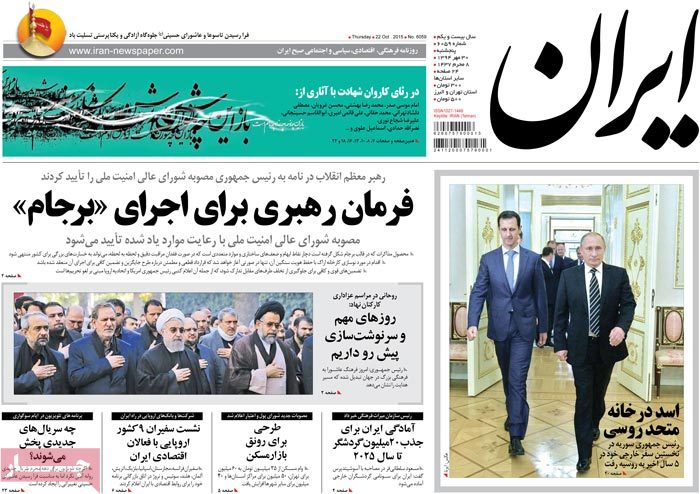
Iran: The ambassadors of nine European countries have met with Iranian economic players.

Iran: “We have important, fateful days ahead,” said the president at a ceremony in the presidential office to mourn the martyrdom of the grandson of the Prophet.
 

A look at Iranian newspaper front pages on Oct. 22


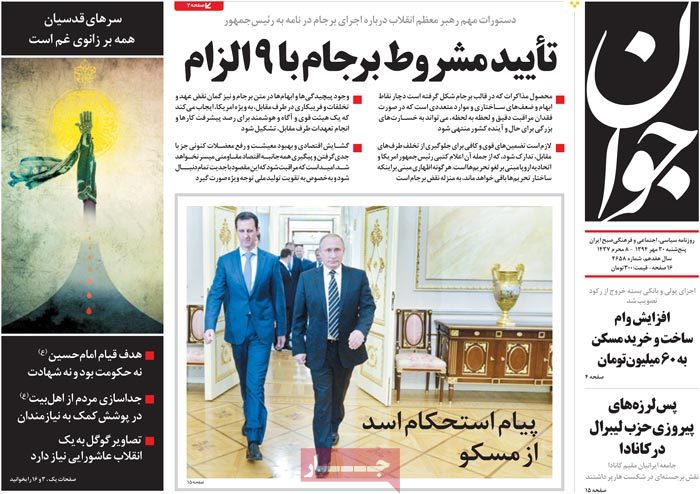
Javan: The aftershocks of a Liberal party victory in Canada

The Iranian community in Canada played an important role in defeating the Conservative Party of Stephen Harper.
 

A look at Iranian newspaper front pages on Oct. 22


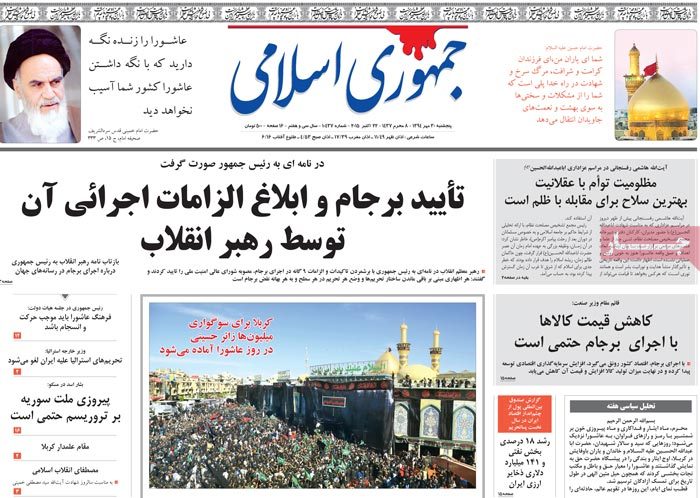
Jomhouri Islami: The oil sector will register an 18 percent growth and Iran’s foreign reserves will stand at $141 billion, an IMF report on the outlook of Iran’s economy in the first post-sanctions year predicts.
 

A look at Iranian newspaper front pages on Oct. 22


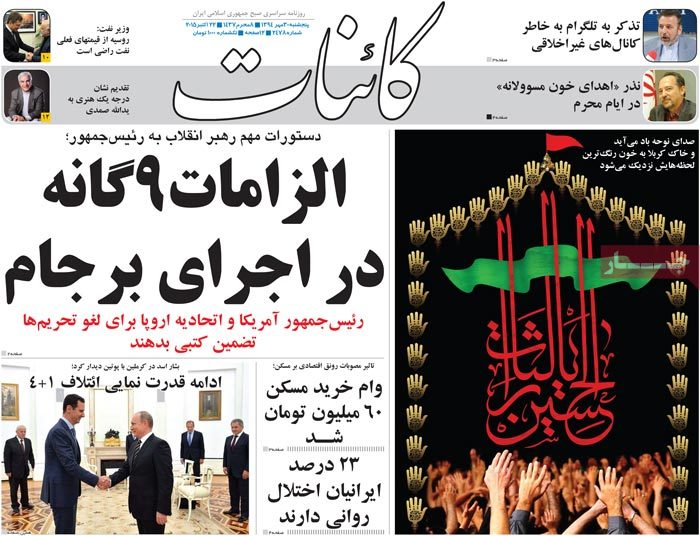
Kaenat: Twenty-three percent of Iranians suffer from some sort of psychological problem, said the deputy health minister.
 

A look at Iranian newspaper front pages on Oct. 22


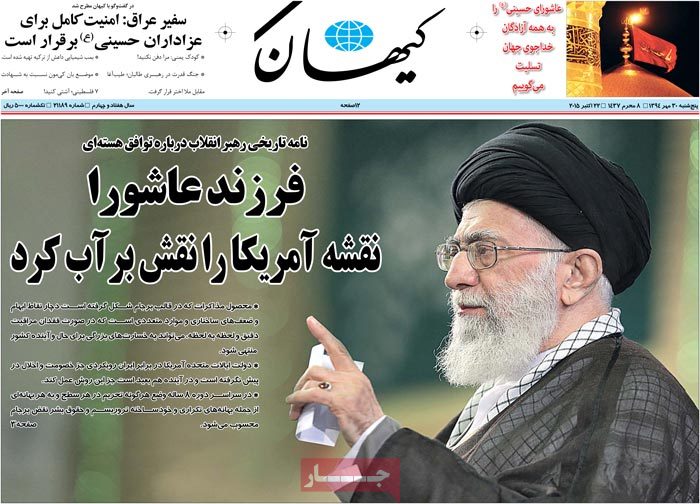
Kayhan: The son of Ashura [a reference to the Supreme Leader] foiled the plots of the US in a historic letter on how the nuclear accord should be implemented.
 

A look at Iranian newspaper front pages on Oct. 22


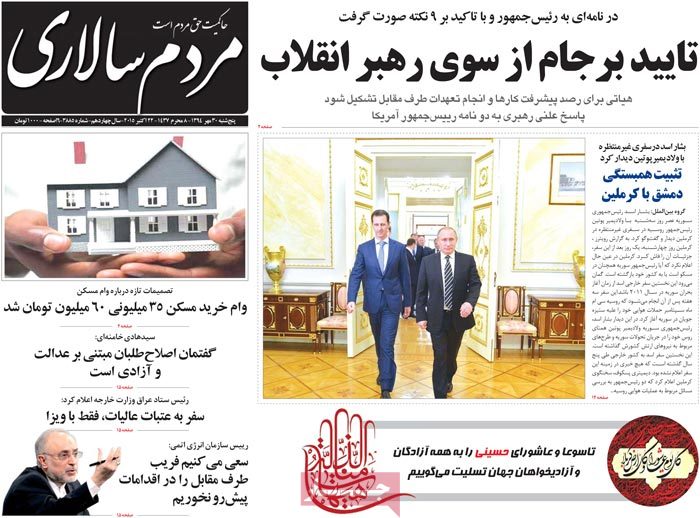
Mardomsalari: The director of the Atomic Energy Organization has said that officials will try their best not to be deceived by the other side in the implementation of the nuclear deal.
 

A look at Iranian newspaper front pages on Oct. 22


Resalat: The Supreme Leader has said that the US president and the European Union should offer written guarantees on the termination of sanctions.
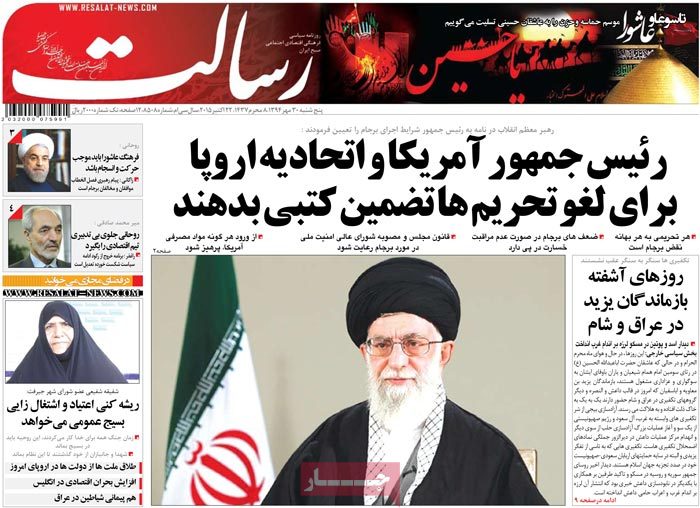
 

A look at Iranian newspaper front pages on Oct. 22


Rooyesh Mellat: The minister of culture and Islamic guidance has said that Iran achieved all its goals by staying away from the Frankfort Book Fair [in protest at the invitation of apostate author Salman Rushdie by organizers of the event to hold a speech there].
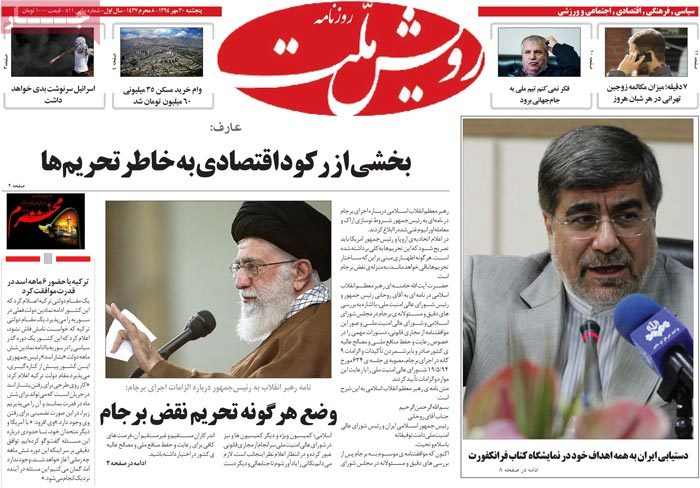
 

A look at Iranian newspaper front pages on Oct. 22


Shahrvand: “Continued opposition to the Joint Comprehensive Plan of Action is worthless,” said Mohammad Reza Bahonar, a principlist Tehran MP.
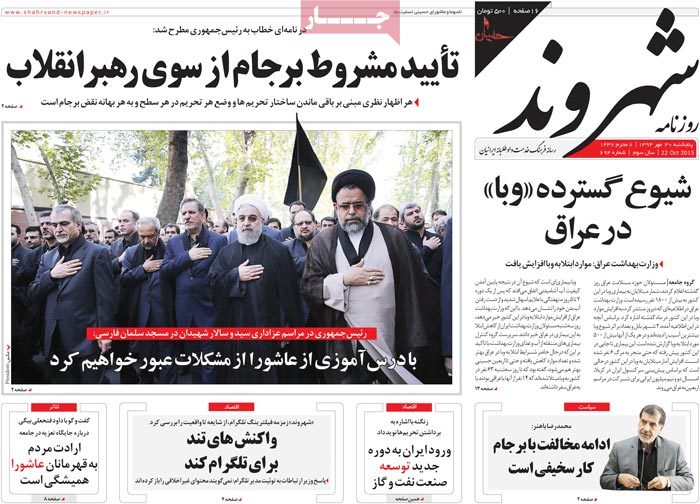

 

A look at Iranian newspaper front pages on Oct. 22
 

Iran-Russia relations help in stabilizing region: Iran defense minister

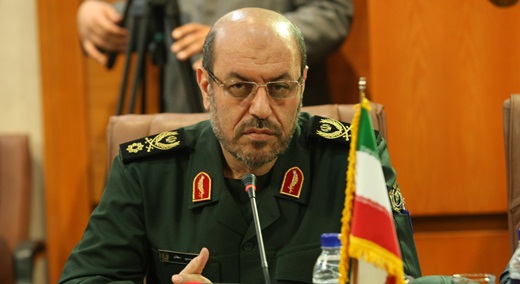
Iranian Defense Minister Brigadier General Hossein Dehghan says his country’s relations with Russia have helped in stabilizing the Middle East.

“The effective steps taken so far towards developing cooperation between the two countries have resulted in bolstering stability and security in the region,” said Dehghan during a meeting with visiting Russian Energy Minister Alexander Novak in Tehran on Wednesday.

According to IRIB, both parties stressed the need for closer ties in battling terrorism and supporting other countries facing it.

“The current conditions require Iran and Russia… to develop their cooperation in the political, economic and defense spheres,” added Dehghan.

Heading a 50-member Russian delegation, Novak is in Iran to discuss bilateral ties particularly the expansion of mutual cooperation in the oil industry.

He also held a meeting with Iranian Energy Minister Hamid Chitchian where the two discussed the establishment of a thermal power plant in the south of Iran and the modernization of current stations constructed by Russia in Iran.

Earlier in the day, he met with the Iranian minister of communications and information technology, Mahmoud Vaezi. Following the meeting, Vaezi announced that Russia has pledged to issue a credit line of $5 billion for joint projects with Iran.

According to reports, during his stay in Tehran, the Russian energy minister is expected to discuss Iran-Russia cooperation in the energy sector as well as the global oil prices and cooperation between OPEC and non-OPEC countries.

Leader’s stance crucial for implementation of JCPOA: Araghchi

Araghchi-12

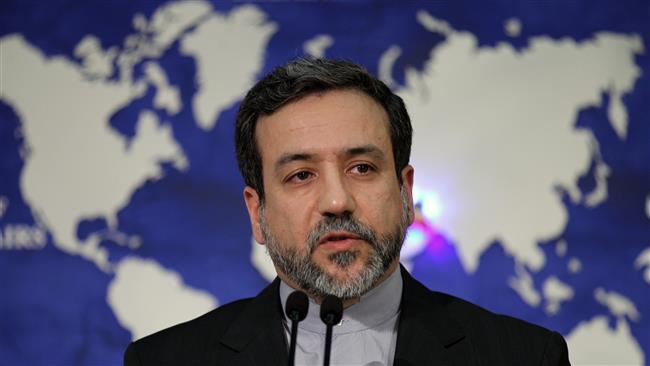
A senior Iranian nuclear negotiator says the Leader of the Islamic Revolution Ayatollah Seyyed Ali Khamenei’s stance on the JCPOA is critical to its implementation.

During a television broadcast on Wednesday, Deputy Foreign Minister for Legal and International Affairs Abbas Araghchi said the directives set out by the Supreme Leader would be taken into account during the implementation process of JCPOA.

He also thanked the Leader for his support during the negotiations, his endorsement of JCPOA, and for the directives for the implementation of the agreement.

OnJuly 14, Iran and P5+1 – the United States, Britain, France, China and Russia plus Germany – finalized the text of an agreement on Tehran’s nuclear program dubbed JCPOA in the Austrian capital Vienna.

“The contract for the modernization of the Arak reactor with P5+1 is being finalized and its implementation will become mandatory after being signed by the foreign ministers of all the seven countries,” said Araghchi.

Any further economic sanctions or failure to remove the existing sanctions by the US Congress will be in violation of JCPOA, he underlined.

He noted that one of the greatest achievements was negotiations with the International Atomic Energy Agency (IAEA) over Iran’s Possible Military Dimensions (PMD) file. “We will not touch Arak until the PMD file is closed.”

Continued sanctions breach of JCPOA: Leader

Leader

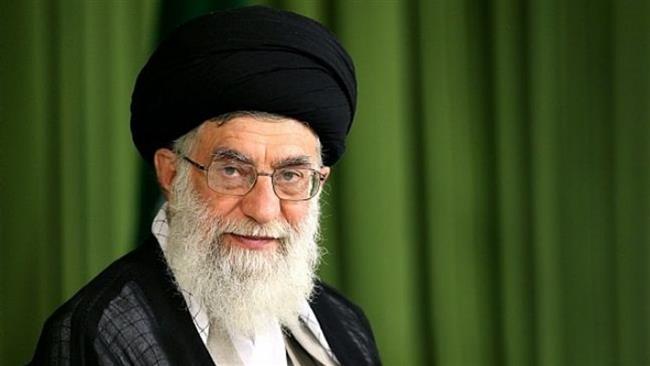
Leader of the Islamic Revolution Ayatollah Seyyed Ali Khamenei has said, in a letter to President Hassan Rouhani, that any remarks which suggest sanctions against Iran will remain in place would be in contravention of the agreement reached between Iran and P5+1 over Tehran’s nuclear program.

“Any comments suggesting the sanctions structure will remain in place or [new] sanctions will be imposed, at any level and under any pretext, would be a violation of JCPOA,” read the letter.

On July 14, Iran and P5+1 – the United States, Britain, France, China and Russia plus Germany – finalized the text of an agreement on Tehran’s nuclear program dubbed the Joint Comprehensive Plan of Action (JCPOA) in the Austrian capital, Vienna.

Under JCPOA, limits will be put on Iran’s nuclear activities in exchange for, among other things, the removal of all economic and financial bans against the Islamic Republic related to its nuclear program.

In a related development, a commission comprising representatives from Iran and the P5+1 met in Vienna last Monday to discuss the implementation of the JCPOA.

The letter also stipulated that measures to retrofit the Arak reactor and trade the existing enriched uranium will get underway only after the Possible Military Dimensions (PMD) file on Iran’s nuclear program is closed and a secure contract with enough guarantees is clinched.

In his letter, the Leader reiterated that the US has adopted a hostile and disruptive approach vis-à-vis Iran’s nuclear program, and is unlikely to change tack in the future.

Iran can use the knowledge of foreign managers to get into global markets

Nematzadeh

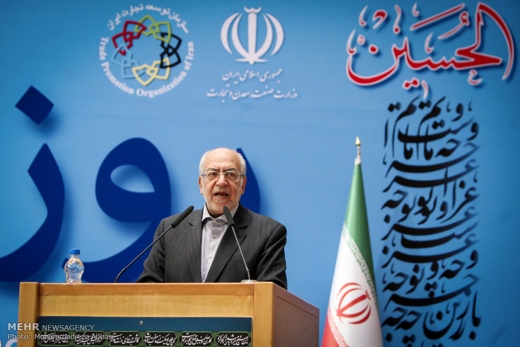
The minister of industries, mines and trade has said that Iran needs to reach out to foreign managers to promote exports and capture international markets.

Mohammad Reza Nematzadeh made the comment in a ceremony to mark National Exports Day on Tuesday and added that like the foreign coaches the sports sector asks to come over to steer different sporting teams, the country should hire foreign managers for the economy sector if it seeks to develop its exports and have a share of the global markets.

Alef.ir on October 20 published a report on Nematzadeh’s remarks in the ceremony. The following is the translation of what else the minister told exporters:

Export is not an option; rather, it is a must for the country if it wants to create jobs and boost its economy. In the twelve months to March 2015, Iran posted a 20 percent increase in non-oil exports, but the export figures dropped in the following six months due to the prolongation of the implementation of the Joint Comprehensive Plan of Action (JCPOA), as well as other factors such as insecurity in target markets and neighboring countries, and a slump in global crude prices. We hope things change and the country can raise its non-oil exports in the six months to March 2016 thanks to [better access to] target markets.

Iran stands 51st among 229 countries which export goods and it ranks 60th among 152 service exporting countries. Oil has a share in Iran’s exports; excluding oil, Iran’s conditions [export-wise] would be worse.

Target: $190b exports in 2025

Iran accounts for %0.34 of [the world’s] exports of commodities and %0.18 of services exports. Iran’s exports of goods and services are projected to climb to $190 billion by 2025 [under the 20-year Outlook Plan], up from the current $63 billion.

Iran’s goods and non-oil export per capita is $800. The figure should rise to $2,000 according to the Outlook Plan. If Iran fails to reach that target, it will lose its status as an exporter.

Resistance-based economy and exports

Iran needs to fully tap into the principles of the resistance-based economy in all sectors. Such an economy has taken into account what is needed in all sectors to develop exports.

Amendments to the Act on Adjusting Part of Government’s Financial Rules were ratified last year [March 2015]. [The government has approved] a number of tax incentives for investment and joint ventures with foreigners, among them a 50 percent tax cut to foreign investors. We hope 20 percent – at least – of the products of such joint ventures will be exported overseas.

To develop exports, the government has also put on its agenda efforts to facilitate the import of raw materials and set preferential price for exports. To that end, the National Development Fund is expected to deposit money into agent banks, which will in turn grant loans to exporters. This is underway now.

Export loans deposited into agent banks

Part of the money [to be granted as loans to exporters] has been deposited into the Bank of Industry and Mine and the ECO Trade and Development Bank.

For years, Iran has easily exported handicrafts, dried fruits, fruits and fresh greens, but it needs to get more involved in the science-based sector for which it should exploit the potential of efficient managers.

Diplomatic ties are not enough to develop exports. The country’s capabilities are not enough to boost exports. To do so, Iran needs more investment.

Certain governmental agencies stop exports to supply the [domestic] market. This is not acceptable. Exports should not stop even if an item is in short supply on the market for a short period, and this is stressed by the country’s Fifth Development Plan as well.

In foreign investments, exports should be taken into account. As a proposal, we can say that 30 percent of what is produced from the initial investment should be exported.

Foreign economy managers

The country also needs to support large-scale companies and industries if it seeks to break into export markets. Macro- and small-sized institutions cannot make it to the international markets and compete there. Investments should be funneled into big, reputable institutions.

We have to bolster marketing management and expertise. I have suggested some companies bring in foreign managers. Some have done so and welcomed the results. Nothing goes wrong if we tap into the expertise and knowledge of well-experienced foreign managers.

Like the sports sector which invites foreign coaches, we, in the economy sector too, need to bring on board foreign economy managers.

$200m deposited into Export Guarantee Fund

Carpet exporters cannot send their items to overseas markets on their own. That’s why officials should step in and give priority to carpet exports. Some $200 million has been deposited into the Export Guarantee Fund of Iran (EGFI) and it can pave the way for efforts to facilitate exports in the country.

Flow of Iran’s oil in post-JCPOA era ends oil honeymoon of Arab nations

oil

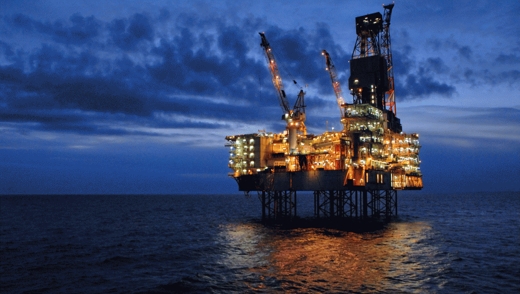
With the countdown to the removal of anti-Iran sanctions on, authorities are getting ready to raise Iran’s oil exports to Turkey. It comes as terrorist explosions along the Kirkuk–Ceyhan Oil Pipeline are interfering with Baghdad’s crude sales to Ankara.

In a report on October 18, Mehr News Agency focused on Iran’s oil trade with other countries, especially Turkey, after the implementation of the Joint Comprehensive Plan of Action. What follows is the translation of part of that report:

Before international sanctions were put in place, Turkey was a major importer of Iran’s crude oil (200,000 barrels a day).

With international sanctions against Iran ratcheting up and challenges such as transfer of foreign currency emerging, Iran’s oil exports to Turkey were cut in half. So Iraq seized the opportunity and raised its crude exports to Turkey.

One of the most serious challenges Baghdad has recently faced in its oil exports to Turkey have been occasional acts of terror along its oil pipeline to Turkey.

On top of that, divisions between the Iraqi Kurdistan Region and the Iraqi central government have thrown an obstacle in the way of exports and have crippled the Iraqi oil market.

When sanctions are lifted, Iran can tap into the great potential of its naval fleet to deliver uninterrupted oil to Turkish refineries.

This potential coupled with the removal of sanctions can spell an end to the oil honeymoon of Arab nations on this traditional market.

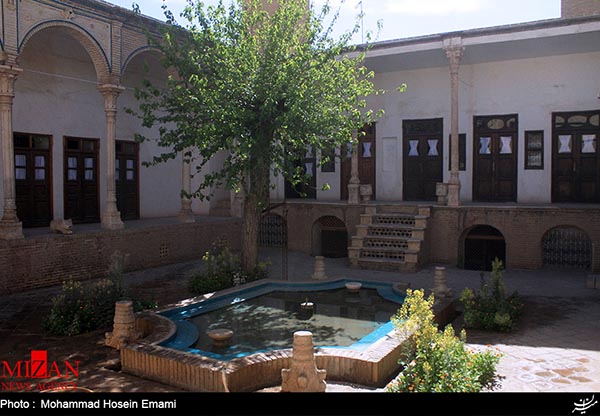
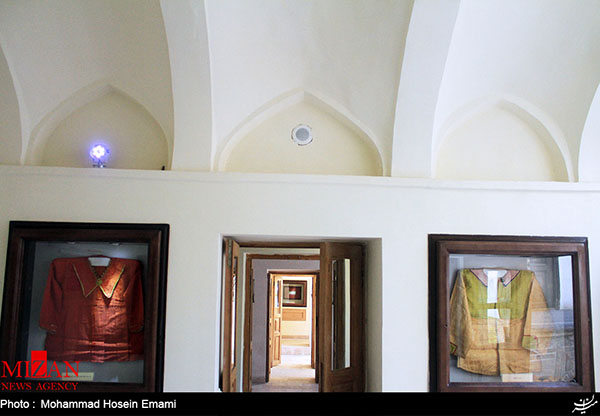
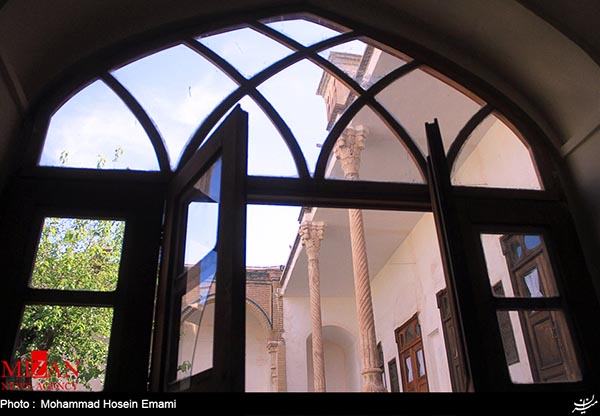
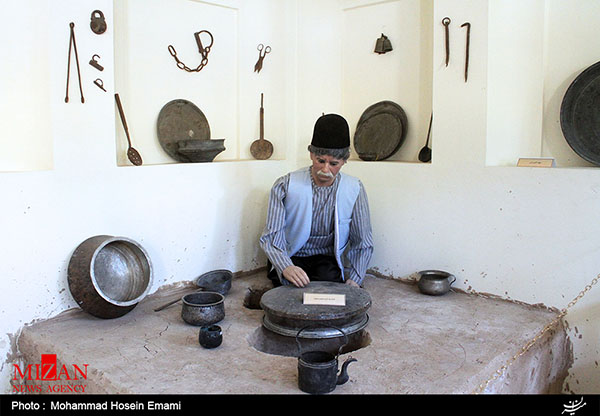
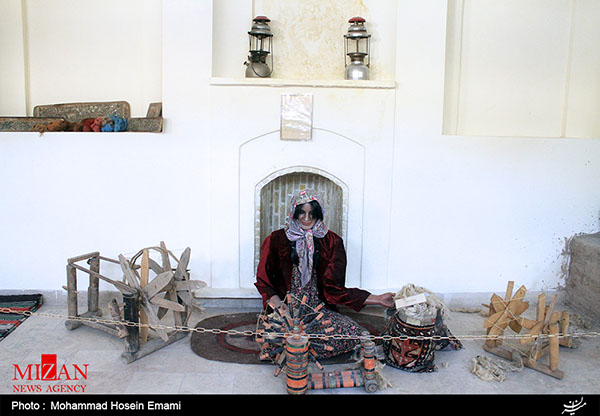
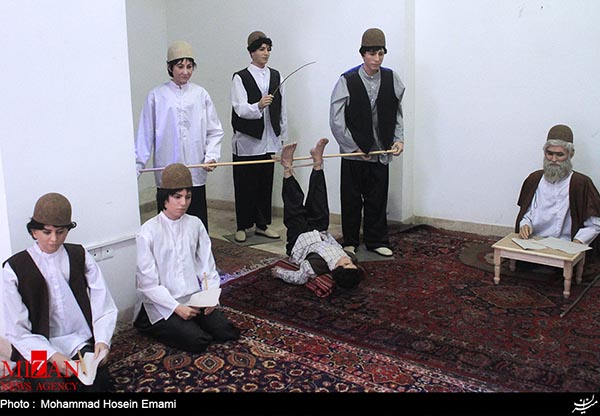
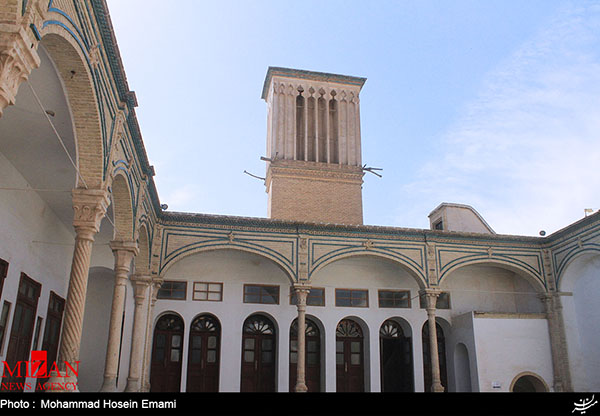
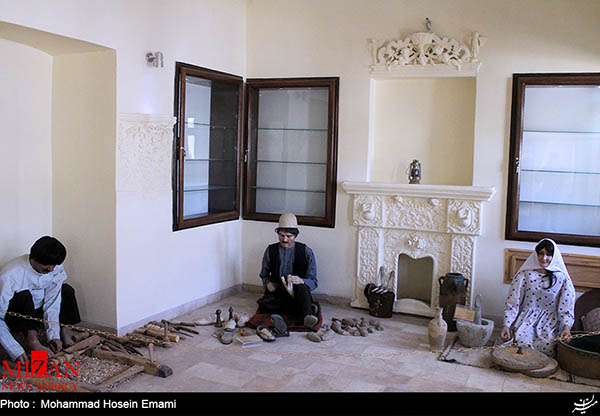
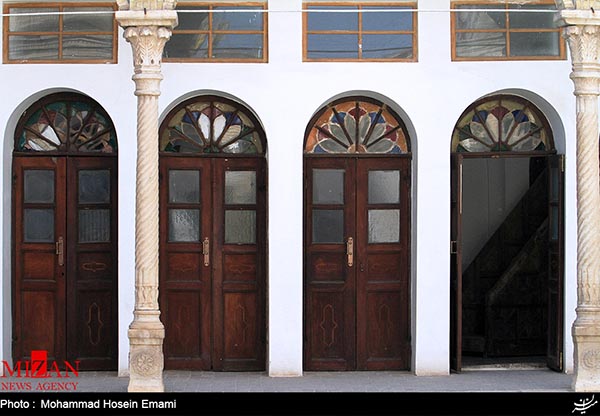
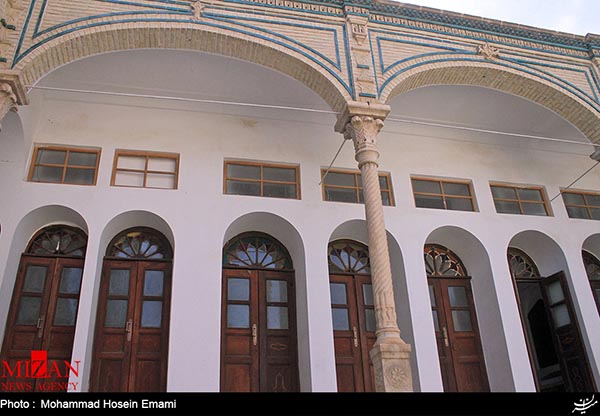
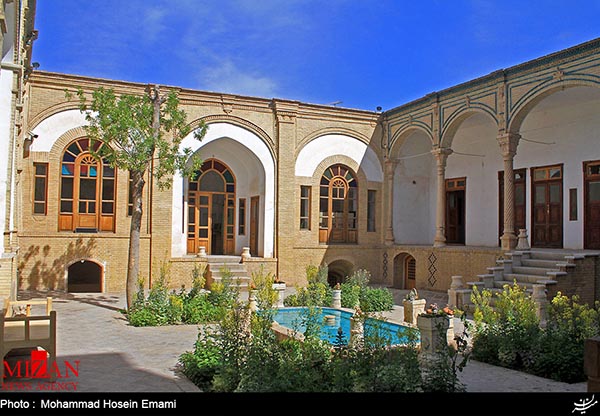
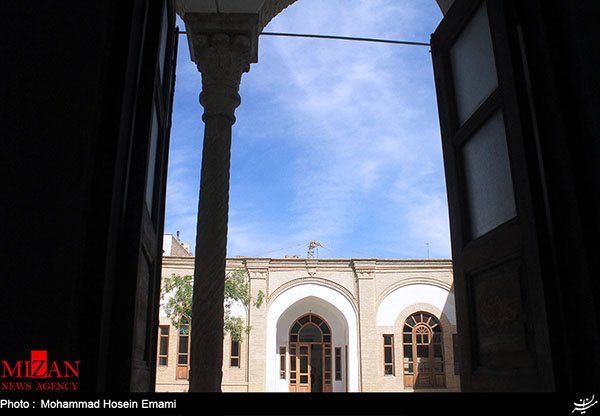
Zand Historical House, a museum of anthropology (PHOTOS)

Zand Historical House0

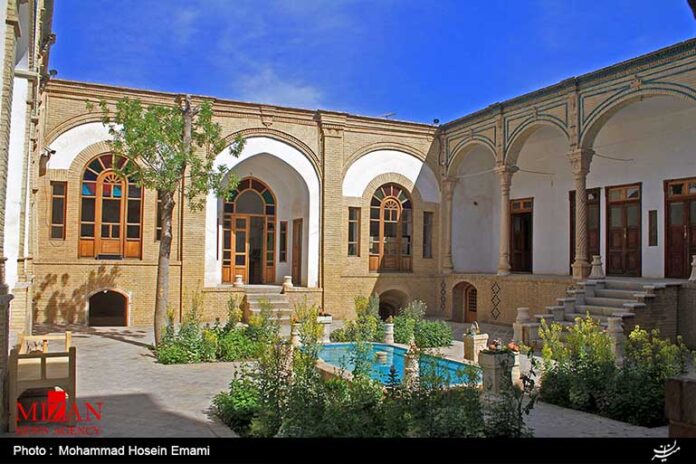
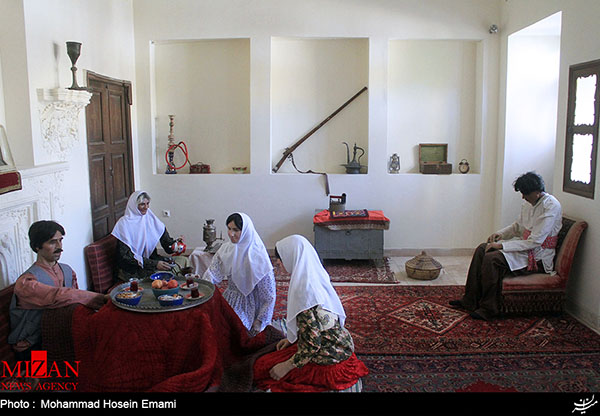
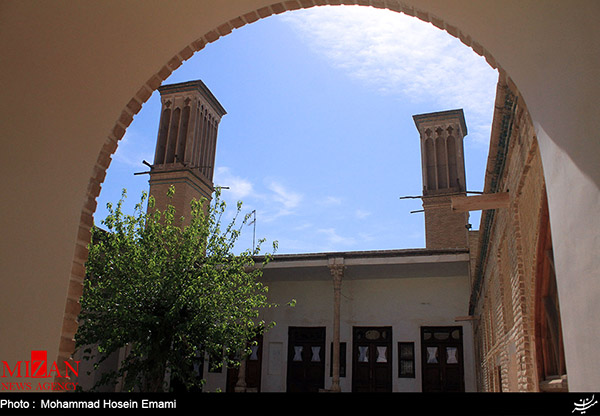
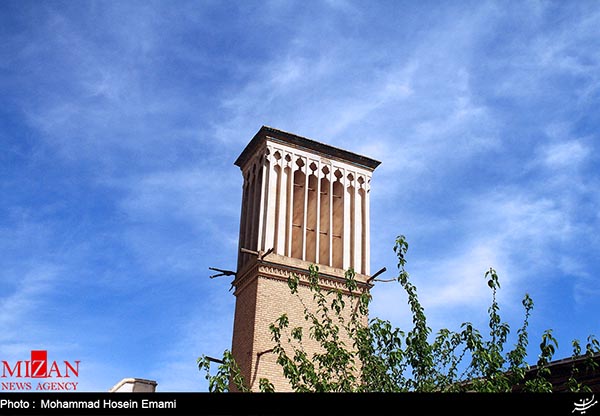
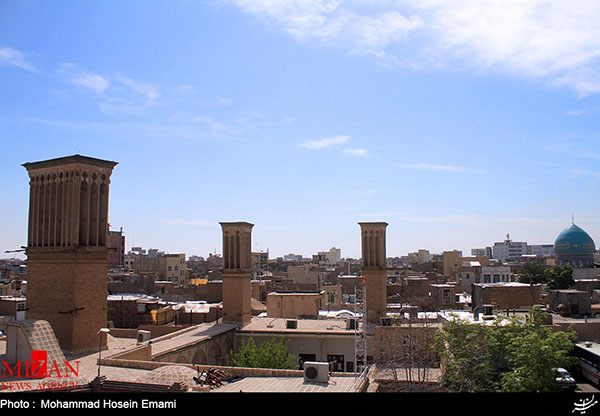
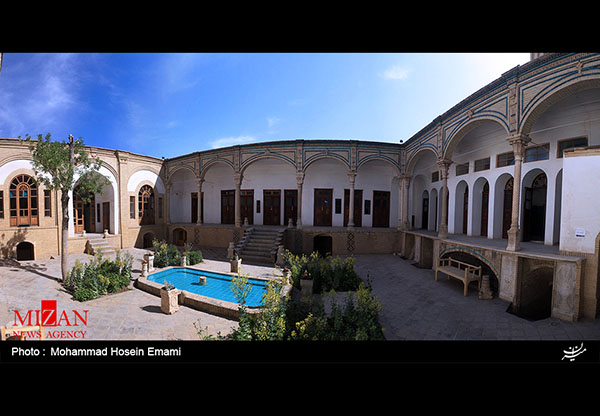
Zand Historical House at the heart of the city of Qom dates back to the late Qajar era. The 130-year-old building which is now a museum of anthropology displays is a manifestation of original Iranian architecture.

The historical house has two yards, 14 rooms, 36 wooden doors and windows and 14 stone pillars.

Stones, woods, bricks, adobe and stucco have been used in the construction of the building. Although the house has been restored a few times, its original structure has remained intact.

The following are images of the house mizanonline.ir has posted online:

Highlights of Ettela’at newspaper on October 21

ettelaat-21-oct

“There are no government red lines in the fight against corruption,” the first vice-president told a meeting of the anti-corruption commission.

Eshagh Jahangiri further said what is important in the case involving Babak Zanjani [a young billionaire on trial for corruption] is the return of the money which has been siphoned off.

 The Environment Protection Organization has said that satellite signal jammers and benzene are carcinogenic.

A deputy director of the organization has said that production of motorcycles with carburetors will stop as of September 2016.

 The defeat of the ruling Conservative party in Canada, a political seismic shift.

In the same elections, two candidates of Iranian origin and one of Afghan descent won parliamentary seats.

 The grandson of the architect of the Islamic Republic has said that collective wisdom should be tapped in teamwork.

Seyyed Hassan Khomeini further said he’ll make a decision “in due time” on whether to run for the Assembly of Experts.

 The Energy Ministry is ready for a harsh winter.

The energy minister has urged water and electricity companies to brace for a bitterly cold winter.

 Bahraini forces have attacked Shiite mourners.

The attack by the security forces left a few worshippers injured.