Friday, January 2, 2026
Home Blog Page 4584

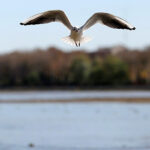
Migratory birds in Zayandeh Rood River (PHOTOS)

Zayandeh Rood0

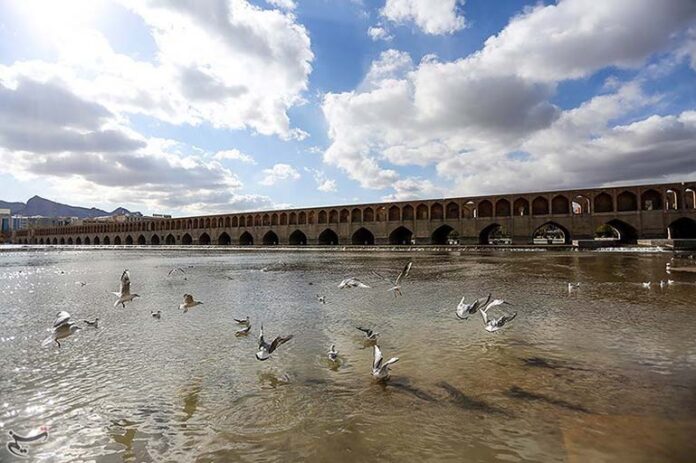
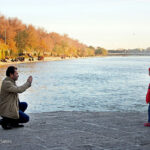
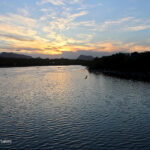
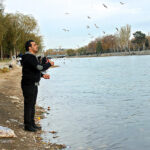
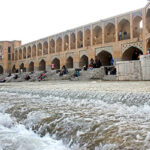
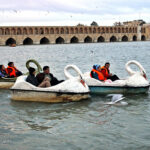
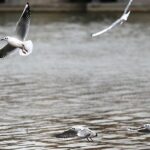
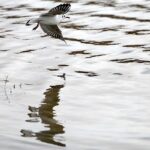
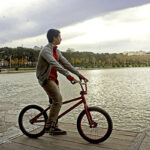
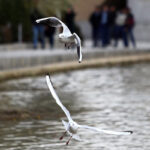
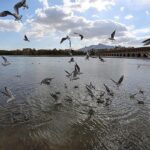
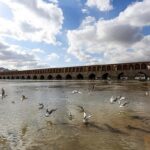
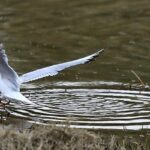
A week after water began flowing again on the river bed of Zayandeh Rood in central Iran, thousands of migratory birds have descended on the river to claim a share of the joy of humans residing on the banks of the river.

The following images have been released by different news websites:

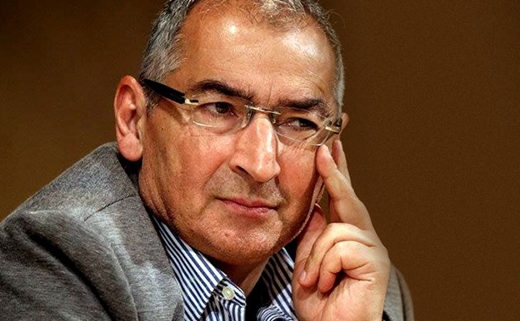
I disagree with you, Mr. President!

Sadegh Zibakalam

President Rouhani has appealed to university students to “critique authority”, telling them that “criticizing some institutions is a bit difficult, so lead off with the Executive branch and the president”.

President Rouhani made the call as he addressed students at a ceremony at Sharif University of Technology on December 7. In reaction to the president’s comments on critiquing those in power, Sadegh Zibakalam – a political analyst and a university professor – has said that people’s representatives in parliament, not university students, should analyze and assess the performance of the government.

The following is the translation of a piece by Zibakalam Arman daily published on December 8:

On Monday, the president was among students at Sharif University of Technology to mark Student Day. President Rouhani brought up issues at the university which received a hearty welcome from the audience.

The fact of the matter is that December 7 and his speech marking Student Day provided the president with the opportunity to indirectly broach his ideas and viewpoints, among them his statements on the accountability of the power structure. The president said that no office holder can shy away from accountability.

Basically authority comes with accountability. You cannot wield power but fail to account for the decisions you make simply because of the power you exercise.

The president also focused on critiquing authority and placed the main burden for critically analyzing the power on the shoulders of universities. I do not see eye to eye with the president on this subject and believe that the role universities are expected to play is clear and defined from a sociological perspective. University is a place where science and research should be developed.

The critique Mr. Rouhani has raised should happen, but universities are not supposed to place such a critique top on their agenda. Authority should be critiqued by parliament which is the most important institution in a democratic system. In other words, people are the ones who are expected to critique the government and the latter should be accountable to the former.

It is quite natural that the government cannot be answerable to all members of society, thus parliament [which represents people] should hold the government accountable. In an undemocratic system, the government does not feel accountable for what it has done or has failed to do.

The other way around, in a parliamentary democracy the representatives of people and in a later stage media outlets should critique authority as well as the policies and decisions of the government.

University professors and students can critique authority, but it should not be forgotten that such a responsibility is placed on universities when political groups, parties and parliament turn into rubber-stamp institutions. Such a parliament does have room for individuals like Mohammad Mosaddegh [an Iranian prime minister who championed the nationalization of the oil industry], Seyyed Hassan Modarres [a notable cleric who supported the Iranian Constitutional Revolution] and Mehdi Bazargan [the first Iranian prime minister after the victory of the Islamic Revolution].

The fact is that independent and freedom-seeking deputies should be given a seat in parliament, those who fear no one and can critique state officials and political movers and shakers.

By and large, the president floated the question of critiquing authority and the accountability of officials. That such a question has been raised was quite helpful. We should be happy and thank God that he raises such issues, simply talking about such issues is not enough, though.


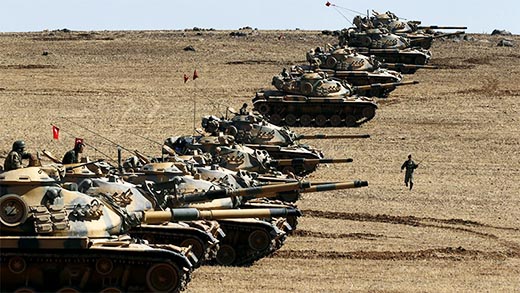
Turkey’s troop deployment to implement a dangerous plot

MIDEAST-CRISIS/TURKEY

Turkish troops with tanks and armored personnel carriers crossed the border into Iraq in early December and took up position in a camp near the Daesh-held northern city of Mosul.

On December 8, Javanonline published an analysis on one possible motive behind Ankara’s move. The following is the translation of part of that analysis:

Sources close to Popular Forces [fighting alongside the Iraqi Army against Daesh terrorists] have revealed that fugitive [former vice-president] Tariq al-Hashimi has returned to Iraq along with Turkish military forces and is based in the camp of Zalkan near Mosul.

The same sources say that al-Hashimi is in touch with former parliament Speaker Osama al-Nujaifi as well as Atheel al-Nujaifi, a former governor of Nineveh Governorate who stands accused of playing a role in the fall of Iraq’s second largest city to Daesh militants.

Hashimi was sentenced to death three times by the Iraqi Judiciary after being found guilty of leading assassination squads and ordering terrorist explosions. As a result of terrorist acts in which Hashimi was implicated, a large number of Iraqi citizens, mostly Shiites, lost their lives.

These sources say that Osama al-Nujaifi and Atheel al-Nujaifi act in coordination with the Turkish intelligence and Army. They are said to have cooperated with al-Hashimi in setting the stage for Turkish troop deployment to Iraqi soil.

The Turkish military presence near Mosul is meant to prevent Popular Forces from closing in on the city to wrest its control from Daesh militants. It is also designed to provide enough manpower for a US and Turkey-backed initiative to declare a Sunni region in Iraq after Mosul and al-Ramadi have been liberated.

The same sources say that the Iraqi Kurdistan Region, specifically its president Masoud Barzani, is a key coordinator between Turkish officials, leader of al-Hashd al-Watani and the US military for the deployment of Turkish forces near Mosul.

They say that Turkish forces used the cover of night to advance deep into the Iraq soil and opted for a new blackout before they officially announced their presence on Iraqi soil.

A spokesman for the so-called Nineveh Liberation Forces has said that Turkish troops are preparing to help the international coalition retake Mosul from Daesh militants and to that end Baghdad is expected to send in more troops.

The revelations about contacts between al-Hashimi and Osama al-Nujaifi and Atheel al-Nujaifi with the US and Turkey ahead of and during the Turkish incursion into Iraq come at a time when the United States says that it plays no role in this, and that Turkish military deployment in Iraq is not part of the operations of the international anti-terror coalition.

Turkish officials, who say that they shot down a Russian bomber in November for violating their country’s airspace, say their military incursion deep into the Iraqi territory is designed to take on Daesh. Given the previous revelations about Ankara’s ties with and support for the Daesh terrorist grouping, Turkey’s claim sounds more of a joke than reality.

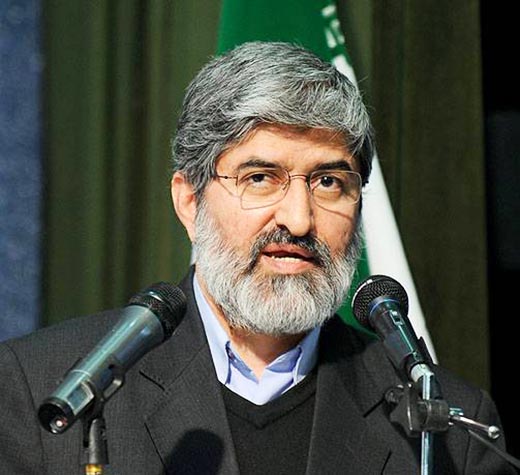
Principlist MP delivers wide-ranging speech on Student Day

Ali Motahari

December 7 was Student Day in Iran. Universities across the country hosted ceremonies, including speeches by prominent figures, to mark the occasion. Tehran MP Ali Motahari delivered one such speech at the capital’s Shahid Beheshti University.

The following are the highlights of his speech Tabnak.ir, an Iranian news website, quoted the principlist deputy as saying:

The question is whether we still need to have a student movement. We do not seek to bring about regime change, all we are after is to reform the system. The answer to the question above is in the affirmative: We always need to have a student movement, because authority needs to be critiqued, otherwise governments grow corrupt.

Authority always needs to be critiqued, but in doing so certain manners should be observed. When you are critiquing something or [the performance of] someone you should have thorough knowledge about the question at issue and be fair as well. Criticism stands somewhere between cajolery and mudslinging, we are in the habit of the latter though.

Students should not mince their words; neither should they try to swim with the tide. Students should not be afflicted by the same problems they seek to remedy. They should not be shackled by wealth, power or sexual desires; after all, they are monitoring things in society.

We cannot build on the fact that our revolution has a leader to shirk our responsibility. The presence of the leader does not take away our responsibility. Depending on their status, everyone needs to critique and pursue reforms.

There are three things that may harm our society and the Islamic Revolution. One is misinterpreting the revolutionary concept of the rule of the religious jurisprudent. Some view this concept as a drag on democracy and freedom of expression. That is not the case, because this principle prescribes the rule of faith and ideology and not an individual.

In practice, we are dealing with holier-than-thou individuals who do not approve of any opinion opposed to that of the Leader. It comes despite the fact that the Supreme Leader has time and again said he has never asked anyone not to critique him.

Another misinterpretation in our society revolves around protection of the establishment. Some build on this principle [protection of the establishment] to seek to stamp out any opponent and critic. The so-called Serial Murders were one such example. A number of individuals killed Dariush Forouhar and his wife supposedly to protect the system. They [Dariush Forouhar and his wife] were entitled to their opinions, though.

We fail to pay enough attention to Chapter Three of the Constitution which focuses on the rights of people. Under this chapter eavesdropping, extrajudicial punishment and imprisonment without authorization are not legal. Unfortunately, the Islamic Consultative Assembly does not pay attention to this chapter. And if a foolish individual like me says something, they say Motahari has acted foolishly by making such comments.

In 2009 if authorities had issued permission for assemblies and if protesters had been given airtime on TV to air their grievances and get an answer, things could have been controlled and the establishment wouldn’t have had to pay such a heavy price.

Hijab is not limited to women. No one should deny the principle of Hijab. Our family system is based on Islam which has its own regulations. We cannot say that stimulation of sexual desires is ok but fulfillment of such desires is not. Otherwise, we have to open night clubs.

If you suggest that we reopen the night clubs and promote a Western lifestyle in society, that is your opinion, not Islam’s.

Serious relationships [between men and women] should fall within the framework of marriage, either permanent or temporary. Young men and women cannot have intimate relations outside that framework. […] That is what Islam prescribes. If you are suggesting otherwise, that is another thing.

A look at Iranian newspaper front pages on Dec. 9

Iranian Newspapers Headlines

The much-anticipated closure of Iran’s PMD file at the IAEA Board of Governors dominated the front pages of Iranian newspapers on Wednesday. The comments of the government spokesman in a news conference also appeared on the cover of dailies.


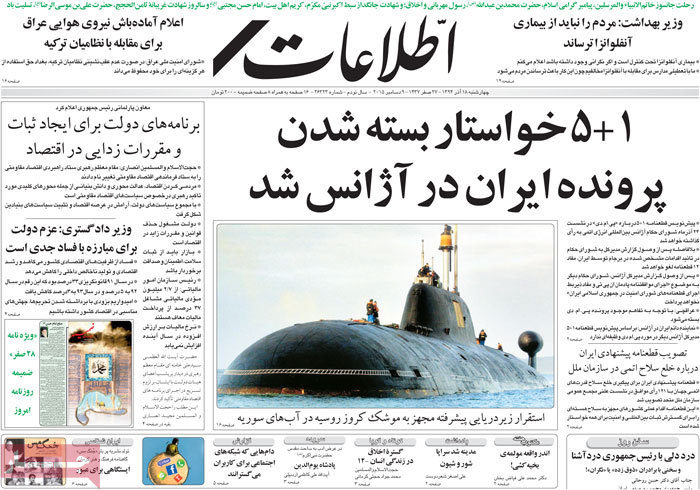
Ettela’at: P5+1 has called for Iran’s case at the International Atomic Energy Agency to be declared closed.

A PMD resolution drafted by P5+1 will be put to the vote at a December 14 meeting of the IAEA Board of Governors.


Abrar: A motion introduced by a number of MPs calls for life imprisonment to replace the death penalty for individuals found guilty of drug smuggling.


A look at Iranian newspaper front pages on Dec. 9


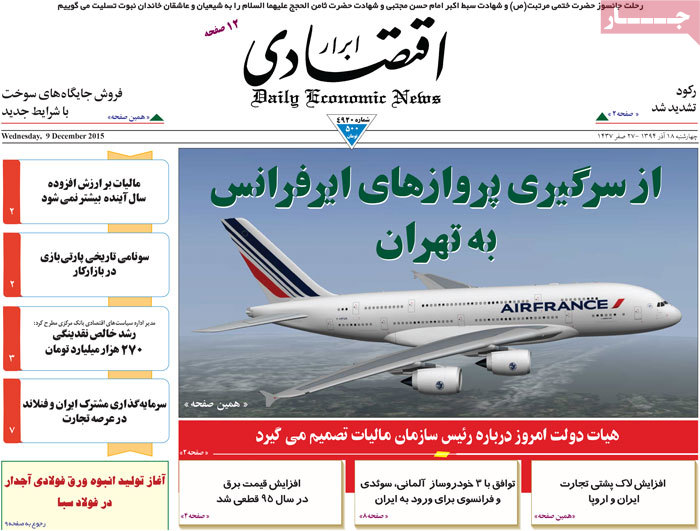
Abrar-e Eghtesadi: Air France to resume flights to Tehran

Abrar-e Eghtesadi: Iran and Finland are to make joint investment in the field of trade.
 

A look at Iranian newspaper front pages on Dec. 9


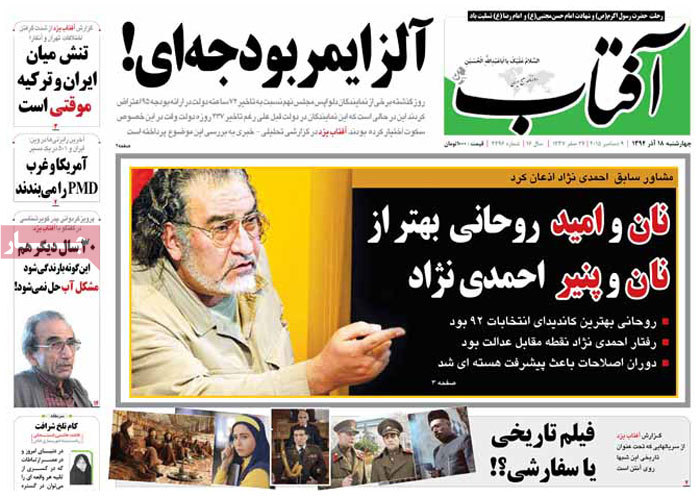
Aftab-e Yazd: Rouhani’s bread and hope is better than Ahmadinejad’s bread and cheese, said a former advisor to the former president.

Mehdi Kalhor further said that the conduct of Ahmadinejad ran counter to the principles of justice.

He said the real nuclear progress was nailed down when the reformist government [of Mohammad Khatami] was in office.

Aftab-e Yazd: Even if the heavy rainfalls of recent weeks persisted for 30 years, the problem of water shortage in the country wouldn’t be solved, said Parviz Kardavani, the father of the country’s desert studies.
 

A look at Iranian newspaper front pages on Dec. 9


Arman-e Emrooz: The Iranian Army is to stage anti-terror maneuvers near Tehran.

Arman-e Emrooz: A historic decision by Seyyed Hassan Khomeini [the grandson of the founder of the Islamic Republic]

There is no reason not to run for the Assembly of Experts.
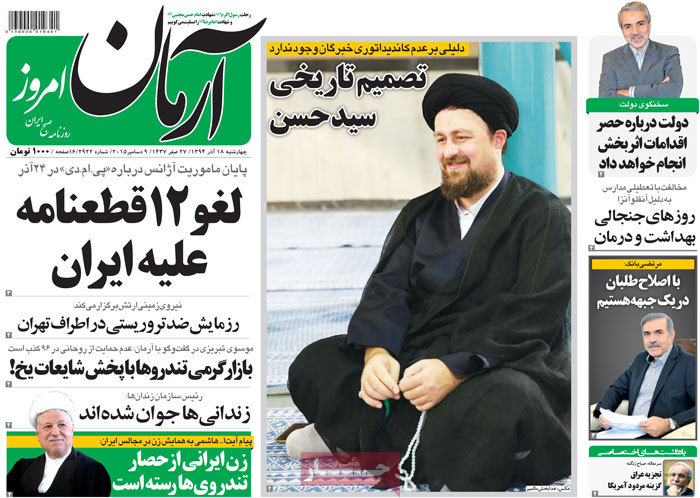
 

A look at Iranian newspaper front pages on Dec. 9


Asr-e Iranian: The secretary general of Iraq’s Badr Organization has vowed to destroy the tanks Erdogan has deployed on Iraqi soil.
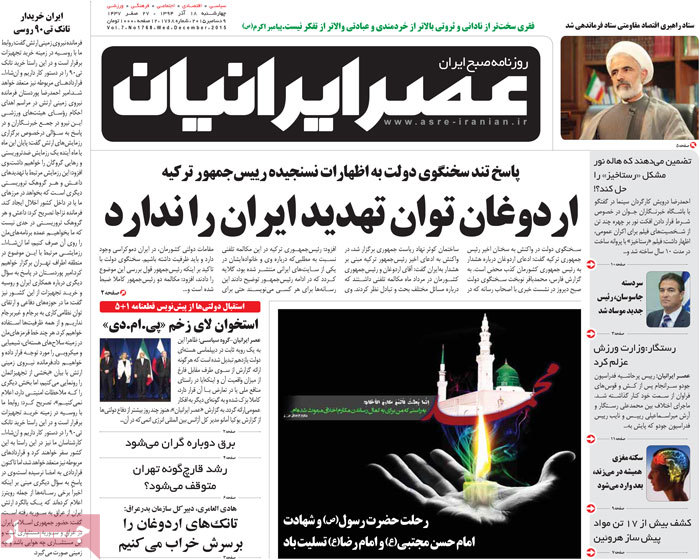
 

A look at Iranian newspaper front pages on Dec. 9


Asr-e Rasaneh: An Iran-Oman gas deal will be signed soon.
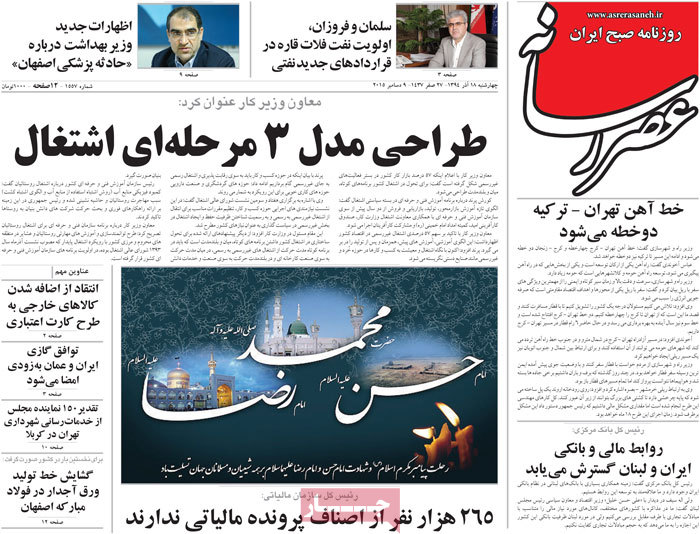
 

A look at Iranian newspaper front pages on Dec. 9


Bahar: Mahmoud Doaei, the managing editor of Ettela’at daily, has said that he has received no warnings and that he would forge ahead with its current approach.

[It came after some principlist news agencies reported that Doaei has been summoned to the Special Clerical Court after his newspaper ran a report featuring the image of former President Mohammad Khatami at a time when the ban on coverage of news stories related to the reformist president remained in effect.]
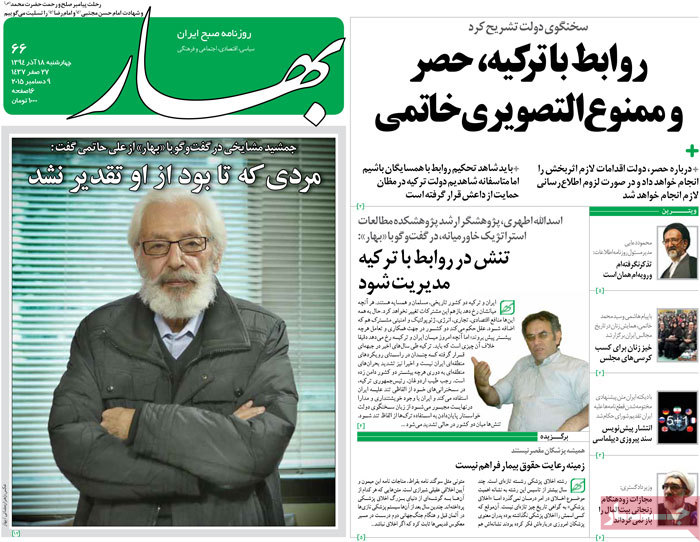
 

A look at Iranian newspaper front pages on Dec. 9


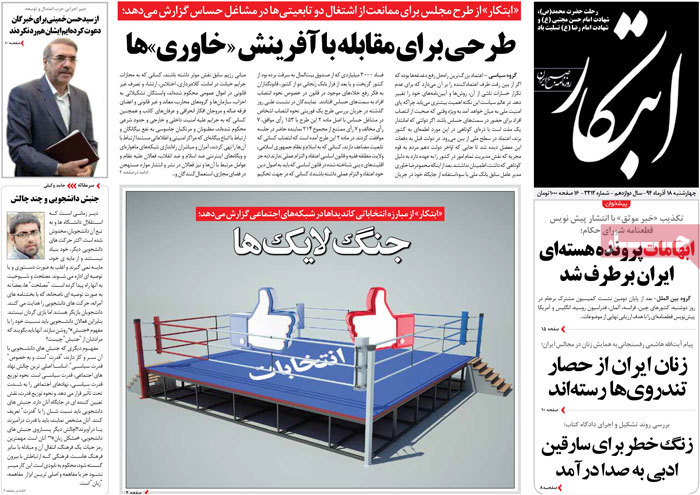
Ebtekar: With measures to set up Book Courts, alarm bells have been sounded for plagiarists.
 

A look at Iranian newspaper front pages on Dec. 9


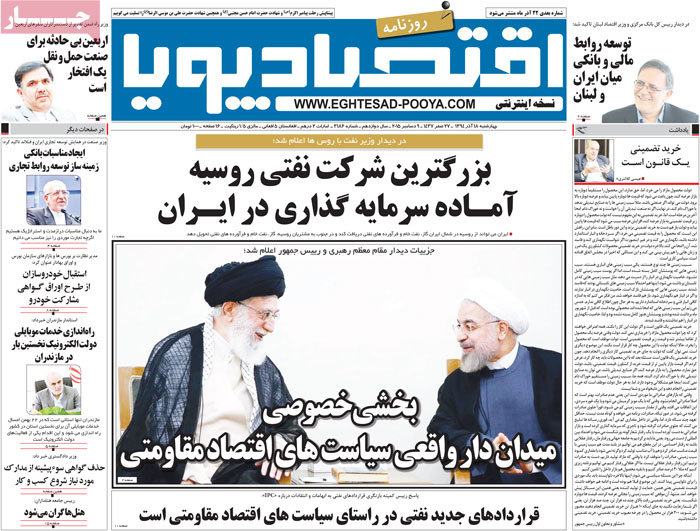
Eghtesad-e Pooya: In a meeting between the Iranian oil minister and the Russians, the largest Russian oil company has signaled its readiness to make investment in Iran.
 

A look at Iranian newspaper front pages on Dec. 9


Etemad: The government spokesman has said that the administration will take effective steps with regard to the house arrest [of the two presidential candidates who disputed the results of the 2009 vote and thus sparked massive unrest].


A look at Iranian newspaper front pages on Dec. 9


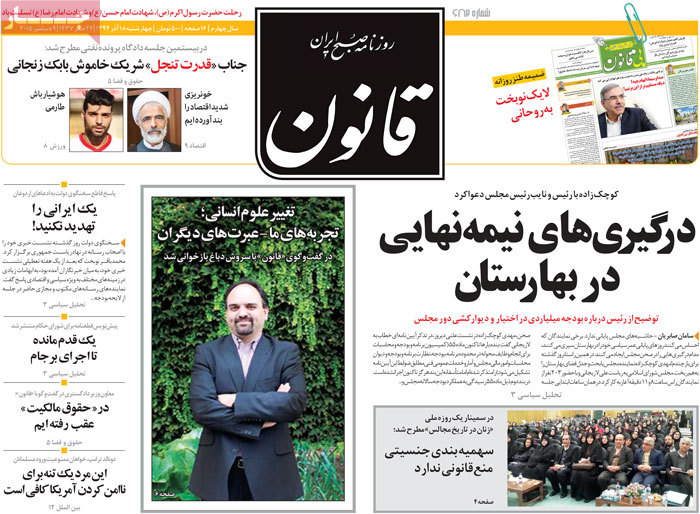
Ghanoon: This man can single-handedly render the US unsafe.

Donald Trump has called for a complete shutdown of Muslim entry to the US.
 

A look at Iranian newspaper front pages on Dec. 9


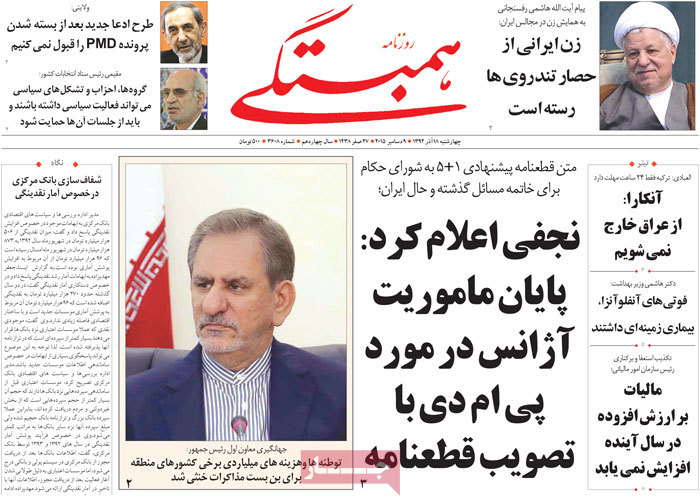
Hambastegi: The director of the National Tax Administration has said that he has not resigned, nor has he been replaced.

He further said VAT won’t increase next year.
 

A look at Iranian newspaper front pages on Dec. 9


Hamshahri: Some 150 MPs have thanked Tehran Municipality for offering services to Shiite pilgrims in neighboring Iraq for Arba’een ceremony.
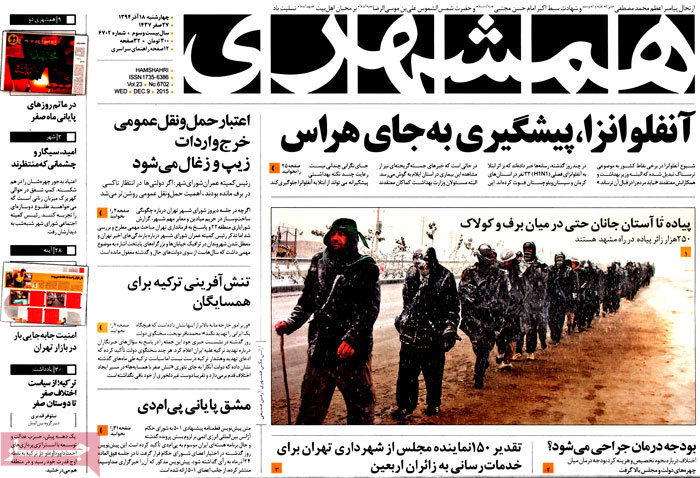
 

A look at Iranian newspaper front pages on Dec. 9


Hemayat: The judiciary chief has criticized certain groups for putting pressure on the Guardian Council [ahead of elections].
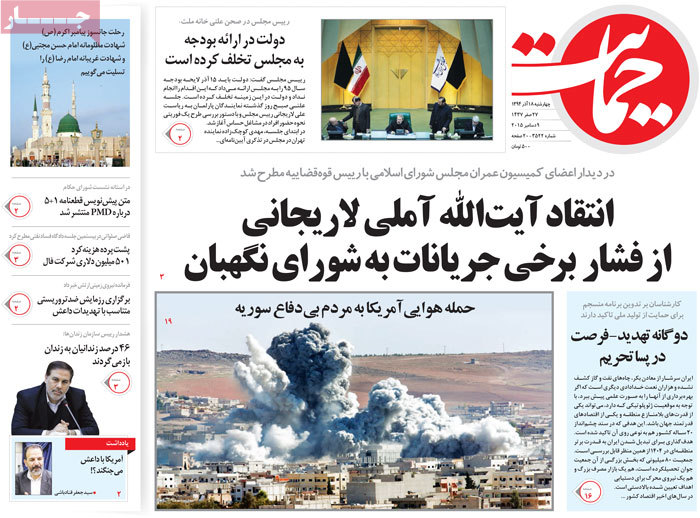
 

A look at Iranian newspaper front pages on Dec. 9


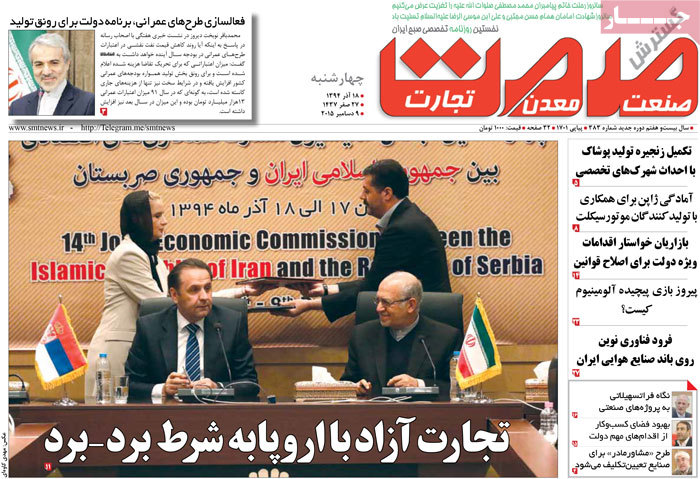
Iran: The presence of three global automotive giants in Iran has been finalized, said the minister of industries, mines and trade at an Iran-Finland trade cooperation conference.
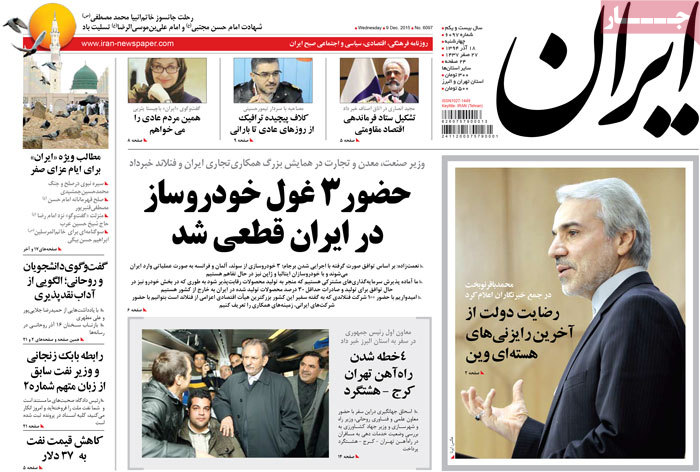
 

A look at Iranian newspaper front pages on Dec. 9


Jahan-e Sanat: Foreign investors have found their way to Isfahan and Mashhad.

A $350 million investment for development of the country’s airports
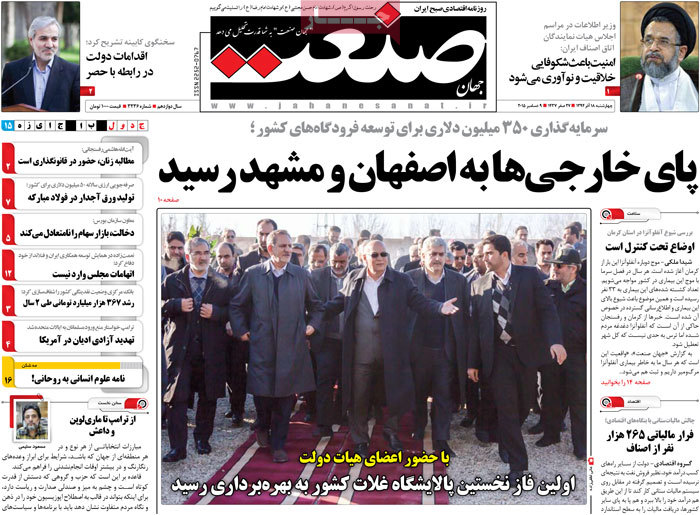
 

A look at Iranian newspaper front pages on Dec. 9


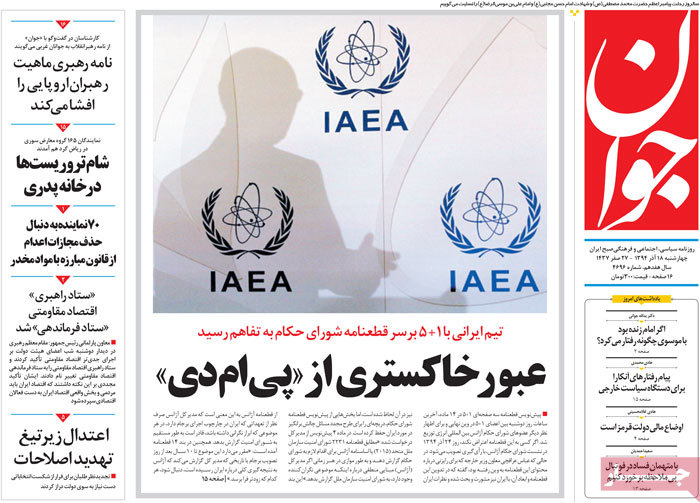
Javan: Seventy MPs want the death penalty to be removed from the anti-drugs law.
 

A look at Iranian newspaper front pages on Dec. 9


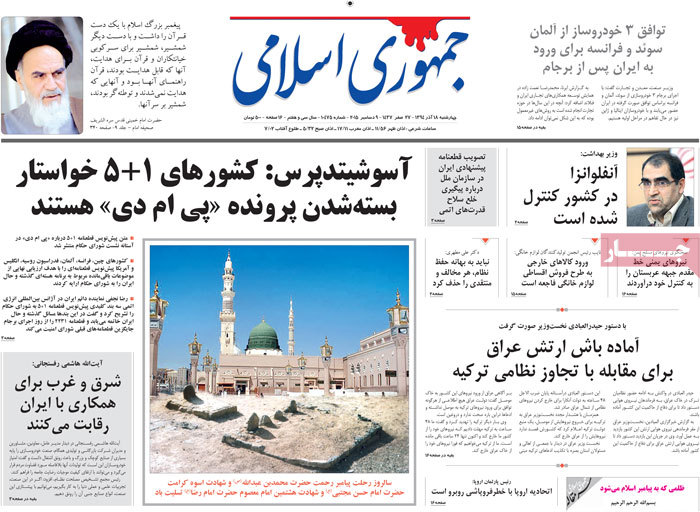
Jomhouri Islami: Three German, Swedish and French carmakers have agreed to make it to the Iran market after the implementation of the Joint Comprehensive Plan of Action.

Jomhouri Islami: Tehran MP Ali Motahari has said that protecting the establishment should not be used as an excuse to set aside all opponents and critics.
 

A look at Iranian newspaper front pages on Dec. 9


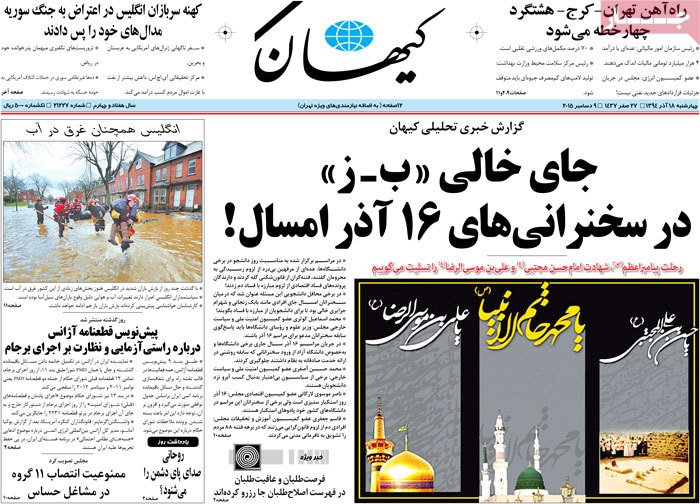
Kayhan: Britain is still in the grips of flooding.
 

A look at Iranian newspaper front pages on Dec. 9


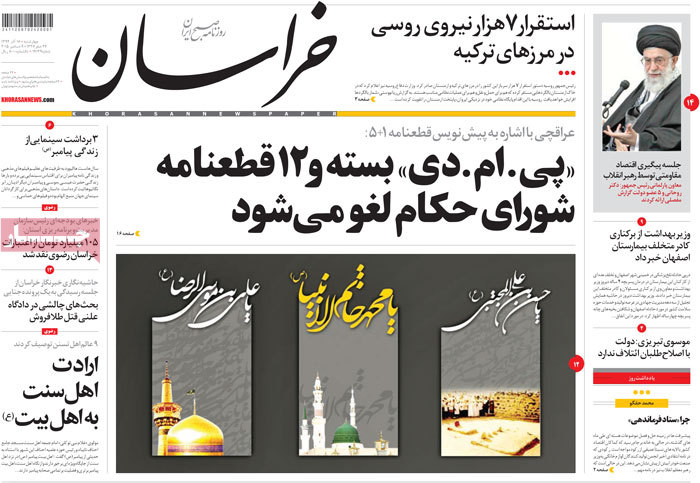
Khorasan: Some 7,000 Russian troops have taken up position near the border with Turkey.
 

A look at Iranian newspaper front pages on Dec. 9


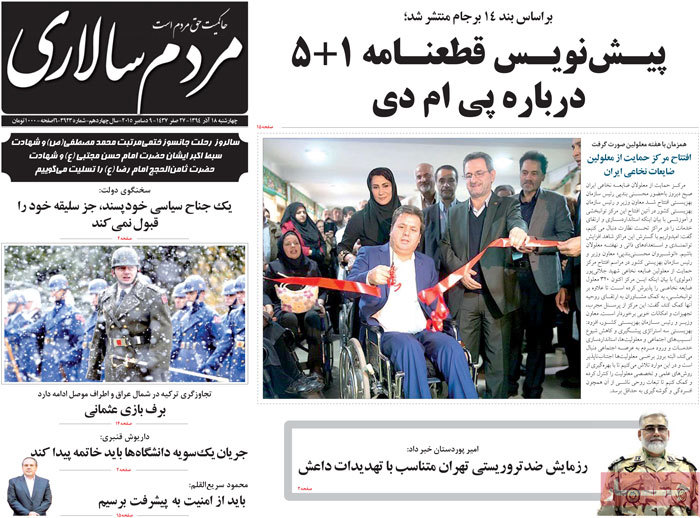
Mardomsalari: To mark People with Disabilities Week, a center has been set up to support people with spinal cord injuries.
 

A look at Iranian newspaper front pages on Dec. 9


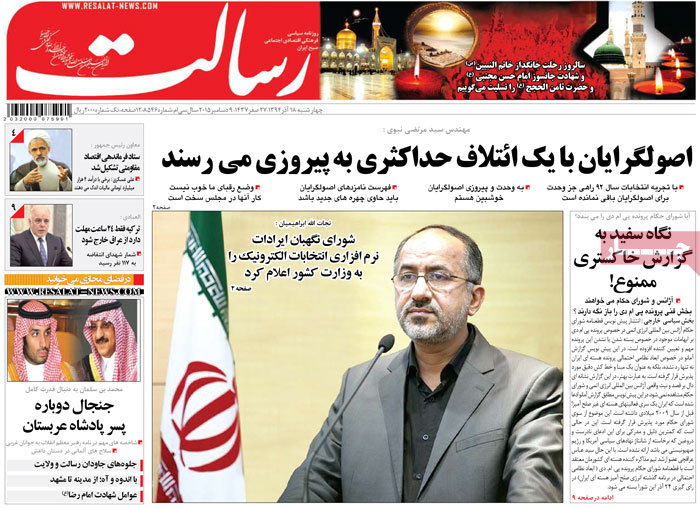
Resalat: The Guardian Council has informed the Interior Ministry of the software-related problems of electronic voting.
 

A look at Iranian newspaper front pages on Dec. 9


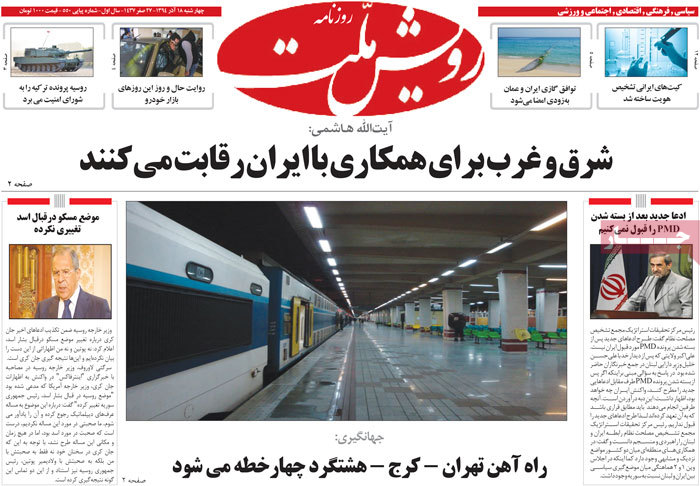
Rooyesh Mellat: Ali Akbar Velayati, an advisor to the Supreme Leader, has said that Iran won’t accept any new claims after the PMD case has been closed.
 

A look at Iranian newspaper front pages on Dec. 9


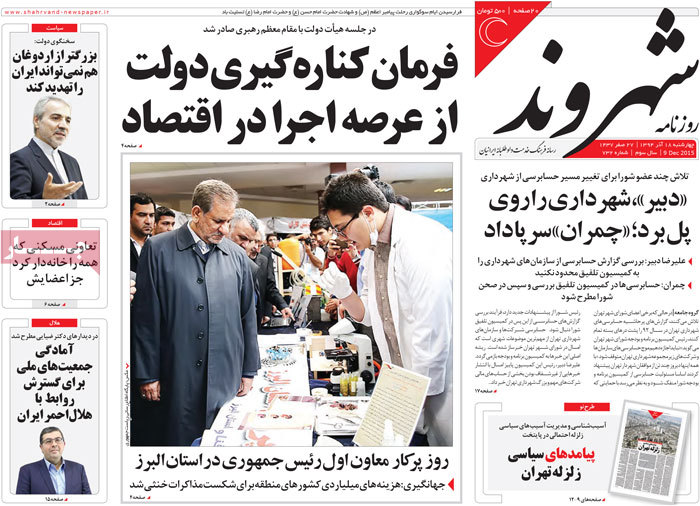
Shahrvand: The first vice-president had a busy schedule in Alborz Province Tuesday.

Billion-dollar attempts by some regional countries to foil the nuclear talks did not produce the intended result, Eshagh Jahangiri said.
 

A look at Iranian newspaper front pages on Dec. 9


SMT: Japan has expressed readiness to cooperate with Iranian motorcycle manufacturers.
 

A look at Iranian newspaper front pages on Dec. 9


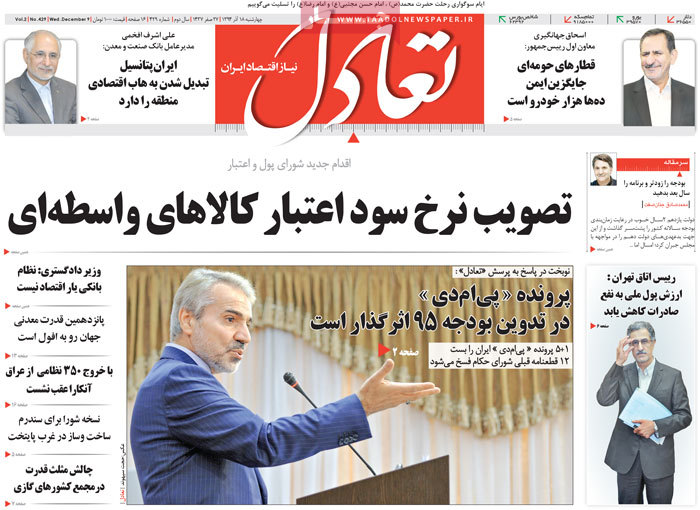
Taadol: The possible military dimension (PMD) case plays a role in how next year’s spending package is drafted, the government spokesman said.

Mohammad Bagher Nobakht further said that P5+1 has closed Iran’s PMD case so the 12 resolutions the IAEA Board of Governors has issued against Iran will be revoked.
 

A look at Iranian newspaper front pages on Dec. 9


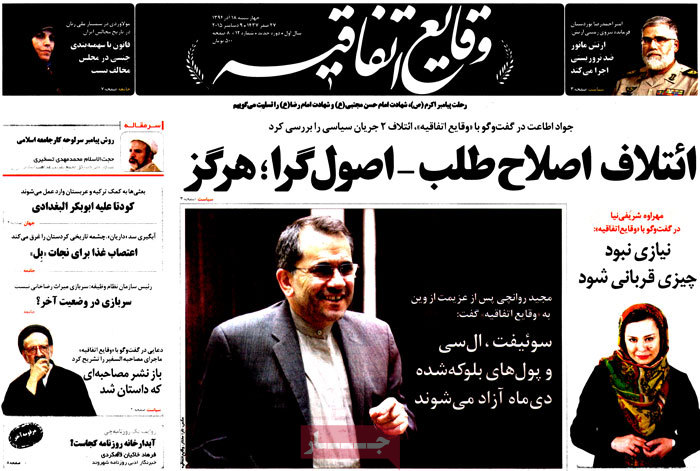
Vaghaye-e Etefaghiyeh: Deputy Foreign Minister Majid Takht-e Ravanchi has said that the problem of LC and SWIFT will be settled and Iran’s frozen assets will be released next month.

 

A look at Iranian newspaper front pages on Dec. 9


Highlights of Ettela’at newspaper on Dec. 9

ettelaat

Ettela’at: P5+1 has called for Iran’s case at the International Atomic Energy Agency to be declared closed.

A PMD resolution drafted by P5+1 will be put to the vote at a December 14 meeting of the IAEA Board of Governors.

Ettela’at: An Iranian-proposed resolution on nuclear disarmament has been adopted at the United Nations.

During an open session of the UN General Assembly, the Iranian-drafted resolution on disarmament of the world’s nuclear powers won 121 votes.

Ettela’at: An advanced Russian submarine armed with cruise missiles has taken up position in Syria’s territorial waters.

Ettela’at: The health minister has said that the public should not be given the fright because of influenza.

Dr. Hassan Hashemi has also said he is opposed to school closures as a way to counter the flu, because that would frighten citizens.

Ettela’at: The Iraqi Air Force has said that it is ready to take on the Turkish military.

The Iraqi National Security Council has announced Baghdad reserves the right to every option in case the Turkish military fails to withdraw from the Iraqi territory.

Ettela’at: The vice-president for parliamentary affairs has mapped out the government’s plans aimed at deregulation and injection of stability into the national economy.

Majid Ansari further said that the Supreme Leader has underlined key resistance-based economic policies to render the country’s economy public-driven, justice-oriented and knowledge-based.    

Ettela’at: The justice minister has said that the administration is determined to take on corruption.

Mostafa Pourmohammadi further said that corruption chips away at the country’s economic potential and pushes down economic growth and GDP.


Fars News EXCLUSIVE: ISIL leader moves to Libya

13940719000898_PhotoI

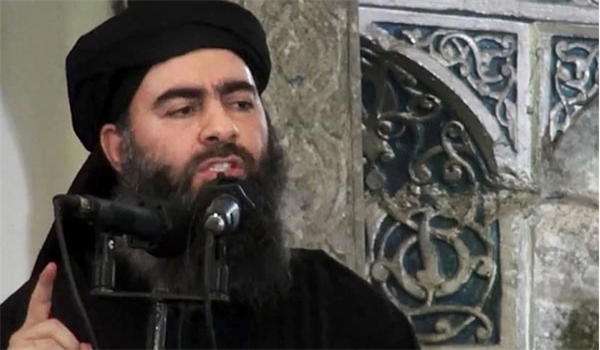
The leader of the Islamic State of Iraq and the Levant (ISIL) Takfiri terrorist group, Abu Bakr al-Baghdadi, has moved from Turkey to Libya to escape the hunt of the Baghdad Intelligence Sharing Center after he was traced down and allegedly targeted a number of times in Iraq and Syria, sources said on Tuesday.

Sources in Libya said al-Baghdadi has arrived in Sirte, the hometown of the slain Libyan dictator Muammar Gaddafi, which is under the control of Takfiri groups.

[…]

While reports earlier this year said the ISIL leader was always on the move between Iraq’s Mosul and Syria’s Raqqa – the self-proclaimed capital of the terrorist group – tips and intelligence revealed in November that Al-Baghdadi had moved from the Syrian city of Albu Kamal to the Iraqi city of Mosul in Nineveh province.

Then in October, Iraq’s air force bombed his convoy as he was heading to Al-Karable to attend a meeting with ISIL commanders. Twenty-five ISIL militants were killed in the special operation that was the product of the Baghdad Intelligence Sharing Center where the latest intelligence arrives from Iranian, Russian, Iraqi and Syrian intelligence agencies around the clock.

The notorious terrorist leader narrowly escaped the attempt on his life, but with serious injuries. Few hours after the assault, the spokesman of Iraq’s joint forces declared that Al-Baghdadi was injured in the Iraqi airstrike on his convoy and was taken away from the scene by his forces.

The terrorist leader was first transferred to Raqqa, where surgeons saved his life but failed to give him a thorough treatment due to a lack of specialized medical equipment.

Sources disclosed a few days later that the ISIL leader had been taken to Turkey for treatment through a series of coordination measures by the CIA.

“The CIA has done the coordination with the Turkish intelligence service (MIT) for transferring al-Baghdadi to Turkey,” the Arabic-language al-Manar TV quoted unnamed sources as saying.

The source said that two companions of al-Baghdadi who were also injured in the attack on the ISIL leader’s convoy and were captured by the Iraqi forces confirmed that al-Baghdadi had been injured in the attack.

After specialists said al-Baghdadi needed months to recover, one of his aides was appointed to run the cult until the so-called caliph would return to duty.

Al-Baghdad has, thus far, escaped several attempts on his life, making him suspicious of bodyguards.

“While everyone is looking for him in Iraq and Syria, no one expects him to be in Sirte,” the Libyan source told FNA, adding, “If he is to be exposed to danger, Sirte would be the last place on Earth for his life to be endangered as it is the safest Takfiri stronghold in the world.”

The Syrian army, the National Defense Forces (NDF), the Lebanese Hezbollah and the Syrian and Russian Air Forces, as well as the Iraqi army and popular forces, Al-Hashd Al-Shaabi, have been conducting large-scale operations in Syria and Iraq to end the ISIL control over swathes of lands in the two Arab countries.

Three European carmakers to return to Iran soon

02400cc2-11d6-4446-a259-7b9dc961c830

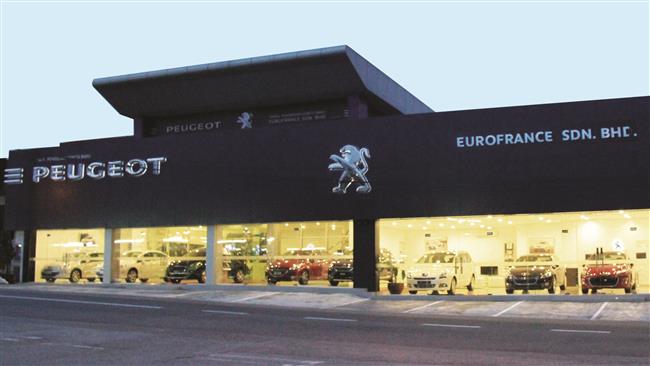
Three automakers from Sweden, Germany and France will resume operations in Iran when a July nuclear accord goes into effect, Industry Minister Mohammad Reza Nematzadeh says.

Iran is also in talks with Italian and Japanese carmakers for cooperation but an agreement has yet to be reached, he told reporters on the sidelines of an Iran-Finland trade forum in Tehran Tuesday.

“We have signed MoUs with France, Germany and Sweden. We will also cooperate with Italy and Japan but we are still in early stages with these two countries,” Nematzadeh added.

The minister did not name the companies but France’s Peugeot, Germany’s Daimler and Sweden’s truck and bus producer Scania are said to be in pole position for resuming operations in Iran.

Last month, Iran Khodro Managing Director Hashem Yeke-Zare said his company and PSA Peugeot Citroen had agreed on a 50-50 venture worth €500 million for production of cars in Iran.

The French manufacturer faces a backlash from its abrupt pullout from Iran in 2012 amid calls for compensation. Yeke-Zare said the issue of reparations had been resolved without giving details.

Meanwhile, Daimler AG’s commercial vehicles division said it intended to open a representative office in Iran “as soon as possible” and was in talks with potential partners in Iran to resume production in the country.

In August, Yeke-Zare said his company and Daimler’s subsidiary Mercedes-Benz would sign a deal “soon” for production of luxury cars and commercial vehicles.

The German company reportedly intends to buy 30% of shares in the Iranian Diesel Engine Manufacturing (IDEM) in Tabriz to build diesel engines.

European automakers are in a race for fresh inroads into the country of 80 million people which is being promoted as the region’s biggest automotive market.

Last week, Swedish Minister for Enterprise and Innovation Mikael Damberg visited Tehran at the head of a delegation of leading Swedish traders.

Nematzadeh said the two sides agreed to jointly produce passenger buses in Iran.

Scania AB officials and Sweden’s biggest companies and banks, including telecommunications firm Ericsson AB, have said they wanted to invest in Iran when sanctions are lifted.

“If and when it takes off, Iran can be a significant market for Scania,” the company’s spokesman Hans-Aake Danielsson was quoted as saying in October.

Iran Army to stage anti-terrorism maneuver: Commander

43dea70a-12e4-48ad-9dd4-250ba3cf7e64

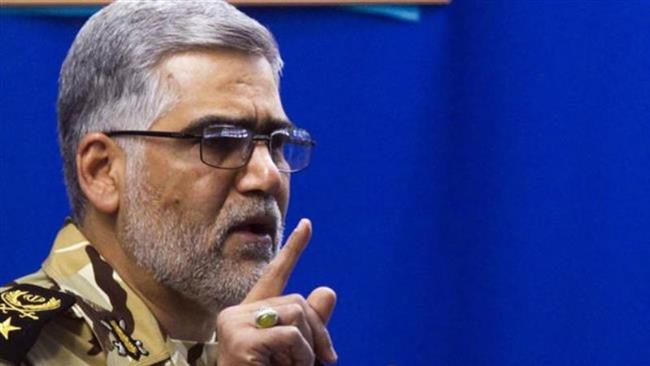
The Iranian Army’s Ground Forces will stage “anti-terrorism” military exercises outside Tehran in the coming days, the forces’ commander says.

“The Ground Forces’ anti-terrorism maneuver will be held in accordance with Daesh threats outside Tehran within the next few days,” Brigadier General Ahmad Reza Pourdastan told reporters on Tuesday.

He added that the Aviation Unit of the Ground Forces will also use helicopters during the drill.

“To defend our country, we will use every weapon, barring nuclear, chemical and microbiological weapons, and we know that upgrading our defense power is of great significance,” said Pourdastan.

“We will nip in the bud any threat meant to affect Iran and the Islamic Republic,” he added.

On November 15, Iran’s Intelligence Minister Mahmoud Alavi said the terrorist attacks in France and Lebanon are also an alert to the Islamic Republic, which should take action to exercise more vigilance.

[…]

Regional cooperation vital for peace in Afghanistan: Iran’s Zarif

Zarif-Press

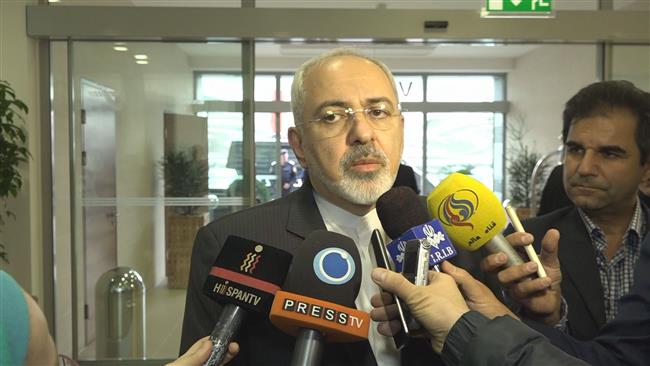
Iranian Foreign Minister Mohammad Javad Zarif on Tuesday stressed that peace in neighboring Afghanistan hinges on collaboration among regional states.

Zarif arrived in the Pakistani capital of Islamabad earlier in the day to attend the ongoing Western Asia session of “Heart of Asia-Istanbul Process” conference.

Speaking to reporters upon arrival, Zarif said the conference is “an initiative for international cooperation to reinforce security and stability” in the heart of Asia, Afghanistan in particular.

“Regional cooperation is necessary for the enhancement of peace in Afghanistan, and regional states should join hands to improve stability since the security in the region is interconnected,” the Iranian minister asserted.

“The negotiations that are underway here can help (the peace process),” he added.

At the regional level, Iran is responsible for the field of “training”, Zarif announced, noting that the country will confer with other countries in their fields of responsibility in a bid to make decisions on optimal cooperation and advancement of security and stability in the extremism-hit region.

He also said that the fight against drug trafficking is also on the agenda of talks among the countries attending the Heart of Asia conference.

Heart of Asia conference is part of the ‘Istanbul Process’, which provides a platform to discuss an agenda of regional cooperation with Afghanistan at its center.

‘Heart of Asia’ countries engage in result-oriented cooperation for a peaceful and stable Afghanistan and, by extension, a secure and prosperous region as a whole.

Fourteen member countries are supported by 16 other countries and 12 regional and international organizations. The member countries are Afghanistan, Azerbaijan, China, India, Iran, Kazakhstan, the Kyrgyz Republic, Pakistan, Russia, Saudi Arabia, Tajikistan, Turkey, Turkmenistan and the UAE.

The United States, Japan, Egypt, the United Kingdom, France and Germany are among the supporting countries, and the UN, NATO, SAARC, SCO and OIC are among the supporting organizations.