Thursday, January 1, 2026
Home Blog Page 4570

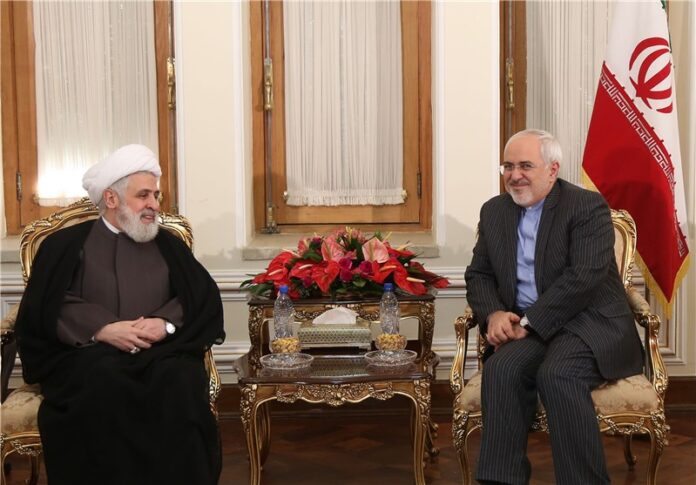
Muslim countries proud of Hezbollah: Iran’s FM

Zarif

Iran’s Foreign Minister Mohammad Javad Zarif highlighted the role of Lebanese Hezbollah Resistance Movement in regional developments, saying that Muslim states are proud of Hezbollah’s achievements in the face of plots hatched by the Zionist regime of Israel.

“We are constantly pleased with the vigilance of Lebanon’s Islamic Resistance regarding different events,” Zarif said Sunday in a meeting in Tehran with Sheikh Naim Qassem, Hezbollah’s second-in-command.

Iran’s top diplomat also described Hezbollah’s approaches, which involve boosting Lebanese people’s unity, as being in the interest of everyone.

In the meeting, Sheikh Qassem, who is in Tehran to attend the 29th International Islamic Unity Conference, appreciated the Islamic Republic’s stances in support of the people of Lebanon.

He also expressed hoped that the scholars, thinkers and politicians attending the conference could come up with solutions for Muslim world issues.

Hundreds of clerics, intellectuals and academics from some 70 countries are taking part in the conference in Tehran to discuss the “present Islamic world crises.”

Organized by the World Forum for Proximity of Islamic Schools of Thought, the gathering is to discuss ways to promote unity and solidarity in the Islamic world and bring closer views of Muslim clerics and scholars’ on diverse religious issues.

The event will also focus on problems that have beset the Islamic world, particularly the threat posed by the Takfiri thoughts and sectarianism.

Participants also plan to discuss the issue of Palestine, propose solutions to settle its problems and adopt a common stance on the issue.

Iran following US plan to seize frozen assets

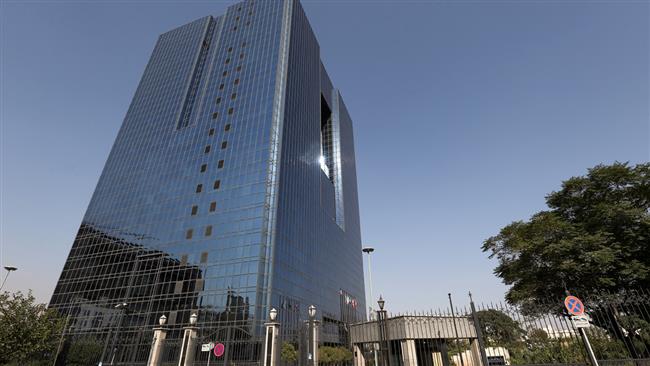
Iran Central Banks

Iran is following the case of its assets frozen in bank accounts in New York which the US seeks to appropriate under court rulings, Central Bank Governor Valiollah Seif says.

The US Congress has approved a bill allowing the Americans to claim Iranian funds in a case which is currently before the Supreme Court, with the Obama administration urging the tribunal to rubber-stamp it.

Over 1,300 Americans are reportedly pressing to receive billions of dollars of the Iranian money in awarded damages over two bombings in Beirut and Saudi Arabia in 1983 and 1996.

On Sunday, Seif said the Central Bank of Iran (CBI) has a total of $2.5 billion frozen in New York, including the interest on top of the original $1.7 billion held in Citibank accounts.

“This case is being followed by the Presidential Office and Ministry of Foreign Affairs which we hope we will get to a conclusion,” he told reporters in Tehran on the sidelines of a forum on Islamic finance.

In 2012, President Barack Obama issued an executive order blocking all of CBI’s assets held in the US in order to prevent Tehran from repatriating them.

At the same time, Congress passed a law which included a provision making it easier for the Americans to use Iranian funds frozen in the US.

CBI says the US Congress passed the law to change the outcome of the case. It has asked the US federal courts to decide whether that violates the constitutional separation of powers.

The case is currently before the US Supreme Court, with the Obama administration urging it not to overturn the decisions of US Circuit and Appeals courts to award the plaintiffs.

Tehran is already disappointed by Obama’s signing of a Congressional bill this month aimed at limiting travels to Iran and trade with the country.

Iran says the law violates a July nuclear accord and amounts to new sanctions on the country.

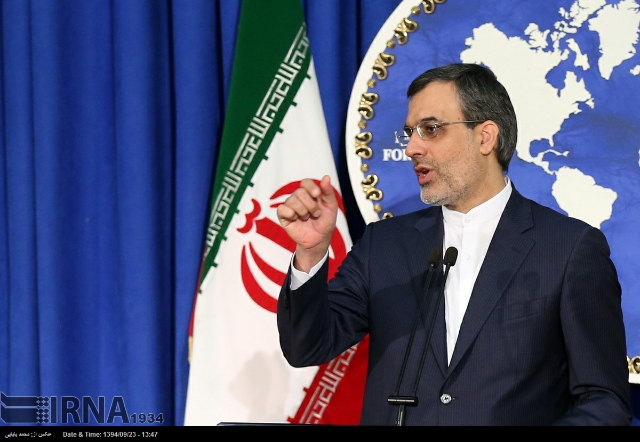
On Friday, Foreign Ministry Spokesman Hossein Jaberi Ansari rapped US judicial decisions, saying American courts are “violating the basic principles of international law through recourse to unsubstantiated and baseless allegations”.

“Some US courts are making a travesty of justice by sentencing the Islamic Republic of Iran over the past few years to paying restitution to victims of terror acts carried out by known citizens of US allies,” he said.

Iran gets berth on LA Times’ list of 16 must-see destinations in 2016

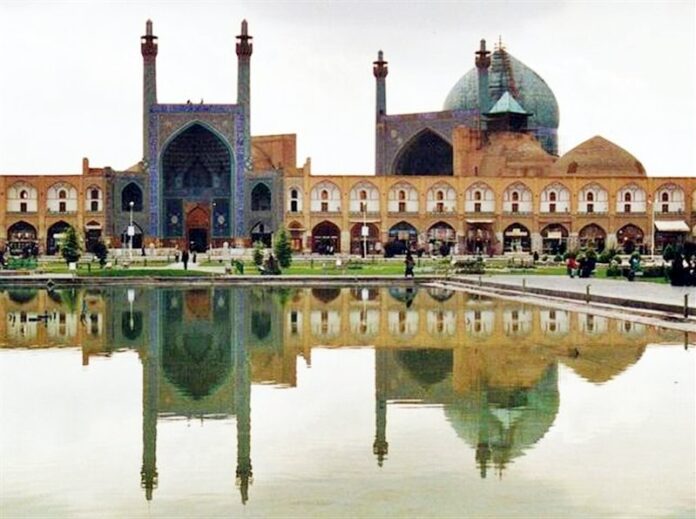
Naghsh Jahan

After CNN recommended its audience to visit Iran in 2016, Los Angeles Times too has put Iran on its list of 16 must-see destinations in 2016.

The following is what the daily wrote about Iran in a story titled: Looking for a 2016 vacation? Here are 16 must-see destinations:


Iran

Many Americans are eager to visit Iran, and several tour operators are helping them. (In terms of U.S. government red tape, it’s easier than going to Cuba.)

Iran is full of historic towers, mosques and squares, especially in the ancient city of Esfahan (where the atmospheric Abbasi Hotel is a favorite of western visitors).

Persepolis, not far from the city of Shiraz, holds some of the most striking pre-Christian ruins outside of Egypt and Peru.

Both destinations are well removed from the Iraq and Afghanistan border zones, which the U.S. State Department urges travelers to avoid.

Tehran, more modern, includes many museums. To get there, Americans often fly to Istanbul, then continue on to Tehran or Esfahan.

At Distant Horizons in Long Beach, owner Janet Moore says she is sending 14 groups to Iran in 2016 — twice the number she sent in 2014.

An ex-envoy sheds light on how Saddam’s Iraq waged war on Iran

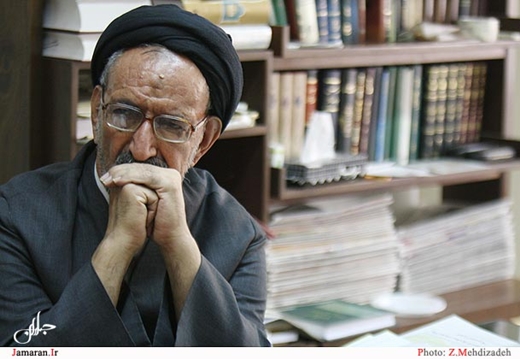
Doai

A former Iranian ambassador to Iraq has reacted to claims that the late Imam Khomeini had insisted on war with Iraq despite advice by his inner circles to avoid such a conflict.

A story from the days predating the Iran-Iraq war has made the rounds on social networking sites despite the fact that Iran’s former ambassador to Iraq – Seyyed Mahmoud Doaei who knows things first-hand – has already denied it outright.

Sharq daily’s Marjan Towhidi had a Q-and-A with Mr. Doaei about his stint as Iran’s ambassador to Iraq, his contacts with Saddam and how the war erupted. The following is the translation of PART ONE of the interview ( Part Two ):

Seyyed Mahmoud Doaei had come to the daily’s office with his characteristic humbleness. New information on the Internet on how the Iran-Iraq prompted him to share with us his first-hand information about the imposed war.

What was the story?

In an interview with a news website, Abdolali Bazargan [the son of former Prime Minister Mehdi Bazargan] has evoked a memory of the pre-war era: Once in 1980, I was asked to attend a consultative session of the Council of the Islamic Revolution on an important issue. Iran’s ambassador to Iraq Mr. Doaei was also there. I was told Mr. Doaei had a report to submit.

Mr. Doaei said, “… Last week Saddam Hussein summoned me, expressed strong protest against [Iran’s alleged] interferences and disruptions and said no longer could he tolerate such a situation. Saddam said, ‘You go to Tehran and tell Mr. Khomeini that Iraq was the first government which recognized the Islamic Republic. If he [the late Imam Khomeini] let me, I will personally come to Iran to hold talks and settle our differences. If he is not willing to talk with me, I will send a high-ranking delegation to Iran, or the Iranian government can send a top ranking team to Iraq for talks so that we can patch up our differences. I cannot take the current trend anymore and I will launch a military attack on Iran to put an end to such a situation.’

Mr. Doaei then stressed that he [Saddam] is a guy who will [definitely] launch military attacks. The Council of the Islamic Revolution decided that Mr. Doaei together with Messrs. [Mehdi] Bazargan and [Mohammad] Beheshti meet with the Islamic Revolution leader [the late Imam Khomeini] to explain the situation on the ground and ask what should be done.

In the meeting, Mr. Doaei tells the whole story as well as Saddam’s threat. The leader tells Mr. Doaei not to pay any attention to him [Saddam]. Then Mr. Bazargan steps in and argues that … In response, the leader says, ‘I said [what I said]. Pay him no attention.’

Once again, Mr. Beheshti starts to reason with the leader, but Ayatollah Khomeini does not wait for Beheshti to finish his words, rises to his feet and says for a third time that they should not pay any attention to Saddam. He then moves toward the door.

Being so dejected, Mr. Doaei tells Imam that he will not go back to Baghdad. Mr. Khomeini, who was close to the door, turns back after a short pause and says, ‘It is your responsibility to go [back to the mission].’ He then leaves the room without waiting for a response.

Those gentlemen come back to the Council of the Islamic Revolution. A downcast Mr. Doaei starts crying and says, ‘Swear to God! He (Saddam) will attack. No one can do anything [to prevent it].’ And after a while Iraq mounted a surprise attack against Iran.

Q: Let’s go to a meeting between you, the late Ayatollah Beheshti, Mr. Ebrahim Yazdi and the late Imam. Apparently the three of you talked about the threat of war and the need to hold talks with Saddam, with you saying that Saddam has asked for a personal meeting [with Imam] and Imam turning it down. Earlier you denied such a meeting and what Mr. Abdolali Bazargan said about it.   

A: The scenario they have created is distorted or damaged from different perspectives. They claimed that I returned from Iraq with a message from Saddam in 1980, but I was not in charge then. I was called home one year earlier, after I served out my term [in Iraq]. Back then I was in charge of the Ettela’at newspaper.

Later they claimed that Saddam had summoned me, but I said that I had no [personal] meetings with Saddam except for those which came my way according to protocols and that I had not had any message from Saddam to convey to the late Imam in the presence of senior officials.

Thanks to Iran’s complaints against their movements and their failure to take note of Iran’s good intentions, the only case which came up for talks was a proposal suggesting that a representative with full authority from Iran come over for talks.

The proposal was brought forward by Sa’dun Hammadi, the then Iraqi foreign minister. There was nothing else except for this proposal. The late Imam prudently said that he preferred a representative who was elected and recognized by people enter the talks.

“We have elections ahead for president and parliament. I prefer to see an official who has political responsibility in the country to represent Iran in the talks. If you have good intentions, you should help maintain calm until Iran elects its office holders and then talks can be held,” the late Imam said.

He wanted somebody who cared about the homeland and the revolution to go on that mission.

Q: One of the topics referred to is the intelligence Mr. Ebrahim Yazdi is provided with on Iraq’s movements near Iran’s borders. In response, Mr. Yazdi says the intelligence was not trustworthy ….

A: The topics Mr. Jafari has referred to could be answered by Mr. Yazdi too. The point I want to make here is that a scenario which was created a few years ago to tarnish Imam’s image and attribute false things to him is recently changing hands on Telegram claiming that it is part Dr. Yazdi’s recollections.

But what is certain is the fact that untrue materials are nowhere to be found in his memories. Courtesy of his piety and accuracy in recalling his memories, he will not include an untrue story – which has never happened – in his memories.

I remember the time when Dr. Yazdi – who was seeking to record his memories – handed me part of his memoir which focused on Iraq to study. I did study it and let him know about my views on the date of some of his memories. I found no such reports in his memoir.

Certain friends attribute a distorted and untrue story to Dr. Yazdi due to his position and the significance of his memories. What they do is in fact cruelty to him.

Q: By and large, do you think it was possible to prevent the war from erupting despite all [provocative] movements of Iraq?

A: The war could have prevented if Iran had surrendered to Iraq’s demands and renounced its national sovereignty. No revolution would have bought such an idea. The Iraqis wanted to act against what was envisioned in the 1975 Algiers Agreement as far as the question of the Arvandrud River was concerned. They wanted to lay claim to Shatt al-Arab [or the Arvandrud River].

They also claimed that the triple islands [in the Persian Gulf] did not belong to Iran and had to be handed over to their Arab owners. They also sought to make Iran offer concessions on Arabic- and Kurdish-speaking Iranians. Since Iran lacked a powerful army in the early months after the revolution, the Iraqis wanted to seize the opportunity and make Iran give in to their conditions.

Q: Do you think talks could have prevented the war if they had ever been held?

A: It could have been put on hold, but talks could not have prevented the war unless Iran would have given in to their demands.

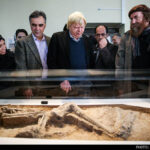
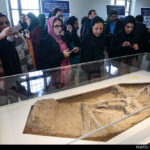
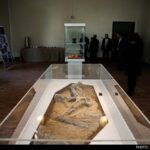
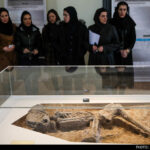
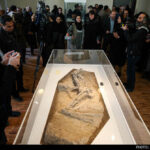
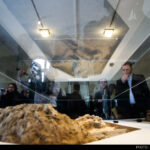
7,000-year-old skeleton goes on display (PHOTOS)

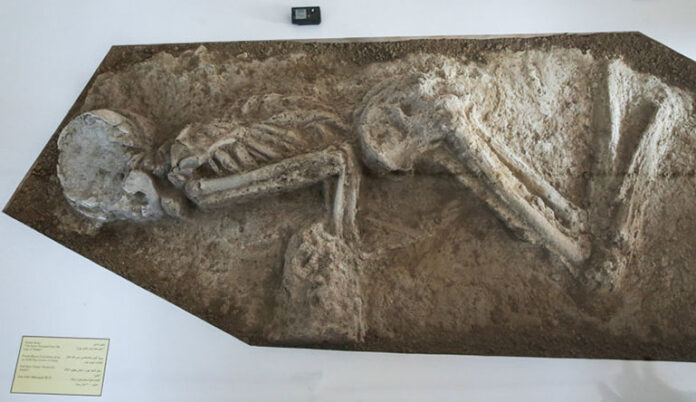
7,000-year-old skeleton-17

The skeleton of a woman who lived in what is downtown Tehran today some 7,000 years ago has gone on display at the Ancient Iran section of the National Museum.

The skeleton and 34 other items found in excavations on Mowlavi Street will remain on display for 50 days.
The following images have been published by the Iranian Students’ News Agency:

Related Posts:

Residence in Tehran dates back to 7,000 years ago

Facial reconstruction of 7,000-year-old skeleton

Muslim unity pivotal in fight against violence: Rouhani

Rouhani-islamic unity

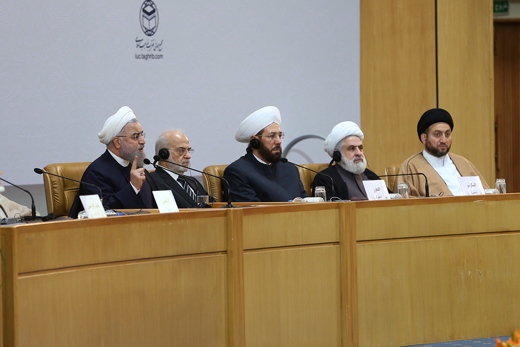
Iran’s President Hassan Rouhani says the Islamic world is currently at a critical juncture, urging all Muslim nations to strengthen unity to counter enemy plots.
Addressing a 29th International Islamic Unity Conference in Tehran on Sunday, Rouhani said enemies and big powers are doing their best to portray Islam as a religion of violence, urging Muslims to take the necessary steps to thwart all efforts aimed at depicting Islam as the religion of violence.

The Iranian president added that faced with such plots, “Muslims have no option but to join hands and … choose the right path.”

Rouhani stated that many ongoing acts of violence and terror as well as massacre are taking place in the Muslim world, North Africa, the Middle East and West Asia, adding that there must be an end to “intellectual and discourse-based violence.”

The president criticized certain Muslim countries for purchasing great quantities of US arms, and either delivering the weapons to militant groups or using them against other Muslim nations.

Daesh Takfiri terrorists, Rouhani argued, recruit members that are overcome by cultural or economic poverty, adding, “So, let’s eradicate cultural and financial poverty in our societies.”

The Iranian president emphasized that bombs and military equipment cannot do away with terrorism.

The biggest responsibility we shoulder is to repair the image of Islam in the court of world public opinion, President Rouhani said.

In reference to efforts made to unseat the Syrian President Bashar Assad, Rouhani said no foreign country can make decision on the fate of another country and only that country’s people can make that decision.

Iran has repeatedly announced that it pursues the goal of achieving a world without violence and that every problem can be settled through negotiations, Rouhani said.

Iran succeeded in solving a problem, which had been aggravated over years, through wisdom and negotiations with major world powers, he noted, adding, “At the negotiating table, we managed to bring the most complicated international political issue to a resolution that is beneficial to all the negotiating sides, the region and the world.”

Prominent religious figures, ministers and scholars from some 70 countries are participating in the conference, organized by the World Forum for Proximity of Islamic Schools of Thought in Tehran. The meeting which focuses mainly on the existing crises in the Muslim world will endon Tuesday.


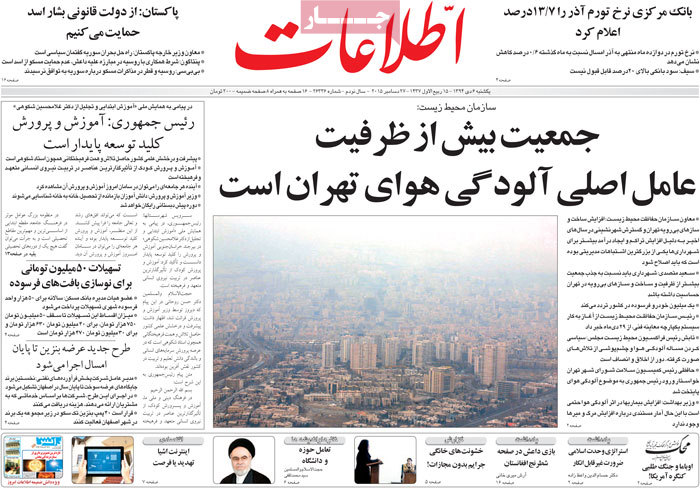
A look at Iranian newspaper front pages on Dec. 27

Iranian Newspapers Headlines

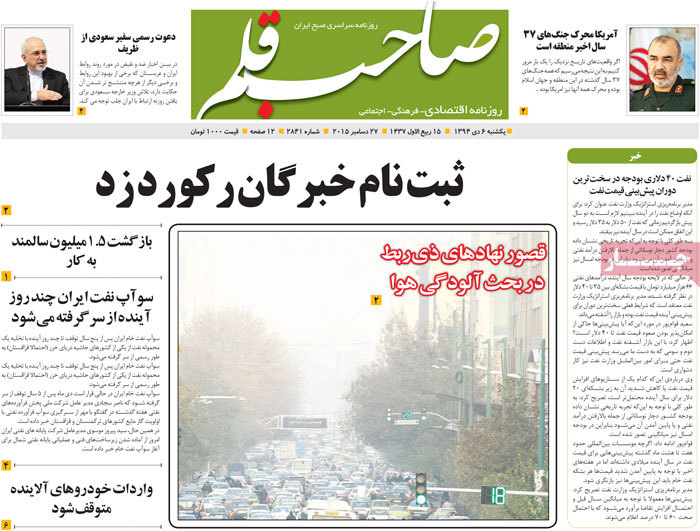
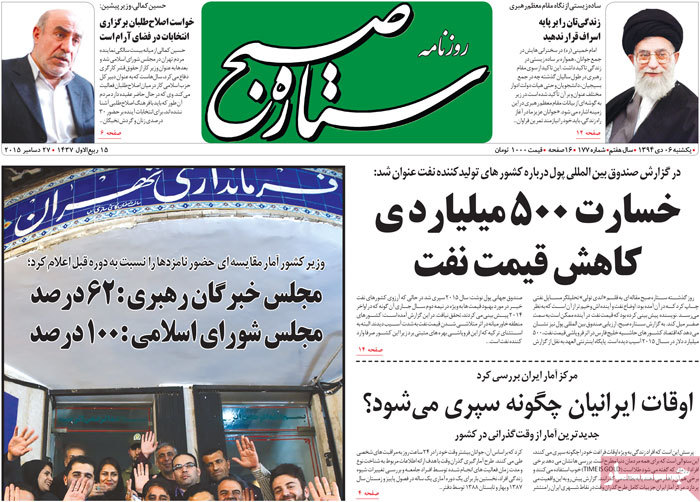
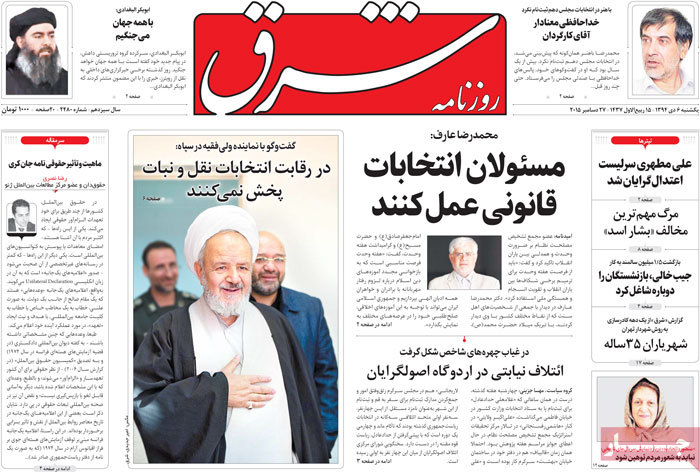
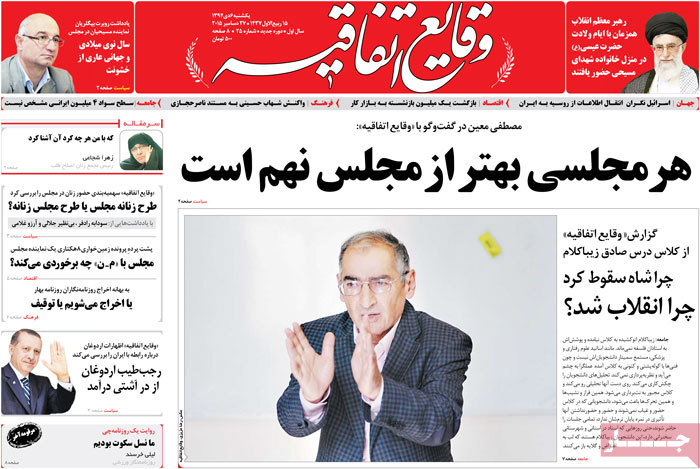
News about high levels of air pollution in the capital dominated the front pages of Iranian newspapers on Sunday. News stories about who has fielded their candidacy and who has not for the upcoming elections also appeared on the cover of dailies.


A look at Iranian newspaper front pages on Dec. 27


Ettela’at: The Environment Protection Organization has said the fact that Tehran is home to more residents than it can accommodate is the main culprit in air pollution in the capital.

A deputy director of the organization said massive property development and growing urbanization of recent years to increase municipal revenues is among the biggest urban management blunders which need to be rectified.

Ettela’at: The Central Bank has said inflation in the 30 days to December 21 stood at 13.7 percent.

The governor of the Central Bank has rejected interest rates of more than 20 percent as unacceptable.

Ettela’at: Pakistan has said it supports the legitimate government of President Assad.

The Pakistani deputy foreign minister said the way to solve the Syrian crisis goes through political dialogue.

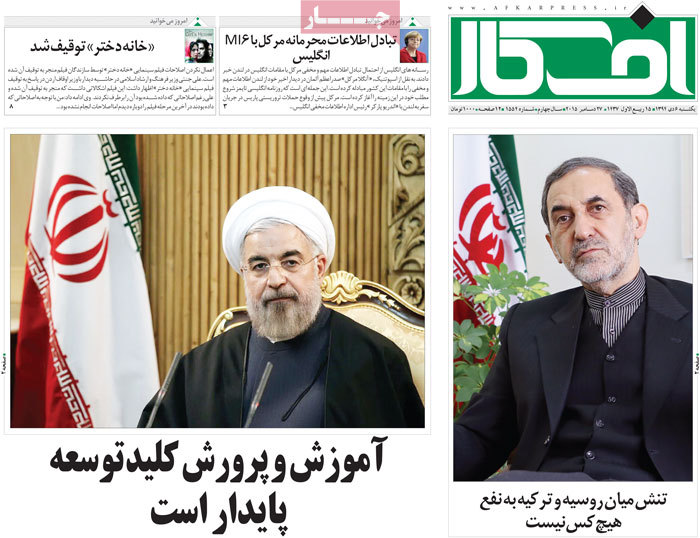
Ettela’at: The president has described education as key to sustainable development.

In a message to a conference held, among other things, to praise the services of Dr. Gholamhossein Shokouhi, President Rouhani said child education is among the most important factors in HR training.

Ettela’at: Some $17,000 in loans for renovation of old buildings.

Ettela’at: A new plan on gasoline sale at the pump will be implemented by yearend.


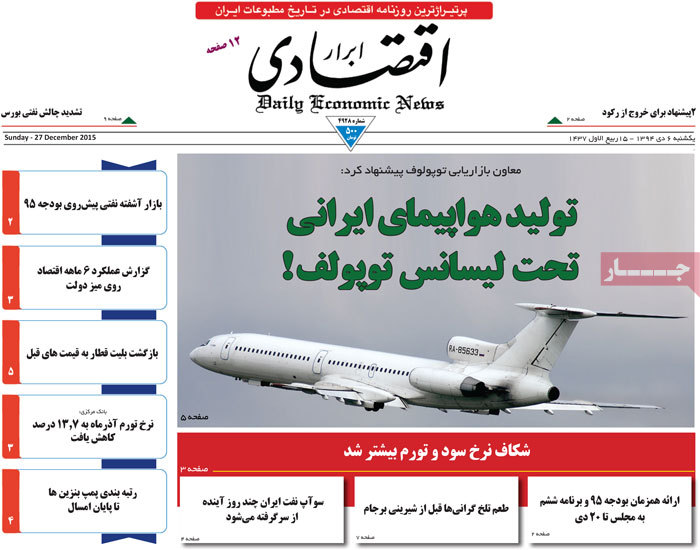
Abrar Eghtesadi: A senior official at the Russian aerospace and defense company Tupolev has put forth the idea of production – under license – in Iran of Tupolev aircraft!


A look at Iranian newspaper front pages on Dec. 27


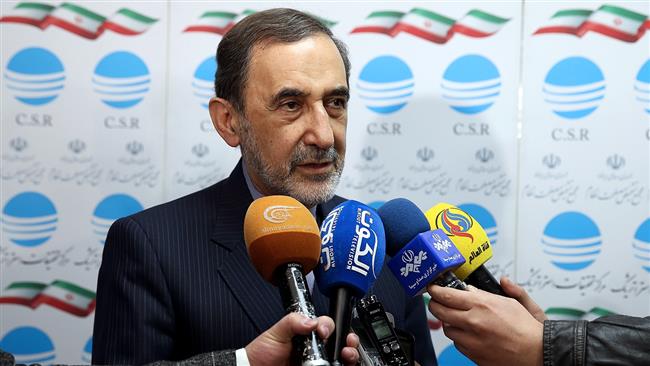
Afkar: Tensions between Russia and Turkey serve no one’s interests, said Ali Akbar Velayati, an advisor to the Supreme Leader.


A look at Iranian newspaper front pages on Dec. 27


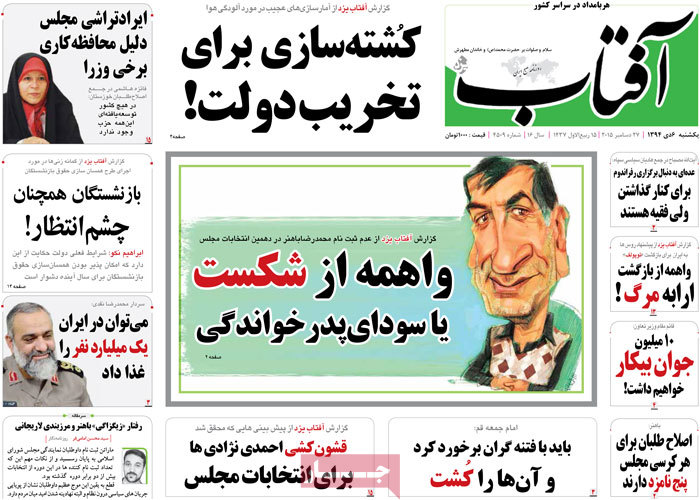
Aftab-e Yazd: Some are trying to set aside the religious jurisprudent through referendum, said Ayatollah Mesbah Yazdi.


A look at Iranian newspaper front pages on Dec. 27


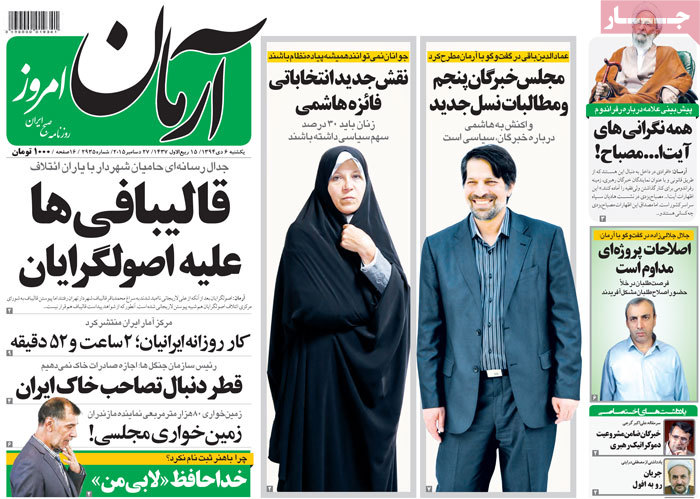
Arman-e Emrooz: The lobbyist bids farewell.

The daily takes a look at why Mohammad Reza Bahonar [a current vice-speaker of the Islamic Consultative Assembly] does not seek reelection in upcoming legislative elections.


A look at Iranian newspaper front pages on Dec. 27


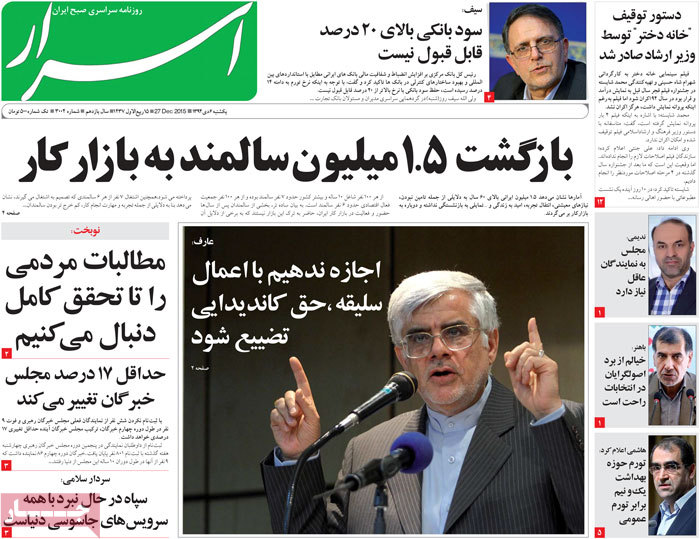
Asrar: The health minister has said that inflation in the healthcare sector is at least 1.5 times more than other areas.

Asrar: The passing of nine incumbents in the fourth assembly and the decision of six other representatives not to seek reelection mean there will be a minimum 17 percent change in the makeup of the Assembly of Experts [following the late February elections].


A look at Iranian newspaper front pages on Dec. 27


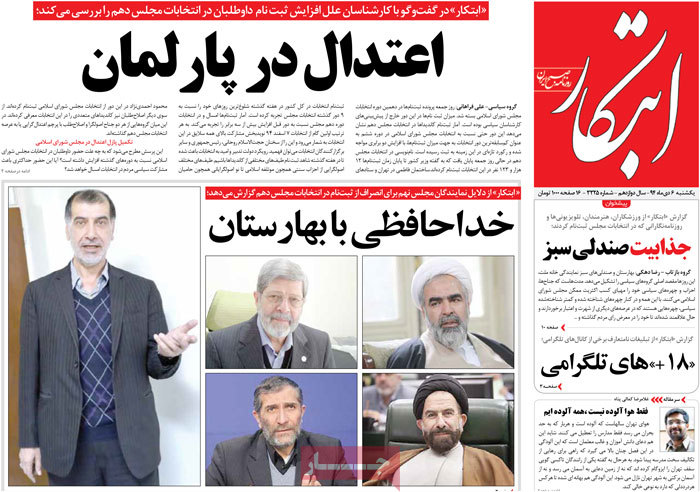
Ebtekar: Moderation in parliament

The daily has interviewed a number of experts on why the number of potential candidates for the 10 parliament has posted a dramatic increase.


A look at Iranian newspaper front pages on Dec. 27


Etemad: Of the 75 known figures running for the Assembly of Experts, 17 are close to reformists and moderates, 26 are members of the two main clerical societies in the country and 21 are independent.


A look at Iranian newspaper front pages on Dec. 27


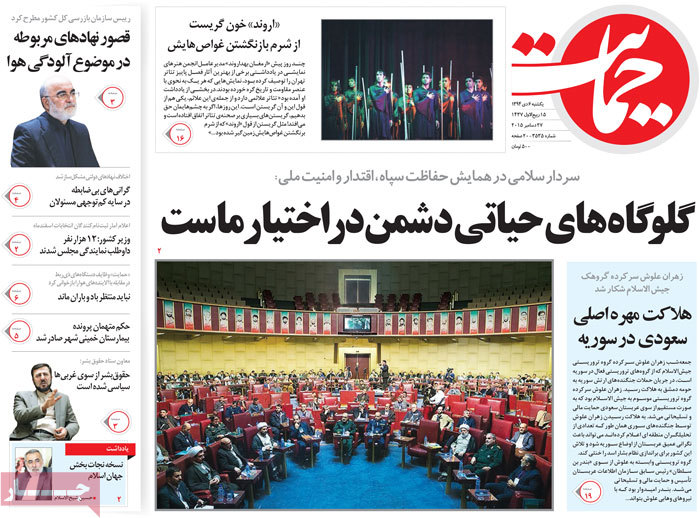
Hemayat: We have the strangleholds of the enemy at our disposal, said the deputy commander of the Islamic Revolution Guard Corps Brigadier General Salami in a gathering on IRGC and national authority and security.


A look at Iranian newspaper front pages on Dec. 27


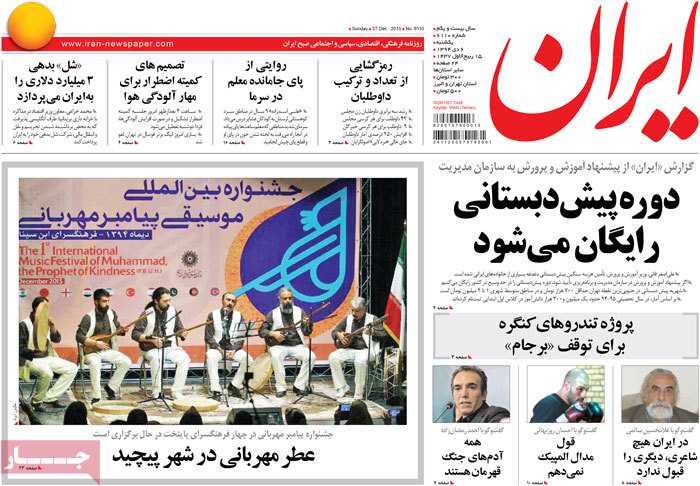
Iran: Four cultural centers in Tehran are playing host to a First International Music Festival of Muhammad, the Prophet of Kindness.

Iran: Pre-school education services will become free of charge.


A look at Iranian newspaper front pages on Dec. 27


Javan: Mosques are torched in France and the US.

Western leaders react passively to the desecration of Muslims as the world celebrates the birth anniversaries of the Prophet Muhammad and Jesus Christ.


A look at Iranian newspaper front pages on Dec. 27


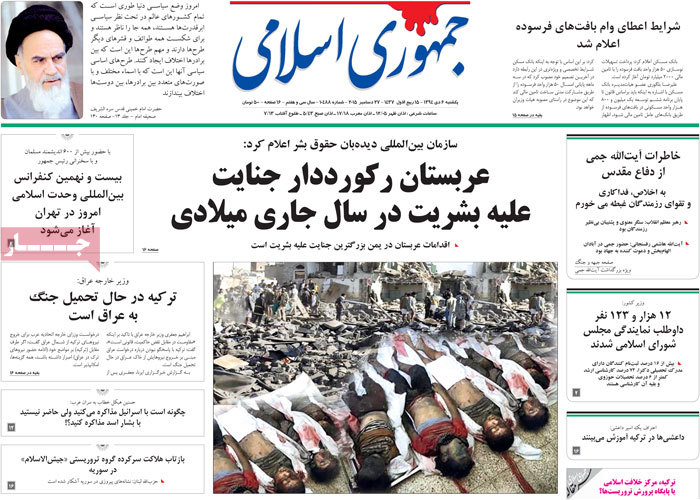
Jomhouri Islami: A 29th international conference on Islamic unity is held in Tehran on Sunday.

More than 600 scholars from across the Muslim world take part in the gathering; President Rouhani delivers a key-note speech.


A look at Iranian newspaper front pages on Dec. 27


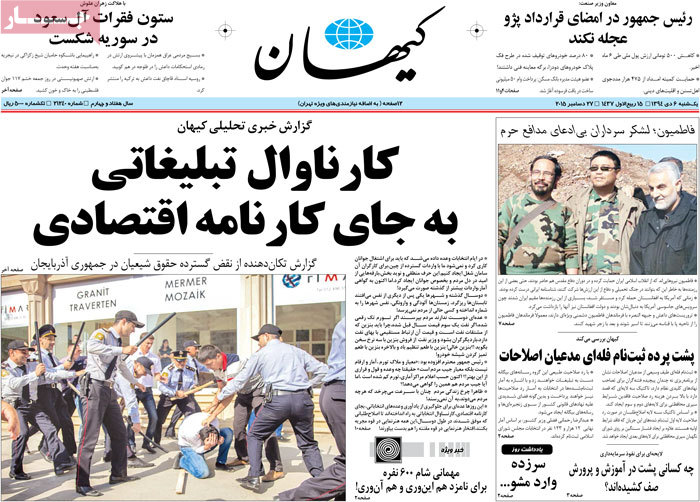
Kayhan: A deputy industry minister has said the president should not rush to signing a deal with Peugeot.


A look at Iranian newspaper front pages on Dec. 27


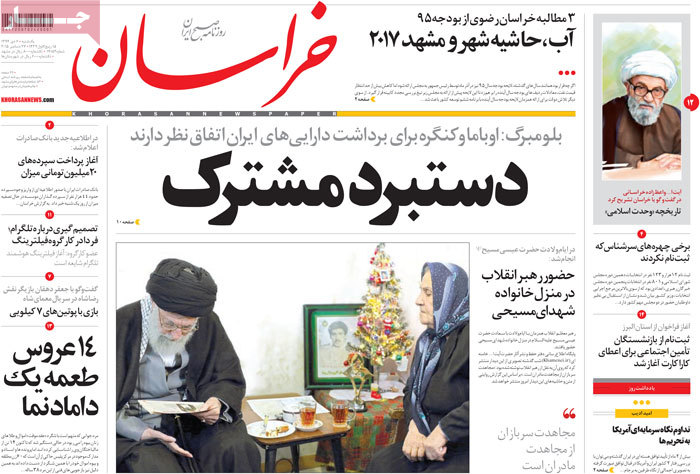
Khorasan: The Supreme Leader has paid visits to the houses of Christian martyrs in a move to mark Christmas.


A look at Iranian newspaper front pages on Dec. 27


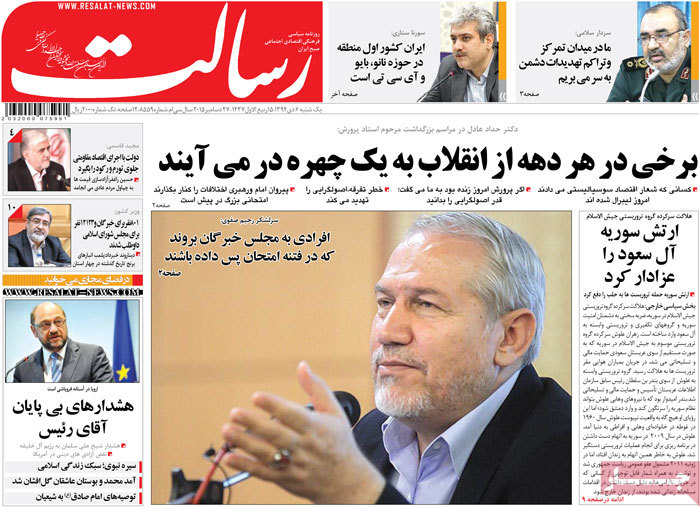
Resalat: Iran is a regional leader when it comes to nanotechnology, biotechnology and ICT, said the vice-president for science and technology.


A look at Iranian newspaper front pages on Dec. 27


Saheb Ghalam: Iran’s oil swap will resume within days.

Saheb Ghalam: Cars emitting pollutants will be impounded.


A look at Iranian newspaper front pages on Dec. 27


Setareh Sobh: The interior minister has said the number of potential candidates for the Assembly of Experts has registered a 62 percent increase over the previous elections. As for the Islamic Consultative Assembly the figure stands at 100 percent.


A look at Iranian newspaper front pages on Dec. 27


Sharq: Ali Motahari, a principlist MP, tops the list of moderates.

The meaningful farewell of the director [a reference to principlist MP Mohammad Reza Bahonar who is not seeking reelection]


A look at Iranian newspaper front pages on Dec. 27


Vaghaye-e Etefaghiyeh: An MP representing the Christian community in Iranian parliament in an opinion piece has called for a world free of violence in 2016.


A look at Iranian newspaper front pages on Dec. 27


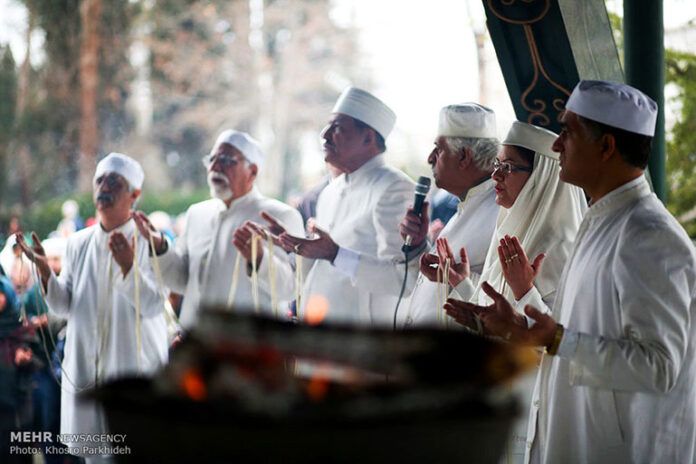
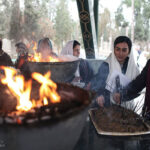
Ceremonies to mark anniversary of Zoroaster’s demise (PHOTOS)

Ceremonies-Zoroast0

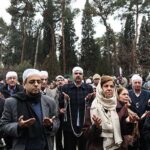
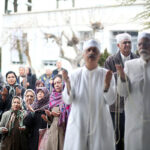
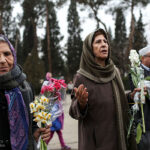
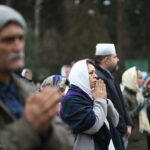
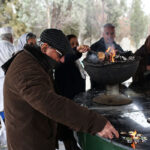
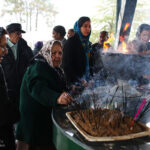
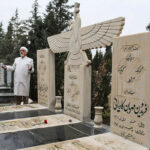
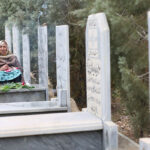
Zoroastrians held memorial ceremonies across the country Saturday to mark the anniversary of the demise of their prophet.

The following images of the memorials have been released by Mehr News Agency:

Iran dismisses Arab League claims as biased, unconstructive

Jaber Ansari

Foreign Ministry Spokesman Hossein Jaberi Ansari has described the anti-Iran claims brought up in the most recent statement issued by the Arab League as wrong, biased, unconstructive, and irrelevant to the issues the foreign ministerial meeting of the grouping was to discuss.

He underlined that Iran has “brotherly relations based on mutual respect with most Arab countries”, adding unfortunately a number of countries which are criticized by regional nations and the international community as the prime suspects in supporting extremism and terrorism are resorting to measures to portray Iran as a threat and to finger-pointing in order to divert attention from their own role in destabilizing the region.

At a time when a third Palestinian Intifadah is underway, regional states are expected to pay closer attention to regional issues, including the Zionist occupation [of Palestinian territories], full restoration of Palestinian rights, and measures to take on extremism and terrorism, so that the way can be paved for expanded cooperation in keeping with the common interests of regional countries and nations.

Iran is an active, responsible player in the region, he said, adding despite the unfriendly stance of some countries, it will continue to play a constructive role in easing tensions and defusing crises through interaction with its neighbors and the international community at large.

Russia-Turkey row against region interests: Leader’s aide

Velayati

A senior Iranian official says the ongoing tensions between Moscow and Ankara will not serve the interests of regional countries, urging all-out efforts to help end the row.

Both Turkey and Russia “are our neighbors and we do not want to see any tension between neighboring countries, with whom we have friendly relations,” Ali-Akbar Velayati, a top advisor to Leader of the Islamic Revolution Ayatollah Seyyed Ali Khamenei, said in Tehran on Saturday.

Velayati, who was speaking to reporters following a meeting with senior Turkish Shia cleric, Sheikh Salahuddin Ozgunduz, added that tensions between Russia and Turkey will serve the interests of neither of the two countries nor those of other regional states.

Tensions between Ankara and Moscow have been escalating since Turkey’s downing of a Russian fighter jet near the Syrian border. On November 24, Turkey shot down a Russian Sukhoi Su-24M bomber with two pilots aboard, claiming the fighter jet had violated the Turkish airspace. One of the pilots lost his life following the attack while the other was rescued in a Syrian army operation.

Moscow has dismissed Ankara’s claims, saying the plane was targeted in Syria’s airspace. Following the incident, Moscow imposed a number of punitive measures against Ankara, including restrictions on Turkish foods imports, a ban on tourist travel to Turkey, an embargo on hiring Turkish citizens in Russia and a ban on Turkish organizations’ activities in Russia.

Velayati further expressed hope that Iran and Turkey will improve cooperation with other regional countries, including Iraq and Syria, to thwart US and Zionist-led plots aimed at disintegrating Muslim states.

“If there is a difference among regional countries or Muslim states, it should be settled through dialog and [we] should not interfere in each other’s internal affairs,” he said.

The senior Iranian official also emphasized that nations in the region should not allow trans-regional countries to meddle in their affairs and stressed the importance of reinforcing unity and solidarity among Muslim nations.