Wednesday, December 24, 2025
Home Blog Page 4465

Army Ground Force to Unveil Latest Accomplishments

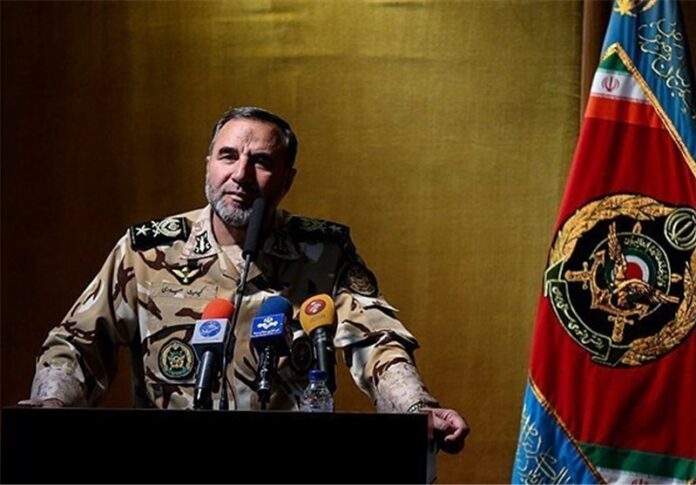
Speaking to Tasnim, General Heidari said the accomplishments of the Ground Force will be unveiled on April 17 during parades marking the National Army Day.

Iran holds the National Army Day every year in honor of its ground, naval and air forces.

Different units of the Army hold massive military parades all over the country to mark the occasion.

General Heidari further referred to the Army’s military exercises in the next Iranian calendar year (starts on March 20) and said the drills will be staged based on a plan approved by the Armed Forces General Staff.

Over the past few years, Iran has held several military drills to enhance the defense capabilities of its armed forces and test modern military tactics and equipment.

Tehran maintains that the maneuvers are defensive in nature and meant to convey a message of peace and friendship to regional countries.

Iran has repeatedly stated that its military might poses no threat to other countries, reiterating that its defense doctrine is based on deterrence.
KOGAS to build Iran-Oman gas pipeline

Pulse news portal reported that related talks are currently underway between officials from Iran and South Korea.

Project owners and KOGAS could sign either a memorandum of understanding or a framework agreement in April or May, the report added.

The 400-kilometer pipeline, stretching from Iran to Oman is defined in two onshore and offshore sections. Land part of the gas pipeline extends for 200 kilometers from Rudan to Mobarak Mount in southern Hormozgan province. The seabed section between Iran and Sohar Port in Oman will stretch for another 200 kilometers.

According to Pulse, the construction of the subsea pipeline is estimated to cost $1.5 billion.

Studies on Iran-Oman undersea gas pipeline is expected be complete by the middle of this year.

Iran and Oman have signed basic agreements based on which Iran will export a daily of 28 million cubic meters (mcm) of gas to Oman. Almost a third of the gas will be used in spare liquefaction facilities of Oman’s Qalhat plant and the rest will be consumed in the Persian Gulf sultanate’s domestic market. Iran will accordingly use the LNG produced for exports to European and Asian markets.

The Qalhat plant has the capacity to liquefy 10.4 million tons per annum (mta) of LNG. Yet, only 7.9 million tons were exported in 2014 from it to international markets, as the priority was given to meeting domestic gas requirements.

Deputy FM: Iran is updating Africa strategy

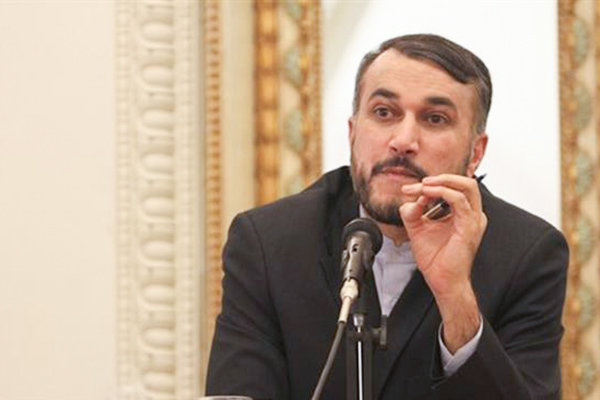
Amir-Abdollahian

Amir-Abdollahian made the remarks speaking during a meeting with Tehran-based African ambassadors.

He said that Iran has set a new target for reaching a higher level in boosting trade relations with Africa over the next five years.

Relations with Africa are growing and visits to Africa by Iranian officials and visits to Iran by African officials are on the agenda, the official said.

He expressed hope that with the help of African ambassadors, Iran can devise a plan for a brighter future in relations with Africa.

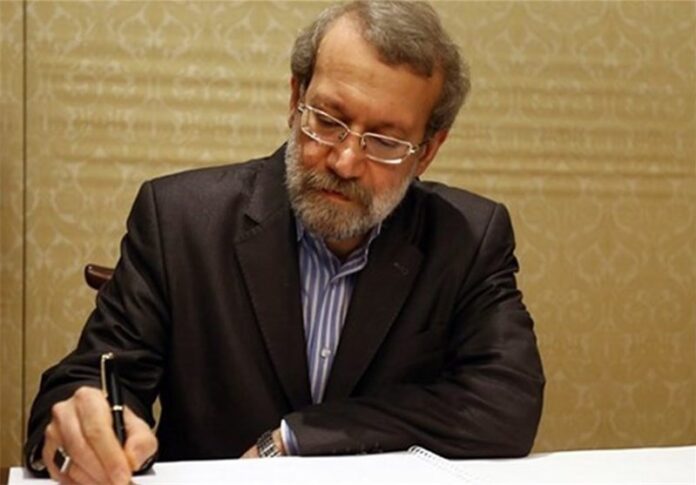
Iran’s Larijani Calls for Closer Regional Cooperation after JCPOA

In a Wednesday message to the parliament speakers of 10 regional countries where Nowruz, the Persian New Year, is celebrated, Larijani offered his congratulations over Nowruz.

He further pointed to the latest developments in the Middle East region and said, “I firmly believe that the current conditions and prospect of regional developments have illustrated more than ever the necessity of creating new security structures based on close cooperation among all countries.”

Larijani stated that in the current atmosphere created after the nuclear agreement with the Group 5+1 (Russia, China, the US, Britain, France and Germany), Iran welcomes any regional cooperation with its neighbors based on mutual respect.

Tehran and the Group 5+1 on July 14, 2015 reached a conclusion over the text of a comprehensive 159-page deal on Tehran’s nuclear program and started implementing it on January 16.

The comprehensive nuclear deal, known as Joint Comprehensive Plan of Action (JCPOA), terminated all nuclear-related sanctions imposed on Iran.

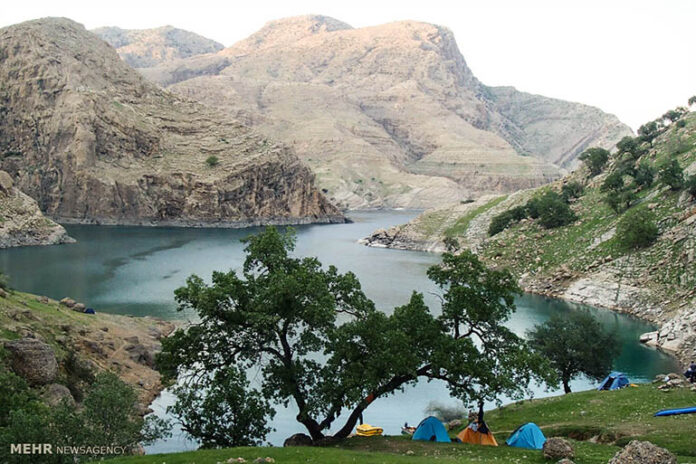
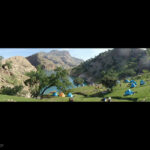
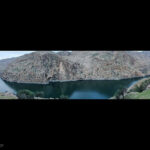
Shahid Abbaspour Dam (PHOTOS)

The Shahid Abbaspour Dam is a large arch dam providing hydroelectricity from the Karun River; it is located about 50 kilometers northeast of Masjed Soleiman, in Khuzestan province, Iran.

The following images have been released by Mehr News Agency:


Iran missiles serve defensive, deterrent purposes: Rouhani

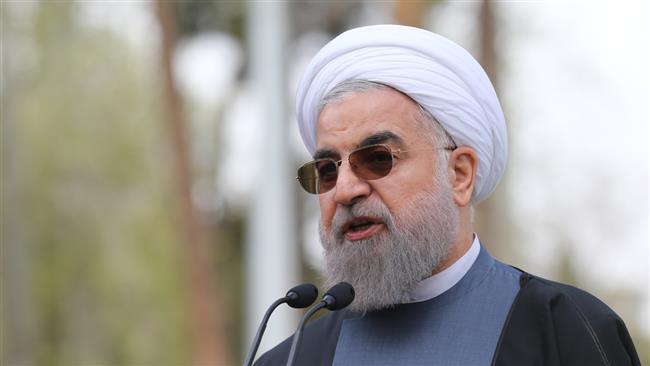
“We have had and no intention of invading any country, particularly our neighbors, with our missiles and we will not do so, and our arms are [designed] solely to defend our nation and country,” Rouhani said on the sidelines of a cabinet session on Wednesday.

The Iranian president further expressed satisfaction that US “hardliners and hawkish” officials, who unjustly took the Iranian missile test to the UN Security Council (UNSC), failed to achieve their objectives.

Earlier on March 14, Washington vowed to continue pushing for UN Security Council action on Iran’s recent ballistic missile tests and accused Russia of looking for reasons not to respond to Tehran’s missile launches.

“This merits a Council response,” US Ambassador to the UN Samantha Power told reporters on Monday after a closed-door meeting of the 15-nation Security Council convened at Washington’s request.

Power was referring to comments from Russian Ambassador Vitaly Churkin, who made clear that in the view of veto-wielding Russia, Iran’s ballistic missile tests did not violate resolution 2231, adopted last July, which endorsed a nuclear agreement between Tehran and six world powers.

Meanwhile, the director general for political and international affairs at Iran’s Foreign Ministry, Hamid Baeedinejad, wrote in his telegram channel on Monday that the UNSC has agreed that the country’s recent missile tests are not in breach of UN resolutions.

Last week, Iran fired Qiam ballistic missile from silo-based launchers in different locations across the country and successfully test-fired two more ballistic missiles of the Qadr family.

Washington claims that Tehran’s missile program is a threat to global security but Iran categorically denies the claim, arguing that its missile program is solely defensive.

Resolution 2231 “calls upon” Iran not to undertake any activity related to ballistic missiles designed to be capable of delivering nuclear weapons, including launches using such ballistic missile technology.

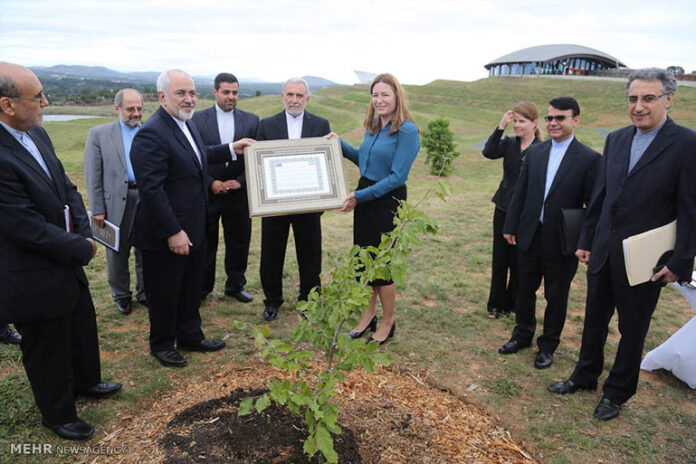
Zarif plants sapling in Australian garden

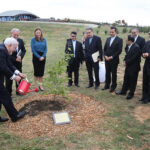
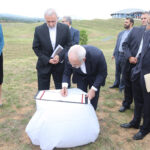
Iranian Foreign Minister Mohammad Javad Zarif planted a sapling in Canberra National Garden on Tuesday as a token of friendship between the two nations.

The following images have been released by Mehr News Agency:


Iran’s Power Only for Defense, FM Zarif Cites IRGC Chief’s Words

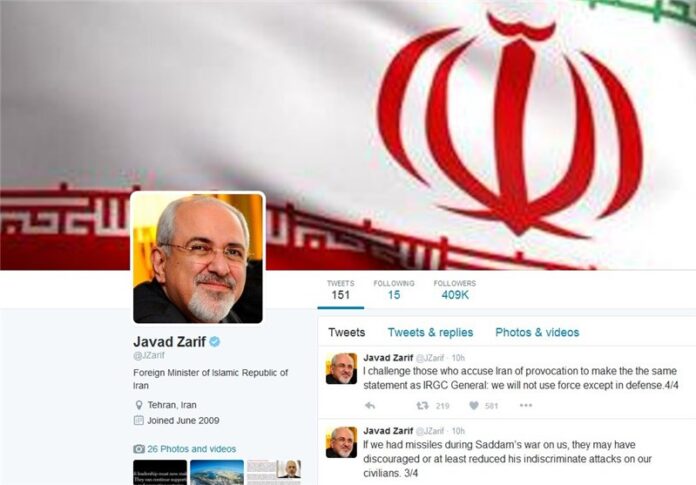
“Neither JCPOA nor SC Res prohibit Iran from missiles not designed for nuke warheads. Read the Document: It’s plain English not legalese,” Mohammad Javad Zarif said in a post in his Twitter account.

“Iran hasn’t attacked any country in 250 years. But when Saddam rained missiles on us and gassed our people for 8 yrs, no one helped us… If we had missiles during Saddam’s war on us, they may have discouraged or at least reduced his indiscriminate attacks on our civilians,” he added.

“I challenge those who accuse Iran of provocation to make the same statement as IRGC General: we will not use force except in defense,” Zarif underlined.

His comments came after a recent missile exercise by the IRGC provoked hue and cry in the West.

The IRGC Aerospace Division test-fired a number of advanced ballistic missiles with pin-point accuracy in the drill.

IRGC Commander Major General Mohammad Ali Jafari had already described the message of the missile drill as security for Iran and its neighboring countries.

Later on March 14, the UN Security Council convened a session to study the issue, but said in a statement that it needed more technical information to determine whether or not the launches were a breach of a UNSC resolution that was approved after the Joint Comprehensive Plan of Action (JCPOA).

Iran and the Group 5+1 (Russia, China, the US, Britain, France and Germany) on July 14, 2015, signed the JCPOA, a 159-page nuclear agreement that terminated all sanctions imposed on Tehran over its nuclear energy program.

Afterwards, the 15-memebr United Nations Security Council passed a resolution that endorsed the JCPOA.

Resolution 2231 calls upon Iran “not to undertake any activity related to ballistic missiles designed to be capable of delivering nuclear weapons.”

Iranian officials have time and again affirmed that none of the country’s missiles have been designed to be capable of carrying nuclear warheads, because nuclear weapons have basically no place in Iran’s defense doctrine.


Iran’s Nuclear Chief: IRGC Missile Tests Not in Breach of JCPOA

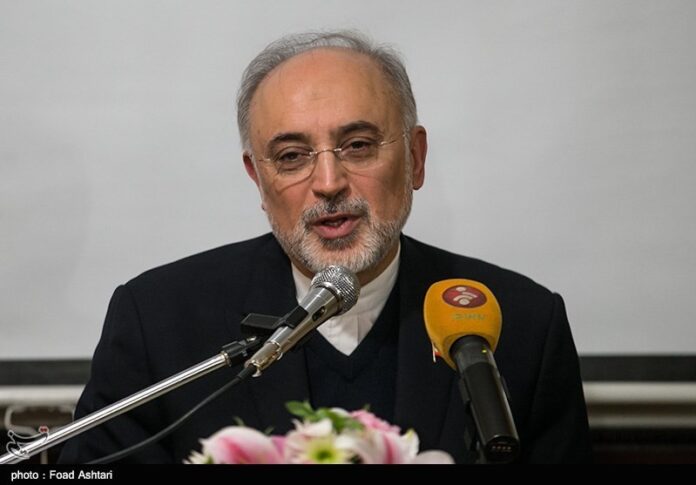
“The IRGC’s recent (missile) war game was definitely not in breach of the JCPOA, since our missiles have not been designed for (carrying) nuclear warheads,” Salehi told reporters in Tehran on Tuesday.

While Iran has undertaken under the JCPOA not to design any missiles with the capability to carry nuclear warheads, the country’s other activities in the military sphere will go on routinely, he added.

Asked about the US threats to re-impose sanctions against Iran, Salehi said Tehran will keep doing what it deems necessary for its national interests.

His comments came after a recent missile exercise by the IRGC provoked hue and cry in the West.

The IRGC Aerospace Division test-fired a number of advanced ballistic missiles with pin-point accuracy in the drill.

IRGC Commander Major General Mohammad Ali Jafari had already described the message of the missile drill as security for Iran and its neighboring countries.

Later on March 14, the UN Security Council convened a session to study the issue, but said in a statement that it needed more technical information to determine whether or not the launches were a breach of a UNSC resolution that was approved after the Joint Comprehensive Plan of Action (JCPOA).

Iran and the Group 5+1 (Russia, China, the US, Britain, France and Germany) on July 14, 2015, signed the JCPOA, a 159-page nuclear agreement that terminated all sanctions imposed on Tehran over its nuclear energy program.

Afterwards, the 15-memebr United Nations Security Council passed a resolution that endorsed the JCPOA.

Resolution 2231 calls upon Iran “not to undertake any activity related to ballistic missiles designed to be capable of delivering nuclear weapons.”

Iranian officials have time and again affirmed that none of the country’s missiles have been designed to be capable of carrying nuclear warheads, because nuclear weapons have basically no place in Iran’s defense doctrine.


Russia’s Syria Withdrawal Pre-Arranged: Iran’s Shamkhani

The pullout of Russian military forces from Syria was “not surprising at all”, Shamkhani told IRIB on Wednesday morning.

He said the plans for the withdrawal had been made earlier by the Kremlin.

Back on Monday, Russian President Vladimir Putin ordered the withdrawal of the “main part” of Russian forces in Syria, a move that reflected what he called the Kremlin’s achievement of nearly all its goals in the war-torn country.

Shamkhani further emphasized that the fight on terrorism is not going to end in Syria.

“The Syrian Army’s advances in areas where terrorist groups are still threatening the security of people and the region will continue with the advisory helps of Iran and Russia within a joint framework,” the top official added.

Russia’s Defense Ministry has announced that the first group of fighter jets left Syria on Tuesday, a day after President Putin’s order.

The technical staff at the Hmeymim air base near Latakia, Syria, “began to prepare the aircraft for the long-range flights to the Russian Federation,” the ministry said in a statement on its website.

Russia deployed about 50 fighter jets and attack helicopters to the base starting in September 2015.

Russia has also maintained a naval repair and refueling station on the coast at Tartus, its sole overseas military outpost.

The deployment of Russian forces helped turn the tide of the war in favor of Syria’s legitimate government.

Iran and Russia, known as the main allies of Syria, increased efforts in recent months to find a solution to the crisis that has plagued the Arab country for five years.

Syria has been gripped by civil war since March 2011 with Takfiri terrorists, including the Daesh (ISIL) terrorist group, currently controlling parts of it, mostly in the east.

The Syrian conflict has killed at least 260,000 people, according to the UN, and more than half of Syria’s pre-war population of 22.4 million has been internally displaced or fled abroad.