Saturday, December 27, 2025
Home Blog Page 4361

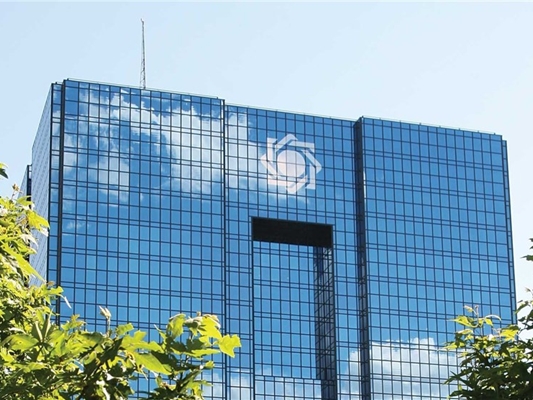
No Hitch to Developing Iran-Pakistan Banking Relations: Zarif

2640892a-80f6-43c0-9090-ef095a109782

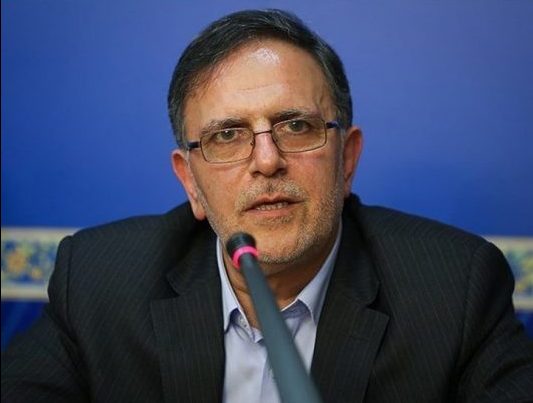
In a meeting with Pakistani Foreign Secretary Aizaz Ahmad Chaudhry in Tehran on Saturday, the Iranian minister added that enhanced economic ties between the two countries hinge on boosting banking cooperation.

“Pakistani banks are capable of speeding up their cooperation without any concern,” Zarif said.

He pointed to good relations between Tehran and Islamabad and urged the two sides to further strengthen their cooperation in all sectors, particularly in economy.

The Iranian minister further stressed the importance of fighting terrorism and extremism and said Daesh and al-Qaeda terrorist groups are common threats to the two countries.

The Iranian minister’s remarks came as the United States and the European Union continue with some acts of obstructionism in the implementation of last year’s nuclear agreement, known as the Joint Comprehensive Plan of Action (JCPOA), clinched between Iran and six global powers.

The nuclear deal envisages Tehran scaling back its nuclear program in return for the lifting of all nuclear-related sanctions on the Islamic Republic.

However, months after the agreement went into effect on January 16, the US and the European Union continue to maintain some sanctions on Iran, scaring off companies from resuming trade with the country.

European banks have balked at the idea of resuming transaction with Iran, fearing punitive US measures. US Republicans, meanwhile, are pushing through three anti-Iran bills in the Congress.

Iran has stressed that developing ties with its neighbouring countries are among its priorities.


Iran, Pakistan Improving All-Out Relations: Chaudhry

Chaudhry, for his part, said Tehran and Islamabad are improving their relations in all sectors.

He added that Pakistani firms are keen to cooperate with Iran and noted that his country attaches great importance to bolstering economic ties with the Islamic Republic.

Iran to Gain 9% Share of Global Fermentation Industry by 2025

Pharma Biotech Fermenters_tcm11-8337

Seyyed Abbas Shojaosadati, the Secretary of Fermentation Industry Working Group at the Biotechnology Development Headquarters of Iran’s Science and Technology Vice-Presidency, stressed on the growing position of fermentation industry in the world and said, “Currently, the share of fermentation industry in the global market is the huge and noteworthy amount of $180bn,” he underlined.

According to a report by IRNA, as translated by IFP, Shojaosadati said that the enzymes in food and detergent industries are among the fermentative materials that have gained a good place in the global market.

“Following a comprehensive study about the future of fermentation industry in 2025, we came to know that it has a bright promising future,” he emphasized.

“If the industry grows as much as 6 to 7 per cent by 2025, it would have a $300bn share of the global market, which is a quite impressive figure.”

“If we are to realize the goals set by the Biotech Development HQ, we should increase the country’s share to 9%.”

Based on the government’s extensive research in this field, authorities are advised to encourage investment in the industries that contribute to the enhancement of Iran’s share in the global market, he went on to say.

Shojaosadati noted that the government has embarked on a process of examining the reasons for the failure or progress of the country’s industries.

He described the fermentation industry as a high-tech one and said, “Since high-tech industries generally grow at a snail’s pace in Iran, we cannot expect a high growth rate here.”

Fermentation is a metabolic process that converts sugar to acids, gases, or alcohol. Humans have used fermentation to produce food and beverages since thousands of years ago. It is also used for food preservation in which the organic compounds with containing large molecules are broken into compounds with smaller molecules.

Rouhani, Putin, Aliyev to Discuss Fight against Terrorism in Baku

Rouhani-Putin-Aliyev

Heading a high-ranking delegation, Rouhani will leave Tehran for Baku on Sunday to hold key talks with his Russian and Azeri counterparts, Parviz Esmaeili, Rouhani’s deputy chief of staff for communications and information, said on Friday, August 5.

Esmaeili noted that the three presidents will discuss “trilateral cooperation in the fight against terrorism and such sectors as commerce, energy, communications, environment, and transportation.”

On the sidelines of the summit, the Iranian and Russian presidents will discuss issues of common interest and ways to strengthen cooperation, Press TV quoted Esmaeili as saying.

He further added that Rouhani plans to hold a meeting with Aliyev on Sunday and discuss the implementation of agreements previously signed between Tehran and Baku.

The Iranian and Azeri presidents will also exchange views about cooperation in different fields including commerce, industry, energy and culture six months after the two countries signed 11 agreements and memoranda of understanding in Tehran.


Necessity for Promotion of Iran-Russia Defence Cooperation

According to a report by IRNA, as translated by IFP, Iran and Russia have long had common interests in the Middle East and the Central Asia, and currently share interests in the ongoing crises in Syria, Iraq, Yemen, and Afghanistan.

The two sides have understood the importance of close defence and security cooperation, and it is now one of the top priorities in their agenda.

In a Friday interview with Azerbaijan’s state news agency Azertac, the Russian president hailed the cooperation among Iran, Russia and Azerbaijan in fighting terrorism and curbing drug trafficking.

“I believe there are also good prospects for intensifying interaction to counter terrorism and drug trafficking in a trilateral format,” Putin said.

According to a report by TASS news agency, as covered by IRNA, Putin stressed that the three countries are engaged in close dialogue on the issue.

He also said that Moscow and Tehran have similar key approaches and see additional opportunities in enhanced multilateral anti-terrorism cooperation within the Shanghai Cooperation Organization (SCO).

“Together with our Iranian partners, we are engaged in the Clean Caspian Sea operation aimed at cutting off drug trafficking routes,” the Russian leader further said.


56-Year-Old History of Iran’s Military Cooperation with USSR and Russia

Since 1960, Tehran and Moscow have put on their agenda the development of their military relations in an organized way. From 1963 to 1978, hundreds of military experts were sent from the Soviet Union to Iran, and 500 Iranian officers were sent to the USSR for higher military education.

Various technologies for ground forces, engineering and artillery, several armoured vehicles and military trucks, anti-aerial and multiple short-range missile systems, special tanks and minesweepers  were among Iran’s imports from the Soviets.

Iran also used the Red Army’s help to construct plants in Isfahan and Shiraz for the overhaul of military equipment. Soviet experts also helped Iran build a grand centre near Tehran to renovate and rebuilt artillery warfare as well as armoured and military vehicles.

The Islamic Revolution in 1979 and the end of Iran’s role as the gendarme of Persian Gulf for the West provided the USSR with the opportunity to improve its ties with Iran; however, along with the US and the West, the USSR remained a major supporter of Iraq and its dictator Saddam Hussein in the war they imposed on Iran.

The deportation American advisors from Iran and the seizure of CIA’s intelligence centres – which were responsible for eavesdropping and observing the Soviets’ military activities – also contributed to the promotion of Tehran-Moscow cooperation.

From 1989 to 1991, a few years before the dissolution of the USSR, four intergovernmental contracts were signed between the Islamic Republic and the Soviet Union on technological-military cooperation. Based on these deals, $1.3bn of arms was sent to Iran, and tens of optimized choppers and portable anti-missile and anti-aerial systems were bought by Tehran.

General Soleimani to Play Major Role in Mosul Operation: Iraqi Spokesman

Ahmad al-Assadi

“The presence of Major General Soleimani in the operations to free Mosul and Nineveh province is necessary and General Soleimani is the greatest advisor that has helped the Iraqi government in the war against the ISIS,” al-Assadi told Fars on Saturday, August 6.

General Soleimani“Hajj Qassem Soleimani is one of the most important military advisors of the Islamic Republic of Iran who is in Iraq at the invitation, demand, and agreement of the Iraqi government,” he added.

He once again stressed that Iranian advisors are in Iraq at the demand of the Iraqi government and have played a major role in most operations conducted by the popular forces.

“They provided the Iraqis with strong views and important consultations given their experience and capabilities,” Fars quoted al-Assadi as saying, as edited by IFP.

In relevant remarks back in June, Iraqi Foreign Minister Ibrahim al-Jaafari underlined that General Soleimani is in Iraq to help the country in its campaign against terrorism after receiving Baghdad’s rigid request.

“General Soleimani is in Iraq at the invitation of the Iraqi government to provide military counselling for the Iraqi forces,” the Arabic-language Sumaria news channel quoted al-Jaafari as saying.

Also in June, Hashd al-Shaabi (volunteer forces) Commander Abu Mehdi al-Mohandes underlined that General Soleimani is helping the Iraqi forces in their campaign against terrorism upon a request by the Iraqi government.

“The Iranian advisors, headed by dear brother Qassem Soleimani, have been beside us since the beginning of the war and his presence is based on the demand of the Iraqi government and agreement of the Armed Forces’ top commander,” Mohandes said at the time.

Families of Saudi Soldiers Hold Protest Rally against Yemen War

Yemen War

According to the Yemeni Press news website, hundreds of Saudi people called for ending the country’s war against Yemen.

Eye-witnesses and foreign journalists reported that the protesters gathered in front of al-Yamama palace and asked for the return of their sons from Yemen battlefields, as reported by Fars and edited by IFP.

The Saudi security forces on the scene seized all cell phones of the protestors, anticipating that they would take photos and record the gathering to upload them onto social media. Tens of protesters were arrested and taken to an unknown place.

A foreign media source who asked for anonymity said that the protestors chanted slogans against the Saudi regime’s war in Yemen, including “stop killing our children” and “Saudi King Salman bin Abdulaziz should be held accountable for shedding the blood of our youth.”

The protest rally was held as the Yemeni forces’ ballistic missile attack killed and wounded tens of Saudi forces in Najran province in the Southern parts of the kingdom in late July.

“At least 200 Saudi troops have been killed or wounded after Yemen’s Zalzal 3 ballistic missile hit their military positions in Najran province,” Senior Ansarullah Commander Abdollah al-Zeidi told Fars on July 26.

Also in late July, the Saudi interior ministry in a statement announced that nearly half a dozen of the kingdom’s soldiers and senior officers were killed in clashes with the Yemeni army and popular forces near the border with Yemen.

“Five Saudi soldiers have been killed in a battle with Yemeni forces in Najran province and two senior Saudi officers were also killed in a tough battle in Jizan province,” the Saudi interior ministry’s statement said.

It said that the Saudi soldiers were killed in Khabash region of Najran province while the officers were killed in clashes with the Yemeni forces in Jizan’s al-Rabou’a region.

Commander Says Emergence of Takfiris Part of West’s Plot against Islam

Hossein Salami

After the victory of the Islamic Revolution in 1979, Islam began to spread quickly in the West, Brigadier General Salami said in a speech in the western province of Lorestan on Saturday.

He added that nearly 50,000 Britons embraced Islam every year and the number of mosques in Europe rose “from a handful to thousands” during the early years after the revolution.

“The emergence of Takfiris was the West’s scenario to destroy Islam’s attractions, create hatred and stop spread of the religion in the West,” the commander said.

He further deplored the terrorist acts of Takfiri groups committed in the name of Islam, saying that Islam is a completely humane school of thought and regards killing one innocent human being as “killing the entire humanity”.

In recent years, the Middle East region has been plagued with Takfiri terrorist groups like Daesh (also known as ISIS or ISIL), which are believed to have been created and supported by the West and some regional Arab countries.

The terrorist groups, which claim to be Islamic but whose actions are anything but, have been committing heinous crimes not only against non-Muslims, but mostly against Muslims in the region.

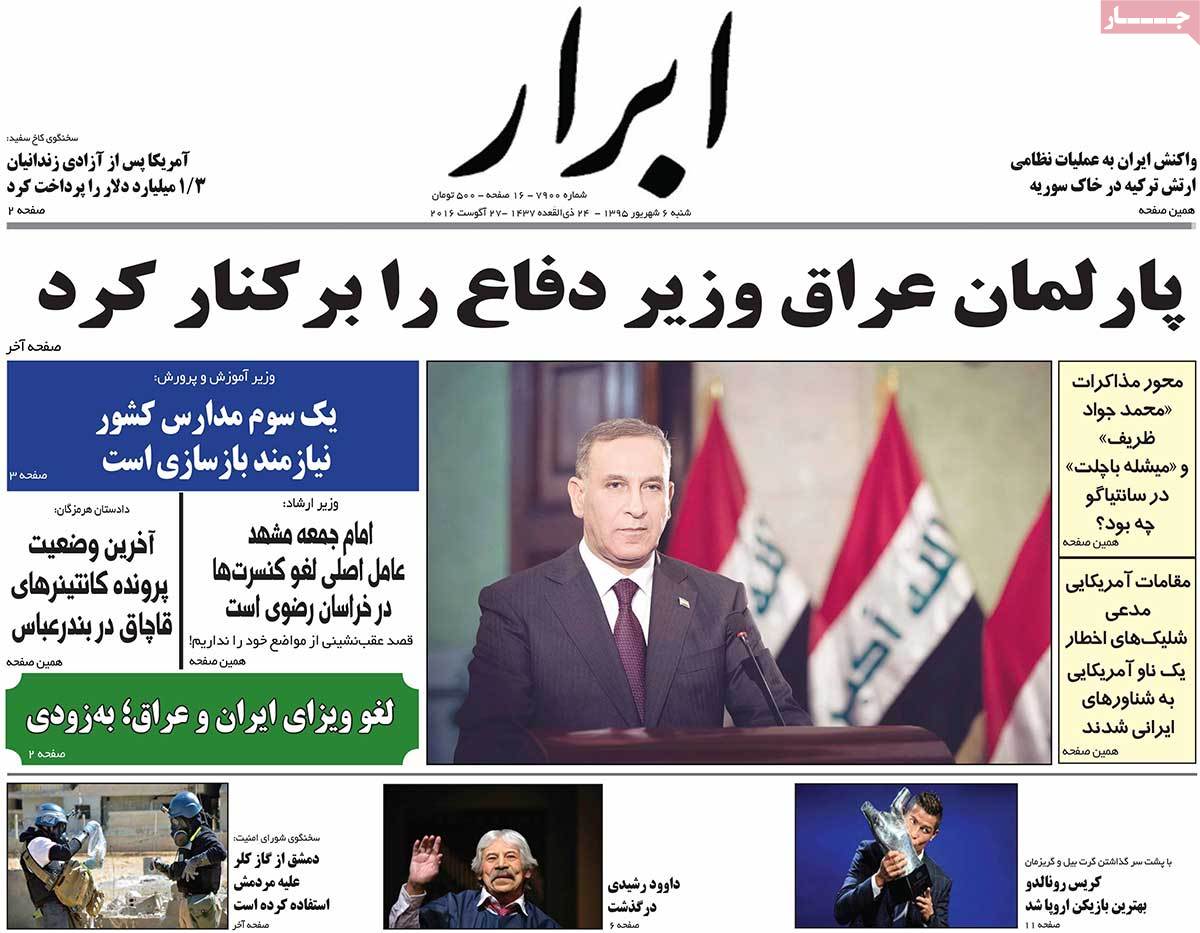
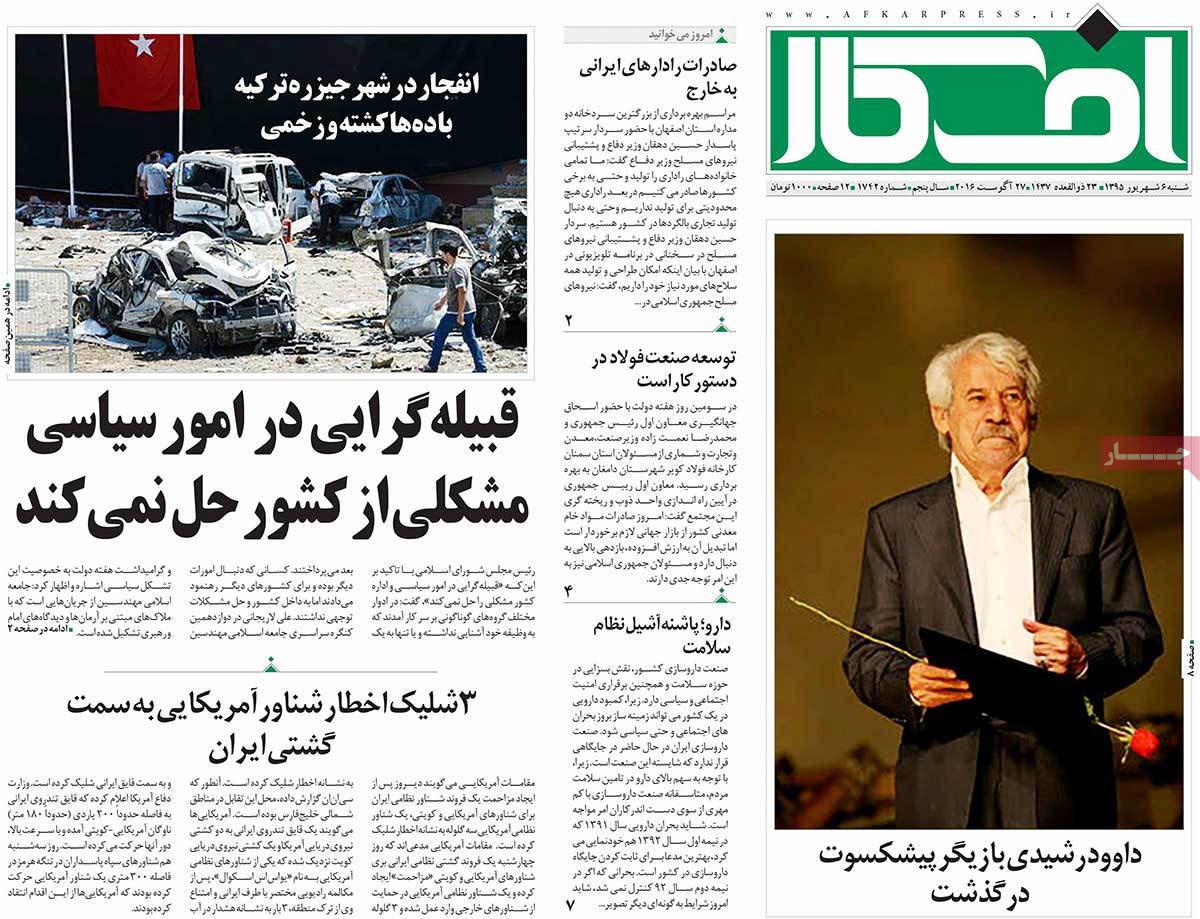
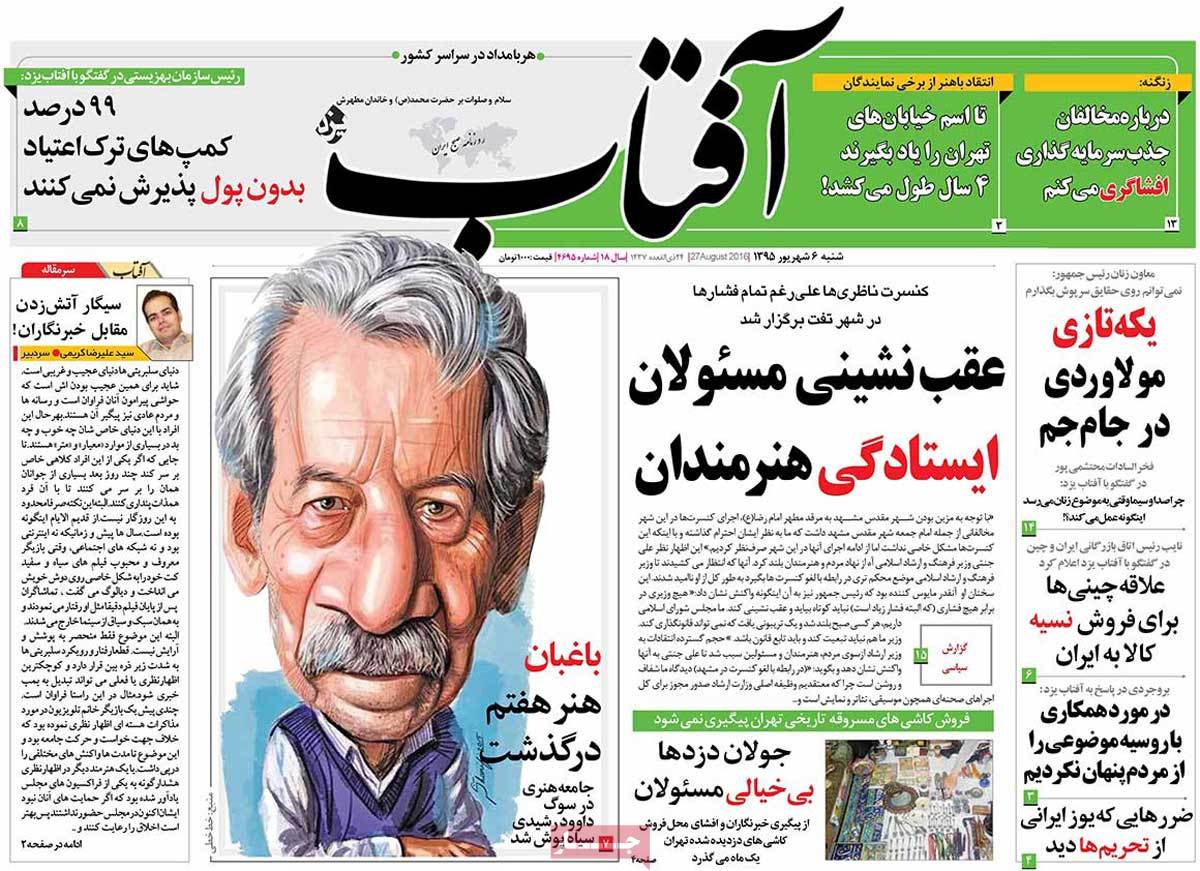
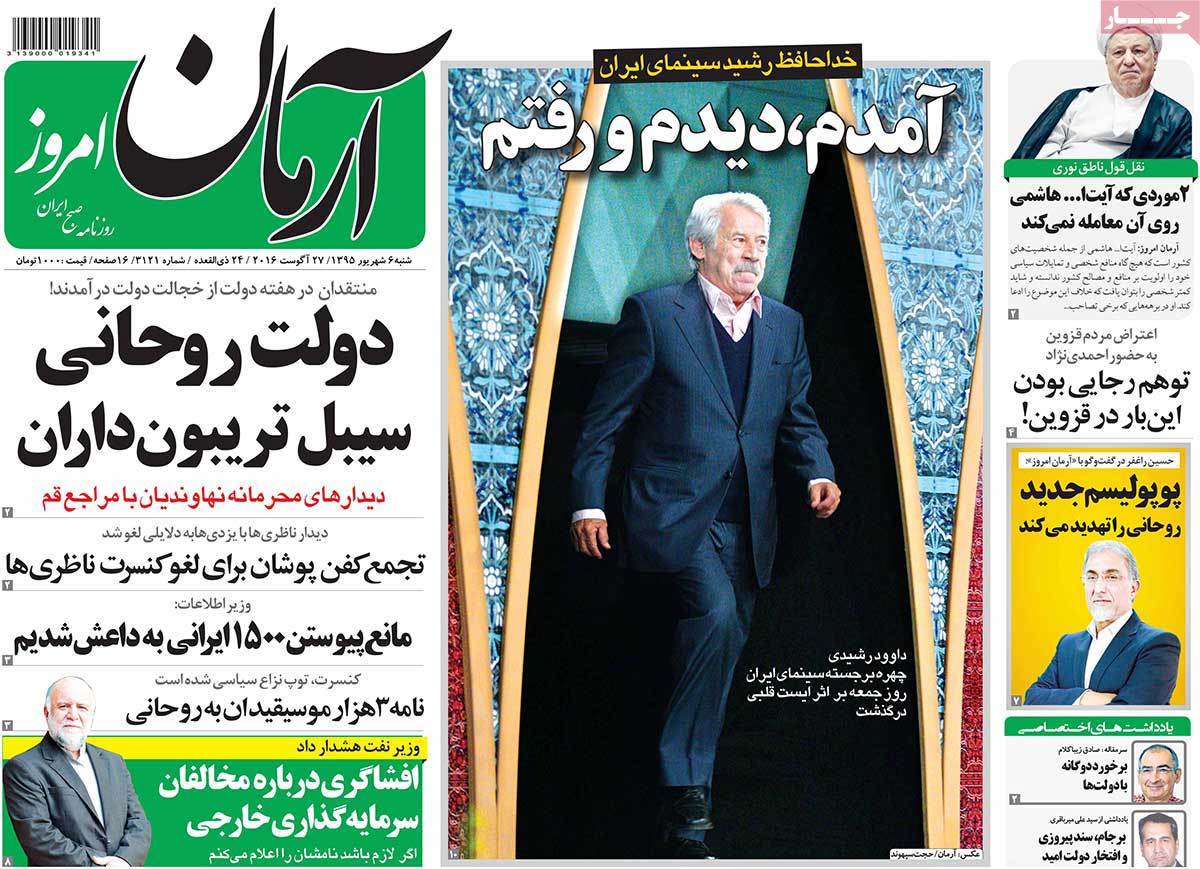
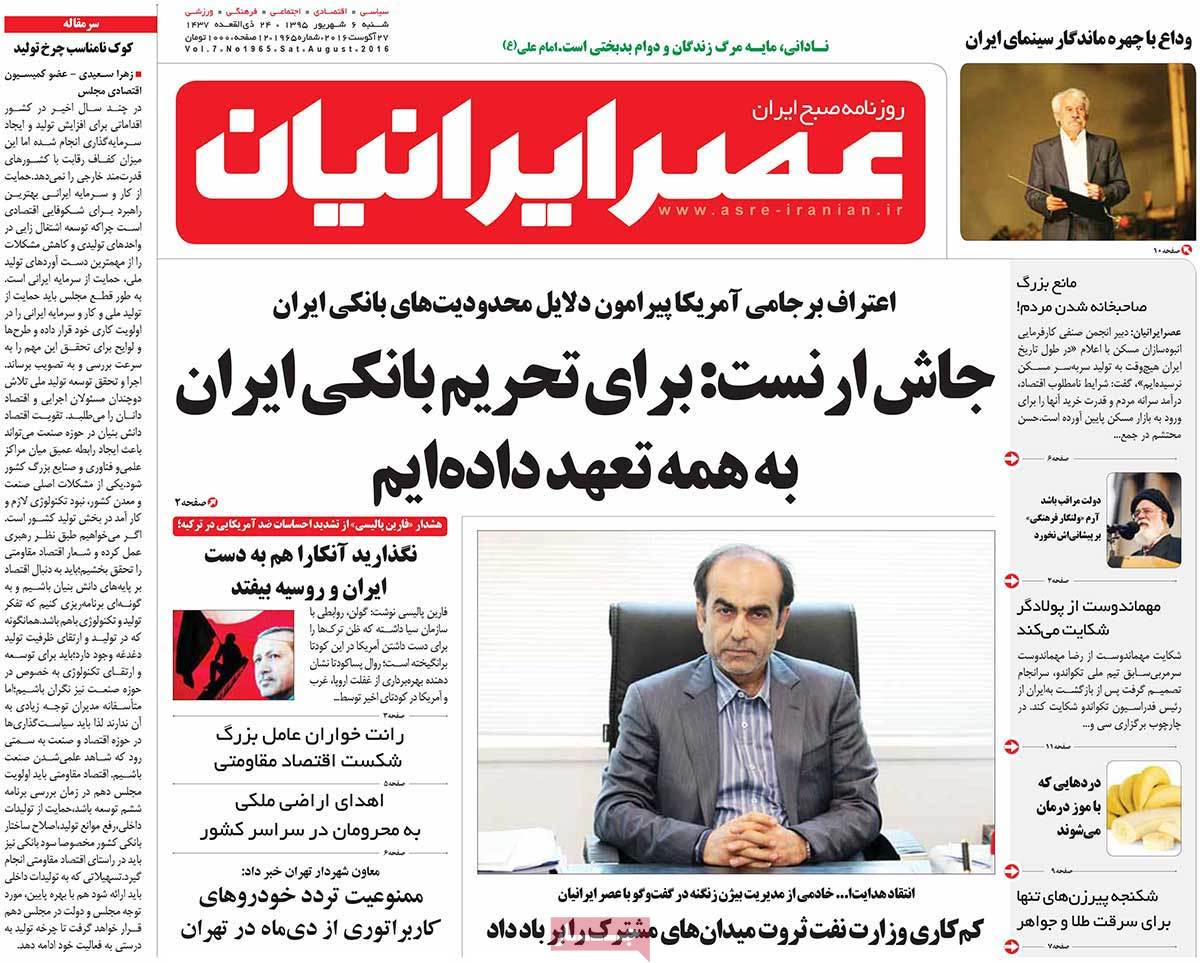
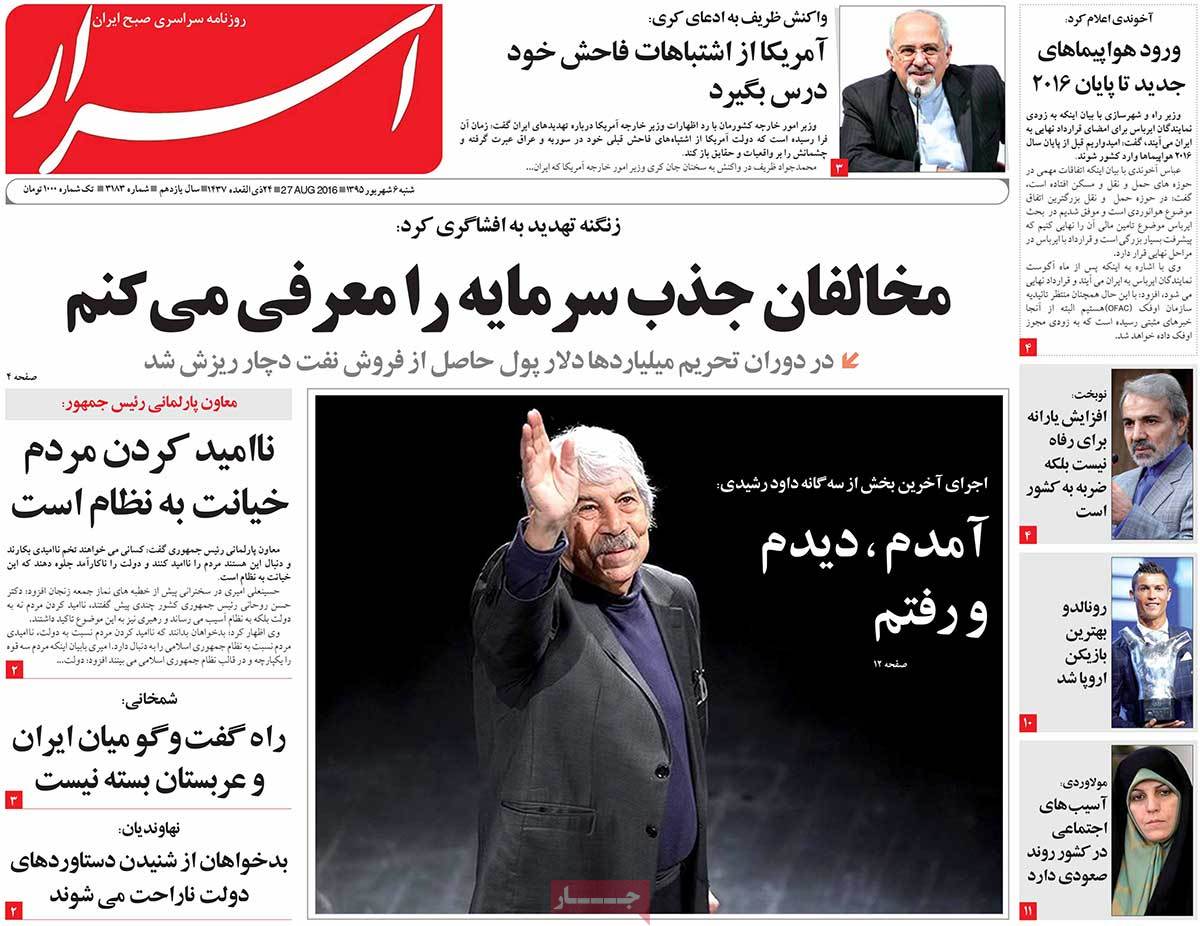
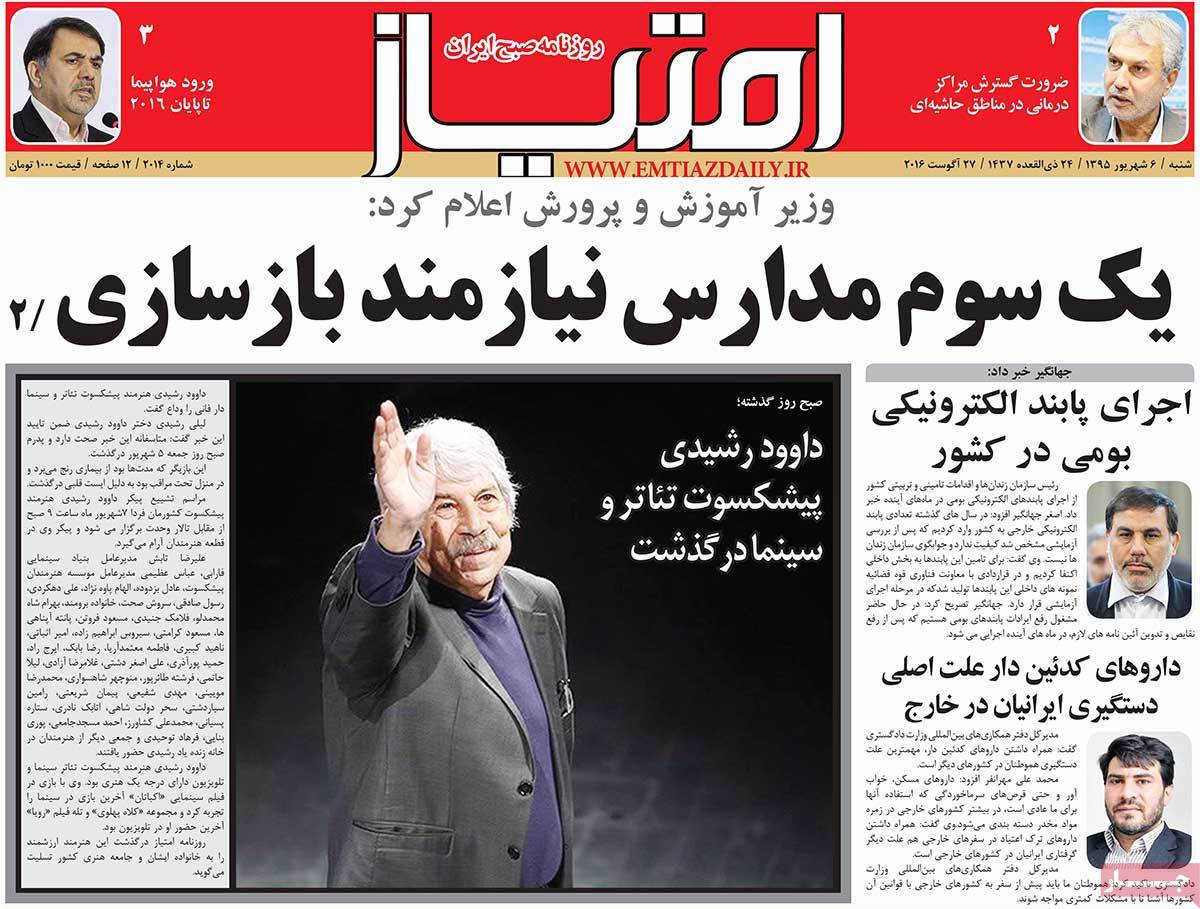
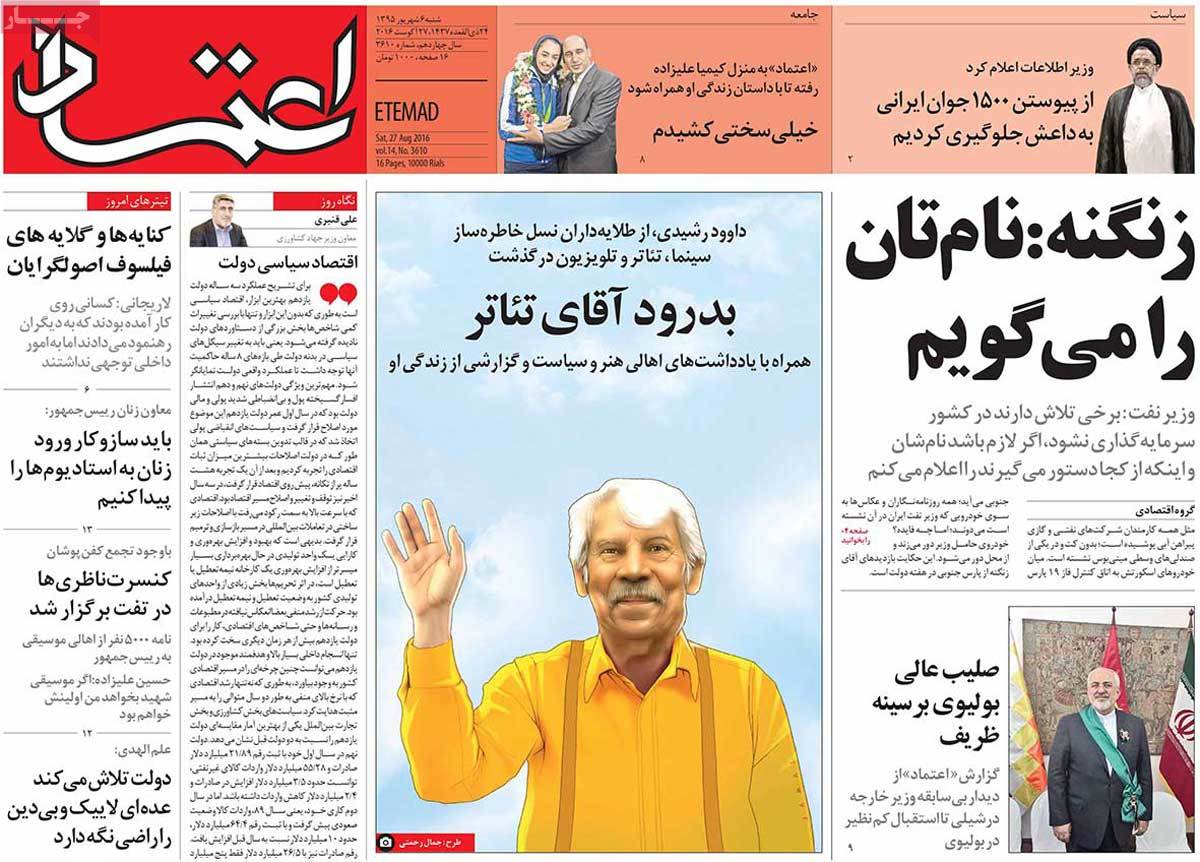
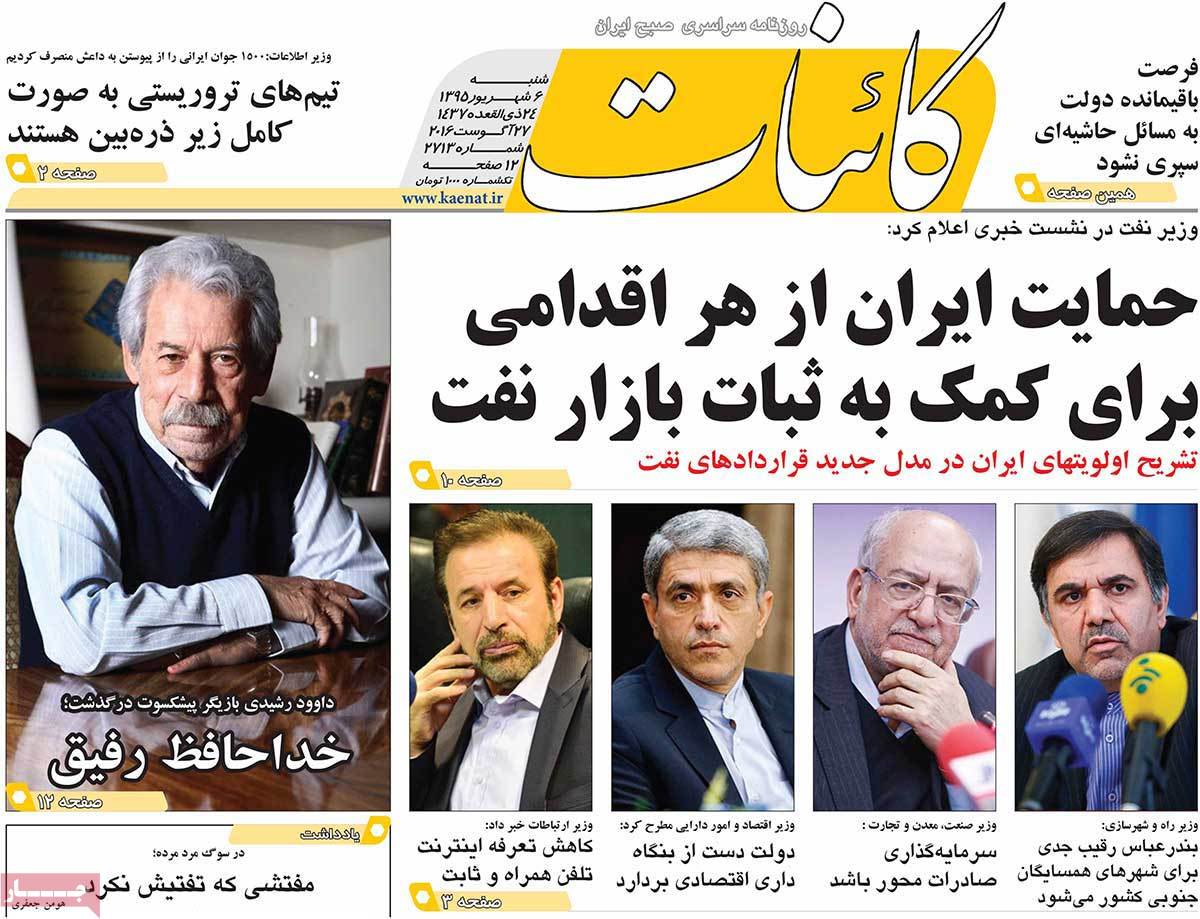
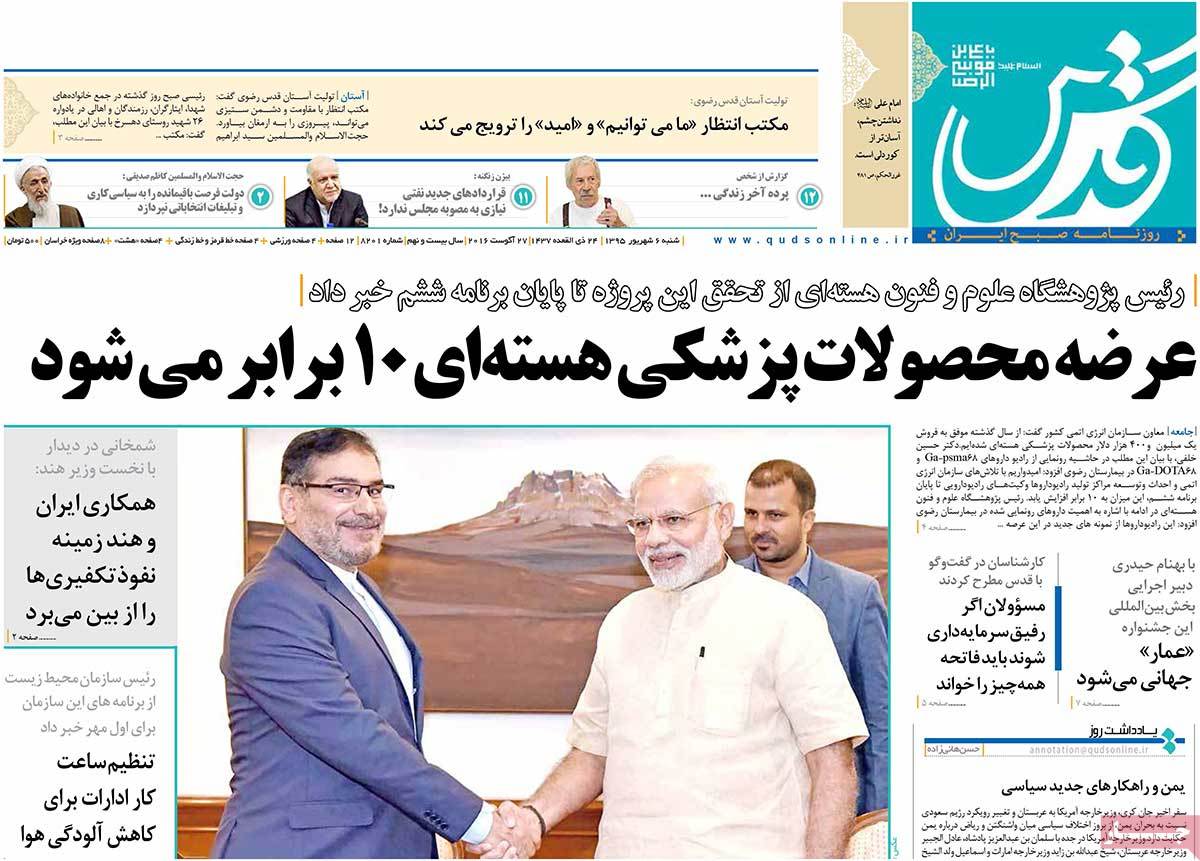
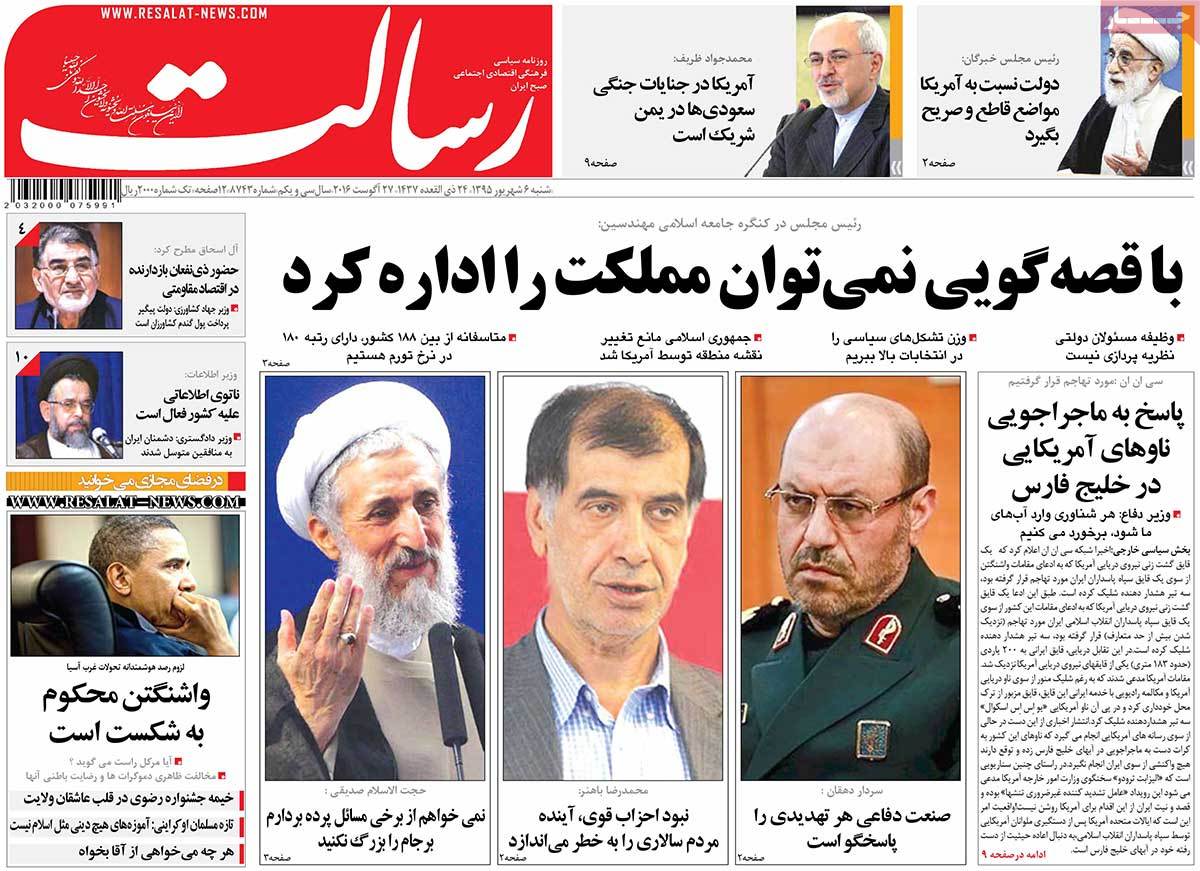
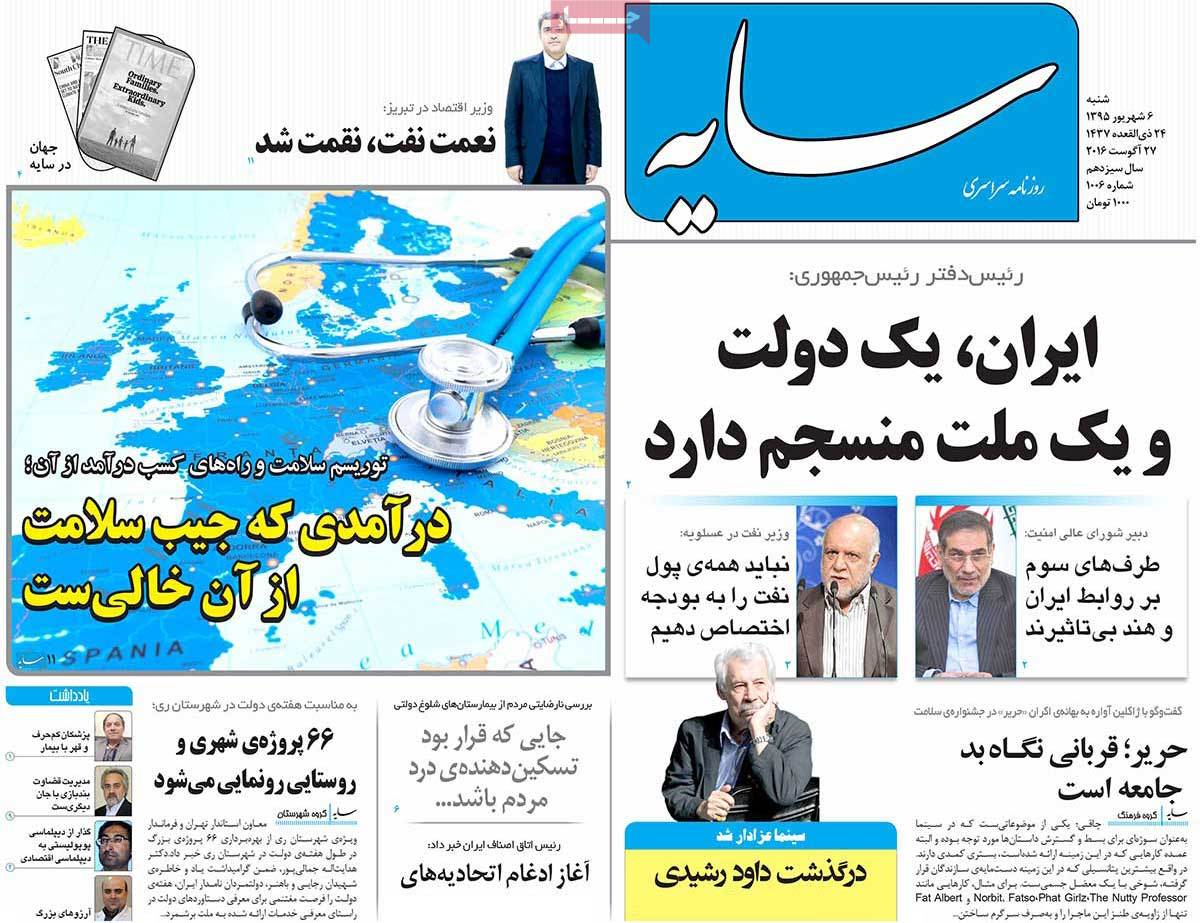
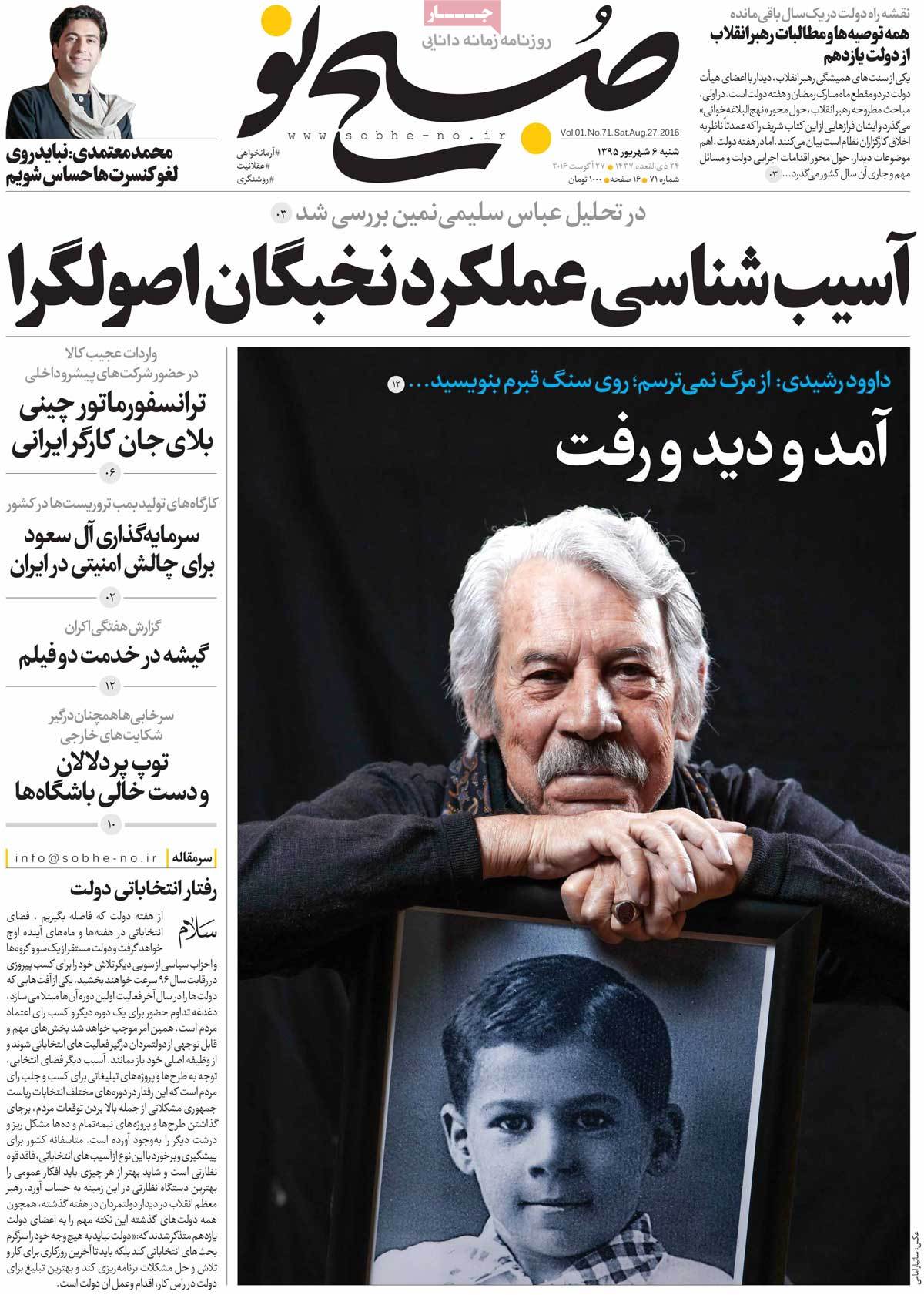
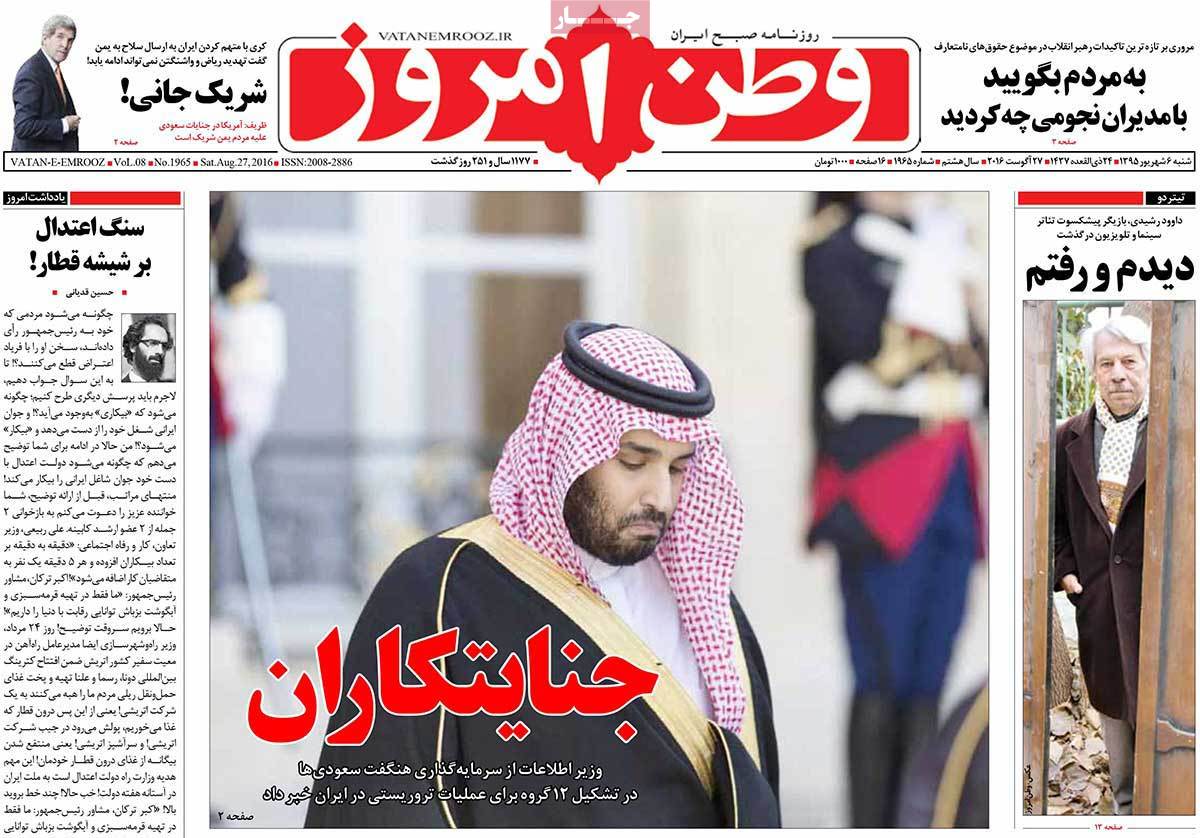
A Look at Iranian Newspaper Front Pages on August 6

Iran Newspaper front pages

Newspapers on Saturday highlighted the death of a disabled war veteran, Rajab Mohammadzadeh, whose face had been deformed in the Iraqi imposed war, and suffered lots of pains in all these decades.

They also covered the ongoing attacks against the government and President Hassan Rouhani, who are being criticized more than ever after the recent remarks by the Leader of the Islamic Revolution Ayatollah Seyyed Ali Khamenei on the fruitlessness of the nuclear deal between Tehran and world powers.

The above issues, as well as many more, are highlighted in the following headlines:


Abrar:

1- UNSC Condemns North Korea’s Missile Test

2- Iran Has a Valuable Peace in Chaotic Conditions of Middle East: Larijani

3- We Didn’t Pay Any Money to Iran for Release of American Prisoners: Kerry

4- EU’s Interventionist Statement in Protest at Executions in Iran
A Look at Iranian Newspaper Front Pages on August 6


Aftab-e Yazd:

1- Forgive Us ‘Baba Rajab’: 70% Disabled War Veteran Rajab Mohammadzadeh Dies in Mashhad

2- 3 Iranian Companies Removed from List of Sanctions

3- Putin: We’ll Build 8 Nuclear Power Plants for Iran; Tehran Once Again Trusts Kremlin

A Look at Iranian Newspaper Front Pages on August 6


Arman-e Emrooz:

1- Iran Should Not Use North Korea as Its Role Model: Businessman

2- $400m Was Not Paid to Iran as Ransom Money: Obama

3- Genetic Manipulation of Agricultural Products: Coloured Bananas in Iranian Market

A Look at Iranian Newspaper Front Pages on August 6


Asrar:

1- Tehran Is Moscow’s Strategic Partner: Putin; We’ll Support Iran’s Full SCO Accession

2- All Concerts Temporarily Cancelled in Iran’s Khorasan Razavi Province [home to holy shrine of Imam Reza, the eighth Shiite Imam]

3- In Every 5 Iranian Families, Unemployment Exists in One: Official

A Look at Iranian Newspaper Front Pages on August 6


Ebtekar:

1- Do’s and Don’ts in the Last Year of Rouhani’s Term [Editorial]

2- Obstacles to Iran’s Accession to WTO: Doing Business in Isolation

3- Golden Triangle of Energy Diplomacy in Caucasia: Rouhani, Putin, and Aliyev to Hold Trilateral Meeting in Baku

4- 31st Edition of Olympic Games Kicked Off in Rio

A Look at Iranian Newspaper Front Pages on August 6


Emtiaz:

1- Decrease in Rates of Road Accidents

A Look at Iranian Newspaper Front Pages on August 6


Etemad:

1- Crisis in Iran-Saudi Arabia Ties Is Very Deep: President’s Aide

2- Airplane Trump Had Seen in His Dreams: Donald’s Lies about $400m Paid to Iran

3- [Clerics’] Attacks against President Rouhani:

  • Rouhani Should Be Tried on Charge of Treason
  • A Naïve Person Says JCPOA Has Given Honour to Iran
  • After Leader’s Remarks, Whoever Talks about Ties with US Is Opposed to Supreme Leader

4- Iran-Pakistan Priorities in Security Cooperation Are Different: Analyst

5- 74% Increase in Divorce Rates in Iran within Past 10 Years

A Look at Iranian Newspaper Front Pages on August 6


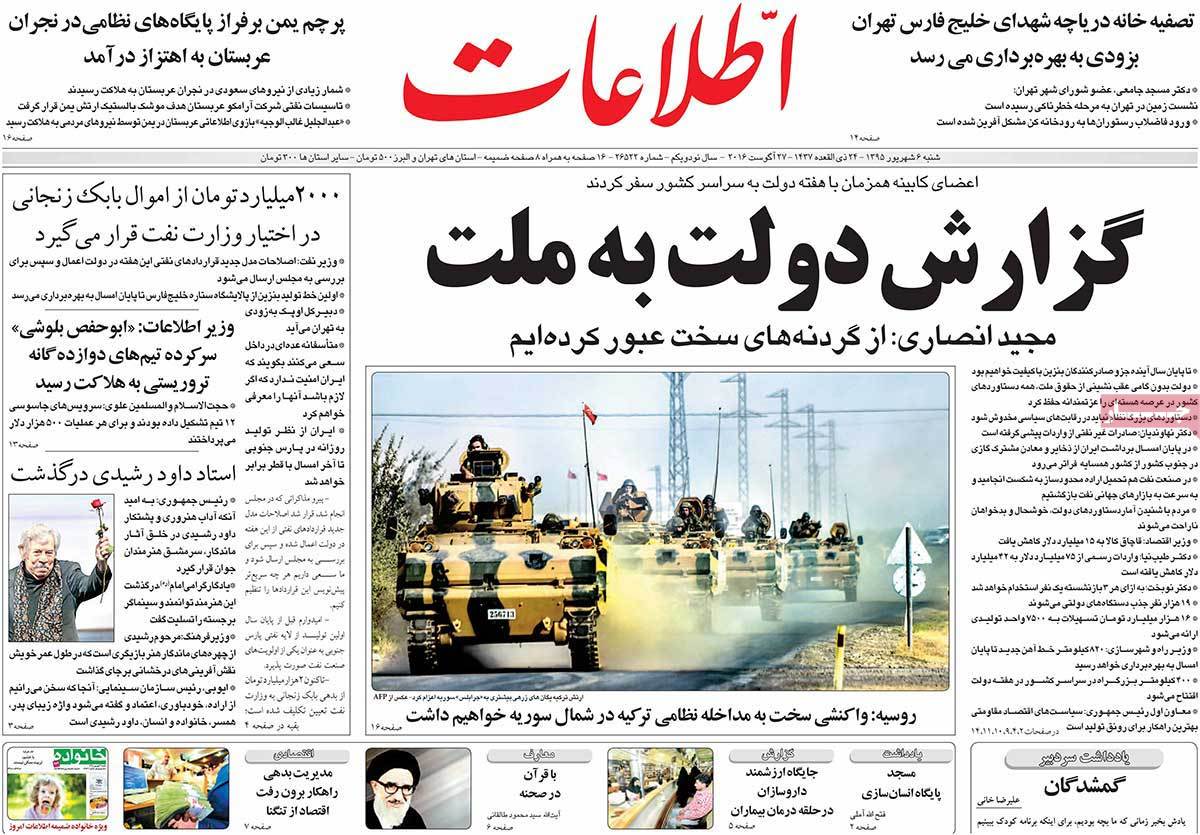
Ettela’at:

1- Saudi Arabia’s Tender to Buy Weapons for Terrorists in Syria Revealed

2- Extensive Projects in Oil and Gas, Aerospace, and Power Will Be Planned between Tehran and Moscow

A Look at Iranian Newspaper Front Pages on August 6


Haft-e Sobh:

1- French Diplomat in Simple Words Talks about Iran’s Commitment to JCPOA and USA’s Violation of Its Obligations

2- Simple Manteaux Sold in Iran from $290 to $5,800: Interview with a Designer

A Look at Iranian Newspaper Front Pages on August 6


Hamshahri:

1- Ban on Selling Seized Smuggled Goods in Market

2- Don’t Give Money to Beggars: Municipality to Remove Beggars from Streets as of Today

3- Tension in US over Payment of Iran’s 40-Year-Old Debt

4- Amendments to Oil Contracts Couldn’t Satisfy Critics

A Look at Iranian Newspaper Front Pages on August 6


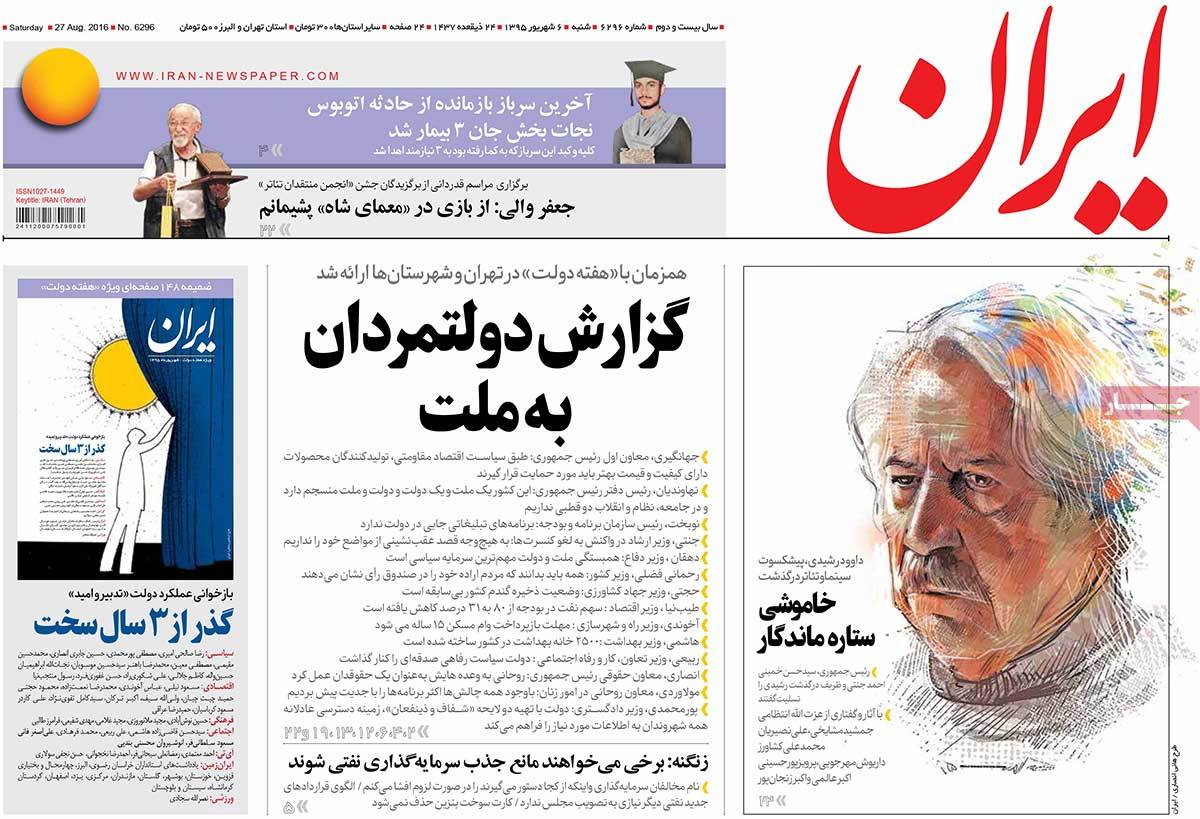
Iran:

1- Resolution of Nuclear Issue Created Peace in Iran: Larijani

2- People Losing Their Interest in ‘Wall of Kindness’

3- Iranian Female Athlete: Lodging Conditions in Rio Not at Level of Olympic Games

A Look at Iranian Newspaper Front Pages on August 6


Jame Jam:

1- Dark Side of the Inauspicious Alliance [Saudi Arabia and Israel]

A Look at Iranian Newspaper Front Pages on August 6


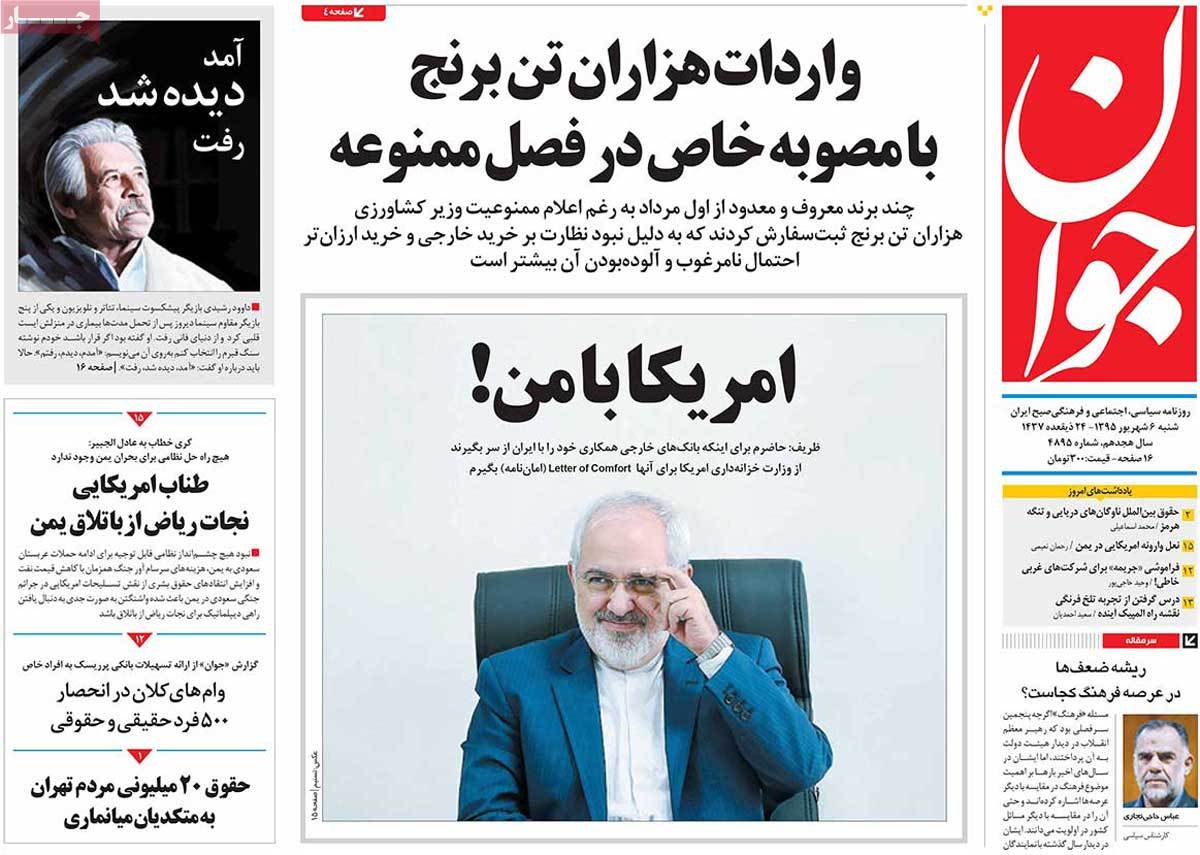
Javan:

1- 5.5m University Graduates Are Searching for Jobs in Iran

2- The Law Based on Which Astronomical Salaries Are Paid Is Non-Islamic and Null: Cleric

3- Mousavian: US Treasury Scares Companies away from Doing Business with Iran; USA’s Semi-Private Campaign against JCPOA

A Look at Iranian Newspaper Front Pages on August 6


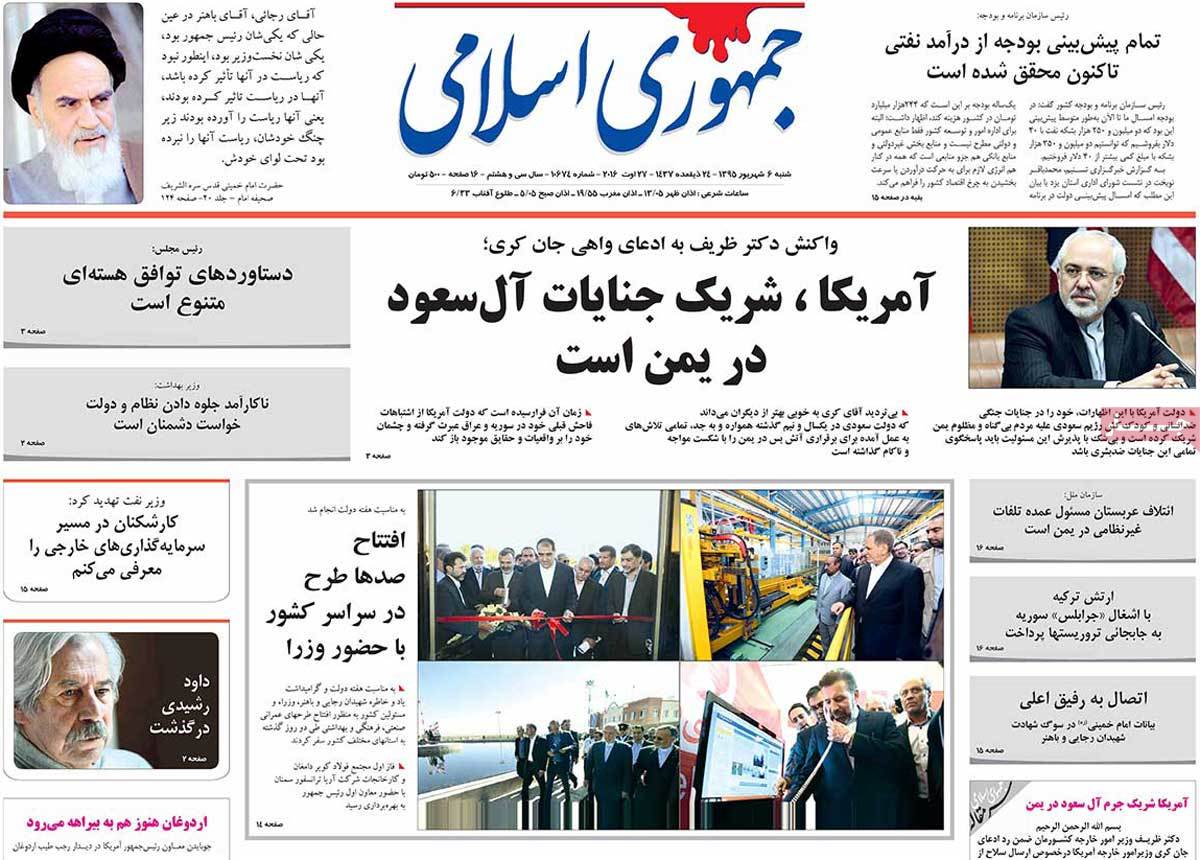
Jomhouri Eslami:

1- Heavy Losses of Terrorists in Iraq, Syria, and Lebanon

2- Three-Fold Increase in Number of Flight over Iran’s Sky

3- 3 Iranian Companies Removed from Britain’s List of Sanctions

4- Terrorist Attacks in Germany Have Their Roots in Saudi Arabia: Spiegel

A Look at Iranian Newspaper Front Pages on August 6


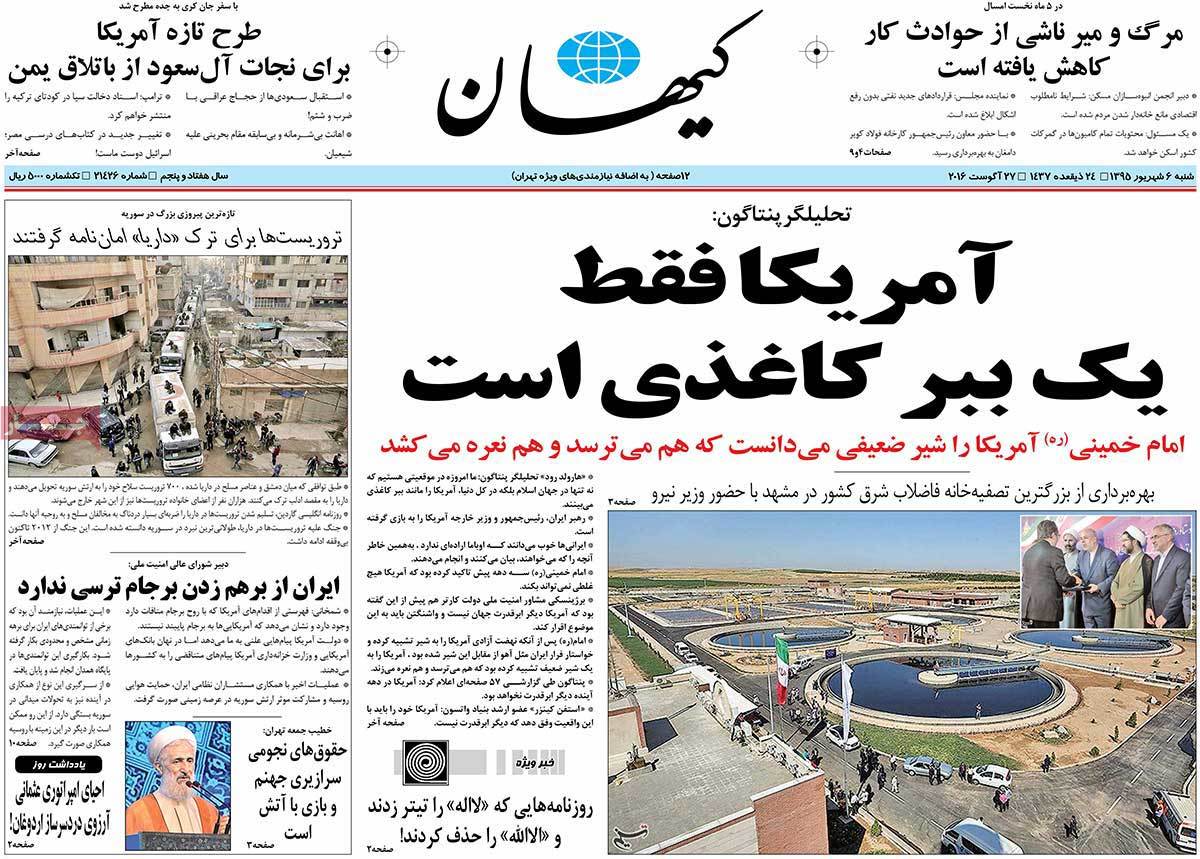
Kayhan:

1- Repeating the Bitter Experience of JCPOA by Making Oil Contracts Secret

2- 400 Takfiri [Extremist] Terrorists Killed in Syrian Army’s Attack on Idlib and Aleppo

3- 14th Edition of Int’l Imam Reza Festival Kicked Off in 77 Countries

4- Why Sanctions Were Not Lifted after Nuclear Deal

A Look at Iranian Newspaper Front Pages on August 6


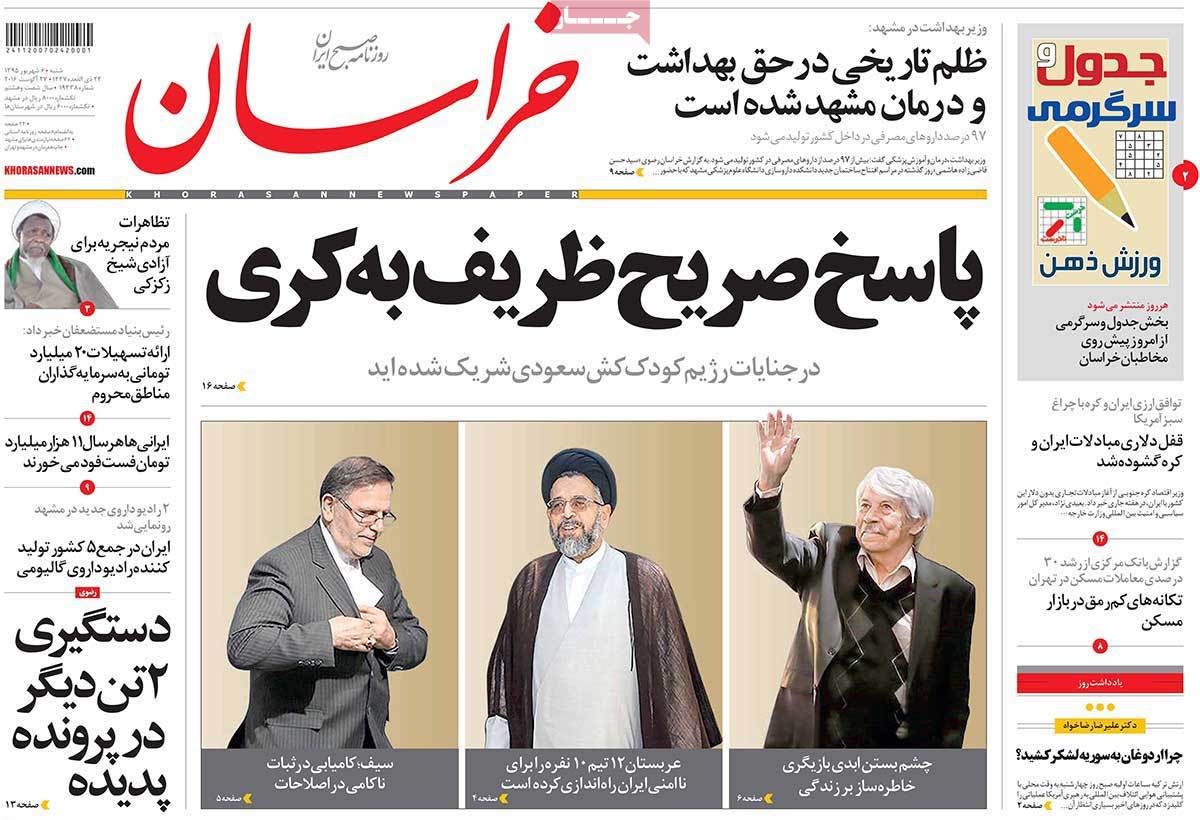
Khorasan:

1- 6 Killed in Attack on Bus Carrying Chinese Reporters in Brazil

2- 2 Norwegian Girls Fall Victim to Family Conflict in Mashhad

3- The New Iraq and the Fight against Corruption [Editorial]

A Look at Iranian Newspaper Front Pages on August 6


Roozan:

1- Why Ahmadinejad Isn’t Afraid of Being Disqualified for Next Year’s Presidential Elections: Zibakalam

2- Necessity for Making the Issue of Human Rights Watch a Top Priority in Negotiations [with Europe]: Analyst

3- Erdogan, a Media and Propaganda Tool for Putin

A Look at Iranian Newspaper Front Pages on August 6


Sayeh:

1- Predictions Come True: Russia Breaks US Dollar’s Hegemony

2- Olympics under Shadow of Fear and Concern

A Look at Iranian Newspaper Front Pages on August 6


Shahrvand:

1- Prosperity in Iran’s Sky: Number of Flights Increased from 500 to 1085

2- Monster of Pokemon Go Filtered in Iran without Any Opposition

3- Venezuelan Oil in Exchange for Food

4- If We Plant the Seeds of Grudge, We Will Harvest ISIS: Imam Khomeini’s Grandson

A Look at Iranian Newspaper Front Pages on August 6


Shargh:

1- Unprecedented Attacks against President; Cleric Says It’s Not an Honour to Receive Italian Fashion Designing Company in Iran

2- Rouhani and Putin to Meet in Baku

3- We Are Going to Prevent Future Shut-Down of Newspapers; Managers rather than the Press Are the Ones to Be Punished: MP

A Look at Iranian Newspaper Front Pages on August 6


Vaghaye Ettefaghieh:

1- Rio 2016 Olympics to Begin with These 3 Women

2- 50% of University Graduated Are Unemployed: Movement of the Educated Unemployed

3- Insults to President Rouhani on Pretext of JCPOA

4- Controversies in US over Ransom Money Paid to Iran

5- Mousavian: JCPOA Opponents Looking for Iran-US Confrontation

A Look at Iranian Newspaper Front Pages on August 6


Vatan-e Emrooz:

1- Axis of Evil: Latest Information about American-Saudi Plot to “Drag the War near Iran’s Borders”

2- MP Reveals Untold Stories about Transgenic Products

3- Latest Efforts by Saudi Arabia and the US to Get Terrorists Out of Siege in Aleppo

A Look at Iranian Newspaper Front Pages on August 6

Iran’s Supertanker, Container Ship Collide in Singapore Strait

container ship

It reported on Thursday that the Dream II Very Large Crude Carrier (VLCC), owned by the National Iranian Tanker Company (NITC), and the Swiss-owned MSC Alexandra container ship collided just before midnight on Wednesday about three kilometres southeast of Sebarok Island.

MSC Alexandra said that six empty container boxes fell into the sea and four others fell onto the deck of Dream II.

The MPA reported that before the incident, its Port Operations Control Centre provided traffic information and alerted both ships of the risk of collision.


Damage to the MSC Alexandria

Immediately after the collision, the MPA issued navigation broadcast to warn ships about the presence of floating containers in the site, and deployed survey and salvage teams to recover the containers, it added.

“We are… extremely relieved to hear that there has been no loss of life, or pollution caused despite the significant damage to the hull of MSC Alexandra,” Yock Juee Tan, the managing director of MSC Asia, said in a statement.

“We are now continuing to work closely with the authorities and salvage teams to ensure containers are safely discharged.”

Both Dream II and MSC Alexandra are in a stable condition and are now safely anchored in Singapore.

Tehran has been seeking to ramp up oil exports following the implementation of last year’s nuclear agreement between Iran and the P5+1 group of countries and the removal of sanctions on January 16.

The lifting of international restrictions against Iran has enabled the NITC to operate more freely and increase shipments of oil cargoes to its top buyers in Asia including China.

Iran and the five permanent members of the United Nations Security Council – the United States, Britain, France, China and Russia – plus Germany clinched the nuclear agreement, known as the Joint Comprehensive Plan of Action (JCPOA), on July 14, 2015.

Under the agreement, all nuclear-related sanctions imposed on Iran by the European Union, the Security Council and the US would be lifted. Iran has, in return, put some limitations on its nuclear activities.

Clinton, Trump No Different to Iran: Leader’s Adviser

Clinton and Trump
Ali Akbar Valayati,
Ali Akbar Valayati, an adviser to Leader of the Islamic Revolution Ayatollah Seyyed Ali Khamenei

Ali Akbar Valayati, who advises the Leader on international affairs, made the remarks in an interview with al-Mayadeen, an Arabic-language TV based in Lebanon, which broadcast the interview on Saturday, August 6.

The presidential race in the US is being contested by Hillary Clinton on the Democratic front and bombastic real estate mogul Donald Trump, who represents the Republican Party.

The former has, in the past, sounded combative on issues concerning the Islamic Republic, including a 2008 instance during which she said the United States could “totally obliterate” Iran in retaliation for what she called a nuclear strike against Israel. Iran has no nuclear weapons and is not pursuing one.

Clinton also accuses Iran of backing “terrorism” in the region by questioning Tehran’s support for the Lebanese resistance movement of Hezbollah, which has been defending Lebanon against Israel.

In his interview, Velayati said, “The US Democrats proved, by refusing to fulfil their obligations [under the Iran nuclear deal], that they are not committed to the nuclear agreement. Therefore, they are no different from the Republicans,” Velayati said.

The nuclear deal was struck between Iran and the P5+1 group (namely Britain, China, France, Germany, Russia and the United States) in July 2015. Under the deal, Iran has agreed to scale back its nuclear program and provide enhanced access to international atomic monitors in return for the lifting of all nuclear-related sanctions against the country.

However, some obstacles continue to remain in the way of the full implementation of the deal on the part of the US and Europe. European banks are also wavering between resuming or not resuming transactions with Iran, fearing punitive US measures, even as the US has attempted to assuage such fears.

GOP aspirant Trump has, meanwhile, threatened to tear up the nuclear agreement.

“Americans should know that if they refused to implement the nuclear agreement, Iran could go for other options,” Valayati said.


‘Saudi Policies Suicidal’

The senior Iranian official also addressed Saudi Arabia’s destructive policies, including the move by Riyadh to try and develop public relations with Israel, the Saudi regime’s policies of spreading extremism, and its unrelenting and deadly war on Yemen.

“The Saudi government’s policy is a kind of political suicide,” Velayati said.


‘Assad Prospects Improved’

Valayati concluded his remarks by saying that Syrian President Bashar al-Assad now enjoyed an even higher chance than before of securing another victory in a potential new election.

“Most countries in the world are now convinced that Assad should remain in power,” he said, apparently referring to how Western countries have become more muted in their calls for Assad’s ouster.

Iran Eyes Developing Joint Strategies with Afghanistan

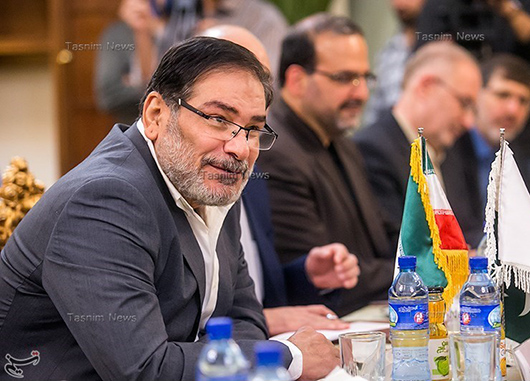
Ali Shamkhani

In a meeting with Afghanistan’s national security adviser, Mohammad Hanif Atmar, held in Tehran on Saturday, Ali Shamkhani urged constant consultation between the two countries to reach sustainable approaches for border security and fighting terrorism.

Expressing Iran’s preparedness to work out joint political, economic and security strategies with Afghanistan, Shamkhani said the two nations need to integrate their potential for contributing to regional peace and stability.

He also referred to security as the underlying factor behind development of the joint border areas, stronger trade ties and curbing narcotics trafficking.

Shamkhani further deplored unconstructive coalitions of certain countries in the region with the aim of eroding the capabilities of regional nations.

Describing the Zionist regime of Israel as the Islamic world’s archenemy, he stressed that any move to undermine Islamic nations is wrong and in line with strengthening Israel.

For his part, Hanif Atmar praised Iran for its constructive role in the development and progress of Afghanistan.

The Afghan official also called for collective efforts in the fight against extremism and terrorism by focusing on regional security.

Atmar has travelled to Tehran for a two-day visit at the invitation of Shamkhani.