Thursday, April 23, 2026
Home Blog Page 4329

A Look at Iranian Newspaper Front Pages on September 27

Iran Newspaper front pages

The majority of newspapers reported the remarks made by the Leader of the Islamic Revolution Ayatollah Seyyed Ali Khamenei who publicly announced that he has advised ex-president Mahmoud Ahmadinejad against running for next year’s presidential elections.

The presidential debate between Hillary Clinton and Donald Trump also remained a top story today among some newspapers.

Newspapers further covered the speech delivered by President Hassan Rouhani at the World Tourism Day conference on the rise of tourism in Iran.

The above issues, as well as many more, are highlighted in the following headlines:


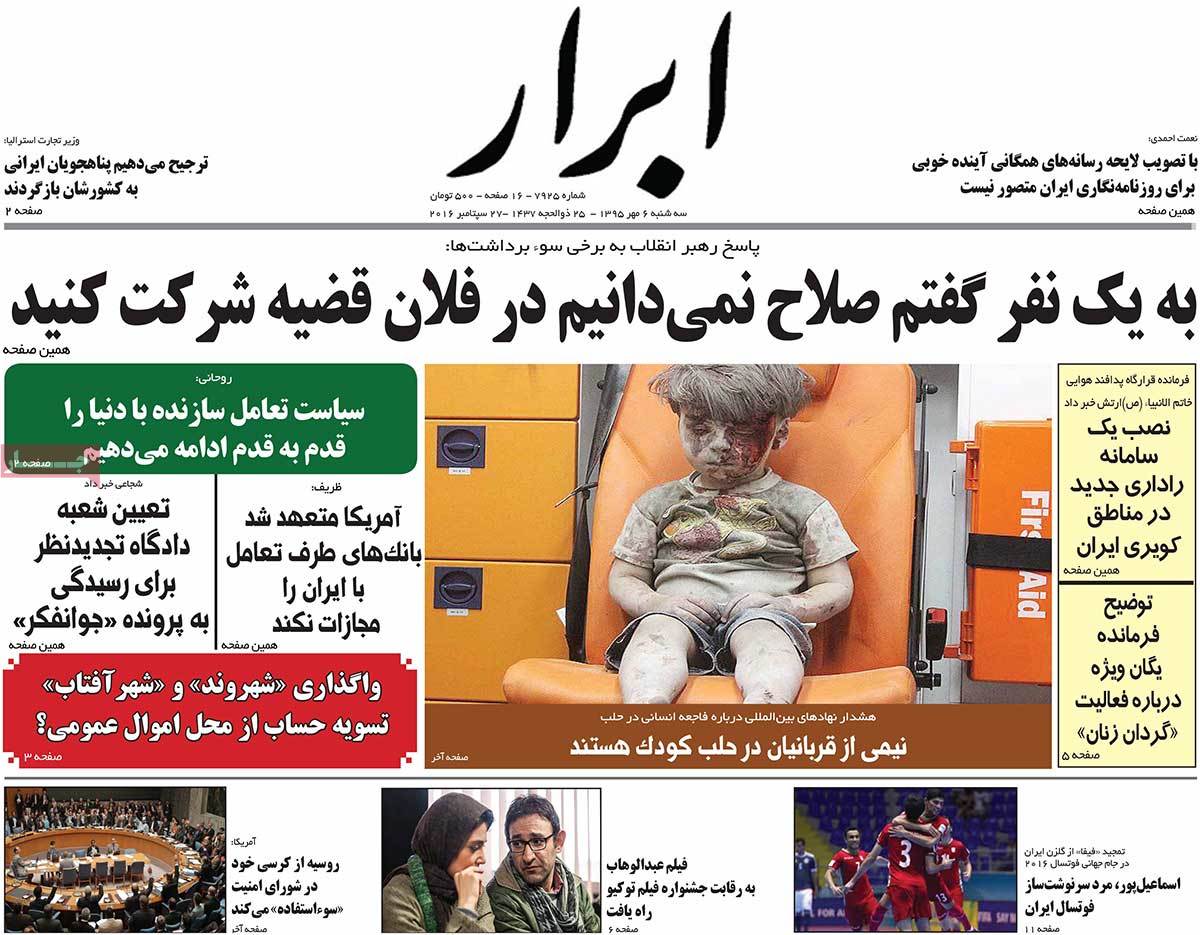
Abrar:

1- Australian Trade Minister: We Prefer that Iranian Asylum-Seekers Return to Their Country

2- Zarif: US Vowed Not to Punish Banks Engaged with Iran

3- Int’l Bodies Warn of Humanitarian Disaster in Aleppo: 50% of Victims Are Children

4- US: Russia Abusing Its UNSC Seat
A Look at Iranian Newspaper Front Pages on September 27


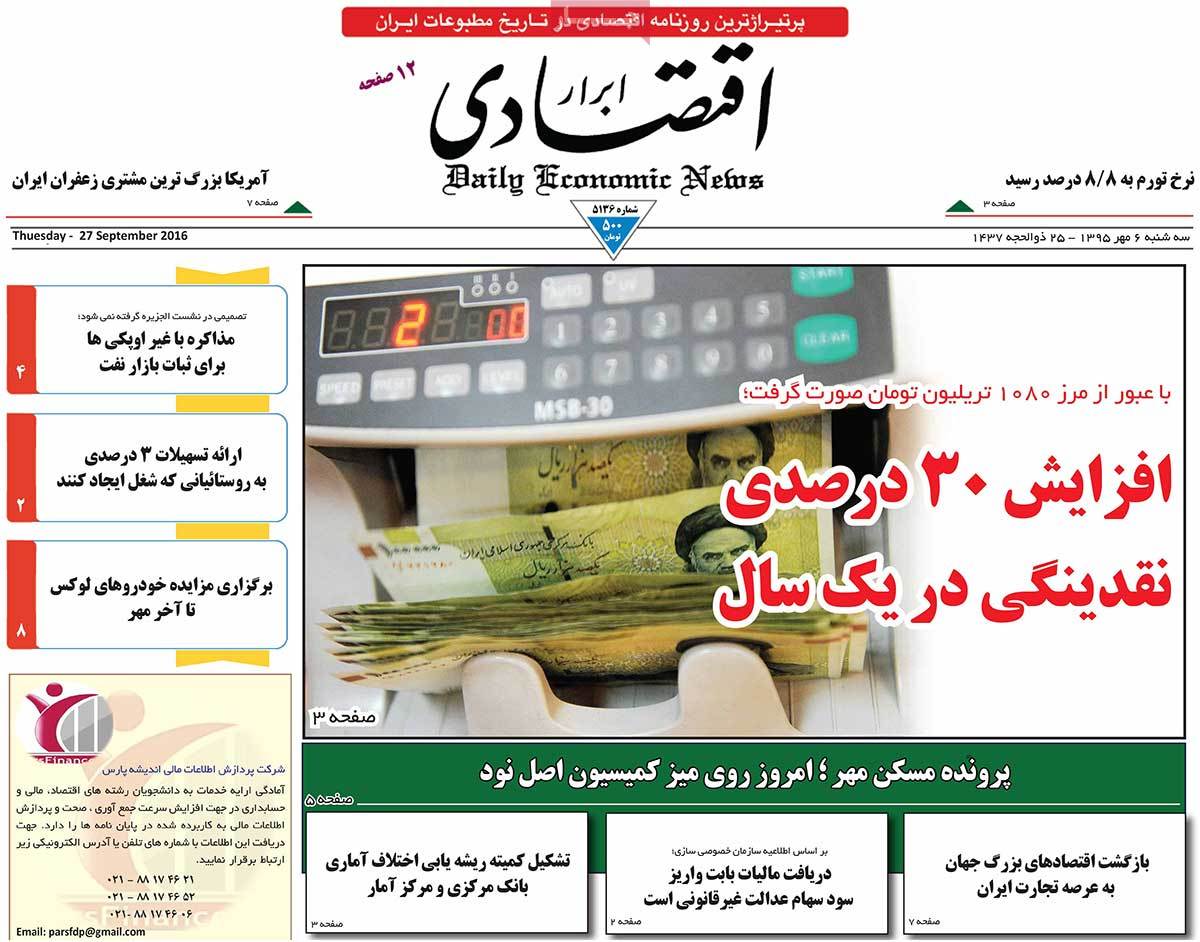
Abrar-e Eqtesadi:

1- 30% Increase in Iran’s Liquidity in 1 Year

2- Return of World’s Major Economies to Doing Business with Iran

3- No Decision to Be Made in Algeria Meeting: Talks with Non-OPEC Members for Stability in Oil Market

4- US Is Biggest Customer of Iran’s Saffron
A Look at Iranian Newspaper Front Pages on September 27


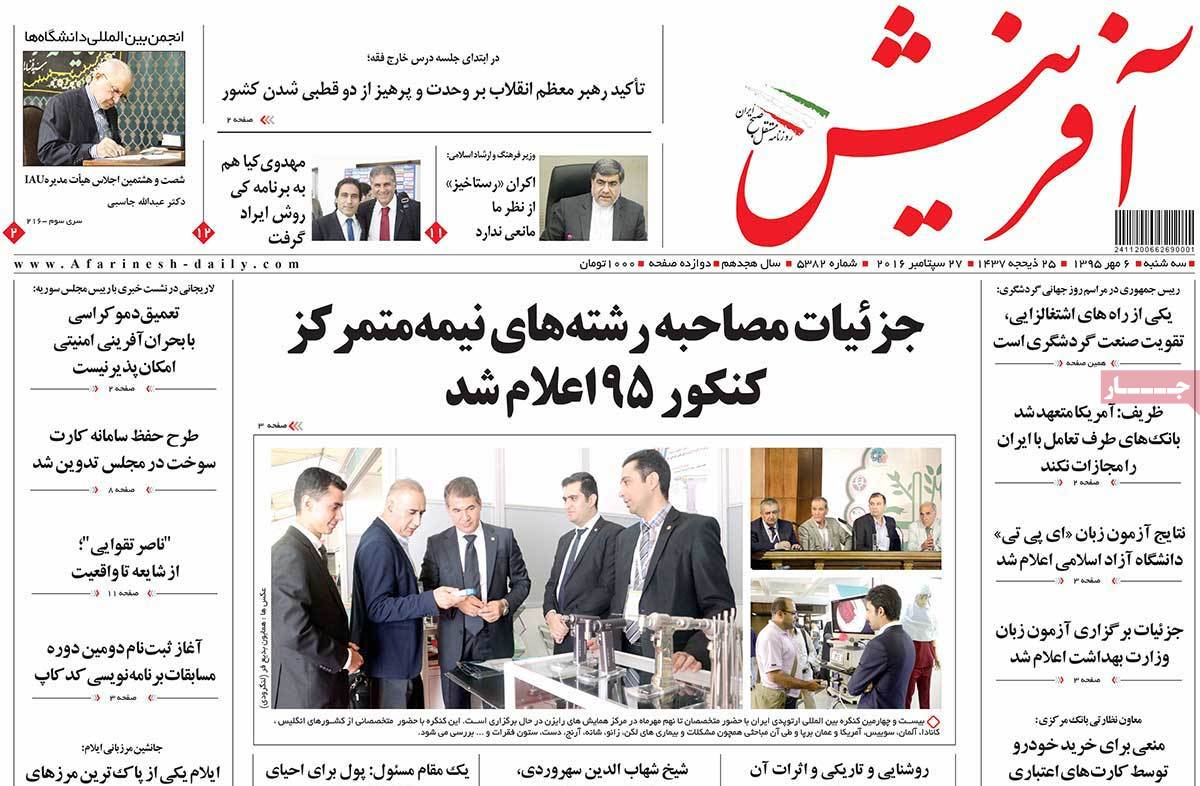
Afarinesh:

1- Larijani: It’s Not Possible to Deepen Democracy through Creating Security Crises
A Look at Iranian Newspaper Front Pages on September 27


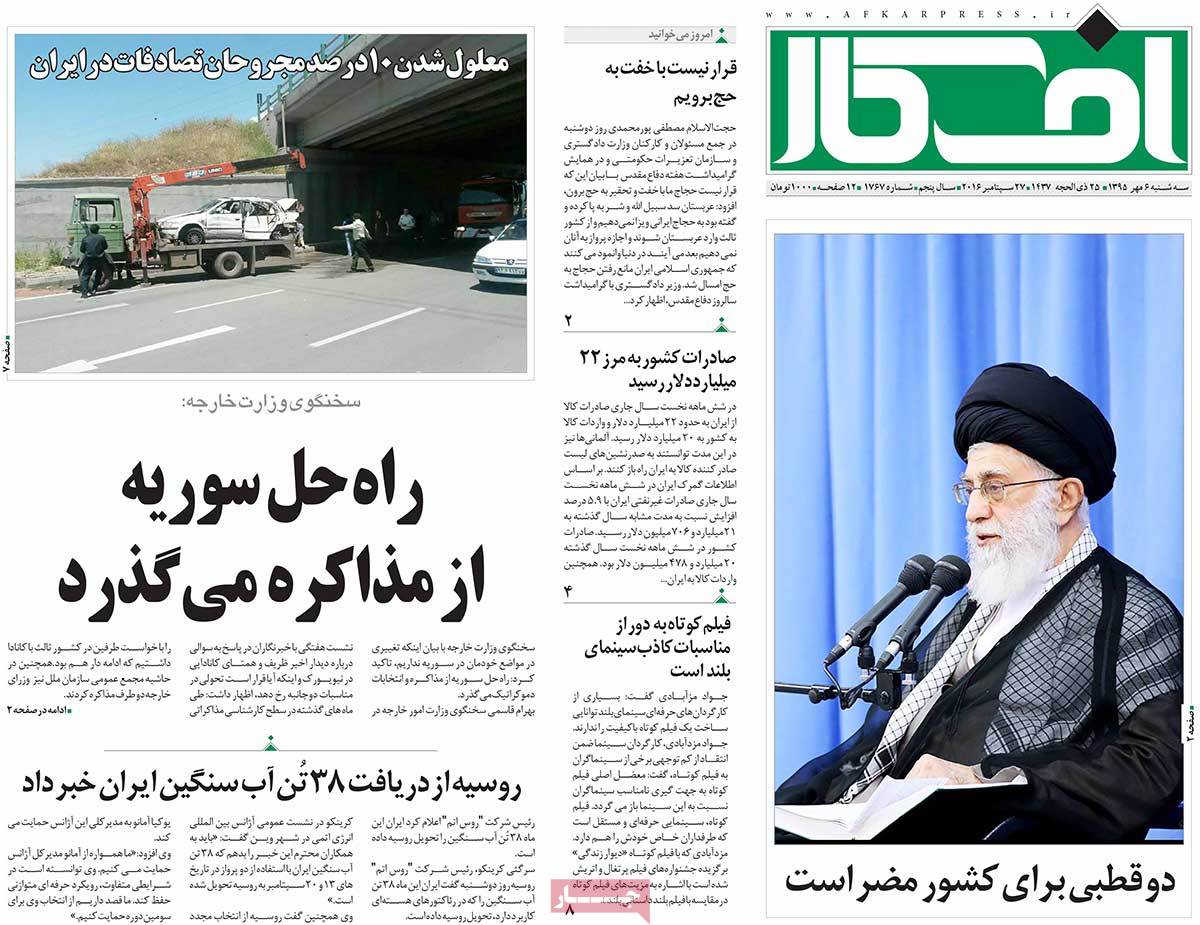
Afkar:

1- Foreign Ministry Spokesman: Syria Crisis Can Only Be Resolved through Negotiations

2- Iran’s Exports Stands near $22bn

3- Russia Receives 38 Tons of Iran’s Heavy Water
A Look at Iranian Newspaper Front Pages on September 27


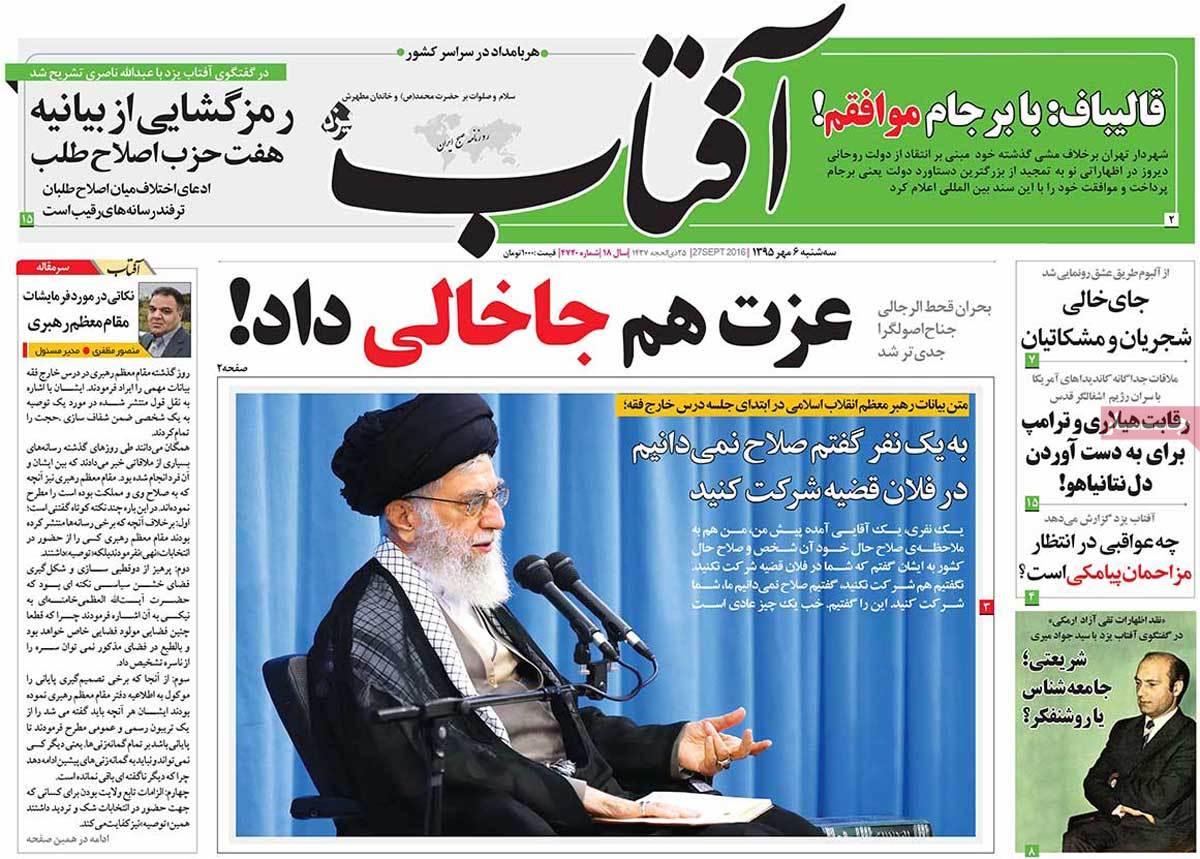
Aftab-e Yazd:

1- Conservative Mayor of Tehran: I Agree with JCPOA; Qalibaf Hails Rouhani’s Greatest Achievement on Contrary to Previous Stances

2- Hillary and Trump’s Competition for Pleasing Netanyahu: Separate Meetings of US Candidates with Leaders of Occupying Regime [Israel]
A Look at Iranian Newspaper Front Pages on September 27


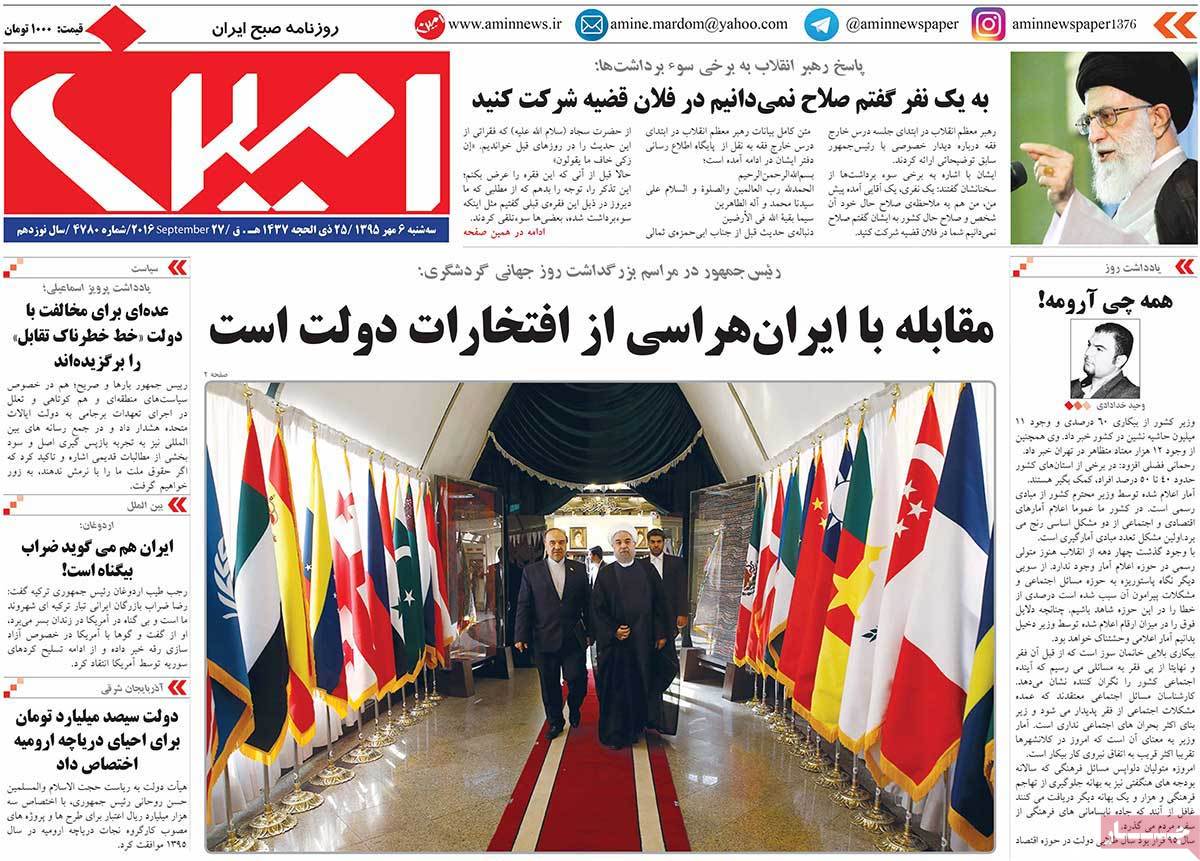
Amin:

1- President: Countering Iranophobia Is an Honour for Government

2- Erdogan: Even Iran Says Reza Zarrab Is Innocent

3- Government Dedicates over $84m to Revival of Lake Urmia
A Look at Iranian Newspaper Front Pages on September 27


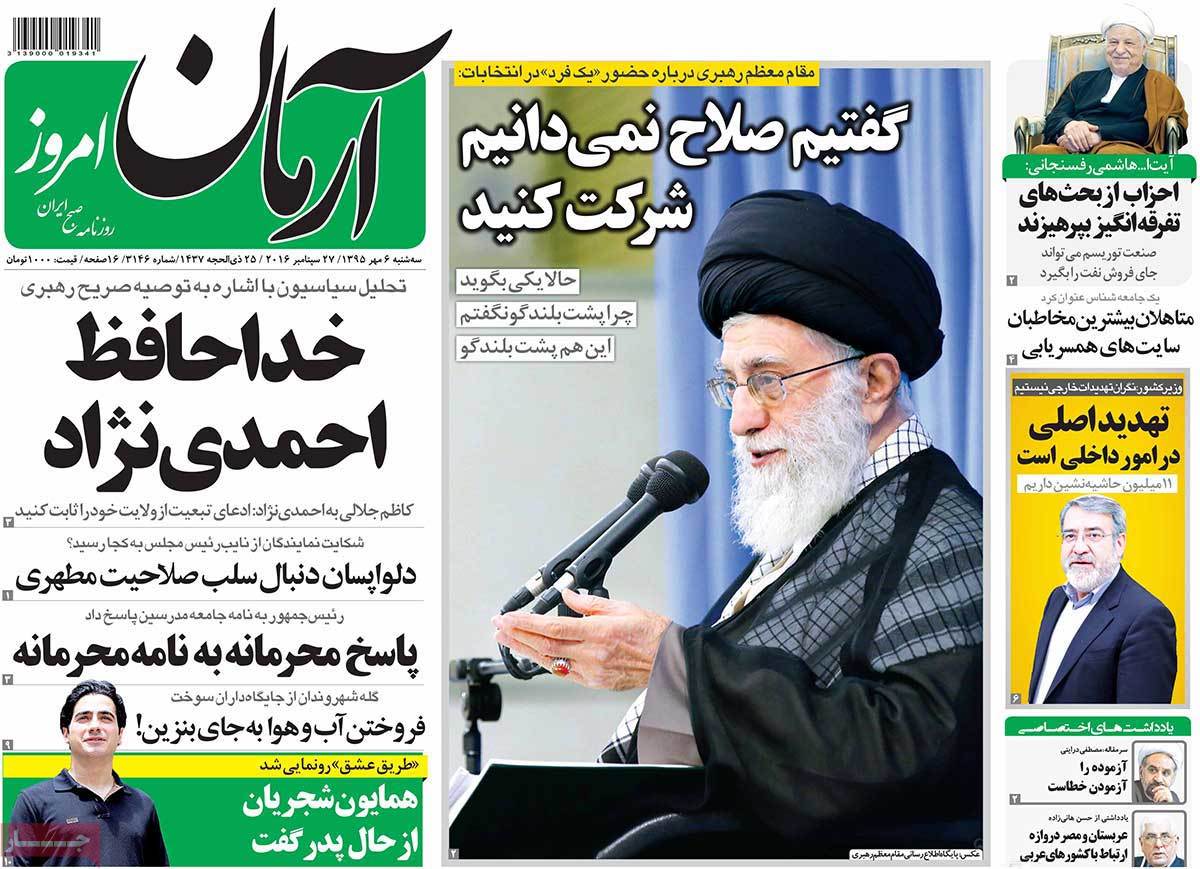
Arman-e Emrooz:

1- Leader on Candidacy of a “Gentleman” in Presidential Elections: We Don’t See His Participation Appropriate

2- Goodbye Ahmadinejad: Experts’ Analyses Given the Leader’s Explicit Advice
A Look at Iranian Newspaper Front Pages on September 27


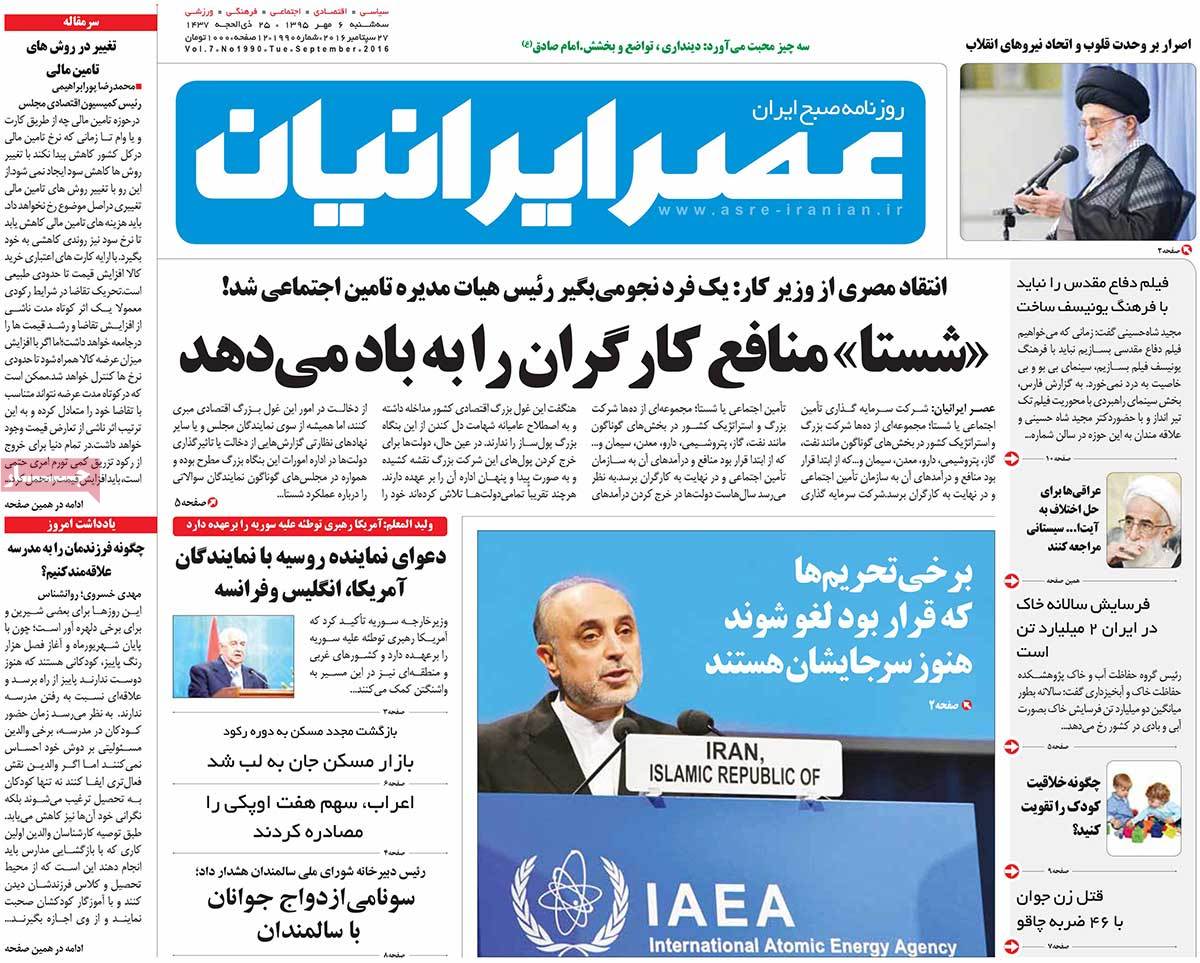
Asr-e Iranian

1- Arabs Seize Shares of 7 OPEC Member States

2- Tsunami of Youths’ Marriage with Old People

3- Russian Representative’ Fight with Envoys of US, Britain, and France
A Look at Iranian Newspaper Front Pages on September 27


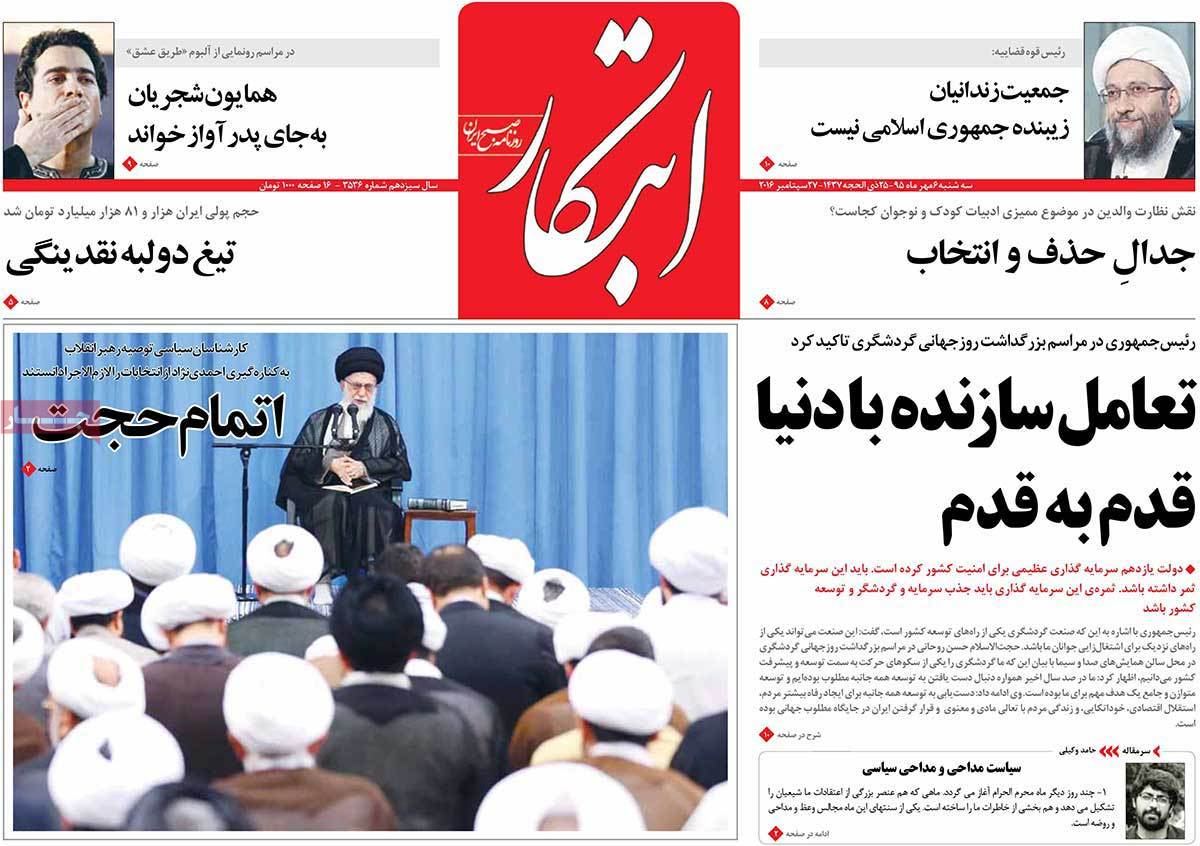
Ebtekar:

1- President: Interaction with the World, Step by Step

2- Judiciary Chief: Huge Number of Prisoners Taints Image of Islamic Republic
A Look at Iranian Newspaper Front Pages on September 27


Etemad:

1- IRGC General Mohsen Rezaei Won’t Run for Presidential Elections

2- Conservatives and Third Division: Another Group of Cons Establish ‘Faction of Revolution’

3- Iranian Spokesman: No Time Can Be Bought for Terrorists in Syria
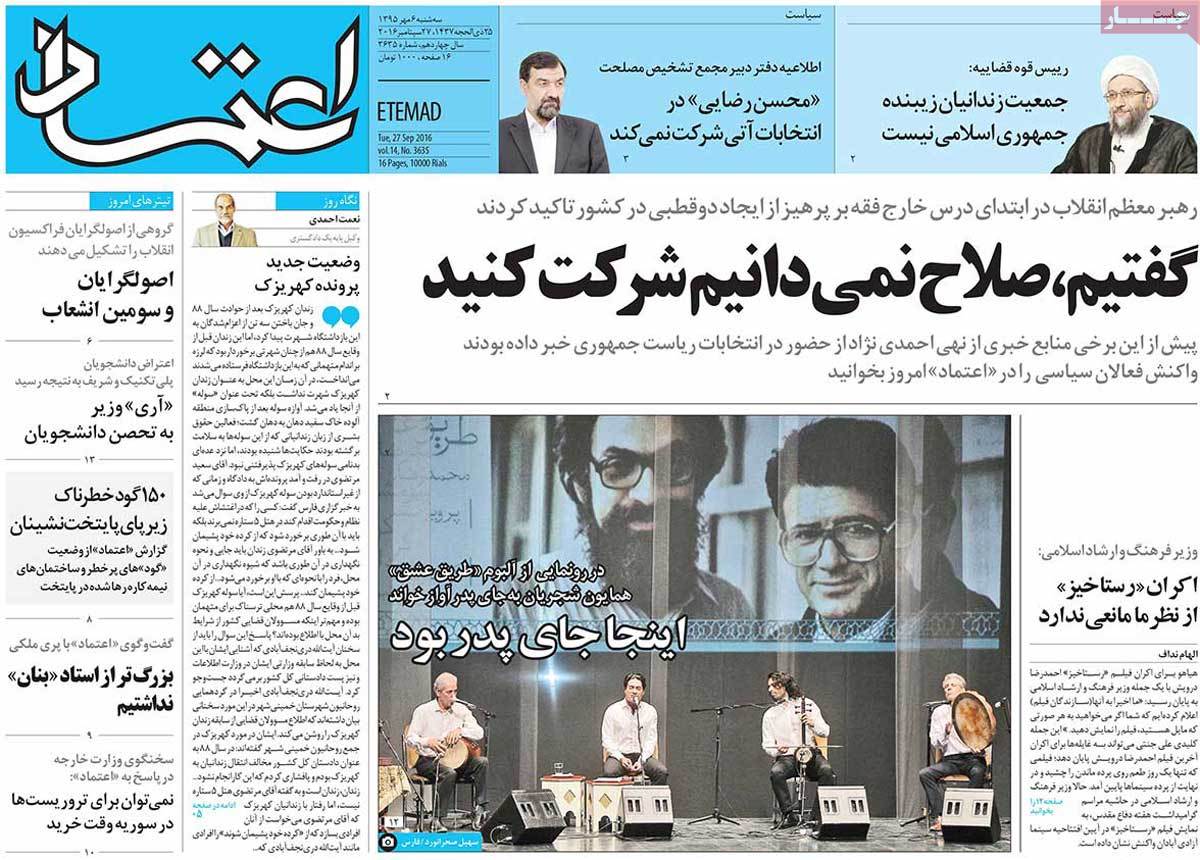
A Look at Iranian Newspaper Front Pages on September 27


Ettela’at:

1- Rouhani: Progress Is a Fruit of Security; We’re Thankful of All Security and Armed Forces

2- Senior Nusra Front Commander: US Gives Us Weapons Directly
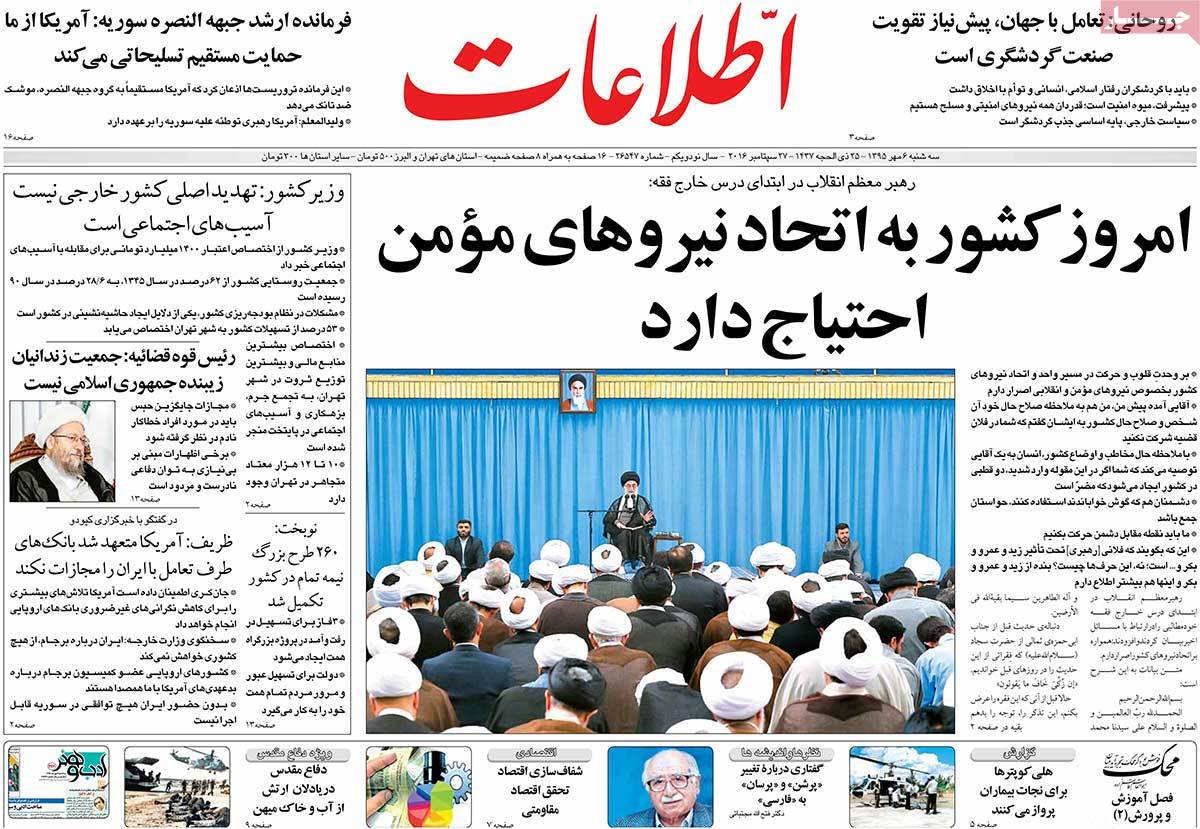
A Look at Iranian Newspaper Front Pages on September 27


Iran:

1- President: 10% Increase in Number of Foreign Tourists Visiting Iran
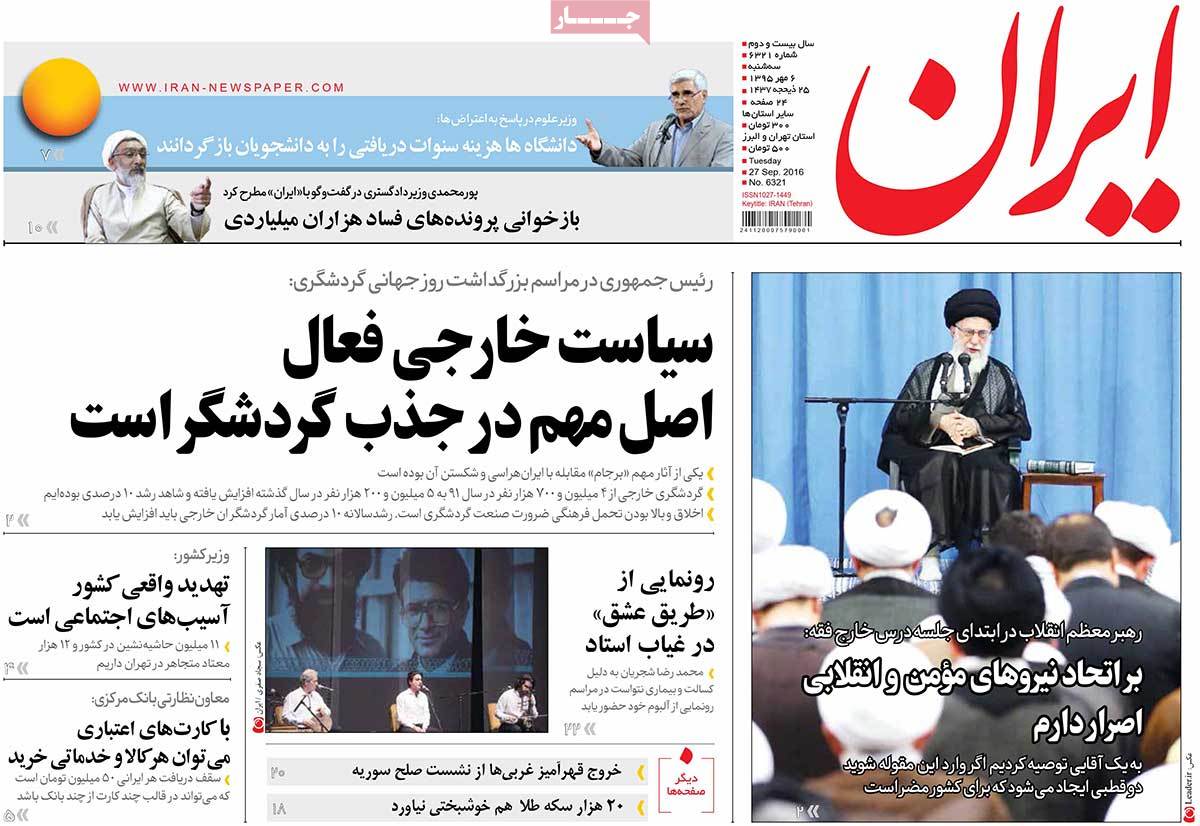
A Look at Iranian Newspaper Front Pages on September 27


Javan:

1- Salehi’s Warning to the West: JCPOA Is Being Threatened

2- Battle in Aleppo, Fight in UNCS: Unprecedented Tension between Western Powers and Russia and Syria in UN Session
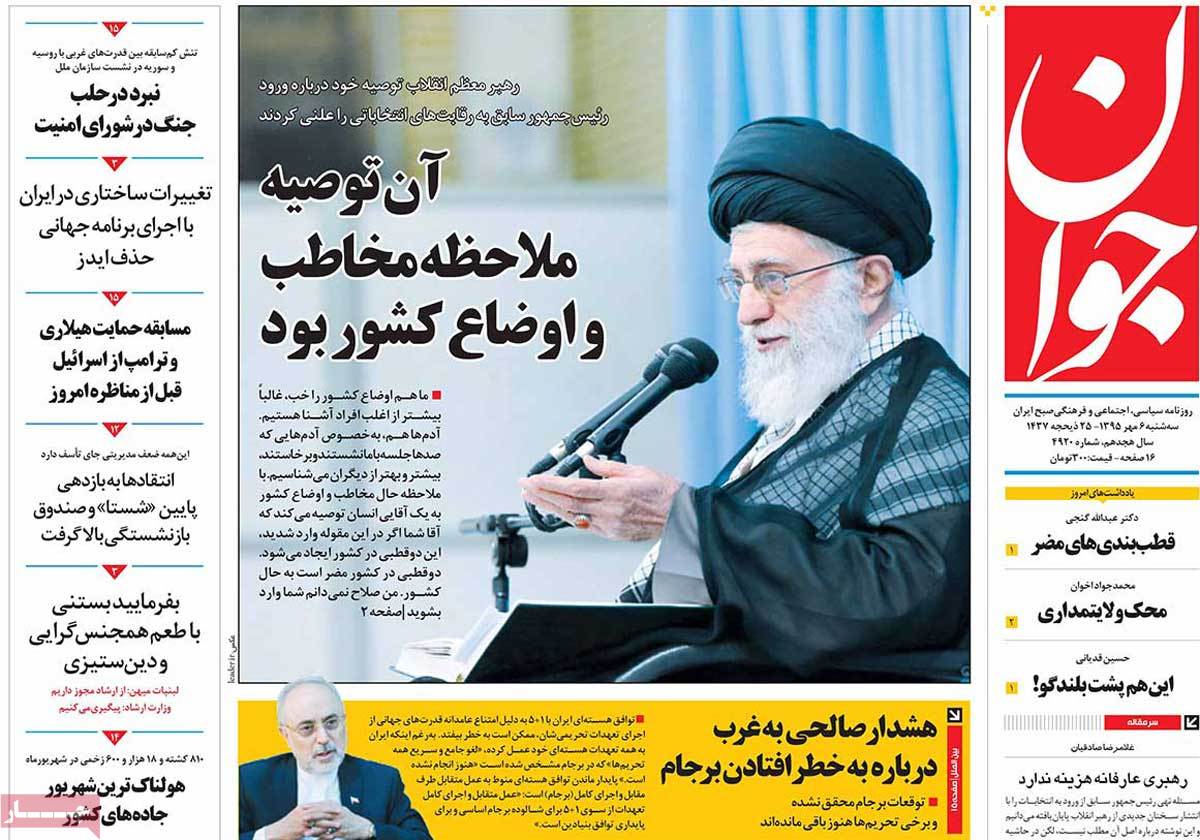
A Look at Iranian Newspaper Front Pages on September 27


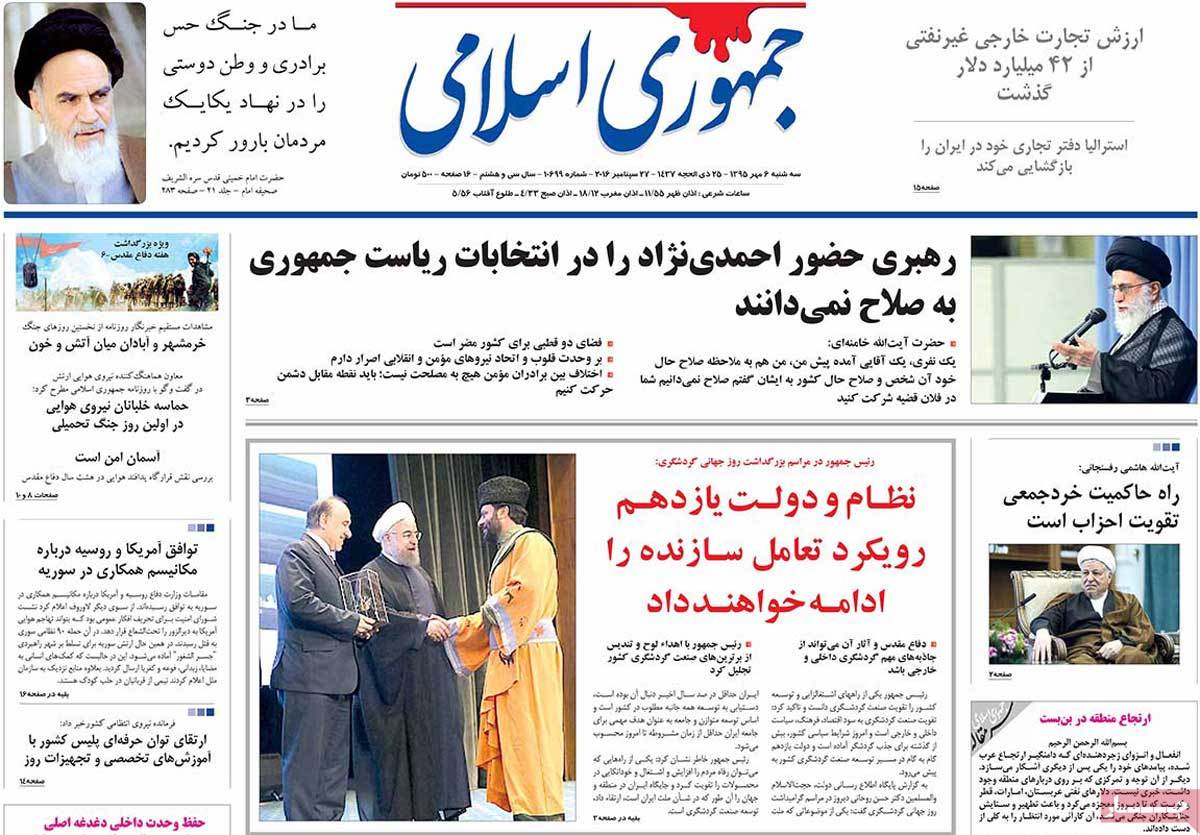
Jomhouri Eslami:

1- Value of Iran’s Non-Oil Foreign Trade Exceeds $42bn

2- Australia to Open Trade Office in Iran

3- President: Establishment and Government Will Continue Its Constructive Interaction Approach
A Look at Iranian Newspaper Front Pages on September 27


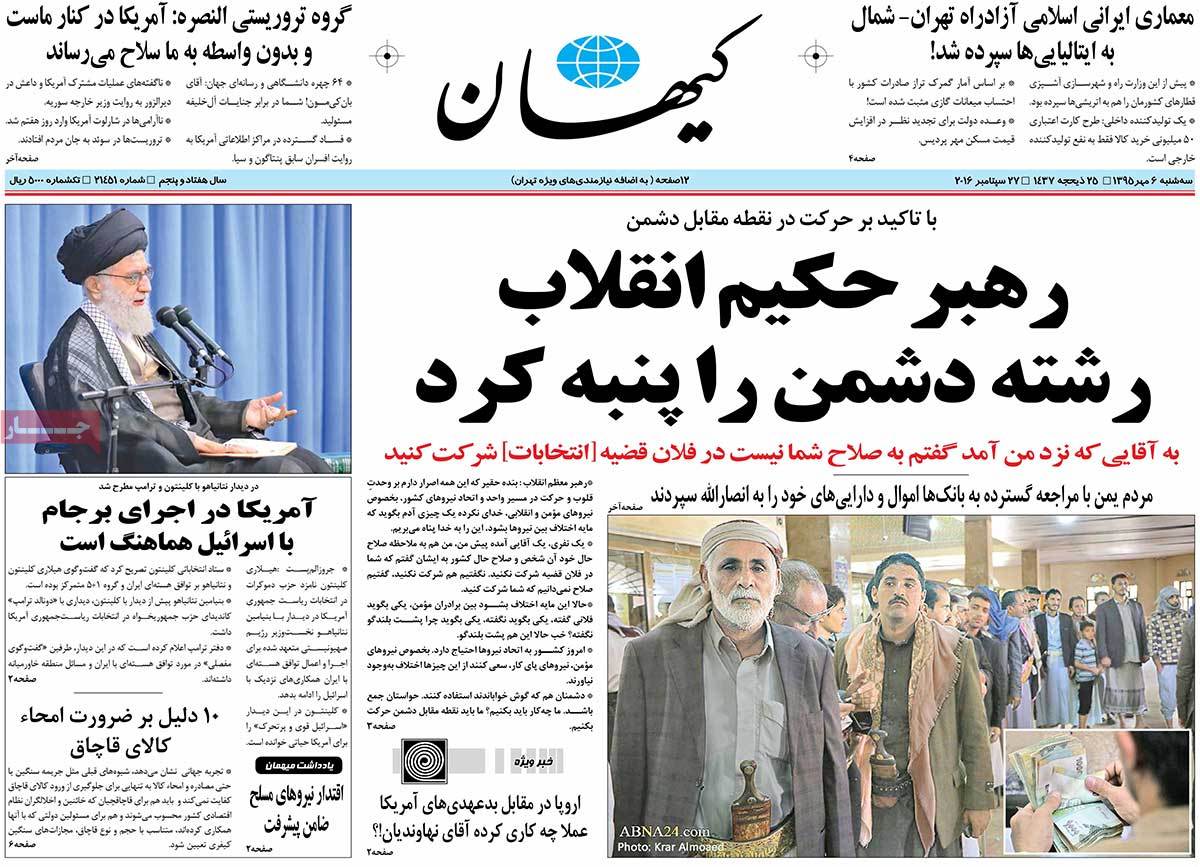
Kayhan:

1- Leader Foils Enemy Plots by Underlining Movement on Opposite Side of the Enemies

2- Iranian-Islamic Architecture of the Freeway Connecting Tehran to Northern Iran Assigned to Italians!

3- Yemeni People Go to Banks and Give Their Money and Assets to Ansarullah

4- During Netanyahu’s Meetings with Clinton and Trump, It’s Said that US Is Coordinated with Israel in JCPOA Implementation
A Look at Iranian Newspaper Front Pages on September 27


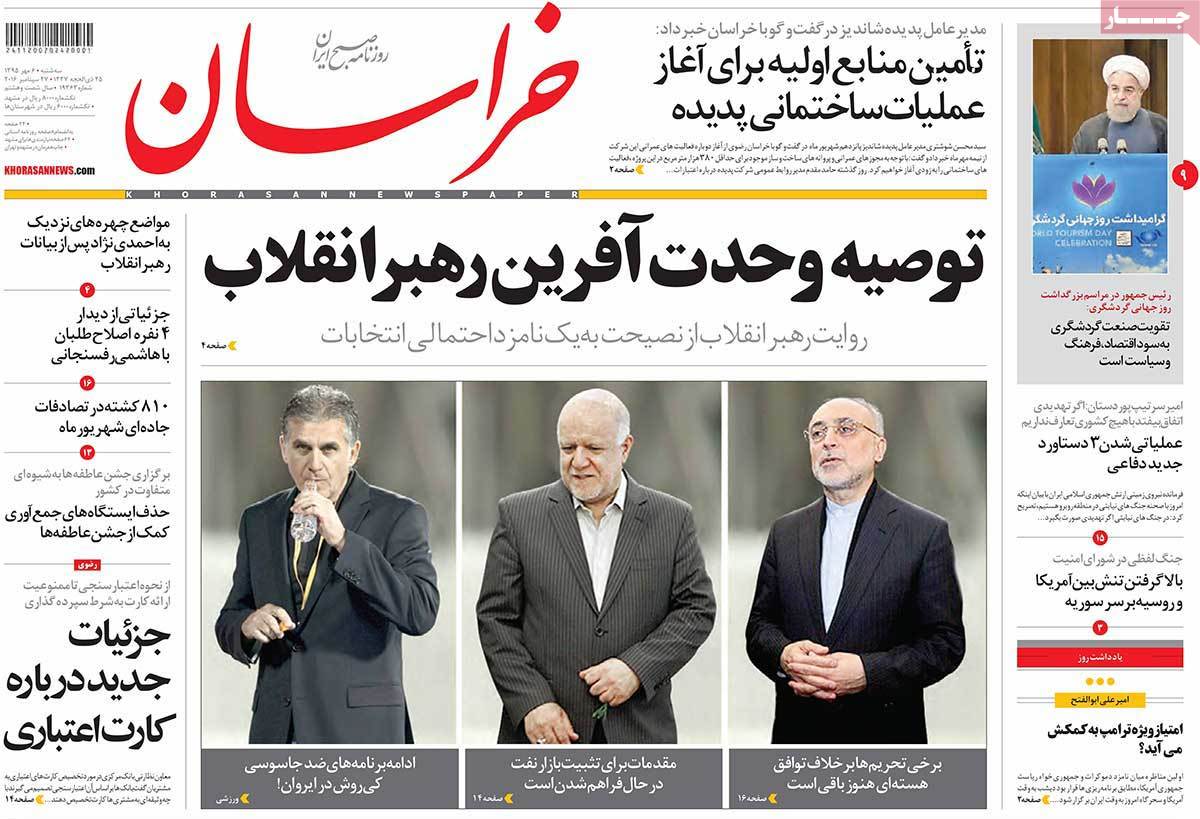
Khorasan:

1- Iran’s Nuclear Chief: Some Sanctions Are Still in Place in Spite of What Agreed Upon in JCPOA

2- 810 Killed in Road Accidents in Iranian Month of Shahrivar
A Look at Iranian Newspaper Front Pages on September 27


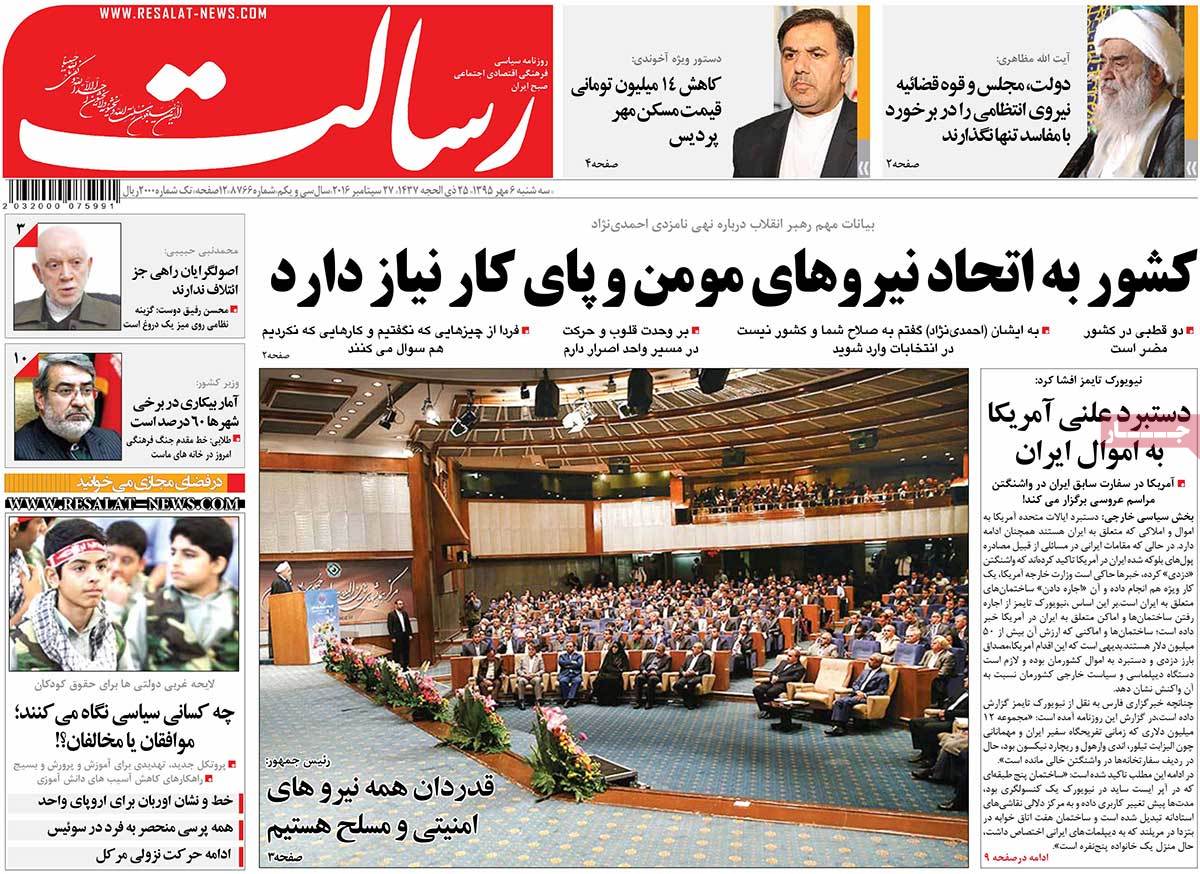
Resalat:

1- New York Times: US Explicit Robbery of Iran’s Assets

2- Interior Minister: Unemployment Rate Is as High as 60% in Some Cities
A Look at Iranian Newspaper Front Pages on September 27


Shargh:

1- President: Tourists Visit Countries with High Cultural Toleration

2- Founding Member of IRGC Mohammad Gharazi: If I Had Three Mortar Shells, Khorramshahr Might Not Fall
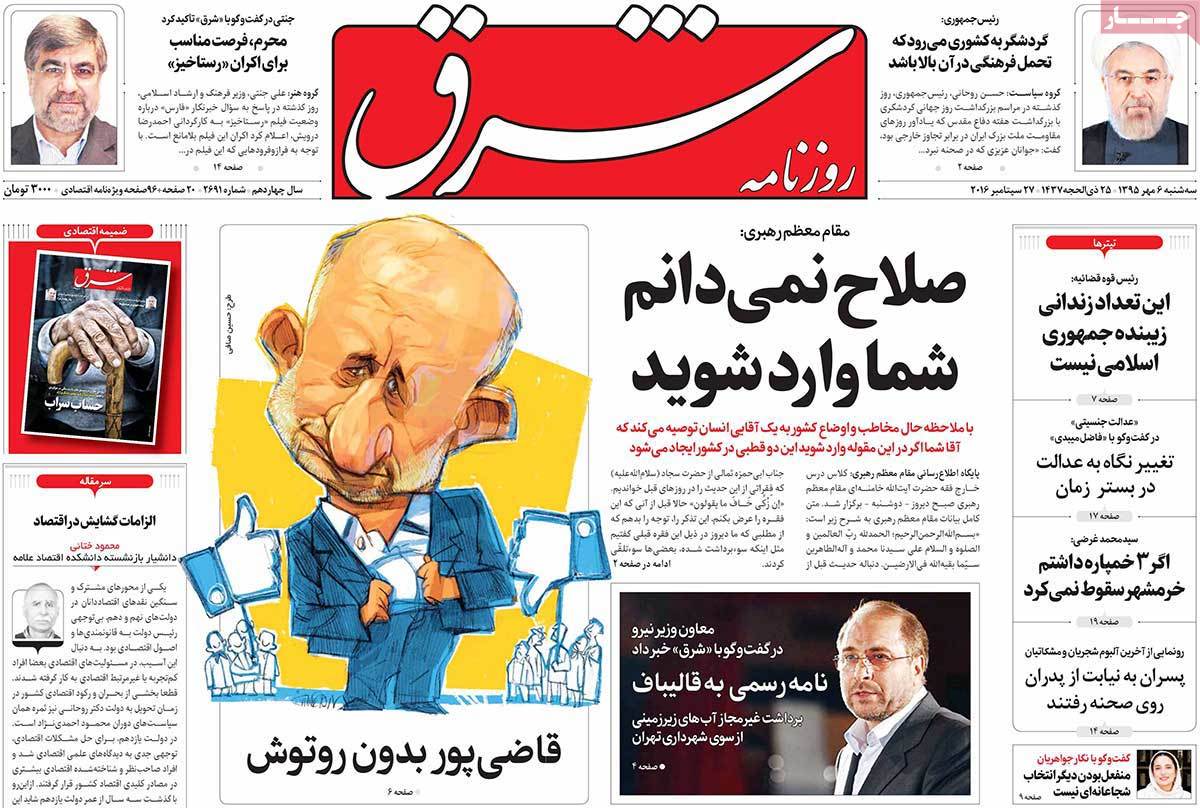
A Look at Iranian Newspaper Front Pages on September 27


Vaghaye Ettefaghieh:

1- Leader Publicly Announce His Advice to Ahmadinejad: I Don’t Think It’s to Iran’s Interests that You Run for Presidential Elections; Country Would Be Polarized

2- Reverse Trend of Globalization? Crisis in Political Leadership of Europe
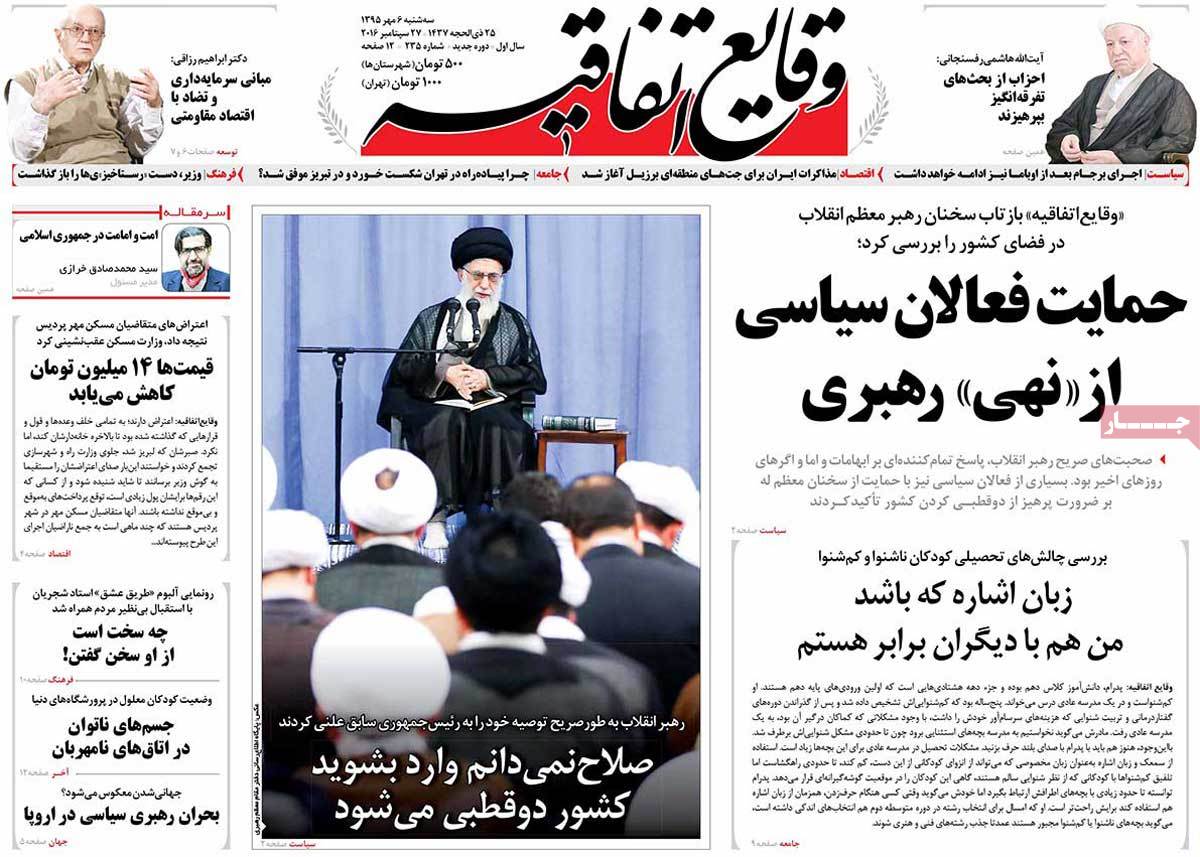
A Look at Iranian Newspaper Front Pages on September 27


Vatan-e Emrooz:

1- Judiciary Chief: Iran’s Security Finds Meaning under Shadow of Its Defensive Might

2- Leader Underlines the Need for Unity among Revolutionary Forces
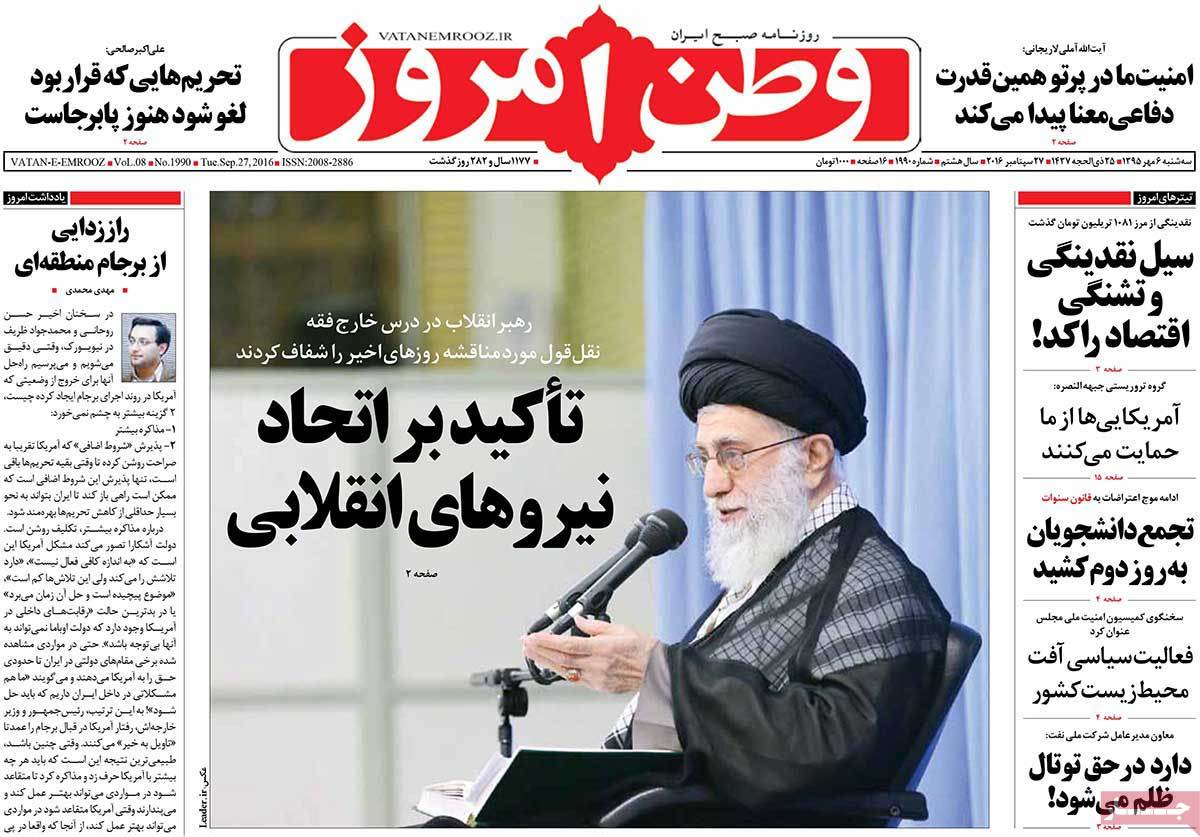
A Look at Iranian Newspaper Front Pages on September 27

Iran Not to Accept Conditional Delivery of Newly Purchased Planes

Comments by Western countries or some members of the Group 5+1 (Russia, China, the US, Britain, France and Germany) about the sale of planes to Iran are an attempt to justify their own failure to live up to commitments and the delay of about a year in exporting the planes to Iran, Foreign Ministry Spokesman Bahram Qassemi told IRIB.

The spokesman underlined that Iran will never accept any conditions set by the sellers if they contravene Iran’s sovereignty and independence.

Iran definitely acts within the framework of its own interests and dignity in any business contract on the exchange of goods or services with foreign countries, Qassemi stressed.

Over the past three decades, Iran has faced a host of cruel sanctions and limitations, but never given in to the unjust demands of others, he stressed.

Last week, the US decided to remove a final hurdle for Western aircraft manufacturers to sell planes to Iran under contracts signed after coming into force of the Joint Comprehensive Plan of Action (JCPOA), a nuclear agreement between Tehran and the group of six countries.

But the US still demands that even non-American manufacturers wishing to sell to Iran obtain an export license if their products include materials made in the United States. Airbus, based in Europe, buys more than 40 percent of all its aircraft parts from the US.

In January, Iran signed a major contract with Airbus worth about $27 billion to buy 118 planes. The contract was signed during the visit to Paris by Iran’s President Hassan Rouhani.

Iran also sealed a deal in June worth around $25 billion with the US aerospace heavyweight, Boeing, for the purchase of 100 passenger planes.

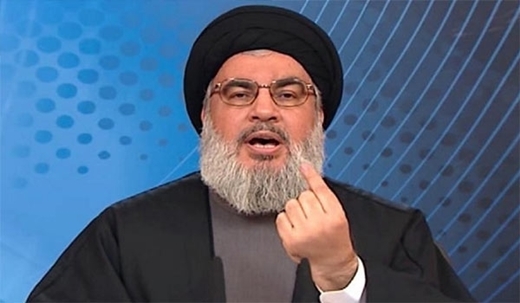
Wahhabism Even More Evil than Israel: Nasrallah

Hassan Nasrollah

Seyyed Hassan Nasrallah, the secretary general of Hezbollah, made the remark during his annual meeting with Muslim eulogists and the people responsible for commemoration ceremonies during the Lunar month of Muharram, Lebanon’s Al Akhbar newspaper reported on Tuesday.

The Hezbollah chief said he considered Wahhabism to be responsible for damaging Islam’s image worldwide. “Wahhabism is more evil than Israel, especially [in] that it seeks to destroy others and eliminate whatever thing that has to do with Islam and its history,” he said.

Not a Shia, Sunni matter

“This project was launched in 2011, and it not a Shia and Sunni matter. The role played by spy services is completely evident here. We should use this opportunity to pin Wahhabism down and deal a blow to it,” he added.

The existent conflict, Nasrallah said, was not between Shias and Sunnis, but with Wahhabism.

Wahhabism is the radical ideology dominating Saudi Arabia, freely preached by government-backed clerics there, and inspiring terrorists worldwide. Daesh and other Takfiri terror groups use the ideology to declare people of other faiths as “infidels” and then kill them.

Nasrallah also said what posed a yet bigger threat than Wahhabism and Zionism was “British Shiism,” which, he said, was being promoted by pseudo-religious figures, whom he called mercenaries of intelligence services.

Hezbollah has been crucial to keeping Wahhabi terrorism out of Lebanon, while helping neighboring Syria in holding back the scourge, too.

The Hezbollah chief said Saudi Arabia had escalated tensions to a climax and was trying, with the help of the US and Britain, to portray conflicts as sectarian.

Referring to the Syrian conflict, he said there were no “moderate” armed groups in Syria, warning that all those fighting Damascus were either working with Daesh or al-Nusra, which has recently renamed itself.

Nasrallah also said he saw no prospect for a political solution for the Syrian conflict. “Developments on the [battle] ground will ultimately determine [the outcome],” he said matter-of-factly.

Syria has been fighting a foreign-backed militancy since March 2011. Hezbollah fighters have been assisting Syrian government forces fighting back the militants, including Daesh and other dangerous groups.

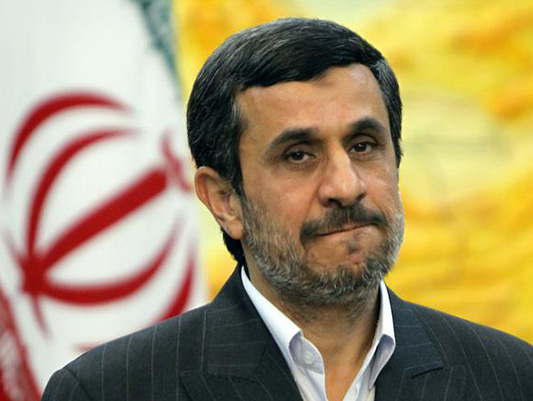
Ahmadinejad Pens Letter to Leader: I Have No Plan for Presidential Elections

Mahmoud-Ahmadinejad

“In a letter to the Leader of the Islamic Revolution, Dr. Ahmadinejad has declared that, in a move to obey what Ayatollah Khamenei says, he has no plan to run for the 2017 presidential elections,” Ali Akbar Javanfekr, a media advisor to the ex-president, announced on Tuesday, September 27.

According to a report by ISNA, as translated by IFP, Javanfekr said that the full text of the letter will be published soon.

The letter came after Ayatollah Khamenei implied on Monday that he has advised Ahmadinejad against running for next year’s presidential elections.

Speaking at the beginning of an advanced course on Islamic religious studies, the Leader confirmed that he has advised a gentleman [without mentioning a specific name] in a recent visit to “avoid getting involved in a certain event [election]” for the good of the country and of that individual himself.

“We did not tell him not to participate either,” the Leader explained, saying the individual has been told that his involvement “is not deemed expedient.”

Ayatollah Khamenei noted that a holistic view of the country’s situation and that specific figure’s conditions led to the recommendation that he had better avoid engagement in the event to prevent polarization of the country.

The Leader once again stressed that he has not ordered anybody to get involved or stay away, saying this is not about ruling, but about expediency.

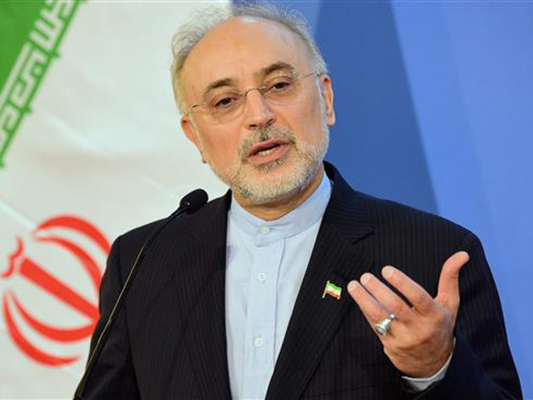
Israel’s Nukes Threaten Regional Stability and NPT Credibility

salehi

“Iran, as the initiator of establishing Nuclear Weapon Free Zone in the Middle East since 1974, reiterates its deep concern over Israeli clandestine military nuclear program,” Ali Akbar Salehi, the head of the Atomic Energy Organization of Iran (AEOI), said in the 60th Regular Session of the International Atomic Energy Agency (IAEA) General Conference in Vienna on Monday.

The Israeli regime, which pursues a policy of so-called deliberate ambiguity about its nuclear bombs, is estimated to have 200 to 400 nuclear warheads in its arsenal. The regime has refused to allow inspections of its military nuclear facilities or to sign the NPT.

According to March 2015 emails by former US secretary of state Colin Powell leaked earlier this month, Israel has 200 nuclear weapons “targeted on Tehran.”

Salehi reiterated Iran’s motto of “Nuclear Energy for All and Nuclear Weapon for None,” saying, “This message, if realized, would accelerate and enlarge the contribution of atomic energy to peace, health and prosperity throughout the world.”

“The world without nuclear weapons under the full implementation of Article VI of NPT and the realization of nuclear disarmament by 2025 as proposed by the Non-Aligned Movement is an inevitable necessity and certainly one of the best guaranties for nuclear security,” he said.

Salehi further underscored the Islamic Republic’s resolve to expand its nuclear program for civilian purposes following the implementation of last year’s agreement, dubbed the Joint Comprehensive Plan of Action (JCPOA), reached between Iran and the P5+1 group of countries – the United States, Britain, France, China and Russia plus Germany.

Citing a key report last December by the UN nuclear monitoring body that it has found no indications of the diversion of nuclear material for non-civilian objectives in Iran’s nuclear program, Salehi said “the official and decisive report on the final assessment of Iran’s past and present nuclear issues … closed for ever [the] false and fabricated nuclear file” on the Islamic Republic’s atomic program.

The top Iranian nuclear official expressed the country’s readiness to cooperate with  interested technologically advanced IAEA member states for advancing peaceful nuclear technology as well as exchanging experiences and know-how with developing countries.

He further expressed regret over the failure of the P5+1 to fully honor its obligations under the JCPOA despite Iran implementing “all its JCPOA commitments, which was monitored and verified by the agency as well as continuing its close cooperation with the IAEA through voluntary effectuation of the Additional Protocol in accordance with the provisions of the JCPOA.”

Iran and the P5+1 signed the JCPOA in Vienna in July 2015. It went into effect on January 16, and resolved a long-running dispute over the Iranian nuclear program.

Israel's Nukes Threaten Regional Stability and NPT Credibility

Under the JCPOA, the Islamic Republic has agreed to roll back certain aspects of its nuclear program – including the volume of its uranium stockpiles enriched to the 20-percent level – and has provided international atomic monitors enhanced access to its nuclear facilities.

In return, Iran’s partners agreed to terminate all nuclear-related sanctions against Tehran.

Some international banks, however, still shy away from financing trade deals and processing transactions with Iran fearing US penalties.


Meetings With IAEA, Rosatom Chiefs

On the sidelines of the IAEA session, the Iranian official also met with IAEA Director General Yukiya Amano and Sergey Kiriyenko, the head of Rosatom, which Russia’s State Atomic Energy Corporation.

During the meeting with Amano, “we discussed arriving at a final conclusion as regards [Iran’s] nuclear activities and [the agency’s] monitoring activities that are underway either as part of the Safeguards [agreement], the Additional Protocol or the JCPOA,” Salehi said.

Speaking about his meeting with the Rosatom chief, the Iranian nuclear chief said the Russo-Iranian ties are of a strategic nature, adding that in the area of nuclear energy it is Russia that has the highest level of cooperation with Iran.

The two also held follow-up negotiations on ongoing cooperation between Iran and Russia aimed at completing the construction of the second and third power plant units at the Bushehr Nuclear Power Plant in southern Iran.

They also discussed financing and other issues concerning the cooperation in order to review the rigor with which the work is expected to take place.

Salehi cited the Russian official as having said that Russia had earlier received the 38 tons of heavy water sent by Iran around eight days before.

“It is a great step that we managed to sell 70 tons of heavy water to the US and Russia within eight months of the JCPOA’s implementation. Other European countries are likewise interested in buying the commodity and relevant negotiations are taking place,” he said.


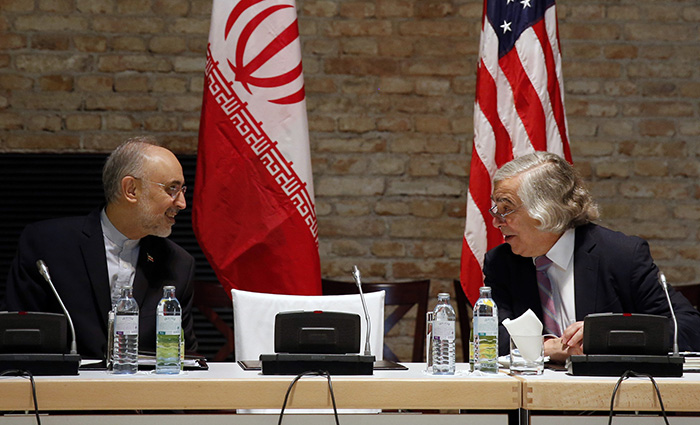
Salehi-Moniz Meeting

Meanwhile, the AEOI head said on Monday that he had met with US Energy Secretary Ernest Moniz in Vienna the previous day to review the two countries’ obligations under the JCPOA.

He added that he would likely hold another meeting with the US energy secretary later on Monday to discuss issues of mutual concerns.

Moniz said on Monday that Washington has kept its side of the JCPOA.

salehi-moniz“The sanctions that were to be relieved have been relieved. That’s what was the commitment. That has happened,” the US energy secretary told a news conference on the sidelines of the IAEA annual meeting.
“The consequences of that in terms of how many companies make foreign direct investments in Iran is not for the government to decide, that’s for companies to decide,” he said.

Moniz added that US officials “at their highest levels” have explained in Europe and to banks how to transact with Iran without falling foul of the remaining restrictions.

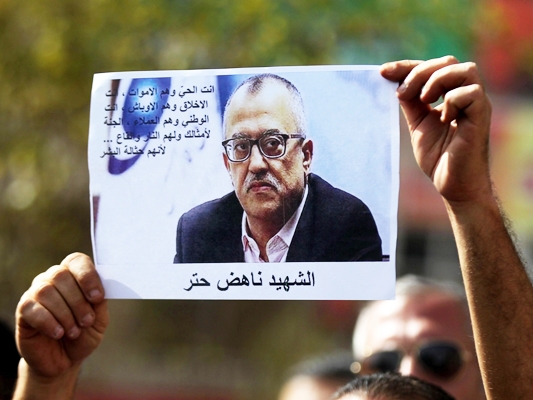
Iran Raps Assassination of Jordanian Anti-Wahhabism Writer

Jordanian writer

“The responsibility of this assassination lies with those individuals who cannot tolerate the writings and opinions of this anti-Zionism and anti-Wahhabism author,” Iranian Foreign Ministry spokesman Bahram Qassemi said on Monday.

“The spread of the wave of violence and terror is a direct outcome of incorrect policies and double-standard approaches by international political and media circles and of disgusting passivity in countering the ideological and political roots of Takfirism and violence,” the Iranian spokesperson added.

He called for immediate action to identify and bring to justice the perpetrators and masterminds of such a terrorist act.

A gunman on Sunday shot dead the Jordanian writer, Nahed Hattar, outside a courthouse where he was expected to stand trial on charges of sharing a cartoon deemed insulting to Islam.

The assailant fired three shots at Hattar in front of the Palace of Justice in the Jordanian capital, Amman.

Hattar had been arrested in August after posting the caricature on his Facebook account. The 56-year-old Christian was charged with inciting sectarian strife and insulting Islam before being released on bail in early September.

The authorities accused the writer of violating law by sharing the cartoon.

Hattar had later apologized and said that he had not meant to disrespect God but rather to mock radicals and their perception of the religion.

Iran’s Zarif Urges Deeds Not Words on Syria, Yemen

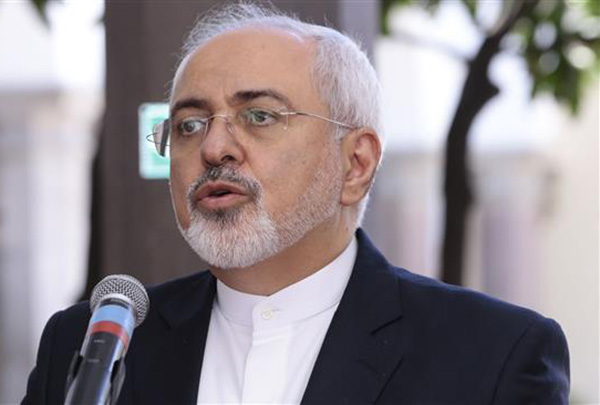
Mohammad Javad Zarif

“Talk is cheap at the UNSC (United Nations Security Council),” Zarif posted on his Twitter account on Monday.

He added that “ceasefire, aid and inclusive political settlement” are the only ways to settle the Yemeni and Syrian crises.


Iran's Zarif Urges Deeds Not Words on Syria, Yemen

The Iranian foreign minister expressed the Islamic Republic’s readiness to help solve the conflicts but rhetorically asked, “Are others too?”

Zarif’s tweet came after the UN Security Council held a crisis meeting Sunday to discuss the critical situation in Syria’s northwestern city of Aleppo. At the meeting, diplomats exchanged blame and fierce words.

Aleppo, Syria’s second largest city, has been divided since 2012 between government forces in the west and foreign-backed terrorists in the east, making it a frontline battleground.

Syria has been gripped by foreign-backed militancy since March 2011. Over the past few months, the Takfiri militants active in the Arab country have suffered major setbacks as the Syrian army has managed to liberate several areas.

Saudi Arabia has been incessantly pounding Yemen since March 2015, with the UN putting the toll at around 10,000. The offensive was launched to reinstate Abd Rabbuh Mansur Hadi, a Saudi ally who has resigned as Yemen’s president.

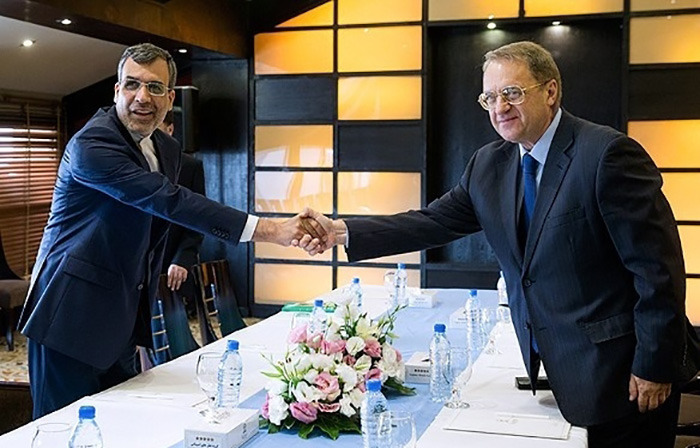
Hossein Jaberi Ansari-Mikhail BogdanovIran, Russia Urge Aid to Syria

Meanwhile, deputy foreign ministers of Iran and Russia on Monday stressed the importance of accelerating the delivery of humanitarian aid to conflict zones in Syria.

Iranian Deputy Foreign Minister for Arab and African Affairs Hossein Jaberi Ansari and Russia’s Deputy Foreign Minister Mikhail Bogdanov made the call in a telephone conversation.

The two top diplomats exchanged views about the latest developments in Syria, particularly the situation in Aleppo.

A week-long truce, brokered by Russia and the US, came to an end across Syria on September 19.

Damascus refused to extend the deal after its military base was hit by US-led airstrikes near the eastern city of Dayr al-Zawr in violation of the agreement.

The air raids, which left more than 80 Syrian troops dead and some 100 others wounded, paved the way for the Takfiri militants to make some gains in the area.

Certain Countries Are not Living Up to Their NPT Commitments: Iranian Official

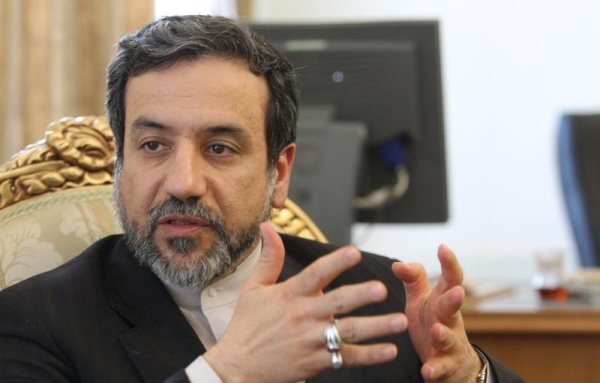
Seyyed Abbas Araghchi

The Iranian Deputy Foreign Minister for Legal and International Affairs Seyyed Abbas Araghchi made the remarks on Monday while addressing the United Nations General Assembly on the UN’s International Day for the Total Elimination of Nuclear Weapons.

Stressing that the demand for nuclear disarmament has been steadily increasing over the years, he noted that the commitments related to the nonproliferation of nuclear weapons are not being implemented appropriately.

Despite expressing their commitment to the articles of Non-Proliferation Treaty (NPT), which requires that they move towards the destruction of their nuclear weapons, some countries have used various innovations and suggestions to avoid international negotiations on doing so, he said.

Araghchi added that there are even some countries that have ignored their commitments to the NPT and allocated huge budgets to bolster the nuclear stockpiles.

He further stressed that Iran has actively taken part in all international and legal efforts towards saving the human race from the threat of nuclear weapons, and believes that in order to reach total nuclear disarmament, the international community must find a general solution based on the initiation of immediate talks and the drawing up of an international convention towards the destruction of nuclear weapons within a specific time period.

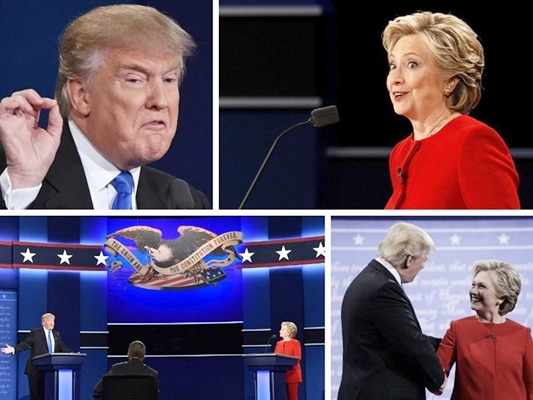
US Election 2016: Clinton, Trump Clash in First Debate

139507060926347498767414

Clinton accused her Republican rival of racism, sexism and tax avoidance, while Trump, a businessman making his first run for public office, repeatedly cast his opponent as a career politician and demanded that she should account for her time in government.

Monday’s televised face-off was the most anticipated moment in the election campaign, with both sides expecting a record-setting audience for the showdown at Hofstra University in New York.

In one of the more heated exchanges, the two candidates attacked each other for the controversy Trump stoked for years over whether President Barack Obama was born in the US.

Obama, who was born in Hawaii, released a long form birth certificate in 2011 to put the issue to rest. Only earlier this month did Trump say publicly that he believed Obama was born in the US.

“He (Trump) has really started his political activity based on this racist lie that our first black president was not an American citizen. There was absolutely no evidence for it. But he persisted. He persisted year after year,” Clinton said.

Trump repeated his false accusation that Clinton’s failed 2008 presidential campaign against Obama had initiated the so-called “birther” issue.

“Nobody was pressing it, nobody was caring much about it … I was the one that got him to produce the birth certificate and I think I did a good job,” Trump said.

The Republican also backed the controversial “stop-and-frisk policing” tactic as a way to bring down crime, while the Democrat said the policy was unconstitutional and ineffective.

The stakes were high as the candidates headed into the debate tied in most national polls ahead of the November 8 election.

The centerpiece of Trump’s case against Clinton, a former senator and secretary of state, was that she was a “typical” politician who has squandered opportunities to address the domestic and international issues she is now pledging to tackle as president.

“She’s got experience,” he said, “but it’s bad experience”.

When the debate moved to international affairs, Trump, who has faced accusations that he has a weak grasp of policy, accused his rival of sowing chaos in the Middle East during her tenure as secretary of state.

“It’s a total mess, under your direction, to a large extent,” the Republican said.

But he appeared on shaky ground as he defended his refusal to reveal his plan for defeating the Daesh (ISIL) terror group.

You’re telling the enemy everything you want to do. No wonder you’ve been fighting ISIS your entire adult life,” he said, with Clinton replying that, unlike, her rival, she at least had a plan for fighting the armed group.

Trump also repeatedly insisted that he opposed the Iraq War before the 2003 US invasion, despite evidence to the contrary.

The Republican charged that Clinton and Obama created a vacuum when the US withdrew the majority of its forces from Iraq in 2011 after years of war.

Daesh “wouldn’t have been formed if (more) troops had been left behind,” he said, Al Jazeera reported.

Clinton countered by saying Trump had supported the invasion of Iraq, adding that the agreement about when US troops would leave Iraq was made by Republican president George W Bush, not Obama.

The Republican also appeared to contradict himself on how he might use nuclear weapons if he is elected president. He first said he “would not do first strike” but then said he could not “take anything off the table”.

Clinton said Trump was too easily provoked to serve as commander-in-chief and could be quickly drawn into a war involving nuclear weapons.

“A man who can be provoked by a tweet should not have his fingers anywhere near the nuclear codes,” she said.

Trump replied: “That line’s getting a little bit old.”

In feisty exchanges on the economy, Clinton called for lowering taxes for the middle class, while Trump focused more on renegotiating trade deals that he said have caused companies to move jobs out of the US.

Clinton attacked Trump for not releasing his income tax returns and said that decision raised questions about whether he was as rich and charitable as he has said.

“There’s something he’s hiding,” she declared, scoffing at his repeated contentions that he will not release his tax returns because he is being audited. Tax experts have said an audit is no bar to making his records public.

Clinton said one reason he has refused is that he may well have paid nothing in federal taxes. He interrupted to say, “That makes me smart”.

Trump aggressively tried to turn the transparency questions around on Clinton, saying he would release his tax returns, “when she releases her 33,000 e-mails that have been deleted,” alluding to the Democrat’s use of a private email server as secretary of state.

Toward the end of the debate, Trump said Clinton did not have the endurance to be president.

“She doesn’t have the look, she doesn’t have the stamina,” he said. Trump has made similar comments in previous events, sparking outrage from Clinton backers who accused him of leveling a sexist attack on the first woman nominated for president by a major US political party.

Clinton leapt at the opportunity to remind voters of Trump’s numerous controversial comments about women, who will be crucial to the outcome of the November election.

“This is a man who has called women pigs, slobs and dogs,” she said.

Citing her own public record, Clinton retorted: “As soon as he travels to 112 countries and negotiates a peace deal, a ceasefire, a release of dissidents … or even spends 11 hours testifying in front of a congressional committee, he can talk to me about stamina.”

Quinnipiac University declared the race “too close to call” on Monday, with its latest national poll of likely voters suggesting 47 percent of support for Clinton and 46 percent for Trump.

“It really felt great,” Trump told reporters after the debate.

But political analyst Jason Johnson told Al Jazeera that he would not be surprised “if we see slight chances in the polls at the end of the week” in favor of Clinton.

“Trump came out aggressively … but never had much in terms of substance or answers,” he said.

“I think Hillary did what she needed to do better than Trump. She offered solutions.. explained how she sees America and her worldview. Her supporters will come out very enthusiastic.”

It was the first time the two candidates stood side by side since becoming their parties’ nominees.

Two more debates are to follow on October 9 and October 19.

Iran, Italy to Stage Joint Naval Drills in Open Seas

139507031320102318739314

Speaking to reporters in Bandar Abbas on Monday night, Admiral Azad said the anti-submarine frigate of the Italian Navy named “Euro” docked in Bandar Abbas on Saturday and its forces have met with a number of local military and political officials.

The Italian frigate will leave Bandar Abbas on Tuesday, he said, adding that the warship accompanied with Euro chopper will hold joint military drills with the Iranian Navy’s Alvand and Alborz destroyers as well as a helicopter of the Navy in open seas.

He noted that drills are aimed at boosting military power and also the exchange of knowledge between the two countries’ navies.

Following a welcome ceremony in Bandar Abbas on Saturday, top Iranian Navy commanders and the visiting warship’s captain as well as Italy’s ambassador to Tehran and the European country’s military attaché in Iran held a meeting.

Earlier in September, a 5-strong military delegation from the Italian Army, led by Rear Admiral Roberto Chia Marcella, travelled to Iran and visited different units of the Iranian Armed Forces.

The ranking Italian official invited the Iranian Navy to send fleets to Italy as well.

Every year, Iran holds a number of joint military war games with other countries and senior Iranian military officials also make reciprocal visits to other nations.