Sunday, April 26, 2026
Home Blog Page 4322

Tehran’s Towers: How Iranian Capital Embraced Bold Architecture

Orsi Khaneh

Here is a report by The Gaurdian, as covered by Haft-e Sobh Newspaper:

In the few decades leading up to the 1979 Islamic revolution, architects such as Houshang Seyhoun, Kamran Diba and Hossein Amanat pushed the boundaries of traditional Persian architecture by using traditional elements in modern designs; Amanat’s Azadi tower epitomises those efforts.

After the revolution, however, the Iranian capital’s architectural scene suffered a serious blow as the country was consumed first by war then by post-war reconstruction. But more recently, with young architects educating themselves in worldwide trends, and the relative stability of the country compared to its post-revolutionary upheaval, a new generation are following in the footsteps of the veterans. The city has embraced a bold, experimental architecture.

Tehran in 2016 “is in a constant mood of reconstructing and rebuilding itself,” according to Mehran Gharleghi, director at London’s Studio Integrate, who has previously worked in Tehran for the prominent architecture firm Mirmiran. “The municipalities accommodate new designs, at least compared to Europe, and there’s a big appetite for new buildings.”
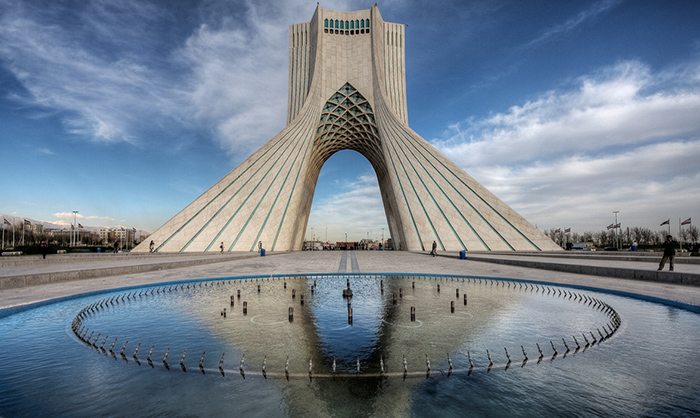
 

Azadi Tower

“Tehran has a unique structure,” he adds. “It is more dynamic than any European capital, and at the same time it’s not a typical Middle Eastern city. Its urban scene is quite chaotic at the first glance. But, similarly to cities like Tokyo, this means Tehran is constantly able to renew its visual identity.”

Tehran’s mayors are also influential. Former president Mahmoud Ahmadinejad was one. And the incumbent, Mohammad Bagher Ghalibaf, who has run eye-catching projects such as installing Picasso and Matisse billboards on the city’s streets, has presidential ambitions himself – leading, says Ghaleghi, to “the motivation of Tehran’s mayor to commission ambitious projects and improve the urban set-up”.

Architects in Iran also enjoy a great deal of freedom. “Their hands are not tied,” says Kamran Rezaianpour, founder of the architecture firm Idehandish, which has offices in Tehran and Shiraz. “The mayor’s office won’t make obstacles; the main issue is to persuade the owner. In Tehran, the mayor’s office is mainly concerned with two issues: parking spaces and the height of buildings.”

Nor is the new architectural freedom limited to the capital. “In fact, in other cities, such as Isfahan, Shiraz, Mashhad and Tabriz, you’ll see more creative works than in Tehran,” Rezaianpour says. “In the past, there was a huge difference between the capital Tehran and big provincial cities in that regard, now this has been narrowed.”


Sharifi-ha House
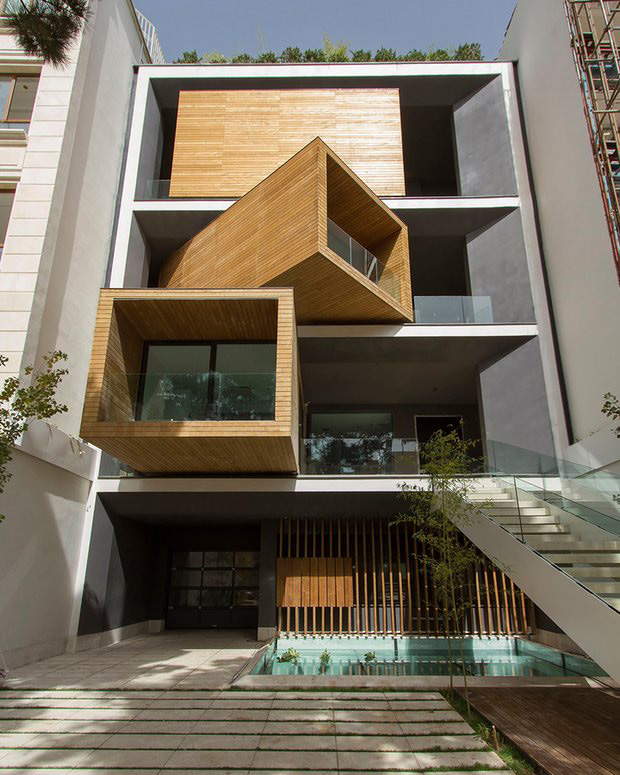
 

Sharifi-ha house

Built in 2014 in Tehran’s affluent Darrous neighbourhood, the Sharifi-ha house is a seven-floor building with three rotating blocks that turn 90 degrees. Each block is on a rotating base that allows the owner, Farshad Sharifi, to change its direction at the push of a button. The house has a swimming pool, a gym and a cinema.

“The openness/closure of the building’s volume is a reference to traditional Iranian houses, which would dynamically serve as seasonal modes of habitation by offering both a Zemestan-Neshin (a winter living room) and Taabestan-Neshin (a summer living room) to their residents,” its lead architect from Next Office, Alireza Taghaboni, has written.


 Tabiat Bridge
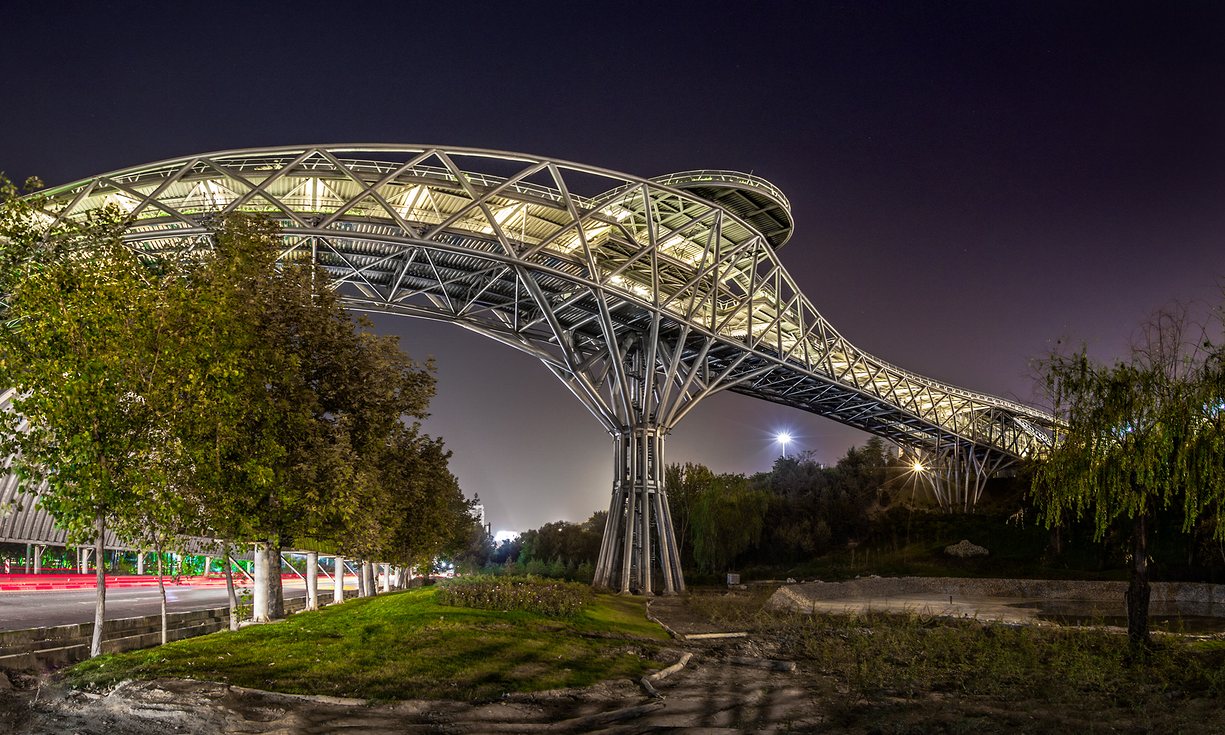
Tabiat Bridge


Unveiled in 2014 by Tehran’s mayor, Tabiat (nature) bridge is a spectacular hi-tech structure designed by young architects Leila Araghian and Alireza Behzadi. Araghian was 26 when she designed the bridge, which took over two years to build and has since become a popular hangout for younger people and a site for morning sports. On public holidays, thousands flock there to picnic.

The bridge received a great deal of international attention after it was named last year among the winners of the Architizer A+ awards, a global competition based in New York. The 270m structure, which connects two parks in north Tehran, is built on three large pillars. It has multiple pathways and three floors of restaurants, cafes and seating areas. “I didn’t want it to be just a bridge that people would use to get from one park to another,” Araghian told the Guardian last year. “I wanted it to be a place for people to stay and ponder, not simply pass.”


Pardis Mellat Cinema
 

Pardis Mellat Cinema

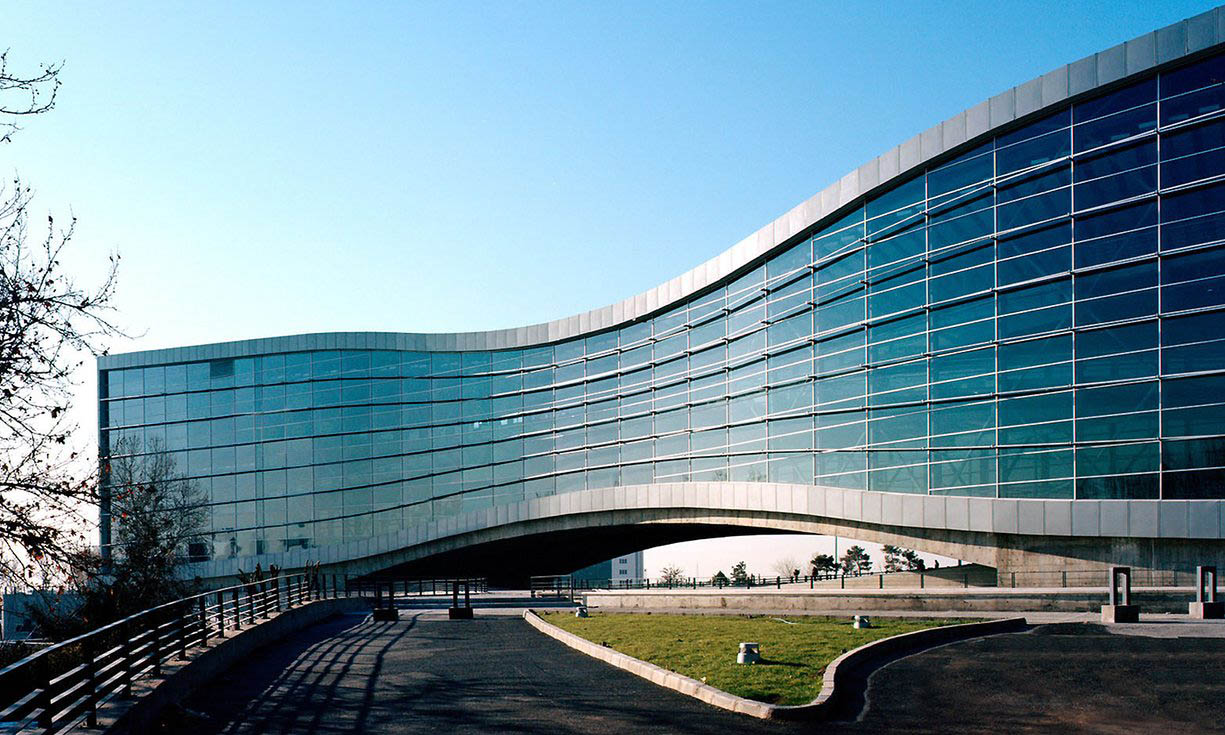
Reza Daneshmir’s Pardis Mellat cinema is responsible in many ways for kicking off the new burst of creativity in the capital, and was one of the first projects to gain international recognition after the revolution. “It was commissioned by Tehran’s mayor and completed in 2008; the state sector continued to commission similar works later such as the Tabiat Bridge,” says Gharleghi.

The cinema is in the southern corner of Tehran’s popular Mellat Park. One of its central features is a 57-metre arch with no supporting columns, and the building is designed as a place to hang out after watching films.


Nikbakht House
 

Nikbakht House


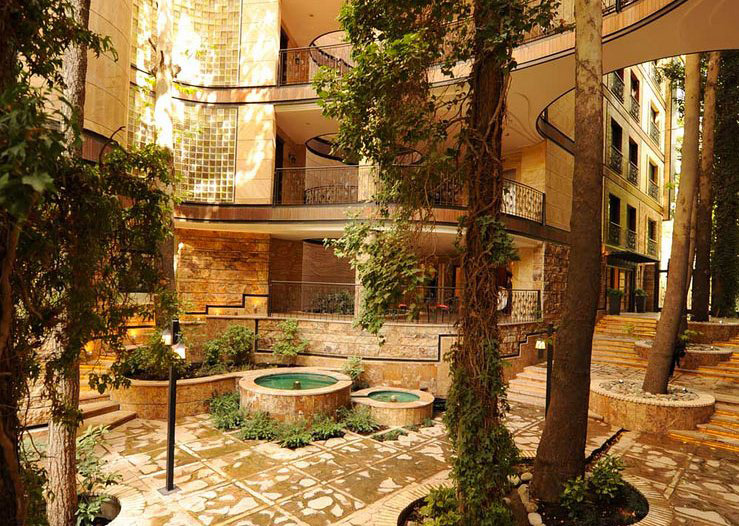
Mohammad-Reza Nikbakht’s residential building in Niavaran, north Tehran, built in 2013, was specifically designed to ensure no trees were cut down during its construction. “We’ve seen too many times in Tehran that 150-year-old or 200-year-old trees are cut for creation of new flats,” he said. “In my project, we faced a total of 128 trees with an average age of 70 years.” The initial plan required around 40 trees to be cut, but Nikbakht redesigned and persuaded the municipality to preserve all of them.

“We tried to protect them by covering them up during the construction. One tree dried up and another caught fire – the rest remained intact,” Nikbakht says. The residential complex has two blocks and each have five floors. “After this project, many people have become conscious about preserving the trees and the authorities have also increased the cost of cutting trees for the purpose of constructing new houses or offices.”


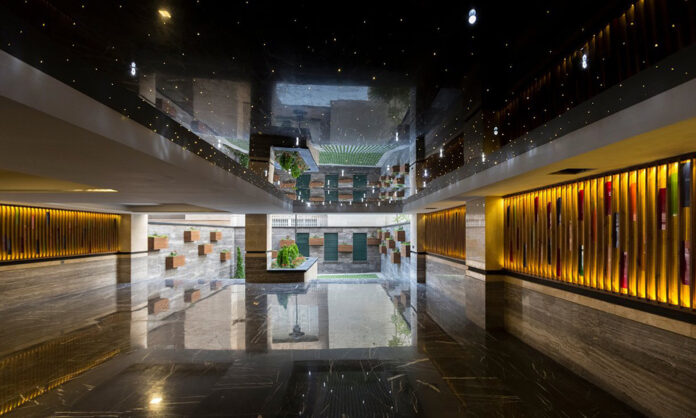
Orsi Khaneh
 

Nikbakht House

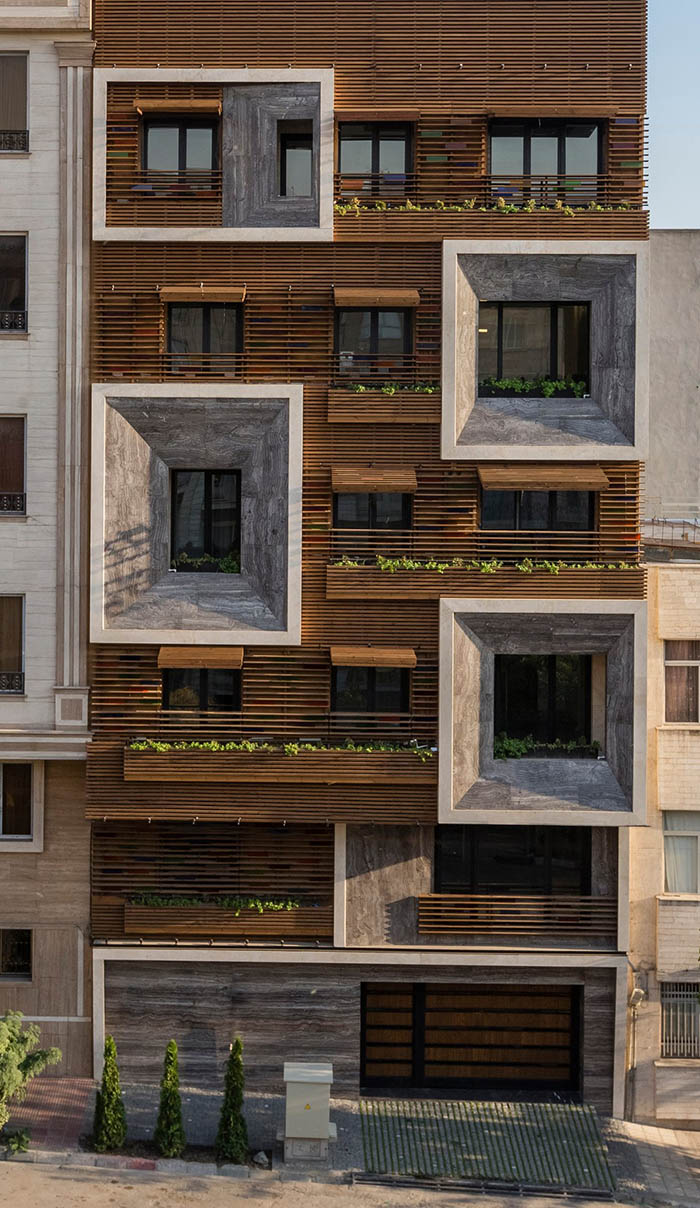
The Orsi Khaneh, designed by the Keivani brothers, is a residential block of flats completed in September 2015 in Tehran’s middle-class Gisha neighbourhood. “One of our main concerns was how to bring our architectural values to today, our aim was to make our Iranian architecture up to date,” Nima Keivani says. “In this project, we used the concept of Orsi windows seen in Iranian houses in the city of Kashan and tried to use it in today’s architecture.”

The building has seven floors, five of which are apartments, and a garden on its roof. “We also used stained glass and used the six colours that have traditionally been seen in Iranian windows,” Keivani said.

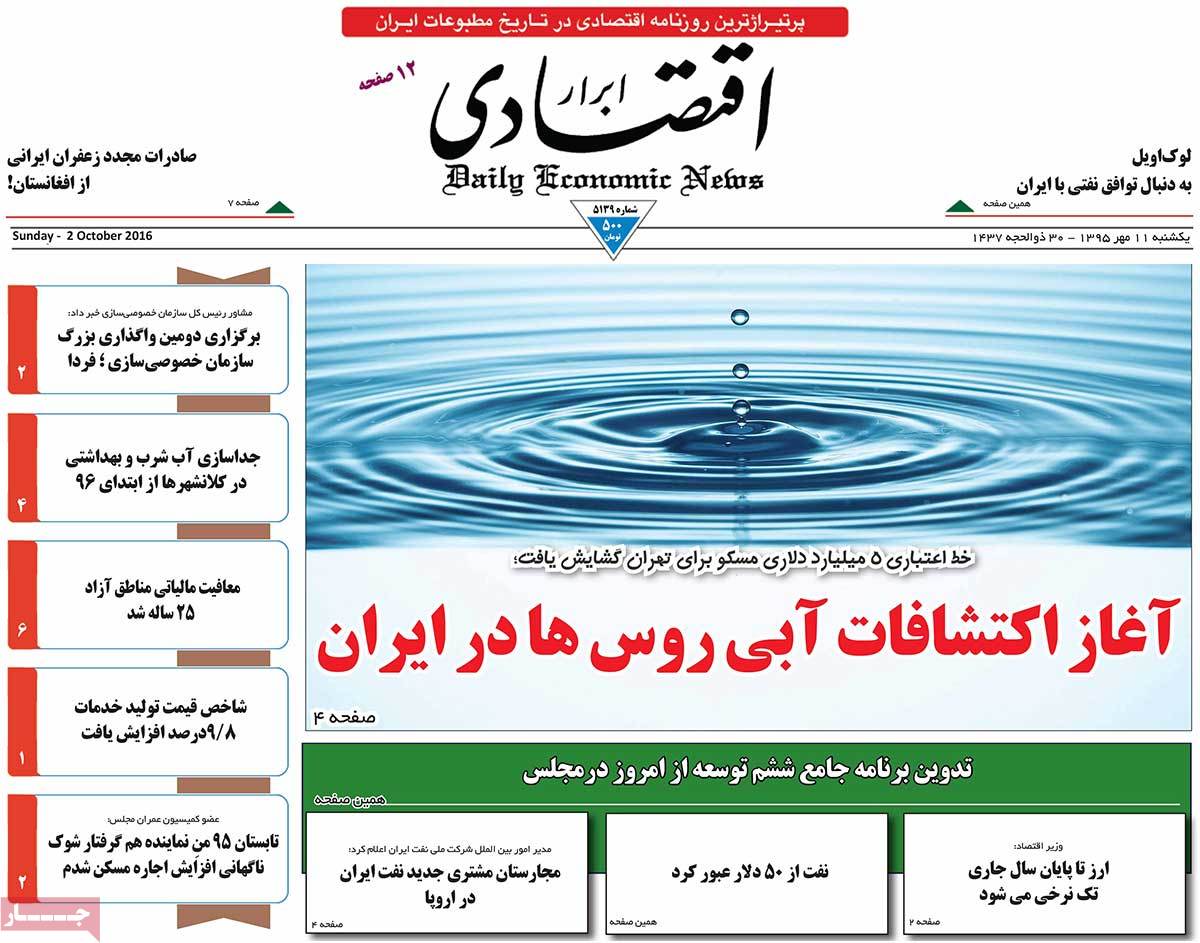
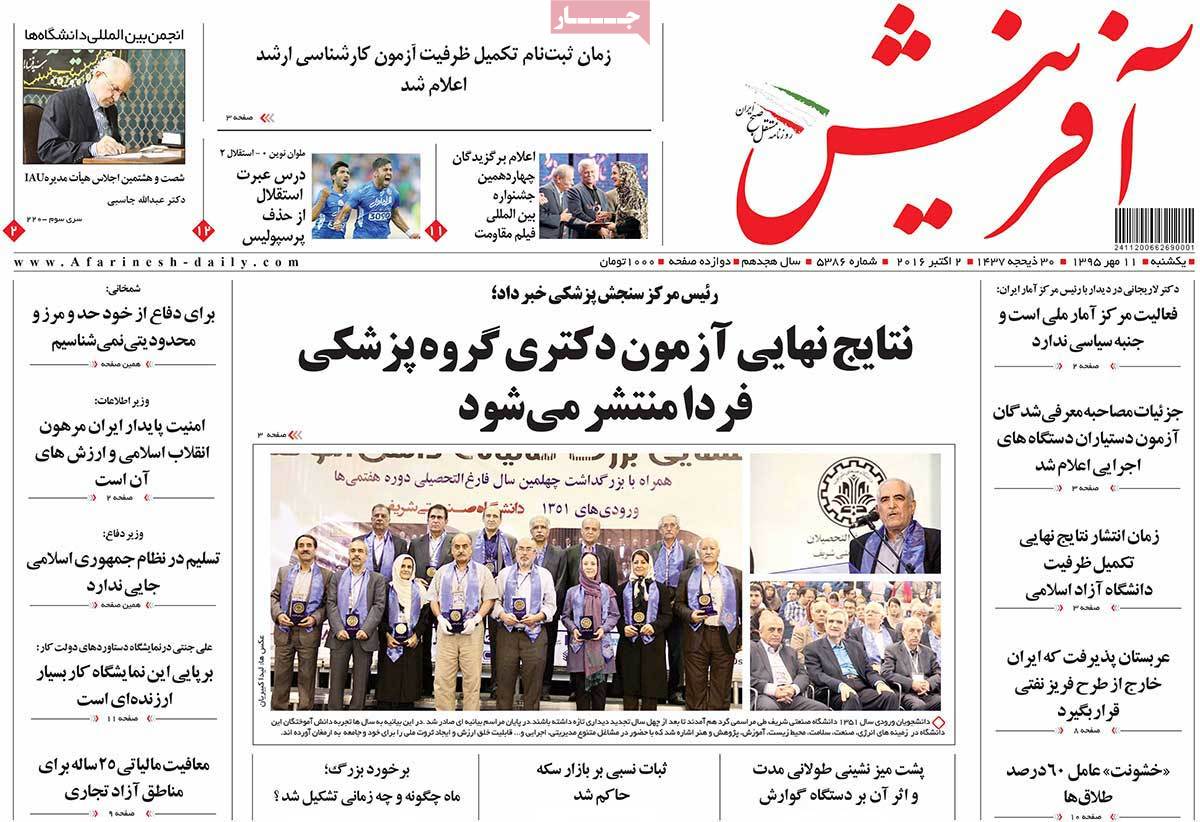
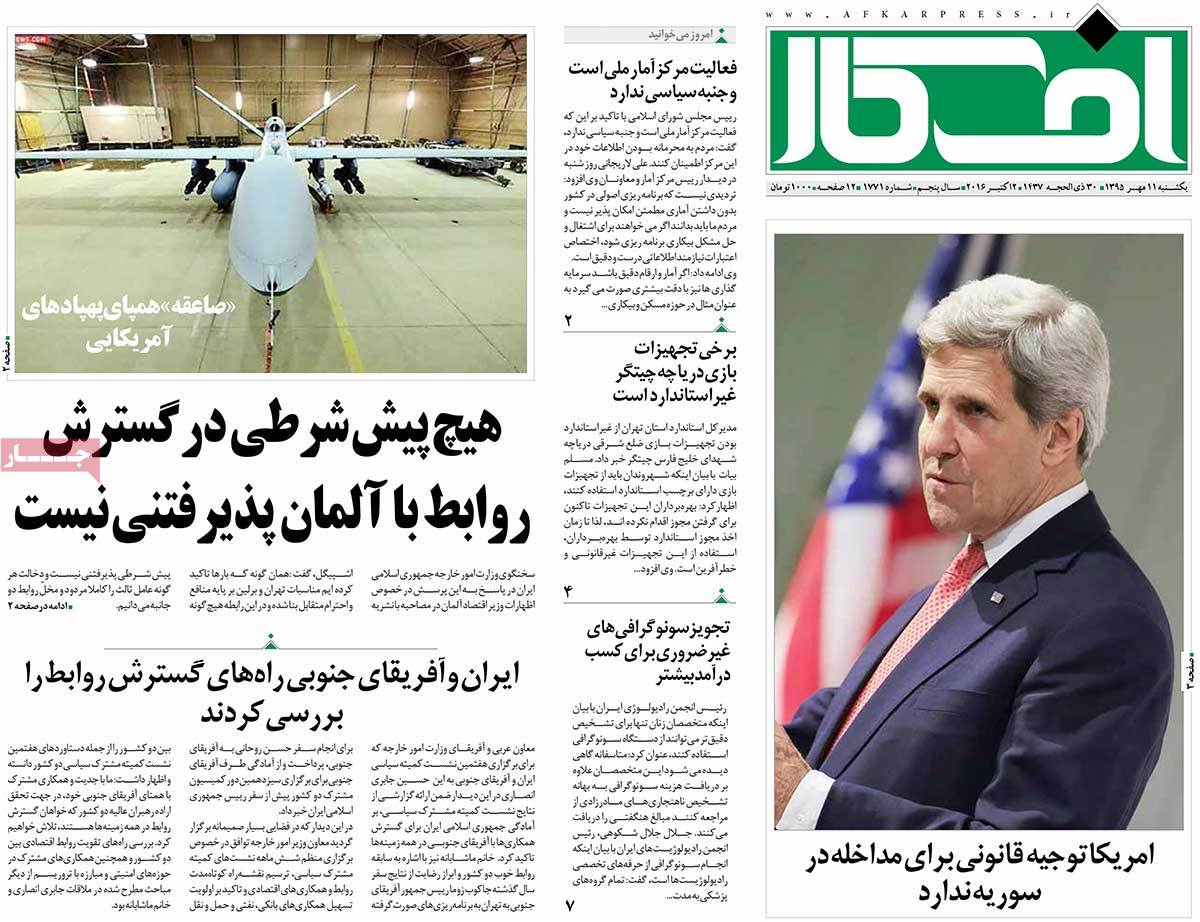
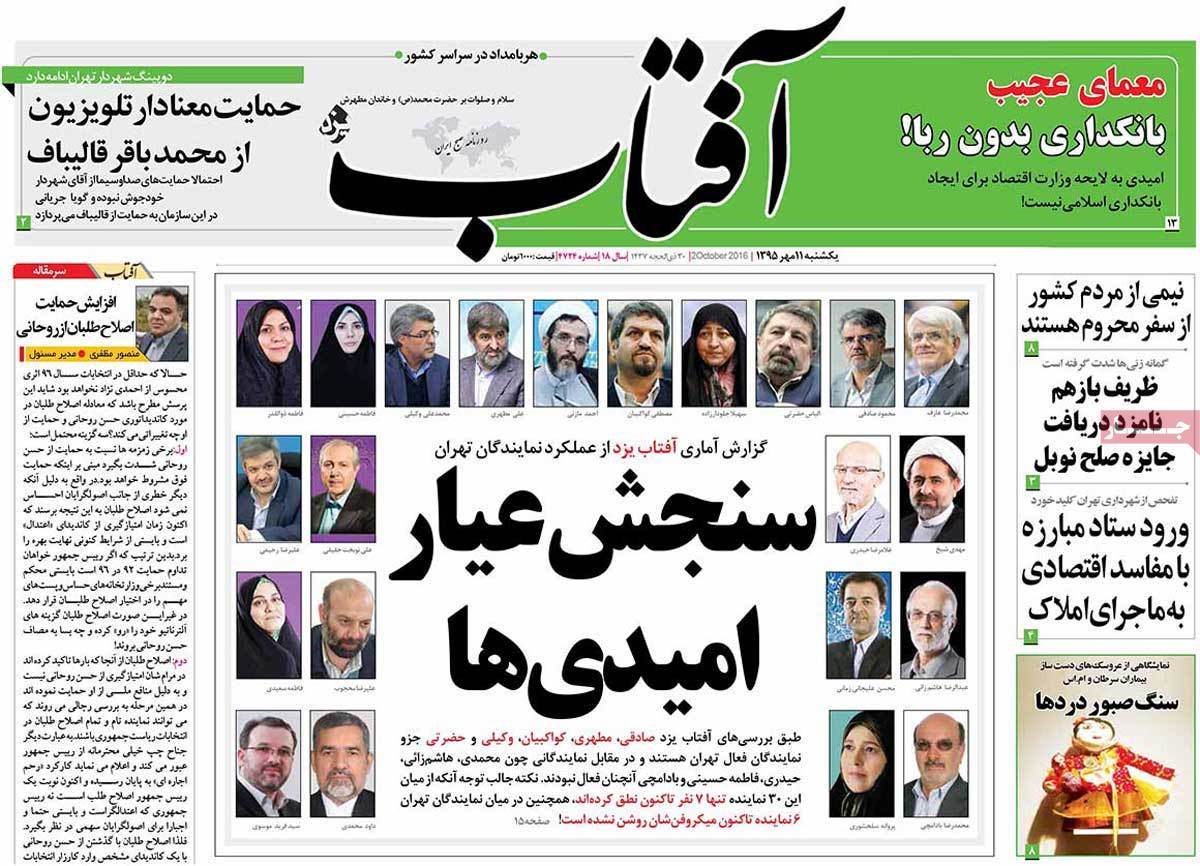
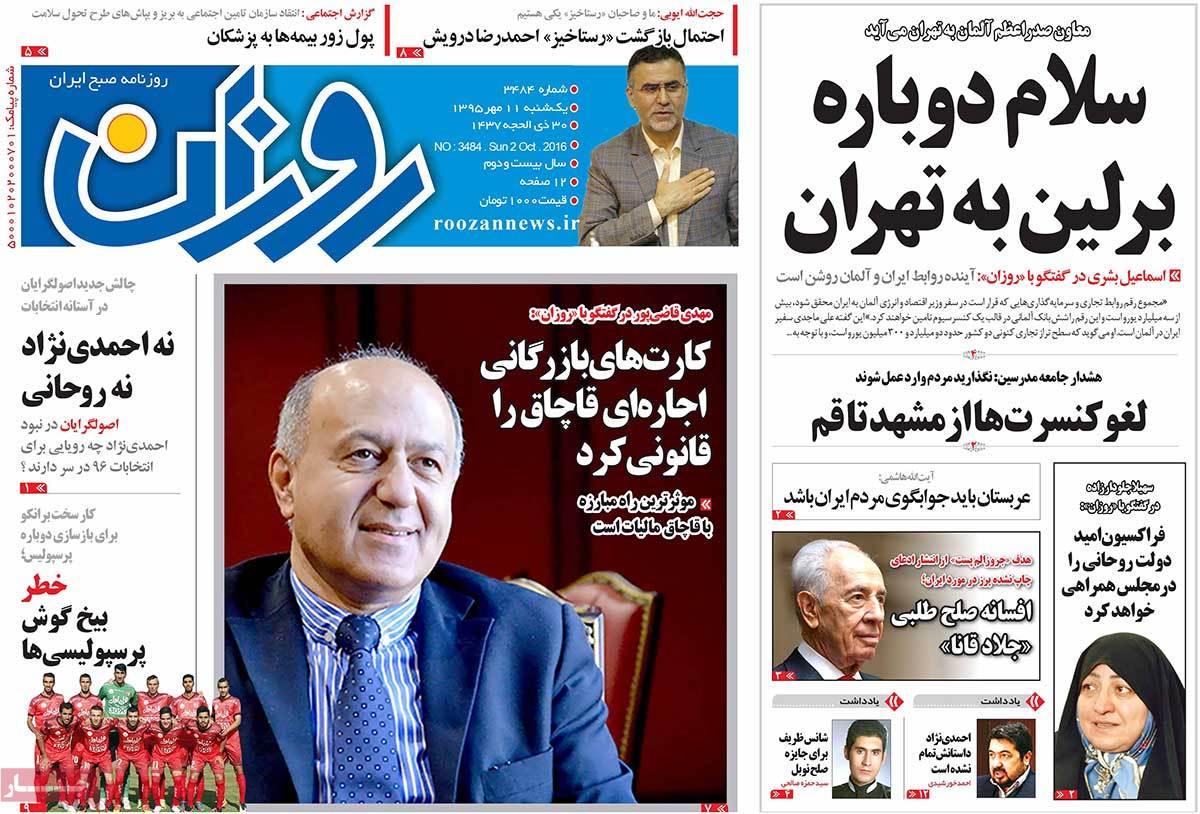
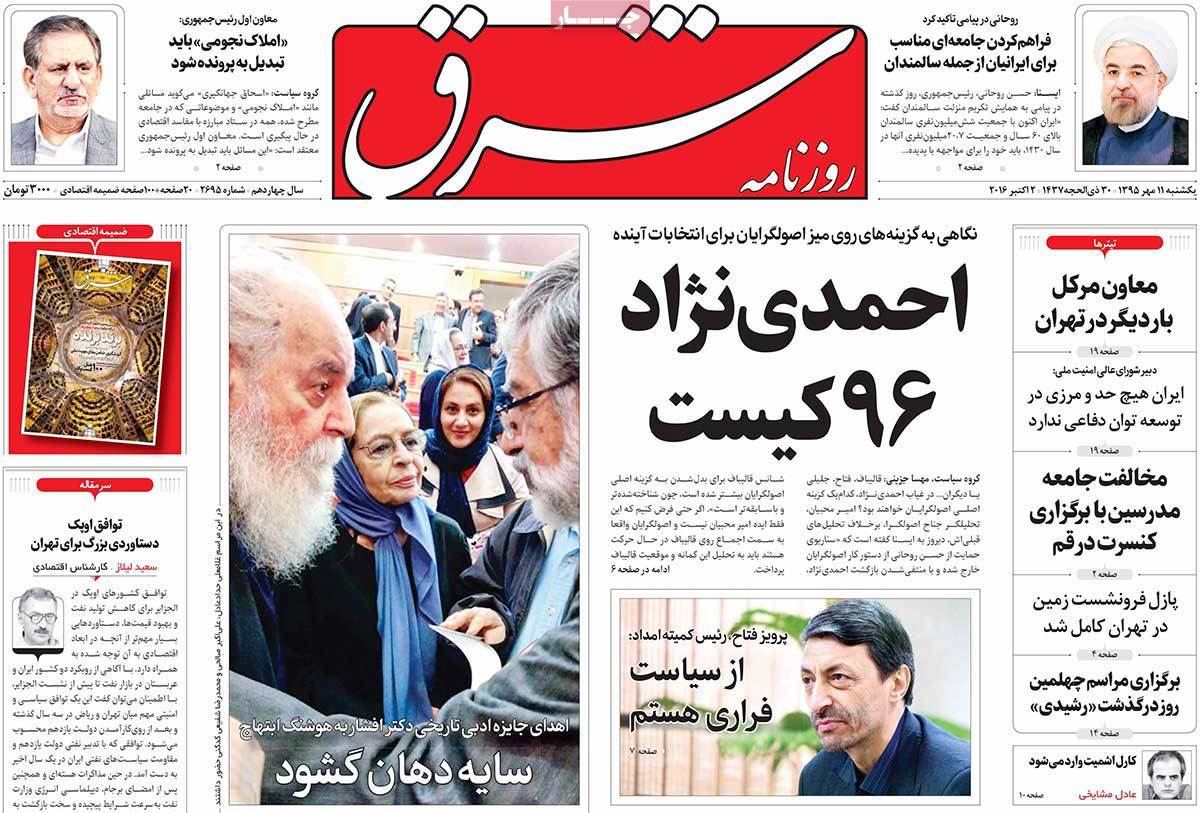
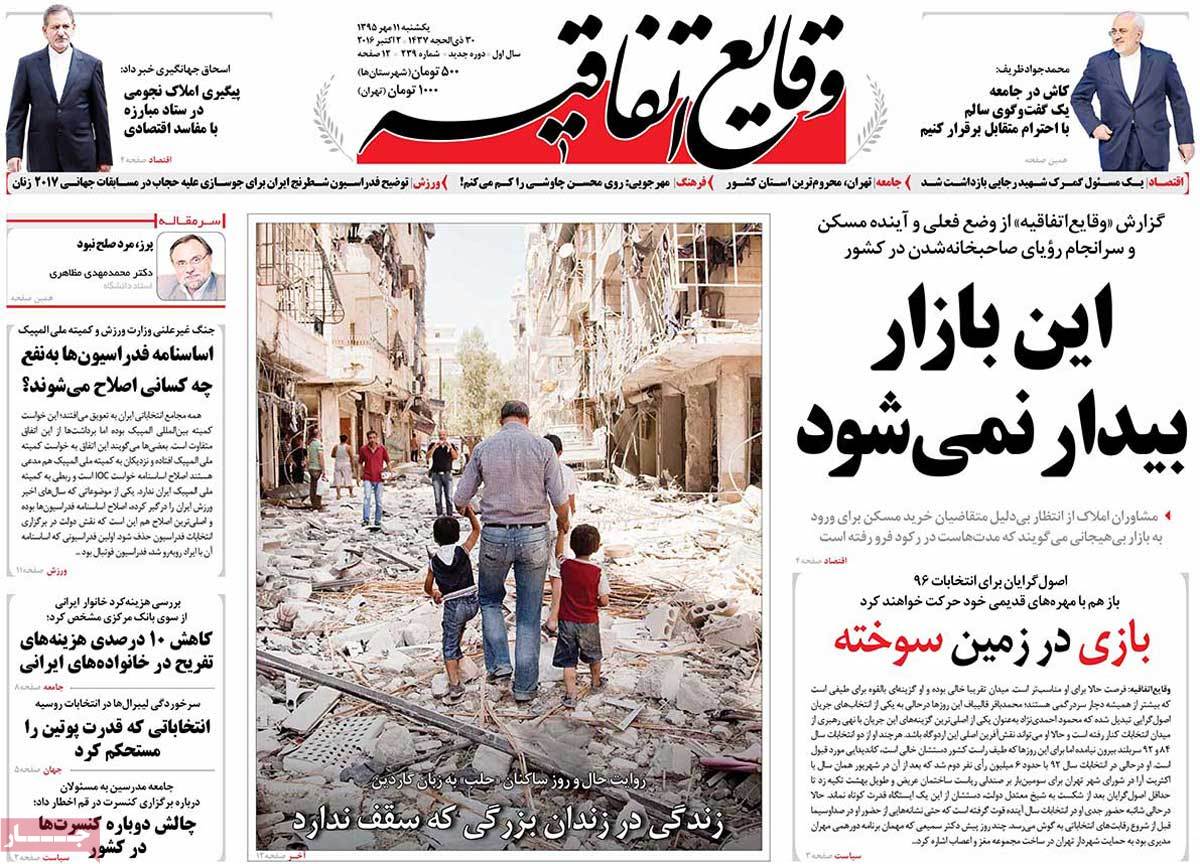
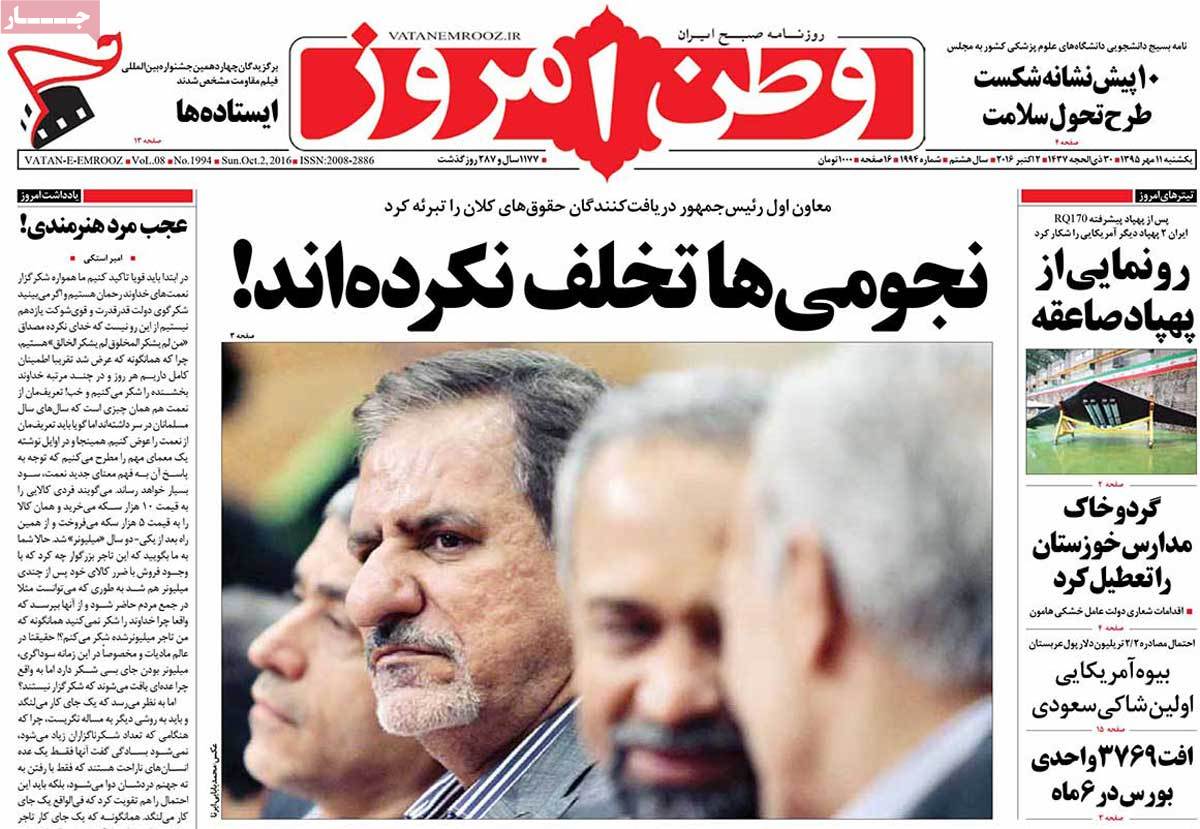
A Look at Iranian Newspaper Front Pages on October 2

Iran Newspaper front pages

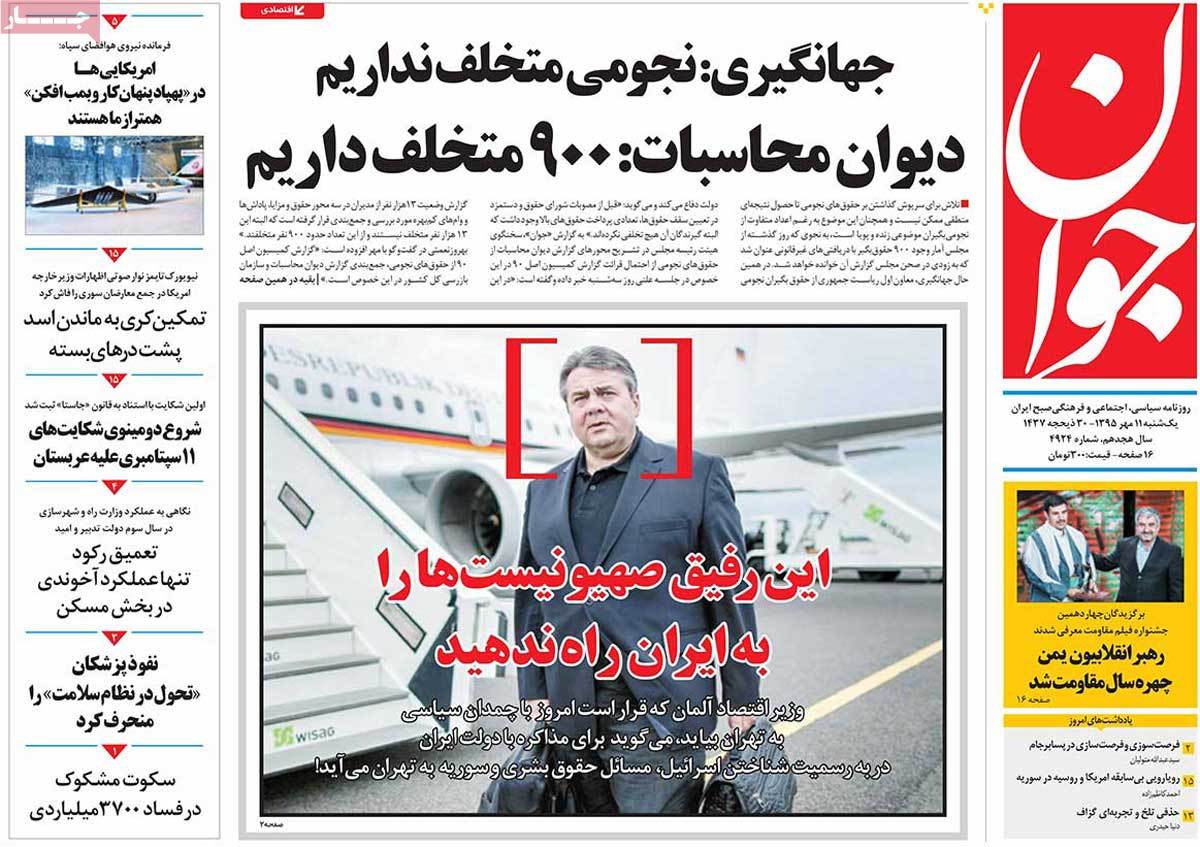
The majority of newspapers on Sunday covered the upcoming visit of German Economy Minister Siegmar Gabriel and his alleged pre-condition – Iran’s recognition of Israel – for expansion of Tehran-Berlin ties.

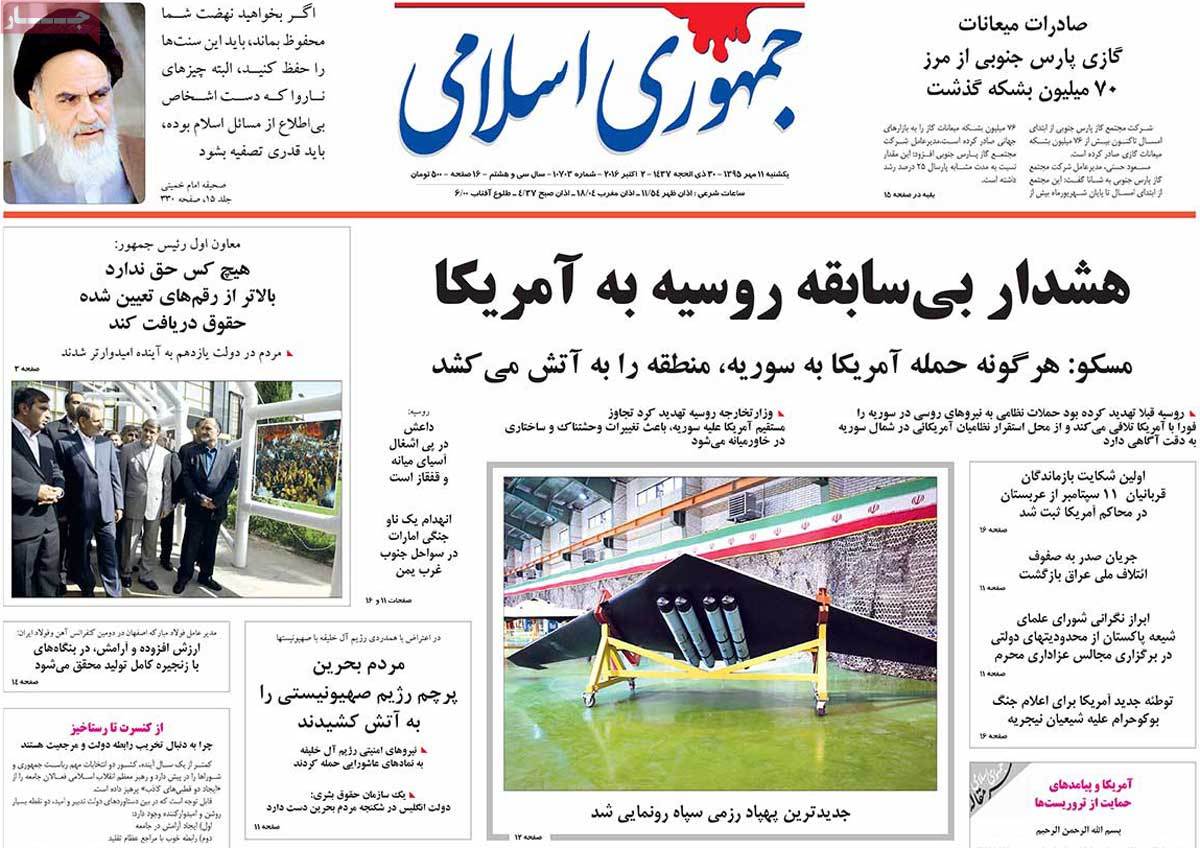
Another top story was the unveiling of Iran’s newly-developed drones and the American UAVs hunted by Iranian forces.

Newspapers also covered the US Secretary of State John Kerry’s remarks about Syrian President Bashar al-Assad’s presence in Syrian elections.

The above issues, as well as many more, are highlighted in the following headlines:


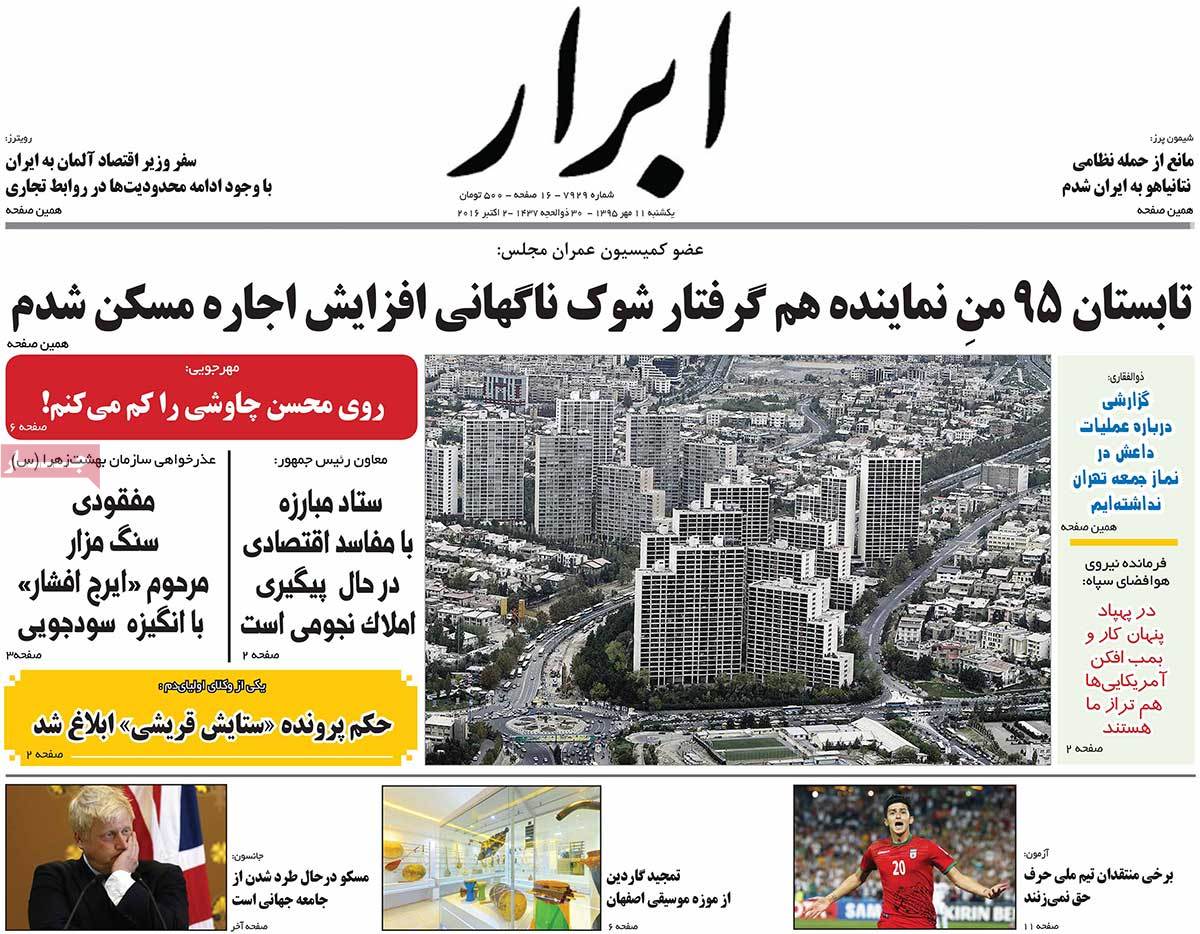
Abrar:

1- IRGC Aerospace Force Commander: US Trying to Draw Level with Iran in Making Stealth and Bomber Drones

2- Deputy Minister: No Report of ISIS’ Operation in Tehran Friday Prayers

3- Reuters: German Economy Minister Visiting Iran in Spite of Continued Restrictions in Trade Ties

A Look at Iranian Newspaper Front Pages on October 2


Abrar-e Eqtesadi:

1- Lukoil Looking for Oil Deal with Iran

2- Re-Export of Iran’s Saffron from Afghanistan!

3- Russians Begin Water Explorations in Iran: Moscow Opens $5bn LC for Tehran

A Look at Iranian Newspaper Front Pages on October 2


Afarinesh:

1- Shamkhani: We See No Limit in Defending Ourselves and Our Borders

2- Intelligence Minister: Iran’s Sustainable Security Achieved Thanks to Islamic Revolution and Its Values

3- Defence Minister: Submission Has No Meaning in Islamic Republic

A Look at Iranian Newspaper Front Pages on October 2


Afkar:

1- Kerry: US Has No Legal Justification for Intervention in Syria

2- Iran and South Africa Explore Avenues for Expansion of Ties

3- Iranian Spokesman: Iran Accepts No Pre-Condition for Expansion of Ties with Germany

A Look at Iranian Newspaper Front Pages on October 2


Aftab-e Yazd:

1- Renewed Speculations: Zarif Once Again Named as Noble Peace Prize Candidate

2- 50% of Iranians Deprived of Travelling

A Look at Iranian Newspaper Front Pages on October 2


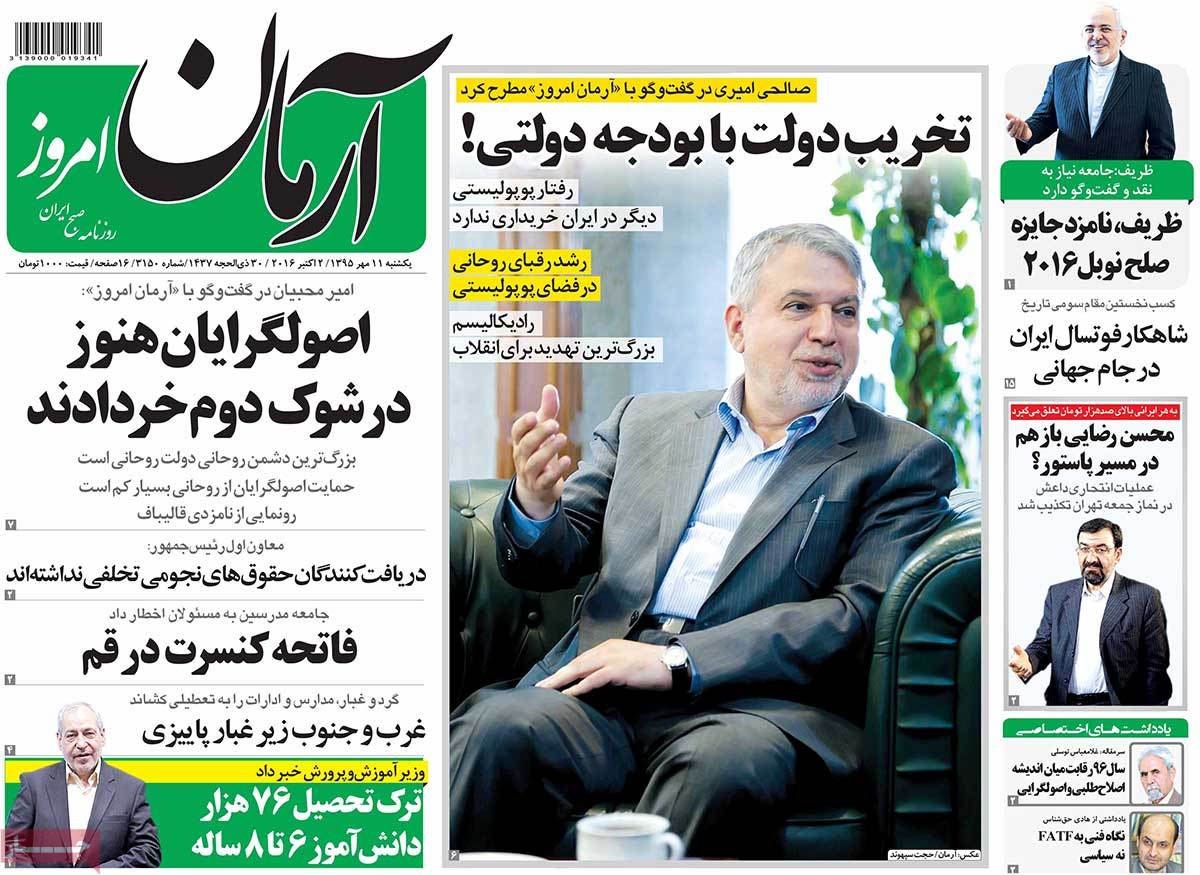
Arman-e Emrooz:

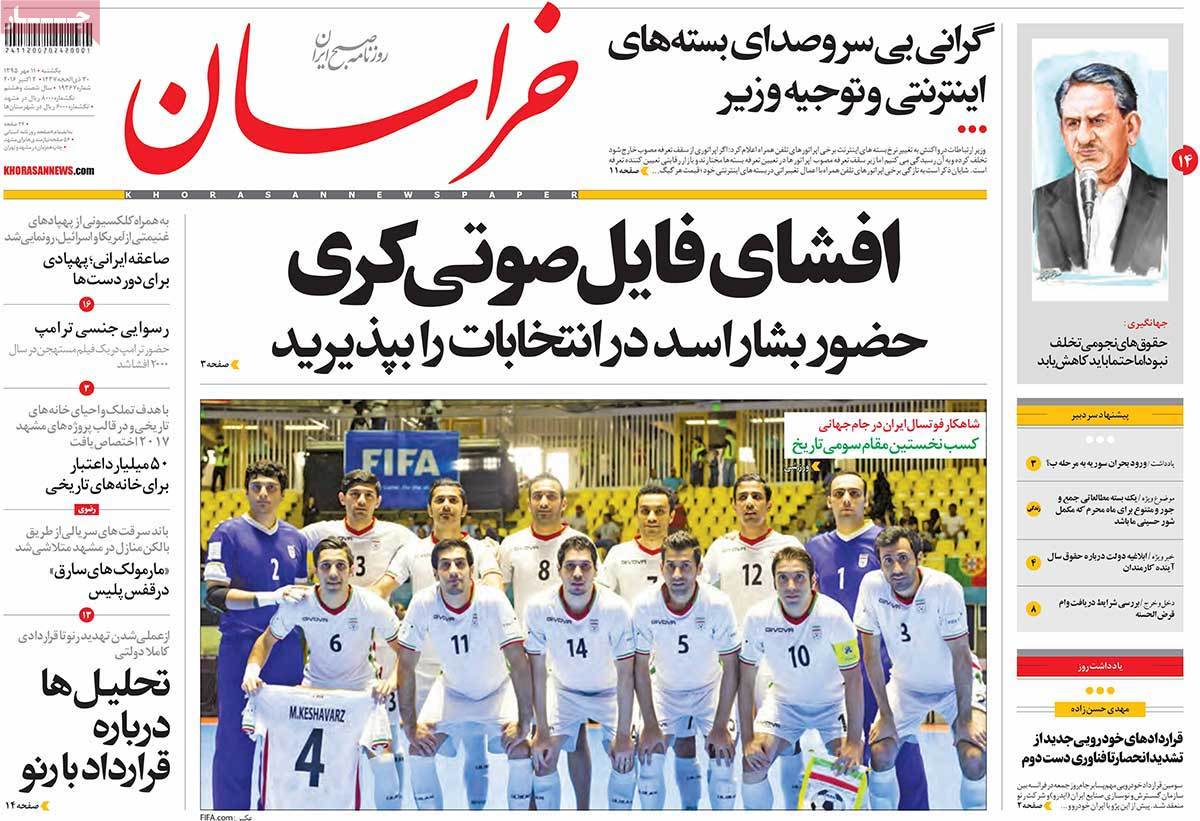
1- Iran Futsal Team Makes History: 3rd Place in World Cup, First Medal in Iran’s Futsal History

2- Western and Southern Iran Hit by Dust Pollution of Autumn: Schools and Administrations Shut Down

A Look at Iranian Newspaper Front Pages on October 2


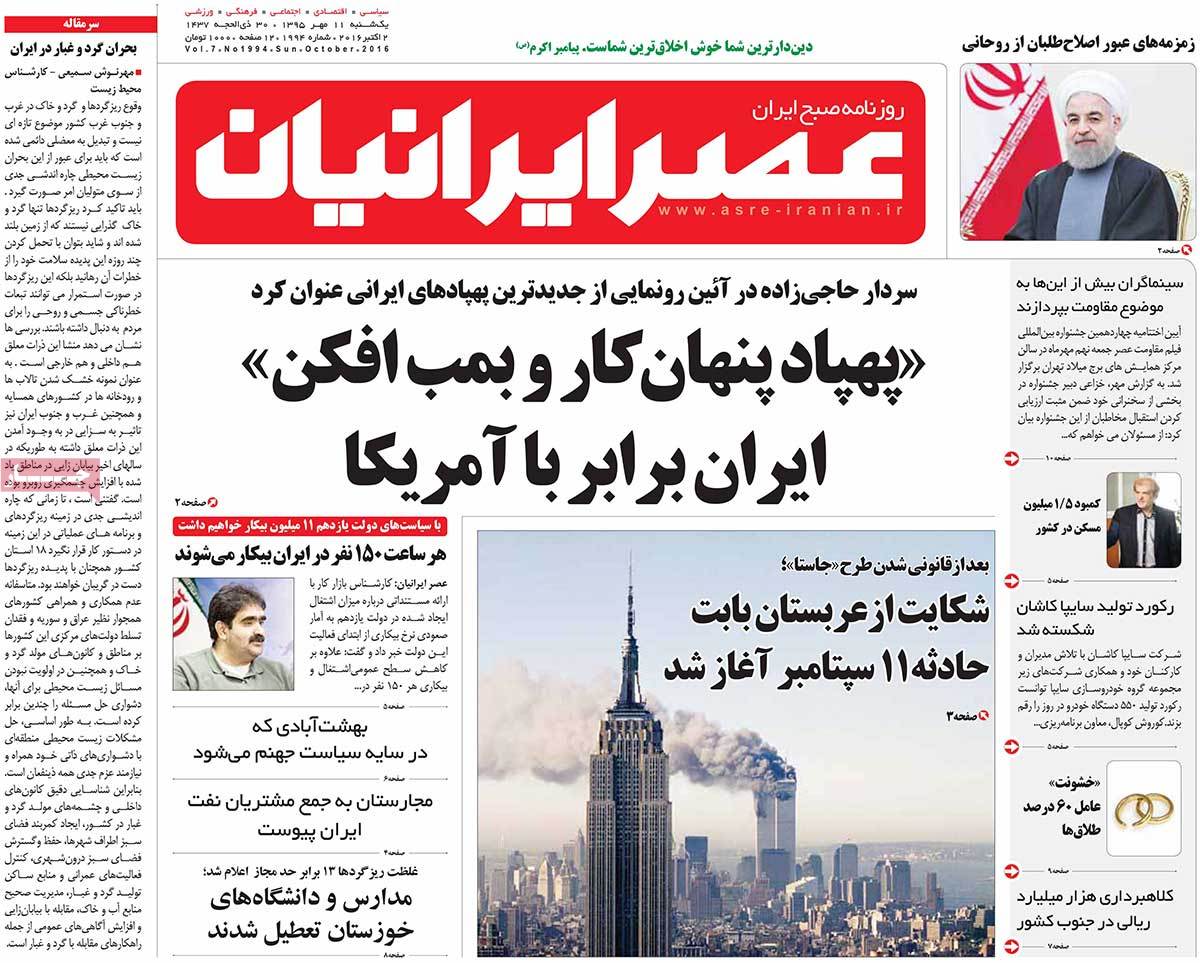
Asr-e Iranian:

1- Hungary Joins Iran’s Oil Customers

A Look at Iranian Newspaper Front Pages on October 2


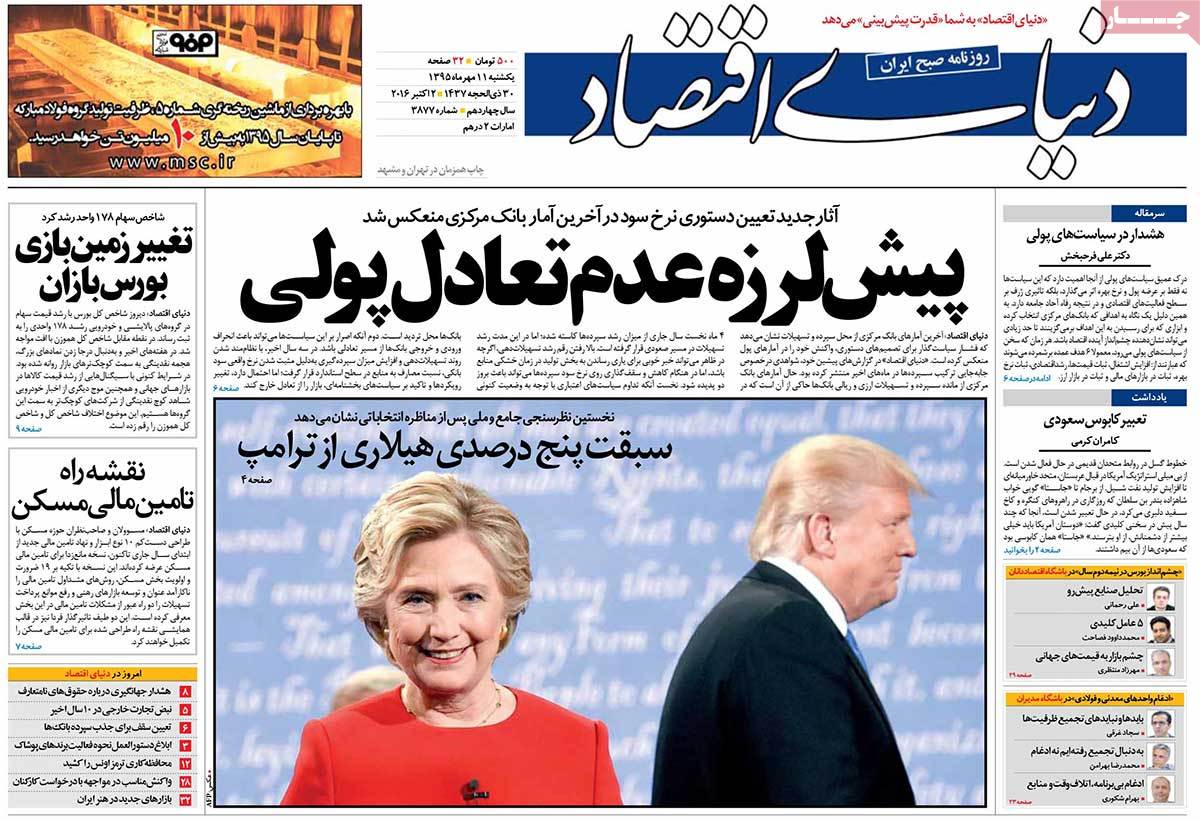
Donya-ye Eqtesad:

1- First Nationwide and Comprehensive Poll after US Presidential Debates Indicates: Hillary Is 5% ahead of Trump

A Look at Iranian Newspaper Front Pages on October 2


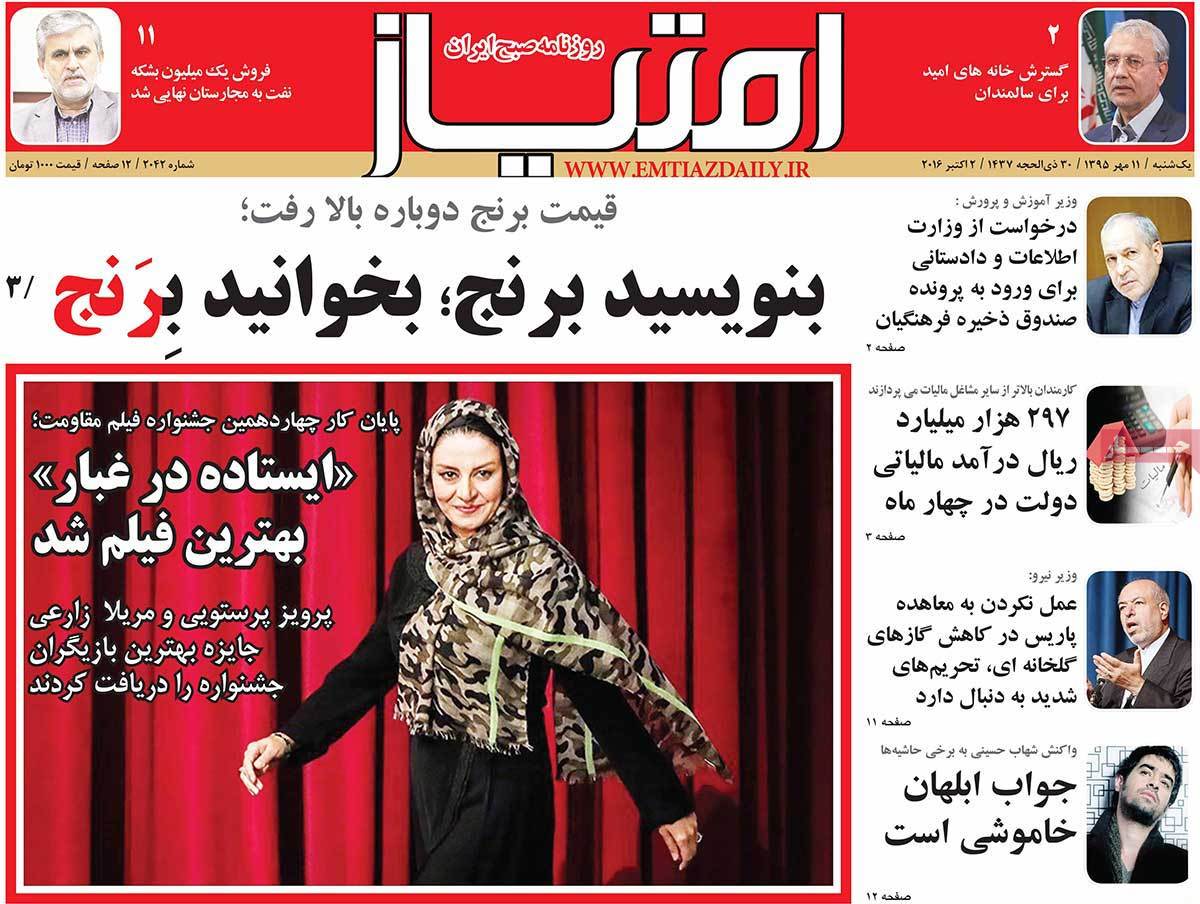
Emtiaz:

1- Power Minister: Serious Sanctions Can Be Imposed If Iran Fails to Implement Its Commitments as per Paris Deal on Greenhouse Gases

A Look at Iranian Newspaper Front Pages on October 2


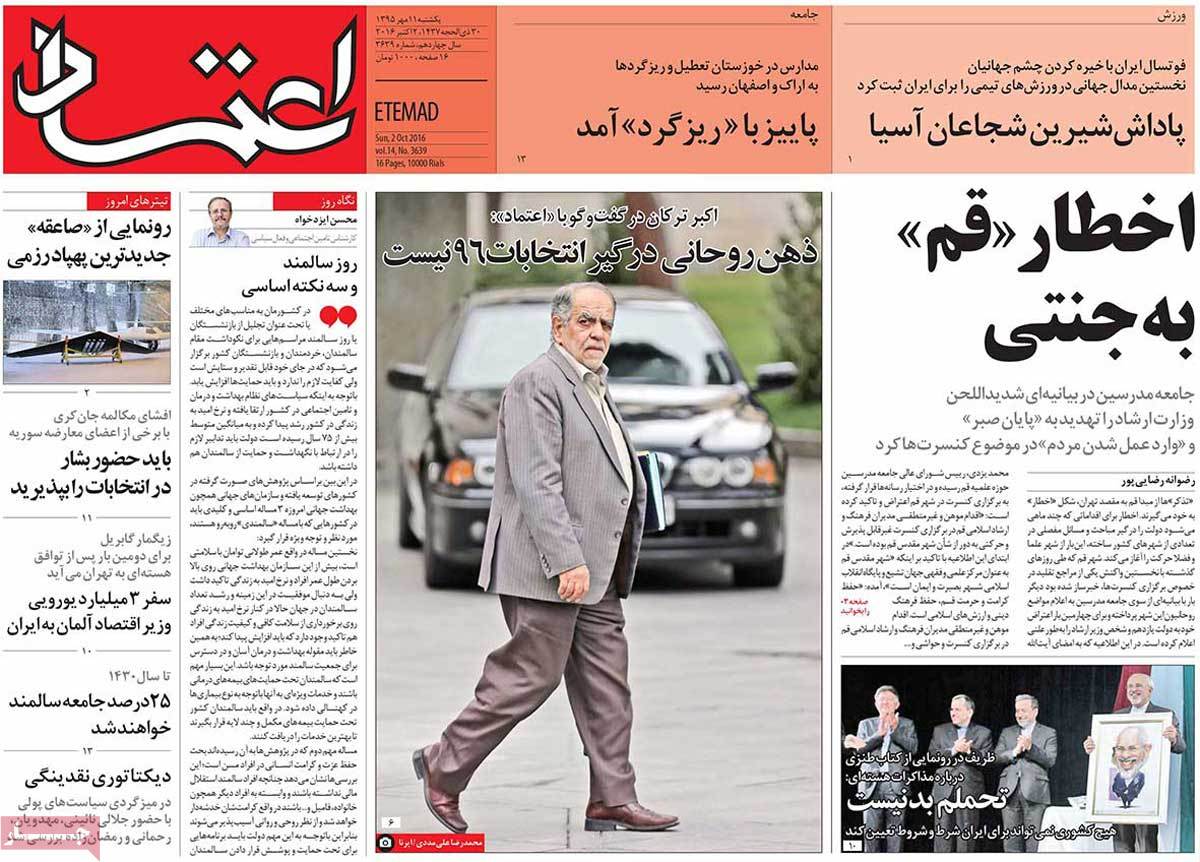
Etemad:

1- Iran Unveils Latest Fighter Drone ‘Sa’eqeh’

2- You Have to Accept Assad’s Presence in Syrian Elections: Kerry’s Conversation with Some Syrian Opposition Figures Leaked

3- German Economy Minister’s Visit to Tehran with €3bn Business Deals: Gabriel to Visit Iran for Second Time Since Nuclear Deal

A Look at Iranian Newspaper Front Pages on October 2


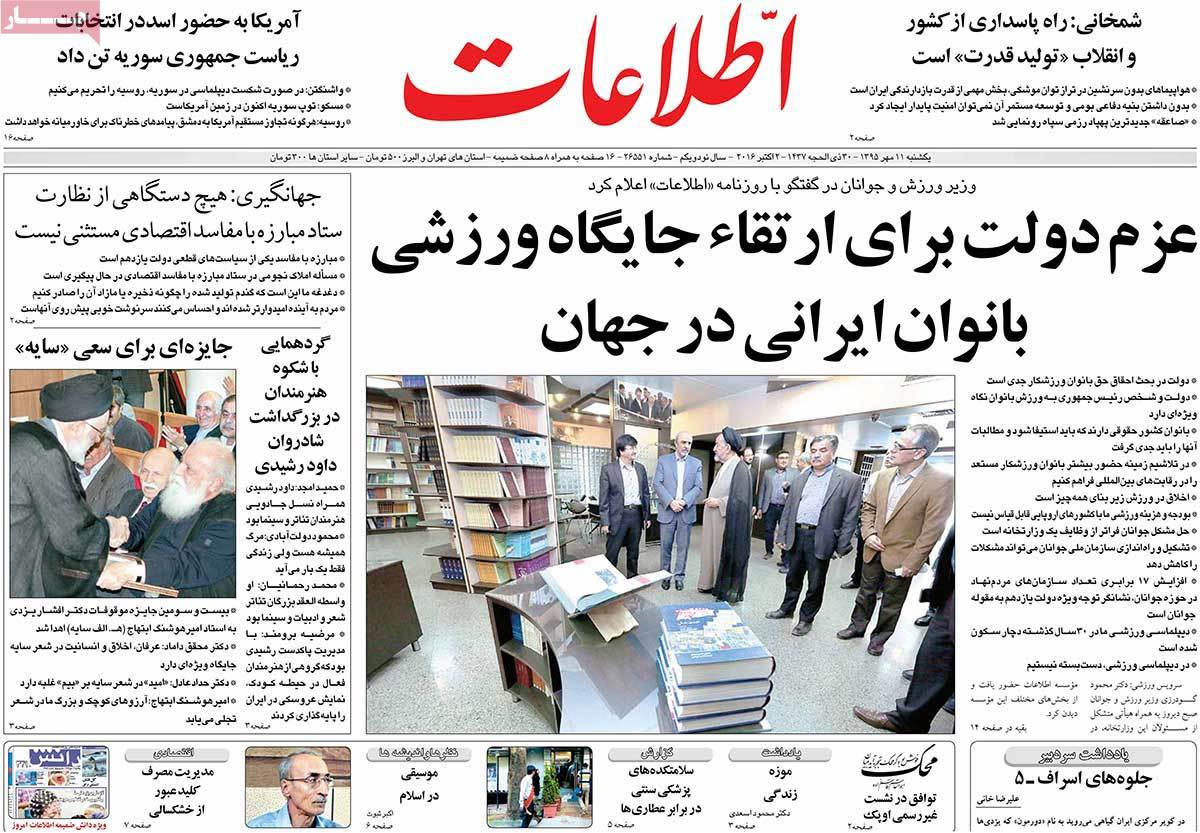
Ettela’at:

1- US Accedes to Assad’s Presence in Syrian Presidential Elections

2- Government Resolved to Promote Position of Iranian Women in World’s Sports

A Look at Iranian Newspaper Front Pages on October 2


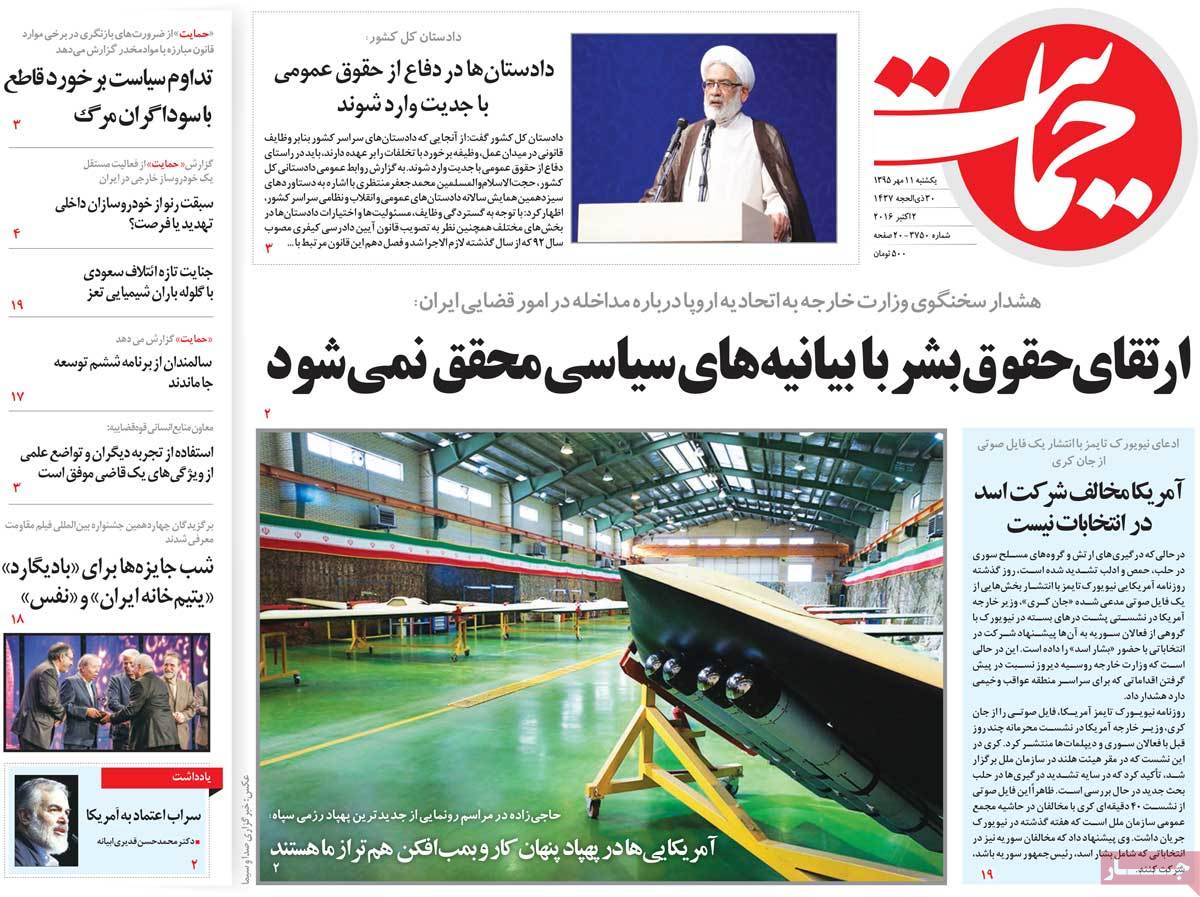
Hemayat:

1- Foreign Ministry Spokesman Warns EU against Interference in Iran’s Judicial Affairs: It’s Not Possible to Promote Human Rights through Politically-Motivated Statements

A Look at Iranian Newspaper Front Pages on October 2


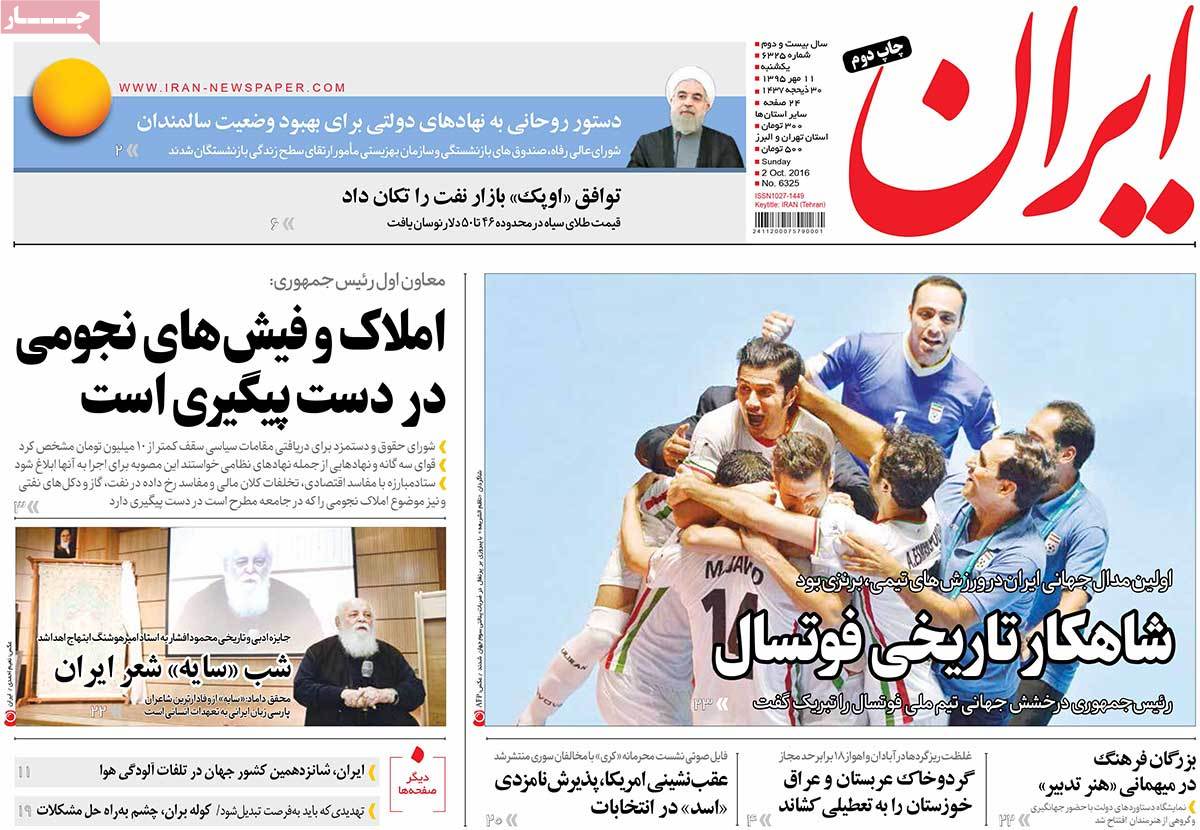
Iran:

1- US Backs Off and Accepts Assad’s Presence in Syrian Elections

2- Iran, 16th Country in the World in Air Pollution Fatalities

A Look at Iranian Newspaper Front Pages on October 2


Javan:

1- Don’t Let This ‘Friend of Zionists’ Enter Iran: German Economy Minister Is Going to Visit Iran for Talks with Government over Recognition of Israel

2- Beginning of the Domino of Lawsuits Filed against Saudi Arabia over 9/11

A Look at Iranian Newspaper Front Pages on October 2


Jomhouri Eslami:

1- Russia’s Unprecedented Warning to US: Moscow Says US Attack on Syria Would Set Fire on Entire Region

2- Export of South Pars Gas Field’s Gas Condensates Exceeds 70m bpd

3- Russia: ISIS after Occupying Central Asia and Caucasia

4- First Lawsuit Filed by a 9/11 Survivor against Saudi Arabia in a US Court

A Look at Iranian Newspaper Front Pages on October 2


Kayhan:

1- Development of Auto Industry by Assembling Renault Products Dating Back to 17 Years Ago!

2- Yemen Army Destroys UAE’s Warship in Ta’iz Coasts

3- On Verge of Islamic Month of Muharram, Al Khalifa Regime Becomes More Brutal in Oppressing Bahraini People

4- First VP: Executives Who Received Astronomical Salaries Didn’t Violate the Law!

A Look at Iranian Newspaper Front Pages on October 2


Khorasan:

1- Trump’s Sexual Scandal: Trump’s Presence in a 2,000 Pornographic Video Leaked

A Look at Iranian Newspaper Front Pages on October 2


Resalat:

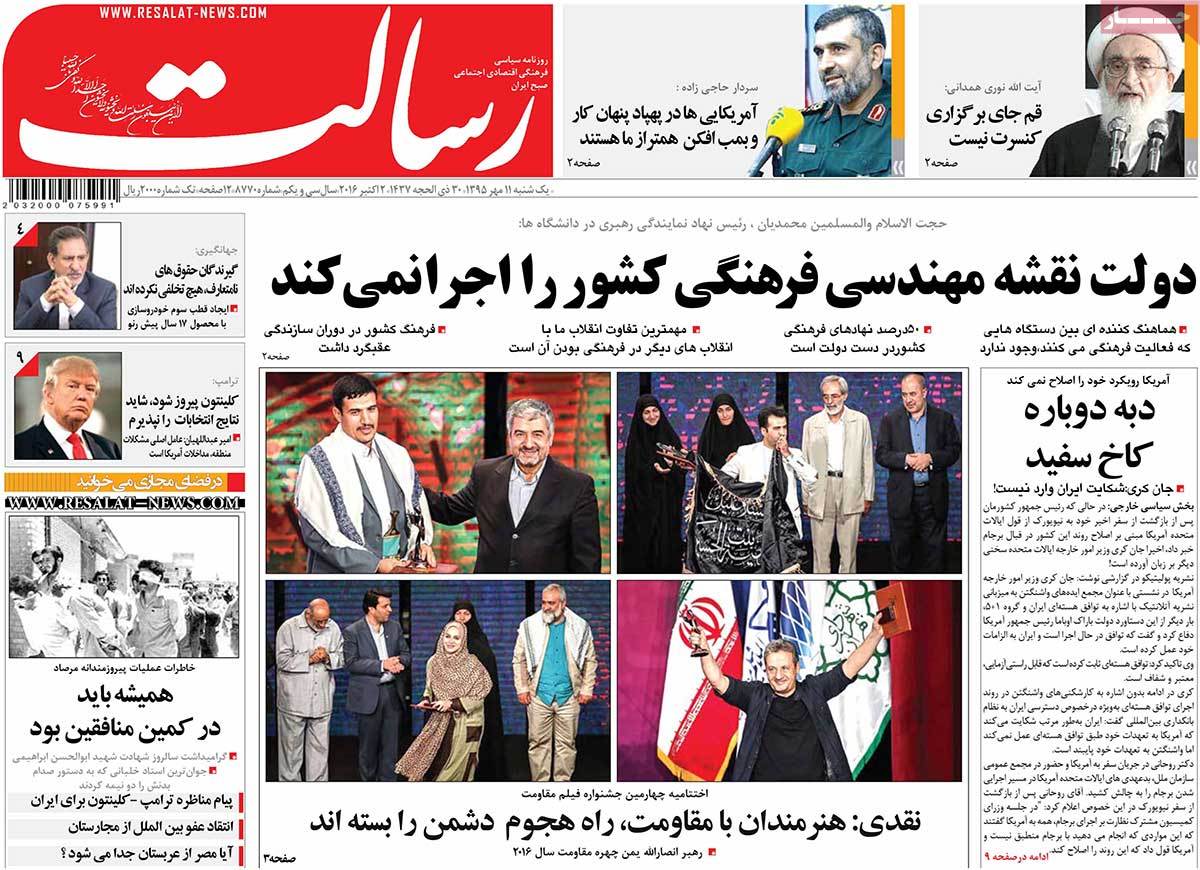
1- Trump: If Clinton Wins, I May Refuse to Accept Election Results

2- Amir Abdollahian: US Interference Is Main Cause of Middle East’s Problems

A Look at Iranian Newspaper Front Pages on October 2


Roozan:

1- Conservatives’ New Challenge ahead of Elections: Neither Ahmadinejad, Nor Rouhani

2- Berlin Once Again Says Hello to Tehran

A Look at Iranian Newspaper Front Pages on October 2


Shargh:

1- Merkel’s Deputy Once Again in Tehran

2- SNSC Secretary: Iran Knows No Limit for Developing Its Defensive Capabilities

A Look at Iranian Newspaper Front Pages on October 2


Vaghaye Ettefaghieh:

1- Life in a Big Prison without a Ceiling: Guardian’s Account of What’s Going on in Aleppo

2- Liberal Frustration in Russian Elections: The Polls that Strengthened Putin’s Power

A Look at Iranian Newspaper Front Pages on October 2


Vatan-e Emrooz:

1- Iran Has Hunted 2 Other American Drones after RQ-170

2- American Widow, the First to Sue Saudi Arabia

A Look at Iranian Newspaper Front Pages on October 2

Iran, Netherlands to Expand Trade Ties According to Roadmap

Iran-Netherlands

“Grounds are provided for closer cooperation between the Islamic Republic and the Netherlands in many fields,” Jahangiri said in a speech in the Erasmus University in Rotterdam.

The diplomat added that therefore, the two countries have devised a roadmap to promote relations within its framework.

“Thanks to the advantages of doing business with the Islamic Republic of Iran, European countries have taken massive steps to boost economic cooperation with Iran over the past two years, especially after the nuclear deal,” he noted.

Earlier last month, Jahangiri and president of the Netherlands’ central bank (De Nederlandsche Bank), Klaas Knot, held a meeting in The Hague to discuss ways to boost banking interactions between the two nations.

The talks come against the backdrop of a new wave of interest in ties with Iran after Tehran and the Group 5+1 (Russia, China, the US, Britain, France and Germany) on July 14, 2015 reached a conclusion over the text of a comprehensive 159-page deal on Tehran’s nuclear program and started implementing it on January 16.

The comprehensive nuclear deal, known as Joint Comprehensive Plan of Action (JCPOA), terminated all nuclear-related sanctions imposed on Iran.

IRGC General Says Saudi Arabia Is Iran’s Enemy

Mohssen Rezai

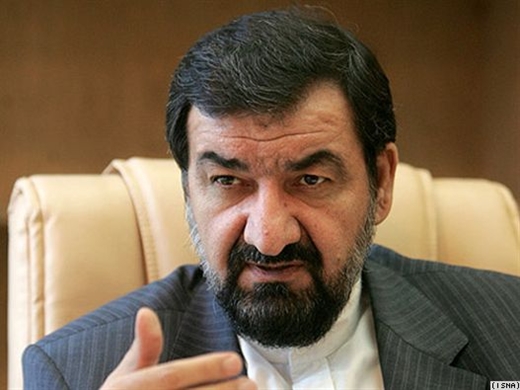
“Today, Saudi Arabia is our enemy and Turkey is our rival,” Rezaei, a former commander of the Islamic Revolution Guards Corps (IRGC), said, addressing a congress in the Western province of Kohgilouyeh and Boyer Ahmad on Sunday.

Referring to the US support for Saudi Arabia, he said, “One day, they will see that Wahhabism will disgrace them in a way worse than the ISIS terrorist group.”

Rezaei expressed regret that the US has learned no lesson from the crimes committed by the former Iraqi dictator Saddam Hussein and the ISIS against the people, as reported by Fars and edited by IFP.

“Iran is asking them why they enter the lands of independent countries like Syria and Yemen.”

He called on regional countries to protect their independence and avoid becoming a puppet of the US and Israel, and asked, “Why shouldn’t a country like Saudi Arabia experience democracy? Why shouldn’t its people decide their own fate?”

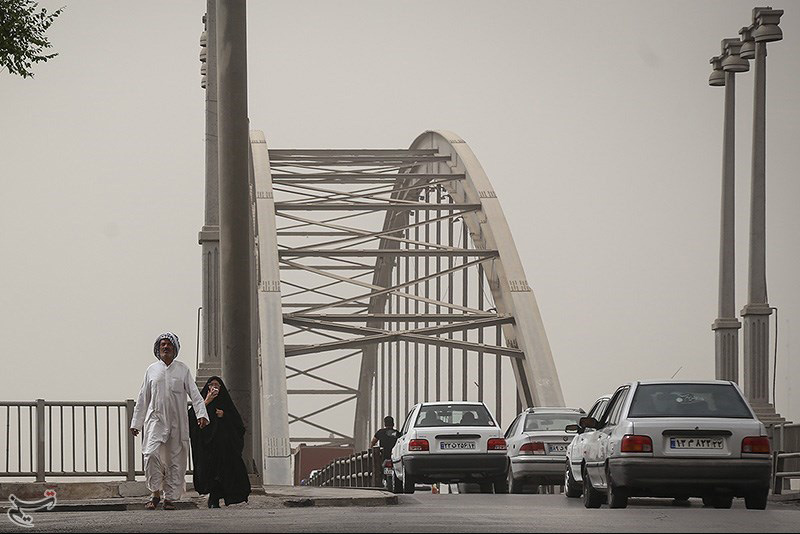
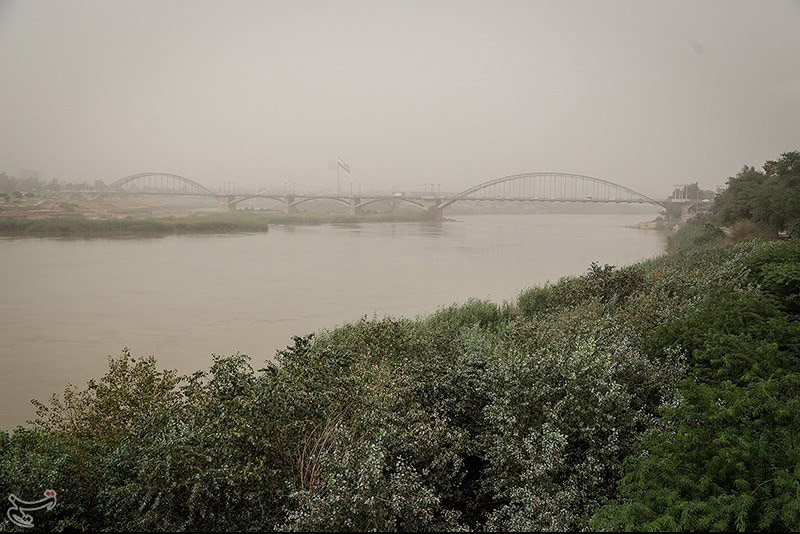
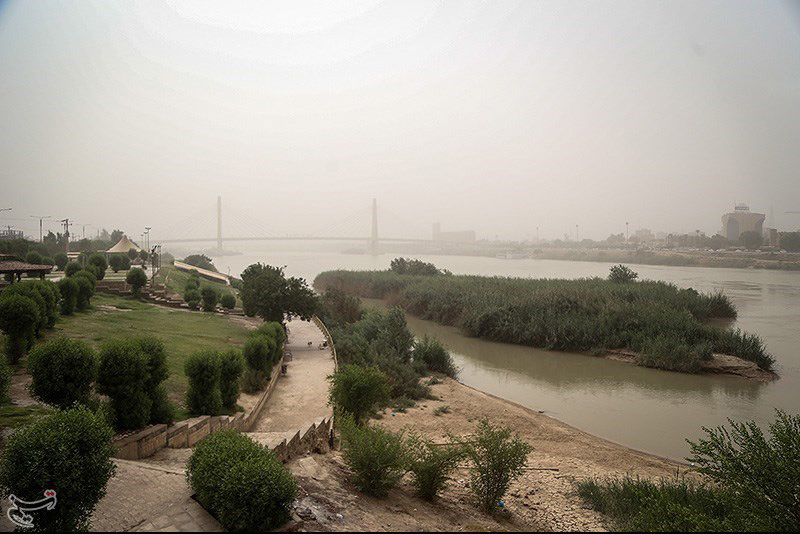
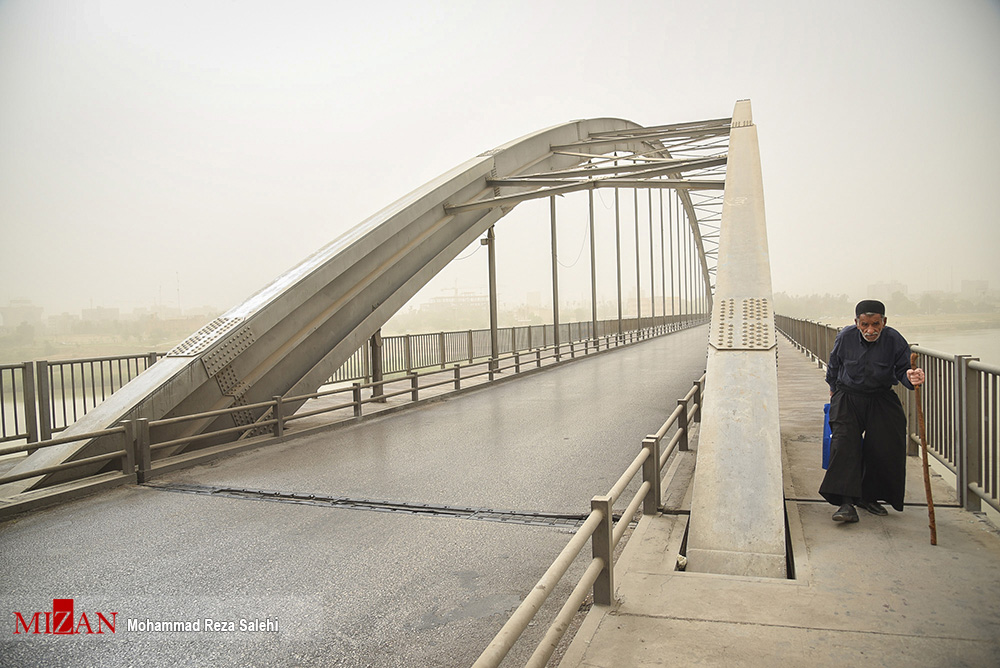
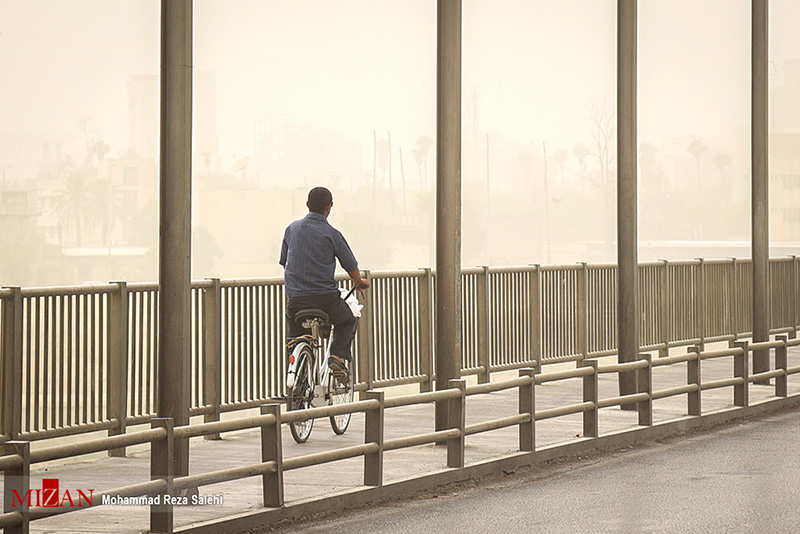
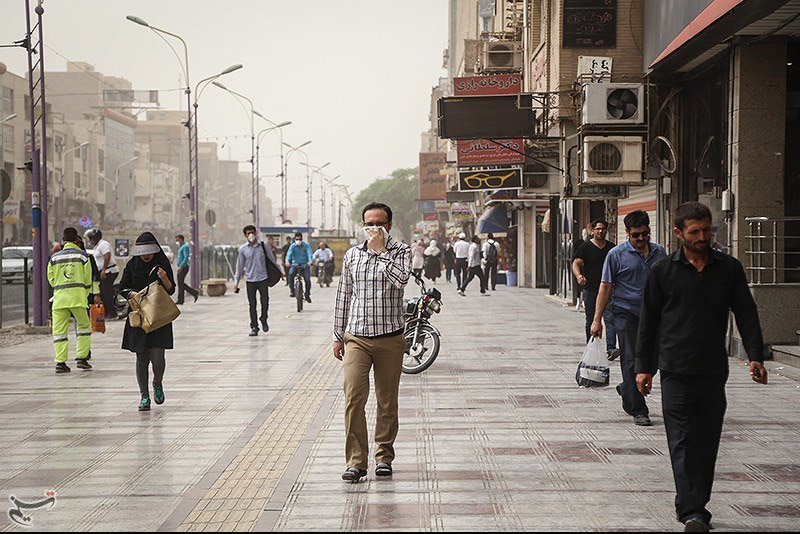
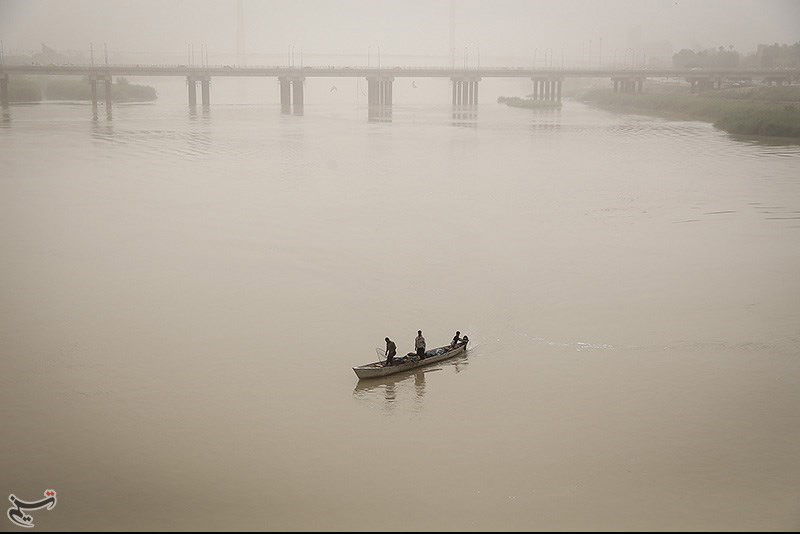
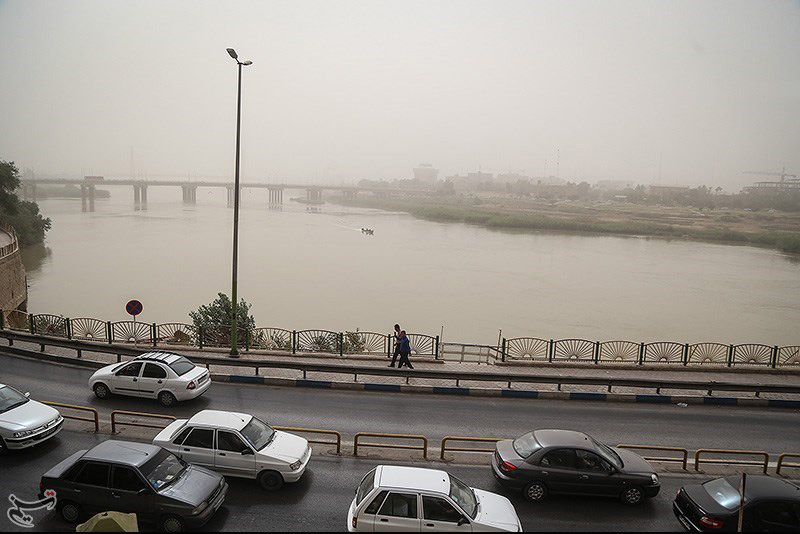
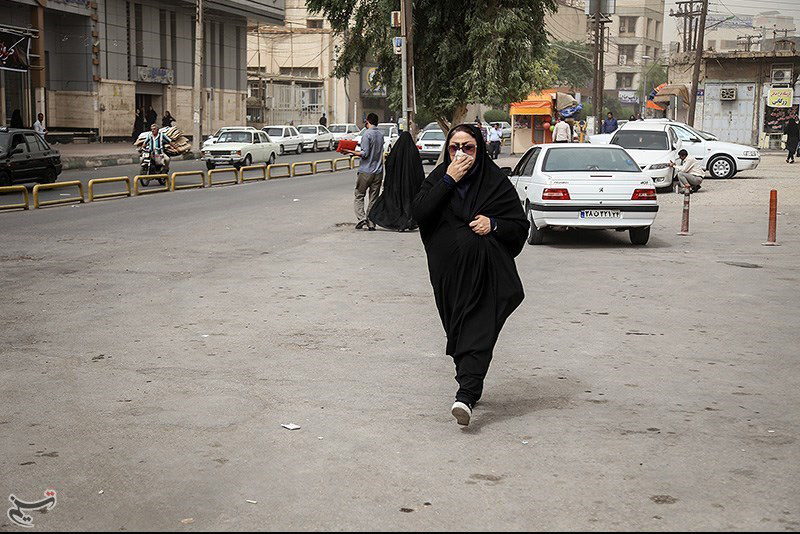
Dust Pollution in Western Iran Reaches ‘Dangerous’ Levels

pollution-Khuzestan

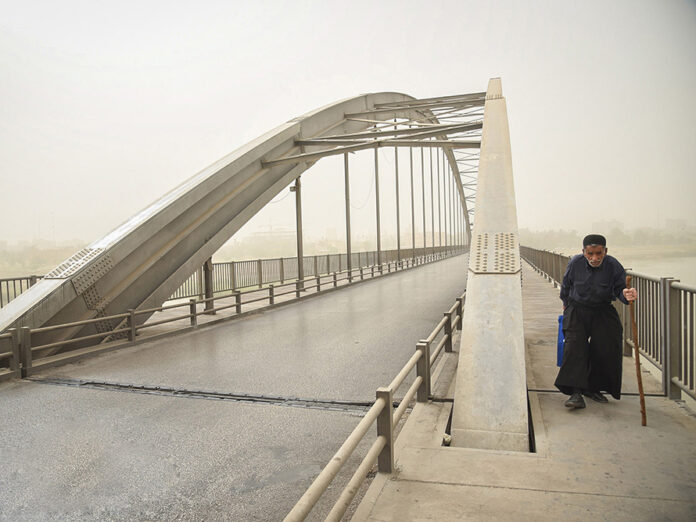
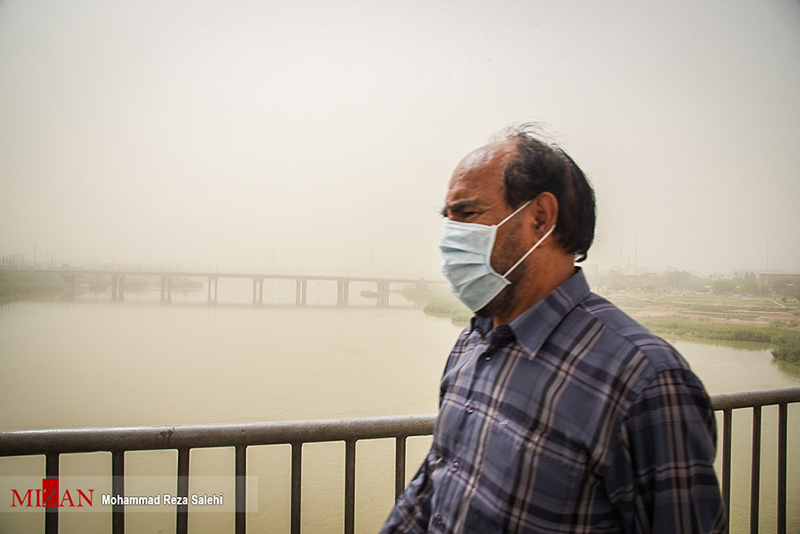
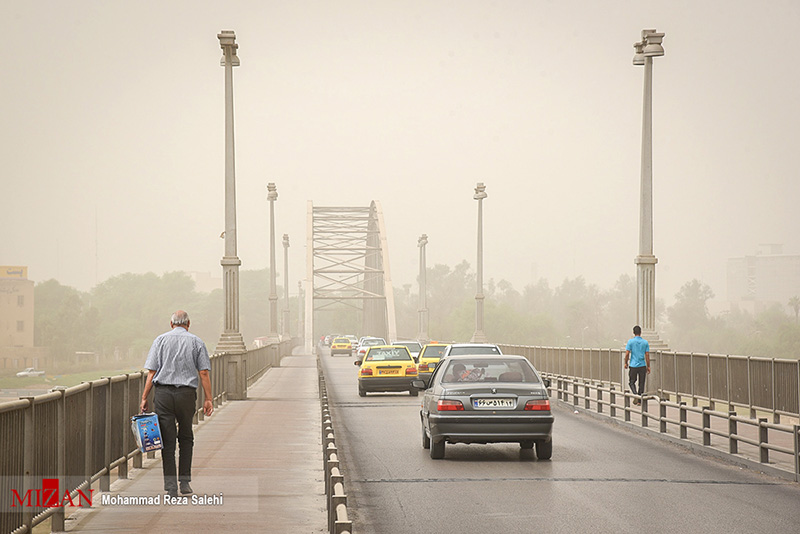
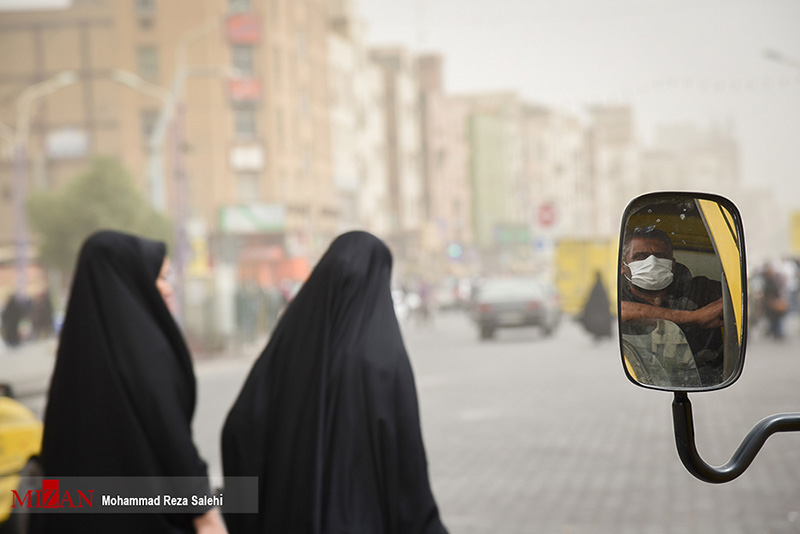
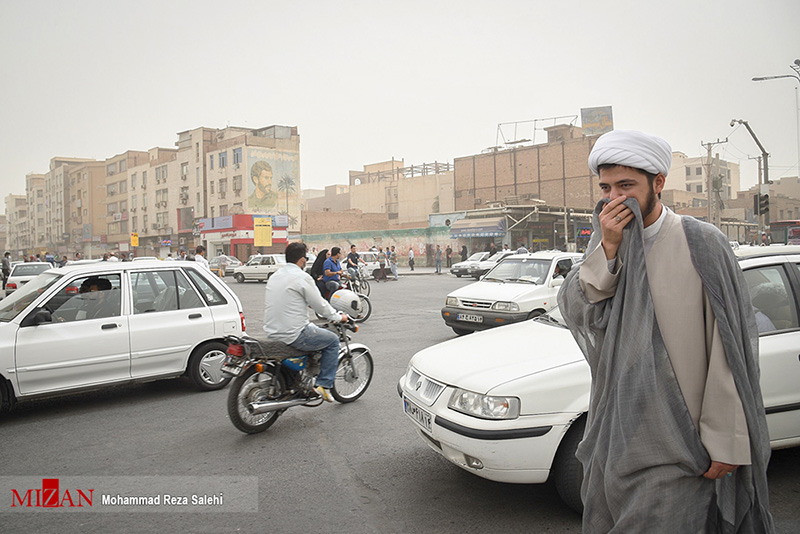
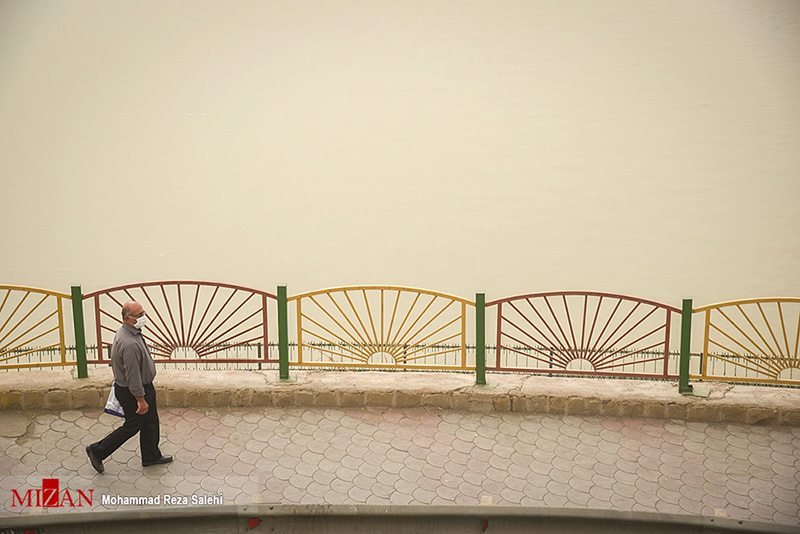
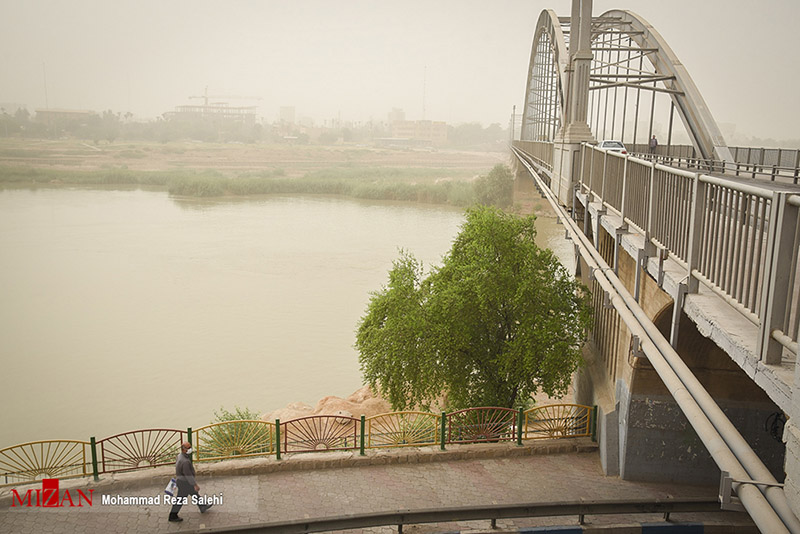
The air pollution caused by dust and particles in Iran’s western provinces, including Khuzestan, has reached “dangerous” levels.

The disruptive dust storms have pushed pollution in these border areas to alarming levels, raising health concerns.

Schools and universities have been shut down due to the alarming dust pollution.

The particles, carried by winds, can penetrate the lungs and enter the bloodstream, causing serious diseases such as lung cancer, asthma and heart problems.

Here are photos of the pollution taken by Mizan and Tasnim:


Soft War Aimed at Making Iranians Indifferent, Leader Warns

leader

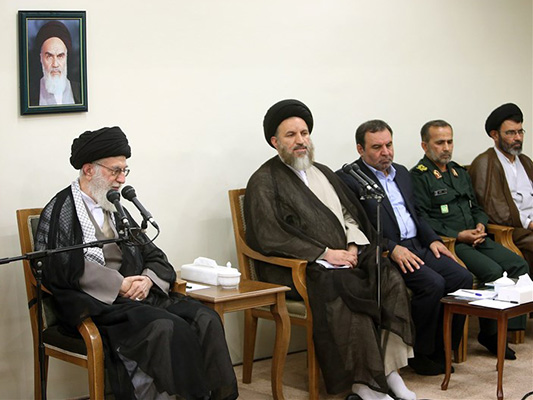
The enemy’s purpose in the soft and covert war against Iran is people’s estrangement from resistance, making people indifferent to their aspirations and dominating the country’s mental and spiritual atmosphere, Ayatollah Khamenei said in a meeting with members of committees tasked with holding congresses to commemorate the country’s martyrs, on September 26.

The leader also warned of tactics that the enemies use to disappoint and sideline the Iranian nation, pointing to their various tools, costly propaganda as well as economic, political and security pressures.

Ayatollah Khamenei, however, highlighted the enemies’ failed attempts at damaging Iran, noting, “With its resistance and fortitude, the Iranian nation has thwarted many of the world powers’ plots.”

The Leader’s comments in that meeting were made public on Sunday morning.

Imam Khamenei has on various occasions cautioned against enemies’ cultural and political plots against Iran, including ploys aimed at impairing the religious beliefs and absorbing the talented young generation.

Iran Arrests Terrorists on Eastern, Western Borders, Police Chief Says

police

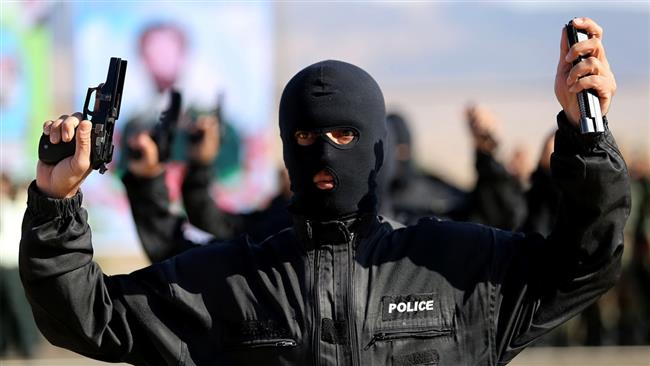
These terrorists were identified, arrested and finally handed over to judicial officials, Brigadier General Hossein Ashtari told reporters on Saturday.

He added that Iran has been boosting security at its borders by providing the country’s security forces with the necessary equipment to fight terrorists.

Ashtari further said Iranian forces had also thwarted plots by Takfiri and Salafi terrorists as well as other groups hostile to the Islamic Republic who sought to illegally cross the borders and stir insecurity in the country.

Iran Arrests Terrorists on Eastern, Western Borders, Police Chief Says

Iranian forces have recently engaged in clashes with terror groups, thwarting their terrorist activities on the border and within the country, arresting several of them and confiscating large amounts of explosives and bomb-making materials.

Iran’s security forces arrested members of an Iraqi-based terrorist group, comprised of two terrorists and their two accomplices, in a village near the Iranian city of Marivan in the western province of Kordestan on September 16 and 18 before they could find a chance to conduct any acts of terror.

The Iranian forces found a number of weapons and ammunition in their hideout.

On September 20, Iran’s Islamic Revolution Guards Corps (IRGC) forces arrested two terrorists of Pakistani nationality in the southeastern Iranian province of Sistan & Baluchestan.

According to a statement by the IRGC, the terrorists had been funded by Saudi Arabia and had received intelligence assistance from spy agencies of enemy states.

Earlier in September, the IRGC announced that it had dismantled a terrorist group, backed by Saudi Arabia and the United States, in the province of Sistan & Baluchestan

Iran’s Intelligence Ministry said in August that it had identified 102 members or supporters of a terrorist group in Kordestan province.

In a statement, the ministry said that the identified individuals belonged to the so-called Tawhid and Jihad Takfiri terrorist group.

No Country Can Set Conditions for ‘Independent’ Iran: Zarif

Mohammad Javad Zarif

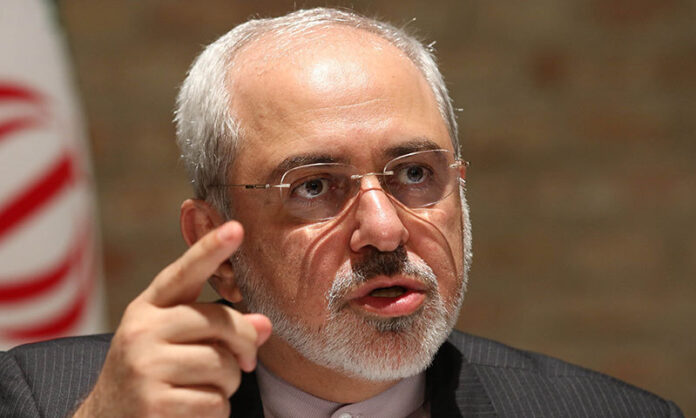
“No one can set conditions for Iran and Iran is an independent country,” Zarif told reporters on Saturday.

He made the remarks in response to an earlier demand by German Economy Minister and Vice Chancellor Sigmar Gabriel who told online weekly magazine Der Spiegel on Friday that Iran could have normal and friendly relations with Germany “only when it accepted Israel’s right to exist.”

Gabriel plans to visit Iran at the head of a large delegation of business executives to discuss possible business deals after last year’s historic nuclear agreement, known as the Joint Comprehensive Plan of Action (JCPOA), between Tehran and the P5+1 group of countries.

As part of the deal, Iran has agreed to limit certain aspects of its nuclear program in exchange for the removal of all nuclear-related sanctions against the Islamic Republic.

He added that Iran has been resisting foreign bullying over the past 37 years “while it is a peace-seeking country.”

Iran’s Foreign Ministry spokesman Bahram Qassemi also on Saturday rejected Germany’s demand and emphasized that Tehran would never drop support for the Palestinians.

“Ties between the Islamic Republic of Iran and Germany are based on mutual respect and interests, and no precondition would be acceptable in this regard,” Qassemi said.

The Iranian spokesperson added, “The Islamic Republic considers defending the rights of the people of Palestine to be a fixed plank of its foreign policy and will never and under no circumstances forsake the Palestinian cause.”

Germany had been Iran’s biggest European trading partner for decades before a series of sanctions were tightened against the Islamic Republic under the pretext of its nuclear program.

Almost immediately after the conclusion of the deal, the German government sent Gabriel to Tehran at the head of a major delegation to discuss post-sanctions business opportunities in the Islamic Republic.

US Hands Internet Control to ICANN

world-wide-web

Capping a highly politicized debate, the US government on Saturday let go of its remaining grip on the internet, handing control of the net’s address book to a non-profit.

Saying free speech in the virtual realm was at stake, Republican Sen. Ted Cruz and others had tried to block the transfer. But a federal judge denied on Friday their request for an injunction and the scheduled handoff took place at midnight.

The transfer involved the internet’s domain name system, or DNS, which translates the Web addresses you type into your browser, like “cnet.com,” into the numerical language that net-connected computers use to communicate.

Under a plan that’s been in the works for years, the US Department of Commerce shuttled control of the DNS to a non-profit called the Internet Corporation for Assigned Names and Numbers (ICANN), whose multiple stakeholders include technical experts, as well as representatives of governments and businesses.

Cruz and other critics had argued the transfer could lead to authoritarian countries taking control of the internet and eventually censoring content throughout the world.

“Imagine an internet run like many Middle Eastern countries that punish what they deem to be blasphemy,” Cruz said at a congressional hearing on September 14. “Or imagine an internet run like China or Russia that punish and incarcerate those who engage in political dissent.”

“When ICANN escapes from [US] government authority,” Cruz said, “ICANN escapes from having to worry about the First Amendment, from having to worry about protecting your rights or my rights.”

But ICANN said such fears were uninformed, as reported by CNET and covered by Click.

“ICANN is a technical organization and does not have the remit or ability to regulate content on the internet,” the group said prior to the transfer. “That is true under the current contract with the US government and will remain true without the contract with the US government.”

Supporters of the handoff also argued that preventing the transfer could actually lessen US impact on the net.

Russia and China, among others, had backed the idea of empowering an obscure United Nations body called the ITU (International Telecommunications Union) with internet governance duties. That would have given governments control, but it also would have diminished the relative importance of tech powers like the States.

Iran’s Saffron Fuelling Growth of German Food Business

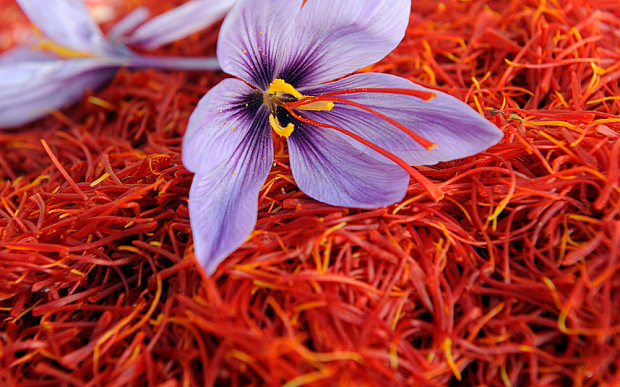
Once cultivated by Persian kings and believed to have healing powers, saffron is now fuelling the growth of a small German business that imports tons of the spice from Iran to make fine food products for sale in Europe and the Persian Gulf.

“We try to capture the soul of saffron and the magic it contains,” says Michael Sabet, an Iranian-German business executive who quit his banking job six years ago to found Miasa GmbH, which is now doubling its revenues every year.

Sabet is one of many German business leaders who see great business opportunities opening up in Iran after the end of sanctions. German Economy Minister Sigmar Gabriel heads to Iran next week with a plane full of executives keen to rebuild trade ties.

“Germany has always had a good relationship with Iran and I think it will continue to expand,” Sabet said. “I hope the end of sanctions will allow exports to rise and have a positive effect on the import business as well.”
Miasa delivers large quantities of high quality saffron to industrial users, but also produces 20 different products ranging from saffron-infused sea salt, honey, rice and even coffee that are sold via the company’s website or at luxury stores in Berlin.

It also produces a liquor infused with elderberry, lychees and saffron that sells for nearly 40 euros ($44.90) a bottle, and even comes in a non-alcoholic version for sale to Muslim countries, as reported by Reuters and covered by Fars.

Sabet says the business is growing fast given increasing demand for specialty “fine foods,” the rise of gourmet cooking shows and the increasing popularity of Middle Eastern cooking. Sweden is one of the biggest consumers of saffron because the spice plays a key role in Christmas baked goods, he said.
In the Persian Gulf, more consumers are also looking for packaged products such saffron rice, he said.
Initially Sabet tried to grow saffron – which comes from the flower of the crocus plant – in Germany’s Black Forest, but soon realised the yield per plant was far too low to produce the quantities needed for industrial-scale sales.

“It takes about 100 plants to produce one gram of saffron,” he said. “So you can imagine how big the fields have to be to produce one kilo.”
Iran produces about 90 percent of the world’s saffron. The idea for Miasa was born when Sabet’s Iranian father and German mother brought back a can of saffron from a trip to Iran.
“I was just fascinated,” said Sabet, who was born in Germany. “So I decided to jump into a new adventure.”

“This has opened up whole new horizons for me. I’m getting back into the language and learning so much,” he said.